india
Auto Added by WPeMatico
Auto Added by WPeMatico
Of the 1.3 billion people who live in India, more than 100 million of whom are using digital payment apps each day, only about 20 million today invest in mutual funds and stocks. An Indian startup that is betting on changing that figure by courting millennials has just received a big backing.
Groww, a Bangalore-based startup, said today it has raised $21.4 million in a Series B financing round that was led by U.S.-based VC firm Ribbit Capital. Existing investors Sequoia India and Y Combinator also participated in the round, said the two-year-old startup that has raised about $29 million to date.
Groww allows users to invest in mutual funds, including systematic investment planning (SIP) and equity-linked savings. The app, which maintains a very simplified user interface to make it easier for its largely millennial customer base to comprehend the investment world, offers every fund that is currently available in India.
Lalit Keshre, co-founder and CEO of Groww, told TechCrunch in an interview earlier this week that the market of mutual funds is increasingly widening in India and the startup is hoping to accelerate its growth with the fresh capital. Other than that, he plans to double Groww’s headcount to 200 in the coming months.
Groww has amassed about 2.5 million registered users, two-thirds of whom are first-time investors, Keshre said. Groww is currently free to use and does not charge any commission on transactions. The startup eventually plans to offer a paid service as it looks to monetize its user base, but Keshre declined to share a timeline on how soon that would happen.
Groww will also soon begin to offer the ability to purchase stocks from its eponymous app, said Keshre, a former executive at Flipkart who co-founded Groww with three other Flipkart colleagues (Harsh Jain, Neeraj Singh and Ishan Bansal).
In a statement, Micky Malka, founder of Ribbit Capital, said, “We backed the Groww team because we believe in their mission. They have built the most trusted product in this space and are on the path to create a category-defining product.”
Ribbit Capital has made a number of investments in India in recent months. Last month, it invested in Cred, a startup that is trying to improve the financial behavior of credit card holders, and BharatPe, a payments solution for businesses.
In recent years, a number of startups such as INDWealth and Cube Wealth have emerged in India to offer wealth management platforms to the country’s growing internet population. Many established financial firms such as Paytm have also expanded their offerings to include investments in mutual funds.
Ashish Agarwal, a principal partner at Sequoia Capital India, said, “Investment products such as mutual funds and stocks were traditionally sold offline through financial advisors, who were mis-incentivized to sell high-commission products. Groww is taking a refreshing approach with a zero-commission mobile first model, enabling investors to make their own investment choices through a slick and easy user interface.”
Powered by WPeMatico

Only about 10% of India’s 1.3 billion people know English. Yet, that is the only language Amazon’s digital assistant Alexa, which was launched in India two years ago, understands in the nation. That is changing today.
At a press conference in New Delhi on Wednesday, the e-commerce giant said Alexa now supports Hindi, a language spoken by roughly half a billion people in India, as the company looks to expand its reach in the nation. Bringing support for Hindi to Alexa was in the works for more than a year, company executives said, noting the unique contextual, cultural and content-related challenges that Hindi implementation posed.
Users can now ask Alexa their questions in Hindi, and the digital assistant will be able to respond in the same language. The feature, which will begin rolling out through a software update to Alexa devices starting today, currently only supports one voice type for Hindi. (For English, Alexa offers multiple voice types.) In the months to come, Amazon said it plans to add support for multilingual households, which will enable members of the family to interact with Alexa in the language they each prefer.
Support for local languages has proven immensely beneficial to customers in the past, Manish Tiwari, head of devices category business for Amazon India, said at the event. Amazon last year introduced support for Hindi language on its apps and website. It has seen Hindi usage grow on the site and app by six times in recent months, he said.
Rohit Prasad, VP and head scientist of Alexa AI at Amazon, said the adoption of Alexa in India has been phenomenal, though he did not share any figures. Prior to today’s update, Alexa supported some Hinglish words, a combination of English and Hindi, but the company said it wanted to bring full-fledged support.
“A lot of how people in India engage with their smartphones and internet services is different from those in the United States. For instance, in India, people often search the name of an actor instead of the singer or the band when they are looking for a particular song,” he added. Alexa supports variants of about 15 languages, executives said.
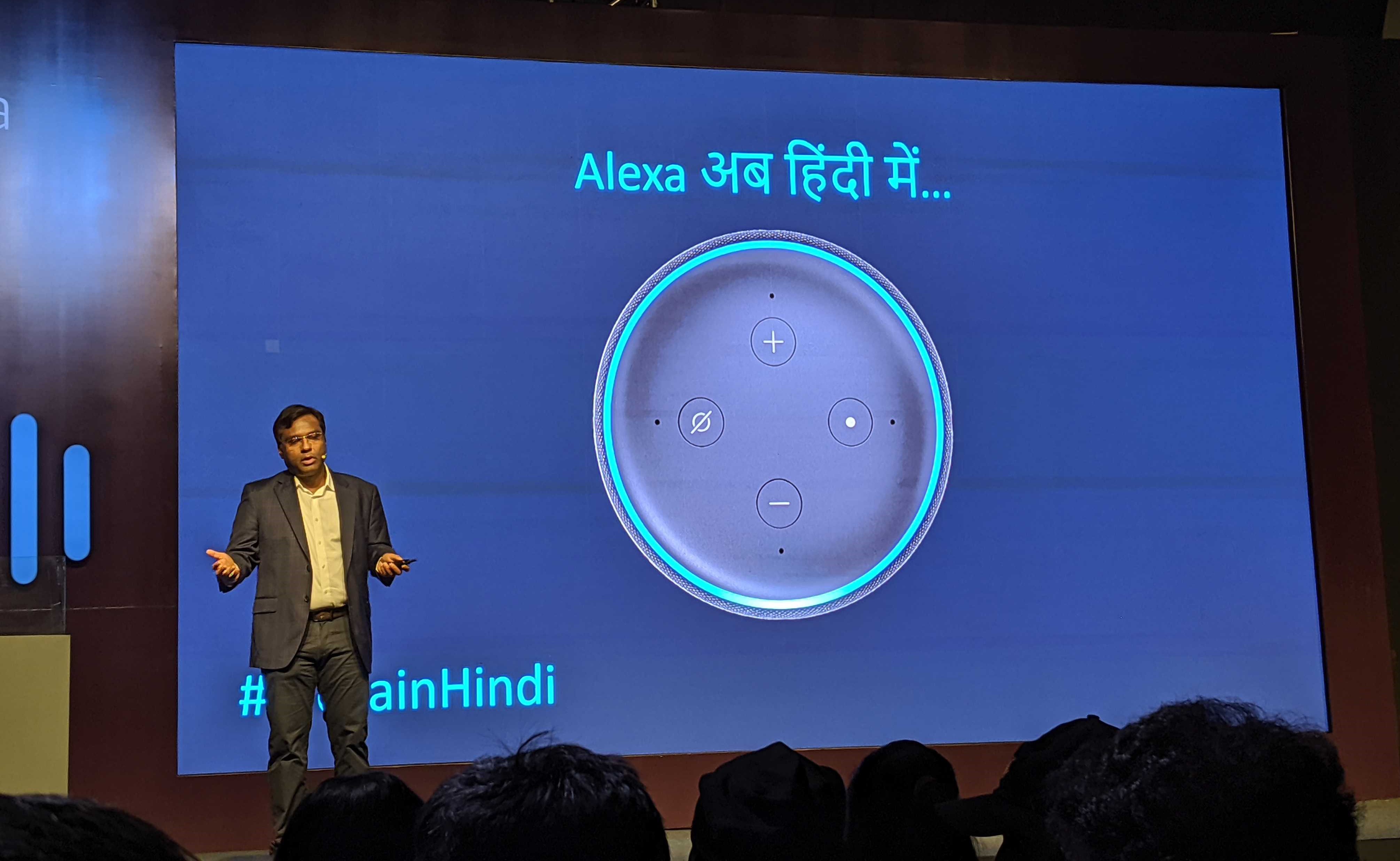
Amazon exec Prasad onstage at an event in New Delhi
Today’s announcement comes months after Amazon added a Hindi voice model to its Alexa Skills Kit, enabling developers to update their skills in India to support the more popular local language. More than 500 skills on the store already support Hindi, Prasad said today. Google smart speakers gained support for the Hindi language late last year.
Amazon says it offers Alexa customers in India more than 30,000 skills across various categories, including cricket, education and Bollywood. The company’s voice assistant is available to users through its smart speakers — Echo Dot, Echo Plus and more — and over three-dozen devices from other manufacturers, including Sony, iBall and LG, the company said.
Hindi should also help Amazon’s smart speakers maintain their lead over Google’s in India. Amazon commanded the local smart speakers market with a 59% market share in 2018, according to research firm IDC. (Google launched its smart speakers in India months after Amazon. IDC has not updated its findings since March this year.)
Indian language internet users are expected to account for nearly 75% of India’s internet user base by 2021, according to a report by KPMG and Google. By same year, nine out of every 10 new internet users in the country will likely be an Indian language speaker, the report said.
Both companies are locked in a global battle to win users through their digital voice assistants. And they should be: In many markets, including India, first-time internet users are increasingly showing that they are more comfortable engaging with their phones through voice instead of typing. Search through voice queries is growing by 270% year-over-year.
Powered by WPeMatico
OkCredit, a Bangalore-based startup that enables small merchants to digitize their bookkeeping, has raised $67 million in a new financing round to grow its business in the nation.
The Series B financing round for the two-year-old startup was led by Lightspeed and Tiger Global. The new round, which follows the Series A in June, increases OkCredit’s total raise to $83 million.
OkCredit operates an eponymous mobile app that allows merchants to keep track of their day-to-day purchases and sales. Last month, OkCredit founders told TechCrunch in an interview that the app had amassed more than 5 million active merchants across 2,000 cities in India.
Amy Wu, a partner at Lightspeed US, said OkCredit’s active users have grown 76 times since the beginning of the year. It’s one of the fastest-growing companies we’ve seen and reflects the incredible virality and network effects of the business,” Wu added.
A wide range of merchants, from roadside vendors to grocery shop owners and pharmacies, have joined OkCredit.
Even as more than 500 million users in India today are online, most merchants in the nation are yet to digitize their business, according to industry estimates. They still rely on large notebooks to keep a log of their transactions.
“Technology has moved from collecting payments in cash, to using point-of-sale machines. More recently, QR codes, paper bills turned to printed bills. But the one thing that has not changed is the fact that most customers still purchase goods on credit recorded in a notebook,” Harsh Pokharna, chief executive of OkCredit said in a statement.
Pokharna told TechCrunch today that the startup will use the capital to hire more people and grow its merchant user base. The startup also plans to build more products for merchants.
Vyapar and KhataBook are two more startups in India that are attempting to solve a similar problem.
In a statement, Harsha Kumar, a partner at Lightspeed, said, “technology adoption in India will happen across sectors and segments. For the longest time, mSME as a segment was ignored but we have seen through Udaan, OkCredit and other Lightspeed investments in the SME space that tech usage is growing rapidly. Very excited and honored to have a front row seat in this journey!”
Powered by WPeMatico
Glance, a subsidiary of Indian mobile ad business firm InMobi, said today it has raised $45 million as it prepares to scale its business outside of India and bulk up its product offerings.
The unnamed maiden financing round for Glance was funded by Mithril Capital, a growth-stage investment firm co-founded by Silicon Valley investors Peter Thiel and Ajay Royan.
In an interview with TechCrunch, Naveen Tewari, founder and CEO of InMobi Group, said the current round has not closed and could bag another $30 million to $55 million in the next two months.
Glance operates an eponymous service that shows media content in local languages on the lock screen of Android-powered smartphones. InMobi has partnered with a number of top smartphone vendors, including Xiaomi, Samsung and Gionee, to integrate Glance into their respective operating systems.
Glance, which was launched in September last year and supports English, Hindi, Tamil and Telugu, has amassed 50 million monthly active users in India, its primary market. Users are spending an average of 22 minutes with Glance each day, he said.
“All the new smartphone models launched by Samsung, Xiaomi and a handful of other vendors have launched with Glance on them,” Tewari said.
In a statement, Mithril Capital’s Royan said, “We share Glance’s global vision of breaking through the constraints of application architectures and linguistic markets to deliver rich, frictionless, and engaging experiences across a myriad of cultures and languages.” As part of the financing round, he is joining Glance’s board.
Glance does not show traditional ads, something it intends to never change, but shows a certain kind of content to drive engagement for brands.
In the months to come, Glance plans to expand the platform and bring short-form videos (Glance TV), and mini games (Glance Games) to the lock screen. It is also working on a feature dubbed Glance Nearby that will enable brands to court users in their vicinity, and Glance Shopping to explore ways to build commerce around content.
As of today, InMobi Group is not monetizing Glance platform, but plans to explore ways to make money from it early next year, Tewari said.
The 12-year-old firm said it plans to expand footprints of Glance outside of India. The company plans to take Glance to some Southeast Asian markets like Malaysia, Indonesia and Thailand. InMobi’s Tewari said Glance has already started to find users in these markets.
InMobi Group, which had raised $320 million prior to today’s financing round, has been profitable for several years, but the company decided to raise outside funding to accelerate Glance’s growth, Tewari said.
The firm, which has three subsidiaries, including its marquee marketing cloud division, plans to go public in the next few years. But instead of taking the entire group public, Tewari said the firm is thinking of publicly listing each division as they mature. The marketing cloud division, which brings in the vast majority of revenue for the firm, will go public first, he said.
“The IPO plans remain, and we will evaluate them as we go along. The reality, however, is that the market is so big and there is so much room that we can continue to be private for a few more years,” he said.
Powered by WPeMatico

Xiaomi said on Friday it has shipped more than 100 million smartphones in India, its most important market, since beginning operations in the nation five years ago. The company cited figures from research firm IDC in its claim.
The Chinese giant, which has held the top smartphone vendor position in India for eight straight quarters, said budget smartphone series Redmi and Redmi Note have been its top selling lineups in the nation.
In India, the world’s fastest growing and second largest smartphone market, most handsets ship with a price tag below $200. Xiaomi, whose phones punch above their price class, has strictly adhered to the budget-conscious market from the day it began operations in India. The company says it never makes more than 5% profit on any hardware product it sells.
In a statement, Manu Jain, VP of Xiaomi and MD of the company’s India business, said the company’s milestone today “is a testament to the love we have received from millions of Mi Fans since our inception. There have been brands who entered the market before us, yet are nowhere close to the astounding feat we have achieved.”
Shipping 100 million smartphones in India alone is a remarkable feat for Xiaomi, which operates in dozens of markets. The company last year shipped 100 million handsets in about 10 months worldwide (India included) in what was a record for the company.
As competition in its home nation intensifies and smartphone shipments slow or decline everywhere, India has emerged as the most important market for Xiaomi in recent years. When the Chinese firm entered the nation, for the first two years, it relied mostly on selling handsets online to cut overhead. But in the years since, it has established presence in brick-and-mortar markets, which continues to drive much of the sales in the nation. (India is also one of the handful of places where smartphone shipments continue to grow.)
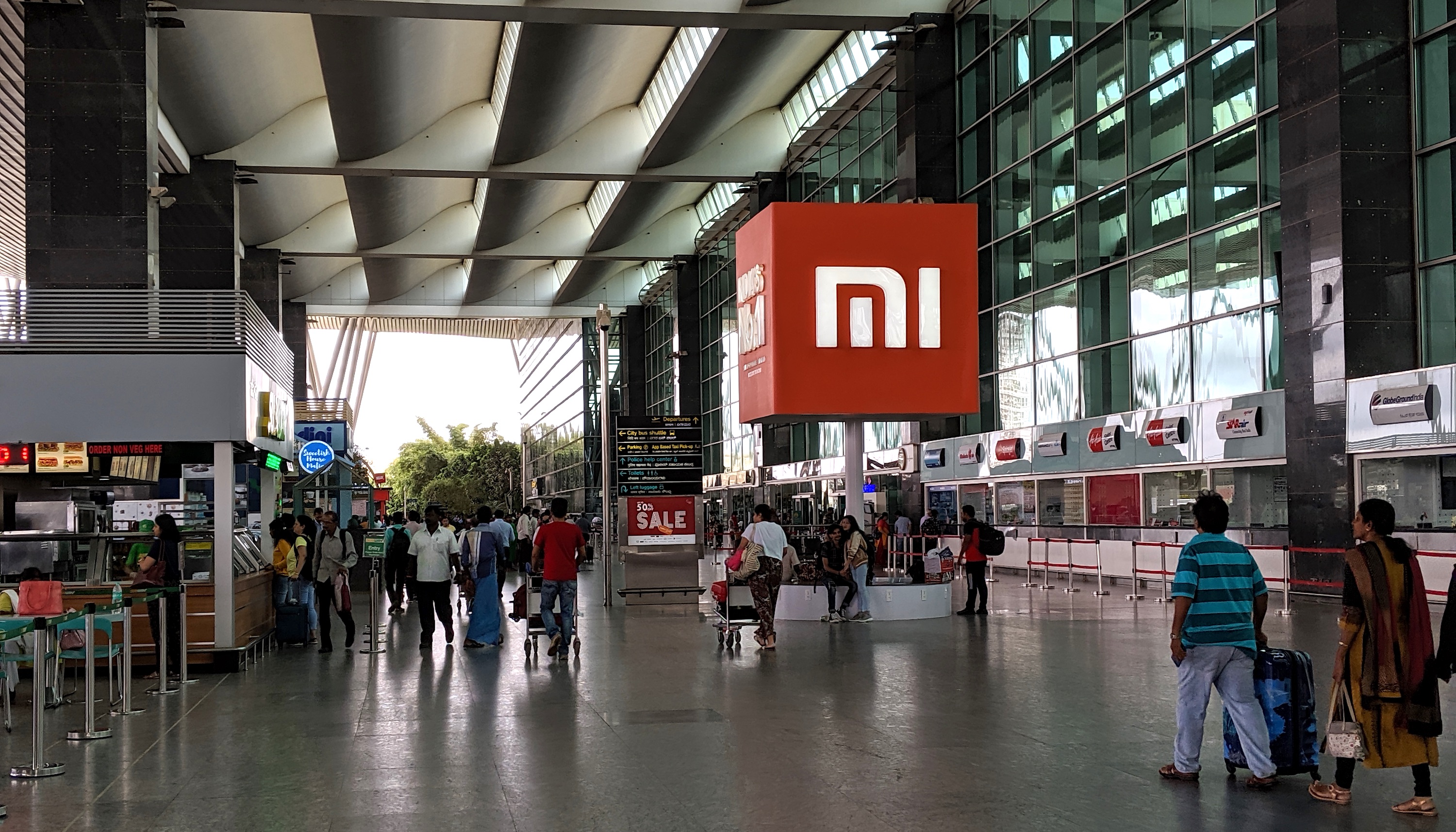
Image: Manish Singh / TechCrunch
Last month, Xiaomi said the company was on track to building presence in 10,000 physical stores in the country by the end of the year. It expects offline market to drive half of its sales by that time frame. Xiaomi says it has created more than 20,000 jobs in India, the vast majority of which have been filled by women.
Even as smartphones continue to be its marquee business in India, Xiaomi has also brought a range of other hardware products to the nation and has built software services for the local market. The company has also donned the hat of an investor, backing a number of startups, including local social network ShareChat, which recently raised $100 million from Twitter and others, fintech startups KrazyBee and ZestMoney and entertainment app maker Hungama.
In recent interviews with TechCrunch, Xiaomi executives said they have a dedicated team in India that closely looks for investment opportunities in local startups.
“We believe this is just the beginning of a brand new chapter, and we will continue to bring in more categories and products with best specs, highest quality at honest pricing for all our Mi Fans,” Jain said today.
Samsung, which once led the Indian smartphone market, has launched a handful of handset models across various price points to better compete with Xiaomi. It has also ramped up its marketing budget in the nation. Xiaomi, which spends little on marketing, remains on top.
Samsung entered India more than a decade ago and has also shipped more than 100 million smartphones in the country, research firm Counterpoint told TechCrunch. Xiaomi is only the second smartphone vendor to achieve this feat, said Tarun Pathak, an analyst with the research firm.
Powered by WPeMatico

An eight-month-old startup in India that wants to improve the user experience of credit card holders in the nation has received the backing of at least two major investors.
Pune-based FPL Technologies said Thursday it has raised $4.5 million from Matrix Partners India, Sequoia Capital India and others in its maiden financing round.
In an interview with TechCrunch earlier this week, Anurag Sinha, co-founder and CEO of FPL Technologies, said the startup aims to build a full-stack solution to reimagine how people in India get their first credit card and engage with it.
Even as hundreds of millions of people in India today are securing loans from organized financial lenders, most of them are unable to get a credit card. Fewer than 25 million people in the country today have a credit card, according to industry estimates. And even those who have a credit card are not exactly pleased with the experience.
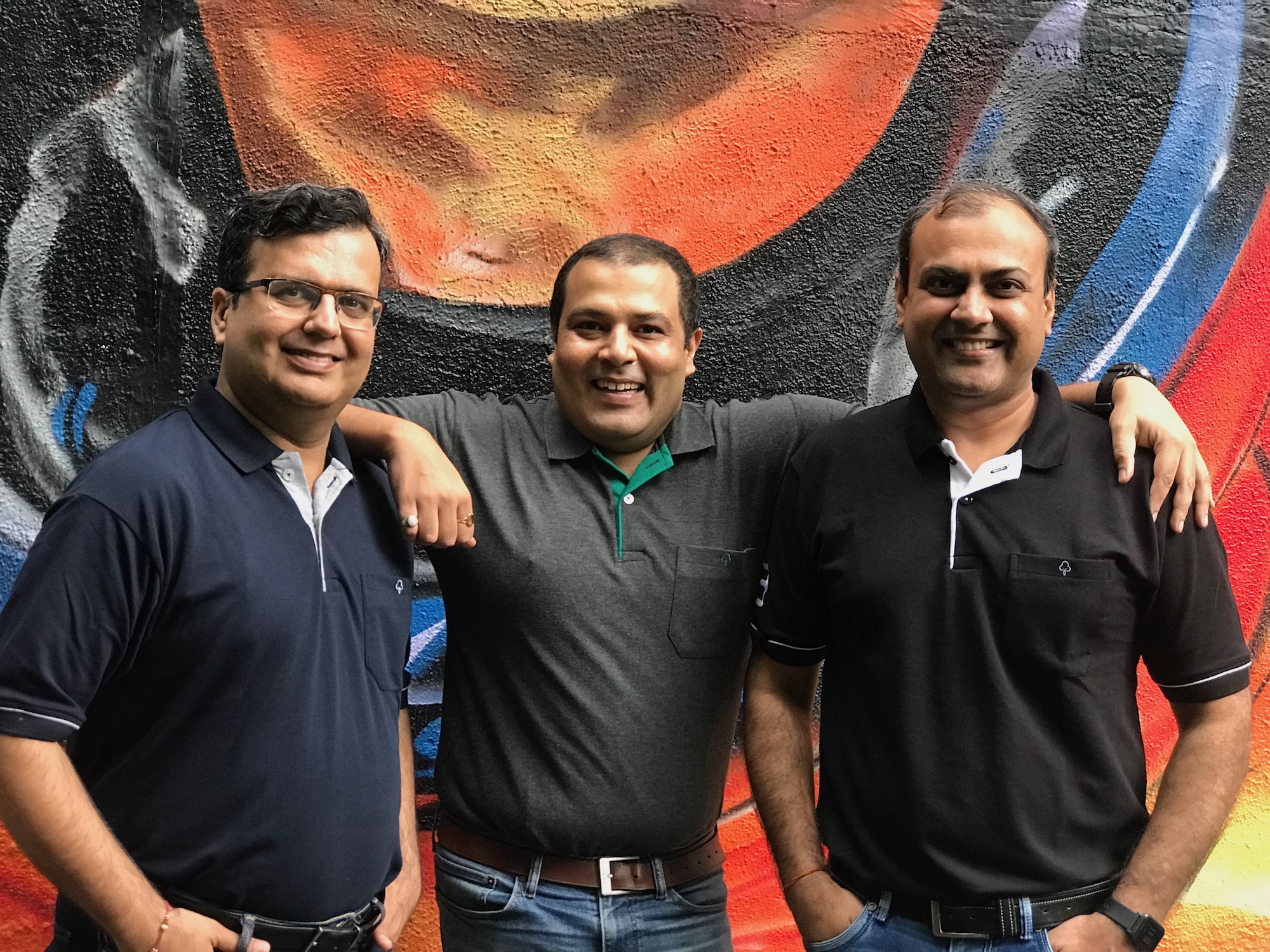
Vibhav, Anurag, Rupesh, co-founders of FPL Technologies, pose for a picture
Much of the blame goes to banks and other credit card issuing firms that are largely relying on archaic technology to operate their plastic card business.
Sinha, an industry veteran, said through his startup he aims to address a wide range of pain points of credit card holders, such as in-person meeting or telephonic interaction with bank representatives for getting a credit card, having to talk to someone to get basic support and not being able to mask the card’s identity when shopping online.
The startup, which employs about 20 people, aims to build the mobile credit card service in the next couple of months, but in the meantime, it is offering an app called OneScore to help users check their credit score and learn how to improve it. Sinha said OneScore, unlike most of its rivals, doesn’t sell the data of customers to third-party agencies.
The app was launched two months ago and has already amassed more than 100,000 users, Sinha said. These users would get the first dibs on the startup’s mobile credit card, he said.
In a statement, Shailesh Lakhani, managing director of Sequoia Capital India, said, “When they presented a plan to modernize credit cards in India it immediately resonated with the Sequoia India team. It’s a delight to partner with them as they work on developing more flexible, affordable and easier to use financial products for Indian consumers.”
In recent months, a handful of startups in India have started to explore ways to expand the reach of credit cards in the nation and incentivize users to become more responsible with how they engage with it. Bangalore-based SlicePay offers a payment card with a pre-approved credit line for students, gig-workers, freelancers and startup employees. CRED, a startup by industry veteran Kunal Shah, recently raised $120 million to motivate users to improve their financial behavior.
Powered by WPeMatico
Flipkart, the largest e-commerce platform in India, said Tuesday it has concluded the roll-out of a range of features to its shopping app in what is its biggest update in recent years.
Chief among these new features is access to Flipkart in Hindi language. Prior to the revamp of the app, Flipkart was available only in English, a language spoken by 10% of India’s 1.3 billion population.
Flipkart says it is hoping that the new features, which includes a video streaming service, would help it reach the next 200 million users in India.
The major bet on Hindi, a language spoken by more than 500 million people in India, illustrates a growing push from local and international companies operating in the country as they adapt their services and business models to go beyond the urban cities.
And that’s where much of the opportunity, which countless startups and companies have trumpeted to investors to successfully raise hundreds of millions of dollars in debt and venture capital in recent years, lies in the nation.
Powered by WPeMatico

Indian mobile payments firm MobiKwik has reached a milestone very few of its local rivals can even contemplate: not burning money. The 10-year-old Gurgaon-headquartered firm said Tuesday it is now generating a profit excluding interest, taxes, depreciation and amortization.
“We have been in an ecosystem where we have seen a lot of high-growth and several regulatory changes in the payments domain. But what we realized was that payments alone is likely not going to be a very profitable business,” Bipin Singh, co-founder and CEO of MobiKwik, told TechCrunch in an interview.
To get to the path of profitability, MobiKwik has made a number of significant changes to its business in recent years. It stopped participating in the race to aggressively acquire users and fighting with heavily backed firms such as Paytm, which has raised more than $2 billion to date.
Paytm remains unprofitable and an analysis of its financial performance shows that this is not going to change anytime soon. Google, which also offers a payments service in India, has no shortage of cash, either. MobiKwik has raised about $118 million to date from Sequoia Capital, American Express and Cisco Investments, among others.
Upasana Taku, co-founder and COO of MobiKwik, said the company has taken inspiration from Kotak and ICICI banks, both of which have about 15 million to 20 million customers — a fraction of many digital payment apps — but are profitable. MobiKwik, which employs 400 people, has 110 million users, she said.
In the last two and a half years, MobiKwik has cut down on cashbacks it bandies out to users — a practice followed by every company offering a payments solution in India — and focused on building financial services on top of its wallet app to retain customers and find additional sources of revenue.
The company continues to focus on its mobile wallet and payments processing businesses that account for about 75% of its revenue, but its growing suite of financial services, such as providing credits and insurance to customers, is already bringing the rest of the revenue, she said.
That’s not surprising, as India remains alarmingly under served. Fewer than 50 million credit cards are in circulation in the nation currently, and for people with limited income, getting a loan of any size remains a major challenge.

“Even the population that has access to smartphones and cheap internet data can’t get a credit card in India. We found it a good match for the growth of our payments app. We started serving these users who have the discipline to repay money and have certain kind of income,” the couple said, who are now also donning the role of angel investors.
MobiKwik works with banks and other lenders to finance loans between Rs 5,000 ($69) to Rs 100,000 ($1,380). In the 18 months since it started offering this, MobiKwik has provided 800,000 loans and disbursed $100 million.
In late 2018, the company launched “sachet-sized” insurance plans to provide protection from cyber fraud, fire, accident and hospitalization. These sachets start at as little as Rs 20 (28 cents) and thousands of users buy these everyday. Similarly, it also allows users to buy mutual funds for as little as $1.30.
MobiKwik expects its revenue to hit $69 million in the financial year that ends in March next year, up from $28 million a year earlier. The company, which expects to turn fully profitable by fiscal year 2021, plans to go public in four to five years, Taku said.
MobiKwik competes with a number of players, many of which are increasingly adding financial services, such as loans, to their platforms. Since these digital platforms are able to process loans without the need of salespeople and support staff, it becomes feasible for banks to chase customers with weak financial power.
India’s overall retail credit demand is expected to grow 60% to $771 billion over the next four years, according to the Digital Lenders Association of India.
Powered by WPeMatico

Many Silicon Valley companies and fintech startups in India today share a common mission: They all want to bring their financial services to the next billion users. Dozens of fintech startups that we have spoken to in recent months have told us that they all want to address much of India, one of the last great growth markets globally, in the next few years.
So you can imagine our excitement when we learned there is at least one startup that is going after just a few million users in the immediate future. We’re talking about CRED, a nine-month-old, Bangalore-based startup that is building solutions to incentivize credit card users in India to become more responsible with money and thereby improve their credit score.
CRED has raised $120 million in a Series B financing round, Kunal Shah, founder and CEO of the startup, told TechCrunch on Monday. He declined to share more information. The startup, which has raised about $145 million to date, is now valued between $430 million to $450 million, a person familiar with the matter told TechCrunch.
According to a regulatory filing, existing investors Sequoia Capital, Ribbit Capital and DST Global’s Gemini Investments led the round, with participation from Tiger Global, Hillhouse Capital, General Catalyst, Greenoaks Capital and Dragoneer.
Hundreds of millions of Indians today don’t have a credit score because they have never taken a loan from a recognized entity nor owned a credit card. According to the government’s official figures, fewer than 50 million credit cards are in circulation in India currently, with industry reports suggesting that the actual number of unique credit card holders is about half of that.
“Nobody taught us about how to use money,” Shah told TechCrunch in a recent interview. “This has created a huge trust gap in India. If you look at developed markets, systematic trust is very high between all the entities. Members don’t have to rely on third-parties. In India, even if you wanted to rent a flat, you look for brokers, for instance.”

You can build that trust when you know how someone handles their money, and how they have handled it in recent history. “Our aim is to create a big membership community with high credit worthiness, therefore open up more opportunities for them,” Shah explained.
Shah is not going after the masses. He wants to focus on just the credit card users for now, and if he could win the trust of just half of those plastic card holders in India, he would consider it a success.
“Instead of chasing the mythological mass customers who are currently useful only on paper if you wanted to boast about your daily active user or monthly active user metric, our goal is to serve the existing users,” he said.
On CRED, users are offered a range of features, including the ability to better track their spending, get reminders and check their credit score, but more importantly, access to a range of lofty offers such as membership to a gym at a discounted price, access to good restaurants at low prices and subscription to various services at little to no charge. Users can access these features by earning points, which they can secure every time they pay their credit card bills on time.
Varun Krishnan, editor of technology news site FoneArena, told TechCrunch that he has found CRED useful in getting reminders to pay his bills and likes that he can pay them through a range of payment options, including UPI apps and debit cards. “I have several cards and it is hard to track amounts and due dates of payment for each one. They send all these alerts on WhatsApp, which is a blessing,” he said.
These are the reasons that attracted many people like Krishnan to join CRED. That, and some incentive to pay his bills — though he hopes that CRED expands the range of offers it currently provides to customers.
That wish may soon come true. In the coming months, CRED will enable these highly sought-after customers to access some financial services from banks in a single-click. Additionally, it is also exploring expansion to some international markets, the aforementioned source said.
CRED does not charge users any money for joining its platform, nor for availing any of the features it offers. But it is generating revenue from some of the partners that are supplying offers on the app.
It’s not a surprise that Shah, an industry veteran known for speaking the uncomfortable truths at conferences, has won the trust of so many investors already. He built one of the biggest payment apps in India, Freecharge, and sold it to e-commerce giant Snapdeal for a whopping $400 million in one of the increasingly rare exits that India’s fintech market has seen to date.
Powered by WPeMatico
FreshToHome, a Bangalore-based e-commerce startup that sells fresh vegetable, fish, chicken and other kinds of meat, has raised $20 million in a new financing round as it looks to expand its footprint in the nation.
The Series B round for the startup was led by Iron Pillar, with Joe Hirao, the founder of Japan’s ZIGExn, also participating. The startup, which closed its $11 million Series A financing round three months ago, has raised $33 million to date.
FreshToHome sells “100 percent” pure and fresh vegetables and meat in Bangalore, Mumbai and Pune — the latter two of which it recently entered. It says it does not add any preservatives or other chemicals to prolong the life of the produce. (Typical meat sold by a retail store is riddled with chemicals and could be months old.)
Unlike most other marketplaces, FreshToHome has built its own supply chain network, which gives it better control over quality and delivery of the food items. It uses trains and planes to move inventory, and has become one of the biggest clients of several local airlines.
The startup sources vegetables and fish directly from 1,500 fishermen and farmers across the nation. It uses an app to negotiate with farmers and fishermen.
It continues to expand its control over all aspects of its business. “Today a large part of our poultry comes from institutional farmers. Now we are going a step ahead and processing the chicken at the slaughtering level ourselves,” Shan Kadavil, CEO of FreshToHome, told TechCrunch in an interview.
FreshToHome is able to deliver the perishables on the same day and as soon as up to two hours, Kadavil said.
The startup also began operations in UAE recently and has opened physical stores in Bangalore and Chennai.
FreshToHome has amassed 650,000 customers — up from 400,000 in late May — in 10 cities in India, and recently started to sell milk in Bangalore, another market segment that remains largely unstructured in the nation. Every day it receives 14,000 orders, and processes 20 tons of fresh food.
It recently crossed $30 million in annualized direct to consumer sales, which makes it the largest e-commerce platform serving this category. It is seeing 30% month-to-month growth, said Kadavil, who has previously managed tech support for Support, and India operations for gaming firm Zynga.
And that growth has helped the startup attract some attention. Several major players in the nation, including Amazon India that recently expanded to include perishable category and Flipkart, have held talks with FreshToHome to acquire some stake in the startup, a person familiar with the matter told TechCrunch.
And there is a big opportunity in the space. The cold-chain market of India is estimated to grow to $37 billion in next five years.
In addition to directly procuring its supplies from farmers and fishermen, FreshToHome also serves as a micro-VC, giving them access to some money upfront and resources to produce more from their farms. It also gives them an assurance that it will buy back their produce.
Kadavil founded FreshToHome with Mathew Joseph, a veteran in the industry who has dealt with fish export for more than 30 years. Joseph started India’s first e-commerce venture in fish and meat, called SeaToHome, in 2012.
FreshToHome will use the fresh capital to expand its network of contract farmers, and add 200 to 300 tons of additional produce each month.
In a prepared statement, Anand Prasanna, managing partner of Iron Pillar, for which it is the first investment in food-tech space, said, “FreshToHome’s brand proposition has been to provide 100% fresh food with 0% chemicals — not an easy thing to achieve in India at a large scale. By smartly using big data and machine learning, they have created a sustainable supply chain, which offers a fair price to consumers, fishermen and farmers, for their premium produce… We love companies that solve such hard issues in large market segments in India through unique tech enabled moats!”
Powered by WPeMatico