india
Auto Added by WPeMatico
Auto Added by WPeMatico
Increasingly, the streets of Karachi and Lahore are being flooded with men riding bikes and wearing green T-shirts, a writer friend recently told me. In a sense, these men represent the emergence of Pakistan’s tech startups.
India now has more than 25,000 startups and raised a record $14.5 billion last year, according to government figures. But not all Asian countries are as large as India or have such a thriving startup ecosystem. Long overdue, things are beginning to change in bordering Pakistan.
Bykea, a three-year-old ride-hailing and delivery service, today has more than 500,000 bikes registered on its platform. It operates in some of Pakistan’s most populated cities, such as Karachi, Lahore and Islamabad, Muneeb Maayr, Bykea founder and CEO, told TechCrunch.
Maayr is one of the most recognized startup founders in Pakistan, and previously worked for Rocket Internet, helping the giant run fashion e-commerce platform Daraz in the country. While leading Daraz, he expanded the platform to cater to categories beyond fashion; Daraz was later sold to Alibaba.
Powered by WPeMatico

Two of the top three telecom operators in India are beginning to address one of the biggest challenges hundreds of millions of their subscribers face in the country each day: poor call quality and abrupt voice drops.
Reliance Jio, India’s second largest telecom operator, announced today that it now supports voice and video calling functionality over Wi-Fi networks. The 4G-only network said it has started to roll out the feature to all of its subscribers in India and expects to reach all of its 360 million consumers by next week.
The rollout of calls over Wi-Fi functionality on Jio comes weeks after Airtel, India’s third largest telecom operator with more than 260 million subscribers, began to support this feature in select places in the country. Neither of the operators are levying any additional fee for this feature and say that their subscribers can place phone calls over Wi-Fi across the networks.
Wi-Fi calling is a popular feature that enables users to latch onto their wireless internet connection to make phone calls. These calls tend to be of much better quality than those that rely on traditional telecom infrastructure. In the U.S., T-Mobile, Verizon (which owns TechCrunch) and AT&T began to offer this feature in late 2015 and early 2016.
In many markets such as India, calls over internet began to gain traction four to five years ago after services such as WhatsApp enabled such functionality. In the years since, telecom operators have also rolled out support for calls over LTE networks.
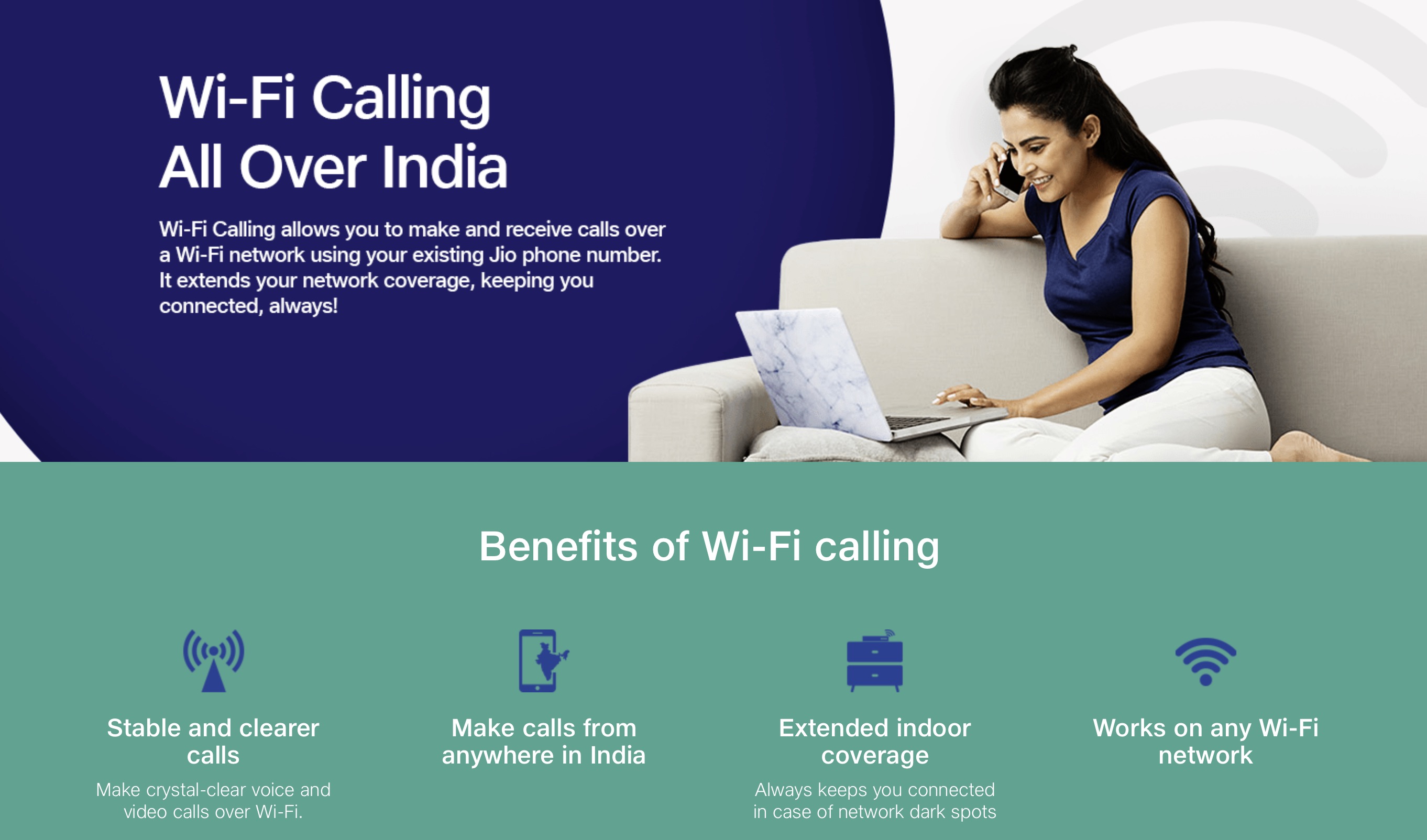
Airtel currently supports Wi-Fi calling in select circles — such as Mumbai, Kolkata, Andhra Pradesh, Karnataka and Tamil Nadu — and requires its users to be a subscriber of Airtel broadband service. It also works only on a handful of smartphone models.
Reliance Jio, on the other hand, supports more than 150 smartphone models, including several recent iPhone generations and a wide range of mid-tier and high-end Android smartphones. A Reliance Jio spokesperson told TechCrunch that Jio’s Wi-Fi calling functionality works on any Wi-Fi network.
Akash Ambani, director of Jio, said Reliance Jio consumers already use more than 900 minutes of voice calling every month. “The launch of Jio Wi-Fi Calling will further enhance every Jio consumer’s voice-calling experience, which is already a benchmark for the industry with India’s-first all VoLTE network,” he said in a statement.
Vodafone, which at the last count (PDF) was ahead of Reliance Jio by a few million subscribers, is yet to offer this functionality. The announcement follows price hikes by all the top three telecom networks in India.
Powered by WPeMatico

Welcome back to Startups Weekly, a weekend newsletter that dives into the week’s noteworthy startups and venture capital news. Before I jump into today’s topic, let’s catch up a bit. Last week I wrote about the startups we lost in 2019. Before that, I noted the defining moments of VC in 2019.
Unfortunately, this will be my last newsletter, as I am leaving TechCrunch for a new opportunity. Don’t worry, Startups Weekly isn’t going anywhere. We’ll have a new writer taking over the weekly update soon enough; in the meantime, TechCrunch editor Henry Pickavet will be at the helm. You can still get in touch with me on Twitter @KateClarkTweets.
If you’re new here, you can subscribe to Startups Weekly here. Lots of good content will be coming your way in 2020.
TechCrunch reporter Manish Singh penned an interesting piece on the state of Indian startups this week: As Indian startups raise record capital, losses are widening (Extra Crunch membership required). In it, he claims the financial performance of India’s largest startups are cause for concern. Gems like Flipkart, BigBasket and Paytm have lost a collective $3 billion in the last year.
“What is especially troublesome for startups is that there is no clear path for how they would ever generate big profits,” he writes. “Silicon Valley companies, for instance, have entered and expanded into India in recent years, investing billions of dollars in local operations, but yet, India has yet to make any substantial contribution to their bottom lines. If that wasn’t challenging enough, many Indian startups compete directly with Silicon Valley giants, which while impressive, is an expensive endeavor.”
Manish’s story came one day after The New York Times published an in-depth report on Oyo, a tech-enabled budget hotel chain and rising star in the Indian tech community. The NYT wrote that Oyo offers unlicensed rooms and has bribed police officials to deter trouble, among other toxic practices.
Whether Oyo, backed by billions from the SoftBank Vision Fund, will become India’s WeWork is the real cause for concern. India’s startup ecosystem is likely to face a number of barriers as it grows to compete with the likes of Silicon Valley.
Follow Manish here or on Twitter for more of TechCrunch’s growing India coverage.
If you’ve still not subscribed to Extra Crunch, now is the time. Longtime TechCrunch reporter and editor Josh Constine is launching a new series to teach you how to pitch your startup. In it he will examine embargoes, exclusives, press kit visuals, interview questions and more. The first of many, How to find the right reporter to pitch your startup, is online now.
Subscribe to Extra Crunch here.

Another week, another new episode of TechCrunch’s venture capital-focused podcast, Equity. This week, we discussed a few of 2019’s largest scandals, Peloton’s strange holiday ad and the controversy over at the luggage startup Away. Listen here and be sure to subscribe, too.
For anyone wondering about changes at Equity following my departure from TechCrunch, the lovely Alex Wilhelm (founding Equity co-host) will keep the show alive and, soon enough, there will be a brand new co-host in my place. Please keep supporting the show and be sure to recommend it to all your podcast-adoring friends.
Powered by WPeMatico
HungerBox, an Indian food tech startup that has courted 10 of the 11 largest companies in the country to use its services, today announced it has raised $12 million from Paytm and others as it looks to sign clients in Southeast Asia.
The three-year-old startup’s new financing round, a Series C, was funded by a consortium of Indian and international investors, including payments firm Paytm and NPTK, an Asian VC fund that invests in emerging firms. Existing investors Sabre Partners and Neoplux also participated in the round, which pushes the Bangalore-based startup’s to-date raise to $16.5 million.
HungerBox offers management services to companies and institutions to improve and run their in-house cafeterias and canteens. HungerBox also enables its clients to connect with food partners through an app and get real-time updates of their order.
The startup, which also provides these firms with a point-of-sale machine, helps them get better insight into the quality of food being catered to their employees, and enables scheduled delivery and tracking of orders to address the long queues, said Sandipan Mitra, co-founder and chief executive of HungerBox, in an interview with TechCrunch.
“We all talk about the food delivery to consumers, but not many are looking to improve the quality of food and how it is being catered to tens of millions of employees in the country each day,” he said. “It’s a challenge that has not been addressed well.”
It turns out, when a startup finally looked into the space, many quickly jumped to appreciate it. HungerBox has amassed more than 126 large businesses and institutions — with more than 100,000 workforce each, across 18 Indian cities, said Mitra. Food delivery startups Swiggy and Zomato have started to explore this space, too, in recent quarters.
HungerBox is processing 560,000 orders each day, a figure that is growing 10% every month, claimed Mitra. The startup’s solutions are today employed at more than 535 cafeterias for its clients that work in IT / technology, retail, healthcare, aviation, education, financial services and manufacturing, he said. He declined to reveal the name of the clients, citing confidential agreements.
Annual food sales on the HungerBox platform have exceeded $100 million, he said.
The startup, which employs 1,500 people, will use the fresh capital to fuel its expansion in 10 additional Indian cities and to markets in Southeast Asia, said Mitra.
In a statement, Madhur Deora, president of Paytm, said HungerBox has enabled Paytm to add new use cases for the company’s payments business and digitization of offline transactions.
“HungerBox is the market leader in the institutional food tech space and we will partner closely with them and bring the benefits of Paytm’s ecosystem to HungerBox,” he said.
Powered by WPeMatico
Licious, a Bangalore-based startup that sells fresh meat and seafood online, has secured $30 million in a new financing round as it looks to expand its footprint in the nation.
The new financing round, dubbed Series E, for the four-year-old startup was led by Singapore-based Vertex Growth Fund, it said Monday. Existing investors 3one4 Capital, Bertelsmann India Investments, Vertex Ventures Southeast Asia and India and Sistema Asia Fund also participated in the round.
The Series E pushes Licious’ to-date raise to $94.5 million.
Licious operates an eponymous e-commerce platform to sell meat and seafood in cities in India (Bengaluru, NCR, Hyderabad, Chandigarh, Panchkula, Mohali, Mumbai, Pune, and Chennai). The startup does not stock any inventory, so any raw material it procures, it processes and ships on the same or next day. It processes more than 17,000 orders every day.
The startup, which employs more than 2,000 people, has built its own supply chain network to control sourcing and production of food, it said. Licious executives said the startup is growing at a healthy rate of 300% year-over-year and aims to generate $140 million in annual revenue by 2023.
Licious will use the fresh capital to expand to more cities in India, and launch new products, said Vivek Gupta, co-founder of the startup.
The startup competes with Bangalore-based FreshToHome, which has amassed more than 650,000 customers in 10 cities in India. As of August, when FreshToHome raised $20 million in a new funding round, the startup was handling 14,000 orders a day.
Gupta said the vast majority of the Indian meat and seafood industry remains unorganized, which has created an immense opportunity for startups to address the sector. The cold-chain market of India is estimated to grow to $37 billion in the next five years, according to industry estimates.
“The traditional meat and seafood industry are in dire need of tech intervention, quality standardisation and a skilled talent pool. Licious is working towards creating these differentiators and will stay committed towards elevating India’s meat and seafood experience,” he said.
Powered by WPeMatico
Amazon is having another go at expanding its reach to listeners in India. The company, which launched pay-to-use Audible in the country last year, today introduced a new service called Audible Suno that offers free access to “hundreds of hours of audio entertainment, enlightenment and learning.”
And it’s banking on major Indian celebrities to draw the listeners.
Audible Suno, which is exclusively available to users in India, features more than 60 original and exclusive episodes (of 20 to 60 minutes in length) in both Hindi and English languages. Audible, the world’s largest seller and producer of audio content, said Suno is aimed at filling the “idle time” listeners have each day during their commutes and performing other daily chores.
The company says Audible Suno, available to users through a dedicated Android app and via iOS Audible app, is also free of advertisements.
The launch of Audible Suno in India illustrates the commitment the company has in the country, said Audible founder and chief executive Don Katz. Amazon has invested more than $5.5 billion in its business in India to date. The company’s tentacles today reach a number of categories in the country, including e-commerce, payments, online ticketing business, video and audio streaming and VC deals.
“I’ve always been passionate about the transformative power of the spoken word, and I’m delighted to be able to offer this breadth of famous voices and culturally resonant genres with unlimited access, ad-free and free of charge,” said Katz.
Who are these famous voices you ask? Here’s the list: Amitabh Bachchan, Katrina Kaif, Karan Johar, Anil Kapoor, Farhan Akhtar, Mouni Roy, Anurag Kashyap, Neelesh Misra, Tabu, Nawazuddin Siddiqui, Diljit Dosanjh, Vir Das and Vicky Kaushal.
Audible Suno currently offers shows in a range of genres, including horror (Kaali Awaazein), romance and relationships (Matrimonial Anonymous and Piya Milan Chowk), suspense (Thriller Factory) and comedy series (The Unexperts by Abish Mathew). Non-fiction series include interviews with some of the country’s biggest stars, and socially relevant subjects such as mental health, sex education and the rights of the LGBTQI+ community.
Powered by WPeMatico
Zetwerk, an Indian business-to-business marketplace for manufacturing items, has closed a significantly large financing round as it scales its operations in the nation and also helps local businesses find customers overseas.
The 18-month-old startup said on Wednesday it has raised $32 million in a Series B financing round led by Lightspeed and Greenoaks Capital. Zetwerk co-founder and chief executive Amrit Acharya told TechCrunch in an interview that the startup has also raised about $14.2 million in debt from a consortium of banks, and others.
Existing investors Accel, Sequoia India and Kae Capital also participated in the round, which pushes the Bangalore-based startup’s total raise to date to about $41 million. Vaibhav Gupta, co-founder of business-to-business marketplace Udaan, and Maninder Gulati, one of the top executives at budget lodging startup Oyo also participated.
Zetwerk was founded by Acharya, Srinath Ramakkrushnan, Rahul Sharma and Vishal Chaudhary last year. The startup connects OEMs (original equipment manufacturers) and EPC (engineering procurement construction) customers with manufacturing small-businesses and enterprises.
Unlike the more common e-commerce firms we come across every day, Zetwerk sells goods such as parts of a crane, doors, chassis of different machines and ladders. The startup operates to serve customers in fabrication, machining, casting and forging businesses. Currently, Zetwerk works with more than 100 enterprises and 1,500 small and medium-sized businesses. It delivers more than 15,000 parts each month.
“These are all custom-made products,” explained Acharya. “Nobody has a stock of such inventories. You get the order, you find manufacturers and workshops that make them. Our customers are companies that are in the business of building infrastructure.”
“We index these small workshops and understand the kinds of products they have built before. These indexes help bigger companies discover and work with them,” he added.
Once a firm has placed an order, Zetwerk allows them to keep a tab on the progress of manufacturing and then the shipping. This “hand-holding” is crucial, as in this line of business, manufacturing and shipping typically take more than two to three months.
Zetwerk has also enabled manufacturers in India to discover and find clients overseas. Today, manufacturers on the platform export their goods to North America and Southeast Asia, Acharya said. “India has a lot of depth in manufacturing, but much of it has not been tapped well,” he said.
Helping these manufacturing workshops find clients online is still a new phenomenon in the nation. Acharya said Zetwerk largely competes with domain project consultants in the offline work. “They specialize in certain products and geographies. So let’s say someone wanted to buy a machine XYZ in Orissa, they reach out to consultants who help them find workshops and estimate how much time it would take to get the project done.”
According to industry reports, manufacturing today accounts for 14% of India’s GDP. But the nation lacks a supporting ecosystem to execute projects in an efficient manner.
Vaibhav Agarwal, a partner at Lightspeed, said it was unusual to come across a market that is as large as $40 billion to $60 billion in India and global trade-tailwinds that creates opportunity to serve international demand.
The startup plans to infuse portions of the fresh capital into expanding its international operations. Acharya did not share exactly how many clients it has outside of India but said exports currently account for less than 5% of the startup’s GMV, or gross merchandize value.
He said the startup will continue to focus on helping Indian manufacturers find clients outside, as it is better suited to address this, as opposed to helping Indian companies find manufacturers overseas.
The startup will also explore helping its manufacturing workshops access working capital, though Acharya cautioned that it is not something that would happen anytime soon.
In a statement, Prayank Swaroop, a partner at Accel, said, “the use of technology in project planning, procurement, audits, and supply chain transparency is the core offering of Zetwerk which is completely original. Accel is very fortunate to be part of Zetwerk journey since the startup’s inception.”
Powered by WPeMatico
Netflix continues to bet heavily on India, one of the world’s largest entertainment markets, where it competes with more than three dozen rivals, including Disney.
Reed Hastings, the chief executive of Netflix, said on Friday that the company is on track to spend 30 billion Indian rupees, or $420.5 million, on producing and licensing content in India this year and next.
“This year and next year, we plan to spend about Rs 3,000 crores developing and licensing content and you will start to see a lot of stuff hit the screens,” he said at a conference in New Delhi.
The rare revelation today has quickly become the talk of the town. “This is significantly higher than what we have invested in content over the past years,” an executive at one of the top five rival services told TechCrunch. Another industry source said that no streaming service in India is spending anything close to that figure on just content.
While it remains unclear exactly how much capital other streaming services are pouring into content, a recent KPMG report estimated that Hotstar was spending about $17 million on producing seven original shows this year, while Eros Now had pumped about $50 million into its India business to create 100 new original shows. (The report does not talk about licensing content expenses.)
Netflix, which entered India as part of its global expansion to more than 200 nations and territories in early 2016, has so far produced more than two dozen original shows and movies in the country and inked partnerships with a number of local studios, including actor Shah Rukh Khan’s Red Chillies Entertainment.
Hastings said several of the shows the company has produced in India, including A-listed cast thriller “Sacred Games” and animated show “Mightly Little Bheem,” have “traveled around the world.” More than 27 million households outside of India, said Hastings, have started to watch “Mighty Little Bheem,” a show aimed at children.
Netflix, which is expected to spend about $15 billion on content globally next year, has never shared the number of subscribers it has in India. (It has over 158 million subscribers globally.) But the company’s financials in the country, where it employs about 100 people, have improved in recent quarters. In the financial year that ended in March, the company posted revenue of $65 million and profit of about $720,000 for its India business.
India has emerged as one of the last great growth markets for global technology and entertainment firms. About half of the nation’s 1.3 billion population is now online and the country’s on-demand video market is expected to grow to $5 billion in the next four years, according to Boston Consulting Group.
But the propensity — or the capacity — of most of these internet users to pay for a subscription service remains significantly low. Most services operating in India today generate the majority of their revenue from ads. And others, which rely on a recurring model, are making major changes to their offerings in the nation.
To broaden its reach in the nation, Netflix earlier this year introduced a new monthly price tier — $2.8 — that allows users in India to watch the streaming service in standard quality on a mobile device. (The company has since expanded this offering to Malaysia.)
Netflix competes with more than three dozen on-demand video streaming services in India. Chief among its competitors in the nation is Disney’s Hotstar. Hotstar’s content includes live TV channels, streaming of sports events and thousands of movies and shows, many syndicated from global networks and studios such as HBO and Showtime.
The ad-supported service offers more than 80% of its catalog at no charge to users and charges 999 Indian rupees ($14) a year for its premium tier.
Among the licensed content that Hotstar — or its operator Star India — owns in the country includes rights to stream a number of cricket tournaments. Cricket is incredibly popular in India and has helped Hotstar set global streaming records.
In May this year, Hotstar reported that more than 25 million people simultaneously watched a cricket match on the platform — a global record. The service, at the time, had more than 300 million monthly active users.
Commenting on the competition, Hastings said the next five to 10 years is going to be “the golden age of television” as “unbelievable and unrivaled levels of investment” go into producing content. “They are all investing here in India. We are seeing more content made than ever before. It’s a great export,” he added.
Disney+, the recently launched streaming service from the global content conglomerate, is set to be available in India and Southeast Asian markets next year through Hotstar, TechCrunch reported last month.
Powered by WPeMatico

Accel, one of the world’s most influential venture capitalist firms, is getting more bullish on India.
The Silicon Valley-headquartered firm, which largely focuses on early-stage investments, said today it has closed $550 million for its sixth venture fund in India.
This is a significant amount of capital for Accel’s efforts in the country, where it began investing 15 years ago and has infused roughly $1 billion through all its previous funds.
Anand Daniel, a partner for Accel in India, told TechCrunch in an interview that the VC fund will continue to focus on identifying and investing in seed and early-stage startups.
But the fund realized it needed more money so it could actively participate in follow-on rounds (later-stage financing rounds) of its portfolio startups. The announcement today follows Accel’s similar recent push in Europe and Israel, where it closed a $575 million fund.
“We also selectively do growth investments for companies that are scaling well, such as Swiggy, UrbanClap, BlackStone and Bounce. We have continued to back them through Series B and Series C rounds,” he said.
At the risk of being accused of bias, I’ll say this: Accel India is a rare Indian fund that had credible exits and more promising exits in the pipeline. They’re also some of the nicest people to work with. https://t.co/aZGjDgSQKe
— JPK (@therealjpk) December 2, 2019
Like in many other markets, Accel’s track record in India is quite impressive. It participated in the seed financing round of e-commerce firm Flipkart, which was then valued at $4 million post-money. Walmart bought a majority stake in Flipkart last year for $16 billion. (This helped Accel net more than $1 billion in return from Flipkart.)
Accel, which has nine partners and more than 50 members in total in India, also invested in the seed round of SaaS giant Freshworks, which is now valued at more than $3 billion, food delivery startup Swiggy, also valued at north of $3 billion, and recently turned unicorn BlackBuck. Accel has been the first institutional investor for 85% of startups in its portfolio.
The VC firm says 44 of the 100-odd startups in its India portfolio today are valued at over $100 million each. In total, including Flipkart’s $21 billion market value, Accel’s portfolio firms have created $44 billion in market value.
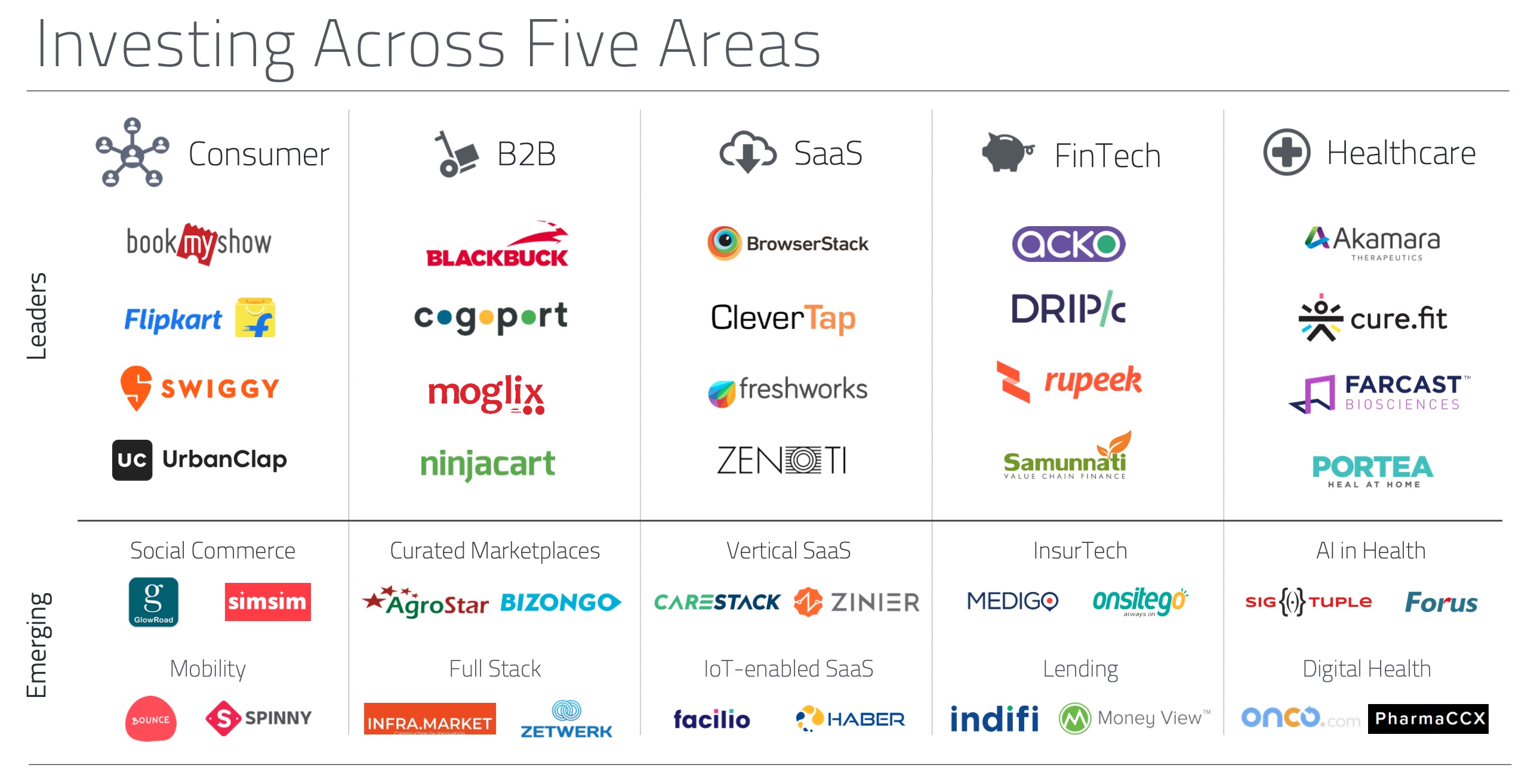
Some of the investments Accel has made in India
“When we started our first fund in India in 2005, the world was a very different place. Just 1 in 50 Indians had access to the internet and mobile phone ownership was nascent. Yet we firmly believed that India was on the cusp of a big change,” the firm said in a statement.
“Today, the opportunity ahead is significantly bigger than when we started in 2005: India can now digitally identify 1.3 billion people, has 600 million internet users and 150 million online transacting customers with a national payments platform that processes $20 billion a month.”
Daniel said moving forward Accel will continue to focus on consumer, business-to-business, fintech, healthcare and global SaaS categories. “We have nine partners with their own areas of interest. They invest from their own conviction and finance seed rounds. If we see a particular sector evolving, then we do a deeper thesis work,” he said.
“We then develop deeper confidence for the space. For example, back in the day we invested in mobility startup TaxiForSure, long before Uber had arrived in India. That helped us understand mobility well. We have used those learnings to invest in several more mobility startups.”
Accel’s growing interest in India comes at a time when several other giants, including SoftBank and Prosus Ventures, have also become more active in the nation — though they tend to finance later-stage rounds.
For Indian startups that are already having their best year, this can only be good news.
Powered by WPeMatico
India has long been a wonderland for cellphone users. At a time when most telecom operators across the globe charge anywhere between $5 to $10 for a gigabyte of mobile data, telcos in India deliver that for just a few cents.
Spare another $2 to the same telecom operator and you get a gigabyte of mobile data everyday for a month and all your nationwide calls become free.
How is that possible, you ask? In 2016, India’s richest man launched Reliance Jio, a telecom network that undercut the local competition by offering unlimited voice calls and the bulk of 4G mobile data at industry-low prices. Vodafone and Airtel — two of the top three carriers in India — dramatically moved to revise their tariffs to aggressively compete with Jio, but in doing so they began to bleed a lot of money.
So now they are making some changes that suddenly make cellphone plans in the country less attractive — but fret not, these plans are still miles ahead of comparable offerings in most other markets.
Vodafone Idea, Bharti Airtel and Reliance Jio — three telecom operators that command over 90% of India’s mobile subscriber base of more than 1.1 billion users — have hiked their tariffs by up to 42% for their prepaid customers. (In India, unlike many other markets, the vast majority of people prefer to pay as they go instead of signing up for a monthly subscription.)
The revised plans from Vodafone start from 26 cents for daily usage and go up to $33.4 for a year-long commitment — that is about 42% costlier compared to the previous offerings. The operator’s new tariffs will go into effect starting Tuesday.
Bharti Airtel’s new tariffs are priced similarly, though the operator says it will offer “generous data and calling benefits” to make up for the hike.
The changes are a direct result to make up for the massive losses Airtel and Vodafone reported last month. In the quarter that ended in September, Airtel lost more than $3.2 billion, while Vodafone posted a loss of $7.1 billion.
While these losses reflect the competition heat that both the networks have been facing from Reliance Jio, which now leads the market with over 350 million subscribers, they largely address a one-time potential outstanding payment these companies owe to the government related to a court dispute surrounding 14-year-old adjusted gross revenue.
Last month, chief executives of both the telecom networks requested the Indian government give them more time to pay the fine. Vodafone’s chief executive added that if the government did not budge, the British firm’s India business might just collapse.
The Indian government budged and offered a small bailout after it postponed certain payments.
Over the weekend, Reliance Jio said it would be introducing new plans, too, that will be “priced up to 40% higher” in a move to “strengthen the telecom sector” and strangely “keep consumers at the center of everything.” Its revised plans would go into effect this Friday.
Its announcement follows a two-month-old decision to hike the prices after other telecom operators floated the idea that they would continue to levy what they call an “interconnect fee.”
When a call from one network is placed to a phone on another network, the former carrier has to pay an “interconnect fee” to the latter. Prior to 2017, the interconnect fee in the country was set at about 14 paise (roughly 1.8 cents) for each minute of the call. In 2017, the Indian telecom regulator cut the interconnect charge to 6 paise per minute, adding that in January 2020, the interconnect fee would no longer be valid. In recent months, Airtel and Vodafone, among other networks (but obviously not Reliance Jio), have been exploring ways to extend this deadline.
At any rate, some industry executives say these tariff hikes were inevitable. Rajan Mathews, who heads the trade group Cellular Operators Association of India, said in a recent interview that the old prices were simply unsustainable for these businesses and carriers needed to address the price war more maturely.
Powered by WPeMatico