india
Auto Added by WPeMatico
Auto Added by WPeMatico

Disney plans to bring its on-demand video streaming service to India and some Southeast Asian markets as soon as the second half of next year, two sources familiar with the company’s plan told TechCrunch.
In India, the company plans to bring Disney+’s catalog to Hotstar, a popular video streaming service it owns, after the end of next year’s IPL cricket tournament in May, the people said.
Soon afterwards, the company plans to expand Hotstar with the Disney+ catalog to Indonesia and Malaysia, among other Southeast Asian nations, said those people on the condition of anonymity.
A spokesperson for Hotstar declined to comment.
Hotstar leads the Indian video streaming market. The service said it had more than 300 million monthly subscribers during the IPL cricket tournament and ICC World Cup earlier this year. More than 25 million users simultaneously streamed one of the matches, setting a new global record.
However, Hotstar’s monthly user base plummeted below 60 million in the weeks following the IPL tournament, according to people who have seen the internal analytics. The arrival of more originals from Disney on Hotstar, which already offers a number of Disney-owned titles in India, could help the service sustain users after cricket season.
The international expansion of Hotstar isn’t a surprise as it has entered the U.S., Canada and the U.K. in recent years. In an interview with TechCrunch earlier this year, Ipsita Dasgupta, president of Hotstar’s international operations, said so far the platform’s international strategy has been to enter markets with “high density of Indians.”
In an earnings call for the quarter that ended in June this year, Disney CEO Robert Iger hinted that the company, which snagged Indian entertainment conglomerate Star India as part of its $71.3 billion deal with 21st Century Fox, would bring Star India-operated Hotstar to Southeast Asian markets, though he did not offer a timeline.
Disney+, currently available in the U.S, Canada and the Netherlands, will expand to Australia and New Zealand next week, and the U.K., Germany, Italy, France and Spain on March 31, the company announced last week.
Disney, which debuted its video streaming service in the U.S. this week and has already amassed more than 10 million subscribers, plans to raise the monthly subscription fee of Hotstar in India, where the service currently costs $14 a year, one of the two aforementioned people said.

A screenshot of Hotstar’s homepage
The price hike will happen toward the end of the first quarter next year, just ahead of commencement of next the IPL cricket tournament season, they said. The company has not decided exactly how much it intends to charge, but one of the people said that it could go as high as $30 a year.
In other Southeast Asian markets, the service is likely to cost above $30 a year, as well, both of the sources said. The prices have yet to be finalized, however, they said.
Even at those suggested price points, Disney would be able to undercut rivals on price. Until recently, Netflix charged at least $7 a month in India and other Southeast Asian markets. But this year, the on-demand streaming pioneer introduced a $2.8 monthly tier in India and $4 in Malaysia.
Hotstar offers a large library of local movies and titles syndicated from international cable networks and studios Showtime, HBO and ABC (also owned by Disney). In its current international markets, Hotstar’s catalog is limited to some local content and a large library of Indian titles.
In recent quarters, Hotstar has also set up an office in Tsinghua Science Park in Beijing, China and hired more than 60 engineers and researchers to expand its tech infrastructure to service more future users, according to job recruitment posts and other data sourced from LinkedIn.
Powered by WPeMatico

Gradeup, an edtech startup in India that operates an exam preparation platform for undergraduate and postgraduate-level courses, has raised $7 million from Times Internet as it looks to expand its business in the country.
Times Internet, a conglomerate in India, invested $7 million in Series A and $3 million in seed financing rounds of the four-year-old Noida-based startup, it said. Times Internet is the only external investor in Gradeup, they said.
Gradeup started as a community for students to discuss their upcoming exams, and help one another with solving questions, said Shobhit Bhatnagar, co-founder and CEO of Gradeup, in an interview with TechCrunch.
While those functionalities continue to be available on the platform, Gradeup has expanded in the last year to offer online courses from teachers to help students prepare for exams, he said. These courses, depending on their complexity and duration, cost anywhere between Rs 5,000 ($70) and Rs 35,000 ($500).

“These are live lectures that are designed to replicate the offline experience,” he said. The startup offers dozens of courses and runs multiple sessions in English and Hindi languages. As many as 200 students tune into a class simultaneously, he said.
Students can interact with the teacher through a chatroom. Each class also has a “student success rate” team assigned to it that follows up with each student to check if they had any difficulties in learning any concept and take their feedback. These extra efforts have helped Gradeup see more than 50% of its students finish their courses — an industry best, Bhatnagar said.
Each year in India, more than 30 million students appear for competitive exams. A significant number of these students enroll themselves to tuitions and other offline coaching centers.
“India has over 200 million students that spend over $90 billion on different educational services. These have primarily been served offline, where the challenge is maintaining high quality while expanding access,” said Satyan Gajwani, vice chairman of Times Internet.
In recent years, a number of ed tech startups have emerged in the country to cater to larger audiences and make access to courses cheaper. Byju’s, backed by Naspers and valued at more than $5.5 billion, offers a wide range of self-learning courses. Vedantu, a Bangalore-based startup that raised $42 million in late August, offers a mix of recorded and live and interactive courses.
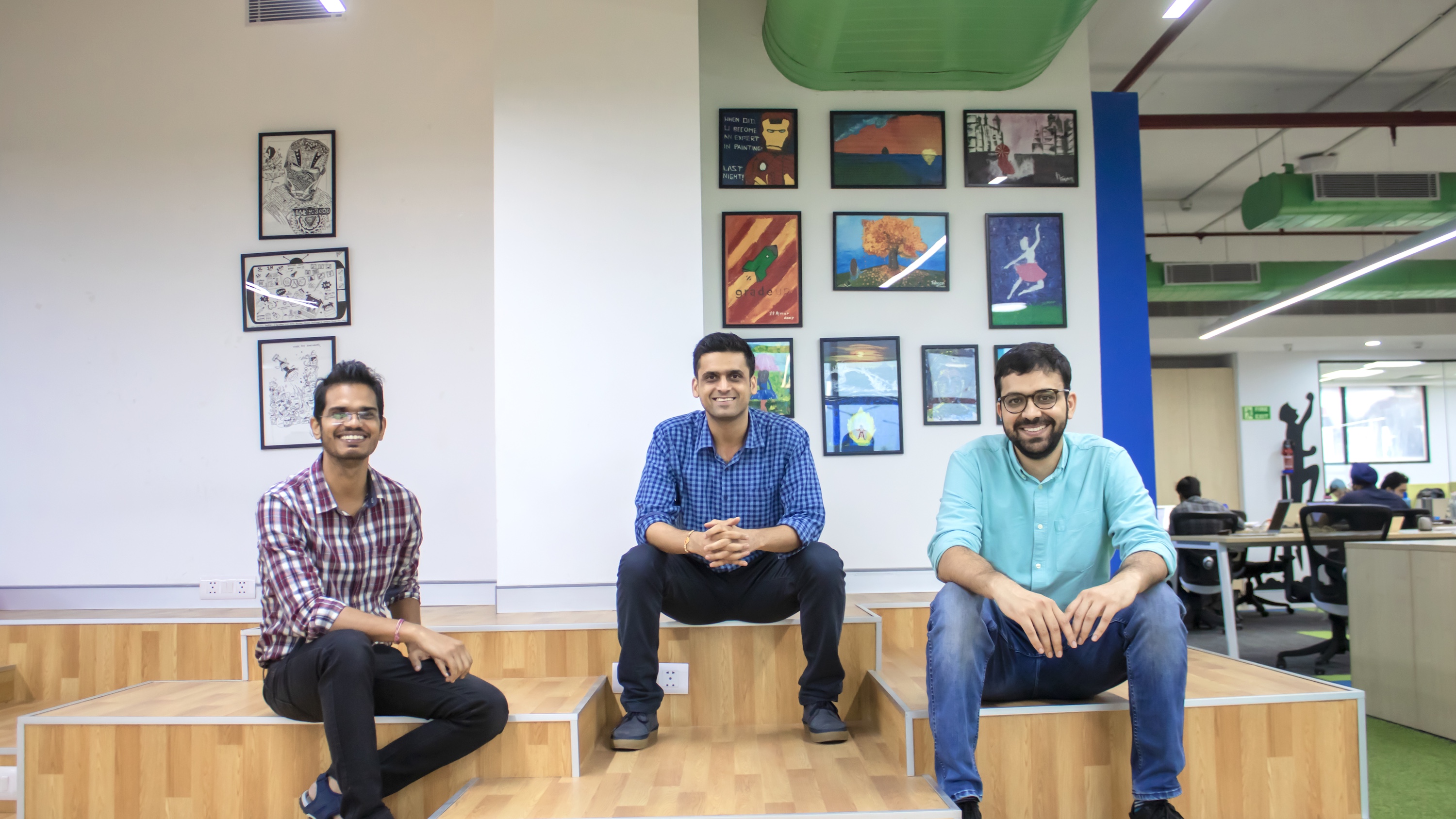
Co-founders of Noida-based ed tech startup Gradeup
But still, only a fraction of students take online courses today. One of the roadblocks in their growth has been access to mobile data, which until recent years was fairly expensive in the country. But arrival of Reliance Jio has solved that issue, said Bhatnagar. The other is acceptance from students and, more importantly, their parents. Watching a course online on a smartphone or desktop is still a new concept for many parents in the country, he said. But this, too, is beginning to change.
“The first wave of online solutions were built around on-demand video content, either free or paid. Today, the next wave is online live courses like Gradeup, with teacher-student interactivity, personalisation and adaptive learning strategies, delivering high-quality solutions that scale, which is particularly valuable in semi-urban and rural markets,” said Times Internet’s Gajwani.
“These match or better the experience quality of offline education, while being more cost-effective. This trend will keep growing in India, where online live education will grow very quickly for test prep, reskilling and professional learning,” he added.
Gradeup has amassed more than 15 million registered students who have enrolled to live lectures. The startup plans to use the fresh capital to expand its academic team to 100 faculty members (from 50 currently) and 200 subject matters and reach more users in smaller cities and towns in India.
“Students even in smaller cities and towns are paying a hefty amount of fee and are unable to get access to high-quality teachers,” Bhatnagar said. “This is exactly the void we can fill.”
Powered by WPeMatico
Millions of neighborhood stores that dot large and small cities, towns and villages in India and have proven tough to beat for e-commerce giants and super-chain retailers are at the center of a new play in the country. A score of e-commerce companies, offline retail chains and fintech startups are now racing to work with these mom and pop stores as they look to tap a massive untapped opportunity.
A Pune-based startup with an idea to build a logistics network using these kirana stores said today it has won the backing of a major international investor. Three-and-a-half-year-old ElasticRun said it has raised $40 million in a Series C financing round led by Prosus Ventures (formerly Naspers Ventures). Existing investors Avataar Ventures and Kalaari Capital also participated in the round.
The startup has raised $55.5 million to date, Sandeep Deshmukh, co-founder and CEO of ElasticRun, told TechCrunch in an interview.
Most of these kirana stores each day go through hours of down time — when the footfall is low and the business is slow. ElasticRun works with hundreds of thousands of these stores across 200 Indian cities to have them deliver goods to other kirana stores and consumers.
Supplying goods to these stores are FMCG (fast moving consumer goods) brands that are trying to reach the last mile in the nation. Nearly every top FMCG brand in the country today is a partner of ElasticRun, said Deshmukh.
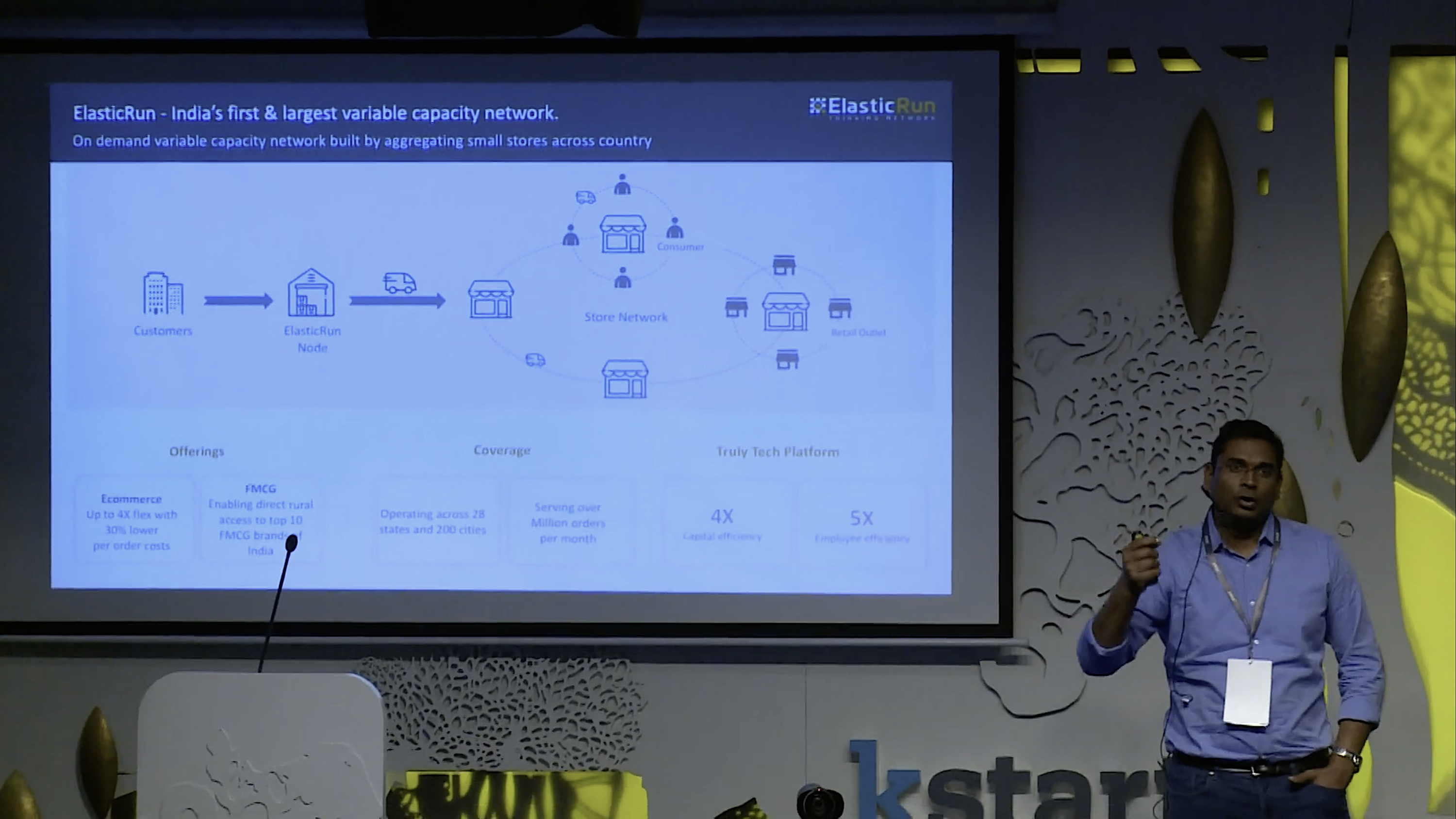
Deshmukh, co-founder and CEO of ElasticRun, talking about the startup’s business at a recent conference
It’s a win-win scenario for every stakeholder, Deshmukh said. Stores are getting access to more goods than ever, and also getting the opportunity to increase their business in slow hours. And for brands and e-commerce companies, access to such a wide-reaching delivery pool has never been easier, he said.
Deshmukh, who previously worked at Amazon and helped the e-commerce company build its transportation network in India, said he and his other co-founders built ElasticRun because traditional logistics networks are beginning to show cracks.
India’s trucking system, for instance, has long been a laggard in India’s economy. A World Bank report five years ago noted that lorries in India spend about 60% of their time sitting idle.
Because there is a digital log of each transaction, Deshmukh said the startup has a good idea about the financial capacity of these kirana stores. This has enabled it to connect them with relevant financial partners to access working capital, he said.
Deshmukh said the startup will use the fresh capital to on-board more neighborhood stores and deepen its penetration in the country. ElasticRun is also working on new products to expand its offerings for brands and kirana stores and improving its analytics and machine learning algorithms to tackle larger scale.
“By working with the network of small stores across the country, we solve that problem while helping the store owners grow their businesses at the same time. In addition, offering a flexible logistics extension to consumer goods companies to directly reach these small retail shops is a huge advantage over traditional distribution networks,” he said.
In a statement, Ashutosh Sharma, head of Investments for India, Prosus Ventures, said, “ElasticRun is one of those rare businesses that identified a massive need in the market, matched it with a local solution paired with technology, for the benefit of all parties involved. Consumers get faster deliveries and greater choice of goods, store owners realize increased revenues and touchpoints with their customers, and consumer goods companies get better access and insight into their target audiences.”
Update: At an event organised by Prosus Ventures this evening, Deshmukh said while ElasticRun is focused on building solutions, in the future he may consider expanding to some Southeast Asian markets that are facing similar challenges.
Powered by WPeMatico
India said on Wednesday it plans to spend nearly $6 billion to revive loss-making state-funded telecom operators Bharat Sanchar Nigam Ltd (BSNL) and Mahanagar Telephone Nigam Ltd (MTNL).
In a press conference, telecom minister Ravi Shankar Prasad said today the Narendra Modi government has given its in-principle approval to the merger of BSNL and MTNL and infuse billions of dollars in capital, though he did not specify a time frame.
BSNL offers telecom services across the nation, while MTNL serves people in New Delhi and Mumbai. Both the firms have been bleeding money for years as competition from private players intensified in recent years after the arrival of India’s richest man Mukesh Ambani’s aggressive firm Reliance Jio. BSNL and MTNL have debt of about $5.65 billion.
The arrival of Reliance Jio, which undercut the market with its 4G-only telecom network, free voice calls and incredibly low-cost data prices, saw incumbents Vodafone and Airtel lower their prices and expand their 4G networks across the country.
MTNL, which is a listed company, will become a subsidiary of BSNL until the merger is completed, Prasad told journalists. “Neither BSNL nor MTNL are being closed, nor are they being disinvested or being hived off to third party,” he said, refuting weeks-long speculation that the government wanted to shut the carriers that serve about 120 million subscribers.
The revival plan includes a capital infusion of $2.8 billion to enable BSNL to purchase 4G spectrum, and write off of $520 million worth of taxes these purchases would incur. The network operators will additionally raise about $2.1 billion of long-term bonds that the New Delhi government will back and monetize $5.3 billion worth of assets over the next four years, the minister said.
“We want to make BSNL and MTNL competitive, and bring in professionalism,” Shankar said. The government is hopeful that BSNL would become operationally profitable in the next two years, he said.
The existence of BSNL, which alone serves more than 116 million subscribers, is in the strategic interest of the nation, Prasad said in a conference last week. “Whenever we have flood or cyclone, BSNL is the first one to offer services for free,” he said.
BSNL, which uses about 75% of its revenue to pay its roughly 176,000 employees, was unable to process their salaries last month. The government said today that it will soon address this and also offer various “attractive voluntary retirement packages” to employees aged 50 or more. In a press release, the government said it would spend about $2.4 billion on the employee retirement packages.
Powered by WPeMatico
MyGate, a Bangalore-based startup that offers security management and convenience service for guard-gated premises, said today it has bagged more than $50 million in a new financing round as it looks to expand its footprint in the nation.
Chinese internet giant Tencent, Tiger Global, JS Capital and existing investor Prime Venture Partners funded the three-year-old startup’s $56 million Series B financing round. The new round pushes MyGate’s total fundraise to $67.5 million.
MyGate offers an eponymous mobile app that allows home residents to approve entries and exits, communicate with their neighbors, log attendance and pay society maintenance bills and daily help workers.
The startup says it is operational in 11 cities in India and has amassed over 1.2 million home customers. Its customer base is increasing by 20% each month, it claimed. The service is handling 60,000 requests each minute and clocking over 45 million check-in requests each month.
The idea of MyGate came after its co-founder and CEO, Vijay Arisetty, left the Indian armed force. In an interview with TechCrunch, he said his family was appalled to learn about the poor state of security across societies in India.
“This was also when e-commerce companies and food delivery firms were beginning to gain strong foothold in the nation. This meant that many people were entering a gated community each day,” he said.
MyGate has inked partnerships with many e-commerce players to create a system to offer a silent and secure delivery experience for its users. The startup also trains guards to understand the system.
According to industry estimates, more than 4.5 million people in India today live in gated communities, and that figure is growing by 13% each year. The private security industry in the country is a $15 billion market.
Arisetty says he believes the startup could significantly accelerate its growth as its solution understands the price-sensitive market. Using MyGate costs an apartment about Rs 20 (28 cents) per month. Even at that price, the startup says it is making a profit. “Today, we are seeing more demand than we can handle,” he said.
That’s where the new funding would come into play for the startup, which today employs about 700 people.
The startup plans to use the fresh capital to expand its technology infrastructure, its marketing and operations teams and build new features. The startup aims to reach 15 million homes in 40 Indian cities in the next 18 months.
In a statement, Sanjay Swamy, managing partner at Prime Venture Partners, said, “It’s been great to see a fledgling startup execute consistently and holistically, and grow into a category-creating market-leader.”
Powered by WPeMatico

South Korean startup True Balance, which operates an eponymous financial services app aimed at tens of millions of users in small cities and towns in India, has closed a new financing round as it looks to court more first-time users in the world’s second largest internet market.
True Balance said on Tuesday that it has raised $23 million in its Series C financing round from seven Korean investors — NH Investment & Securities, IBK Capital, D3 Jubilee Partners, SB Partners, Shinhan Capital and existing partners IMM Investment and HB Investment.
TechCrunch reported earlier this year that True Balance — which has raised $65 million to date, including the $38 million that it closed in its previous financing round — was looking to raise as much as $70 million in its Series C round.
True Balance began its life as a tool to help users easily find their mobile balance, or top up pre-pay mobile credit. But in its four-year journey, its ambition has significantly grown beyond that. Today, it serves as a digital wallet app that helps users pay their mobile and electricity bills, and offer credit to customers so that they can pay later for their digital purchases.
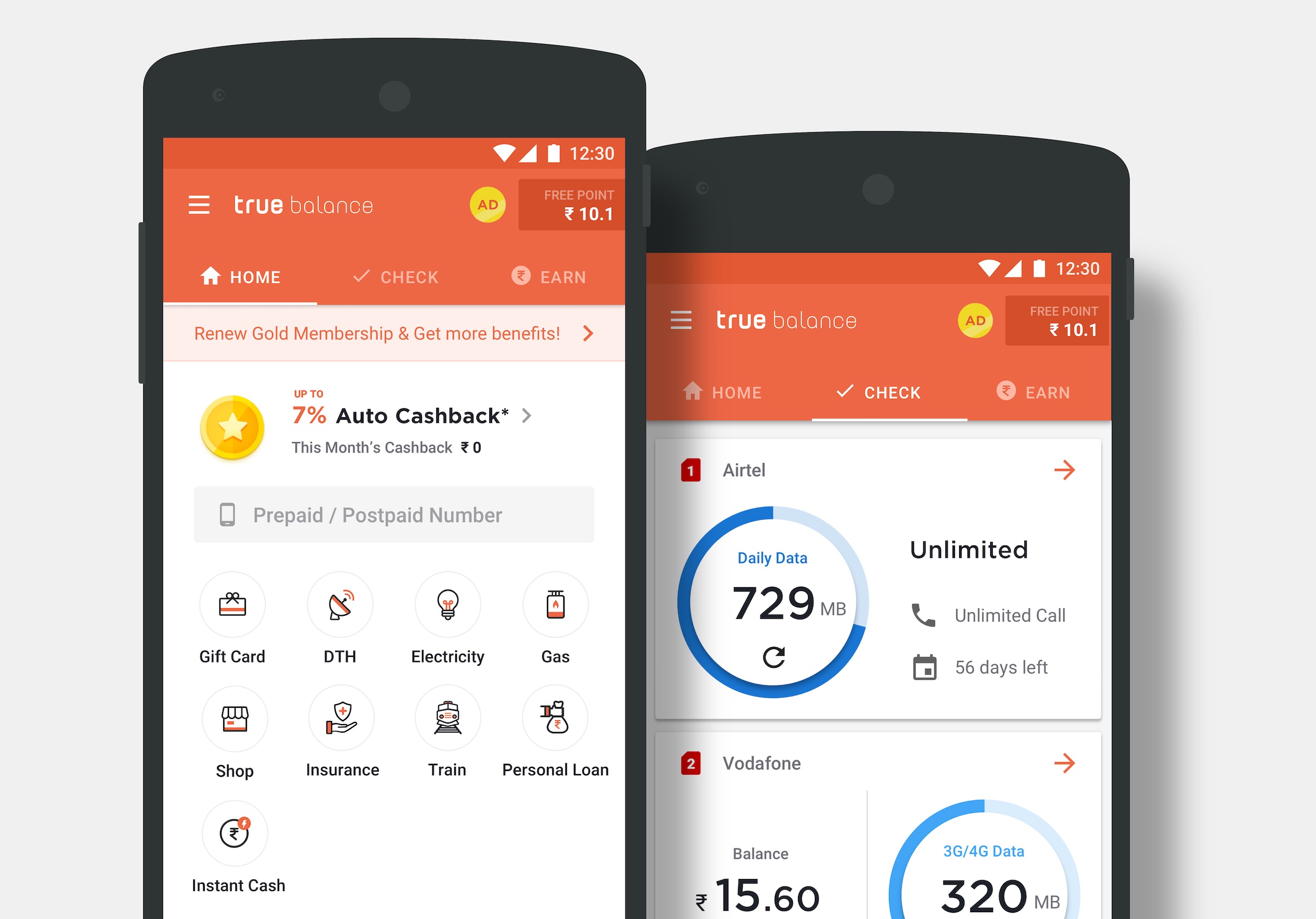
The startup says it has amassed more than 60 million registered users in India, most of whom live in small cities and towns — or dubbed India 2 and India 3. Most of these users are coming online for the first time and True Balance says it has an army of local agents — who get certain incentives — to help first-time internet users understand the benefit of online transactions and start using the app.
True Balance says it clocks more than 300,000 digital transactions on its app each day. The startup, which recently introduced e-commerce shopping services on its app to sell products like smartphones, has clocked $100 million in GMV sales in the country to date.
Charlie Lee, founder of True Balance, said the startup will use the fresh capital to bulk up the offerings on the app. Some of the features that True Balance intends to add before the end of this fiscal year include the ability to purchase bus and train tickets, digital gold and book cooking gas cylinders.
True Balance will also expand its lending and e-commerce services, Lee said. Its lending feature was used 1 million times in three months when it was introduced earlier this year. “We aim to strengthen our data and alternative credit scoring strategy to provide better financial services to our target — the next billion Indian users. Our goal is to reach 100 million digital touch points and become one of the top fintech companies in India by 2022,” he added in a statement.
Even as more than 600 million users in India are online today, just about as many remain offline. In recent years, many major companies in India have started to customize their services to appeal to users in India 2 and India 3 — who also have limited financial power.
Powered by WPeMatico

Club Factory, a Chinese e-commerce platform that sells fashion and beauty items and electronics accessories, has raised $100 million in a new financing round as it looks to expand its footprint in India.
The new financing round — Series D — was led by Qiming Venture Partners, Bertelsmann, IDG Capital “and other Fortune 500 companies from the U.S. and Asia,” the five-year-old Hangzhou-headquartered startup said. Club Factory, which raised $100 million in its previous financing round early last year, has raised about $220 million to date.
Club Factory has amassed more than 70 million users on its platform, of which about 40 million live in India. The startup cited figures from app analytics firm App Annie to claim that Club Factory is now the third-largest e-commerce platform in India, surpassing once a market-leader Snapdeal.
Club Factory does not charge local sellers any commission fee, incentivizing them to cut down the cost of their items and expand offerings. The number of sellers on its platform in India has grown by 10X in the last six months, the startup claimed. Club Factory, which has about 5,000 sellers in India, plans to double that figure by year-end, it said.

A screenshot of Club Factory’s homepage
“At the same time, we have also pioneered to strengthen the ‘store-within-platform’ concept in India’s e-commerce industry, allowing direct contact between buyers and sellers through our application,” said Vincent Lou, co-founder and chief executive of Club Factory, in a statement.
He added, “We have changed the status of the Indian e-commerce industry that monopolized information of buyers and sellers, allowing SMEs to own their customers and run their business better. All this, combined with our strategy to reduce the transaction costs of buyers and sellers and allow more local players to enter the ecosystem, has worked very well for us in India.”
The startup said in the coming months it will also bulk up more items on its platform and introduce new product categories.
Powered by WPeMatico
Fyle, a Bangalore-headquartered startup that operates an expense management platform, has extended its previous financing round to add $4.5 million of new investment as it looks to court more clients in overseas markets.
The additional $4.5 million tranche of investment was led by U.S.-based hedge fund Steadview Capital, the startup said. Tiger Global, Freshworks and Pravega Ventures also participated in the round. The new tranche of investment, dubbed Series A1, means that the three-and-a-half-year-old startup has raised $8.7 million as part of its Series A financing round, and $10.5 million to date.
The SaaS startup offers an expense management platform that makes it easier for employees of a firm to report their business expenses. The eponymous service supports a range of popular email providers, including G Suite and Office 365, and uses a proprietary technology to scan and fetch details from emails, Yash Madhusudhan, co-founder and CEO of Fyle, demonstrated to TechCrunch last week.
A user, for instance, could open a flight ticket email and click on Fyle’s Chrome extension to fetch all details and report the expense in a single click in real-time. As part of today’s announcement, Madhusudhan unveiled an integration with WhatsApp . Users will now be able to take pictures of their tickets and other things and forward it to Fyle, which will quickly scan and report expense filings for them.
These integrations come in handy to users. “Eighty percent to ninety percent of a user’s spending patterns land on their email and messaging clients. And traditionally it has been a pain point for them to get done with their expense filings. So we built a platform that looks at the challenges faced by them. At the same time, our platform understands frauds and works with a company’s compliances and policies to ensure that the filings are legitimate,” he said.
“Every company today could make use of an intelligent expense platform like Fyle. Major giants already subscribe to ERP services that offer similar capabilities as part of their offerings. But as a company or startup grows beyond 50 to 100 people, it becomes tedious to manage expense filings,” he added.
Fyle maintains a web application and a mobile app, and users are free to use them. But the rationale behind introducing integrations with popular services is to make it easier than ever for them to report filings. The startup retains its algorithms each month to improve their scanning abilities. “The idea is to extend expense filing to a service that people already use,” he said.
Until late last year, Fyle was serving customers in India. Earlier this year, it began searching for clients outside the nation. “Our philosophy was if we are able to sell in India remotely and get people to use the product without any training, we should be able to replicate this in any part of the world,” he said.
And that bet has worked. Fyle has amassed more than 300 clients, more than 250 of which are from outside of India. Today, the startup says it has customers in 17 nations, including the U.S. and the U.K. Furthermore, Fyle’s revenue has grown by five times in the last five months, said Madhusudhan, without disclosing the exact figures.
To accelerate its momentum, the startup is today also launching an enterprise version of Fyle that will serve the needs of major companies. The enterprise version supports a range of additional security features, such as IP restriction and a single sign-in option.
Fyle will use the new capital to develop more product solutions and integrations and expand its footprint in international markets, Madhusudhan said. The startup, which just recently set up its sales and marketing team, will also expand the headcount, he said.
Moving forward, Madhusudhan said the startup would also explore tie-ups with ERP providers and other ways to extend the reach of Fyle.
In a statement, Ravi Mehta, MD at Steadview Capital, said, “intelligent and automated systems will empower businesses to be more efficient in the coming decade. We are excited to partner with Fyle to transform one of the core business processes of expense management through intelligence and automation.”
Powered by WPeMatico

Chinese mobile phone and device maker Transsion has listed in an IPO on Shanghai’s STAR Market, a Transsion spokesperson confirmed to TechCrunch.
Headquartered in Shenzhen, Transsion is a top seller of smartphones in Africa under its Tecno brand. The company has also started to support venture funding of African startups.
Transsion issued 80 million A shares at an opening price of 35.15 yuan (≈ $5.00) to raise 2.8 billion yuan (or ≈ $394 million).
A shares are the common shares issued by mainland Chinese companies and are normally available for purchases only by mainland citizens.
Transsion’s IPO prospectus is downloadable (in Chinese) and its STAR Market listing application is available on the Shanghai Stock Exchange’s website.
STAR is the Shanghai Stock Exchange’s new Nasdaq-style board for tech stocks that went live in July with some 25 companies going public.
Transsion plans to spend 1.6 billion yuan (or $227 million) of its STAR Market raise on building more phone assembly hubs, and around 430 million yuan ($62 million) on research and development, including a mobile phone R&D center in Shanghai, a company spokesperson said.
To support its African sales network, Transsion maintains a manufacturing facility in Ethiopia. The company recently announced plans to build an industrial park and R&D facility in India for manufacture of phones to Africa.
The IPO comes after Transsion announced its intent to go public and filed its first docs with the Shanghai Stock Exchange in April.
Listing on STAR Market puts Transsion on China’s new exchange — seen as an extension of Beijing’s ambition to become a hub for tech startups to raise public capital. Chinese regulators lowered profitability requirements for the STAR Market, which means pre-profit ventures can list.

Transsion’s IPO comes when the company is actually in the black. The firm generated 22.6 billion yuan ($3.29 billion) in revenue in 2018, up from 20 billion yuan a year earlier. Net profit for the year slid to 654 million yuan, down from 677 million yuan in 2017, according to the firm’s prospectus.
Transsion sold 124 million phones globally in 2018, per company data. In Africa, Transsion holds 54% of the feature phone market — through its brands Tecno, Infinix and Itel — and in smartphone sales is second to Samsung and before Huawei, according to International Data Corporation stats.
Transsion has R&D centers in Nigeria and Kenya and its sales network in Africa includes retail shops in Nigeria, Kenya, Tanzania, Ethiopia and Egypt. The company also attracted attention for being one of the first known device makers to optimize its camera phones for African complexions.
On a 2019 research trip to Addis Ababa, TechCrunch learned the top entry-level Tecno smartphone was the W3, which lists for 3,600 Ethiopian Birr, or roughly $125.
In Africa, Transsion’s ability to build market share and find a sweet spot with consumers on price and features gives it prominence in the continent’s booming tech scene.
Africa already has strong mobile-phone penetration, but continues to undergo a conversion from basic USSD phones, to feature phones, to smartphones.
Smartphone adoption on the continent is low, at 34%, but expected to grow to 67% by 2025, according to GSMA.
This, added to an improving internet profile, is key to Africa’s tech scene. In top markets for VC and startup origination — such as Nigeria, Kenya and South Africa — thousands of ventures are building business models around mobile-based products and digital applications.

If Transsion’s IPO enables higher smartphone conversion on the continent, that could enable more startups and startup opportunities — from fintech to VOD apps.
Another interesting facet to Transsion’s IPO is its potential to create greater influence from China in African tech, in particular as the Shenzhen company moves more definitely toward venture investing.
In August, Transsion-funded Future Hub teamed up with Kenya’s Wapi Capital to source and fund early-stage African fintech startups.
China’s engagement with African startups has been light compared to China’s deal-making on infrastructure and commodities — further boosted in recent years as Beijing pushes its Belt and Road plan.
Transsion’s IPO is the second event this year — after Chinese owned Opera’s venture spending in Nigeria — to reflect greater Chinese influence and investment in the continent’s digital scene.
So in coming years, China could be less known for building roads and bridges in Africa and more for selling smartphones and providing VC for African startups.
Powered by WPeMatico
ALTBalaji, a leading video streaming service in India, has partnered with Microsoft and fintech firm Eko as it moves to expand its subscriber base in the country that is already larger than any of its local rivals.
ALTBalaji, which has more than 27 million paying subscribers, said it will use Microsoft’s BlendNet technology to help its users download and access more titles without consuming large amounts of cellular data.
Microsoft is providing ALTBalaji with BlendNet technology that enables videos to be disseminated through a combination of cloud-enabled metadata systems. “The file is transferred onto the recipient’s mobile using peer-to-peer local Wi-Fi. While the creation of this cloud plane might need a data network, the transfer of data will happen over local Wi-Fi,” Microsoft said.
The idea is to move much of the downloading without relying on cellular data connectivity, which remains costly for the masses in India. ALTBalaji subscribers will be able to download files from their nearby Eko retail stores, as well as from other users who have the same files. When neither options are viable, the downloading is paused.
Nachiket Pantvaidya, CEO of ALTBalaji and Group COO of Balaji Telefilms, said he hopes the new feature would help the video streaming service attract new users who don’t have access to cheap and reliable data. He said the firm also expects the feature to boost engagement for other subscribers on the platform who’re watching two to three episodes on the app each day.
“At ALTBalaji it has always been our endeavor to reach out to the masses and enhance our users’ experience through such services, while being affordable. And through this pilot feature, we aim to attract more viewers to our platform from areas with not so good internet connectivity,” said Pantvaidya.
In a statement, Meetul Patel, COO of Microsoft India, said, “Microsoft’s BlendNet is a great example of advanced technologies being used to make information and content accessible to all. It leverages the power of the cloud and intelligent edge networks to address gaps in connectivity and reduces the costs of content distribution.”
ALTBalaji, a wholly owned subsidiary of Balaji Telefilms, has more paying subscribers in India than any other video streaming service in the nation, Pantvaidya told TechCrunch in a recent interview. The service is available for Rs 100 ($1.40) for three months, or comes bundled with offerings from telecom providers.
Unlike most other streaming services, ALTBalaji only serves originally produced locally relevant content on its platform. It has made 45 original TV shows to date. Each year, the firm invests about 1,500 million Indian rupees ($21 million) in production of original shows, Pantvaidya said.
The firm, which employs about 100 people, today fights with more than three dozen companies, including Netflix, Amazon Prime Video and Disney-owned Hotstar. Even as Hotstar claimed to have more than 300 million users earlier this year, it has fewer than 10 million paying subscribers, people familiar with the matter have told TechCrunch.
Netflix has fewer than 3 million subscribers in India, according to industry estimates. It recently launched an aggressively priced mobile-only plan in the country. A person familiar with the matter told TechCrunch that the new price tier has attracted a significant number of new subscribers to Netflix.
Powered by WPeMatico