Enterprise
Auto Added by WPeMatico
Auto Added by WPeMatico
Isovalent, a startup that aims to bring networking into the cloud-native era, today announced that it has raised a $29 million Series A round led by Andreessen Horowitz and Google. In addition, the company today officially launched its Cilium Enterprise platform (which was in stealth until now) to help enterprises connect, observe and secure their applications.
The open-source Cilium project is already seeing growing adoption, with Google choosing it for its new GKE data plane, for example. Other users include Adobe, Capital One, Datadog and GitLab. Isovalent is following what is now the standard model for commercializing open-source projects by launching an enterprise version.
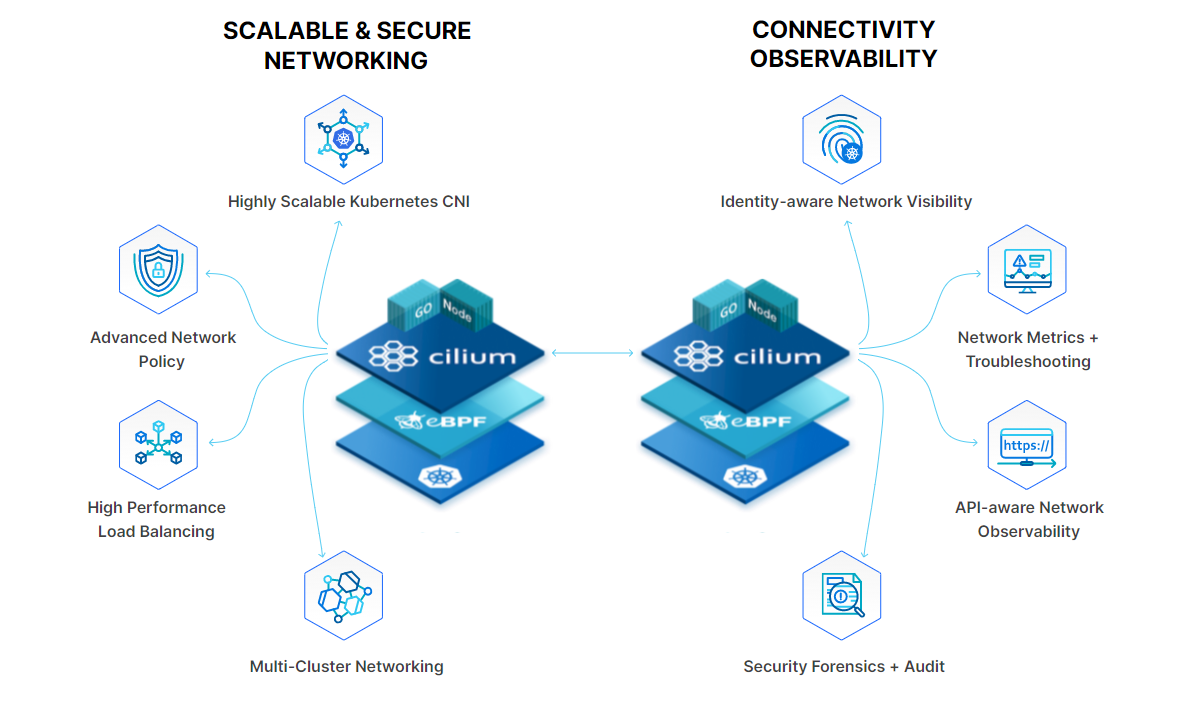
Image Credits: Cilium
The founding team of CEO Dan Wendlandt and CTO Thomas Graf has deep experience in working on the Linux kernel and building networking products. Graf spent 15 years working on the Linux kernel and created the Cilium open-source project, while Wendlandt worked on Open vSwitch at Nicira (and then VMware).

Image Credits: Isovalent
“We saw that first wave of network intelligence be moved into software, but I think we both shared the view that the first wave was about replicating the traditional network devices in software,” Wendlandt told me. “You had IPs, you still had ports, you created virtual routers, and this and that. We both had that shared vision that the next step was to go beyond what the hardware did in software — and now, in software, you can do so much more. Thomas, with his deep insight in the Linux kernel, really saw this eBPF technology as something that was just obviously going to be groundbreaking technology, in terms of where we could take Linux networking and security.”
As Graf told me, when Docker, Kubernetes and containers, in general, become popular, what he saw was that networking companies at first were simply trying to reapply what they had already done for virtualization. “Let’s just treat containers as many as miniature VMs. That was incredibly wrong,” he said. “So we looked around, and we saw eBPF and said: this is just out there and it is perfect, how can we shape it forward?”
And while Isovalent’s focus is on cloud-native networking, the added benefit of how it uses the eBPF Linux kernel technology is that it also gains deep insights into how data flows between services and hence allows it to add advanced security features as well.
As the team noted, though, users definitely don’t need to understand or program eBPF, which is essentially the next generation of Linux kernel modules, themselves.
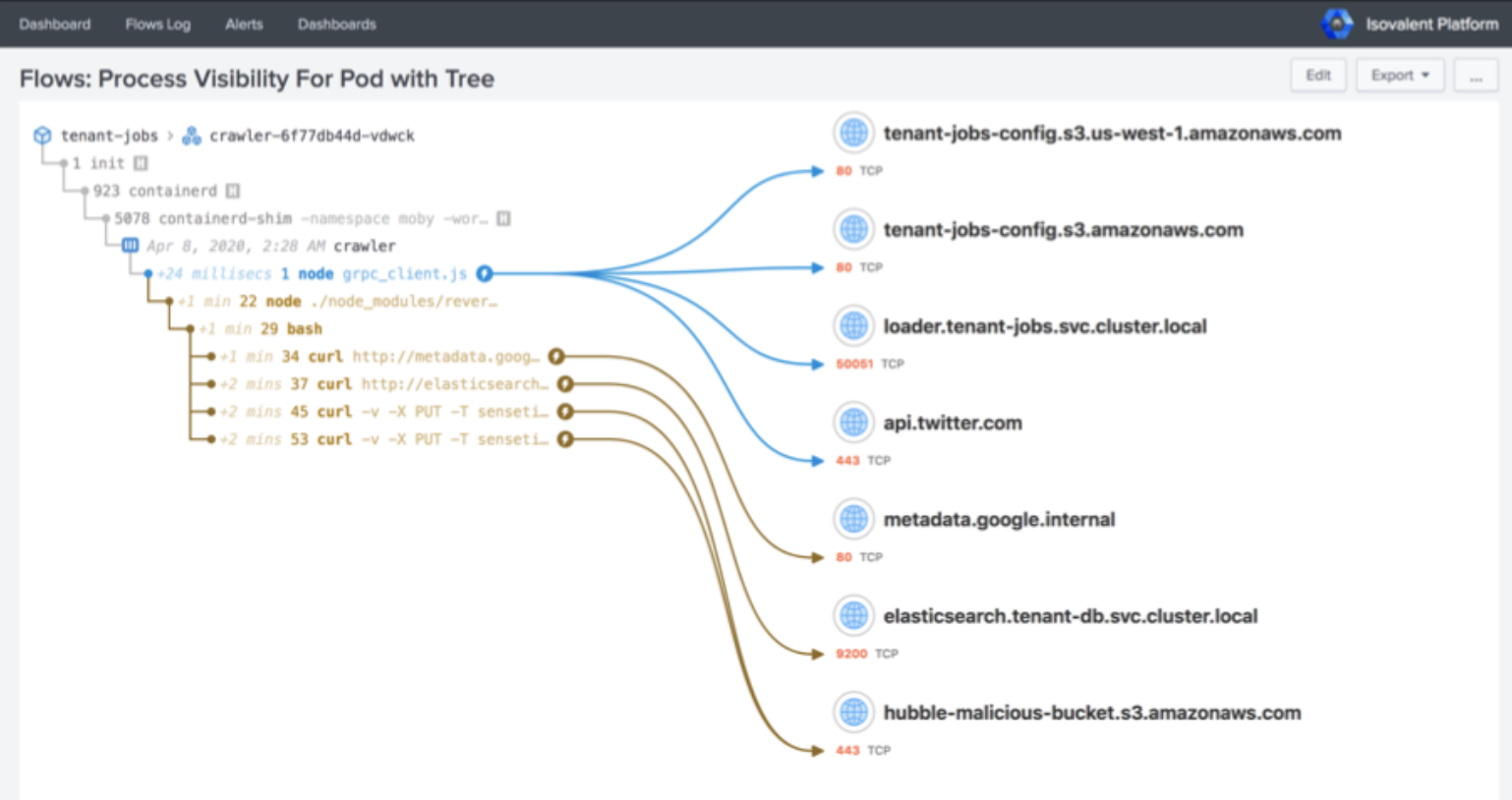
Image Credits: Isovalent
“I have spent my entire career in this space, and the North Star has always been to go beyond IPs + ports and build networking visibility and security at a layer that is aligned with how developers, operations and security think about their applications and data,” said Martin Casado, partner at Andreesen Horowitz (and the founder of Nicira). “Until just recently, the technology did not exist. All of that changed with Kubernetes and eBPF. Dan and Thomas have put together the best team in the industry and given the traction around Cilium, they are well on their way to upending the world of networking yet again.”
As more companies adopt Kubernetes, they are now reaching a stage where they have the basics down but are now facing the next set of problems that come with this transition. Those, almost by default, include figuring out how to isolate workloads and get visibility into their networks — all areas where Isovalent/Cilium can help.
The team tells me its focus, now that the product is out of stealth, is about building out its go-to-market efforts and, of course, continuing to build out its platform.
Powered by WPeMatico
Explo, a member of the Y Combinator Winter 2020 class, which is helping customers build customer-facing business intelligence dashboards, announced a $2.3 million seed round today. Investors included Amplo VC, Soma Capital and Y Combinator, along with several individual investors.
The company originally was looking at a way to simplify getting data ready for models or other applications, but as the founders spoke to customers, they saw a big need for a simple way to build dashboards backed by that data and quickly pivoted.
Explo CEO and co-founder Gary Lin says the company was able to leverage the core infrastructure, data engineering and production that it had built while at Y Combinator, but the new service they created is much different from the original idea.
“In terms of the UI and the output, we had to build out the ability for our end users to create dashboards, for them to embed the dashboards and for them to customize the styles on these dashboards, so that it looks and feels as though it was part of their own product,” Lin explained.
While the founders had been working on the original idea since last year, they didn’t actually make the pivot until September. They made the change because they were hearing this was really what customers needed more than the tool they had been building while at Y Combinator. In fact, Chen says that their YC mentors and investors have been highly supportive of the switch.
The company is just getting started with the four original co-founders — Lin, COO Andrew Chen, CTO Rohan Varma and product designer Carly Stanisic — but the plan is to use this money to beef up the engineering team with three to five new hires.
With a diverse founding team, the company wants to continue looking at diversity as it builds the company. “One of the biggest reasons that we think diversity is important is that it allows us to have a bigger perspective and a grander perspective on things. And honestly, it’s in environments where I have personally […] been involved where we’ve actually been able to create the best ideas was by having a larger perspective. And so we definitely are going to be as inclusive as possible and are definitely thinking about that as we hire,” Lin said.
As the company has grown up during the pandemic, the founding core is used to working remotely and the goal moving forward is to be a distributed company. “We will be a remote distributed company so we’re hiring people no matter where they are, which actually makes it a lot easier from a hiring perspective because we’re able to reach a much more diverse and large pool of applicants,” Lin said.
They are in the process of thinking about how they can build a culture as they bring in distributed employees. “I think the way that we’ve started to see it is that working distributed is not a reduced experience, but just a different one and we are thinking about different things like how we organize new people when they on-board, and maybe we can meet up as a team and have a retreat where we are located in the same place [when travel allows],” he said.
For now, they will remain remote as they take their first half-dozen customers and begin to build the company with the new investment.
Powered by WPeMatico
JumpCloud, the cloud directory service that debuted at TechCrunch Disrupt Battlefield in 2013, announced a $75 million Series E today. The round was led by BlackRock with participation from existing investor General Atlantic.
The company wasn’t willing to discuss the current valuation, but has now raised more than $166 million, according to Crunchbase data.
Changes in the way that IT works have been evolving since the company launched. Back then, most companies used Microsoft Active Directory in a Windows-centric environment. Since then, things have gotten more heterogeneous with multiple operating systems, web applications, the cloud and mobile, and that has required a different way of thinking about directory structures.
JumpCloud co-founder and CEO Rajat Bhargava says that the pandemic has only accelerated the need for his company’s kind of service as more companies move to the cloud. “Obviously now with COVID, all these changes made it much more difficult for IT to connect their users to all the resources that they needed, and to us that’s one of the most critical tasks that an IT organization has is making their team productive,” he said.
He said their idea was to build an “independent cloud directory platform that would connect people to really whatever it is they need and do that in a secure way while giving IT complete control over that access.”
The product, which includes a free tier for 10 users on 10 systems for an unlimited amount of time, has 100,000 users. Of those, Bhargava says that about 3,000 are paying.
The company has 300 employees, with plans to add 200-250 in the next year with a goal of adding 500 in the next couple of years. As he does that, Bhargava, who is South Asian, sees diversity and inclusion as an important component of the hiring process. In fact, the company tries to make sure it always has diverse candidates in the hiring pool.
“Some of the things that we’ve tried to do is make sure that every role has some diversity candidates involved in the hiring process. That’s something that our recruiting team is working on and making sure that we’re having that conversation with every single hire,” he said. He acknowledges that it’s a work in progress, and a problem across the entire tech industry that he and his company continue to try to address.
Since the pandemic, the company, which is based in Colorado, has made the decision to be remote first, and they will be hiring from across the country and across the world as they make these new hires, which could help contribute to a more diverse workforce over time.
With a $75 million investment, and having reached Series E, it’s fair to ask if the company is thinking ahead to an IPO, but Bhargava didn’t want to discuss that. “We just raised this $75 million round. There’s so much work to be done, so we’re just looking forward to that right now,” he said.
Powered by WPeMatico
Qualcomm Ventures, Qualcomm’s investment arm, today announced four new strategic investments in 5G-related startups. These companies are private mobile network specialist Celona, mobile network automation platform Cellwize, the edge computing platform Azion and Pensando, another edge computing platform that combines its software stack with custom hardware.
The overall goal here is obviously to help jumpstart 5G use cases in the enterprise and — by extension — for consumers by investing in a wide range of companies that can build the necessary infrastructure to enable these.
“We invest globally in the wireless mobile ecosystem, with a goal of expanding our base of customers and partners — and one of the areas we’re particularly excited about is the area of 5G,” Quinn Li, a senior VP at Qualcomm and the global head of Qualcomm Ventures, told me. “Within 5G, there are three buckets of areas we look to invest in: one is in use cases, second is in network transformation, third is applying 5G technology in enterprises.”
So far, Qualcomm Ventures has invested more than $170 million in the 5G ecosystem, including this new batch. The firm did not disclose how much it invested in these four new startups, though.
Overall, this new set of companies touches upon the core areas Qualcomm Ventures is looking at, Li explained. Celona, for example, aims to make it as easy for enterprises to deploy private cellular infrastructure as it is to deploy Wi-Fi today.
“They built this platform with a cloud-based controller that leverages the available spectrum — CBRS — to be able to take the cellular technology, whether it’s LTE or 5G, into enterprises,” Li explained. “And then these enterprise use cases could be in manufacturing settings, could be in schools, could be in hospitals, or it could be on campus for universities.”
Cellwize, meanwhile, helps automate wireless networks to make them more flexible and manageable, in part by using machine learning to tune the network based on the data it collects. One of the main investment theses for this fund, Li told me, is that wireless technology will become increasingly software-defined, and Cellwize fits right into this trend. The potential customer here isn’t necessarily an individual enterprise, though, but wireless and mobile operators.
Edge computing, where Azion and Pensando play, is obviously also a hot category right now, and one where 5G has some obvious advantages, so it’s maybe no surprise that Qualcomm Ventures is putting a bit of a focus on these today with its investments in Azion and Pensando.
“As we move forward, [you will] see a lot of the compute moving from the cloud into the edge of the network, which allows for processing happening at the edge of the network, which allows for low latency applications to run much faster and much more efficiently,” Li said.
In total, Qualcomm Ventures has deployed $1.5 billion and made 360 investments since its launch in 2000. Some of the more successful companies the firm has invested in include unicorns like Zoom, Cloudflare, Xiaomi, Cruise Automation and Fitbit.
Powered by WPeMatico
Adobe just announced that it is acquiring marketing workflow management startup Workfront for $1.5 billion. Bloomberg first reported the sale earlier today.
Workfront was founded back in 2001, making it a bit long in the tooth for a private company that has raised $375 million, according to Crunchbase. (It’s worth noting that $280 million of that was secondary money raised last year.)
The acquisition gives Adobe more online marketing tooling to fit into its Experience Cloud. This one helps companies manage complex projects inside the marketing department (or elsewhere in the company, for that matter).
Suresh Vittal, VP of platform and product for Adobe Experience Cloud, said that the two companies often work together and encounter one another’s sales teams. As the pandemic has played out, it began to make more sense to bring in-house this kind of tooling that works well in a distributed environment, and over the last several months the deal came together.
“The new normal distributed marketing team, distributed experience delivery teams, people having to work remotely — we started to see new use cases emerge around the idea of work management, around the idea of content velocity, around the idea of providing compliance and governance capabilities so no asset escapes the organization, and it goes through this process of passing through creative and the marketing teams and getting out there and really representing your brand in the right way,” Vittal explained.
Workfront CEO Alex Shootman sees the deal as a way to accelerate the roadmap while working with a much larger company. “We are barely scratching the surface of marketing and we could grow tremendously, just by having that great kind of integrated relationship,” he said.
Holger Mueller, an analyst at Constellation Research, says the acquisition will help Adobe customers manage the complexities of marketing project management. “Scheduling and managing work had gotten orders of magnitude more complex for enterprises, and Adobe is accounting for that with the acquisition of Workfront, providing better tool support for the new future of work,” Mueller told TechCrunch.
Workfront’s 960 employees will become part of Adobe and become part of the Adobe Experience Cloud. Shootman will continue to run it and report to Anil Chakravarthy, executive vice president and general manager of the digital experience business at Adobe.
Workfront’s customers include Home Depot, T-Mobile and Deloitte, and the two companies share 1,000 common customers among Workfront’s 3,000 total customer base. In fact, it has APIs that connect to Adobe Creative Cloud and Experience Cloud, two parts of the company’s product family that marketers frequently access.
As Adobe battles Salesforce, SAP and Oracle in the marketing automation space, it’s been using its checkbook to acquire additional fire power in recent years. This acquisition comes after Adobe spent $1.6 billion for Magento and $4.75 billion for Marketo in 2018. That’s almost $8 billion for three companies in less than two years, even as it builds out parts of its Adobe Experience Cloud in-house. Combined, it shows just how serious the company is about making headway in this valuable area.
Customer experience has always been an essential element of online and in-person transactions, making sure the customer feels good about the interactions it has with a brand. It not only keeps them coming back, but it encourages them to act as ambassadors on behalf of a company, something that has incredible value.
Conversely, a bad experience can lead to the opposite impact, causing a prospective or even loyal customer to abandon a brand and speak badly about it to friends online and in person. Adobe hopes that by bringing another marketing tool into the fold, it can help its customers increase the likelihood of a positive online customer experience. This one should allow marketing personnel working at a company to move marketing projects through a workflow from idea to delivery.
The deal is expected to close in the first quarter of Adobe’s fiscal year. Per usual, it will be subject to typical regulatory scrutiny.
Powered by WPeMatico
Qumulo, the Seattle-based data storage startup, announced a bunch of updates today, including support for NvME caching, an approach that should enable customers to access faster flash storage at a lower price point.
NvME flash storage development is evolving quickly, driving down the price with higher performance, a win-win situation for large data producers, but it’s still more expensive than traditional drives. Qumulo CEO Bill Richter pointed out that the software still has to take advantage of these changing flash storage dynamics.
To that end, the company claims with its new NvME caching capability, it is giving customers the ability to access faster flash storage for the same price as spinning disks by optimizing the software to more intelligently manage data on its platform and take advantage of the higher performance storage.
The company is also announcing the ability to dynamically scale using the latest technologies such as chips, memory and storage in an automated way. Further, it’s providing automated data encryption at no additional charge, and new instant updates, which it says can be implemented without any downtime. Finally, it has introduced a new interface to make it easier for customers to move their data from on premises data storage to Amazon S3.
Richter says that the company’s mission has always been about creating, managing and consuming massive amounts of file-based data. As the pandemic has taken hold, more companies are moving their data and applications to the cloud.
“The major secular trends that underpin Qumulo’s mission — the massive amount of file-based content, and the use of cloud computing to solve the content challenge, have both accelerated during the pandemic and we have received really clear signs of that,” he said.
Qumulo was founded in 2012 and has raised $351 million. Its most recent raise was a hefty $125 million last July on a valuation over $1.2 billion.
Powered by WPeMatico
As 5G slowly moves from being a theoretical to an active part of the coverage map for the mobile industry — if not for consumers themselves — companies that are helping carriers make the migration less painful and less costly are seeing a boost of attention.
In the latest development, Cellwize, a startup that’s built a platform to automate and optimize data for carriers to run 5G networks within multi-vendor environments, has raised $32 million — funding that it will use to continue expanding its business into more geographies and investing in R&D to bring more capabilities to its flagship CHIME platform.
The funding is notable because of the list of strategic companies doing the investing, as well as because of the amount of traction that Cellwize has had to date.
The Series B round is being co-led Intel Capital and Qualcomm Ventures LLC, and Verizon Ventures (which is part of Verizon, which also owns TechCrunch by way of Verizon Media) and Samsung Next, with existing shareholders also participating. That list includes Deutsche Telekom and Sonae, a Portuguese conglomerate that owns multiple brands in retail, financial services, telecoms and more.
That backing underscores Cellwize’s growth. The company — which is based in Israel with operations also in Dallas and Singapore — says it currently provides services to some 40 carriers (including Verizon, Telefonica and more), covering 16 countries, 3 million cell sites, and 800 million subscribers.
Cellwize is not disclosing its valuation but it has raised $56.5 million from investors to date.
5G holds a lot of promise for carriers, their vendors, handset makers and others in the mobile ecosystem: the belief is that faster and more efficient speeds for wireless data will unlock a new wave of services and usage and revenues from services for consumers and business, covering not just people but IoT networks, too.
Notwithstanding the concerns some have had with health risks, despite much of that theory being debunked over the years, one of the technical issues with 5G has been implementing it.
Migrating can be costly and laborious, not least because carriers need to deploy more equipment at closer distances, and because they will likely be running hybrid systems in the Radio Access Network (RAN, which controls how devices interface with carriers’ networks); and they will be managing legacy networks (eg, 2G, 3G, 4G, LTE) alongside 5G, and working with multiple vendors within 5G itself.
Cellwize positions its CHIME platform — which works as an all-in-one tool that leverages AI and other tech in the cloud, and covers configuring new 5G networks, optimizing and monitoring data on them, and also providing APIs for third-party developers to integrate with it — as the bridge to letting carriers operate in the more open-shop approach that marks the move to 5G.
“While large companies have traditionally been more dominant in the RAN market, 5G is changing the landscape for how the entire mobile industry operates,” said Ofir Zemer, Cellwize’s CEO. “These traditional vendors usually offer solutions which plug into their own equipment, while not allowing third parties to connect, and this creates a closed and limited ecosystem. [But] the large operators also are not interested in being tied to one vendor: not technology-wise and not on the business side – as they identify this as an inhibitor to their own innovation.”
Cellwize provides an open platform that allows a carrier to plan, deploy and manage the RAN in that kind of multi-vendor ecosystem. “We have seen an extremely high demand for our solution and as 5G rollouts continue to increase globally, we expect the demand for our product will only continue to grow,” he added.
Previously, Zemer said that carriers would build their own products internally to manage data in the RAN, but these “struggle to support 5G.”
The competition element is not just lip service: the fact that both Intel and Qualcomm — competitors in key respects — are investing in this round underscores how Cellwize sees itself as a kind of Switzerland in mobile architecture. It also underscores that both view easy and deep integrations with its tech as something worth backing, given the priorities of each of their carrier customers.
“Over the last decade, Intel technologies have been instrumental in enabling the communications industry to transform networks with an agile and scalable infrastructure,” said David Flanagan, VP and senior MD at Intel Capital, in a statement. “With the challenges in managing the high complexity of radio access networks, we are encouraged by the opportunity in front of Cellwize to explore ways to utilize their AI-based automation capabilities as Intel brings the benefits of cloud architectures to service provider and private networks.”
“Qualcomm is at the forefront of 5G expansion, creating a robust ecosystem of technologies that will usher in the new era of connectivity,” added Merav Weinryb, Senior Director of Qualcomm Israel Ltd. and MD of Qualcomm Ventures Israel and Europe. “As a leader in RAN automation and orchestration, Cellwize plays an important role in 5G deployment. We are excited to support Cellwize through the Qualcomm Ventures’ 5G global ecosystem fund as they scale and expedite 5G adoption worldwide.”
And that is the key point. Right now there are precious few 5G deployments, and sometimes, when you read some the less shiny reports of 5G rollouts, you might be forgiven for feeling like it’s more marketing than reality at this point. But Zemer — who is not a co-founder (both of them have left the company) but has been with it since 2013, almost from the start — is sitting in on the meetings with carriers, and he believes that it won’t be long before all that tips.
“Within the next five years, approximately 75% of mobile connections will be powered by 5G, and 2.6 billion 5G mobile subscriptions will be serving 65% of the world’s population,” he said. “While 5G technology holds a tremendous amount of promise, the reality is that it is also hyper-complex, comprised of multiple technologies, architectures, bands, layers, and RAN/vRAN players. We are working with network operators around the world to help them overcome the challenges of rolling out and managing these next generation networks, by automating their entire RAN processes, allowing them to successfully deliver 5G to their customers.”
Powered by WPeMatico
Inrupt, the startup from World Wide Web founder Tim Berners-Lee, announced an enterprise version of the Solid privacy platform today, which allows large organizations and governments to build applications that put users in control of their data.
Berners-Lee has always believed that the web should be free and open, but large organizations have grown up over the last 20 years that make their money using our data. He wanted to put people back in charge of their data, and the Solid open source project, developed at MIT, was the first step in that process.
Three years ago he launched Inrupt, a startup built on top of the open source project, and hired John Bruce to run the company. The two shared the same vision of shifting data ownership without changing the way websites get developed. With Solid, developers use the same standards and methods of building sites, and these applications will work in any browser. What Solid aims to do is alter the balance of data power and redirect it to the user.
“Fast forward to today, and we’re releasing the first significant technology as the fruits of our labor, which is an enterprise version of Solid to be deployed at scale by large organizations,” Bruce explained.
The core idea behind this approach is that users control their data in online storage entities called Personal Online Data Stores or Pods for short. The enterprise version consists of Solid Server to manage the Pods, and developers can build applications using an SDK to take advantage of the Pods and access the data they need to do a particular job like pay taxes or interact with a healthcare provider. Bruce points out that the enterprise version is fully compatible with the open source Solid project specifications.
The company has been working with some major organizations prior to today’s release including the BBC and National Health Service in the UK and the Government of Flanders in Belgium as they have been working to bring this to market.
To give you a sense of how this works, the National Health Service has been building an application for patients interacting with them, who using Solid can control their health data. “Patients will be able to permit doctors, family or at-home caregivers to read certain data from their Solid Pods, and add caretaking notes or observations that doctors can then read in order to improve patient care,” the company explained.
The difference between this and more conventional web or phone apps is that it is up to the user who can access this information and the application owner has to ask the user for permission and the user has to explicitly grant it and under what conditions.
The startup launched in 2017 and has raised about $20 million so far. Bruce and Berners-Lee understand that for this to take root, it has to be easy to use, be standards-based and and have the capacity to handle massive scale. Anyone can download and use the open source version of Solid, but by having an enterprise version, it gives large organizations like the ones they have been working with the support, security and scale that these companies require.
Powered by WPeMatico
When large parts of the world were shutting down in March, we really didn’t know how we would move massive numbers of employees used to working in the office to work from home.
In early March, I wrote a piece on how to prepare for such an eventuality, speaking to several experts who had a background in the software and other tooling that would be involved. But the shift involved so much more than the mechanics of working at home. We were making this transition during a pandemic that was forcing us to deal with a much broader set of issues in our lives.
Yet here we are seven months later, and surely we must have learned some lessons along the way about working from home effectively, but what do these lessons look like and how can we make the most of this working approach for however long this pandemic lasts?
I spoke to Karen Mangia, vice president of customer and market insights at Salesforce and author of the book, Working from Home, Making the New Normal Work for You, to get her perspective on what working from home looks like as we enter our eighth month and what we’ve learned along the way.
As employees moved home in March, managers had to wonder how productive employees would be without being in the office. While many companies had flexible approaches to work, this usually involved some small percentage of employees working from home, not the entire workforce, and that presented challenges to management used to judging employee performance based for the most part on being in the building during the work day.
One of the things that we looked at in March was putting the correct tools in place to enable communication even when we weren’t together. Mangia says that those tools can help close what she calls the trust gap.
“Leaders want to know that their employees are working on what’s expected and delivering outcomes. Employees want to make sure their managers know how hard they’re working and that they’re getting things done. And the technology and tools I think help us solve for that trust gap in the middle,” she explained.
She believes the biggest thing that individuals can do at the moment is to simply reassess and look for small ways to improve your work life because we are probably not going to be returning to the office anytime soon. “I think what we’re discovering is the things that we can put in place to improve the quality of our own experiences as employees, as learners and as leaders can be very simple adjustments. This does not have to be a five year, five phase, $5 million roadmap kind of a situation. Simple adjustments matter,” she said, adding that could be measures as basic as purchasing a comfortable chair because the one you’ve been using at the dining room table is hurting your back.
Powered by WPeMatico
As the pandemic rages on, companies are looking for an edge when it comes to sales. Having the right data about the customers most likely to convert can be a huge boost right now. Slintel, an early-stage startup building a sales intelligence tool, announced a $4.2 million seed round today.
The investment was led by Accel with help from Sequoia Capital India and existing investor Stellaris Venture Partners. The company reports it has now raised $5.7 million, including a pre-seed round last year.
Deepak Anchala, company founder and CEO, says that while sales and marketing teams are trying to target a broad market, most of the time their emails and other forms of communication with customers fall flat. As a sales person in previous startups, Eightfold and Tracxn, this was a problem Anchala experienced first hand. He believed with data, he could improve this, and he started Slintel to build a tool to provide the sales data that he was missing in these previous positions.
“We focus on helping our customers solve that [lack of data] by identifying people with high buying intent. So we are able to tell sales and marketing teams, for example, who is most likely to buy your product or your service, and who is most likely to buy your product today, as opposed to two months or six months from now,” Anchala explained.
They do this by looking at signals that might not be obvious, but which let sales teams know key information about these companies and their likelihood of buying soon. He says that every company leaves a technology footprint. This could be data from SEC filings, annual reports, job openings and so forth.
“In today’s world there is an enormous amount of footprint left online when a company uses a certain product. So what our algorithms do is we map that at scale for about 15 million companies to all the products that they’re using from the different sources we are able to identify — and we track it all from week to week,” he said.
The company has 45 employees today and expects to double that number by the end of 2021. As he builds the company, especially as an immigrant founder, Anchala wants to build a diverse and inclusive organization.
“I think one of the key successes for companies today is having diversity. We have a global workforce, so we have a workforce in the U.S. and India and we want to capitalize on that. In the next phase of hires we are looking at hiring more diverse candidates, more female employees and people of different nationalities,” he said.
The company, which was founded in 2018, and emerged from stealth last year, has amassed 100 enterprise customers and has seen most of the customers actually come on board this year as COVID has forced companies to find ways to be more efficient with their sales processes.
Powered by WPeMatico