Enterprise
Auto Added by WPeMatico
Auto Added by WPeMatico
It was barely a month ago we began hearing rumors that Twilio was interested in acquiring Segment. The $3.2 billion deal was officially announced three weeks ago, and this morning the communications API company announced that the deal had closed, astonishingly fast for an acquisition of this size.
While we can’t know for sure, the speed with which the deal closed could suggest that it was in the works longer than we had known, and when we began hearing rumors of the acquisition, it could have already been signed, sealed and delivered. In addition, the fact that Twilio CEO Jeff Lawson and Segment CEO Peter Reinhardt knew one another before coming to terms might have helped accelerate the process.
Regardless, the two companies are a nice fit. Both deal with the API economy, providing a set of tools to help developers easily add a particular set of functions to their applications. For Twilio, that’s a set of communications APIs, while Segment focuses on customer data.
When you pull the two sets of tooling together, and combine that with Twilio’s 2018 SendGrid acquisition, you can see the possibility to build more complete applications for interacting with customers at every level, including basic communications like video, SMS and audio from Twilio, as well as customer data from Segment and customized emails and ads based on those interactions from SendGrid.
As companies increasingly focus on digital engagement, especially in the midst of a pandemic, Twilio’s Lawson believes the biggest roadblock to this type of engagement has been that data has been locked in silos, precisely the kind of problem that Segment has been attacking.
“With the addition of Segment, Twilio’s Customer Engagement Platform now enables companies to both understand their customer and engage with them digitally — the combination is key to building great digital experiences,” Lawson said in a statement.
In a recent post looking at the reasoning behind the deal, Brent Leary, founder and principal analyst at CRM Essentials, saw it this way: “This move allows Twilio to impact the data-insight-interaction-experience transformation process by removing friction from developers using their platform,” Leary explained.
With the deal closed, Segment will become a division of Twilio. Reinhardt will continue to be CEO, and will report directly to Lawson.
Powered by WPeMatico
Stensul, a startup aiming to streamline the process of building marketing emails, has raised $16 million in Series B funding.
When the company raised its $7 million Series A two years ago, founder and CEO Noah Dinkin told me about how it spun out of his previous startup, FanBridge. And while there are many products focused on email delivery, he said Stensul is focused on the email creation process.
Dinkin made many similar points when we discussed the Series B last week. He said that for many teams, creating a marketing email can take weeks. With Stensul, that process can be reduced to just two hours, with marketers able to create the email on their own, without asking developers for help. Things like brand guidelines are already built in, and it’s easy to get feedback and approval from executives and other teams.
Dinkin also noted that while the big marketing clouds all include “some kind of email builder, it’s not their center of gravity.”
He added, “What we tell folks [is that] literally over half the company is engineers, and they are only working on email creation.”
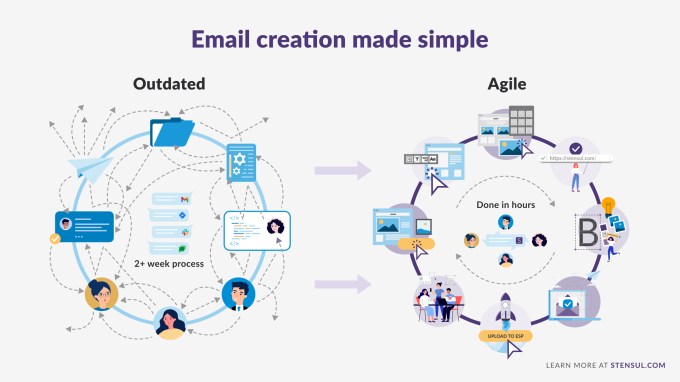
Image Credits: Stensul
The team has recently grown to more than 100 employees, with new customers like Capital One, ASICS Digital, Greenhouse, Samsung, AppDynamics, Kroger and Clover Health. New features include an integration with work management platform Workfront.
Plus, with other marketing channels paused or diminished during the pandemic, Dinkin said that email has only become more important, with the old, time-intensive process becoming more and more of a burden.
“We need more emails — whether that’s more versions or more segments or more languages, the requests are through the roof,” he said. “The teams are the same size … and so that’s where especially the leaders of these organizations have looked inward a lot more. The ways that they have been doing it for years or decades just doesn’t work anymore and prevents them from being competitive in the marketplace.”
The new round was led by USVP, with participation from Capital One Ventures, Peak State Ventures, plus existing investors Javelin Venture Partners, Uncork Capital, First Round Capital and Lowercase Capital . Individual investors include Okta co-founder and COO Frederic Kerrest, Okta CMO Ryan Carlson, former Marketo/Adobe executive Aaron Bird, Avid Larizadeh Duggan, Gary Swart and Talend CMO Lauren Vaccarello.
Dinkin said the money will allow Stensul to expand its marketing, product, engineering and sales teams.
“We originally thought: Everybody who sends email should have an email creation platform,” he said. “And ‘everyone who sends email’ is synonymous with ‘every company in the world.’ We’ve just seen that accelerate in that last few years.”
Powered by WPeMatico
When we covered Leena AI as a member of the Y Combinator Summer 2018 cohort, the young startup was firmly focused on building HR chatbots, but in the intervening years it has expanded the vision to a broader HR policy platform. Today, the company announced an $8 million Series A led by Greycroft with help from several individual industry investors.
Company CEO and co-founder Adit Jain says that in 2018 the company was concentrating on building an intelligent virtual assistant for HR-related questions. It allowed employees to ask the bot questions like how many vacation days they have left or what holidays they have off this year.
Over the last couple of years since leaving Y Combinator, the company has moved into broader HR service delivery. “So I’m talking about having an intelligent case management, knowledge management and document management system, which is backing the virtual assistant as well,” Jain explained.
He says that users should think of it as an entire system where the chatbot is the user interface for employees to interact with the HR information on the back end. For example, he says that the knowledge management component is where the chatbots find the answers to questions, and as employees interact with the chatbot, it grows more intelligent based on the feedback from them.
The document management piece enables HR to write or import HR policies and the case management system comes into play when the situation is too complex for the chatbot to handle and it has to be escalated to a human HR representative.
When we spoke to Jain in September 2018 at the time of his startup’s $2 million seed round, he had 16 customers and hoped to have 50 in the next 12-18 months. Today the company has 100 enterprise customers with 300,000 employees using the platform worldwide.
In fact, the pandemic has fueled business with more than half of those customers coming on board this year. He says this is because companies are looking for ways to digitize processes like HR as employees are working from home more.
“This is a trend that’s going to continue as organizations have realized the value of doing things with more and more digital applications taking care of your processes […] especially mundane, repeatable tasks being handed over to technology more and more,” Jain said.
As the business has grown this year, the company has expanded from 30 to 75 employees and he hopes to double that number in the next year. As he does, he has discussed with his lead investor how to build a diverse and inclusive culture at Leena AI .
One thing he is trying to do is raise some money from a diverse group of investors, approximately $400,000, and his hope is that these diverse investors can help him build solid diversity programs as he adds employees to his growing company.
That the startup hasn’t only grown during these turbulent times, but thrived, shows that companies are looking to modernize every part of the enterprise technology stack, and that includes HR.
Powered by WPeMatico
Started as a side project by its founders, Warren is now helping regional cloud infrastructure service providers compete against Amazon, Microsoft, IBM, Google and other tech giants. Based in Tallinn, Estonia, Warren’s self-service distributed cloud platform is gaining traction in Southeast Asia, one of the world’s fastest-growing cloud service markets, and Europe. It recently closed a $1.4 million seed round led by Passion Capital, with plans to expand in South America, where it recently launched in Brazil.
Warren’s seed funding also included participation from Lemonade Stand and angel investors like former Nokia vice president Paul Melin and Marek Kiisa, co-founder of funds Superangel and NordicNinja.
The leading global cloud providers are aggressively expanding their international businesses by growing their marketing teams and data centers around the world (for example, over the past few months, Microsoft has launched a new data center region in Austria, expanded in Brazil and announced it will build a new region in Taiwan as it competes against Amazon Web Services).
But demand for customized service and control over data still prompt many companies, especially smaller ones, to pick local cloud infrastructure providers instead, Warren co-founder and chief executive officer Tarmo Tael told TechCrunch.
“Local providers pay more attention to personal sales and support, in local language, to all clients in general, and more importantly, take the time to focus on SME clients to provide flexibility and address their custom needs,” he said. “Whereas global providers give a personal touch maybe only to a few big clients in the enterprise sectors.” Many local providers also offer lower prices and give a large amount of bandwidth for free, attracting SMEs.
He added that “the data sovereignty aspect that plays an important role in choosing their cloud platform for many of the clients.”
In 2015, Tael and co-founder Henry Vaaderpass began working on the project that eventually became Warren while running a development agency for e-commerce sites. From the beginning, the two wanted to develop a product of their own and tested several ideas out, but weren’t really excited by any of them, he said. At the same time, the agency’s e-commerce clients were running into challenges as their businesses grew.
Tael and Vaaderpass’s clients tended to pick local cloud infrastructure providers because of lower costs and more personalized support. But setting up new e-commerce projects with scalable infrastructure was costly because many local cloud infrastructure providers use different platforms.
“So we started looking for tools to use for managing our e-commerce projects better and more efficiently,” Tael said. “As we didn’t find what we were looking for, we saw this as an opportunity to build our own.”
After creating their first prototype, Tael and Vaaderpass realized that it could be used by other development teams, and decided to seek angel funding from investors, like Kiisa, who have experience working with cloud data centers or infrastructure providers.
Southeast Asia, one of the world’s fastest-growing cloud markets, is an important part of Warren’s business. Warren will continue to expand in Southeast Asia, while focusing on other developing regions with large domestic markets, like South America (starting with Brazil). Tael said the startup is also in discussion with potential partners in other markets, including Russia, Turkey and China.
Warren’s current clients include Estonian cloud provider Pilw.io and Indonesian cloud provider IdCloudHost. Tael said working with Warren means its customers spend less time dealing with technical issues related to infrastructure software, so their teams, including developers, can instead focus on supporting clients and managing other services they sell.
The company’s goal is to give local cloud infrastructure providers the ability to meet increasing demand, and eventually expand internationally, with tools to handle more installations and end users. These include features like automated maintenance and DevOps processes that streamline feature testing and handling different platforms.
Ultimately, Warren wants to connect providers in a network that end users can access through a single API and user interface. It also envisions the network as a community where Warren’s clients can share resources and, eventually, have a marketplace for their apps and services.
In terms of competition, Tael said local cloud infrastructure providers often turn to OpenStack, Virtuozzo, Stratoscale or Mirantis. The advantage these companies currently have over Warren is a wider network, but Warren is busy building out its own. The company will be able to connect several locations to one provider by the first quarter of 2021. After that, Tael said, it will “gradually connect providers to each other, upgrading our user management and billing services to handle all that complexity.”
Powered by WPeMatico
The cloud infrastructure market kept growing at a brisk pace last quarter, as the pandemic continued to push more companies to the cloud with offices shut down in much of the world. This week the big three — Amazon, Microsoft and Google — all reported their numbers and, as expected, the news was good, with Synergy Research reporting revenue growth of 33% year over year, up to almost $33 billion for the quarter.
Still, John Dinsdale, chief analyst at Synergy, was a bit taken aback that the market continued to grow as much as it did. “While we were fully expecting continued strong growth in the market, the scale of the growth in Q3 was a little surprising,” he said in a statement.
He added, “Total revenues were up by $2.5 billion from the previous quarter causing the year-on-year growth rate to nudge upwards, which is unusual for such a large market. It is quite clear that COVID-19 has provided an added boost to a market that was already developing rapidly.”
Per usual Amazon led the way with $11.6 billion in revenue, up from $10.8 billion last quarter. That’s up 29% year over year. Amazon continues to exhibit slowing growth in the cloud market, but because of its market share lead of 33%, a rate that has held fairly steady for some time, the growth is less important than the eye-popping revenue it continues to generate, almost double its closest rival Microsoft .
Speaking of Microsoft, Azure revenue was up 48% year over year, also slowing some, but good enough for a strong second place with 18% market share. Using Synergy’s total quarterly number of $33 billion, Microsoft came in at $5.9 billion in revenue for the quarter, up from $5.2 billion last quarter.
Finally, Google announced cloud revenue of $3.4 billion, but that number includes all of its cloud revenue including G Suite and other software. Synergy reported that this was good for 9%, or $2.98 billion, up from $2.7 billion last quarter, good for third place.
Alibaba and IBM were tied for fourth with 5%, or around $1.65 billion each.
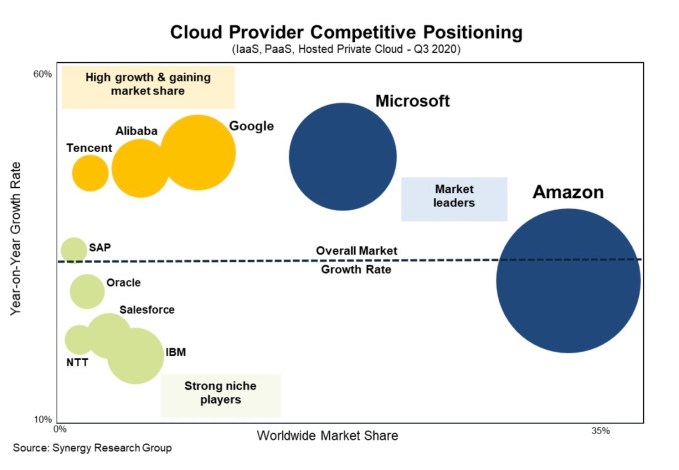
Image Credits: Synergy Research
It’s worth noting that Canalys had similar numbers to Synergy, with growth of 33% to $36.5 billion. They had the same market order with slightly different numbers, with Amazon at 32%, Microsoft at 19% and Google at 7%, and Alibaba in 4th place at 6%.
Canalys sees continued growth ahead, especially as hybrid cloud begins to merge with newer technologies like 5G and edge computing. “All three [providers] are collaborating with mobile operators to deploy their cloud stacks at the edge in the operators’ data centers. These are part of holistic initiatives to profit from 5G services among business customers, as well as transform the mobile operators’ IT infrastructure,” Canalys analyst Blake Murray said in a statement.
While the pure growth continues to move steadily downward over time, this is expected in a market that’s maturing like cloud infrastructure, but as companies continue to shift workloads more rapidly to the cloud during the pandemic, and find new use cases like 5G and edge computing, the market could continue to generate substantial revenue well into the future.
Powered by WPeMatico
If you miss hanging out with your co-workers but don’t want to spend a single second more on Zoom, the latest product from Donut might be the answer.
The startup is launching its new Watercooler product today while also announcing that it has raised $12 million in total funding, led by Accel and with participation from Bloomberg Beta, FirstMark, Slack Fund and various angel investors.
Co-founder and CEO Dan Manian told me that this is actually money that the startup raised before the pandemic, across multiple rounds. It just didn’t announce the fundraising until now.
The startup’s vision, Manian said, is “to create human connection between people at work.” Its first product, Intros, connects via Slack teammates who didn’t already know each other, often with the goal of setting up quick coffee meetings (originally in-person and now virtual).
Donut says it has facilitated 4 million connections across 12,000 companies (including The New York Times, Toyota and InVision), with 1 million of those connections made since the beginning of the pandemic.
However, Manian said customers have been asking Donut to facilitate more frequent interactions, especially since most people aren’t going to have these coffee meetings every day. At the same time, people face the dueling issues of isolation and Zoom fatigue, where “the antidote to one thing makes the other pain worse.” And he suggested that one of the hardest things to recreate while so many of us are working remotely are “all the little microinteractions that you have while you’re working.”
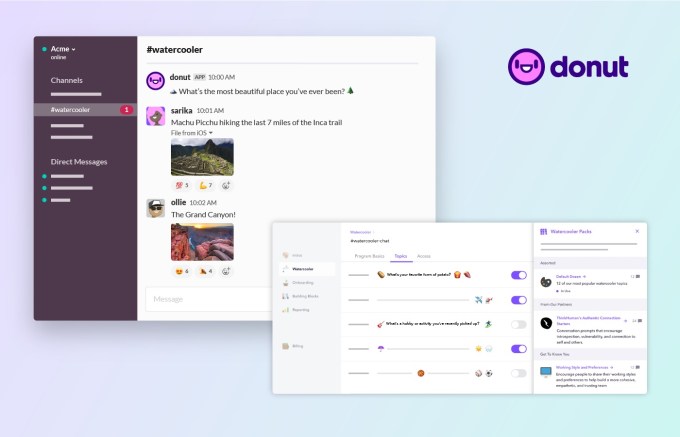
That’s where Watercooler comes in — as the name suggests, it’s designed to replicate the feeling of hanging out at the office watercooler, having brief, low-key conversations. Like Intros, it integrates with Slack, creating a new channel where Watercooler will post fun, conversation-starting questions like “‘What’s your favorite form of potato?” or “What’s one thing you’ve learned in your career that you wish you knew sooner?”
Talking about these topics shouldn’t take much time, but Manian argued that brief conversations are important: “Those things add up to friendship over time, they’re what actually transform you from co-worker to friend.” And those friendships are important for employers too, because they help with team cohesion and retention.
I fully endorse the idea of a Slack watercooler — in fact, the TechCrunch editorial team has a very active “watercooler” channel and I’m always happy to waste time there. My big question was: Why do companies need to purchase a product for this?
Donut Watercooler. Image Credits: Donut
Manian said that there were “a bunch of our early adopters” who had tried doing this manually, but it was always in the “past tense”: “It got too hard to come up with the questions, or it took real work coming up with them, whoever was doing it already had a it full time job.”
With Watercooler, on the other hand, the company can choose from pre-selected topics and questions, set the frequency with which those questions are posted and then everything happens automatically.
Manian also noted that different organizations will focus on different types of questions. There are no divisive political questions included, but while some teams will stick to easy questions about things like potatoes and breakfast foods, others will get into more substantive topics like the ways that people prefer to receive feedback.
And yes, Manian thinks companies will still need these tools after the pandemic is over.
“Work has fundamentally changed,” he said. “I don’t think we’ll put remote work back in the bottle. I think it’s here to stay.”
At the same time, he described the past few months as “training wheels” for a hybrid model, where some team members go back to the office while others continue working remotely. In his view, teams will face an even bigger challenge then: To keep their remote members feeling like they’re connected and in-the-loop.
Powered by WPeMatico
Intel has been doubling down on building chips and related architecture for the next generation of computing, and today it announced an acquisition that will bolster its expertise and work specifically in one area of future technology: artificial intelligence.
The semiconductor giant today announced that it has acquired SigOpt, a startup out of San Francisco that has built an optimization platform that can be used to run modeling and simulations (two key applications of AI tech) in a better way. Anthony described SigOpt as a startup built to “optimize everything” when we covered its Series A, but Intel specifically will be integrating the tech into its AI business, specifically into its AI Analytics Toolkit, a spokesperson tells me.
Terms of the deal were not disclosed, but SigOpt already counted a number of large enterprises — “SigOpt’s customer base includes Fortune 500 companies across industries, as well as leading research institutions, universities and consortiums using its products” — among its customers. The product was still in a closed beta, however. Notably, it had raised money from an interesting group of investors that included In-Q-Tel (the firm associated with the CIA that makes strategic investments) and Andreessen Horowitz, and Y Combinator, among others. It had raised less than $10 million.
The plan will be to continue providing services to existing users, and to continue building out the company’s platform — co-founders Scott Clark (CEO) and Patrick Hayes (CTO) and their team are joining Intel.
“We will continue to work with SigOpt’s existing customers and will also integrate the technology into our product road map,” a spokesperson confirmed.
While Intel is working hard on streamlining its business around next-generation chips to better compete against the likes of Nvidia (which itself is growing substantially with the acquisition of ARM) and smaller players like GraphCore, in part by divesting more legacy operations, it seems a strong opportunity in providing services for its customers alongside those chips, and these services specifically will help customers with the compute loads that they will be running on those chips.
The focus for Intel has been on the next generation of computing to offset declines in its legacy operations. In the last quarter, even as it beat expectations, Intel reported a 3% decline in its revenues, led by a drop in its data center business. It said that it’s projecting the AI silicon market to be bigger than $25 billion by 2024, with AI silicon in the data center to be greater than $10 billion in that period.
In 2019, Intel reported some $3.8 billion in AI-driven revenue, but it hopes that tools like SigOpt’s will help drive more activity in that business, dovetailing with the push for more AI applications in a wider range of businesses.
“In the new intelligence era, AI is driving the compute needs of the future. It is even more important for software to automatically extract the best compute performance while scaling AI models,” said Raja Koduri, Intel’s chief architect and senior vice president of its discrete graphics division. “SigOpt’s AI software platform and data science talent will augment Intel software, architecture, product offerings and teams, and provide us with valuable customer insights. We welcome the SigOpt team and its customers to the Intel family.”
While there could potentially be a number of applications for SigOpt’s tech, this is a signal of how bigger players will continue to consolidate specific services around their bigger business, giving the small startup a much bigger horizon in terms of potential business (even if it is all tied to customers that only use Intel hardware).
“We are excited to join Intel and supercharge our mission to accelerate and amplify the impact of modelers everywhere. By combining our AI optimization software with Intel’s decades-long leadership in AI computing and machine learning performance, we will be able to unlock entirely new AI capabilities for modelers,” said Clark in a statement.
Powered by WPeMatico
It’s been quite a time for chip industry consolidation, and today Marvell joined the acquisition parade when it announced it is acquiring Inphi in a combination of stock and cash valued at approximately $10 billion, according to the company.
Marvell CEO Matt Murphy believes that by adding Inphi, a chip maker that helps connect internal servers in cloud data centers, and then between data centers, using fiber cabling, it will complement Marvell’s copper-based chip portfolio and give it an edge in developing more future-looking use cases where Inphi shines.
“Our acquisition of Inphi will fuel Marvell’s leadership in the cloud and extend our 5G position over the next decade,” Murphy said in a statement.
In the classic buy versus build calculus, this acquisition uses the company’s cash to push it in new directions without having to build all this new technology. “This highly complementary transaction expands Marvell’s addressable market, strengthens customer base and accelerates Marvell’s leadership in hyperscale cloud data centers and 5G wireless infrastructure,” the company said in a statement.
It’s been a busy time for the chip industry as multiple players are combining, hoping for a similar kind of lift that Marvell sees with this deal. In fact, today’s announcement comes in the same week AMD announced it was acquiring Xilinx for $35 billion and follows Nvidia acquiring ARM for $40 billion last month. The three deals combined come to a whopping $85 billion.
There appears to be prevailing wisdom in the industry that by combining forces and using the power of the checkbook, these companies can do more together than they can by themselves.
Certainly Marvell and Inphi are suggesting that. As they highlighted, their combined enterprise value will be more than $40 billion, with hundreds of millions of dollars in market potential. All of this of course depends on how well these combined entities work together, and we won’t know that for some time.
For what it’s worth, the stock market appears unimpressed with the deal, with Marvell’s stock down more than 7% in early trading — but Inphi stock is being bolstered in a big way by the announcement, up almost 23% this morning so far.
The deal, which has been approved by both companies’ boards, is expected to close by the second half of 2021, subject to shareholder and regulatory approval.
Powered by WPeMatico
Code is the lifeblood of the modern world, yet the tooling for some programming environments can be remarkably spartan. While developers have long had access to graphical programming environments (IDEs) and performance profilers and debuggers, advanced products to analyze and improve lines of code have been harder to find.
These days, the most typical tool in the kit is a linter, which scans through code pointing out flaws that might cause issues. For instance, there might be too many spaces on a line, or a particular line might have a well-known ambiguity that could cause bugs that are hard to diagnose and would best be avoided.
What if we could expand the power of linters to do a lot more though? What if programmers had an assistant that could analyze their code and actively point out new security issues, erroneous code, style problems and bad logic?
Static code analysis is a whole interesting branch of computer science, and some of those ideas have trickled into the real-world with tools like semgrep, which was developed at Facebook to add more robust code-checking tools to its developer workflow. Semgrep is an open-source project, and it’s being commercialized through r2c, a startup that wants to bring the power of this tool to the developer masses.
The whole project has found enough traction among developers that Satish Dharmaraj at Redpoint and Jim Goetz at Sequoia teamed up to pour $13 million into the company for its Series A round, and also backed the company in an earlier, unannounced seed round.
The company was founded by three MIT grads — CEO Isaac Evans and Drew Dennison were roommates in college, and they joined up with head of product Luke O’Malley. Across their various experiences, they have worked at Palantir, the intelligence community, and Fortune 500 companies, and when Evans and Dennison were EIRs at Redpoint, they explored ideas based on what they had seen in their wide-ranging coding experiences.

The r2c team, which I assume only writes bug-free code. Image by r2c.
“Facebook, Apple, and Amazon are so far ahead when it comes to what they do at the code level to bake security [into their products compared to] other companies, it’s really not even funny,” Evans explained. The big tech companies have massively scaled their coding infrastructure to ensure uniform coding standards, but few others have access to the talent or technology to be on an equal playing field. Through r2c and semgrep, the founders want to close the gap.
With r2c’s technology, developers can scan their codebases on-demand or enforce a regular code check through their continuous integration platform. The company provides its own template rulesets (“rule packs”) to check for issues like security holes, complicated errors and other potential bugs, and developers and companies can add their own custom rulesets to enforce their own standards. Currently, r2c supports eight programming languages, including JavaScript and Python, and a variety of frameworks, and it is actively working on more compatibility.
One unique focus for r2c has been getting developers onboard with the model. The core technology remains open-sourced. Evans said that “if you actually want something that’s going to get broad developer adoption, it has to be predominantly open source so that developers can actually mess with it and hack on it and see whether or not it’s valuable without having to worry about some kind of super restrictive license.”
Beyond its model, the key has been getting developers to actually use the tool. No one likes bugs, and no developer wants to find more bugs that they have to fix. With semgrep and r2c though, developers can get much more immediate and comprehensive feedback — helping them fix tricky errors before they move on and forget the context of what they were engineering.
“I think one of the coolest things for us is that none of the existing tools in the space have ever been adopted by developers, but for us, it’s about 50/50 developer teams who are getting excited about it versus security teams getting excited about it,” Evans said. Developers hate finding more bugs, but they also hate writing them in the first place. Evans notes that the company’s key metric is the number of bugs found that are actually fixed by developers, indicating that they are offering “good, actionable results” through the product. One area that r2c has explored is actively patching obvious bugs, saving developers time.
Breaches, errors and downtime are a bedrock of software, but it doesn’t have to be that way. With more than a dozen employees and a hefty pool of capital, r2c hopes to improve the reliability of all the experiences we enjoy — and save developers time in the process.
Powered by WPeMatico
As communicating with customers across the world grows ever more challenging due to multiple channels, tools and networking providers, companies are looking for a way to simplify it all. Sinch, a company that makes communications APIs, announced a new tool this morning called the Conversation API designed to make it easier to interact with customers across the planet using multiple messaging products.
Sinch chief product officer Vikram Khandpur says that business is being conducted in different messaging channels such as SMS, WhatsApp or Viber depending on location, and businesses have to be able to communicate with their customers wherever they happen to be from a technology and geographic standpoint. What’s more, this need has become even more pronounced during a pandemic when online communication has become paramount.
Khandpur says that up until now, Sinch has concentrated on optimizing the SMS experience for actions like customer acquisition, customer engagement, delivery notifications and customer support. Now the company wants to take that next step into richer omni-channel messaging.
The idea is to provide a set of tools to help marketing teams communicate across these multiple channels by walking them through the processes required by each player. “By writing to our API, what we can provide is that we can get our customers on all these platforms if they are not already on these platforms,” he said.
He uses WhatsApp as an example because it has a very defined process for brands to work with it. “On WhatsApp, there is this concept of creating these pre-approved templates, and they need to be reviewed, curated and finally approved by the WhatsApp team. We help them with that process, and then do the same with other channels and platforms, so we take that complexity away from the brand,” Khandpur explained.
He adds, “By giving us that message once, we take care of all of [the different tools] behind the scenes transcoding when needed. So if you give us a very rich message with images and videos, WhatsApp may want to render it in a certain way, but then Viber renders that in a different way, and we take care of that.

Examples of transcoding across messaging channels. Image Credits: Sinch
Marketers can use the Conversation API to define parameters like using WhatsApp first in India, but if the targeted customer doesn’t open WhatsApp, then fall back to SMS.
The company has made four acquisitions in the last year, including ACL Mobile in India and SAP’s Interconnect Messaging business, to enhance its presence across the world.
Sinch, which competes with Twilio in the communications API space, may be one of the most successful companies you never heard of, generating more than $500 million in revenue last year while processing over 110 billion messages.
The company launched in Sweden in 2008 and has never taken a dime of venture capital, yet has been profitable since the early days. In fact, it’s publicly traded on the NASDAQ Exchange in Stockholm and will be reporting earnings next week.
Powered by WPeMatico