Enterprise
Auto Added by WPeMatico
Auto Added by WPeMatico
PingCAP, the open-source software developer best known for NewSQL database TiDB, has raised a $270 million Series D. TiDB handles hybrid transactional and analytical processing (HTAP), and is aimed at high-growth companies, including payment and e-commerce services, that need to handle increasingly large amounts of data.
The round’s lead investors were GGV Capital, Access Technology Ventures, Anatole Investment, Jeneration Capital and 5Y Capital (formerly known as Morningside Venture Capital). It also included participation from Coatue, Bertelsmann Asia Investment Fund, FutureX Capital, Kunlun Capital, Trustbridge Partners, and returning investors Matrix Partners China and Yunqi Partners.
The funding brings PingCAP’s total raised so far to $341.6 million. Its last round, a Series C of $50 million, was announced back in September 2018.
PingCAP says TiDB has been adopted by about 1,500 companies across the world. Some examples include Square; Japanese mobile payments company PayPay; e-commerce app Shopee; video-sharing platform Dailymotion; and ticketing platfrom BookMyShow. TiDB handles online transactional processing (OLTP) and online analytical processing (OLAP) in the same database, which PingCAP says results in faster real-time analytics than other distributed databases.
In June, PingCAP launched TiDB Cloud, which it describes as fully-managed “TiDB as a Service,” on Amazon Web Services and Google Cloud. The company plans to add more platforms, and part of the funding will be used to increase TiDB Cloud’s global user base.
Powered by WPeMatico
As companies work with data, one of the big obstacles they face is making sure they are not exposing personally identifiable information (PII) or other sensitive data. It usually requires a painstaking manual effort to strip out that data. Gretel, an early-stage startup, wants to change that by making it faster and easier to anonymize data sets. Today the company announced a $12 million Series A led by Greylock. The company has now raised $15.5 million.
Gretel co-founder and CEO Alex Watson says that his company was founded to make it simpler to anonymize data and unlock data sets that were previously out of reach because of privacy concerns.
“As a developer, you want to test an idea or build a new feature, and it can take weeks to get access to the data you need. Then essentially it boils down to getting approvals to get started, then snapshotting a database, and manually removing what looks like personal data and hoping that you got everything.”
Watson, who previously worked as a GM at AWS, believed that there needed to be a faster and more reliable way to anonymize the data, and that’s why he started Gretel. The first product is an open-source, synthetic machine learning library for developers that strips out personally identifiable information.
“Developers use our open source library, which trains machine learning models on their sensitive data, then as that training is happening we are enforcing something called differential privacy, which basically ensures that the model doesn’t memorize details about secrets for individual people inside of the data,” he said. The result is a new artificial data set that is anonymized and safe to share across a business.
The company was founded last year, and they have actually used this year to develop the open-source product and build an open-source community around it. “So our approach and our go-to-market here is we’ve open-sourced our underlying libraries, and we will also build a SaaS service that makes it really easy to generate synthetic data and anonymized data at scale,” he said.
As the founders build the company, they are looking at how to build a diverse and inclusive organization, something that they discuss at their regular founders’ meetings, especially as they look to take these investment dollars and begin to hire additional senior people.
“We make a conscious effort to have diverse candidates apply, and to really make sure we reach out to them and have a conversation, and that’s paid off, or is in the process of paying off I would say, with the candidates in our pipeline right now. So we’re excited. It’s tremendously important that we avoid group think that happens so often,” he said.
The company doesn’t have paying customers, but the plan is to build off the relationships it has with design partners and begin taking in revenue next year. Sridhar Ramaswamy, the partner at Greylock who is leading the investment, says that his firm is placing a bet on a pre-revenue company because he sees great potential for a service like this.
“We think Gretel will democratize safe and controlled access to data for the whole world the way GitHub democratized source code access and control,” Ramaswamy said.
Powered by WPeMatico
Over the past decade, many startups have tried (and many have failed) to rethink the way we schedule our meetings and calls. But we seem to be in a calendrical renaissance, with incumbents like Google and Outlook getting smarter and smarter and newcomers like Calendly growing significantly.
Undock, an Entrepreneurs Roundtable Accelerator-backed startup, is looking to enter the space.
The startup recently closed a $1.6 million seed round with investors that include Lightship Capital, Bessemer Venture Partners, Lerer Hippeau, Alumni Ventures Group, Active Capital, Arlan Hamilton of Backstage Capital, Sarah Imbach of PayPal/LinkedIn and several other angel investors.
For now, Undock is a Chrome extension that allows users to seamlessly see mutual availability across a group, whether or not all users in the group have Undock, all from within their email. Founder and CEO Nash Ahmed wouldn’t go into too much detail about the technology that allows Undock to accomplish this. But, on the surface, users who don’t yet have Undock can temporarily link their calendar to the individual meeting request to automatically find times that work for everyone in the group. Otherwise, they can see the suggested times of the rest of the group and mark the ones that work for them.
This is just the beginning of the journey for Undock. The company plans to launch a full-featured calendar in Q1 of 2021, that would include collaborative editing right within calendar events, and embedded video conferencing.
According to Ahmed, the most important differentiating features of Undock are that it focuses on mutual availability (not just singular availability) and that it does so right within the email client.
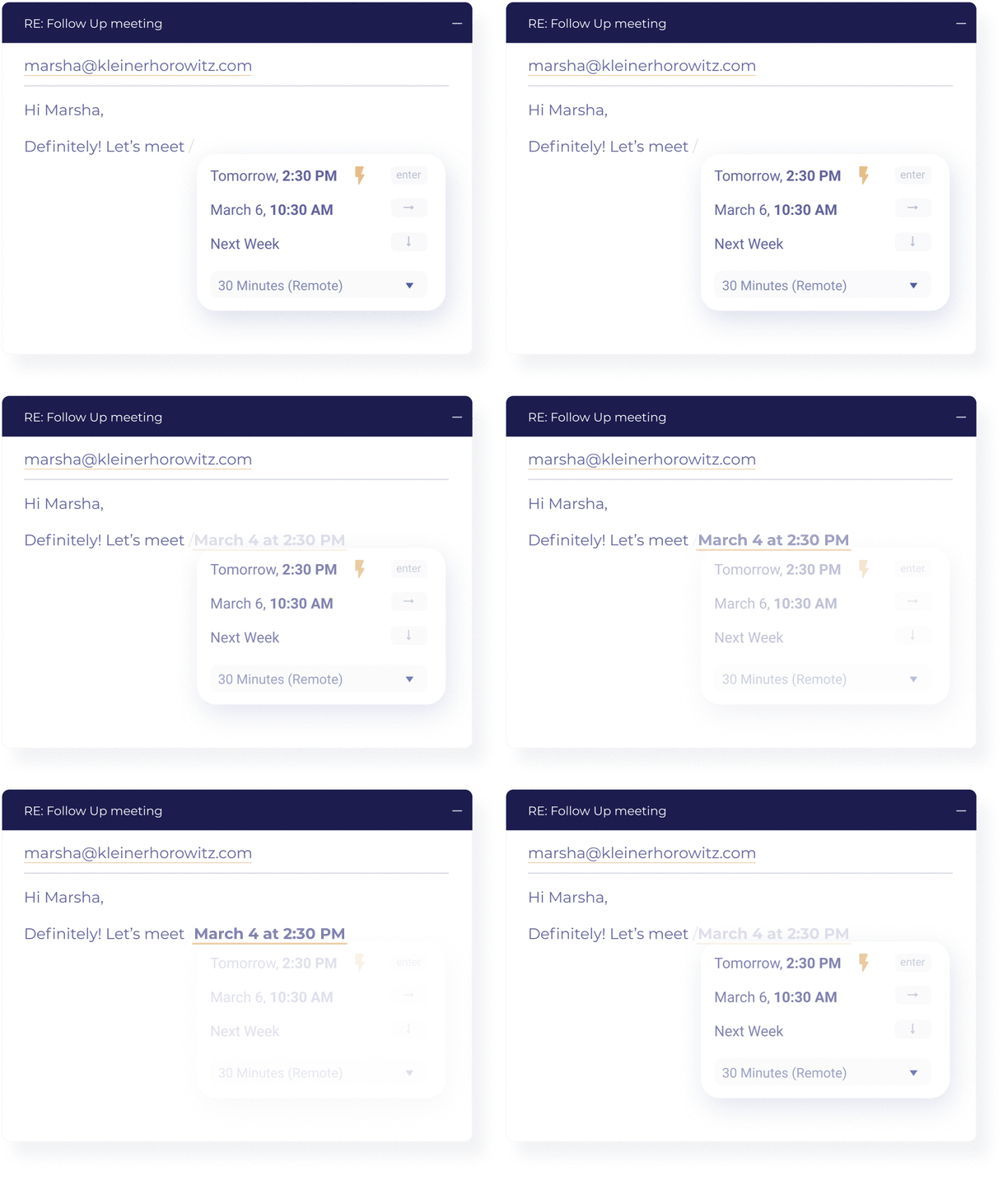
Image Credits: Undock
Scheduling will always be free within Undock, but the full calendar (when it’s released publicly) will have a variety of tiers starting at $10/month per user. Undock will also borrow from the Slack model and charge more for retention of information.
“The greatest challenge is definitely customer education,” said Ahmed, explaining that early on some users were confused by the product’s simplicity. “We messaged it by saying it’s like autocomplete. And early users would get into their email and then ask what to do next, or if they had to go back to Undock or to the Chrome extension. And we’d have to say ‘no, just keep typing.’ ”
The Undock team, which is Black and female-founded, numbers 18 people; 28% of the team is female, 22% are Black and 11% are LGBTQ, and the diversity of the leadership team is even higher.
Powered by WPeMatico
Chooch.ai, a startup that hopes to bring computer vision more broadly to companies to help them identify and tag elements at high speed, announced a $20 million Series A today.
Vickers Venture Partners led the round with participation from 212, Streamlined Ventures, Alumni Ventures Group, Waterman Ventures and several other unnamed investors. Today’s investment brings the total raised to $25.8 million, according to the company.
“Basically we set out to copy human visual intelligence in machines. That’s really what this whole journey is about,” CEO and co-founder Emrah Gultekin explained. As the company describes it, “Chooch Al can rapidly ingest and process visual data from any spectrum, generating AI models in hours that can detect objects, actions, processes, coordinates, states, and more.”
Chooch is trying to differentiate itself from other AI startups by taking a broader approach that could work in any setting, rather than concentrating on specific vertical applications. Using the pandemic as an example, Gultekin says you could use his company’s software to identify everyone who is not wearing a mask in the building or everyone who is not wearing a hard hat at a construction site.
With 22 employees spread across the U.S., India and Turkey, Chooch is building a diverse company just by virtue of its geography, but as it doubles the workforce in the coming year, it wants to continue to build on that.
“We’re immigrants. We’ve been through a lot of different things, and we recognize some of the issues and are very sensitive to them. One of our senior members is a person of color and we are very cognizant of the fact that we need to develop that part of our company,” he said. At a recent company meeting, he said that they were discussing how to build diversity into the policies and values of the company as they move forward.
The company currently has 18 enterprise clients and hopes to use the money to add engineers, data scientists and begin to build out a worldwide sales team to continue to build the product and expand its go-to-market effort.
Gultekin says that the company’s unusual name comes from a mix of the words choose and search. He says that it is also an old Italian insult. “It means dummy or idiot, which is what artificial intelligence is today. It’s a poor reflection of humanity or human intelligence in humans,” he said. His startup aims to change that.
Powered by WPeMatico
Organizations today are sitting on mountains of data that they amass and use in their own businesses, but many are also looking to share those troves with other parties to expand their prospects — a model that comes with challenges (privacy and data protection being two key ones); and, these days (due to COVID-19 and the push to more digital transformation), with urgency; but also big rewards if you can pull it off well.
Today, a new London startup called Harbr, which has built a secure platform to enable big data exchange, is announcing a big round of funding to tap into that demand.
The company has raised $38.5 million in a Series A round of funding, just six months since emerging from stealth mode. It plans to use the money to hire more people to meet the demand of serving more enterprise customers, and for R&D.
Led jointly by new backers Dawn Capital and Tiger Global Management, the round also had participation from past investors Mike Chalfen, Boldstart Ventures, Crane Venture Partners, Backed and Seedcamp, alongside UiPath’s founder and CEO Daniel Dines and head of strategy Brandon Deer. Harbr has now raised over $50 million, and it’s not disclosing its valuation.
Harbr has been around since 2017, but it only came out of stealth mode earlier this year, in May. Its approach has mirrored that of a lot of other enterprise startups that spend a long time building their product under wraps. Identifying the market opportunity when it was still nascent, Harbr then worked directly (and quietly) with enterprises to figure out what they needed and built it, before launching it as a commercial product (with customers already in hand).
“Back in 2017 no one was talking about enterprise data exchanges,” Harbr’s CSO Anthony Cosgrove (who co-founded the company with Gary Butler, the CEO) told me in an interview. “So we worked with big companies to understand their needs and built Harbr based on that.”
Customers include those in financial and enterprise services such as Moody’s Analytics and WinterCorp, as well as governments. Cosgrove noted that nearly 100% of Harbr’s clients are in the U.S., where the startup’s chairman Leo Spiegel is based. Spiegel is also an investor, with an extensive enterprise data services resume to his name.
“This is a team that has worked together for a long time,” Spiegel said in an interview. “Gary [the CEO] and I have worked together for 20 years before Harbr. I have been in data a very long time, and we have a lot of relationships with U.S. companies.” (That is one sign of why this enterprise startup has raised a substantial amount of funding so early in its public life.)
Cosgrove, an MBE, himself has a background in banking and before that U.K. government.
The platform today provides enterprises with a way to tap into data that an organization may already have in data lakes and warehouses, which it already uses for analytics and business intelligence. The idea is to make that data ready and secure for enterprise data exchange, either with other parts of your own large organization, or with third parties. That involves creating a “clean room”, providing tools for making it accessible by third parties, and potentially turning it into a data marketplace, if that is your goal.
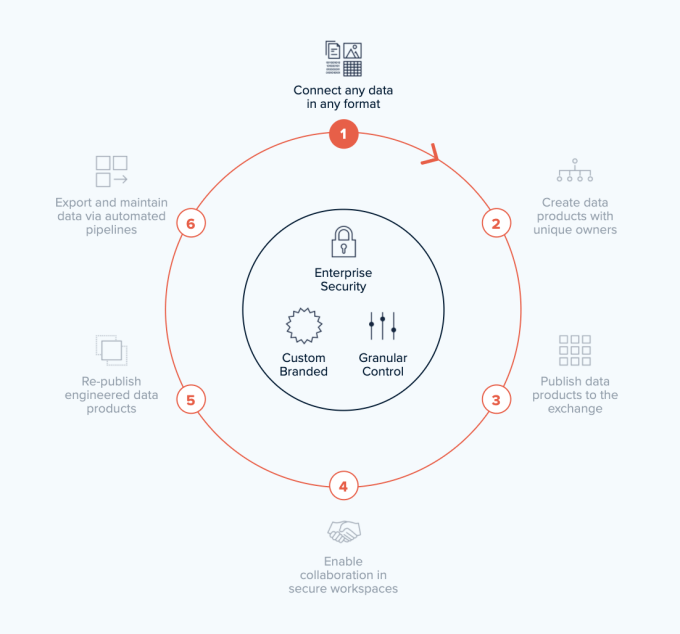
Image Credits: Harbr
The challenges that Harbr addresses come from a couple of different angles. The first of these is technical: putting data troves from disparate sources into a format that can be usable by others. The second of these is commercial: creating something that you can then provide to others, but also making that marketplace findable and usable. The third of these is security.
Cosgrove said that he doesn’t think of Harbr as a security company first, but he points out that these days this has become as much of a concern (if not more) than simply making a data product usable. Being able to protect your data as valuable IP is important, but on top of that, you have the roles of privacy and data protection.
These have moved from being fringe concerns to a priority for many users, and, in an increasing number of cases, a legal requirement. So, as companies look for ways to tap into the big data opportunity while keeping those principles in mind, they are looking for companies built with privacy and data protection from the ground up.
“We’re really focused on helping people to treat data as a product. They bring assets into a platform and turn them into data products that are easy to consume, use and merge,” said Cosgrove. “We see security as a by-product of that: you have to consider security as part of it.” Harbr the name is a play on Harbor, which itself is a reference to safe harbor principles and regulations.
Harbr is not the only company looking at this opportunity. InfoSum, also out of the U.K., is also tackling the concept of a privacy-first approach to federated data, providing a way to share data across organizations without compromising data protection in any way. DataFleets out of the Bay Area is another startup also building a platform and tools to help enterprises with this challenge and opportunity.
“For data to become truly powerful, we need more automation and collaboration. Today, human efforts are consumed by finding and preparing data, rather than focused on high-value activities that drive real productivity gains,” said Evgenia Plotnikova, partner at Dawn Capital, in a statement. “Harbr is in the vanguard of companies changing this reality, and we are incredibly excited to be partnering with them. Customers we’ve spoken to find Harbr’s enterprise data exchange transformative, and their engagement across Fortune 1000 companies substantiates this.”
Powered by WPeMatico
Startups need to live in the future. They create roadmaps, build products and continually upgrade them with an eye on next year — or even a few years out.
Big companies, often the target customers for startups, live in a much more near-term world. They buy technologies that can solve problems they know about today, rather than those they may face a couple bends down the road. In other words, they’re driving a Dodge, and most tech entrepreneurs are driving a DeLorean equipped with a flux-capacitor.
That situation can lead to a huge waste of time for startups that want to sell to enterprise customers: a business development black hole. Startups are talking about technology shifts and customer demands that the executives inside the large company — even if they have “innovation,” “IT,” or “emerging technology” in their titles — just don’t see as an urgent priority yet, or can’t sell to their colleagues.
How do you avoid the aforementioned black hole? Some recent research that my company, Innovation Leader, conducted in collaboration with KPMG LLP, suggests a constructive approach.
Rather than asking large companies about which technologies they were experimenting with, we created four buckets, based on what you might call “commitment level.” (Our survey had 211 respondents, 62% of them in North America and 59% at companies with greater than $1 billion in annual revenue.) We asked survey respondents to assess a list of 16 technologies, from advanced analytics to quantum computing, and put each one into one of these four buckets. We conducted the survey at the tail end of Q3 2020.
Respondents in the first group were “not exploring or investing” — in other words, “we don’t care about this right now.” The top technology there was quantum computing.
Bucket #2 was the second-lowest commitment level: “learning and exploring.” At this stage, a startup gets to educate its prospective corporate customer about an emerging technology — but nabbing a purchase commitment is still quite a few exits down the highway. It can be constructive to begin building relationships when a company is at this stage, but your sales staff shouldn’t start calculating their commissions just yet.
Here are the top five things that fell into the “learning and exploring” cohort, in ranked order:
Technologies in the third group, “investing or piloting,” may represent the sweet spot for startups. At this stage, the corporate customer has already discovered some internal problem or use case that the technology might address. They may have shaken loose some early funding. They may have departments internally, or test sites externally, where they know they can conduct pilots. Often, they’re assessing what established tech vendors like Microsoft, Oracle and Cisco can provide — and they may find their solutions wanting.
Here’s what our survey respondents put into the “investing or piloting” bucket, in ranked order:
By the time a technology is placed into the fourth category, which we dubbed “in-market or accelerating investment,” it may be too late for a startup to find a foothold. There’s already a clear understanding of at least some of the use cases or problems that need solving, and return-on-investment metrics have been established. But some providers have already been chosen, based on successful pilots and you may need to dislodge someone that the enterprise is already working with. It can happen, but the headwinds are strong.
Here’s what the survey respondents placed into the “in-market or accelerating investment” bucket, in ranked order:
Powered by WPeMatico
Kyklo, a startup that helps wholesale distributors of electrical and automation products launch e-commerce stores, is announcing that it has raised $8.5 million in seed funding.
The industry may sound a bit arcane, but it’s one that founders Remi Ducrocq (Kyklo’s CEO) and Fabien Legouic (CTO) know from having worked at Schneider Electric. Ducrocq said that the process of selling these products to manufacturers and electricians remains cumbersome, relying largely on PDF catalogs.
Shifting these businesses to digital is a much bigger challenge than creating your standard online store, both because of the number of products being sold and the needs for accurate listings.
“Even the small folks sell 100,000 SKUs [distinct products], up to 1 million SKUs,” Ducrocq told me. “If you choose the wrong product, your factory gets shut down. [It’s essential] to have accurate information present on the web store to have a transaction happen.”
Kyklo doesn’t automate the process completely, Ducrocq added, because “you can’t just create content or apply AI to something that is so unstructured.” Creating these stores remains a manual process for the Kylo team, but the company has built “technology to make that manual process as easy as possible.”

That includes standardized data structures and a variety of scripts to create these product listings more quickly. Ultimately, Ducrocq said Kyklo can get distributors up and running with an online store within 30 days, and sometimes as quickly as two weeks.
In total, Kyklo has created a catalog of more than 2.5 million products for more than 35 distributors. It’s also been endorsed by manufacturers like Schneider Electric, Wago, Festo US and Mitsubishi Electric Automation as their preferred e-commerce partner.
Ducrocq suggested that going digital with Kyklo helps these businesses both by allowing them to reach new customers with improved SEO and by giving them tools to expand their sales with existing customers. For example, IEC Supply says that its online sales increased 500% for the first six months after launching with Kyklo, while new customer interactions tripled.
“Market maturity accelerated because of the pandemic,” he added. “These B2B traditional businesses were reluctant to go towards digitization, with only visionaries embarking on the journey. But during the pandemic, salespeople haven’t been able to see their customers in person for six months, so many distributors are reassessing how they should effectively go to market.”
Kyklo has now raised a total of $10.2 million. The new funding was led by Felicis Ventures and IA Ventures, with participation from Jungle Ventures, partners at Wavemaker, Seedplus and strategic angel investors.
“With 80% of the $640 billion electrical, industrial and automation distribution industry still relying on PDF catalogs and phone and emails for its operations, distributors face a challenge in the market,” said Felicis Managing Director Sundeep Peechu in a statement. “KYKLO’s platform helps these companies keep pace with crucial industry needs and reassess how digital tools can transform their sales force.”
Powered by WPeMatico
Earlier this year, Mirantis, the company that now owns Docker’s enterprise business, acquired Lens, a desktop application that provides developers with something akin to an IDE for managing their Kubernetes clusters. At the time, Mirantis CEO Adrian Ionel told me that the company wants to offer enterprises the tools to quickly build modern applications. Today, it’s taking another step in that direction with the launch of an extensions API for Lens that will take the tool far beyond its original capabilities.
In addition to this update to Lens, Mirantis also today announced a new open-source project: k0s. The company describes it as “a modern, 100% upstream vanilla Kubernetes distro that is designed and packaged without compromise.”
It’s a single optimized binary without any OS dependencies (besides the kernel). Based on upstream Kubernetes, k0s supports Intel and Arm architectures and can run on any Linux host or Windows Server 2019 worker nodes. Given these requirements, the team argues that k0s should work for virtually any use case, ranging from local development clusters to private data centers, telco clusters and hybrid cloud solutions.
“We wanted to create a modern, robust and versatile base layer for various use cases where Kubernetes is in play. Something that leverages vanilla upstream Kubernetes and is versatile enough to cover use cases ranging from typical cloud based deployments to various edge/IoT type of cases,” said Jussi Nummelin, senior principal engineer at Mirantis and founder of k0s. “Leveraging our previous experiences, we really did not want to start maintaining the setup and packaging for various OS distros. Hence the packaging model of a single binary to allow us to focus more on the core problem rather than different flavors of packaging such as debs, rpms and what-nots.”
Mirantis, of course, has a bit of experience in the distro game. In its earliest iteration, back in 2013, the company offered one of the first major OpenStack distributions, after all.
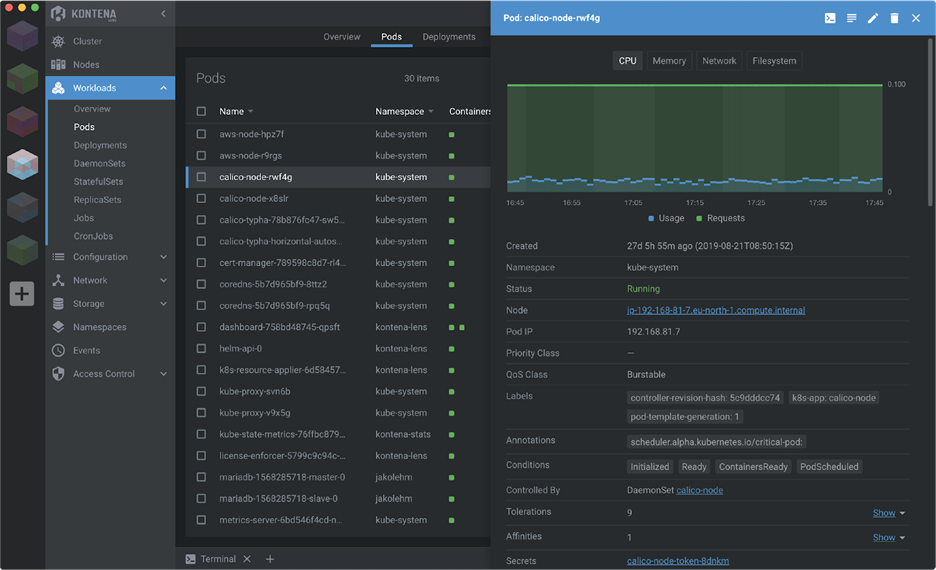
Image Credits: Mirantis
As for Lens, the new API, which will go live next week to coincide with KubeCon, will enable developers to extend the service with support for other Kubernetes-integrated components and services.
“Extensions API will unlock collaboration with technology vendors and transform Lens into a fully featured cloud native development IDE that we can extend and enhance without limits,” said Miska Kaipiainen, the co-founder of the Lens open-source project and senior director of engineering at Mirantis. “If you are a vendor, Lens will provide the best channel to reach tens of thousands of active Kubernetes developers and gain distribution to your technology in a way that did not exist before. At the same time, the users of Lens enjoy quality features, technologies and integrations easier than ever.”
The company has already lined up a number of popular CNCF projects and vendors in the cloud-native ecosystem to build integrations. These include Kubernetes security vendors Aqua and Carbonetes, API gateway maker Ambassador Labs and AIOps company Carbon Relay. Venafi, nCipher, Tigera, Kong and StackRox are also currently working on their extensions.
“Introducing an extensions API to Lens is a game-changer for Kubernetes operators and developers, because it will foster an ecosystem of cloud-native tools that can be used in context with the full power of Kubernetes controls, at the user’s fingertips,” said Viswajith Venugopal, StackRox software engineer and developer of KubeLinter. “We look forward to integrating KubeLinter with Lens for a more seamless user experience.”
Powered by WPeMatico
Video communication startup Livestorm announced today that it has raised $30 million in Series B funding.
Co-founder and CEO Gilles Bertaux told me that the company started out with a focus on webinars before launching a video meeting product as well (which we used for our interview).
“The way we think about it is, webinars and meetings are not use cases,” Bertaux said.
He argued that it’s more meaningful to talk about whether you’re having a team meeting or a training demo or whatever else, and then how many people you want to attend, with Livestorm supporting all of those use cases and meeting sizes through different templates: “We’re trying to remove the semantic distinction of meeting and webinar out of the equation.”
Among other things, Livestorm is distinguished from other video conferencing tools because it’s purely browser based, without requiring presenters or attendees to install any software. The company says it has grown revenue 8x since it raised its €4.6 million Series A last fall, with a customer base that now includes 3,500 customers such as Shopify, Honda and Sephora.
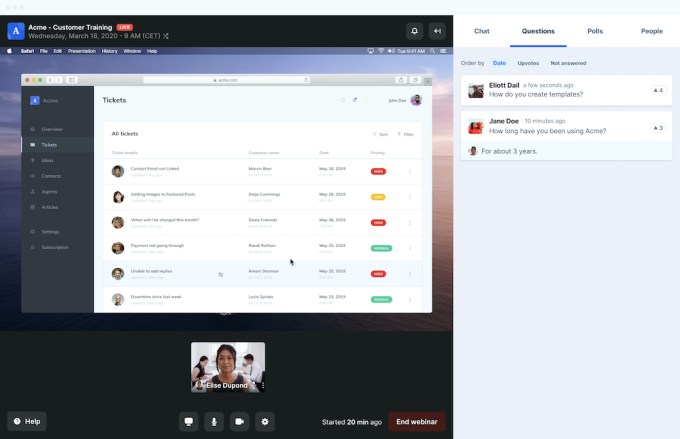
Image Credits: Livestorm
Of course, you’d expect a video communication product to do well in 2020. At the same time, Zoom has dominated the remote work conversation this year — in fact, Bertaux acknowledged that Zoom may have built “the best video meeting technology.”
But he also suggested that the landscape is changing: “The thing is, we’re entering a period where video is becoming a commodity.”
So the Livestorm team is less focused on the core video technology and more on the experience around the video, with in-meeting features like screen sharing and virtual background, as well as a broader suite of marketing tools that allow customers to continue delivering targeted messages to event attendees.
Bertaux compared Livestorm to HubSpot, which he said “didn’t reinvent landing pages,” but put the different pieces of the marketing stack together around those landing pages.

The Livestorm executive team. Image Credits: Livestorm
“In 2021, we want to have the biggest ecosystem of integrations on a video product,” he said.
The round was led by Aglaé Ventures and Bpifrance Digital Venture, with participation from Raise Ventures and IDInvest.
In a statement, Aglaé Ventures partner Cyril Guenoun similarly described Livestorm “the HubSpot for video communications,” adding, “Video and online events have become essential in 2020, and are here to stay. The Livestorm platform thrives in this environment, providing a seamless solution for meetings and events with all the connectors that marketing, sales, customer service and HR pros need to make video a tightly integrated part of their communications strategies.”
Bertaux said the new funding will allow Paris-headquartered Livestorm to continue expanding into North America — apparently, the U.S. already represents one-third of its customer base and is the company’s fastest-growing region.
Powered by WPeMatico
Menlo Security, a malware and phishing prevention startup, announced a $100 million Series E today on an $800 million valuation. The round was led by Vista Equity Partners with help from Neuberger Berman, General Catalyst, JP Morgan and other unnamed existing investors. The company has now raised approximately $250 million.
CEO and co-founder Amir Ben-Efraim says that while the platform has expanded over the years, the company stays mostly focused on web and email as major attack vectors for customers. “We really focused on a better kind of security outcome relative to the major threat factors of web and email. So web and email is really how most of the world or the enterprise world at least does its work, and these channels remain forever vulnerable to the latest attack,” Ben-Efraim explained.
He says that to protect those attack surfaces, the company pioneered a technology called web isolation to disconnect the user from the content and send only safe visuals. “When they click a link or engage with a website, the safe visuals are guaranteed to be malware-free, no matter where you go or you end up,” Ben-Efraim said.
With a valuation of $800 million, he’s proud having built his company from the ground up to this point. He’s not quite ready to discuss an IPO yet, but he expects to take this large influx of cash and continue to grow an independent company with an IPO perhaps three years out.
With an increase in business and the new capital, the company, which has 270 employees of which around 70 came on board this year, hopes to continue to grow at that pace in 2021. He says that as that happens the security startup has been paying close attention to the social justice movements.
“As a management team and for myself as a CEO, it’s an important topic. So we were paying close attention to our own diversification goals. We want Menlo to become a more diversified company,” Ben-Efraim said. He believes the way to get there is to prioritize recruiting channels where they can tap into a wider variety of potential recruits for the company.
While he wouldn’t discuss revenue, he did say in spite of the pandemic, the business is growing rapidly and sales are up 155% in terms of net new sales over last year. “The momentum for that being customers specifically in critical infrastructure, financial services, government and the like are seeing an uptick in attacks associated with COVID, and are looking at security as essential in an area that they need to double down on. So despite the financial difficulties, that’s created a bit of a tailwind for us strangely in 2020, even though the world economy as a whole is clearly being challenged by this epidemic,” he said.
Powered by WPeMatico