Enterprise
Auto Added by WPeMatico
Auto Added by WPeMatico
Solo.io, a Cambridge, Massachusetts service mesh startup, announced some big changes to its approach today with a full-stack platform of services aimed squarely at the enterprise. The culmination of this will be Gloo Mesh Enterprise, a new product that will be available in beta by the end of the year.
Service meshes are part of a cloud native, containerized approach to development that enable micro services to communicate with one another.
Idit Levine, founder and CEO at Solo, says that she began by creating individual components since launching the company in 2017 because she knew that it was early for service meshes. Today’s announcement is about bringing all of these components the company has created into a more coherent and connected enterprise product.
While she was worried at first that the pandemic would have a negative impact on business, she says that her company has been busier than ever and today’s announcement is really about giving customers what they have been asking for throughout this tumultuous year.
Most of Solo’s customers are running Kubernetes and they needed some missing pieces that Solo was happy to provide for them. The first problem is the primary reason the company started, which was to manage service meshes, and Gloo Mesh, which is based on the open-source Istio service mesh, helps developers manage their service mesh clusters.
Another problem involved running containers at the edge, which required an API gateway. To that end, the company announced Gloo Edge, an API gateway built on the Envoy Proxy, an edge service proxy. Running applications at the edge means they get the resources they need to improve performance and save bandwidth.
The third piece is called Gloo Portal. This provides a centralized, self-service catalog of services that developers can tap into as they are building their applications. The final piece is Gloo Extensions, which provides a way for developers to access or build extensions called web assembly modules.
All of these pieces are available as open source, but companies that want additional functionality and support and a way to connect all of these pieces will need to buy the enterprise product. Among the additional features in the enterprise version is the ability to apply roles to the APIs in Gloo Edge to control who has access. Gloo Mesh users get production Istio support including updates and patches. It also includes a dashboard for managing clusters and developer tools for building web assembly pieces in Gloo Extension.
The company has raised more than $36 million, according to PitchBook data. The most recent deal was $23 million in September. Levine says the startup has several dozen large customers at this point, and 35 employees. She said she is actively hiring and expects to be at 50 soon.
Powered by WPeMatico
mmhmm, the presentation software developed by Evernote founder Phil Libin, is today coming out of beta. The mmhmm app is now officially available for Mac.
The software allows folks to spice up their video calls with the ability to add different backgrounds, play videos, add images and use filters, among other cool effects. The app has been invite-only since its inception, but today it becomes available to all.
Alongside the launch of the free app, mmhmm is also introducing Premium Tools.
This includes customizable rooms, presenter controls and extra add-ons like laser pointers. Users can get a free seven-day trial of the Premium Tools, and after the trial will have access to these tools for one hour per day. The Premium Tools will cost $99/year or $9.99/month, but free users will still be able to video chat, record, collaborate and use the basic present with a default background and simple presenter mode.
Another important note: mmhmm has decided to make its Premium Tools free to students and educators for one year.
The public launch also brings a handful of new features, including Big Hand Mode (which lets folks in the video call visually react), improvements to the appearance of mmhmm’s virtual green screen and mmhmm Creative Services.
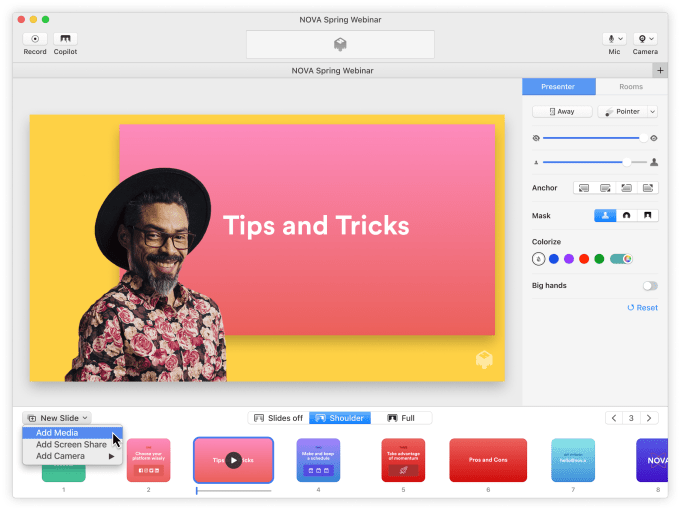
Image Credits: mmhmm
Big Hand Mode is only available on Apple’s new M1-powered Macs.
Creative Services represent another revenue channel for the company, which will now offer white-glove bespoke services to folks running large events or experiences.
For now, mmhmm is only available on MacOS, but the company is working on a Windows beta as we speak.
Powered by WPeMatico

AI and data analytics company Databricks today announced the launch of SQL Analytics, a new service that makes it easier for data analysts to run their standard SQL queries directly on data lakes. And with that, enterprises can now easily connect their business intelligence tools like Tableau and Microsoft’s Power BI to these data repositories as well.
SQL Analytics will be available in public preview on November 18.
In many ways, SQL Analytics is the product Databricks has long been looking to build and that brings its concept of a “lake house” to life. It combines the performance of a data warehouse, where you store data after it has already been transformed and cleaned, with a data lake, where you store all of your data in its raw form. The data in the data lake, a concept that Databricks’ co-founder and CEO Ali Ghodsi has long championed, is typically only transformed when it gets used. That makes data lakes cheaper, but also a bit harder to handle for users.

Image Credits: Databricks
“We’ve been saying Unified Data Analytics, which means unify the data with the analytics. So data processing and analytics, those two should be merged. But no one picked that up,” Ghodsi told me. But “lake house” caught on as a term.
“Databricks has always offered data science, machine learning. We’ve talked about that for years. And with Spark, we provide the data processing capability. You can do [extract, transform, load]. That has always been possible. SQL Analytics enables you to now do the data warehousing workloads directly, and concretely, the business intelligence and reporting workloads, directly on the data lake.”
The general idea here is that with just one copy of the data, you can enable both traditional data analyst use cases (think BI) and the data science workloads (think AI) Databricks was already known for. Ideally, that makes both use cases cheaper and simpler.
The service sits on top of an optimized version of Databricks’ open-source Delta Lake storage layer to enable the service to quickly complete queries. In addition, Delta Lake also provides auto-scaling endpoints to keep the query latency consistent, even under high loads.
While data analysts can query these data sets directly, using standard SQL, the company also built a set of connectors to BI tools. Its BI partners include Tableau, Qlik, Looker and ThoughtSpot, as well as ingest partners like Fivetran, Fishtown Analytics, Talend and Matillion.

Image Credits: Databricks
“Now more than ever, organizations need a data strategy that enables speed and agility to be adaptable,” said Francois Ajenstat, chief product officer at Tableau. “As organizations are rapidly moving their data to the cloud, we’re seeing growing interest in doing analytics on the data lake. The introduction of SQL Analytics delivers an entirely new experience for customers to tap into insights from massive volumes of data with the performance, reliability and scale they need.”
In a demo, Ghodsi showed me what the new SQL Analytics workspace looks like. It’s essentially a stripped-down version of the standard code-heavy experience with which Databricks users are familiar. Unsurprisingly, SQL Analytics provides a more graphical experience that focuses more on visualizations and not Python code.
While there are already some data analysts on the Databricks platform, this obviously opens up a large new market for the company — something that would surely bolster its plans for an IPO next year.
Powered by WPeMatico
Fishtown Analytics, the Philadelphia-based company behind the dbt open-source data engineering tool, today announced that it has raised a $29.5 million Series B round led by Sequoia Capital, with participation from previous investors Andreessen Horowitz and Amplify Partners.
The company is building a platform that allows data analysts to more easily create and disseminate organizational knowledge. Its focus is on data modeling, with its dbt tool allowing anybody who knows SQL to build data transformation workflows. Dbt also features support for automatically testing data quality and documenting changes, but maybe most importantly it uses standard software engineering techniques to help engineers collaborate on code and integrate changes continuously.
If this all sounds a bit familiar, it’s probably because you saw that Fishtown Analytics also announced a $12.9 million Series A round in April. It’s not often we see both a Series A and B round within half a year, but that goes to show how the market for Fishtown’s service is expanding as companies continue to grapple with how to best make use of their data — and how much investors want to be part of that.
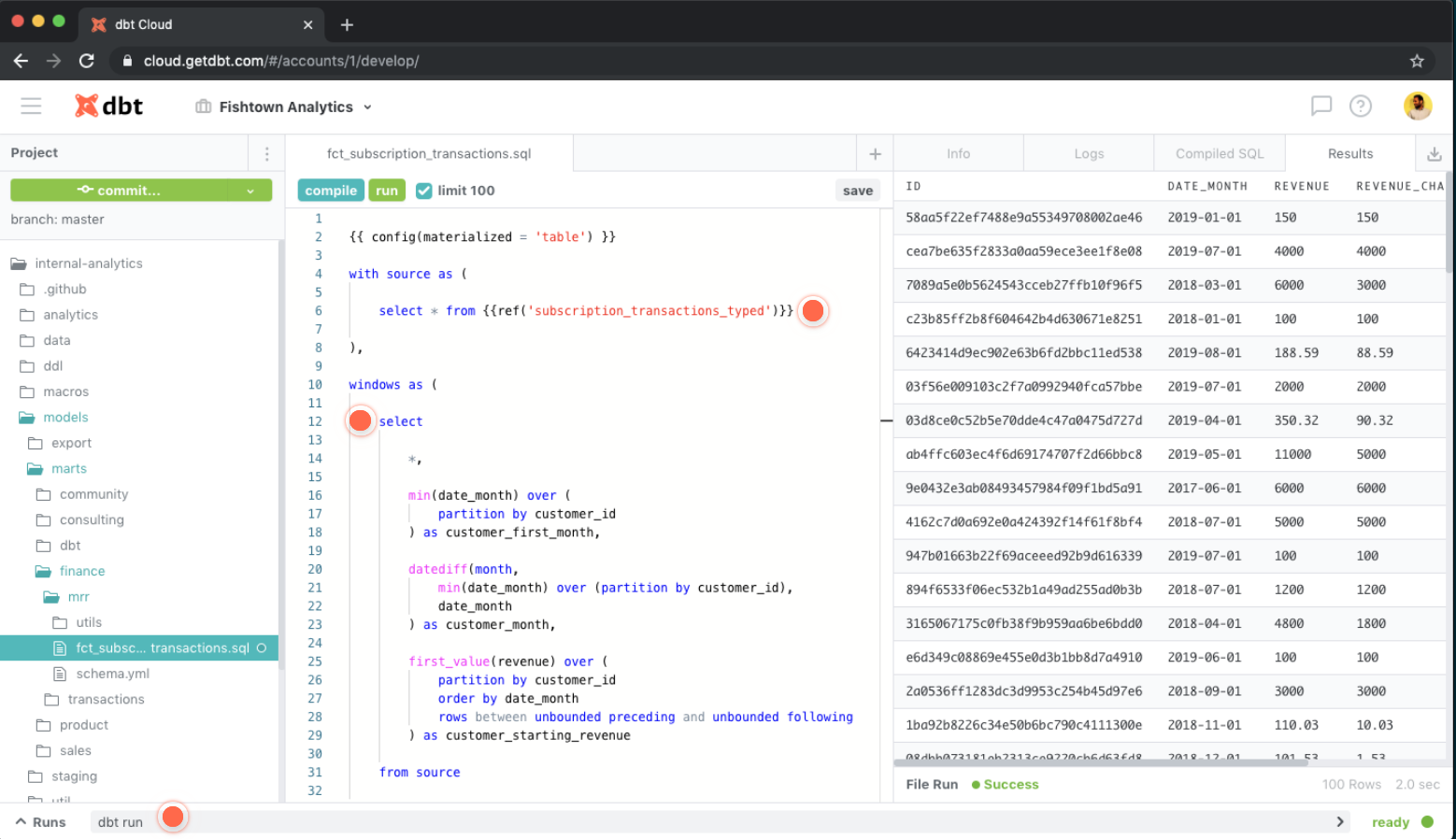
Image Credits: Fishtown
“This was a very productive thing for us,” Fishtown Analytics co-founder and CEO Tristan Handy told me when I asked him why he raised again so quickly. “It’s standard best practice to do quarterly catch-ups with investors and eventually you’ll be ready to fundraise. And Matt Miller from Sequoia showed up to one of these quarterly catch-ups and he shared the 40-page memo that he had written to the Sequoia partnership — and he came with the term sheet.”
Initially, Handy declined. “We’re very bullheaded people, I think, as many founders are. It took some real reflection and thinking about, ‘is this what we want to be doing right now?’ ”
In the end, though, the team decided to go ahead with this round — mostly because this round allowed the team to think long-term and provided stability and certainty.
One thing Handy has always been very clear about is that he did not found Fishtown to purely build the largest possible company but to solve its users’ problems, even as the market looked at companies like Databricks and Snowflake — and their financial success — as potential analogs. “My worry was that the financial markets were driving things that weren’t necessarily going to be good for our users,” Handy said.
Powered by WPeMatico
Last week was a busy week, what with an election in Myanmar and all (well, and the United States, I guess). So perhaps you were glued to your TV or smartphone, and missed out on our conversation with Asheem Chandna, a long-time partner at Greylock who has invested in enterprise and cybersecurity startups for nearly two decades now, backing such notable companies as Palo Alto Networks, AppDynamics and Sumo Logic. We have more Extra Crunch Live shows coming up.
Enterprise software is changing faster this year than it has in a decade. Coronavirus, remote work, collaboration and new cybersecurity threats have combined to force companies to rethink their IT strategies, and that means more opportunities — and challenges — for enterprise founders than ever before. In some cases, we are seeing an acceleration of existing trends, and in others, we are seeing all new trends come to the forefront.
All that is to say that there was so much on the docket to talk about last week. Chandna and I discussed what’s happening in early-stage enterprise startups, whether vertical SaaS is the future of enterprise investing, data and no-code platforms, and then this rise of “shift left” security.
The following interview has been edited and condensed from our original Extra Crunch Live conversation.
Chandna has been a long-time backer of startups at their earliest stages, with some of his investments being literally birthed in Greylock’s offices. So I was curious how he saw the landscape today given all that prior experience.
TechCrunch: What sort of companies are exciting for you today? Are there particular markets you’re particularly attuned to?
Asheem Chandna: One is digital transformation. Every company is trying to figure out how to become more digital, and this has been accelerated by COVID-19. Second is information technology today and its journey to the cloud. I would say we might be about 10% or 15% of the way there. Some of the trends are clear, but the journey is actually still relatively early, and so there’s just a ton of opportunity ahead.
The third one is leveraging data for better predictability along with analytics. Every CEO is looking to make better decisions. And you know, most leaders make decisions based on gut instinct and a combination of data. If the data can tell a story, if the data can help you better predict, there’s a lot of potential here.
I view these as three macro trends, and then if one was to add to that, I would say cybersecurity has never been more important than it is today. I’ve been around cyber for over two decades, and just the prominence and importance and priority has never been more important than today. So that’s kind of another key area.
I want to dive into your first category, digital transformation. This is a phrase that I feel like I’ve heard for a decade now, with “Data is the new oil” and all these sorts of buzzwords and marketing phrases. Where are we in that process? Are we at the beginning? Are we at the end? What’s next from a startup perspective?
Due to COVID-19 and because of the way people are working today, digital’s become the primary medium. I would still say we’re early, and you can literally look sector by sector to see how much more work there is to do here.
Take enterprise sales itself, which is early in what I consider digitalization. It’s even more important today than it was a year ago. I’m using video to basically communicate, and then the next piece would basically be trialing of software. Can I allow even complex software to be self trials and can I measure the customer journey through that trial? Then there’s the contracting of the software, and we go to the sale process, can all that be done digitally?
So even when you take something as very mundane as enterprise sales, it’s being transformed. Winning teams, winning software entrepreneurs, they understand this well, and they’d be wise to examine every step of this process, and instrument it and digitize it.
Powered by WPeMatico
Software is eating the world, and that grub can be costly. As the market for enterprise tools and software continues to balloon, organizations are spending more and more on that software across an increasingly complicated and rapidly evolving landscape.
That’s where Clearfind comes in.
Clearfind was founded (and bootstrapped) by James Layfield and Jocelyn Simons. The startup aims to provide clarity and transparency to organizations looking to buy enterprise software. Over the past two years, Clearfind has been building out its backend, which is a mix of machine learning and humans, to distill a software offering down to its features.
When clients join the Clearfind platform, they give the startup access to their backend through integrations with products like Sage, Quickbooks, SAP, etc. so that Clearfind can take a look at their overall software spend. CIOs or CTOs can then see if there are any redundancies in their current software suite. These executives can also input the use case they’re looking to solve and Clearfind will deliver a detailed report on which SaaS products have the features to solve for it.
Before Clearfind, this process could be incredibly manual or costs tens and sometimes hundreds of thousands of dollars through a consultancy. And even then, those consultants may likely be recommending the products that have paid for top placement, not necessarily the best fit.

Image Credits: Clearfind
Clearfind makes money by charging 1.2 cents per dollar of annual software spend. The company says that it usually reduces spend by about 30 percent for most of the companies it works with by helping them optimize their software ecosystem and eliminate redundancies.
Clearfind also generates revenue through referral fees that come from search within Clearfind. Layfield and Simons were clear that vendors can not pay to influence search results or for placement on the Clearfind front-end, but rather pay for the leads that come through. These fees vary from vendor to vendor.
“When a vendor gets a lead from us, they prioritize it because it’s the most qualified lead they’ll ever get,” said Layfield. “That vendor will know everything. about the buyer and that the buyer is looking for all the criteria their product meets, and how much the buyer is willing to pay. That’s a level of qualified lead that just does not exist.”
Layfield explained there is an even more important reason for vendors to pay a referral fee, which is the implied LTV of a Clearfind lead. A customer that actually wants and needs the product, and the features it provides, is far less likely to churn.
Clearfind isn’t alone in the space. YC-backed Vendr, which is already profitable, is also looking to reduce SaaS spend and Intello, which doesn’t just give a view of software in use but also includes a compliance component.
Powered by WPeMatico
Palo Alto Networks has been on a buying binge for the last couple of years, and today it added to its haul, announcing a deal to acquire Expanse for $800 million in cash and equity awards. The deal breaks down to $670 million in cash and stock and another $130 million in equity awards to Expanse employees.
Expanse provides a service to help companies understand and protect their attack surface, where they could be most vulnerable to attack. It works by giving the security team a view of how the company’s security profile could look to an attacker trying to gain access.
The plan is to fold Expanse into Palo Alto’s Cortex Suite, an AI-driven set of tools designed to detect and prevent attacks in an automated way. Expanse should provide Palo Alto with a highly valuable set of data to help feed the AI models.
“By integrating Expanse’s attack surface management capabilities into Cortex after closing, we will be able to offer the first solution that combines the outside view of an organization’s attack surface with an inside view to proactively address all security threats,” Palo Alto Networks chairman and CEO Nikesh Arora said in a statement.
Expanse sees the acquisition as a way to accelerate the company road map using the resources of a larger company like Palo Alto, a typical argument from companies being acquired. “Joining forces with Palo Alto Networks will let us achieve our most important business goals years ahead of schedule. During the course of conversations with Palo Alto Networks leadership, we shared optimism that the right combination of technology and people can solve many cybersecurity challenges that to date have seemed intractable,” the startup’s founders wrote in a blog post announcing the deal.
The two co-founders, Dr. Tim Junio and Dr. Matt Kraning, will be joining Palo Alto under the terms of the deal, which is expected to close in Palo Alto’s fiscal second quarter, assuming it passes regulatory muster.
Expanse was founded in 2012 and has raised $136 million, according to Crunchbase data. Its most recent raise was a $70 million Series C last year, which was led by TPG.
Today’s acquisition is Palo Alto’s third in 2020 and the 10th since 2018. Palo Alto stock was up 2.15% in early trading.
Powered by WPeMatico
Mozart Data founders Peter Fishman and Dan Silberman have been friends for over 20 years, working at various startups, and even launching a hot sauce company together along the way. As technologists, they saw companies building a data stack over and over. They decided to provide one for them and Mozart Data was born.
The company graduated from the Y Combinator Summer 2020 cohort in August and announced a $4 million seed round today led by Craft Ventures and Array Ventures with participation from Coelius Capital, Jigsaw VC, Signia VC, Taurus VC and various angel investors.
In spite of the detour into hot sauce, the two founders were mostly involved in data over the years and they formed strong opinions about what a data stack should look like. “We wanted to bring the same stack that we’ve been building at all these different startups, and make it available more broadly,” Fishman told TechCrunch.
They see a modern data stack as one that has different databases, SaaS tools and data sources. They pull it together, process it and make it ready for whatever business intelligence tool you use. “We do all of the parts before the BI tool. So we extract and load the data. We manage a data warehouse for you under the hood in Snowflake, and we provide a layer for you to do transformations,” he said.
The service is aimed mostly at technical people who know some SQL like data analysts, data scientists and sales and marketing operations. They founded the company earlier this year with their own money, and joined Y Combinator in June. Today, they have about a dozen customers and six employees. They expect to add 10-12 more in the next year.
Fishman says they have mostly hired from their networks, but have begun looking outward as they make their next hires with a goal of building a diverse company. In fact, they have made offers to several diverse candidates, who didn’t ultimately take the job, but he believes if you start looking at the top of the funnel, you will get good results. “I think if you spend a lot of energy in terms of top of funnel recruiting, you end up getting a good, diverse set at the bottom,” he said.
The company has been able to start from scratch in the midst of a pandemic and add employees and customers because the founders had a good network to pitch the product to, but they understand that moving forward they will have to move outside of that. They plan to use their experience as users to drive their message.
“I think talking about some of the whys and the rationale is our strategy for adding value to customers […], it’s about basically how would we set up a data stack if we were at this type of startup,” he said.
Powered by WPeMatico
This year, more than ever before because of the COVID-19 pandemic, huge droves of workers and consumers have been turning to the internet to communicate, get things done and entertain themselves. That has created a huge bonanza for cybercriminals, but also companies that are building tools to combat them.
In the latest development, an Israel-hatched, Mountain View-based enterprise startup called SentinelOne — which has built a machine learning-based solution that it sells under the brand Singularity that works across the entire edge of the network to monitor and secure laptops, phones, containerised applications and the many other devices and services connected to a network — has closed $267 million in funding to continue expanding its business to meet demand, which has seen business boom this year. Its valuation is now over $3 billion.
Given the large sums the company has now raised — $430 million to date — the funding will likely be used for acquisitions (cyber is a very crowded market and will likely see some strong consolidation in the coming years), as well as more in-house development and sales and marketing. Earlier this year, CEO and founder Tomer Weingarten told me that an IPO “would be the next logical step” for the company. “But we’re not in any rush,” he said at the time. “We have one to two years of growth left as a private company.”
SentinelOne contacted TechCrunch with the above details but said that an official press release was due only to be released at 3 p.m. U.K. time. We’ll update with more details if they’re available when they are published. In the meantime, other outlets such as Calcalist in Israel (in Hebrew) have also published these details. And it should be noted that the round was rumored for almost a month ahead of this, although the sums raised were off by quite a bit: the reports had said $150-200 million.
(Side note: Why the pointless games with timings and exclusives? Who knows — I certainly don’t. )
This round included Tiger Global, Sequoia, Insight Partners, Third Point Ventures and Qualcomm Ventures . It looks like Sequoia — which is currently building up a new European operation to look more closely at opportunities on this side of the globe — is the only new name in that list. The others have all backed SentinelOne in previous rounds.
It was only in February of this year that SentinelOne had raised $200 million at a $1.1 billion valuation.
The rapid fundraising, from a top-shelf list of firms, is a notable aspect of this story.
In the world of startups, we are firmly living in a time when investors are looking for strong opportunities to back companies that are shining in a market that is particularly challenging. COVID-19 has all but decimated the travel industry and live in-person event industry, among others.
But services that are helping people continue to live their lives, and those that are helping find a cure or at least solutions to minimise the impact, are very much in demand.
The cybersecurity market — in particular companies that are providing solutions that can immediately prove to be effective in what is an increasingly sophisticated threat landscape — is incredibly active right now, even more than it already was.
“Around 450 cybersecurity companies are operating in Israel, constituting 5% of the global cybersecurity market, in some cyber segments the two world leaders are by Israeli founders like CheckPoint and Palo Alto,” noted Avihai Michaeli, an advisor who scouts startups for corporate VCs.
Within that, endpoint security, the area where SentinelOne concentrates its efforts, is particularly strong. Last year, endpoint security solutions was estimated to be around an $8 billion market, and analysts project that it could be worth as much as $18.4 billion by 2024.
While SentinelOne has a lot of competitors — they include Microsoft, CrowdStrike, Kaspersky, McAfee and Symantec — it is also a strong player in the market. Relying on the advances of AI and with roots in the Israeli cyberintelligence community, its platform is built around the idea of working automatically not just to detect endpoints and their vulnerabilities, but to apply behavioral models, and various modes of protection, detection and response in one go.
“We are seeing more automated and real-time attacks that themselves are using more machine learning,” Weingarten said to me this year. “That translates to the fact that you need defence that moves in real time as with as much automation as possible.”
As of February, it had 3,500 customers, including three of the biggest companies in the world, and “hundreds” from the global 2,000 enterprises, with 113% year-on-year new bookings growth, revenue growth of 104% year-on-year and 150% growth year-on-year in transactions over $2 million. Those numbers will have likely grown significantly since then. (We’ll update as and when we learn more.)
Powered by WPeMatico
When IBM announced it was spinning out its infrastructure services business last month, it was surely a sign that the company was going all in on hybrid cloud. Today in an interview with Jon Fortt at the CNBC Evolve summit, IBM CEO Arvind Krishna made it clear that his whole focus is going to be on transforming his organization into a hybrid cloud management vendor moving forward.
That means that instead of trying to primarily sell its own infrastructure or software services — although it will continue to do that — it will concentrate on leveraging Red Hat, the company it bought for $34 billion in 2018, to help customers manage their hybrid environments regardless of location. That could be on prem or it could be with any of the public cloud providers or anything in between.
Krishna sees this acquisition as a key part of the transition strategy to capture what he estimates is a trillion dollar opportunity in the hybrid cloud management market, and he believes his company is well-positioned to grab a piece of that. “The Red Hat acquisition gave us the technology base on which to build a hybrid cloud technology platform based on open-source, and based on giving choice to our clients as they embark on this journey. With the success of that acquisition now giving us the fuel, we can then take the next step, and the larger step, of taking the managed infrastructure services out. So the rest of the company can be absolutely focused on hybrid cloud and artificial intelligence,” Krishna told CNBC.
While he recognizes that Microsoft and Amazon are powerful players in the public cloud, he doesn’t see them as competitors, so much as partners in this new approach. In fact, mixing in a broad variety of third party partners is a big part of this.
“I look at both Microsoft and Amazon as likely partners in this journey, not as being the one and two [in market share]. In the hybrid world the question is where does the client want to decide where the workload runs? They could run it on Amazon. They can run on Microsoft. They can run it on IBM or they can run it on premises,” he said.
He believes that Red Hat can be the glue to hold this environment together and let customers have a single way of managing this complexity. The key question for IBM is whether customers see IBM and by extension Red Hat, as the key vendor for this role.
He recognizes that this isn’t just about adding and subtracting technology pieces. When it comes to transforming the way you do business in this way, it requires a massive cultural shift, one we saw Satya Nadella pull off when he took over as CEO at Microsoft in 2014. Much like Nadella, Krishna was promoted from within. He understands how things operate and that he needs to change the way things have traditionally been done at Big Blue if he’s going to succeed.
“I’ve talked a lot internally about a growth mindset, and about being much more entrepreneurial. And we can be entrepreneurs, even within large companies. But it comes from having extreme focus. So when we provide the focus of being focused on hybrid cloud and artificial intelligence, which I believe are the two fundamental forces, then you say how do you unlock everybody being able to go after that,” he said.
That’s going to be the big key for him moving forward as transforming a company the size of IBM is going to be a tremendous challenge for him as a leader. As Fortt pointed out, IBM salespeople are used to focusing on IBM products. This approach means they have to look at the market much more broadly, and that requires a new mindset. It will be up to Krishna to lead the way and make sure that his employees are on the same page about this. The success of this approach depends on that.
Powered by WPeMatico