Enterprise
Auto Added by WPeMatico
Auto Added by WPeMatico
Aquarium, a startup from two former Cruise employees, wants to help companies refine their machine learning model data more easily and move the models into production faster. Today the company announced a $2.6 million seed led by Sequoia with participation from Y Combinator and a bunch of angel investors, including Cruise co-founders Kyle Vogt and Dan Kan.
When the two co-founders, CEO Peter Gao and head of engineering Quinn Johnson, were at Cruise they learned that finding areas of weakness in the model data was often the problem that prevented it from getting into production. Aquarium aims to solve this issue.
“Aquarium is a machine learning data management system that helps people improve model performance by improving the data that it’s trained on, which is usually the most important part of making the model work in production,” Gao told me.
He says that they are seeing a lot of different models being built across a variety of industries, but teams are getting stuck because iterating on the data set and continually finding relevant data is a hard problem to solve. That’s why Aquarium’s founders decided to focus on this.
“It turns out that most of the improvement to your model, and most of the work that it takes to get it into production is about deciding, ‘Here’s what I need to go and collect next. Here’s what I need to go label. Here’s what I need to go and retrain my model on and analyze it for errors and repeat that iteration cycle,” Gao explained.
The idea is to get a model into production that outperforms humans. One customer, Sterblue, offers a good example. They provide drone inspection services for wind turbines. Their customers used to send out humans to inspect the turbines for damage, but with a set of drone data, they were able to train a machine learning model to find issues. Using Aquarium, they refined their model and improved accuracy by 13%, while cutting the cost of human reviews in half, Gao said.

The Aquarium team. Image: Aquarium
Aquarium currently has seven employees, including the founders, of which three are women. Gao says that they are being diverse by design. He understands the issues of bias inherent in machine learning model creation, and creating a diverse team for this kind of tooling is one way to help mitigate that bias.
The company launched last February and spent part of the year participating in the Y Combinator Summer 2020 cohort. They worked on refining the product throughout 2020, and recently opened it up from beta to generally available.
Powered by WPeMatico
Virtual events platform Hopin is hopin’ for a mega valuation.
According to multiple sources who spoke with TechCrunch, the company, which was founded in mid-2019, is running around the fundraise circuit and perhaps nearing the end of a fundraise in which it is looking to raise roughly $400 million at a pre-money valuation of $5 billion for its Series C. The two names out in front, likely part of a joint ticket, are thought to be Andreessen Horowitz and General Catalyst.
Two sources implied that the valuation could have gone as high as $6 billion, but with greater dilution based on some offered terms the company has received. The deal is in flux, and both the round size and valuation are subject to change.
One source told TechCrunch that the company’s ARR has grown to $60 million, implying a valuation multiple of 80-100x if the valuation we’re hearing pans out. That sort of multiple wouldn’t be out of line with other major fundraises for star companies with SaaS-based business models.
Hopin has been on a fundraise tear in recent months. The company raised $125 million at a $2.125 billion valuation late last year for its Series B, which came just a few months after it raised a Series A of $40 million over the summer and a $6.5 million seed round last winter. All told, the roughly 20-month-old company has raised a known $171.4 million in VC according to Crunchbase.
When we last reported on the company, Hopin’s ARR had gone from $0 to $20 million, while its overall userbase had grown from essentially zero to 3.5 million users in November. The company reported then that it had 50,000 groups using its platform.
Hopin’s platform is designed to translate the in-person events experience into a virtual one, providing tools to recreate the experience of walking exhibition floors, networking one-on-one and spontaneously joining fireside chats and panels. It’s become a darling in the midst of the COVID-19 pandemic, which has seen most business and educational conferences canceled in the midst of mass restrictions on domestic and international travel worldwide.

It’s probably also useful to note that our business team uses Hopin to run all of TechCrunch’s editorial events, including Disrupt, Early Stage, Extra Crunch Live and next week’s TechCrunch Sessions: Justice 2021 event (these software selections and their costs are — thankfully — outside the purview of our editorial team).
Hopin may be the mega-leader of the virtual events space right now, but it isn’t the only startup trying to take on this suddenly vital industry. Run The World raised capital last year, Welcome wants to be the “Ritz-Carlton for event platforms,” Spotify is getting into the business, Clubhouse is arguably a contender here, InEvent raised a seed earlier this month and Hubilo is another entrant, which nabbed a check from Lightspeed a few months ago. Plus, quite literally dozens of other startups have either started in the space or are pivoting toward it.
We have reached out to Hopin for comment.
Post updated to report that Andreessen Horowitz and General Catalyst are in the lead.
Powered by WPeMatico
Many companies spend a significant amount of money and resources processing data from logs, traces and metrics, forcing them to make trade-offs about how much to collect and store. Hydrolix, an early-stage startup, announced a $10 million seed round today to help tackle logging at scale, while using unique technology to lower the cost of storing and querying this data.
Wing Venture Capital led the round with help from AV8 Ventures, Oregon Venture Fund and Silicon Valley Data Capital.
Company CEO and co-founder Marty Kagan noted that in his previous roles, he saw organizations with tons of data in logs, metrics and traces that could be valuable to various parts of the company, but most organizations couldn’t afford the high cost to maintain these records for very long due to the incredible volume of data involved. He started Hydrolix because he wanted to change the economics to make it easier to store and query this valuable data.
“The classic problem with these cluster-based databases is that they’ve got locally attached storage. So as the data set gets larger, you have no choice but to either spend a ton of money to grow your cluster or separate your hot and cold data to keep your costs under control,” Kagan told me.
What’s more, he says that when it comes to querying, the solutions out there like BigQuery and Snowflake are not well-suited for this kind of data. “They rely really heavily on caching and bulk column scans, so they’re not really useful for […] these infrastructure plays where you want to do livestream ingest, and you want to be able to do ad hoc data exploration,” he said.
Hydrolix wanted to create a more cost-effective way of storing and querying log data, while solving these issues with other tooling. “So we built a new storage layer which delivers […] SSD-like performance using nothing but cloud storage and diskless spot instances,” Kagan explained. He says that this means that there is no caching or column scales, enabling them to do index searches. “You’re getting the low cost, unlimited retention benefits of cloud storage, but with the interactive performance of fully indexed search,” he added.
Peter Wagner, founding partner at investor Wing Venture Capital, says that the beauty of this tool is that it eliminates trade-offs, while lowering customers’ overall data processing costs. “The Hydrolix team has built a real-time data platform optimized not only to deliver superior performance at a fraction of the cost of current analytics solutions, but one architected to offer those same advantages as data volumes grow by orders of magnitude,” Wagner said in a statement.
It’s worth pointing out that in the past couple of weeks SentinelOne bought high-speed logging platform Scalyr for $155 million, then CrowdStrike grabbed Humio, another high-speed logging tool for $400 million, so this category is getting attention.
The product is currently compatible with AWS and offered through the Amazon Marketplace, but Kagan says they are working on versions for Azure and Google Cloud and expect to have those available later this year. The company was founded at the end of 2018 and currently has 20 employees spread out over six countries, with headquarters in Portland, Oregon.
Powered by WPeMatico
Engineering teams face steep challenges when it comes to staying on schedule, and keeping to those schedules can have an impact on the entire organization. Acumen, an Israeli engineering operations startup, announced a $7 million seed investment today to help tackle this problem.
Hetz, 10D, Crescendo and Jibe participated in the round, designed to give the startup the funding to continue building out the product and bring it to market. The company, which has been working with beta customers for almost a year, also announced it was emerging from stealth today.
As an experienced startup founder, Acumen CEO and co-founder Nevo Alva has seen engineering teams struggle as they grow due to a lack of data and insight into how the teams are performing. He and his co-founders launched Acumen to give companies that missing visibility.
“As engineering teams scale, they face challenges due to a lack of visibility into what’s going on in the team. Suddenly prioritizing our tasks becomes much harder. We experience interdependencies [that have an impact on the schedule] every day,” Alva explained.
He says this manifests itself in a decrease in productivity and velocity and ultimately missed deadlines that have an impact across the whole company. What Acumen does is collect data from a variety of planning and communications tools that the engineering teams are using to organize their various projects. It then uses machine learning to identify potential problems that could have an impact on the schedule and presents this information in a customizable dashboard.
The tool is aimed at engineering team leaders, who are charged with getting their various projects completed on time with the goal of helping them understand possible bottlenecks. The software’s machine learning algorithms will learn over time which situations cause problems, and offer suggestions on how to prevent them from becoming major issues.
The company was founded in July 2019 and the founders spent the first 10 months working with a dozen design partners building out the first version of the product, making sure it could pass muster with various standards bodies like SOC-2. It has been in closed private beta since last year and is launching publicly this week.
Acumen currently has 20 employees with plans to add 10 more by the end of this year. After working remotely for most of 2020, Alva says that location is no longer really important when it comes to hiring. “It definitely becomes less and less important where they are. I think time zones are still a consideration when speaking of remote,” he said. In fact, they have people in Israel, the U.S. and eastern Europe at the moment among their 20 employees.
He recognizes that employees can feel isolated working alone, so the company has video meetings every day during which they spend the first part just chatting about non-work stuff as a way to stay connected. Starting today, Acumen will begin its go to market effort in earnest. While Alva recognizes there are competing products out there like Harness and Pinpoint, he thinks his company’s use of data and machine learning really helps differentiate it.
Powered by WPeMatico
The concept of the “marketing cloud” — sold by the likes of Salesforce, Oracle and Adobe — has become a standard way for large tech companies to package together and sell marketing tools to businesses that want to improve how they use digital channels to grow their business.
Some argue, however, that “cloud”, singular, might be a misnomer: typically those tools are not integrated well with each other and effectively are run as separate pieces of software. Today a startup called Blueshift — which claims to offer an end-to-end marketing stack, by having built it from the ground up to include both traditional marketing data as well as customer experience — is announcing some funding, pointing to the opportunity to build more efficient alternatives.
The startup has closed a round of $30 million, a Series C that co-founder and CEO Vijay Chittoor said it will be using to expand to more markets (it’s most active in the U.S. and Europe currently) and also to expand its technology.
“The product already has a unified format, to ingest data from multiple sources and redistribute that out to apps. Now, we want to distribute that data to more last-mile applications,” he said in an interview. “Our biggest initiative is to scale out the notion of us being not just an app but a platform.”
The company’s customers include LendingTree, Discovery Inc., Udacity, BBC and Groupon, and it has seen revenue growth of 858% in the last three years, although it’s not disclosing actual revenues, nor valuation, today.
The round is being led by Fort Ross Ventures, with strong participation also from Avatar Growth Capital. Past investors Softbank Ventures Asia (which led its last round of $15 million), Storm Ventures, Conductive Ventures and Nexus Venture Partners also invested.
The concept for Blueshift came out of Chittoor’s direct experience at Groupon — which acquired his previous startup, social e-commerce company Mertado — and before that a long period at Walmart Labs — which Walmart rebranded after it acquired another startup where Chittoor was an early employee, semantic search company Kosmix.
“The challenges we are solving today we saw firsthand as challenges our customers saw at Groupon and Walmart,” he said. “The connected customer journey is creating a thousand times more data than before, and people and brands are engaging across more touchpoints. Tracking that has become harder with legacy channel-centric applications.”
Blueshift’s approach for solving that has been, he said, “to unify the data and to make decisions at customer level.”
That is to say, although the customer experience today is very fragmented — you might potentially encounter something about a company or brand in multiple places, such as in a physical environment, on various social media platforms, in your email, through a web search, in a vertical search portal, in a marketplace on a site, in an app, and so on — the experience for marketers should not be.
The company addresses this by way of a customer data platform (CDP) it markets as “SmartHub.” Designed for non-technical users although customizable by engineers if you need it to be, users can integrate different data feeds from multiple sources, which then Blueshift crunches and organises to let you view in a more structured way.
That data can then be used to power actions in a number of places where you might be setting up marketing campaigns. And Chittoor pointed out — like other marketing people have — that these days, the focus on that is largely first-party data to fuel that machine, rather than buying in data from third-party sources (which is definitely part of a bigger trend).
“Our mission is to back category-leading companies that are poised to dominate a market. Blueshift clearly stood out to us as the leader in the enterprise CDP space,” said Ratan Singh of Fort Ross Ventures in a statement. “We are thrilled to partner with the Blueshift team as they accelerate the adoption of their SmartHub CDP platform.” Singh is joining Blueshift’s board with this round.
Powered by WPeMatico
Slack took the workplace communications landscape by storm after it launched its integration-friendly, GIF-tastic chat platform in 2013. Within the space of a decade it entered into the pantheon of Big Tech: First with massive growth and usage, then a series of giant VC rounds and valuations, spawning controversial competition from incumbents, followed by a public listing and ultimately a $27.7 billion acquisition by Salesforce. Now that the cycle is complete, the decks are clear for a Slack disruptor!
Today, a new app quietly launched out of stealth called Quill, available by way of apps for the web, MacOS, Windows, Linux, Android and iOS.
Like Slack, Quill is a messaging app for co-workers to update each other on what they are doing, have conversations about projects and more. It is (also like Slack) priced as a freemium service, with a $15 per user, per month tier giving users more message history and storage. An enterprise tier is also on the cards.
Unlike Slack — the implication seems to be — the difference is that Quill is about delivering messaging in a nondistracting way that doesn’t take up too much of your time, your concentration and your energy. Quill bills itself as “messaging for people that focus.”
So while you get a lot of the same features you have in Slack for chatting with workers, creating channels, integrating other apps, and having video and voice conversations — one of my colleagues quipped, “It looks like Slack, but more colorful!” — it also includes a bunch of features that put the focus on, well, focus.
“We grew exhausted having to skim thousands of messages every day to keep up, so we built a way to chat that’s even better than how we already communicate in person,” Quill notes on its website. “A more deliberate way to chat. That’s what Quill is all about.”
For example, “structured channels” let you enforce threads in a channel for different conversations rather than view chatter in a waterfall. Automatic sorting in the app moves up active conversations you’re in above others. Limitations on notifications mean you can have more nuance in what ultimately might end up distracting you. For example, senders can alter a setting (with a !!) to notify you if something is critical and needs to ping you. Video chats come automatically with a sidebar to continue texting, too.

Then, you get separate channels for social and nonwork chat; and a series of features that let you manipulate conversations after they’ve already started: You can recast conversations into threads after they’ve already started and you have a fast way to reply to messages. There is an easier and more obvious way to pin important things to the tops of channels; and in addition to creating new threads after a conversation starts, you can also move messages from one channel or thread to another.
You can also interact with Quill chats using SMS and email, and like Slack, it offers the ability to integrate other app notifications into the process.
It’s also working on adding a Clubhouse-like feature for voice channels, end-to-end encryption, context-based search (it already has keyword search), and user profiles.
The app has been in stealth mode for nearly three years, and while some projects might never go noticed in that time, this one is a little different because of the pedigree and the context.
For starters, Quill was founded by the former creative director of Stripe, Ludwig Pettersson, who was given a lot of the credit for the simplicity and focus of the payment company’s flagship product and platform (simplicity that became the hallmark of the service and helped it balloon into a commerce behemoth).
His involvement signaled that the effort might get at least a little attention. In a landscape that seemed to be all but dominated by Slack and a few huge, well-funded rivals in the form of Microsoft and Facebook, it’s notable that when Quill was just an idea, it had already picked up $2 million in seed funding from Sam Altman (at the time the head of Y Combinator) and General Catalyst.
Following that it raised a Series A of $12.5 million led by Sarah Cannon of Index Ventures, totaling some $14.5 million in funding in all. The Series A valued the company at $62.5 million, as we reported at the time.
Added to this is the story behind Quill and what brought Pettersson and others on his team to the idea of building it. From what we understand, the idea in its earliest inception was to capture something of the magic of communication that you get from messaging apps, and specifically from workplace communication tools like Slack, but without the distraction and resulting frustration that often come along with them.
By 2018, Slack was already a big product, valued at over $7 billion and attracting millions of users. But there was also a growing number of people criticizing it for being the opposite of productive. “It’s hard to track everything that’s going on in Slack, it can be distracting. Given the network effect, Slack has become powerful, but it was not designed as a high-load system,” Sam Altman, the investor and former head of both Y Combinator and OpenAI, said to me back in 2018 when I asked him what he knew about Quill after I first got wind of it.
He said he was “super impressed” by Ludwig’s work at Stripe, and then OpenAI (where he stayed for a year after leaving Stripe), so much so that when Ludwig suggested building “a better version of Slack,” it seemed like a “credible idea” and one worth backing even without a product yet to be built.
It’s quite fitting that for an app focused on focus, Quill launched today quietly and without much fanfare: Why worry about PR distraction when you can just get something out there?
In any case, we’re hoping to hear more and see what kind of momentum it picks up. We’ve asked Index if we can talk to Sarah Cannon about the investment, and we are still waiting to hear back. We are also trying to see if we can talk to Pettersson. But I should mention we have been trying to talk to him since first getting wind of this app back in August of 2018, so we’re not holding our breath (nor this story).
Powered by WPeMatico

Building a front-end for business applications is often a matter of reinventing the wheel, but because every business’ needs are slightly different, it’s also hard to automate. Kleeen is the latest startup to attempt this, with a focus on building the user interface and experience for today’s data-centric applications. The service, which was founded by a team that previously ran a UI/UX studio in the Bay Area, uses a wizard-like interface to build the routine elements of the app and frees a company’s designers and developers to focus on the more custom elements of an application.
The company today announced that it has raised a $3.8 million seed round led by First Ray Venture Partners. Leslie Ventures, Silicon Valley Data Capital, WestWave Capital, Neotribe Ventures, AI Fund and a group of angel investors also participated in the round. Neotribe also led Kleeen’s $1.6 million pre-seed round, bringing the company’s total funding to $5.3 million.
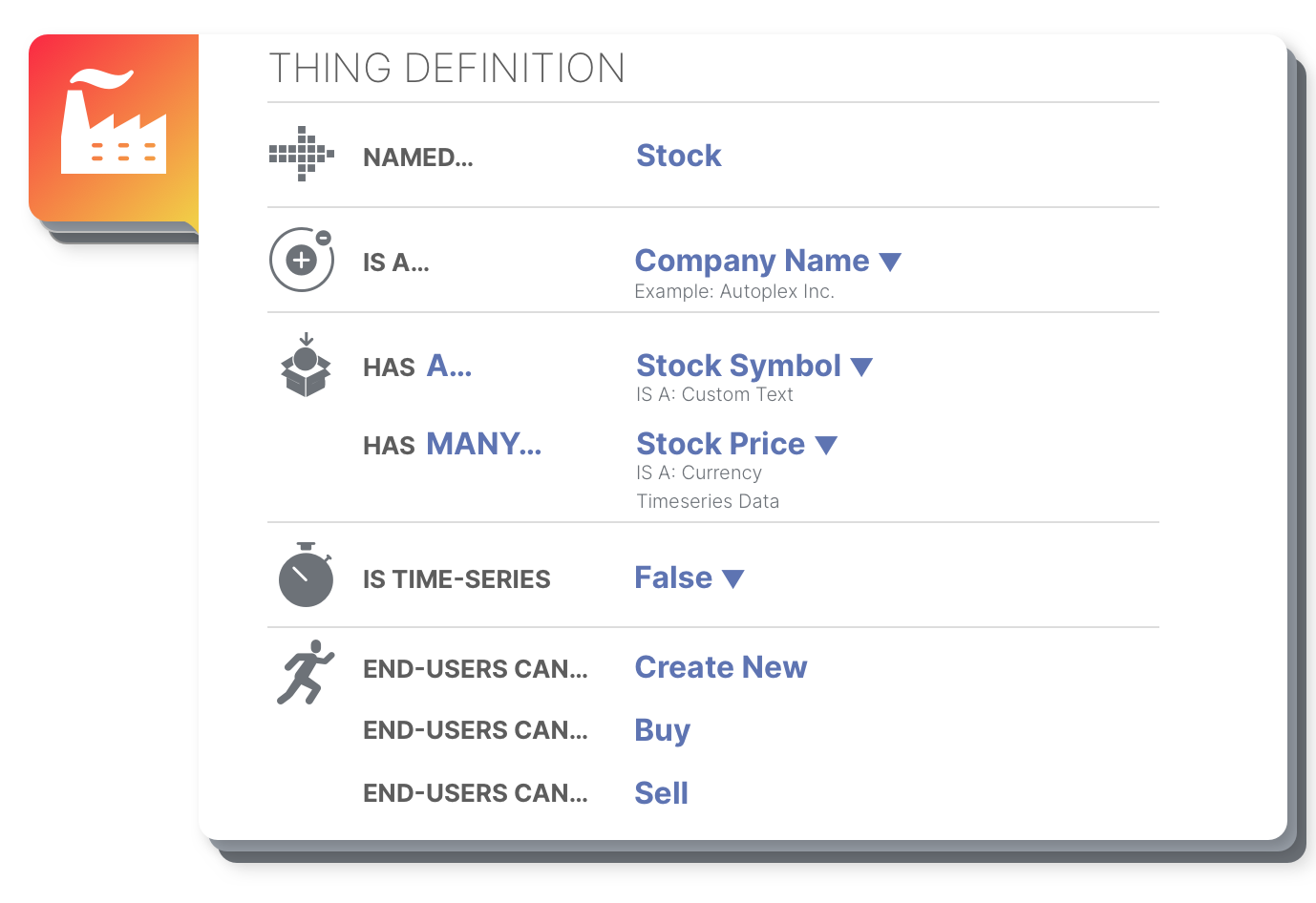
Image Credits: Kleeen
After the startup he worked at sold, Kleeen co-founder, CPO and President Joshua Hailpern told me, he started his own B2B design studio, which focused on front-end design and engineering.
“What we ended up seeing was the same pattern that would happen over and over again,” he said. “We would go into a client, and they would be like: ‘we have the greatest idea ever. We want to do this, this, this and this.’ And they would tell us all these really cool things and we were: ‘hey, we want to be part of that.’ But then what we would end up doing was not that. Because when building products — there’s the showcase of the product and there’s all these parts that support that product that are necessary but you’re not going to win a deal because someone loved that config screen.”
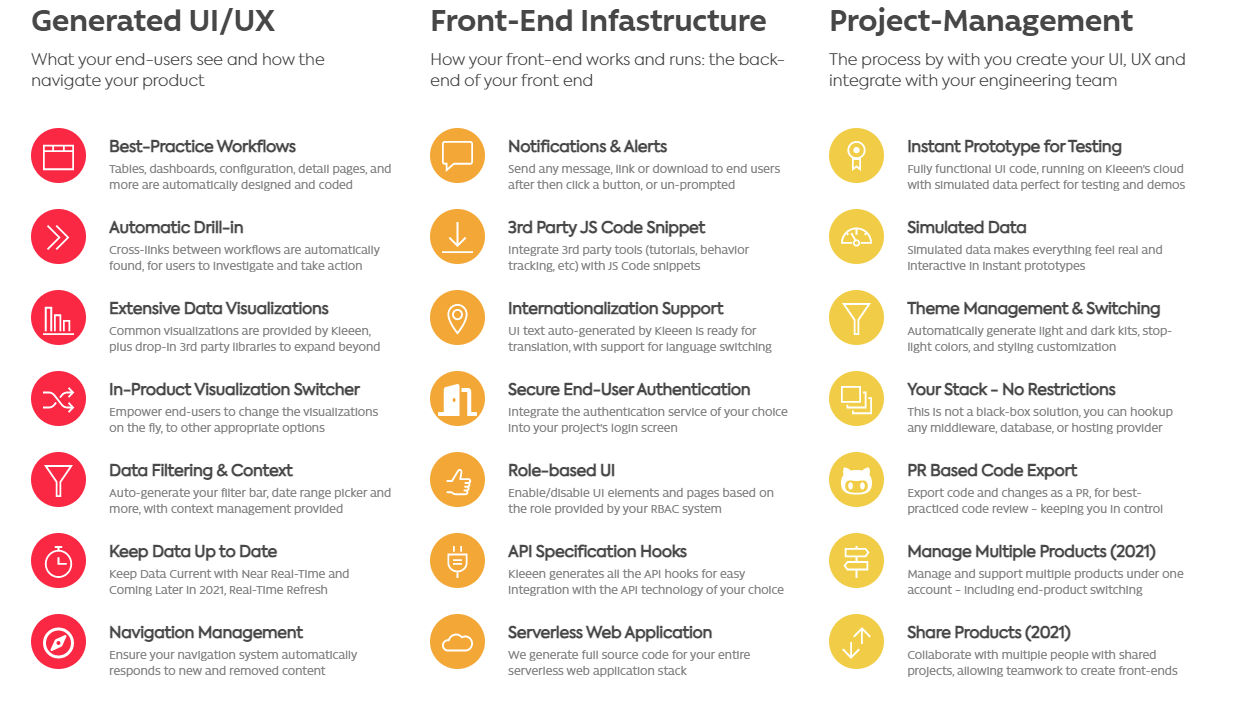
The idea behind Kleeen is that you can essentially tell the system what you are trying to do and what the users need to be able to accomplish — because at the end of the day, there are some variations in what companies need from these basic building blocks, but not a ton. Kleeen can then generate this user interface and workflow for you — and generate the sample data to make this mock-up come to life.
Once that work is done, likely after a few iterations, Kleeen can generate React code, which development teams can then take and work with directly.
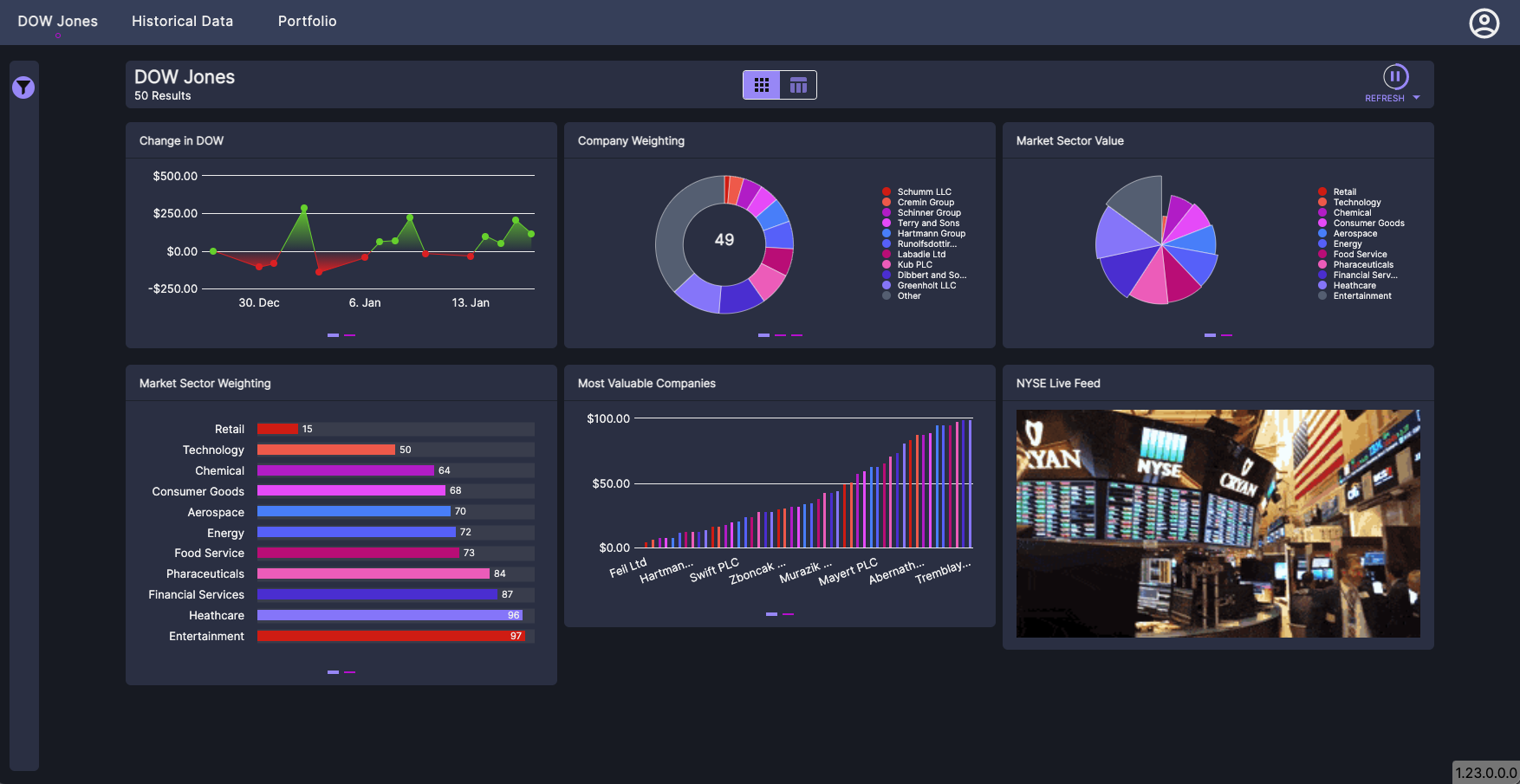
Image Credits: Kleeen
As Kleeen co-founder and CEO Matt Fox noted, the platform explicitly doesn’t want to be everything to everybody.
“In the no-code space, to say that you can build any app probably means that you’re not building any app very well if you’re just going to cover every use case. If someone wants to build a Bumble-style phone app where they swipe right and swipe left and find their next mate, we’re not the application platform for you. We’re focused on really data-intensive workflows.” He noted that Kleeen is at its best when developers use it to build applications that help a company analyze and monitor information and, crucially, take action on that information within the app. It’s this last part that also clearly sets it apart from a standard business intelligence platform.
Powered by WPeMatico
It would be an understatement to say that enterprise-focused startups have fared well during the pandemic. As organizations look to go remote, and the way we work has been flipped on its head, quickly growing tech companies that simplify this transition are in high demand.
One such startup has, in fact, raised $61.5 million in the last 12 months alone. Electric, a company looking to put IT departments in the cloud, just announced the close of a $40 million Series C round. This comes after an extension of its Series B in March of 2020, when it raised $14.5 million, and then an additional $7 million from 01 Advisors in May of 2020.
This Series C round was led by Greenspring Associates, with participation from existing investors Bessemer Venture Partners, GGV Capital, 01 Advisors and Primary Venture Partners as well as new investors including Atreides Management and Vintage Investment Partners.
Electric launched in 2016 with a mission to make IT much simpler for small and medium-sized businesses. Rather than bringing on a dedicated IT department, or contracting out high-priced local service providers, Electric’s software allows one admin to manage devices, software subscriptions, permissions and more.
According to founder Ryan Denehy, the vast majority of IT’s work is administration, distribution and maintenance of the broad variety of software programs at any given company. Electric does most of that job on behalf of IT, meaning that a smaller business only needs to worry about desk-side troubleshooting when it comes up, rather than the whole kit and caboodle.
Electric charges a flat price per seat per month, and Denehy says the company more than doubled its customer base in the last year. It now supports around 25,000 users across more than 400 individual customer organizations, which puts Electric just shy of $20 million ARR.
This is the first time Denehy has come anywhere close to sharing revenue numbers publicly, but it’s a good time to flex. The company has recently introduced a new lighter-weight offering that includes all of the same functionality as its more expensive product, but without access to chat functionality.
“The name of the game is just simplicity, simplicity, simplicity,” said Denehy. “Part of this is in response to the fact that people are realizing the permanence of hybrid work. During the pandemic, people stopped paying their landlords but they didn’t stop paying us. So in the summer, we started to focus on how we can create more offerings that we can get in the hands of more businesses and let them start their journey with us.”
Denehy says that a little less than half of Electric’s client base are tech startups, which makes sense considering the company launched in New York in a tech and media-centric ecosystem. As a way to expand into other verticals, Electric acquired Sinu, an IT service provider who happened to have an impressive roster of clients outside of Electric’s comfort zone, such as legal, accounting and nonprofit.
Here’s what Denehy said at the time:
Organic market entry, even in adjacent markets can be extremely time consuming and expensive. Sinu’s team has done an excellent job winning and pleasing customers in a lot of industries where we currently don’t play but probably should. The combination of our two companies is a massive shot in the arm to our national expansion strategy.
Alongside growth, both of the Electric team and its customer base, the company is also investing in expanding its diversity programs and philanthropic efforts.
The Electric team is currently made up of just under 250 full-time employees, with 32.5% women and around 30% of employees being non-white. Specifically, nearly 12% of employees are Black and 10% are Latinx.
Denehy explained that he thinks of the company’s payroll, which is in the tens of millions of dollars, as one of the biggest ways he can make a change in the world.
“We will wait longer to fill a role to make sure that we have the most diverse pipeline of candidates possible,” said Denehy. “A lot of founders will say that nobody applied. Well, the reality is you didn’t look hard enough. We’ve just accepted that it may take us longer to fill certain roles.”
This latest round brings Electric’s total funding to more than $100 million.
Powered by WPeMatico
Spreadsheet software — led by products like Microsoft’s Excel, Google’s Sheets and Apple’s Numbers — continues to be one of the most-used categories of business apps, with Excel alone clocking up more than a billion users just on its Android version. Now, a startup called Rows that’s built on that ubiquity, with a low-code platform that lets people populate and analyze web apps using just spreadsheet interfaces, is announcing funding and launching a freemium open beta of its expanded service.
The Berlin-based startup — which rebranded from dashdash at the end of last year — closed a Series B round of $16 million, money that it is using to continue investing in its platform as well as in sales and marketing. The platform’s move into an open beta comes with some 50 new integrations with other platforms like LinkedIn, Instagram and more, as well as 200 new features (using known spreadsheet shortcuts) to use in them.
The round was led by Lakestar, with past investors Accel (which led its $8 million Series A in 2018) and Cherry Ventures also participating. Christian Reber has also invested in this round. Reber knows a thing or two about software disrupting legacy productivity software — he is the co-founder and CEO of presentation software startup Pitch and the former CEO and founder of Microsoft-acquired Wunderlist — and notably he is joining Rows’ Advisory Board along with the investment.
A little detail about this Series B: CEO Humberto Ayres Pereira, who is based out of Porto, Portugal, where some of the staff is also based, tells us that this round actually was quietly closed over a year ago, in January 2020 — just ahead of the world shutting down amid the COVID-19 pandemic.
The startup chose to announce that round today to coincide with adding more features to its product and moving it into an open beta, he said.
That open beta is free in its most basic form — the free tier is limited to 10 users or less and a minimal amount of integration usage. Paid tiers, which cover more team members and up to 100,000 integration tasks (which are measured by how many times a spreadsheet queries another service), start at $59 per month.
One strong sign of interest in this latest iteration of the software is the lasting popularity of spreadsheets. Another is Rows’ traction to date: in invite-only mode, it picked up 10,000 users off its waitlist, and hundreds of companies, as customers. Currently most of those are free, Ayres Pereira said.
“Our goal is to have 1,000 paying companies as customers in the 12 months,” he said. That process has only just started, he added, with paying numbers in the modest “dozens” for now. He emphasized though that the company is very cash efficient and has, even without raising more funding, two years of runway on the money it has in the bank now.
No-code and low-code software, which let people create and work with apps and other digital content without delving deep into the lines of code that underpin them, have continued to pick up traction in the market in the last several years.
The reason for this is straightforward: non-technical employees may not code, but they are getting increasingly adept at understanding how services function and what can be achieved within an app.
No-code and low-code platforms let them get more hands-on when it comes to customizing and creating the services that they need to use everyday to get their work done, without the time and effort it might take to get an engineer involved.
“People want to create their own tools,” said Ayres Pereira. “They want to understand and test and iterate.” He said that the majority of Rows’ users so far are based out of North America, and typical use cases include marketing and sales teams, as well as companies using Rows spreadsheets as a dynamic interface to manage logistics and other operations.
Stephen Nundy, the partner at Lakestar who led its investment, describes the army of users taking up no-code tools as “citizen developers.”
Rows is precisely the kind of platform that plays into the low-code trend. For people who are already au fait with the kinds of tools that you find in spreadsheets — and something like Excel has hundreds of functions in it — it presents a way of leaning on those familiar functions to trigger integrations with other apps, and to subsequently use a spreadsheet created in Rows to both analyse data from other apps, as well as update them.
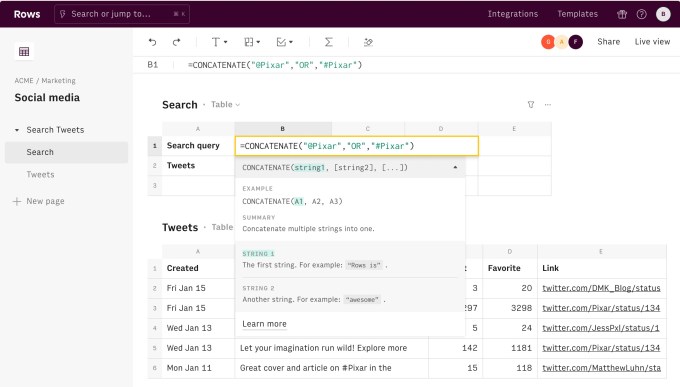
Image: Rows
You might ask, why is it more useful, for example, to look at content from Twitter in Rows rather than Twitter itself? A Rows document might let a person search for a set of Tweets using a certain chain of keywords, and then organise those results based on parameters such as how many “likes” those Tweets received.
Or users responding to a call to action for a promotion on Instagram might then be cross-referenced with a company’s existing database of customers, to analyze how those respondents overlap or present new leads.
You might also wonder why existing spreadsheet products may not have already build functionality like this.
Interestingly, Microsoft did dabble in building a way of linking up Excel with some rudimentary computing functions, in the form of Visual Basic for Applications. This however reached the dubious distinction of topping developers’ “most dreaded” languages list for two years running, and so as you might imagine it has somewhat died a death.
However, it does point to an opportunity for incumbents to disrupt their disruptors.
Apart from those most obvious, entrenched competitors, there have been a number of other startups building tools that are providing similar no- and low-code approaches.
Gyana is focusing more on data science, Tray.io provides a graphical interface to integrate how apps work together, Zapier and Notion also provide simple interfaces to integrate apps and APIs together and Airtable has its own take on reinventing the spreadsheet interface. For now, Ayres Pereira sees these more as compatriots than competitors.
“Yes, we overlap with services like Zapier and Notion,” he said. “But I’d say we are friends. We’re all raising awareness about people being able to do more and not having to be stuck using old tools. It’s not a zero sum game for us.”
When we covered Rows’s Series A two years ago, the startup had built a platform to let people who are comfortable working with data in spreadsheets use that interface to create and populate content in web apps. It had a lot of extensibility, but mainly geared at people still willing to do the work to create those links.
Two years on, while the spreadsheet has remained the anchor, the platform has grown. Ayres Pereira, who co-founded the company with Torben Schulz (both pictured above), said that there are some 50 new integrations now, including ways to analyse and update content on social media platforms like Instagram, YouTube, CrunchBase, Salesforce, Slack, LinkedIn and Twitter, as well as some 200 new features in the platform itself.
While people can import into Rows data from Google Sheets, he noted that the big daddy of them all, Excel, is not supported right now. The reason, he said, is because the vast majority of users of the product use the desktop version, which does not have APIs.
Meanwhile, Rows also has a number of templates available for people to guide them through simple tasks, such as looking up LinkedIn profiles or emails for a list of people, tracking social media counts and so on.
One of the most common aspects of spreadsheets, however, has yet to be built. The interface is still banked around rows and columns, but with no graphical tools to visualize data in different ways such as pie charts or graphs as you might have in a typical spreadsheet program.
It’s for this reason that Rows has yet to exit beta. The feature is one that is requested a lot, Pereira admitted, describing it as “the final frontier.” When Rows is ready to ship with that functionality, likely by Q3 of this year, it will tick over to general “1.0” release, he added.
“Humberto and Torben have really impressed us with their ambition to disrupt the market with a new spreadsheet paradigm that tackles the significant shortcomings of today’s solutions,” said Nundy at Lakestar. “Data integrations are native, the collaboration experience is first class and the ability to share and publish your work as an application is unique and will create more ‘Citizen developers’ to emerge. This is essential to the growing needs of today’s technology literate workforce. The level of interest they’ve received in their private beta is proof of the desirability of platforms like Rows, and we’re excited to be supporting them through their public beta launch and beyond with this investment.” Nundy is also joining Rows’ board with this round.
Powered by WPeMatico
Many enterprise software startups at some point have faced the invisible wall. For months, your sales team has done everything right. They’ve met with a prospect several times, provided them with demos, free trials, documentation and references, and perhaps even signed a provisional contract.
The stars are all aligned and then, suddenly, the deal falls apart. Someone has put the kibosh on the entire project. Who is this deal-blocker and what can software companies do to identify, support and convince this person to move forward with a contract?
I call this person the Chief Objection Officer.
Who is this deal-blocker and what can software companies do to identify, support and convince this person to move forward with a contract?
Most software companies spend a lot of time and effort identifying their potential buyers and champions within an organization. They build personas and do targeted marketing to these individuals and then fine-tune their products to meet their needs. These targets may be VPs of engineering, data leaders, CTOs, CISOs, CMOs or anyone else with decision-making authority. But what most software companies neglect to do during this exploratory phase is to identify the person who may block the entire deal.
This person is the anti-champion with the power to scuttle a potential partnership. Like your potential deal-makers, these deal-breakers can have any title with decision-making power. Chief Objection Officers aren’t simply potential buyers who end up deciding your product is not the right fit, but are instead blockers-in-chief who can make departmentwide or companywide decisions. Thus, it’s critical for software companies to identify the Chief Objection Officers that might block deals and, then, address their concerns.
So how do you identify the Chief Objection Officer? The trick is to figure out the main pain points that arise for companies when considering deploying your solution, and then walk backward to figure out which person these challenges impact the most. Here are some common pain points that your potential customers may face when considering your product.
Change is hard. Never underestimate the power of the status quo. Does implementing your product in one part of an organization, such as IT, force another department, such as HR, to change how they do their daily jobs?
Think about which leaders will be most reluctant to make changes; these Chief Objection Officers will likely not be your buyers, but instead the heads of departments most impacted by the implementation of your software. For example, a marketing team may love the ad targeting platform they use and thus a CMO will balk at new database software that would limit or change the way customer segment data is collected. Or field sales would object to new security infrastructure software that makes it harder for them to access the company network from their phones. The head of the department that will bear the brunt of change will often be a Chief Objection Officer.
Another common pain point when deploying a new software solution is that one or more jobs may become obsolete once it’s up and running. Perhaps your software streamlines and outsources most of a company’s accounts payable processes. Maybe your SaaS solution will replace an on-premise homegrown one that a team of developers has built and nurtured for years.
Powered by WPeMatico