Enterprise
Auto Added by WPeMatico
Auto Added by WPeMatico
We’ve known for a long time that music streaming royalties are fundamentally broken. As revenue has shifted away from sales of physical music, it’s become increasingly difficult for many independent artists to make a living off recorded music. But all of that has come to a head as the pandemic has stripped live music out of the equation entirely.
Some services have looked to buck the trend. The immensely popular Bandcamp Fridays are a notable example, offering all revenue to artists and labels one day a month. And now SoundCloud is looking to shake up how it pays its own independent creators — a move that could prove a nice boon for musicians on a service that’s lent its name to at least one popular musical subgenre.
The site will institute a new revenue structure at the beginning of next month. Soundcloud breaks down “Fan-powered” royalties thusly,
Fan-powered royalties are a more equitable and transparent way for independent artists who monetize directly with SoundCloud to get paid. The more fans listen on SoundCloud, and listen to your music, the more you get paid.
Under the old model, money from your dedicated fans goes into a giant pool that’s paid out to artists based on their share of total streams. That model mostly benefits mega stars.
Under fan-powered royalties, you get paid based on your fans’ actual listening habits. The more of their time your dedicated fans listen to your music, the more you get paid. This model benefits independent artists.
The service is available for independent artists who monetize their pages through select Pro accounts. There are a number of factors that go into the final payment (the first of which will arrive in May), including whether listeners have a subscription, the amount they’ve listened to one artist relative to others and ads they’ve listened to. The fine print is available here.
Musicians have become increasingly vocal about their inability to live off of streaming revenue as the pandemic has cut off major income sources over the past year. Spotify, in particular, has drawn harsh criticism as the company has spent hundreds of millions on podcast acquisitions while maintaining old revenue models for musicians.
Powered by WPeMatico
This morning Parabol, a startup that provides retrospective meeting software to agile development teams, announced that it has closed an $8 million Series A. Microsoft’s venture capital arm, M12, led the deal. The investment also saw participation from Techstars, CRV, and Haystack.
TechCrunch caught up with Parabol CEO Jordan Husney to talk about the round, and his company. We were curious how large the market that Parabol serves is, and if the company was overly-nicheing its service. While the startup is still young, the answer appears to be no – adding to our general sentiment that the software market is even larger than we perhaps thought.
Let’s explore how Parabol came to be, and how it came to pick its target market. Or more precisely, how its target market chose it.
After a stint in the consulting world, Husney was more than aware of the communications issues that distributed teams can endure. With multiple offices the norm among big companies, he told TechCrunch in an interview, communications between remote workers came down to an email thread, or a meeting. A self-described “recovering engineer,” Husney wondered if there was space in the business market for “structured communications,” or the type of asynchronous meetings that are popular in the code-writing world.
Borrowing from the ethos of agile development, a method of writing software that prioritizes collaboration and evolution over process and documentation, Husney built Parabol to bring agile work and communications methods to non-developer business teams. If agile principles were good at helping foster developer results through status meetings, why wouldn’t the same process translate to other work settings?
But the market had other ideas. Instead of hitting it big in the business world, owing to the friction resulting from needing what Husney described as a “behavior change” — something often lethal to rapid adoption of a new service, or product — agile teams themselves started using Parabol’s tech.
The startup followed the demand. And there’s quite a lot of it, as it turns out. Husney estimated that there are around 20 million agile developers in the world, the business from which has helped propel companies like Atlassian to enormous heights. It’s a big enough pool for the startup to swim in for a long time.
Returning to our earlier note about the depth of the software market, Parabol is a good reference point. It appears capable of building a real company on the back of supporting a subset of the software creation world’s peculiar meeting style; the market for software is simply gigantic.
After deciding to support agile software teams, growth came quickly to Parabol. In 2018 and 2019, the company saw growth of 20% to 40% each month, its CEO said. Calling his company a “rocket,” Husney gave partial credit to Parabol’s freemium go-to-market model, a common approach when selling to developers who eschew the traditional sales process.
By selling to the already-converted, Parabol found product-market fit. Husney himself had underestimated the demand from agile software developers for tools to support they work, because he thought that they’d already figured out their own needs, he told TechCrunch.
What Parabol has built is not a simple tool, however. Powering retrospective meetings and incident post-mortems, its software collects notes from workers on things that should be done, things that should no longer done, and things that should be kept up. The service then aggregates them automatically by topic, followed by users voting to decide on changes and takeaway actions. The result is an asynchronous way for developer teams to stay in sync.
The startup closed a Seed round in November of 2019, just in time to have cash on hand for the COVID-19 pandemic. The rapid switch to remote work quickly drove Parabol’s user growth from 600 per week in January of 2020, to 5,000 per week in March of the same year. The company has some public usage data available here, in case you want to check the spike yourself.
After raising its $4 million Seed, Husney decided to raise more capital after being told by others that it was a great time to do so. And after winding up with a few firms to choose between, wound up taking Microsoft’s money.
There’s a story there. Per Husney, Microsoft’s M12 was not on the top of its venture capital list; there is a somewhat good reason for that, as taking strategic capital over pure-venture capital is a choice and not the best one for every startup. But after Husney and company got to know the Microsoft partners, and each side underwent diligence, the fit became clear. According to the CEO, M12’s investing team called various Microsoft groups — Azure, GitHub, etc — to ask them about their views on Parabol. They raved. So Microsoft had strong internal signals concerning the deal, and Parabol learned that its potential investor was a heavy user of its product.
The deal worked out.
Why $8 million and not more? The startup’s growth plan isn’t super capital intensive according to Husney, and its market is pulling it instead of the other way around. The team is dilution-conscious as well, he explained. The founding team put the company together in 2015, and didn’t raise its seed round until 2019. It was ramen days back then, he explained; you’ll cling to your ownership, I suppose, when you have bought it that dearly.
Parabol runs lean on purpose. Husney said that his team was not following the Reid Hoffman blitzscaling ethos, instead focusing on hiring for individual leverage. In the CEO’s view, you don’t need to scale quickly to build collaboration products.
The $8 million raise could give Parabol infinite runway, the CEO said, but his company instead raised it for about a 24 month spend. At the end of that he expects the company to have around 30 workers, up from its current 10.
Parabol wants to quadruple its revenues this year, and triple them in 2022. And it wants to scale to 500,000 users from its current 100,000 this year, reaching one million by the end of next year. Let’s see how it performs against those goals.
Powered by WPeMatico
When a hacker broke into the computer systems of the Oldsmar, Florida water supply last month, it sent up red flags across the operational tech world, whether that’s utilities or oil and gas pipelines. Xage, a security startup that has been building a solution to help protect these hard-to-secure operations, announced a Zero Trust remote access cloud solution today that could help prevent these kinds of attacks.
Duncan Greatwood, CEO at Xage, says flat out that if his company’s software was in place in Oldsmar, that hack wouldn’t have happened. Smaller operations like the one in Oldsmar tend to be one-person IT shops running older remote access software that’s vulnerable to hacking on a number of levels.
“It’s not difficult to compromise a virtual network computing (VNC) connection. It’s not difficult to compromise a stale account that’s been left on a jump box. What we started to do last year was deliver what we call a Zero Trust remote access solution to these kinds of customers,” Greatwood told me.
This involves controlling access device by device and person by person by determining who can do what based on them authenticating themselves and proving who they are. “It doesn’t rely on knowledge of a device password or a VPN zone password,” he explained.
The solution goes further with a secure traversal tunnel, which relies on a tamper-proof certificate to prevent hackers from getting from the operations side of the house — whether that’s a utility grid, water supply or oil and gas pipeline — to the IT side where they could then begin to muck about with the operational technology.
Xage also uses a distributed ledger as a core part of its solution to help protect identity policies, logs and other key information across the platform. “Having a distributed ledger means that rather than an attacker having to compromise just a single node, it would have to compromise a majority of the nodes simultaneously, and that’s very difficult [if not impossible] to do,” he said.
What’s more, the ledgers operate independently across locations in a hierarchy with a global ledger that acts as the ultimate rules enforcer. That means even if a location goes offline, the rules will be enforced by the main system whenever it reconnects.
They introduced an on-premise version of the Zero Trust remote access system last October, but with this kind of technology difficult to configure and maintain, some customers were looking for a managed solution like the one being introduced today. With the cloud solution, customers get a hosted solution accessible via a web browser with much faster deployment.
“What we’ve done with the cloud solution is made it really simple for people to adopt us by hosting the management software and the core Xage fabric nodes in this Xage cloud, and we’re really dramatically reducing that time to value for a remote access solution for OT,” Greatwood said.
You might be thinking that CISOs might not trust a cloud solution for these sensitive kinds of environments, and he admits that there is some caution in this market, even though they understand the benefits of moving to the cloud. To help ease these concerns, they can do a PoC in the cloud and there is a transfer tool to move back on prem easily if they are not comfortable with the cloud approach. So far he says that no early customers have chosen to do that, but the option is there.
Xage was founded in 2017 and has raised $16 million so far, according to Crunchbase data.
Early Stage is the premier “how-to” event for startup entrepreneurs and investors. You’ll hear firsthand how some of the most successful founders and VCs build their businesses, raise money and manage their portfolios. We’ll cover every aspect of company building: Fundraising, recruiting, sales, legal, PR, marketing and brand building. Each session also has audience participation built-in — there’s ample time included in each for audience questions and discussion.
Powered by WPeMatico

As the pandemic drags on and we learn about the requirements of working from home with distributed teams, users could be craving more integration across their tools to help reduce the clicks required to complete a set of tasks. Today at the Ignite Conference, Microsoft announced tighter integration between its business suite Dynamics 365 and its collaboration tool Teams to help with that issue.
Alysa Taylor, corporate VP for business applications and global industry at Microsoft, pointed out that one of the advantages of this native integration approach is that it helps reduce context switching across different applications. “We are committed to really bringing together the collaboration platform and the business process layer to enable salespeople, service representatives, operations managers [and other similar roles] to really have a unified platform in which they both collaborate and have their everyday business functions,” Taylor explained.
This could manifest itself in a number of different ways across marketing, sales and service. For instance, a marketer can create a webinar, which they set up and track in Dynamics 365 Marketing tools and run in Teams as a streaming event with the Teams streaming setup integrated directly into the Dynamics 365 console.
In a sales example Taylor says, “We’re enabling sellers to be able to track the career movements of their contacts using the LinkedIn Sales Navigator, as well as connect very specific sales records within Microsoft Teams without ever having to leave Dynamics 365 Sales. So you can be in the Sales application and you have the ability to deeply understand a contact and any contact changes that occur in Teams, and that’s automatically updated in Sales.”
If your company is not an all-Microsoft shop and wants to use different tools as part of these workflows, Taylor says that you can use Microsoft cross-cloud connectors to connect to another service, and this is true regardless of the tasks involved (so long as the connector to the desired application is available).
Salesforce, a primary rival of Microsoft in the business software space, spent over $27 billion to buy Slack at the end of last year to bring this kind of integration to its platform. Taylor sees the acquisition as a reaction to the integration Microsoft already has and continues to build.
“I think that Salesforce had to acquire Slack to be able to have that collaboration [we have], so we are years ahead of what they’re going to be able to provide because they will not have these native integrations. So I actually see the Salesforce acquisition as a response to what we’re doing with Dynamics 365 and Teams,” Taylor told me.
It’s worth pointing out that Salesforce is far ahead of Microsoft when it comes market share in the CRM space, with over 19% versus under 3% for Microsoft, according to Gartner numbers from 2019. While it’s possible these numbers have shifted some since then, probably not significantly.

Early Stage is the premier “how-to” event for startup entrepreneurs and investors. You’ll hear firsthand how some of the most successful founders and VCs build their businesses, raise money and manage their portfolios. We’ll cover every aspect of company building: Fundraising, recruiting, sales, legal, PR, marketing and brand building. Each session also has audience participation built-in — there’s ample time included in each for audience questions and discussion.
Powered by WPeMatico

Microsoft today announced Azure Percept, its new hardware and software platform for bringing more of its Azure AI services to the edge. Percept combines Microsoft’s Azure cloud tools for managing devices and creating AI models with hardware from Microsoft’s device partners. The general idea here is to make it far easier for all kinds of businesses to build and implement AI for things like object detection, anomaly detections, shelf analytics and keyword spotting at the edge by providing them with an end-to-end solution that takes them from building AI models to deploying them on compatible hardware.
To kickstart this, Microsoft also today launches a hardware development kit with an intelligent camera for vision use cases (dubbed Azure Percept Vision). The kit features hardware-enabled AI modules for running models at the edge, but it can also be connected to the cloud. Users will also be able to trial their proofs-of-concept in the real world because the development kit conforms to the widely used 80/20 T-slot framing architecture.
In addition to Percept Vision, Microsoft is also launching Azure Percept Audio for audio-centric use cases.

Azure Percept devices, including Trust Platform Module, Azure Percept Vision and Azure Percept Audio. Image Credits: Microsoft
“We’ve started with the two most common AI workloads, vision and voice, sight and sound, and we’ve given out that blueprint so that manufacturers can take the basics of what we’ve started,” said Roanne Sones, the corporate vice president of Microsoft’s edge and platform group. “But they can envision it in any kind of responsible form factor to cover a pattern of the world.”
Percept customers will have access to Azure’s cognitive service and machine learning models and Percept devices will automatically connect to Azure’s IoT hub.
Microsoft says it is working with silicon and equipment manufacturers to build an ecosystem of “intelligent edge devices that are certified to run on the Azure Percept platform.” Over the course of the next few months, Microsoft plans to certify third-party devices for inclusion in this program, which will ideally allow its customers to take their proofs-of-concept and easily deploy them to any certified devices.
“Anybody who builds a prototype using one of our development kits, if they buy a certified device, they don’t have to do any additional work,” said Christa St. Pierre, a product manager in Microsoft’s Azure edge and platform group.
St. Pierre also noted that all of the components of the platform will have to conform to Microsoft’s responsible AI principles — and go through extensive security testing.
Early Stage is the premiere “how-to” event for startup entrepreneurs and investors. You’ll hear firsthand how some of the most successful founders and VCs build their businesses, raise money and manage their portfolios. We’ll cover every aspect of company-building: Fundraising, recruiting, sales, legal, PR, marketing and brand building. Each session also has audience participation built-in — there’s ample time included in each for audience questions and discussion.
Powered by WPeMatico

At its Ignite conference today, Microsoft announced the launch of Azure Managed Instance for Apache Cassandra, its latest NoSQL database offering and a competitor to Cassandra-centric companies like Datastax. Microsoft describes the new service as a “semi-managed offering that will help companies bring more of their Cassandra-based workloads into its cloud.”
“Customers can easily take on-prem Cassandra workloads and add limitless cloud scale while maintaining full compatibility with the latest version of Apache Cassandra,” Microsoft explains in its press materials. “Their deployments gain improved performance and availability, while benefiting from Azure’s security and compliance capabilities.”
Like its counterpart, Azure SQL Manages Instance, the idea here is to give users access to a scalable, cloud-based database service. To use Cassandra in Azure before, businesses had to either move to Cosmos DB, its highly scalable database service that supports the Cassandra, MongoDB, SQL and Gremlin APIs, or manage their own fleet of virtual machines or on-premises infrastructure.
Cassandra was originally developed at Facebook and then open-sourced in 2008. A year later, it joined the Apache Foundation and today it’s used widely across the industry, with companies like Apple and Netflix betting on it for some of their core services, for example. AWS launched a managed Cassandra-compatible service at its re:Invent conference in 2019 (it’s called Amazon Keyspaces today), Microsoft launched the Cassandra API for Cosmos DB in September 2018. With today’s announcement, though, the company can now offer a full range of Cassandra-based servicer for enterprises that want to move these workloads to its cloud.
Early Stage is the premiere “how-to” event for startup entrepreneurs and investors. You’ll hear firsthand how some of the most successful founders and VCs build their businesses, raise money and manage their portfolios. We’ll cover every aspect of company-building: Fundraising, recruiting, sales, legal, PR, marketing and brand building. Each session also has audience participation built-in — there’s ample time included in each for audience questions and discussion.
Powered by WPeMatico
Microsoft today announced Power Fx, a new low-code language that takes its cues from Excel formulas. Power Fx will become the standard for writing logic customization across Microsoft’s own low-code Power Platform, but since the company is open-sourcing the language, Microsoft also hopes that others will implement it as well and that it will become the de facto standard for these kinds of use cases.
Since Power Platform itself targets business users more so than professional developers, it feels like a smart move to leverage their existing knowledge of Excel and their familiarity with Excel formulas to get started.
“We have this long history of programming languages and something really interesting happened over the last 15 years, which is programming languages became free, they became open source and they became community-driven,” Charles Lamanna, the CVP of Power Platform engineering at Microsoft, told me. He noted that even internal languages like C#, TypeScript or Google’s Go are good examples for this.
“That’s been an ongoing trend. And what’s interesting is: that’s all for pro devs and coders. If we go back and look at the low-code/no-code space, there actually are programming languages, like the Excel programming language, or in every low-code/no-code platform has its own programming language. But those aren’t open, those aren’t portable, and those are community-driven,” Lamanna explained.
Microsoft says the language was developed by a team led by Vijay Mital, Robin Abraham, Shon Katzenberger and Darryl Rubin. Beyond Excel, the team also took inspiration from tools and languages like Pascal, Mathematica and Miranda, a functional programming language developed in the 1980s.
Microsoft plans to bring Power Fx to all of its low-code platforms, but given the focus on community, it’ll start making appearances in Power Automate, Power Virtual Agents and elsewhere soon.
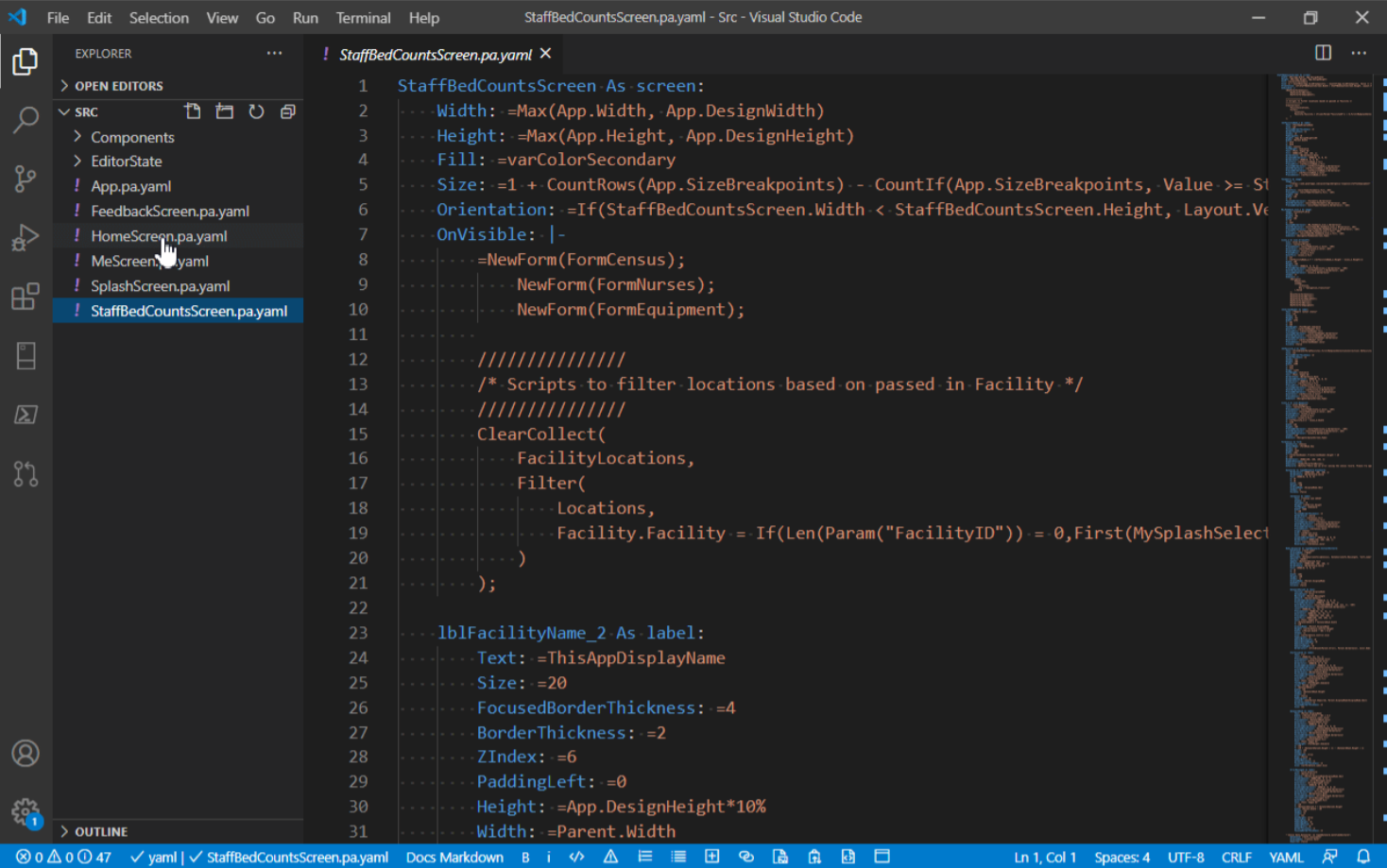
But the team clearly hopes that others will adopt it as well. Low-code developers will see it pop up in the formula bars of products like Power Apps Studio, but more sophisticated users will also be able to use it to go to Visual Studio Code and build more complex applications with it.
As the team noted, it focused on not just making the language Excel-like but also having it behave like Excel — or like a REPL, for you high-code programmers out there. That means formulas are declarative and instantly recalculate as developers update their code.
Most low-code/no-code tools these days offer an escape hatch to allow users to either extend their apps with more sophisticated code or have their tool export the entire code base. Because at the end of the day, you can only take these tools so far. By default, they are built to support a wide range of scenarios, but since every company has its own way of doing things, they can’t cover every use case.
“We imagine that probably the majority of developers — and I say ‘developers’ as business users to coders that use Power Platform — will ultimately drop into writing these formulas in some form. The idea is that on that first day that you get started with Power Platform, we’re not going to write any formulas, right? […] It’s a macro recorder, it’s templates. Same thing for Power Apps: it’s pure visual, drag and drop, you don’t write a single formula. But what’s great about Power Platform, in week number two, when you’re using this thing, you learn a little bit more sophistication. You start to use a little bit more of the advanced capabilities. And before you know it, you actually have professionals who are Power Platform or low-code developers because they’re able to go down that spectrum of capability.”
Early Stage is the premiere ‘how-to’ event for startup entrepreneurs and investors. You’ll hear firsthand how some of the most successful founders and VCs build their businesses, raise money and manage their portfolios. We’ll cover every aspect of company-building: Fundraising, recruiting, sales, legal, PR, marketing and brand building. Each session also has audience participation built-in — there’s ample time included in each for audience questions and discussion.
Powered by WPeMatico
It’s (virtual) Microsoft Ignite this week, Microsoft’s annual IT-centric conference and its largest, with more than 26,000 people attending the last in-person event in 2019. Given its focus, it’s no surprise that Microsoft Teams is taking center stage in the announcements this year. Teams, after all, is now core to Microsoft’s productivity suite. Today’s announcements span the gamut from new meeting features to conference room hardware.
At the core of Teams — or its competitors like Slack for that matter — is the ability to collaborate across teams, but increasingly, that also includes collaboration with others outside of your organization. Today, Microsoft is announcing the preview of Teams Connect to allow users to share channels with anyone, internal or external. These channels will appear alongside other teams and channels and allow for all of the standard Teams use cases. Admins will keep full control over these channels to ensure that external users only get access to the data they need, for example. This feature will roll out widely later this year.
What’s maybe more important to individual users, though, is that Teams will get a new PowerPoint Live feature that will allow presenters to present as usual — but with the added benefit of seeing all their notes, slides and meeting chats in a single view. And for those suffering through yet another PowerPoint presentation while trying to look engaged, PowerPoint Live lets them scroll through the presentation at will — or use a screen reader to make the content more accessible. This new feature is now available in Teams.
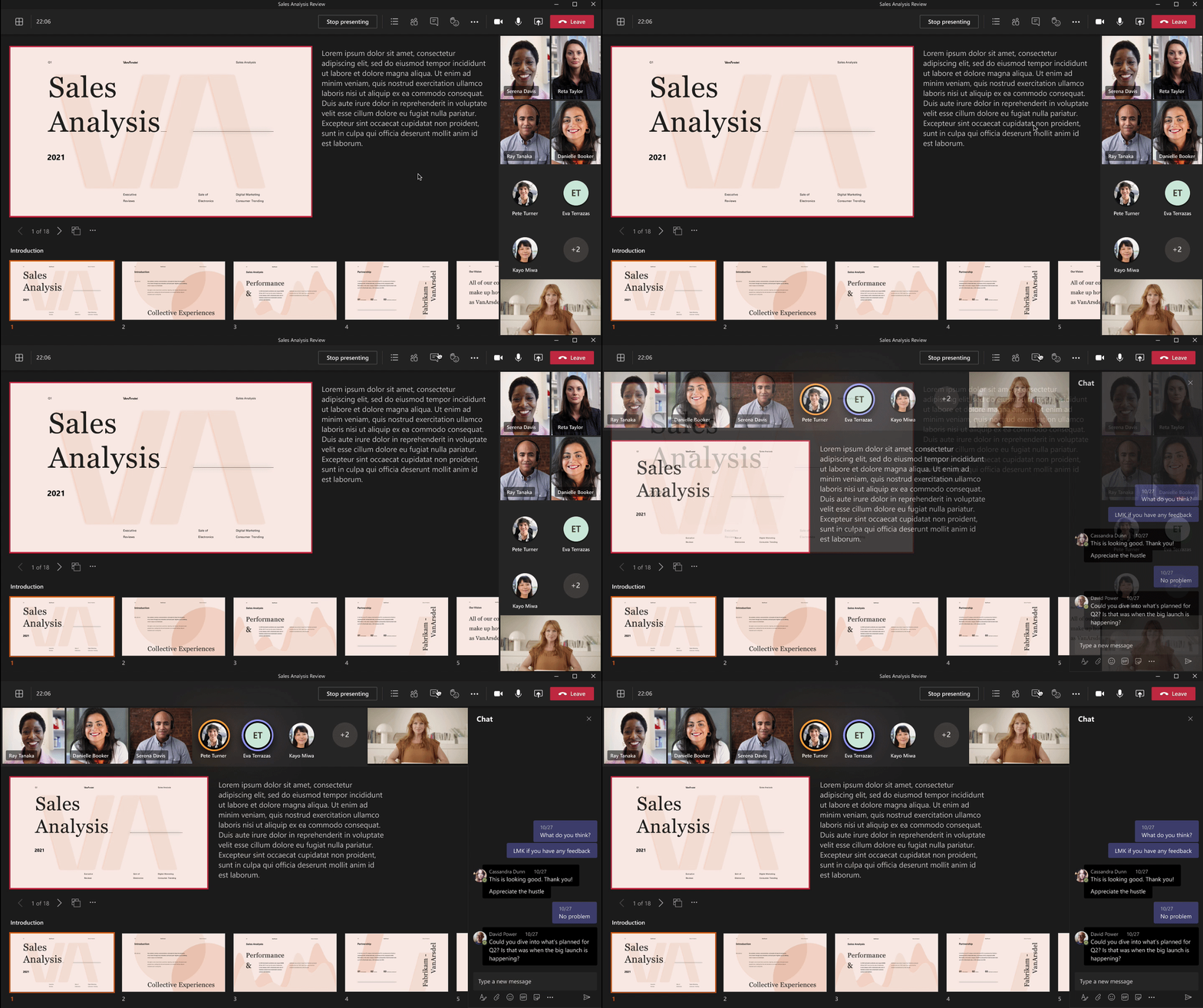
Image Credits: Microsoft
Also new on the presentation side is a set of presentation modes that use some visual wizardry to make presentations more engaging. “Standout mode” shows the speaker’s video feed in front of the content, for example, while “Reporter mode” shows the content above the speaker’s shoulder, just like in your local news show. And side-by-side view — well, you can guess it. This feature will launch in March, but it will only feature the Standout mode first. Reporter mode and side-by-side will launch “soon.”
Another new view meant to visually spice up your meetings is the “Dynamic view.” With this, Teams will try to arrange all of the elements of a meeting “for an optimal viewing experience,” personalized for each viewer. “As people join, turn on video, start to speak, or begin to present in a meeting, Teams automatically adjusts and personalizes your layout,” Microsoft says. What’s maybe more useful, though, is that Teams will put a gallery of participants at the top of the screen to help you maintain a natural eye gaze (without any AI trickery).

Image Credits: Microsoft
As for large-scale meetings, Teams users can now hold interactive webinars with up to 1,000 people inside and outside of their organization. And for all of those occasions where your CEO just has to give a presentation to everybody, Teams supports broadcast-only meetings with up to 20,000 viewers. That’ll go down to 10,000 attendees after June 30, 2021, based on the idea that the pandemic will be mostly over then and the heightened demand for visual events will subside around that time. Good luck to us all.
For that time when we’ll go back to an office, Microsoft is building intelligent speakers for conference rooms that are able to differentiate between the voices of up to 10 speakers to provide more accurate transcripts. It’s also teaming up with Dell and others to launch new conference room monitors and speaker bars.
Early Stage is the premier “how-to” event for startup entrepreneurs and investors. You’ll hear firsthand how some of the most successful founders and VCs build their businesses, raise money and manage their portfolios. We’ll cover every aspect of company building: Fundraising, recruiting, sales, legal, PR, marketing and brand building. Each session also has audience participation built-in — there’s ample time included in each for audience questions and discussion.
Powered by WPeMatico

Google Workspace, the company’s productivity platform you’ll forever refer to as G Suite (or even “Google Docs”), is launching a large update today that touches everything from your calendar to Google Meet and how you can use Workspace with Google Assistant.

Image Credits: Google
Indeed, the highlight here is probably that you can now use Assistant in combination with Google Workspace, allowing you to check your work calendar or send a message to your colleagues. Until now, this feature was available in beta and even after it goes live, your company’s admins will have to turn on the “Search and Assistant” service. And this is a bit of a slow rollout, too, with this capability now being generally available on mobile but still in beta for smart speakers and displays like Google’s own Nest Hub. Still, it’s been a long time coming, given that Google promised these features a very long time ago now.
The other new feature that will directly influence your day-to-day work is support for recurring out-of-office entries and segmentable working hours, as well as a new event type, Focus Time, to help you minimize distractions. Focus Time is a bit cleverer than the three-hour blocks of time you may block off on your calendar anyway in that it limits notifications during those event windows. Google is also launching a new analytics feature that tells you how much time you spend (waste) in meetings. This isn’t quite as fully featured (and potentially creepy) as Microsoft’s Productivity Score, since it only displays how much time you spend in meetings, but it’s a nice overview of how you spend your days (though you know that already). None of this data is shared with your managers.
For when you go back to an office, Google is also adding location indicators to Workspace so you can share when you will be working from there and when you’ll be working from home.
And talking about meetings, since most of these remain online for the time being, Google is adding a few new features that now allow those of you who use their Google Nest Hub Max to host meetings at home and to set up a laptop as their own second-screen experience. What’s far more important, though, is that when you join a meeting on mobile, Google will now implement a picture-in-picture mode so you can be in that Meet meeting on your phone and still browse the web, Gmail and get important work done during that brainstorming session.
Mobile support for background replace is also coming, as well as the addition of Q&As and polls on mobile. Currently, you can only blur your background on mobile.
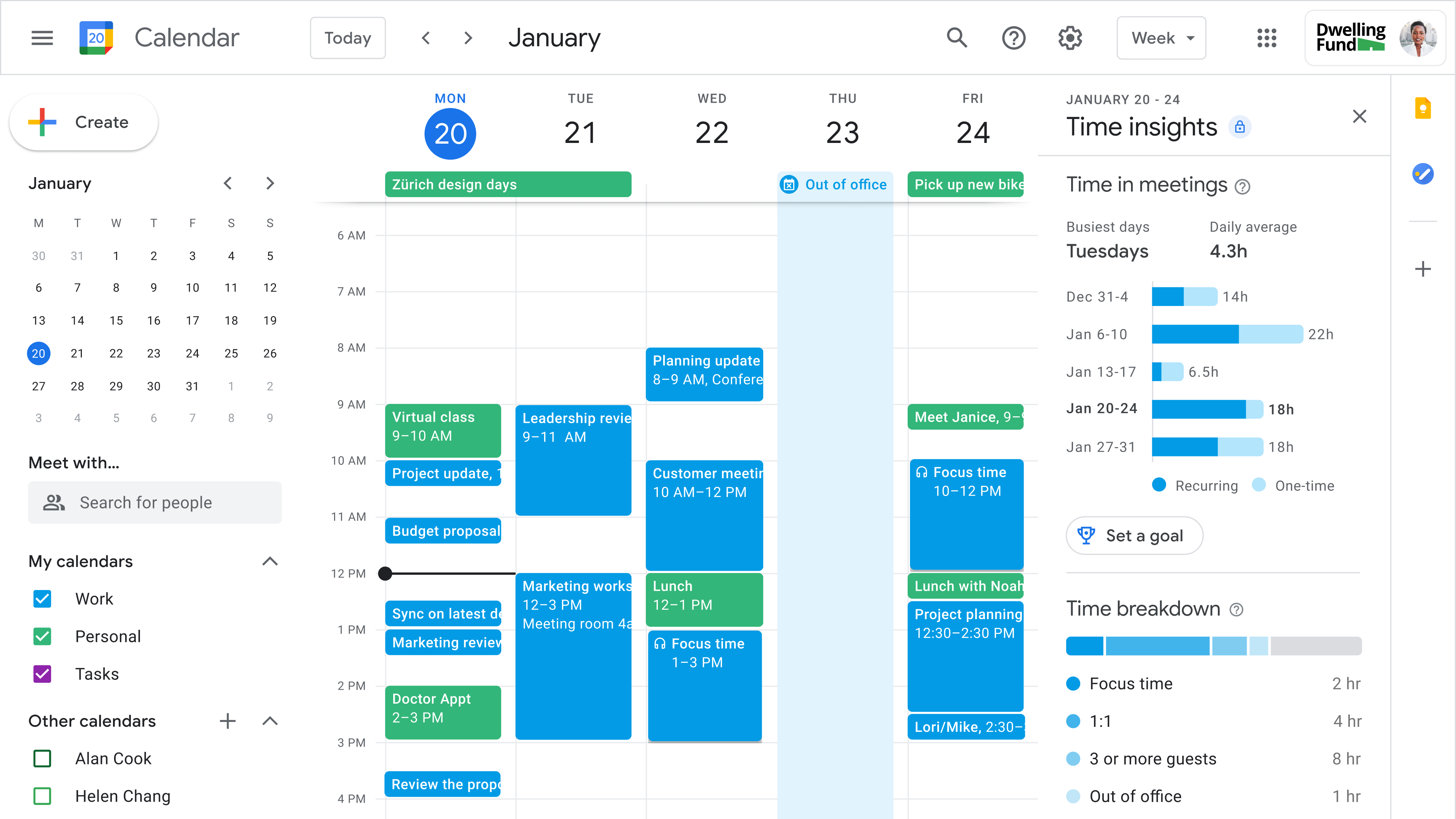
Image Credits: Google
For frontline workers, Google is adding something it calls Google Workspace Frontline, with new features for this group of users, and it is also making it easier for users to build custom AppSheet apps from Google Sheets and Drive, “so that frontline workers can digitize and streamline their work, whether it’s collecting data in the field, reporting safety risks, or managing customer requests.”
Powered by WPeMatico
Zeta Global, the marketing technology company founded by David A. Steinberg and former Apple CEO John Sculley, is announcing an additional $222.5 million in new debt financing.
The company has gone down the debt route before — a Series F raised in 2017 combined $115 million funding with $25 million in debt. BofA Securities served as lead arranger and bookrunner for the new financing, with participation from Barclays, Credit Suisse and Morgan Stanley Senior Funding.
“For this round, we were able to both refinance our debt and add in a large amount of capacity for current operations and future initiatives,” Steinberg (Zeta’s CEO) told me via email. “We were able to work with our syndicate to capture a low interest rate and take advantage of the strong credit markets.”
The company emphasizes its data-driven approach to marketing, combining companies’ first-party data with artificial intelligence and what it says are more than 2.4 billion customer identifiers. Steinberg said this approach has only become more crucial, with 2020 delivering “a five-year acceleration” as brands face the challenge of “digitally transforming their business structure to be data-centric.”
“Zeta’s capabilities are helping marketers engage customers across the entire digital ecosystem more intelligently and efficiently, with individualized messages, offers, and content by way of our identity-based data and predictive AI,” Steinberg continued. “Our challenge is to continue to keep up with our customers’ needs and maintain our competitive advantage around data and AI.”
The company’s funding announcement notes that previous loans have been used to finance acquisitions and integrations, including commenting platform Disqus and machine learning-powered marketing platform Boomtrain. Asked whether this new debt will also be used for acquisitions, Steinberg said the company continues to “organically innovate,” with a focus on its customer data platform and connected TV capabilities.
Early Stage is the premiere ‘how-to’ event for startup entrepreneurs and investors. You’ll hear firsthand how some of the most successful founders and VCs build their businesses, raise money and manage their portfolios. We’ll cover every aspect of company-building: Fundraising, recruiting, sales, legal, PR, marketing and brand building. Each session also has audience participation built-in — there’s ample time included in each for audience questions and discussion.
Powered by WPeMatico