Enterprise
Auto Added by WPeMatico
Auto Added by WPeMatico
The team at Reduct.Video is hoping to dramatically increase the amount of videos created by businesses.
The startup’s technology is already used by customers including Intuit, Autodesk, Facebook, Dell, Spotify, Indeed, Superhuman and IDEO. And today, Reduct is announcing that it has raised a $4 million round led by Greylock and South Park Commons, with participation from Figma CEO Dylan Field, Hopin Chief Business Officer Armando Mann and former Twitter exec Elad Gil.
Reduct was founded by CEO Prabhas Pokharel and CTO Robert Ochshorn (both pictured above). Pokharel argued that despite the proliferation of streaming video platforms and social media apps on the consumer side, video remains “underutilized” in a business context, because it simply takes so much time to sort through video footage, much less edit it down into something watchable.
As Pokharel demonstrated for me, Reduct uses artificial intelligence, natural language processing and other technologies to simplify the process by automatically transcribing video footage (users can also pay for professional transcription), then tying that transcript to the video.
“The magic starts there: Once the transcription has been made, every single word is connected to the [corresponding] moment in the video,” he said.
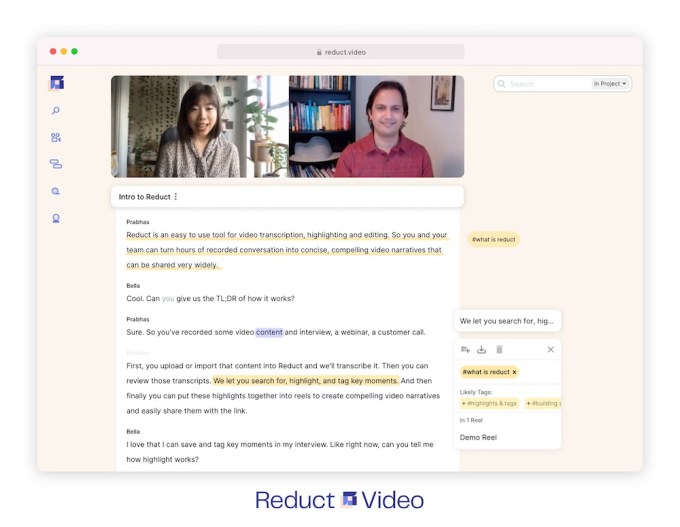
Image Credits: Reduct.Video
That means editing a video is as simple as editing text. (I’ve taken advantage of a similar linkage between text and media in Otter, but Otter is focused on audio and I’ve treated it more as a transcription tool.) It also means you can search through hours of footage for every time a topic is mentioned, then organize, tag and share it.
Pokharel said that AI allows Reduct to simplify parts of the sorting and editing process, like understanding how different search terms might be related. But he doesn’t think the process will ever become fully automated — instead, he compared the product to an “Iron Man suit,” which makes a human editor more powerful.
He also suggested that this approach changes businesses’ perspective on video, and not just by making editing faster and easier.
“Users on Reduct emphasize authenticity over polish, where it’s much more the content of the video that matters,” Pokharel said. He added that Reduct has been “learning from our customers” about what they can do with the product — user research teams can now easily organize and share hundreds of hours of user footage, while marketers can turn customer testimonials and webinars into short, shareable videos.
“Video has been so supply constrained, it’s crazy,” he continued. “There are all these use cases for asynchronous video that [companies] haven’t even bothered with.”
For example, he recalled one customer who said that she used to insist that team members attend a meeting even if there was only two minutes of it that they needed to hear. With Reduct, she can “give them that time back” and just share the parts they need.
Powered by WPeMatico
Workplace injuries and illnesses cost the U.S. upwards of $250 billion each year, according to the Economic Policy Institute. ERA-backed startup Intenseye, a machine learning platform, has raised a $4 million seed round to try to bring that number way down in an economic and efficient way.
The round was co-led by Point Nine and Air Street Capital, with participation by angel investors from Twitter, Cortex, Fastly and Even Financial.
Intenseye integrates with existing network-connected cameras within facilities and then uses computer vision to monitor employee health and safety on the job. This means that Intenseye can identify health and safety violations, from not wearing a hard hat to ignoring social distancing protocols and everything in between, in real time.
The service’s dashboard incorporates federal and local workplace safety laws, as well as an individual organization’s rules to monitor worker safety in real time. All told, the Intenseye platform can identify 30 different unsafe behaviors which are common within workplaces. Managers can further customize these rules using a drag-and-drop interface.
When a violation occurs and is spotted, employee health and safety professionals receive an alert immediately, by text or email, to resolve the issue.
Intenseye also takes the aggregate of workplace safety compliance within a facility to generate a compliance score and diagnose problem areas.
The company charges a base deployment fee and then on an annual fee based on the number of cameras the facility wants to use as Intenseye monitoring points.
Co-founder Sercan Esen says that one of the greatest challenges of the business is a technical one: Intenseye monitors workplace safety through computer vision to send EHS (employee health and safety) violation alerts but it also never analyzes faces or identifies individuals, and all video is destroyed on the fly and never stored with Intenseye.
The Intenseye team is made up of 20 people.
“Today, our team at Intenseye is 20% female and 80% male and includes four nationalities,” said Esen. “We have teammates with MSes in computer science and teammates who have graduated from high school.”
Diversity and inclusion among the team is critical at every company, but is particularly important at a company that builds computer vision software.
The company has moved to remote work in the wake of the pandemic and is using VR to build a virtual office and connect workers in a way that’s more immersive than Zoom.
Intenseye is currently deployed across 30 cities and will use the funding to build out the team, particularly in the sales and marketing departments, and deploy go-to-market strategies.
Powered by WPeMatico
Since the start of the year, I’ve covered nine M&A deals already, the largest being Citrix buying Wrike for $2.25 billion. But not every deal involves a huge price tag. Today we are going to look at three smaller deals that show there is plenty of activity at the lower-end of the acquisition spectrum.
As companies look for ways to enhance their offerings, and bring in some talent at the same time, smaller acquisitions can provide a way to fill in the product road map without having to build everything in-house.
This gives acquiring companies additional functionality for a modest amount of cash. In smaller deals, we often don’t even get the dollar amount, although in one case today we did. If the deal isn’t large enough to have a material financial impact on a publicly traded company, they don’t have to share the price.
Let’s have a look at three such deals that came through in recent days.
For starters, Tenable, a network security company that went public in 2018, bought French Active Directory security startup Alsid for $98 million. Active Directory, Microsoft’s popular user management tool, is also a target of hackers. If they can get a user’s credentials, it’s an easy way to get on the network and Alsid is designed to prevent that.
Security companies tend to enhance the breadth of their offerings over time and Alsid gives Tenable another tool and broader coverage across their security platform. “We view the acquisition of Alsid as a natural extension into user access and permissioning. Once completed, this acquisition will be a strategic complement to our Cyber Exposure vision to help organizations understand and reduce cyber risk across the entire attack surface,” according to the investor FAQ on this acquisition.
Emmanuel Gras, CEO and co-founder, Alsid says he started the company to prevent this kind of attack. “We started Alsid to help organizations solve one of the biggest security challenges, an unprotected Active Directory, which is one of the most common ways for threat actors to move laterally across enterprise systems,” Gras said in a statement.
Alsid is based in Paris and was founded in 2014. It raised a modest amount, approximately $15,000, according to Crunchbase data.
Copper, a CRM tool built on top of the Google Workspace, announced it has purchased Sherlock, a customer experience platform. They did not share the purchase price.
The pandemic pushed many shoppers online and providing a more customized experience by understanding more about your customer can contribute to and drive more engagement and sales. With Sherlock, the company is getting a tool that can help Copper users understand their customers better.
“Sherlock is an innovative engagement analytics and scoring platform, and surfaces your prospects’ and customers’ intentions in a way that drives action for sales, account management and customer success professionals,” Copper CEO Dennis Fois wrote in a blog post announcing the deal.
He added, “Relationships are based on engagement, and with Sherlock we are going to create CRM that is focused on action and momentum.”
It’s clear that APIs have changed the way we think about software development, but they have also created a management problem of their own as they proliferate across large organizations. RapidAPI, an API management platform, announced today that it has acquired Paw.
With Paw, RapidAPI adds the ability to design your own APIs, essentially giving customers a one-stop shop for everything related to creating and managing the API environment inside a company. “The acquisition enables RapidAPI to extend its open API platform across the entire API development lifecycle, creating a connected experience for developers from API development to consumption, across multiple clouds and gateways,” the company explained in a statement.
RapidAPI was founded in 2015 and has raised over $67 million, according to Crunchbase data. Its most recent funding came last May, a $25 million round from Andreessen Horowitz, DNS Capital, Green Bay Ventures, M12 (Microsoft’s Venture Fund) and Grove.
Each of these purchases fills an important need for the acquiring company and expands the abilities of the existing platform to offer more functionality to customers without putting out a ton of cash to do it.
Powered by WPeMatico
The founders of Accord, an early-stage startup focused on bringing order to B2B sales, are not your typical engineer founders. Instead, the two brothers, Ross and Ryan Rich, worked as sales reps seeing the problems unique to this kind of sale firsthand.
In November 2019, they decided to leave the comfort of their high-paying jobs at Google and Stripe to launch Accord and build what they believe is a missing platform for B2B sales, one that takes into account the needs of both the sales person and the buyer.
Today the company is launching with a $6 million seed round from former employer Stripe and Y Combinator. It should be noted that the founders applied to YC after leaving their jobs and impressed the incubator with their insight and industry experience, even though they didn’t really have a product yet. In fact, they literally drew their original idea on a piece of paper.
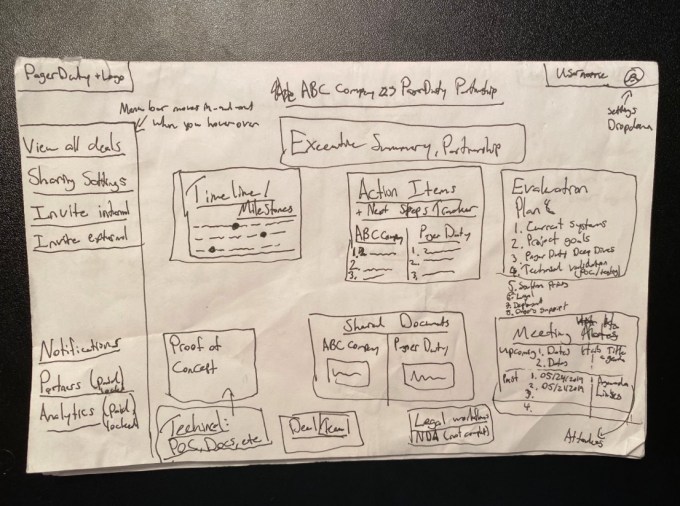
The original prototype was just a drawing of their idea. Image Credits: Accord
Recognizing they had the sales skills, but lacked programming chops, they quickly brought in a third partner, Wayne Pan, to bring their idea to life. Today, they have an actual working program with paying customers. They’ve created a kind of online hub for B2B salespeople and buyers to interact.
As co-founder Ross Rich points out, these kinds of sales are very different from the consumer variety, often involving as many as 14 people on average on the buyer side. With so many people involved in the decision-making process, it can become unwieldy pretty quickly.
“We provide within the application shared next steps and milestones to align on and that the buyer can track asynchronously, a resource hub to avoid sorting through those hundreds of emails and threads for a single document or presentation and stakeholder management to make sure the right people are looped in at the right time,” Rich explained.
Accord also integrates with the company CRM like Salesforce to make sure all of that juicy data is being tracked properly in the sales database. At the same time, Rich says the startup wants this platform to be a place for human interaction. Instead of an automated email or text, this provides a place where humans can actually interact with one another, and he believes that human element is important to help reduce the complexity inherent in these kinds of deals.
With $6 million in runway and a stint at Y Combinator under their belts, the founders are ready to make a more concerted go-to-market push. They are currently at nine people, mostly engineers aside from the two sales-focused founders. He figures to be bringing in some new employees this year, but doesn’t really have a sense of how many they will bring on just yet, saying that is something that they will figure out in the coming months.
As they do that, they are already thinking about being inclusive with several women on the engineering team, recognizing if they don’t start diversity early, it will be more difficult later on. “[Hiring a diverse group early] only compounds when you get to nine or 10 people and then when you’re talking to someone and they are wondering, ‘Do I trust this team and is that a culture where I want to work?’ He says if you want to build a diverse and inclusive workplace, you have to start making that investment early.
It’s early days for this team, but they are building a product to help B2B sales teams work more closely and effectively with customers, and with their background and understanding of the space, they seem well-positioned to succeed.
Powered by WPeMatico
SLAs, SLOs, SLIs. If there’s one thing everybody in the business of managing software development loves, it’s acronyms. And while everyone probably knows what a Service Level Agreement (SLA) is, Service Level Objectives (SLOs) and Service Level Indicators (SLIs) may not be quite as well known. The idea, though, is straightforward, with SLOs being the overall goals a team must hit to meet the promises of its SLA agreements, and SLIs being the actual measurements that back up those other two numbers. With the advent of DevOps, these ideas, which are typically part of a company’s overall Site Reliability Engineering (SRE) efforts, are becoming more mainstream, but putting them into practice isn’t always straightforward.
Nobl9 aims to provide enterprises with the tools they need to build SLO-centric operations and the right feedback loops inside an organization to help it hit its SLOs without making too many trade-offs between the cost of engineering, feature development and reliability.
The company today announced that it has raised a $21 million Series B round led by its Series A investors Battery Ventures and CRV. In addition, Series A investors Bonfire Ventures and Resolute Ventures also participated, together with new investors Harmony Partners and Sorenson Ventures.
Before starting Nobl9, co-founders Marcin Kurc (CEO) and Brian Singer (CPO) spent time together at Orbitera, where Singer was the co-founder and COO and Kurc the CEO, and then at Google Cloud, after it acquired Orbitera in 2016. In the process, the team got to work with and appreciate Google’s site reliability engineering frameworks.
As they started looking into what to do next, that experience led them to look into productizing these ideas. “We came to this conclusion that if you’re going into Kubernetes, into service-based applications and modern architectures, there’s really no better way to run that than SRE,” Kurc told me. “And when we started looking at this, naturally SRE is a complete framework, there are processes. We started looking at elements of SRE and we agreed that SLO — service level objectives — is really the foundational part. You can’t do SRE without SLOs.”
As Singer noted, in order to adopt SLOs, businesses have to know how to turn the data they have about the reliability of their services, which could be measured in uptime or latency, for example, into the right objectives. That’s complicated by the fact that this data could live in a variety of databases and logs, but the real question is how to define the right SLOs for any given organization based on this data.
“When you go into the conversation with an organization about what their goals are with respect to reliability and how they start to think about understanding if there’s risks to that, they very quickly get bogged down in how are we going to get this data or that data and instrument this or instrument that,” Singer said. “What we’ve done is we’ve built a platform that essentially takes that as the problem that we’re solving. So no matter where the data lives and in what format it lives, we want to be able to reduce it to very simply an error budget and an objective that can be tracked and measured and reported on.”
The company’s platform launched into general availability last week, after a beta that started last year. Early customers include Brex and Adobe.
As Kurc told me, the team actually thinks of this new funding round as a Series A round, but because its $7.5 million Series A was pretty sizable, they decided to call it a Series A instead of a seed round. “It’s hard to define it. If you define it based on a revenue milestone, we’re pre-revenue, we just launched the GA product,” Singer told me. “But I think just in terms of the maturity of the product and the company, I would put us at the [Series] B.”
The team told me that it closed the round at the end of last November, and while it considered pitching new VCs, its existing investors were already interested in putting more money into the company and since its previous round had been oversubscribed, they decided to add to this new round some of the investors that didn’t make the cut for the Series A.
The company plans to use the new funding to advance its roadmap and expand its team, especially across sales, marketing and customer success.
Powered by WPeMatico
Managing IoT devices in a large organization can be a messy proposition, especially when many of them aren’t even managed directly by IT and often involve integrating with a number of third-party systems. SecuriThings wants to help with a platform of services to bring that all under control, and today the startup announced a $14 million Series A.
Aleph led the round with participation from existing investor Firstime VC and a number of unnamed angels. The company has raised a total of $17 million, according to Crunchbase data.
Roy Dagan, company CEO and co-founder, says that he sees organizations with many different connected devices running on a network, and it’s difficult to manage. “We enable organizations to manage IoT devices securely at scale in a consolidated and cost-efficient manner,” Dagan told me.
This could include devices like security cameras, along with access control systems and building management systems involving thousands — or in some instances, tens of thousands — of devices. “The technology we build, we integrate with management systems, and then we deploy our capabilities which are focused on the edge devices. So that’s how we also find the devices, and then we have these different capabilities running on the edge devices or fetching information from the edge devices,” Dagan explained.
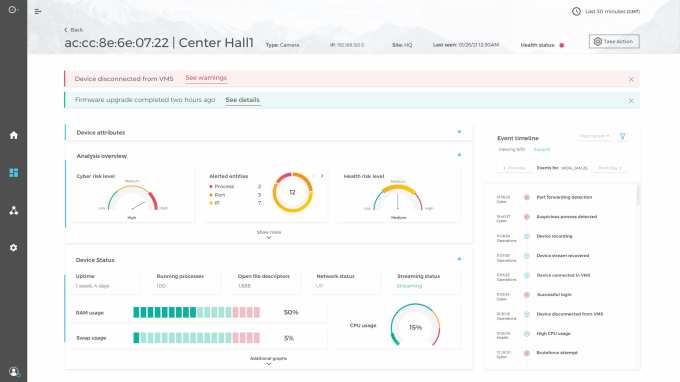
Image Credits: SecuriThings
The company has formed partnerships with a number of key device manufacturers, including Microsoft, Convergint Technologies and Johnson Controls, among others. They work with a range of industries including airports, casinos and large corporate campuses.
Aaron Rosenson, general partner at lead investor Aleph, says the company is solving a big problem managing the myriad devices inside large organizations. “Until SecuriThings came along, there were these massive enterprise software categories of automation, orchestration and observability just waiting to be built for IoT,” Rosenson said in a statement. He says that SecuiThings is pulling that all together for its customers.
The company was founded in 2016 originally with the idea of being an IoT security company, and while they still are involved in securing these devices, their ability to communicate with them gives IT much greater visibility and insight and the ability to update and manage them.
Today, the company has 30 employees, and with the new investment it will be doubling that number by the end of the year. While Dagan didn’t cite specific customer numbers, he did say they have dozens of customers with deal sizes of between five and seven figures.
Powered by WPeMatico
When Amazon announced last week that founder and CEO Jeff Bezos planned to step back from overseeing operations and shift into an executive chairman role, it also revealed that AWS CEO Andy Jassy, head of the company’s profitable cloud division, would replace him.
As Bessemer partner Byron Deeter pointed out on Twitter, Jassy’s promotion was similar to Satya Nadella’s ascent at Microsoft: in 2014, he moved from executive VP in charge of Azure to the chief exec’s office. Similarly, Arvind Krishna, who was promoted to replace Ginni Rometti as IBM CEO last year, also was formerly head of the company’s cloud business.
Could Nadella’s successful rise serve as a blueprint for Amazon as it makes a similar transition? While there are major differences in the missions of these companies, it’s inevitable that we will compare these two executives based on their former jobs. It’s true that they have an awful lot in common, but there are some stark differences, too.
For starters, Jassy is taking over for someone who founded one of the world’s biggest corporations. Nadella replaced Steve Ballmer, who had taken over for the company’s face, Bill Gates. Holger Mueller, an analyst at Constellation Research, says this notable difference could have a huge impact for Jassy with his founder boss still looking over his shoulder.
“There’s a lot of similarity in the two situations, but Satya was a little removed from the founder Gates. Bezos will always hover and be there, whereas Gates (and Ballmer) had retired for good. [ … ] It was clear [they] would not be coming back. [ … ] For Jassy, the owner could [conceivably] come back anytime,” Mueller said.
But Andrew Bartels, an analyst at Forrester Research, says it’s not a coincidence that both leaders were plucked from the cloud divisions of their respective companies, even if it was seven years apart.
“In both cases, these hyperscale business units of Microsoft and Amazon were the fastest-growing and best-performing units of the companies. [ … ] In both cases, cloud infrastructure was seen as a platform on top of which and around which other cloud offerings could be developed,” Bartels said. The companies both believe that the leaders of these two growth engines were best suited to lead the company into the future.
Powered by WPeMatico
LiveRamp has acquired DataFleets, a fresh young startup that made it possible to take advantage of large volumes of encrypted data without the risk or fuss of decrypting or transferring it. LiveRamp, an enterprise data connectivity platform itself, paid more than $68 million for the company, a huge multiple on DataFleet’s $4.5 million seed announced just last fall.
DataFleets saw the increasing need for sensitive data like medical or financial records to be analyzed or used to train machine learning models. Not only are such databases bulky and complex, making transfers difficult, but allowing them to be decrypted and used elsewhere opens the door to errors, abuse and hacks.
The company’s solution was essentially to have software on both sides of the equation, the data provider (perhaps a hospital or bank) and the client (an analyst or AI developer), and act as a secure go-between. Not for the sensitive data itself, but for the systems of analysis and machine learning models that the client wanted to set loose on the data. This allows the client to perform an automated task on the data, such as harvesting and comparing values or building an ML model, without ever having direct access to it.
Clearly this approach seemed valuable to LiveRamp, which provides a number of data connectivity services to major enterprise customers, household names in fact. They announced in their earnings statement last night that they paid $68 million up front for DataFleets, though that price does not reflect the various other incentives and deferred payments that many such deals involve, and in this case seem likely to remain private.
The deal will probably result in the retiring of the DataFleets brand (young as it was), but their various customers will probably make the trip to LiveRamp. The most recent of those is HCA Healthcare, a major national provider that just announced a COVID-19 data sharing consortium that would be using DataFleets’s services. That’s a pretty powerful validation for an approach just commercialized late last year, and a nice catch for LiveRamp to add to its healthcare client collection.
For its part LiveRamp plans to use its augmented services to expand its operations and offerings in Europe, Asia and Latin America over the coming year. The company has also called for a federal data privacy law, something that hopefully that will be achieved under the new administration.
Powered by WPeMatico
SentinelOne, a late-stage security startup that helps customers make sense of security data using AI and machine learning, announced today that it is acquiring high-speed logging startup Scalyr for $155 million in stock and cash.
SentinelOne sorts through oodles of data to help customers understand their security posture, and having a tool that enables engineers to iterate rapidly in the data, and get to the root of the problem, is going to be extremely valuable for them, CEO and co-founder Tomer Weingarten explained. “We thought Scalyr would be just an amazing fit to our continued vision in how we secure data at scale for every enterprise [customer] out there,” he told me.
He said they spent a lot of time shopping for a company that could meet their unique scaling needs and when they came across Scalyr, they saw the potential pretty quickly with a company that has built a real-time data lake. “When we look at the scale of our technology, we obviously scoured the world to find the best data analytics technology out there. We [believe] we found something incredibly special when we found a platform that can ingest data, and make it accessible in real time,” Weingarten explained.
He believes the real time element is a game changer because it enables customers to prevent breaches, rather than just reacting to them. “If you’re thinking about mitigating attacks or reacting to attacks, if you can do that in real time and you can process data in real time, and find the anomalies in real time and then meet them, you’re turning into a system that can actually deflect the attacks and not just see them and react to them,” he explained.
The company sees Scalyr as a product they can integrate into the platform, but also one which will remain a standalone. That means existing customers should be able to continue using Scalyr as before, while benefiting from having a larger company contributing to its R&D.
While SentinelOne is not a public company, it is a pretty substantial private one, having raised over $695 million, according to Crunchbase data. The company’s most recent funding round came last November, a $267 million investment with a $3.1 billion valuation.
As for Scalyr, it was launched in 2011 by Steve Newman, who first built a word processor called Writely and sold it to Google in 2006. It was actually the basis for what became Google Docs. Newman stuck around and started building the infrastructure to scale Google Docs, and he used that experience and knowledge to build Scalyr. The startup raised $27 million along the way, according to Crunchbase data, including a $20 million Series A investment in 2017.
The deal will close this quarter, at which time Scalyr’s 45 employees will join SentinelOne.
Powered by WPeMatico
Last week, another container security startup came off the board when Rapid7 bought Alcide for $50 million. The purchase is part of a broader trend in which larger companies are buying up cloud-native security startups at a rapid clip. But why is there so much M&A action in this space now?
Palo Alto Networks was first to the punch, grabbing Twistlock for $410 million in May 2019. VMware struck a year later, snaring Octarine. Cisco followed with PortShift in October and Red Hat snagged StackRox last month before the Rapid7 response last week.
This is partly because many companies chose to become cloud-native more quickly during the pandemic. This has created a sharper focus on security, but it would be a mistake to attribute the acquisition wave strictly to COVID-19, as companies were shifting in this direction pre-pandemic.
It’s also important to note that security startups that cover a niche like container security often reach market saturation faster than companies with broader coverage because customers often want to consolidate on a single platform, rather than dealing with a fragmented set of vendors and figuring out how to make them all work together.
Containers provide a way to deliver software by breaking down a large application into discrete pieces known as microservices. These are packaged and delivered in containers. Kubernetes provides the orchestration layer, determining when to deliver the container and when to shut it down.
This level of automation presents a security challenge, making sure the containers are configured correctly and not vulnerable to hackers. With myriad switches this isn’t easy, and it’s made even more challenging by the ephemeral nature of the containers themselves.
Yoav Leitersdorf, managing partner at YL Ventures, an Israeli investment firm specializing in security startups, says these challenges are driving interest in container startups from large companies. “The acquisitions we are seeing now are filling gaps in the portfolio of security capabilities offered by the larger companies,” he said.
Powered by WPeMatico