Enterprise
Auto Added by WPeMatico
Auto Added by WPeMatico
Syniverse Technologies, a company that helps mobile providers move communications across public and private networks, announced an extensive partnership with Twilio this morning. Under the agreement, Twilio is investing up to $750 million to become a minority owner in the company.
The idea behind the partnership is to combine Twilio’s API communications expertise with Syniverse’s mobile carrier contacts to create this end-to-end communications system. Twilio’s strength has always been its ability to deliver communications like texts without having a carrier relationship. This deal gives them access to that side of the equation.
James Attwood, executive chairman at Syniverse, certainly saw the value of the two companies working together. “The partnership will provide Syniverse access to Twilio’s extensive enterprise and API services expertise, creating opportunities to continue to build on Syniverse’s highly innovative product portfolio that helps mobile network operators and enterprises make communications better for their customers,” Attwood said in a statement.
Today’s deal comes on the heels of the company’s $3.2 billion acquisition of Segment at the end of last year as it continues to look for ways to expand its markets. Will Townsend, an analyst at Moor Insight & Strategy who covers the network and carrier markets, sees this deal giving Twilio access to a broader set of technologies.
“Twilio [gets] access to Syniverse’s significant capabilities in massive industrial IoT and private 4G LTE and 5G cellular networking. Both are poised to ramp significantly given newfound enterprise access to licensed spectrum via recent C-Band and CBRS auctions,” Townsend told me. He believes this will help Twilio reach parts of the enterprise not connected by Wi-FI or where the customers are dealing with “a mishmash of solutions that don’t scale or propagate well.”
As it turns out, it’s not a coincidence the two companies are coming together like this. In fact, Twilio has been a Syniverse customer for some time, according to Chee Chew, chief product officer at Twilio.
It’s a case of an old-school company like Syniverse, which was founded in 1987, combining forces with a more modern approach to communications like Twilio, which provides developers with APIs to deliver communications services inside applications with just a couple of lines of code.
The Wall Street Journal, which broke the news of this deal, is also reporting the company could go public via SPAC at a value of between $2 and $3 billion some time later this year. That would suggest that it has not gained much value since the 2010 deal.
Holger Mueller, an analyst at Constellation Research, says the SPAC provides an interesting additional component to the deal. “The high-flying stock market creates all kind of new chickens, one of them being a SPAC, and that’s the financial opportunity that Twilio is likely pursuing with the investment into Syniverse. The more immediate benefit is for Twilio to use the messaging vendor for its services. Call it a partnership with investment upside,” Mueller said.
According to Syniverse, “the company is one of the largest private IP Packet Exchange (IPX) providers in the world and offers a range of networking solutions, excelling in scenarios where seamless connections must cross over networks — either across multiple private networks or between public and private networks.”
The company is currently owned by the Carlyle Group private equity firm, which bought it in 2010 for $2.6 billion. Twilio launched in 2008 and raised over $236 million before going public in 2016 at $15 per share. The stock was up 3.82% in early trading, suggesting that Wall Street approves of the deal.
Early Stage is the premiere “how-to” event for startup entrepreneurs and investors. You’ll hear firsthand how some of the most successful founders and VCs build their businesses, raise money and manage their portfolios. We’ll cover every aspect of company-building: Fundraising, recruiting, sales, legal, PR, marketing and brand building. Each session also has audience participation built-in — there’s ample time included in each for audience questions and discussion.
Powered by WPeMatico
Storm Ventures, a venture firm that focuses on early stage B2B enterprise startups, announced this week that it has promoted Pascale Diaine and Frederik Groce to partners at the firm.
The two new partners have worked their way up over the last several years. Groce joined Storm in 2016 and has invested in enterprise SaaS startups like Workato, Splashtop, NextRequest and Camino. Diaine joined a year later and has invested in firms like Sendoso, German Bionic, InEvent and Talkdesk.
Groce, who is also a founder at BLCK VC and helped organize the Black Venture Institute to create a network of Black investors, says that these promotions show that venture needs to be more diverse, and Storm recognizes this. “If you think about the way our team works, that’s the way I think venture teams will need to work to be able to be successful in the next 40 years. And so the hope is that over time everyone does this and we’re just early to it,” Groce told me.
Unfortunately, right now that’s not the case, not even close. According to research by Crunchbase, just 12% of venture capitalists are women and two-thirds of firms don’t have any female investors. Meanwhile, only about 4% of ventures investors are Black.
Those numbers have an impact on the number of Black and female founders because as Groce points out the lack of founders in underrepresented groups is in part a networking problem. “In a business that’s predicated on networks if you don’t have diversity in the network, or the teams that are driving those networks, you just can’t make sure you’re seeing great talent across all ecosystems,” he said.
Diaine, who is French and started her career by founding Orange Fab, the corporate accelerator of the European Telco Orange, has brought her international business background to Storm where they helped her tune that experience to an investor focus and supported her as she learned the nuances of the investment side of the business.
“I don’t come from the VC world. I come from the innovative corporate world. So they had to train me and spend time getting me up to date. And they did spend so much time making sure I understood everything to make sure I got to this level,” she said.
Both partners bring their own unique views looking beyond Silicon Valley for investment opportunities. Diaine’s investment include a German, Brazilian and Portuguese company, while Groce’s investments include companies in Chicago, Atlanta and Seattle.
The two partners have also developed an algorithm to help find investments based on a number of online signals, something that has become more important during the pandemic when they couldn’t network in person.
“Frederik and I have been working on [an algorithm to find] what are the signals that you can identify online that will tell you this company’s doing well, this company growing.You have to have a nice set of startup search tracking [signals], but what do you track if you can’t just get the revenue in real time, which is impossible. So we’ve developed an algorithm that helps us identify some of these signals and create alerts on which startups we should pay attention to,” Diaine explained.
She says this data-driven approach should be helpful and augment their in-person efforts even after the pandemic is over and increase their overall efficiency in finding and tracking companies in their portfolios.
Powered by WPeMatico
Wall Street investors can be fickle beasts. Take Salesforce as an example. The CRM giant announced a $5.82 billion quarter when it reported earnings yesterday. Revenue was up 20% year over year. The company also reported $21.25 billion in total revenue for the just-closed FY2021, up 24% YoY. If that wasn’t enough, it raised its FY2022 guidance (its upcoming fiscal year) to over $25 billion. What’s not to like?
You want higher quarterly revenue, Salesforce gave you higher revenue. You want high growth and solid projected revenue — check and check. In fact, it’s hard to find anything to complain about in the report. The company is performing and growing at a rate that is remarkable for an organization of its size and maturity — and it is expected to continue to perform and grow.
How did Wall Street react to this stellar report? It punished the stock with the price down over 6%, a pretty dismal day considering the company brought home such a promising report card.
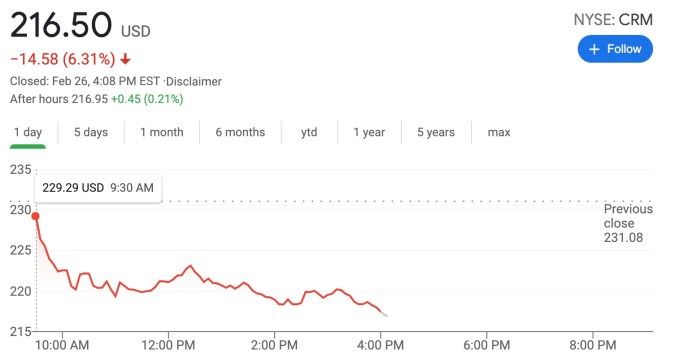
Image Credits: Google
So what is going on here? It could be that investors simply don’t believe the growth is sustainable or that the company overpaid when it bought Slack at the end of last year for over $27 billion. It could be it’s just people overreacting to a cooling market this week. But if investors are looking for a high-growth company, Salesforce is delivering that.
While Slack was expensive, it reported revenue over $250 million yesterday, pushing it over the $1 billion run rate with more than 100 customers paying over $1 million in ARR. Those numbers will eventually get added to Salesforce’s bottom line.
Canaccord Genuity analyst David Hynes Jr. wrote that he was baffled by investors’ reaction to this report. Like me, he saw a lot of positives. Yet Wall Street decided to focus on the negative, and see “the glass half empty,” as he put it in his note to investors.
“The stock is clearly in the show-me camp, which means it’s likely to take another couple of quarters for investors to buy into the idea that fundamentals are actually quite solid here, and that Slack was opportunistic (and yes, pricey), but not an attempt to mask suddenly deteriorating growth,” Hynes wrote.
During the call with analysts yesterday, Brad Zelnick from Credit Suisse asked how well the company could accelerate out of the pandemic-induced economic malaise, and Gavin Patterson, Salesforce’s president and chief revenue officer, says the company is ready whenever the world moves past the pandemic.
“And let me reassure you, we are building the capability in terms of the sales force. You’d be delighted to hear that we’re investing significantly in terms of our direct sales force to take advantage of that demand. And I’m very confident we’ll be able to meet it. So I think you’re hearing today a message from us all that the business is strong, the pipeline is strong and we’ve got confidence going into the year,” Patterson said.
While Salesforce execs were clearly pumped up yesterday with good reason, there’s still doubt out in investor land that manifested itself in the stock starting down and staying down all day. It will be, as Hynes suggested, up to Salesforce to keep proving them wrong. As long as they keep producing quarters like the one they had this week, they should be just fine, regardless of what the naysayers on Wall Street may be thinking today.
Powered by WPeMatico

When I needed a new sofa several months ago, I was pleased to find a buy now, pay later (BNPL) option during the checkout process. I had prepared myself to make a major financial outlay, but the service fees were well worth the convenience of deferring the entire payment.
Coincidentally, I was siting on said sofa this morning and considering that transaction when Alex Wilhelm submitted a column that compared recent earnings for three BNPL providers: Afterpay, Affirm and Klarna.
I asked him why he decided to dig into the sector with such gusto.
Full Extra Crunch articles are only available to members.
Use discount code ECFriday to save 20% off a one- or two-year subscription.
“What struck me about the concept was that we had just seen earnings from Affirm,” he said. “So we had three BNPL players with known earnings, and I had just covered a startup funding round in the space.”
“Toss in some obvious audience interest, and it was an easy choice to write the piece. Now the question is whether I did a good job and people find value in it.”
Thanks very much for reading Extra Crunch this week! Have a great weekend.
Walter Thompson
Senior Editor, TechCrunch
@yourprotagonist

Image Credits: Colin Hawkins (opens in a new window) / Getty Images
I avoid running Extra Crunch stories that focus on best practices; you can find those anywhere. Instead, we look for “here’s what worked for me” articles that give readers actionable insights.
That’s a much better use of your time and ours.
With that ethos in mind, Lucas Matney interviewed Pilot CEO Waseem Daher to deconstruct the pitch deck that helped his company land a $60M Series C round.
“If the Series A was about, ‘Do you have the right ingredients to make this work?’ then the Series B is about, ‘Is this actually working?’” Daher tells TechCrunch.
“And then the Series C is more, ‘Well, show me that the core business is really working and that you have unlocked real drivers to allow the business to continue growing.’”

Image Credits: Bryce Durbin
A global survey of automobile owners found three hurdles to overcome before consumers will widely embrace electric vehicles:
“Theoretically, solid state batteries (SSB) could deliver all three,” but for now, lithium-ion batteries are the go-to for most EVs (along with laptops and phones).
In our latest market map, we’ve plotted the new and established players in the SSB sector and listed many of the investors who are backing them.
Although SSBs are years away from mass production, “we are on the cusp of some pretty incredible discoveries using major improvements in computational science and machine learning algorithms to accelerate that process,” says SSB startup founder Amy Prieto.

Image Credits: Bryce Durbin/TechCrunch
Dear Sophie:
Help! Our startup needs to hire 50 engineers in artificial intelligence and related fields ASAP. Which visa and green card options are the quickest to get for top immigrant engineers?
And will Biden’s new immigration bill help us?
— Mesmerized in Menlo Park

Image Credits: Jasmin Merdan / Getty Images
Founded in 1996, F5 has repositioned itself in the networking market several times in its history. In the last two years, however, it spent $2.2 billion to acquire Shape Security, Volterra and NGINX.
“As large organizations age, they often need to pivot to stay relevant, and I wanted to explore one of these transformational shifts,” said enterprise reporter Ron Miller.
“I spoke to the CEO of F5 to find out the strategy behind his company’s pivot and how he leveraged three acquisitions to push his organization in a new direction.”

Image Credits: Who_I_am (opens in a new window) / Getty Images
Cloud hosting company DigitalOcean filed to go public this week, so Ron Miller and Alex Wilhelm unpacked its financials.
“AWS and Microsoft Azure will not be losing too much sleep worrying about DigitalOcean, but it is not trying to compete head-on with them across the full spectrum of cloud infrastructure services,” said John Dinsdale, chief analyst and research director at Synergy Research.

Image Credits: Nigel Sussman (opens in a new window)
I asked Alex Wilhelm to dial back the profanity he used to describe Oscar Health’s proposed valuation, but perhaps I was too conservative.
In March 2018, the insurtech unicorn was valued at around $3.2 billion. Today, with the company aiming to debut at $32 to $34 per share, its fully diluted valuation is closer to $7.7 billion.
“The clear takeaway from the first Oscar Health IPO pricing interval is that public investors have lost their minds,” says Alex.
His advice for companies considering an IPO? “Go public now.”

Image Credits: Nigel Sussman (opens in a new window)
Last week, Alex wrote about how cryptocurrency trading platform Coinbase was being valued at $77 billion in the private markets.
As of Monday, “it’s now $100 billion, per Axios’ reporting.”
He reviewed Coinbase’s performance from 2019 through the end of Q3 2020 “to decide whether Coinbase at $100 billion makes no sense, a little sense or perfect sense.”

Image Credits: Alla Aramyan (opens in a new window) / Getty Images
A skilled software sales team devotes a lot of resources to pinpointing potential customers.
Poring through LinkedIn and reviewing past speaker lists at industry conferences are good places to find decision-makers, for example.
Despite this detective work, GGV Capital investor Oren Yunger says sales teams still need to identify the deal-blockers who can spike a deal with a single email.
“I call this person the Chief Objection Officer.”

Image Credits: Klaus Vedfelt / Getty Images
Every startup wants to raise its profile, but for many early-stage companies, marketing budgets are too small to make a meaningful difference.
“Providing real value through content is an excellent way to build authority in the short and long term,” says Amanda Milligan, marketing director at growth agency Fractl.

Image Credits: luchezar (opens in a new window) / Getty Images
The most effective marketing uses good storytelling, not persuasion.
According to Caryn Marooney, general partner at Coatue Management, every compelling story is relevant, inevitable, believable and simple.
“Behind most successful companies is a story that checks every one of those boxes,” says Marooney, but “this is a central challenge for every startup.”

On a recent episode of Extra Crunch Live, Ironclad founder and CEO Jason Boehmig and Accel partner Steve Loughlin discussed the pitch that brought them together almost four years ago.
Since that $8 million Series A, Loughlin joined Ironclad’s board. “Both agree that the work they put in up front had paid off” when it comes to how well they work together, says Jordan Crook.
“We’ve always been up front about the fact that we consider the board a part of the company,” said Boehmig.
From April 1-2, some of the most successful founders and VCs will explain how they build their businesses, raise money and manage their portfolios.
At TC Early Stage, we’ll cover topics like recruiting, sales, legal, PR, marketing and brand building. Each session includes ample time for audience questions and discussion.
Use discount code ECNEWSLETTER to take 20% off the cost of your TC Early Stage ticket!
Powered by WPeMatico
The Atlassian platform is chock full of data about how a company operates and communicates. Atlassian launched a machine learning layer, which relies on data on the platform with the addition of Atlassian Smarts last fall. Today the company announced it was acquiring Chartio to add a new data analysis and visualization component to the Atlassian family of products. The companies did not share a purchase price.
The company plans to incorporate Chartio technology across the platform, starting with Jira. Before being acquired, Chartio has generated its share of data, reporting that 280,000 users have created 10.5 million charts for 540,000 dashboards pulled from over 100,000 data sources.
Atlassian sees Chartio as way to bring that data visualization component to the platform and really take advantage of the data locked inside its products. “Atlassian products are home to a treasure trove of data, and our goal is to unleash the power of this data so our customers can go beyond out-of-the-box reports and truly customize analytics to meet the needs of their organization,” Zoe Ghani, head of product experience at platform at Atlassian wrote in a blog post announcing the deal.
Chartio co-founder and CEO Dave Fowler wrote in a blog post on his company website that the two companies started discussing a deal late last year, which culminated in today’s announcement. As is often the case in these deals, he is arguing that his company will be better off as part of large organization like Atlassian with its vast resources than it would have been by remaining stand-alone.
“While we’ve been proudly independent for years, the opportunity to team up our technology with Atlassian’s platform and massive reach was incredibly compelling. Their product-led go to market, customer focus and educational marketing have always been aspirational for us,” Fowler wrote.
As for Chartio customers unfortunately, according to a notice on the company website, the product is going to be going away next year, but customers will have plenty of time to export the data to another tool. The notice includes a link to instructions on how to do this.
Chartio was founded in 2010, and participated in the Y Combinator Summer 2010 cohort. It raised a modest $8.03 million along the way, according to Pitchbook data.
Powered by WPeMatico
This morning DigitalOcean, a provider of cloud computing services to SMBs, filed to go public. The company intends to list on the New York Stock Exchange (NYSE) under the ticker symbol “DOCN.”
DigitalOcean’s offering comes amidst a hot streak for tech IPOs, and valuations that are stretched by historical norms. The cloud hosting company was joined by Coinbase in filing its numbers publicly today.
DigitalOcean’s offering comes amidst a hot streak for tech IPOs.
However, unlike the cryptocurrency exchange, DigitalOcean intends to raise capital through its offering. Its S-1 filing lists a $100 million placeholder number, a figure that will update when the company announces an IPO price range target.
This morning let’s explore the company’s financials briefly, and then ask ourselves what its results can tell us about the cloud market as a whole.
TechCrunch has covered DigitalOcean with some frequency in recent years, including its early-2020 layoffs, its early-2020 $100 million debt raise and its $50 million investment from May of the same year that prior investors Access Industries and Andreessen Horowitz participated in.
From those pieces we knew that the company had reportedly reached $200 million in revenue during 2018, $250 million in 2019 and that DigitalOcean had expected to reach an annualized run rate of $300 million in 2020.
Those numbers held up well. Per its S-1 filing, DigitalOcean generated $203.1 million in 2018 revenue, $254.8 million in 2019 and $318.4 million in 2020. The company closed 2020 out with a self-calculated $357 million in annual run rate.
During its recent years of growth, DigitalOcean has managed to lose modestly increasing amounts of money, calculated using generally accepted accounting principles (GAAP), and non-GAAP profit (adjusted EBITDA) in rising quantities. Observe the rising disconnect:
Powered by WPeMatico
It’s essential for older companies to recognize changes in the marketplace or face the brutal reality of being left in the dust. F5 is an old-school company that launched back in the 90s, yet has been able to transform a number of times in its history to avoid major disruption. Over the last two years, the company has continued that process of redefining itself, this time using a trio of acquisitions — NGINX, Shape Security and Volterra — totaling $2.2 billion to push in a new direction.
While F5 has been associated with applications management for some time, it recognized that the way companies developed and managed applications was changing in a big way with the shift to Kubernetes, microservices and containerization. At the same time, applications have been increasingly moving to the edge, closer to the user. The company understood that it needed to up its game in these areas if it was going to keep up with customers.
Taken separately, it would be easy to miss that there was a game plan behind the three acquisitions, but together they show a company with a clear opinion of where they want to go next. We spoke to F5 president and CEO François Locoh-Donou to learn why he bought these companies and to figure out the method in his company’s acquisition spree madness.
F5, which was founded in 1996, has found itself at a number of crossroads in its long history, times where it needed to reassess its position in the market. A few years ago it found itself at one such juncture. The company had successfully navigated the shift from physical appliance to virtual, and from data center to cloud. But it also saw the shift to cloud native on the horizon and it knew it had to be there to survive and thrive long term.
“We moved from just keeping applications performing to actually keeping them performing and secure. Over the years, we have become an application delivery and security company. And that’s really how F5 grew over the last 15 years,” said Locoh-Donou.
Today the company has over 18,000 customers centered in enterprise verticals like financial services, healthcare, government, technology and telecom. He says that the focus of the company has always been on applications and how to deliver and secure them, but as they looked ahead, they wanted to be able to do that in a modern context, and that’s where the acquisitions came into play.
As F5 saw it, applications were becoming central to their customers’ success and their IT departments were expending too many resources connecting applications to the cloud and keeping them secure. So part of the goal for these three acquisitions was to bring a level of automation to this whole process of managing modern applications.
“Our view is you fast forward five or 10 years, we are going to move to a world where applications will become adaptive, which essentially means that we are going to bring automation to the security and delivery and performance of applications, so that a lot of that stuff gets done in a more native and automated way,” Locoh-Donou said.
As part of this shift, the company saw customers increasingly using microservices architecture in their applications. This means instead of delivering a large monolithic application, developers were delivering them in smaller pieces inside containers, making it easier to manage, deploy and update.
At the same time, it saw companies needing a new way to secure these applications as they shifted from data center to cloud to the edge. And finally, that shift to the edge would require a new way to manage applications.
Powered by WPeMatico
Every business needs to track fundamental financial information, but the data typically lives in a variety of silos, making it a constant challenge to understand a company’s overall financial health. DataJoy, an early-stage startup, wants to solve that issue. The company announced a $6 million seed round today led by Foundation Capital with help from Quarry VC, Partech Partners, IGSB, Bow Capital and SVB.
Like many startup founders, CEO Jon Lee has experienced the frustration firsthand of trying to gather this financial data, and he decided to start a company to deal with it once and for all. “The reason why I started this company was that I was really frustrated at Copper, my last company, because it was really hard just to find the answers to simple business questions in my data,” he told me.
These include basic questions like how the business is doing this quarter, if there are any surprises that could throw the company off track and where are the best places to invest in the business to accelerate more quickly.
The company has decided to concentrate its efforts for starters on SaaS companies and their requirements. “We basically focus on taking the work out of revenue intelligence, and just give you the insights that successful companies in the SaaS vertical depend on to be the largest and fastest growing in the market,” Lee explained.
The idea is to build a product with a way to connect to key business systems, pull the data and answer a very specific set of business questions, while using machine learning to provide more proactive advice.
While the company is still in the process of building the product and is pre-revenue, it has begun developing the pieces to ultimately help companies answer these questions. Eventually it will have a set of connectors to various key systems like Salesforce for CRM, HubSpot and Marketo for marketing, NetSuite for ERP, Gainsight for customer experience and Amplitude for product intelligence.
Lee says the set of connectors will be as specific as the questions themselves and based on their research with potential customers and what they are using to track this information. Ashu Garg, general partner at lead investor Foundation Capital, says that he was attracted to the founding team’s experience, but also to the fact they were solving a problem he sees all the time sitting on the boards of various SaaS startups.
“I spend my life in the board meetings. It’s what I do, and every CEO, every board is looking for straight answers for what should be obvious questions, but they require this intersection of data,” Garg said. He says to an extent, it’s only possible now due to the evolution of technology to pull this all together in a way that simplifies this process.
The company currently has 11 employees, with plans to double that by the middle of this year. As a longtime entrepreneur, Lee says that he has found that building a diverse workforce is essential to building a successful company. “People have found diversity usually [results in a company that is] more productive, more creative and works faster,” Lee said. He said that that’s why it’s important to focus on diversity from the earliest days of the company, while being proactive to make that happen. For example, ensuring you have a diverse set of candidates to choose from when you are reviewing resumes.
For now, the company is 100% remote. In fact, Lee and his co-founder, Chief Product Officer Ken Wong, who previously ran AI and machine learning at Tableau, have yet to meet in person, but they are hoping that changes soon. The company will eventually have a presence in Vancouver and San Mateo whenever offices start to open.
Powered by WPeMatico
Google Cloud today announced a new operating mode for its Kubernetes Engine (GKE) that turns over the management of much of the day-to-day operations of a container cluster to Google’s own engineers and automated tools. With Autopilot, as the new mode is called, Google manages all of the Day 2 operations of managing these clusters and their nodes, all while implementing best practices for operating and securing them.
This new mode augments the existing GKE experience, which already managed most of the infrastructure of standing up a cluster. This “standard” experience, as Google Cloud now calls it, is still available and allows users to customize their configurations to their heart’s content and manually provision and manage their node infrastructure.
Drew Bradstock, the group product manager for GKE, told me that the idea behind Autopilot was to bring together all of the tools that Google already had for GKE and bring them together with its SRE teams who know how to run these clusters in production — and have long done so inside of the company.
“Autopilot stitches together auto-scaling, auto-upgrades, maintenance, Day 2 operations and — just as importantly — does it in a hardened fashion,” Bradstock noted. “[ … ] What this has allowed our initial customers to do is very quickly offer a better environment for developers or dev and test, as well as production, because they can go from Day Zero and the end of that five-minute cluster creation time, and actually have Day 2 done as well.”
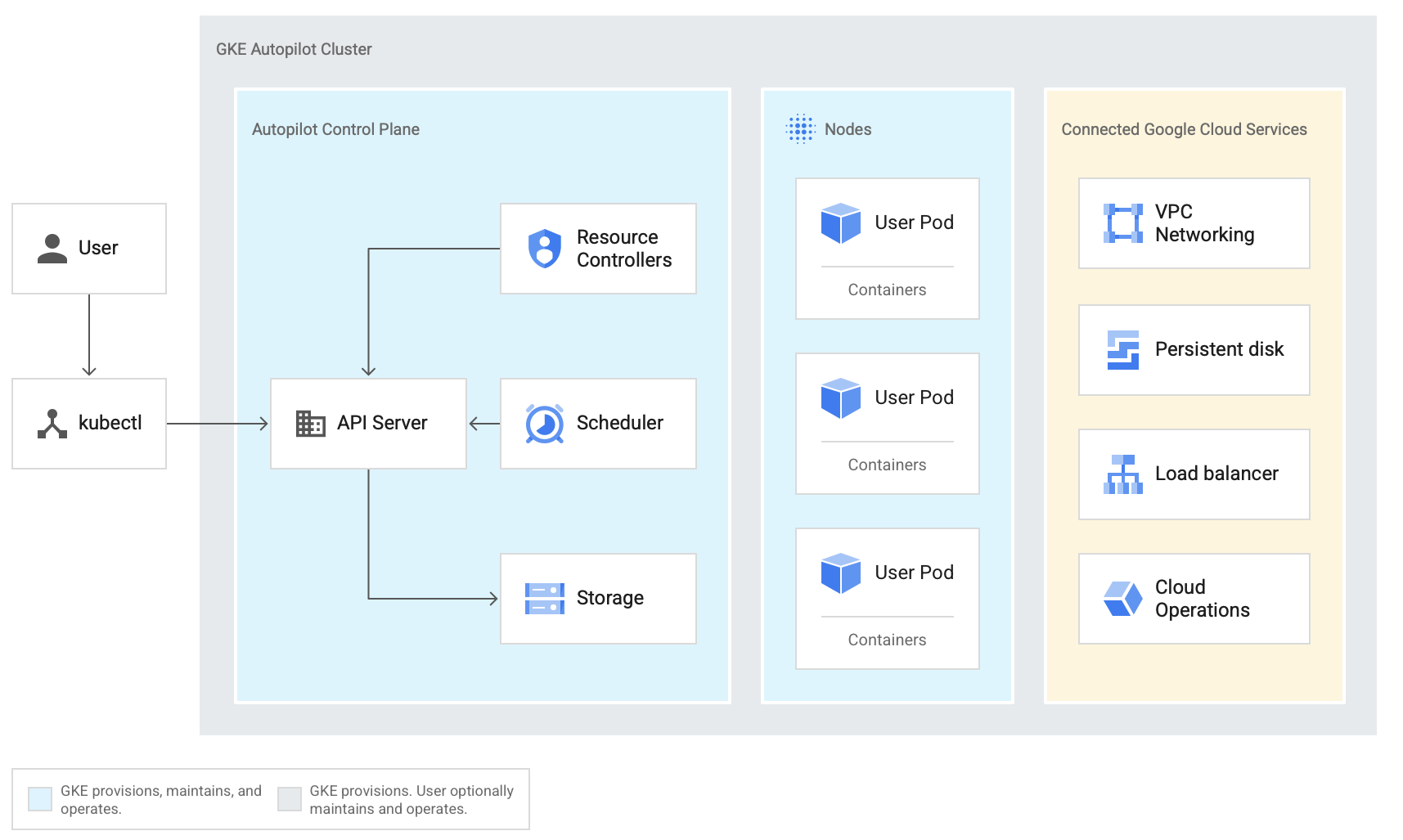
Image Credits: Google
From a developer’s perspective, nothing really changes here, but this new mode does free up teams to focus on the actual workloads and less on managing Kubernetes clusters. With Autopilot, businesses still get the benefits of Kubernetes, but without all of the routine management and maintenance work that comes with that. And that’s definitely a trend we’ve been seeing as the Kubernetes ecosystem has evolved. Few companies, after all, see their ability to effectively manage Kubernetes as their real competitive differentiator.
All of that comes at a price, of course, in addition to the standard GKE flat fee of $0.10 per hour and cluster (there’s also a free GKE tier that provides $74.40 in billing credits), plus additional fees for resources that your clusters and pods consume. Google offers a 99.95% SLA for the control plane of its Autopilot clusters and a 99.9% SLA for Autopilot pods in multiple zones.
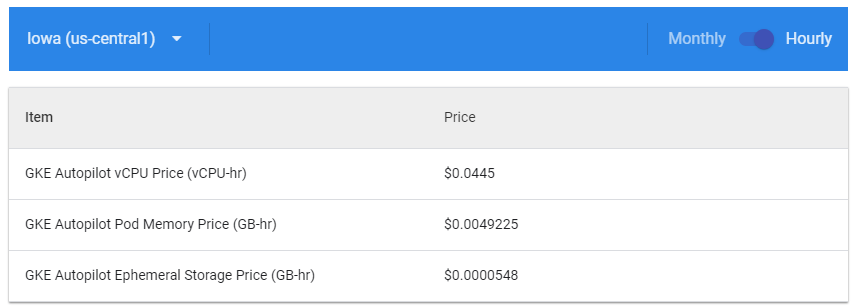
Image Credits: Google
Autopilot for GKE joins a set of container-centric products in the Google Cloud portfolio that also include Anthos for running in multicloud environments and Cloud Run, Google’s serverless offering. “[Autopilot] is really [about] bringing the automation aspects in GKE we have for running on Google Cloud, and bringing it all together in an easy-to-use package, so that if you’re newer to Kubernetes, or you’ve got a very large fleet, it drastically reduces the amount of time, operations and even compute you need to use,” Bradstock explained.
And while GKE is a key part of Anthos, that service is more about brining Google’s config management, service mesh and other tools to an enterprise’s own data center. Autopilot of GKE is, at least for now, only available on Google Cloud.
“On the serverless side, Cloud Run is really, really great for an opinionated development experience,” Bradstock added. “So you can get going really fast if you want an app to be able to go from zero to 1,000 and back to zero — and not worry about anything at all and have it managed entirely by Google. That’s highly valuable and ideal for a lot of development. Autopilot is more about simplifying the entire platform people work on when they want to leverage the Kubernetes ecosystem, be a lot more in control and have a whole bunch of apps running within one environment.”
Powered by WPeMatico
Back when I was a wee lad with a very security-compromised MySQL installation, I used to answer every web request with multiple “SELECT *” database requests — give me all the data and I’ll figure out what to do with it myself.
Today in a modern, data-intensive org, “SELECT *” will kill you. With petabytes of information, tens of thousands of tables (on the small side!), and millions and perhaps billions of calls flung at the database server, data science teams can no longer just ask for all the data and start working with it immediately.
Big data has led to the rise of data warehouses and data lakes (and apparently data lake houses), infrastructure to make accessing data more robust and easy. There is still a cataloguing and discovery problem though — just because you have all of your data in one place doesn’t mean a data scientist knows what the data represents, who owns it or what that data might affect in the myriad web and corporate reporting apps built on top of it.
That’s where Select Star comes in. The startup, which was founded about a year ago (in March 2020), is designed to automatically build out metadata within the context of a data warehouse. From there, it offers a full-text search that allows users to quickly find data as well as “heat map” signals in its search results, which can quickly pinpoint which columns of a data set are most used by applications within a company and have the most queries that reference them.
The product is SaaS, and it is designed to allow for quick onboarding by connecting to a customer’s data warehouse or business intelligence (BI) tool.
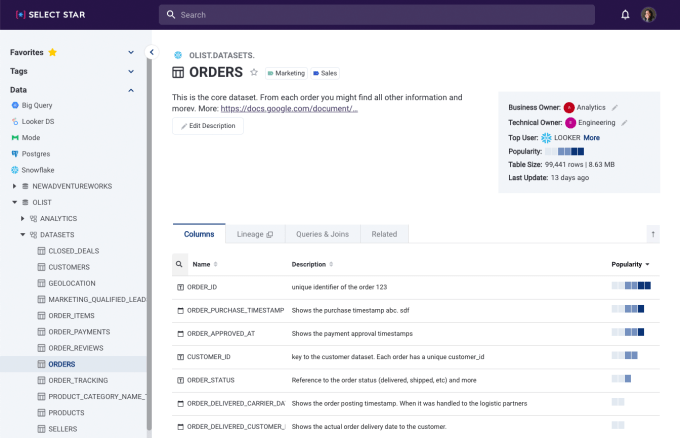
Select Star’s interface allows data scientists to understand what data they are looking at. Image via Select Star.
Shinji Kim, the sole founder and CEO, explained that the tool is a solution to a problem she has seen directly in corporate data science teams. She formerly founded Concord Systems, a real-time data processing startup that was acquired by Akamai in 2016. “The part that I noticed is that we now have all the data and we have the ability to compute, but now the next challenge is to know what the data is and how to use it,” she explained.
She said that “tribal knowledge is starting to become more wasteful [in] time and pain in growing companies,” and pointed out that large companies like Facebook, Airbnb, Uber, Lyft, Spotify and others have built out their own homebrewed data discovery tools. Her mission for Select Star is to allow any corporation to quickly tap into an easy-to-use platform to solve this problem.
The company raised a $2.5 million seed round led by Bowery Capital, with participation from Background Capital and a number of prominent angels including Spencer Kimball, Scott Belsky, Nick Caldwell, Michael Li, Ryan Denehy and TLC Collective.
Data discovery tools have been around in some form for years, with popular companies like Alation having raised tens of millions of VC dollars over the years. Kim sees an opportunity to compete by offering a better onboarding experience and also automating large parts of the workflow that remain manual for many alternative data discovery tools. With many of these tools, “they don’t do the work of connecting and building the relationship,” between data she said, adding that “documentation is still important, but being able to automatically generate [metadata] allows data teams to get value right away.”
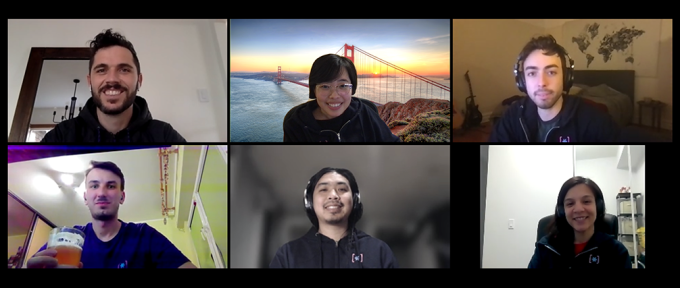
Select Star’s team, with CEO and founder Shinji Kim in top row, middle. Image via Select Star.
In addition to just understanding data, Select Star can help data engineers begin to figure out how to change their databases without leading to cascading errors. The platform can identify how columns are used and how a change to one may affect other applications or even other data sets.
Select Star is coming out of private beta today. The company’s team currently has seven people, and Kim says they are focused on growing the team and making it even easier to onboard users by the end of the year.
Powered by WPeMatico