Enterprise
Auto Added by WPeMatico
Auto Added by WPeMatico

According to Startup Genome, Beijing, London, Silicon Valley, Stockholm and Tel Aviv are some of the world’s best startup ecosystems. The data and research organisation uses factors like performance, capital, market reach, connectedness, talent and knowledge to produce its rankings.
Startup ecosystems from emerging markets excluding China and India didn’t make the organisation’s top 40 list last year. It is a known fact that these regions lag well behind in all six factors, and decades might pass before they catch up to the standards of the aforementioned ecosystems.
However, Pariti, a Kenyan B2B management startup founded by Yacob Berhane and Wossen Ayele, wants to close the gap on three of the six factors — access to capital, knowledge and talent.
These issues, specifically that of access to capital, is heightened in Africa. For instance, only 25% of funding goes to early-stage startups in Sub-Saharan Africa compared to more than 50% in Latin America, MENA and South Asia regions.
“We wanted to build a solution that will help startups be successful that otherwise would not have been able to get the resources they needed,” CEO Berhane told TechCrunch. “This problem is especially acute in Africa because it’s particularly nascent, but this platform is designed for founders across emerging markets. So basically anywhere that doesn’t have a mature, healthy startup ecosystem.”
So, how is the team at Pariti setting out to solve these problems? Ayele tells me that in one sense, Pariti is like an unbundled accelerator.
In a typical accelerator, founders will need to go through an intense program where they are loaded with information on all the things a startup will likely need to know at some point in their growth. Whereas with Pariti, founders get the needed information or resources that are immediately relevant to helping them get to the next stage of the business.
When a founder joins Pariti, they run their company through an assessment tool. There, they share pitch materials and information about their business. Pariti then assesses each company across more than 70 information points ranging from the team and market to product and economics.
After this is done, Pariti benchmarks each company against its peers. Companies in the same industry, product stage, revenue and fundraising are some of the comparisons made. The founder gets a detailed assessment with feedback on their pitch materials, the underlying metrics that they can use to develop their business and their ability to raise capital down the line.
“This approach gives us an extremely granular view of their businesses, its strengths, weaknesses and allows us to triage the right resources to the founder based on their particular needs,” Ayele said.
It doesn’t end there. Pariti also connects the founders for one-on-one sessions with members of its global expert community. Their backgrounds, according to Ayele, run the gamut from finance and marketing to product and technology across a range of sectors. Pariti also provides vetted professionals for hire from its community if a founder needs more hands-on support building a product.
Ayele says founders can continue to go through this process multiple times, getting assessed, implementing feedback and connecting with resources and talent.
On another end, Pariti allows investors to sign up on its platform, thereby collating data on their preferences. So once a startup wants to raise capital, the platform matches them with investors based on their profile and preferences.
“We’ve built an algorithm-based matching platform where we curate relevant deals to VC investors. We also simplify the investor reach-out process for founders, which is a huge pain point — especially in this ecosystem,” Ayele added.
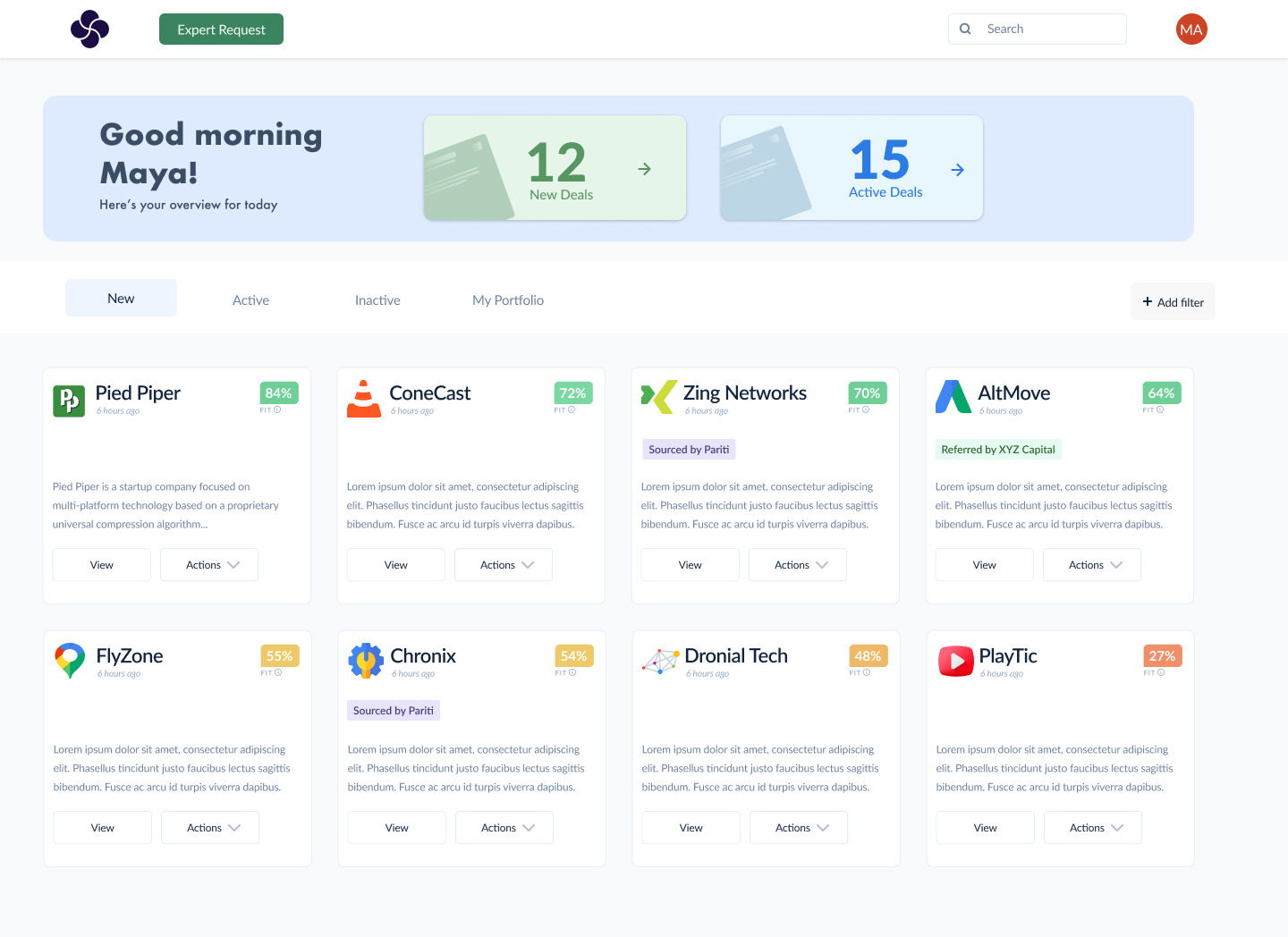
Pariti’s investor platform
In a nutshell, Pariti helps founders connect with affordable talent, access capital and develop their businesses. Professionals can find interesting opportunities to mentor startups and get paid gig opportunities. They also get more exposure to the early-stage ecosystem while tracking their progress, verifying their skills and increasing earning potential. Investors can run extremely lean operations with access to proprietary deal flow, automated deal filtering and on-demand experts to support due diligence, research and portfolio support.
According to the COO, the company has seen a tremendous amount of value built through the platform so far. A testament to this is an experience shared by Kiiru Muhoya, founder of Kenyan fintech startup Fingo Africa with TechCrunch, on how the platform helped him raise a $250,000 pre-seed round.
He said that after going through Pariti’s assessment ahead of a planned fundraiser, he realized that the market he was targeting was too small. Also, he needed to learn more about what VCs were looking for to be successful.
Muhoya decided to switch to being at the other end of things. Joining the expert platform on Pariti, he began to review companies and provided feedback to other founders. This led him to take some months off to pivot his business based on Pariti’s first feedback and what he had learned from the expert platform. He took his startup through another assessment on the platform and thus closed the round.
The company has made significant strides since launching in 2019. It has over 500 companies across 42 countries, 100 freelance experts and 60 investors using its platform. Berhane also adds that five funds currently use Pariti’s operating system for their deal management.
“For us, I think we’re building the rails for how ventures are built and scaled in emerging markets. We have partners in place across emerging markets, including Latin America and India. We also have a strong interest in the United States, where we see a real need for our platform,” Berhane said.
It charges a subscription model for investors, but Berhane wouldn’t disclose the numbers. He says that Pariti will begin to charge a subscription fee for founders as well. Another revenue stream comes when investors or founders pay a certain transaction fee when using Pariti’s freelance experts for projects. The same happens when there’s any fundraise executed from the platform.
Talking about fundraising, the company recently secured an undisclosed pre-seed capital from angels and VCs like 500 Startups, Kepple Africa and Huddle VC.
But it hasn’t been smooth sailing for Pariti, as one issue that has stood out in dealing with founders and investors is trust. Berhane says founders have shared some horror stories about engaging with investors, while investors have shared trust concerns about founders reporting false numbers.
Pariti tries to address this by providing NDAs for both parties where the company will not share founders’ data with investors until they want it to be shared. And investors won’t get deals that Pariti hasn’t thoroughly vetted.
Both founders are of East African descent — Berhane from Eritrea and Ayele from Ethiopia — and crossed paths a couple of times but took different routes to be where they are now.

Wossen Ayele (COO) and Yacob Berhane (CEO). Image Credits: Khadija M Farah & Rebecca Ume Crook
Ayele started his career at a consulting shop with offices across East Africa before moving back to the U.S. for law school. There, he got his first exposure to the early-stage startup world and worked with an emerging markets-focused VC fund.
“I could see how technology and innovation could play a role in helping communities — whether it’s through financial inclusion, access to essential goods and services, connecting people at the base of the pyramid to markets,” he said.
Upon graduation and completion of his legal training, Ayele headed back to Nairobi to get involved with its growing African startup ecosystem, where he and Berhane founded the company.
The CEO who studied finance and investment banking in the U.S. moved back to Africa to start a pan-African accelerator in Johannesburg, South Africa. While he has worked in managerial positions for companies like the African Leadership University and Ajua, Berhane spent most of his time brokering deals for them, which ultimately led him to start Pariti.
“After helping businesses raise more than $20 million and seeing how that money led to job creation and upward mobility for employees, I knew there was a path I could have that would be meaningful within finance. I continued to think about the growing asymmetry of access to capital, talent and knowledge in the startup ecosystem and the lack of infrastructure addressing it. Pariti was how we wanted to solve it,” Berhane said.
Early Stage is the premier “how-to” event for startup entrepreneurs and investors. You’ll hear firsthand how some of the most successful founders and VCs build their businesses, raise money and manage their portfolios. We’ll cover every aspect of company building: Fundraising, recruiting, sales, product-market fit, PR, marketing and brand building. Each session also has audience participation built-in — there’s ample time included for audience questions and discussion.
Powered by WPeMatico
When Okta announced that it was acquiring Auth0 yesterday for $6.5 billion, the deal raised eyebrows. After all, it’s a substantial amount of money for one identity and access management (IAM) company to pay to buy another, similar entity. But the deal ultimately brings together two companies that come at identity from different sides of the market — and as such could be the beginning of a beautiful identity friendship.
The deal ultimately brings together two companies that come at identity from different sides of the market — and as such could be the beginning of a beautiful identity friendship.
On a simple level, Okta delivers identity and access management (IAM) to companies who use the service to provide single-sign-on access for employees to a variety of cloud services — think Gmail, Salesforce, Slack and Workday.
Meanwhile, Auth0 is a developer tool providing coders with easy API access to single-sign-on functionality. With just a couple of lines of code, the developer can deliver IAM tooling without having to build it themselves. It’s a similar value proposition to what Twilio offers for communications or Stripe for payments.
The thing about IAM is that it’s not exciting, but it is essential. That could explain why such a large number of dollars are exchanging hands. As Auth0 co-founder and CEO Eugenio Pace told TechCrunch’s Zack Whittacker in 2019, “Nobody cares about authentication, but everybody needs it.”
Putting the two companies together generates a fairly comprehensive approach to IAM covering back end to front end. We’re going to look at why this deal matters from an identity market perspective, and if it was worth the substantial price Okta paid to get Auth0.
When you think about identity and access management, it’s about making sure you are who you say you are, and that you have the right to enter and access a set of applications. That’s why it’s a key part of any company’s security strategy.
Gartner found that IAM was a $12 billion business last year with projected growth to over $13.5 billion in 2021. To give you a sense of where Okta and Auth0 fit, Okta just closed FY2021 with over $800 million in revenue. Meanwhile Auth0 is projected to close this year with $200 million in annual recurring revenue.

Image Credits: Gartner
Among the top players in this market according to Gartner’s November 2020 Magic Quadrant market analysis are Ping Identity, Microsoft and Okta in that order. Meanwhile Gartner listed Auth0 as a key challenger in their market grid.
Michael Kelly, a Gartner analyst, told TechCrunch that Okta and Auth0 are both gaining something from the deal.
“For Okta, while they have a very good product, they have marketing muscle and adoption rates that are not available to smaller vendors like Auth0. When having [IAM] conversations with clients, Okta is almost always on the short list. Auth0 will immediately benefit from being associated with the larger Okta brand, and Okta will likewise now have credibility in the deals that involve a heavy developer focused buyer,” Kelly told me.
Okta co-founder and CEO Todd McKinnon said he was enthusiastic about the deal precisely because of the complementary nature of the two companies’ approaches to identity. “How a developer interacts with the service, and the flexibility they need is different from how the CIO wants to work with [identity]. So by giving customers this choice and support, it’s really compelling,” McKinnon explained.
Powered by WPeMatico
Google today announced that its Chrome browser is moving to a faster release cycle by shipping a new milestone every four weeks instead of the current six-week cycle (with a bi-weekly security patch). That’s one way to hasten the singularity, I guess, but it’s worth noting that Mozilla also moved to a four-week cycle for Firefox last year.
“As we have improved our testing and release processes for Chrome, and deployed bi-weekly security updates to improve our patch gap, it became clear that we could shorten our release cycle and deliver new features more quickly,” the Chrome team explains in today’s announcement.
Google, however, also acknowledges that not everybody wants to move this quickly — especially in the enterprise. For those users, Google is adding a new Extended Stable option with updates that come every eight weeks. This feature will be available to enterprise admins and Chromium embedders. They will still get security updates on a bi-weekly schedule, but Google notes that “those updates won’t contain new features or all security fixes that the 4 week option will receive.”
The new four-week cycle will start with Chrome 94 in Q3 2021, and at this faster rate, we’ll see Chrome 100 launch into the stable channel by March 29, 2022. I expect there will be cake.
Powered by WPeMatico
Remote working — hiring people further afield and letting people work outside of a central physical office — is looking like it will be here to stay, and today one of the startups building tools for that environment is announcing a big fundraise in response to the opportunity.
Papaya Global, an Israeli startup that provides cloud-based payroll and hiring, onboarding and compliance services across 140 countries for organizations that employ full-time, part-time and contract workers outside of their home country, has picked up $100 million in funding and has confirmed that its valuation is now over $1 billion.
The company targets organizations that not only have global workforces, but are expanding their employee bases quickly. They include fast-growing startups like OneTrust, nCino and Hopin (which today announced a monster $400 million round), as well as major corporates like Toyota, Microsoft, Wix and General Dynamics.
Papaya is not disclosing revenue numbers but said that sales have grown 300% year-over-year for each of the last three years.
Led by Greenoaks Capital Partners, this Series C also includes significant participation from IVP and Alkeon Capital. Previous backers Insight Venture Partners, Scale Venture Partners, Bessemer Venture Partners, Dynamic Loop, New Era and Workday Ventures, Access Ventures and Group 11 also chipped in. The new investment brings Papaya’s total funding to $190 million.
Papaya has been on a fundraising tear in the last 18 months. Today’s news comes less than six months after it raised a $40 million Series B. And that round came less than a year after a $45 million Series A.
Why so much, so quickly? Partly because of the demands on the business, but possibly also to capitalize on an opportunity at a time when so many others are also going after it as well.
The opportunity is that companies and other organizations are finding themselves needing tools to address the current state of play: Workforce growth today doesn’t look like it did in 2019, and so incumbent solutions like ADP, or cobbled together solutions covering multiple geographies, either don’t cut it, or are too costly to maintain.
Papaya Global, in contrast, says it has built an AI-based platform that automates a lot of work and removes much of the manual activity that comes out of trying to right-size a lot of legacy payroll products to work in new paradigms.
“The major impact of COVID-19 for us has been changing attitudes,” CEO Eynat Guez, who co-founded the company with Ruben Drong and Ofer Herman, told me in an interview last September. “People usually think that payroll works by itself, but it’s one of the more complex parts of the organization, covering major areas like labor, accounting, tax. Eight months ago, a lot of clients thought, it just happens. But now they realize they didn’t have control of the data, some don’t even have a handle on who is being paid.”
One challenge, however, is that many others are also chasing these customers in hopes of becoming the ADP of distributed and global work.
Last month, a startup called Oyster, also aimed at distributed workforces, raised $20 million. Others in the same area that have raised lots of capital include Turing, Deel, Remote, Hibob, Personio, Factorial, Lattice, Turing and Rippling.
And as we have pointed out before, these are just some of the HR startups that have raised money in the last year. There are many, many more.
Investors here are hoping that as we see some consolidation emerge out of this mix, there will be a few leaders and that Papaya will be one of them.
“Papaya Global has built a best in class solution to onboard new employees, automate payroll, and manage a global workforce through a single pane of glass. Both growing and established companies have dramatically changed their working practices in recent years, and Papaya has seen impressive growth as a result. We’re excited to continue supporting them as they seek to simplify an increasingly complex challenge for some of the world’s biggest companies,” said Patrick Backhouse, partner at Greenoaks Capital, in a statement.
Early Stage is the premier “how-to” event for startup entrepreneurs and investors. You’ll hear firsthand how some of the most successful founders and VCs build their businesses, raise money and manage their portfolios. We’ll cover every aspect of company building: Fundraising, recruiting, sales, product-market fit, PR, marketing and brand building. Each session also has audience participation built-in — there’s ample time included for audience questions and discussion.
Powered by WPeMatico
Box could be facing troubled times if a Reuters story from last week is accurate. Activist investor Starboard Value took a 7.9% stake in the storage company in September 2019, and a year ago took three board seats as its involvement in the cloud company deepened. It seemed only a matter of time before another shoe dropped.
Activist investor Starboard Value is reportedly after three additional board seats.
That thunk you just heard could be said shoe as Starboard is reportedly after three additional board seats. Those include current CEO Aaron Levie’s and two independent board members, all of whom have their seats coming up for election in June. If the firm were to obtain three additional seats, it would control six of nine votes and could have its way with Box.
What could the future hold for the company given this development (assuming it’s true)? It seems changes are coming for Box.
Below, we’ll explore how Box got to this point. And if an acquisition is in Box’s future, just who might be in the market for a cloud-native content management company built to scale in the enterprise? There would very likely be multiple suitors.
Starboard may have reason to be frustrated by Box’s performance. The cloud company’s stock price and market cap remain stubbornly low. Its share price is mired around $18 a share, not much higher than the price it went public at in 2015 when it was valued at $14 per share. Its market cap today is $3 billion, which is lacking in comparison to fellow cloud stalwarts like Dropbox at $9 billion, Slack at $23 billion or Okta at $34 billion.
Remember back in March 2014 when Box announced it was going public? It then did something highly unusual, delaying the deed 10 months until January 2015. One thing or another kept the company from pulling the trigger and just doing it. Perhaps it was a sign.
Instead, Box raised $150 million more after its S-1 filing received a lackluster response from the market. Looking back, you could argue that the SaaS model was simply less well known in 2014 than it is today. Certainly public investors are more sympathetic to software companies that run deficits in the name of growth than they were back then.
But when Box did file again, finally pricing at $14 per share in 2015, it received a strong welcome. The company had priced above its $11 to $13 per-share IPO range as TechCrunch reported at the time and instantly shot higher. We wrote on its IPO day that the cloud company quickly “surged to over $20 a share and [was then] trading at $23.67.”
A year later, our continuing coverage had flipped with the share price stuck at $10 in January 2016.
Powered by WPeMatico
As Okta announced earnings today after the bell, it revealed that it’s buying cloud identity startup Auth0 for a hefty $6.5 billion. The company had a valuation of $1.92 billion when it raised $120 million led by Salesforce Ventures last July.
With Auth0, Okta gets a cloud identity company that helps developers embed identity management into applications, adding an entirely new dimension to its identity platform. Okta co-founder and CEO Todd McKinnon says the acquisition gives his company broad coverage in the identity space and the acquisition has the power to lift identity to a first-class cloud category along with infrastructure, enterprise software like collaboration and CRM and others.
“There are a few other [primary cloud categories], but one of those has to be identity. And for identity to rise to that status, it has to cover all the use cases. It’s got to be both workforce and customer. So workforce [has been] our [primary] business traditionally, and customer is newer,” McKinnon told me.
The customer piece involves having your customers use Okta/Auth0 on the back end to sign onto your platform, rather using it as just your corporate credentials. Having coverage across both areas is what has McKinnon so excited.
Eugenio Pace, co-founder and CEO Auth0 sees his company together with Okta as powerful combination in the identity management space, and he’s not just hyping the deal when he says that. “Together, we can offer our customers workforce and customer identity solutions with exceptional speed, simplicity, security, reliability and scalability. By joining forces, we will accelerate our customers’ innovation and ability to meet the needs and demands of consumers, businesses and employees everywhere,” Pace said in a statement.
Pace and co-founder Matias Woloski came from Microsoft where they worked until launching their startup in 2013. As McKinnon points out this is a substantial company with 800 employees. It is expected to reach $200 million in revenue this year.
“So they have this mindset of building a service that is flexible and API-driven and great tools for developers and all the extensibility or customizability, that developers would need. And you can’t, you can’t do that later, you have to start from the beginning
McKinnon says while they share some common customers, there will be net new ones as well and the nature of the two companies coverage areas means that they can sell Auth0 into traditional Okta customers and vice versa. The combined entities could fill in a soup-to-nuts kind of identity offering.
As Pace told TechCrunch’s Zack Whittaker in 2019, it has always been focused on developers:
“We’re not profitable because we’ve chosen to reinvest and continue to sustain the high scale of growth,” he said. “But we are more efficient every day — in the way we acquire customers, the way we service customers, in the way we ship new design capabilities.”
The question is how much this will change under the Okta, but Auth0 users can breathe a sigh of relief in that McKinnon says that the company will operate as an independent unit inside of Okta as they look for paths to integration in the coming months. What’s more, McKinnon says he has a relationship with the two founders going back years and it sounds like there is an element of trust there.
Okta had a pretty good quarter too while it was at it, announcing $234.7 million in revenue up 40% year over year, but Wall Street appears to be unhappy with the deal with the stock price down 6.9% in after hours trading.
Auth0 was founded in 2013 and raised over $300 million along the way. In addition to Salesforce Ventures, other investors included Sapphire Ventures, Bessemer Venture Partners and Meritech Capital Partners.
Powered by WPeMatico
Clari, the revenue operations platform that helps companies predict revenue outcomes, announced a $150 million Series E today on a $1.6 billion valuation, a number that more than triples its 2019 Series D valuation of $500 million.
Silver Lake led the latest investment with participation from B Capital Group and existing investors Sequoia Capital, Bain Capital Ventures, Sapphire Ventures, Madrona Ventures, Thomvest and Tenaya Capital. The company reports it has now raised a total of $285 million.
While COVID made 2020 trying for everyone, a company with a product that allows executive teams to understand and predict revenue at a granular level was obviously going to be in demand, and Clari saw a lot of interest over the last year.
“It was a surreal year for us, given the momentum we had and all of the tough news we saw going on around us. For us, the usage metrics were just off the charts, as people need visibility and predictability and control over their revenue forecasts,” company co-founder and CEO Andy Byrne told me.
While Byrne didn’t want to discuss revenue specifics, he did point out that he beat by 110% the revenue plan he submitted to his board. He said the performance has led to a lot of inbound investor interest in the company.
“That’s why we’ve had such great investor interest is that [VCs] were hearing in the investment community about how transformative Clari has been […] just giving companies what we call revenue confidence, being able to go and understand where you’re going to be and to accurately predict the impact the pandemic is going to have on your trajectory, good or bad,” Byrne explained.
To this point, the company has been working with sales and marketing teams, but Byrne says that the company is expanding the scope of the product to bring that same predictability to other parts of an organization.
Clari has mostly focused on technology companies with customers like HPE, Workday and Adobe, but it has plans to expand beyond that vertical. In fact, one of the ways Byrne plans to put today’s investment to work is to push into other verticals, which could also benefit from this kind of revenue visibility.
The company is up to 300 employees, with plans to double that number by the end of 2021. Byrne says he is building a positive work culture and points to recently being recognized as one of the best places to work by Inc., Bay Area News Group, #GirlsClub and Built In. He says they have made progress when it comes to diversity hirings across a number dimensions, but admits there is still work to be done.
“We actually specifically [established] a commission around diversity and inclusion that has board level [backing] that we’re running to continue to do better work there. Having said that, we still recognize that we’re not too dissimilar to a lot of companies where we feel like there’s so much more that we need to do,” he said.
At this point in the company’s evolution with plenty of money in the bank and a healthy valuation, Byrne did not shy away from the IPO question, although as you would imagine, he wasn’t ready to discuss specifics.
“I would say the answer is unequivocally yes, and we’re building toward this. […] We don’t have a time frame upon which we know where we’re going to go public, but the next goal is to get to the IPO starting line,” he said.
Early Stage is the premier “how-to” event for startup entrepreneurs and investors. You’ll hear firsthand how some of the most successful founders and VCs build their businesses, raise money and manage their portfolios. We’ll cover every aspect of company building: Fundraising, recruiting, sales, legal, PR, marketing and brand building. Each session also has audience participation built-in — there’s ample time included in each for audience questions and discussion.
Powered by WPeMatico
As demand for cloud-native applications is growing, Yugabyte, makers of the cloud-native, open-source YugabyteDB database, is seeing a corresponding rise in demand for its products, especially with large enterprise customers. Today, the company announced a $48 million financing round to help build on that momentum. The round is an extension of the startup’s $30 million Series B last June.
Lightspeed Venture Partners led the round with participation from Greenspring Associates, Dell Technologies Capital, Wipro Ventures and 8VC. It has raised a total of $103 million, according to the company.
Kannan Muthukkaruppan, Yugabyte co-founder and president, says the startup saw a marked increase in interest in both the open-source and commercial offerings in 2020 as the pandemic pushed many companies to the cloud faster than they might have gone otherwise, something many startup founders have pointed out to me.
“The distributed SQL space is definitely heating up, and if anything over the last six months almost in every vector in terms of enterprise customers — from Fortune 500 companies across financial, retail, ISP or telcos — are putting Yugabyte in production to be the system of record database to meet some of their business critical services needs,” Muthukkaruppan told me.
In addition, he’s seeing a similar rise in the level of interest from the open-source version of the product. “Similarly, the groundswell on the community and the open-source adoption has been phenomenal. Our Slack [open source] user community quadrupled in 2020,” he said.
That kind of momentum led to the increased investor interest, says co-founder and CTO Karthik Ranganathan. “Some of the primary reasons to go and even ask for funding was that we realized we could accelerate some of this stuff, and we couldn’t do that with the original $30 million we had raised,” he said. The original thinking was to do a secondary raise in the $15-20 million range, but multiple investors expressed interest in participating, and it ended up being $48 million when all was said and done.
Former Pivotal president Bill Cook came on board as CEO at the same time they were announcing their last funding round in June, and brought some enterprise chops to the table. It was his job to figure out how to expand the market opportunity with larger high-value enterprise clients. “And so the last six or seven months has been about that, dealing with enterprise clients on one hand and then this emerging developer-led cloud offering as well,” Cook said.
The company has a three-tier offering that includes the open-source YugabyteDB. Then there is a fully managed cloud version called Yugabyte Cloud, and finally there is a self-managed cloud version of the database called Yugabyte Platform. The latter is especially attractive to large enterprise customers who want to be in the cloud, but still want to maintain control of their data and infrastructure, and so choose to manage the cloud installation themselves.
Yugabyte started last year with 50 employees, doubled that to this point, and now expects to reach 200 by the end of this year. As they add employees, the leadership team is cognizant of the importance of building a diverse and inclusive workforce, while recognizing the challenges in doing so.
“It’s work in progress as always. We’ve added diversity candidates right along the whole spectrum as we’ve grown but from my perspective it’s never sufficient, and we just need to keep pushing on it hard, and I think as a leadership team we recognize that,” Cook said.
The three leaders of the company have been working together remotely now since the announcement in June, and had only met briefly in person prior to the pandemic shutting down offices, but they say that it has gone smoothly. And while they would obviously like to meet in person again when the time is right, the momentum the company is experiencing shows that things are moving in the right direction, regardless of where they are getting their work done.
Note: The article originally stated this was a Series C round, but the company later clarified that it was a B-1 round; we’ve updated the article to reflect that.
Early Stage is the premier “how-to” event for startup entrepreneurs and investors. You’ll hear firsthand how some of the most successful founders and VCs build their businesses, raise money and manage their portfolios. We’ll cover every aspect of company building: Fundraising, recruiting, sales, legal, PR, marketing and brand building. Each session also has audience participation built-in — there’s ample time included in each for audience questions and discussion.
Powered by WPeMatico
Robotic process automation has taken the enterprise world by storm by providing a set of tools for those doing repetitive, volume-based tasks to use software to remove some of that labor to let those people focus on more complicated tasks. Today a startup that’s taken some of that ethos and is applying it to more individualized work — that of salespeople — is announcing some funding.
Dooly, a Vancouver, Canada-based startup that has built a set of AI-based tools that automate the busywork that goes into updating data in their sales software, and namely Salesforce, has picked up $20 million in funding to build out its business, which to date has picked up a number of customers among the sales teams of enterprise-focused software companies. They include Airtable, Asana, Intercom, Contentful, Vidyard, BigCommerce, Liftoff and CrowdRiff.
Its aim is to make sales software more useful for salespeople by eliminating the work that goes into inputting data into those systems.
“Really they’ve just created a mountain of virtual filing cabinets,” Kris Hartvigsen, Dooly’s founder and CEO, said in an emailed interview with me. “Filing cabinets just wait for drawers to be opened — or in the case of enterprise software, reports to be pulled and data to be input. We know people are capturing information across the business and our job is to make sure that the people and systems across the business have a better, faster, more far-reaching way of staying informed.”
The funding is being announced today, but it was actually raised in two tranches that had not previously been disclosed. A $3.3 million seed round was led by Boldstart Ventures and also included BoxGroup. Its $17 million Series A, meanwhile, was led by Addition, with Boldstart and BoxGroup again participating, along with Battery Ventures, Mantis (representing musicians The Chainsmokers) and SV Angel.
Alongside the VCs, there are a number of interesting strategic individual investors, too. Daniel Dines and Brandon Deer of UiPath (the RPA connection clearly is not one that I’m imagining!); Allison Pickens, the ex-COO of Gainsight; Zander Lurie of SurveyMonkey); Jay Simons, ex-CEO of Atlassian); Harry Stebbings; and other unnamed investors are all also involved. Ed Sim of Boldstart is joining Dooly’s board of directors with this announcement.
The challenge that Dooly has been built to solve is that while there are a lot of tools out there now to help salespeople source leads, manage the progress of their sales, give them advice and other helpful material to supplement their charm and the basic strength of a product, manage customers once they’ve signed on, and so on, all of them still require something important to work: a time commitment from salespeople to keep them updated with information. Ironically, the more tools to help them that are built, the more time salespeople need to spend feeding them data.
Even more ironically, one of the big daddies of the problem — the somewhat overweight Salesforce — has published figures (cited by Dooly) that say salespeople spend just 34% of their time selling. The rest (minus trips to get coffee to stay caffeinated) seems to be about data entry.
The idea with Dooly is that you turn it on, connect it to what you are using — starting with Salesforce — and Dooly lets you make notes which it then organises and puts into the right places in the rest of your apps.
“When a salesperson starts using Dooly, the ‘aha moment’ is pretty immediate,” Hartvigsen said. “Whether they want to do quick pipeline edits or push their notes to Salesforce, we don’t ask the user to learn any new patterns they aren’t familiar with, we just automate a bunch of things they hate doing, often comparing those traditional chores to clerical work.” For example, he notes, when they sync a note, Dooly automatically updates any Salesforce with any contacts found in the meeting, updates fields, adds to-dos, logs activities, and pushes messages to the appropriate internal stakeholders on Slack, all in the same motion.
The product currently also integrates with Slack, G-Cal and G-Drive, because, Hartvigsen said, “we see this as an area where there is the most immediate friction and an area that was in need of disruption.” He added that the plan is to add more integrations over time. “We see need to expand the solutions that anchor to our connected workspace, with our near-term focus being the systems that touch revenue teams,” he said.
The design of Dooly seems to be about investing a little in order to save more. On average people are using Dooly between 2.5 and 5 hours each day, but Hartvigsen claims that right now the system helps people make up for more hours each week in lost productivity. Its pricing starts at $25 per user per month, going up depending on features and use.
There are quite literally thousands of products out in the market today, and among them hundreds of strong ones, being built to help salespeople with different aspects of getting their jobs done. I’ve written about quite a few of them, and I’ve actually asked companies about whether they are tackling the very issue that Dooly has identified and is trying to fix.
They weren’t, but that doesn’t mean that they won’t. Chief among them are companies like UiPath and Salesforce, which sit on different sides of this problem and could well move into it as they keep growing. (Having UiPath as a backer by way of its founder and a senior executive points to a relationship there, which is interesting.)
In the meantime, there have been some other interesting innovations using AI to improve the sales process, with companies like Pipedrive, Clari, Seismic, Chorus.ai and Gong all using natural language, machine learning and big data analytics (itself helped by AI) to improve how sales get done.
“The first thing we noticed when we met the Dooly team was the thoughtful design-first approach to product that engendered tons of customer love. This love was inherent not only on popular ratings sites like G2 Crowd but also in the individual usage and viral adoption throughout companies with only one initial user,” said Ed Sim, founder and managing partner at Boldstart Ventures in a statement. “Dooly is revolutionizing the note-taking experience for customer facing end users from sales to customer success to product.”
“Dooly is relentlessly focused on building a user-first experience for its customers to seamlessly create workflows and unlock new revenue opportunities,” said Lee Fixel, founder of Addition, added. “We are thrilled to support Dooly as it continues to scale and enhance the sales function for more businesses.”
Early Stage is the premier “how-to” event for startup entrepreneurs and investors. You’ll hear firsthand how some of the most successful founders and VCs build their businesses, raise money and manage their portfolios. We’ll cover every aspect of company building: Fundraising, recruiting, sales, legal, PR, marketing and brand building. Each session also has audience participation built-in — there’s ample time included in each for audience questions and discussion.
Powered by WPeMatico
Airbyte, an open-source data integration platform, today announced that it has raised a $5.2 million seed funding round led by Accel. Other investors include Y Combinator, 8VC, Segment co-founder Calvin French-Owen, former Cloudera GM Charles Zedlewski, LiveRamp and Safegraph CEO Auren Hoffman, Datavant CEO Travis May and Alain Rossmann, the president of Machinify.
The company was co-founded by Michel Tricot, the former director of engineering and head of integrations at LiverRamp and RideOS, and John Lafleur, a serial entrepreneur who focuses on developer tools and B2B services. The last startup he co-founded was Anaxi.
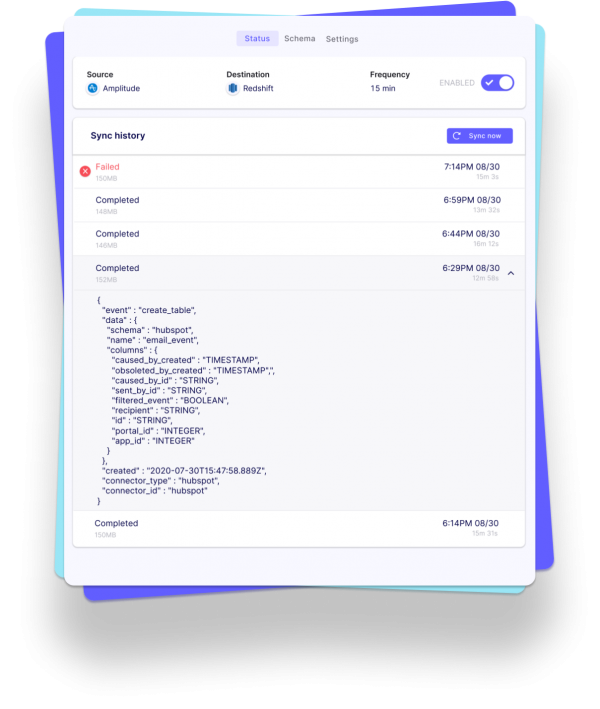
Image Credits: Airbyte
In its early days, the team was actually working on a slightly different project that focused on data connectivity for marketing companies. The founders were accepted into Y Combinator and built out their application, but once the COVID pandemic hit, a lot of the companies that had placed early bets on Airbyte’s original project faced budget freezes and layoffs.
“At that point, we decided to go into deeper data integration and that’s how we started the Airbyte project and product as we know it today,” Tricot explained.
Today’s Airbyte is geared toward data engineering, without the specific industry focus of its early incarnation, but it offers both a graphical UI for building connectors, as well as APIs for developers to hook into.
As Tricot noted, a lot of companies start out by building their own data connectors — and that tends to work alright at first. But the real complexity is in maintaining them. “You have zero control over how they behave,” he noted. “So either they’re going to fail, or they’re going to change something. The cost of data integration is in the maintenance.”
Even for a company that specializes in building these connectors, the complexity will quickly outpace its ability to keep up, so the team decided on building Airbyte as an open-source company. The team also argues that while there are companies like Fivetran that focus on data integration, a lot of customers end up with use cases that aren’t supported by Airbyte’s closed-source competitors and that they had to build themselves from the ground up.
“Our mission with Airbyte is really to become the standard to replicate data,” Lafleur said. “To do that, we will open source every feature that addresses the need of the individual contributor, so all the connectors.” He also noted that Airbyte will exclusively focus on its open-source tools until it raises a Series A round — likely early next year.
To monetize its service, Airbyte plans to use an open-core model, where all of the features that address the needs of a company (think enterprise features like data quality, privacy, user management, etc.) will be licensed. The team is also looking at white-labeling its containerized connectors to others.
Currently, about 600 companies use Airbyte’s connectors — up from 250 just a month ago. Its users include the likes of Safegraph, Dribbble, Mercato, GraniteRock, Agridigital and Cart.com.
The company plans to use the new funding to double its team from about 12 people to 25 by the end of the year. Right now, the company’s focus is on establishing its user base, and then it plans to start monetizing that — and raise more funding — next year.
Early Stage is the premiere ‘how-to’ event for startup entrepreneurs and investors. You’ll hear first-hand how some of the most successful founders and VCs build their businesses, raise money and manage their portfolios. We’ll cover every aspect of company-building: Fundraising, recruiting, sales, legal, PR, marketing and brand building. Each session also has audience participation built-in – there’s ample time included in each for audience questions and discussion.
Powered by WPeMatico