Enterprise
Auto Added by WPeMatico
Auto Added by WPeMatico
DataGrail, a startup that helps customers understand where their data lives in order to help comply with a growing body of privacy regulations, announced a $30 million Series B today.
Felicis Ventures led the round with help from Basis Set Ventures, Operator Collective and previous investors. One of the interesting aspects of this round was the participation from several strategic investors including HubSpot, Okta and Next47, the venture firm backed by Siemens. The company has now raised over $39 million, according to Crunchbase data.
That investor interest could stem from the fact that DataGrail helps organizations find data by building connectors to popular applications and then helps ensure that they are in compliance with customer privacy regulations such as GDPR, CCPA and similar laws.
“DataGrail [is really] the first integrated solution with over 900 integrations (up from 180 in 2019) to different apps and infrastructure platforms that allow the product to detect when new apps or new infrastructure platforms are added, and then also perform automated data discovery across those applications,” company CEO and co-founder Daniel Barber explained to me. This helps users find customer data wherever it lives and enables them to comply with legal requirements to manage and protect that data.
Victoria Treyger, general partner at lead investors Felicis Ventures says that one of the things that attracted her to DataGrail was that she had to help implement GDPR regulations at a previous venture and felt the pain first hand. She said that her firm tends to look for startups in large markets where the product or service being offered is a critical need, rather an option, and she believes that DataGrail is an example of that.
“I really liked the fact that privacy management is such a hard problem, and it is not optional. As a business, you have to manage privacy requests, which you may do manually or you may do it with a solution like DataGrail,” Treyger told me.
HubSpot’s Andrew Lindsay, who is SVP of corporate and business development, says his company is both a customer and an investor because DataGrail is helping HubSpot customers navigate the complexity of privacy regulation. “DataGrail’s unique ecosystem approach, where they are integrating with key Saas and business applications is an easy way for many of our joint customers to protect their customers’ privacy,” Lindsay said.
The company has 40 employees today with plans to grow to 90 or 100 by the end of this year. It’s worth noting that Treyger is joining the Board, which already has 3 other women. That shows shows a commitment to gender diversity at the board level that is not typical for startups.
Powered by WPeMatico
Aqua Security, a Boston- and Tel Aviv-based security startup that focuses squarely on securing cloud-native services, today announced that it has raised a $135 million Series E funding round at a $1 billion valuation. The round was led by ION Crossover Partners. Existing investors M12 Ventures, Lightspeed Venture Partners, Insight Partners, TLV Partners, Greenspring Associates and Acrew Capital also participated. In total, Aqua Security has now raised $265 million since it was founded in 2015.
The company was one of the earliest to focus on securing container deployments. And while many of its competitors were acquired over the years, Aqua remains independent and is now likely on a path to an IPO. When it launched, the industry focus was still very much on Docker and Docker containers. To the detriment of Docker, that quickly shifted to Kubernetes, which is now the de facto standard. But enterprises are also now looking at serverless and other new technologies on top of this new stack.
“Enterprises that five years ago were experimenting with different types of technologies are now facing a completely different technology stack, a completely different ecosystem and a completely new set of security requirements,” Aqua CEO Dror Davidoff told me. And with these new security requirements came a plethora of startups, all focusing on specific parts of the stack.
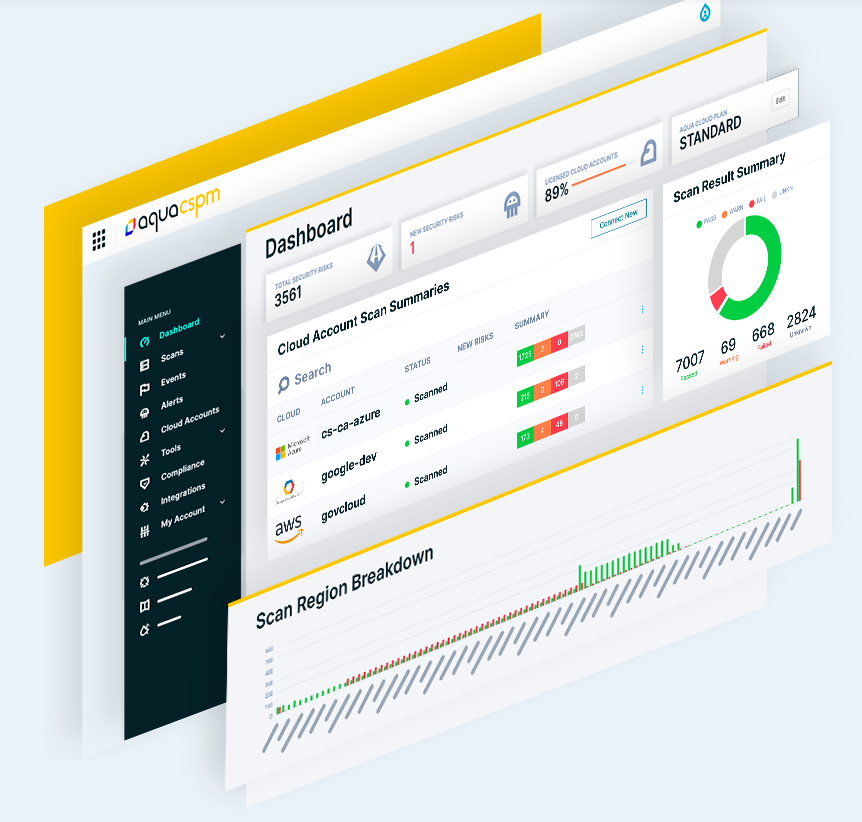
Image Credits: Aqua Security
What set Aqua apart, Dror argues, is that it managed to 1) become the best solution for container security and 2) realized that to succeed in the long run, it had to become a platform that would secure the entire cloud-native environment. About two years ago, the company made this switch from a product to a platform, as Davidoff describes it.
“There was a spree of acquisitions by CheckPoint and Palo Alto [Networks] and Trend [Micro],” Davidoff said. “They all started to acquire pieces and tried to build a more complete offering. The big advantage for Aqua was that we had everything natively built on one platform. […] Five years later, everyone is talking about cloud-native security. No one says ‘container security’ or ‘serverless security’ anymore. And Aqua is practically the broadest cloud-native security [platform].”
One interesting aspect of Aqua’s strategy is that it continues to bet on open source, too. Trivy, its open-source vulnerability scanner, is the default scanner for GitLab’s Harbor Registry and the CNCF’s Artifact Hub, for example.
“We are probably the best security open-source player there is because not only do we secure from vulnerable open source, we are also very active in the open-source community,” Davidoff said (with maybe a bit of hyperbole). “We provide tools to the community that are open source. To keep evolving, we have a whole open-source team. It’s part of the philosophy here that we want to be part of the community and it really helps us to understand it better and provide the right tools.”
In 2020, Aqua, which mostly focuses on mid-size and larger companies, doubled the number of paying customers and it now has more than half a dozen customers with an ARR of over $1 million each.
Davidoff tells me the company wasn’t actively looking for new funding. Its last funding round came together only a year ago, after all. But the team decided that it wanted to be able to double down on its current strategy and raise sooner than originally planned. ION had been interested in working with Aqua for a while, Davidoff told me, and while the company received other offers, the team decided to go ahead with ION as the lead investor (with all of Aqua’s existing investors also participating in this round).
“We want to grow from a product perspective, we want to grow from a go-to-market [perspective] and expand our geographical coverage — and we also want to be a little more acquisitive. That’s another direction we’re looking at because now we have the platform that allows us to do that. […] I feel we can take the company to great heights. That’s the plan. The market opportunity allows us to dream big.”
Powered by WPeMatico
Wrapbook, a startup that simplifies the payroll process for TV, film and commercial productions, has raised $27 million in Series A funding from noteworthy names in both the tech and entertainment worlds.
The round was led by Andreessen Horowitz, with participation from Equal Ventures and Uncork Capital, as well as from WndrCo (the investment and holding company led by DreamWorks and Quibi founder/co-founder Jeffrey Katzenberg) and from CAA co-founder Michael Ovitz.
“It’s time we bring production financial services into the 21st century,” Katzenberg said in a statement. “We need a technology solution that will address the increasing complexities of production onboarding, pay and insuring cast and crew, only exacerbated by COVID-19, and I believe that Wrapbook delivers.”
Wrapbook co-founder and CEO Ali Javid explained that entertainment payroll has remained a largely old-fashioned, paper-based process, which can be particularly difficult to track as cast and crew move from project to project, up to 30 times in single year. Wrapbook digitizes and simplifies the process — electronically collecting all the forms and signatures needed at the beginning of production, handling payroll itself, creating a dashboard to track payments and also making it easy to obtain the necessary insurance.

Wrapbook founders Cameron Woodward, Ali Javid, Hesham El-Nahhas and Naysawn Naji
Although the startup was founded in 2018, Javid told me that demand has increased dramatically as production resumed during the pandemic, with COVID-19 “totally” changing the industry’s culture and prompting production companies to say, “Hey, if there’s an easier, faster way to do this from my house, then yeah let’s look at it.”
Javid also described the Wrapbook platform as a “a vertical fintech solution that’s growing really fast in an industry that we understand really well and not many others have thought about.” In fact, he said the company’s revenue grew 7x in 2020.
And while Wrapbook’s direct customers are the production companies, co-founder and CMO Cameron Woodward (who previously worked in filmmaking insurance and commercial production) said that the team has also focused on creating a good experience for the cast and crew who get paid through the platform — a growing number of them (12% thus far) have used their Wrapbook profiles to get paid on multiple productions.
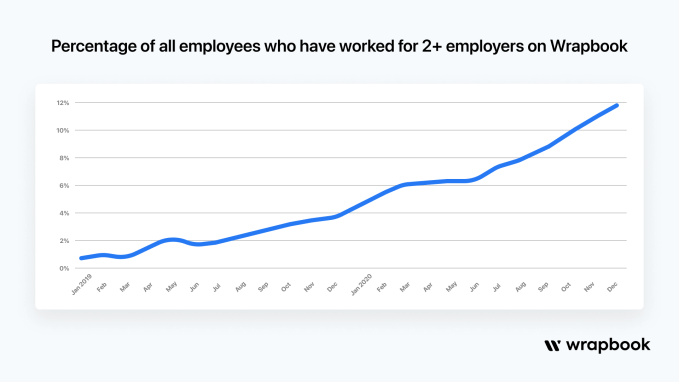
Image Credits: Wrapbook
The startup previously raised $3.6 million in seed funding. Looking ahead, Javid and Woodward said that Wrapbook’s solution could eventually be adopted in other project-based industries. But for now, they see plenty of opportunity to continue growing within entertainment alone — they estimated that the industry currently sees $200 billion in annual payments.
“We’re going to double down on what’s working and build things out based on what customers have asked for within entertainment,” Javid said. “To that end, we’re working towards hiring 100 people in the next 12 months.”
Powered by WPeMatico
Dropbox announced today that it plans to acquire DocSend for $165 million. The company helps customers share and track documents by sending a secure link instead of an attachment.
“We’re announcing that we’re acquiring DocSend to help us deliver an even broader set of tools for remote work, and DocSend helps customers securely manage and share their business-critical documents, backed by powerful engagement analytics,” Dropbox CEO Drew Houston told me.
When combined with the electronic signature capability of HelloSign, which Dropbox acquired in 2019, the acquisition gives the company an end-to-end document-sharing workflow it had been missing. “Dropbox, DocSend and HelloSign will be able to offer a full suite of self-serve products to help our millions of customers manage the entire critical document workflows and give more control over all aspects of that,” Houston explained.
Houston and DocSend co-founder and CEO Russ Heddleston have known each for other years, and have an established relationship. In fact, Heddleston worked for Dropbox as a summer in intern in 2010. He even ran the idea for the company by Houston prior to launching in 2013, who gave it his seal of approval, and the two companies have been partners for some time.
“We’ve just been following the thread of external sending, which has just kind of evolved and opened up into all these different workflows. And it’s just really interesting that by just being laser-focused on that we’ve been able to create a really differentiated product that users love a ton,” Heddleston said.
Those workflows include creative, sales, client services or startups using DocSend to deliver proposals or pitch decks and track engagement. In fact, among the earliest use cases for the company was helping startups track engagement with their pitch decks at VC firms.
The company raised a modest amount of the money along the way, just $15.3 million, according to Crunchbase, but Heddleston says that he wanted to build a company that was self-sufficient and raising more VC dollars was never a priority or necessity. “We had [VCs] chase us to give us more money all the time, and what we would tell our employees is that we don’t keep count based on money raised or headcount. It’s just about building a great company,” he said.
That builder’s attitude was one of the things that attracted Houston to the company. “We’re big believers in the model of product growth and capital efficiency, and building really intuitive products that are viral, and that’s a lot of what what attracted us to DocSend,” Houston said. While DocSend has 17,000 customers, Houston says the acquisition gives the company the opportunity to get in front of a much larger customer base as part of Dropbox.
It’s worth noting that Box offers a similar secure document-sharing capability enabling users to share a link instead of using an attachment. It recently bought e-signature startup SignRequest for $55 million with an eye toward building more complex document workflows similar to what Dropbox now has with HelloSign and DocSend. PandaDoc is another competitor in this space.
Both Dropbox and DocSend participated in the TechCrunch Disrupt Battlefield, with Houston debuting Dropbox in 2008 at the TechCrunch 50, the original name of the event. Meanwhile, DocSend participated in 2014 at TechCrunch Disrupt in New York City.
DocSend’s approximately 50 employees will be joining Dropbox when the deal closes, which should happen soon, subject to standard regulatory oversight.
Powered by WPeMatico
The vast majority of startups remain focused on consumers, knowledge workers and the opportunities to provide services to those that are already operating completely, or at least partially, in digital environments. But today comes news of funding for a startup building a social network for what is probably one of the least digital business sectors of all: independent, small-hold farmers in the developing world.
Wefarm, a social networking platform aimed at independent farmers to help them meet each other, exchange ideas and get advice, and sell or trade equipment and supplies, has raised $11 million funding to continue expanding its business, which now has 2.5 million users.
To put that number and the growth opportunity into some perspective, Wefarm estimates there are some 400 million small-hold farmers globally, with a large proportion of them in developing markets.
The funding, an extension to the company’s 2019 Series A, is being led by Octopus Ventures. True Ventures (which led the 2019 round), Rabo Frontier Ventures, LocalGlobe, June Fund and AgFunder also participated. Wefarm has raised $32 million since being founded in 2015.
To date, London-based Wefarm has primarily found traction in countries in East Africa. Its service is available via a website, but most of its users are accessing without any internet use at all, via the company’s SMS interface. The SMS format has now hosted more than 37 million conversations from farmers engaging in around 400 different types of farming (from livestock or dairy to grains and fruits and vegetables) and $29 million in marketplace sales, the company said.
But rolling out SMS services can be slow, in part because it requires Wefarm to strike local deals with carriers over data usage. (That has also meant that the company has tightly controlled growth: if you go to the main site, you’ll see that you can either join a waitlist or join by way of an invitation from an existing member.)
Kenny Ewan, Wefarm’s founder and CEO, said this latest tranche of funding in part will be used to roll out an app (currently in beta) that will help it launch in more countries and pick up more farmers.
“The big step we’re taking is going from SMS to a digital, app-based service, which will remove the digital barrier,” he said in an interview. “We compare it to the shift from sending DVDs in the mail to streaming video online. We feel like the time is right and believe it could take us to the 100 million mark of users.”
Wefarm’s role in helping link up independent farmers — traditionally and by its nature one of the most analog of industries — has taken on an interesting profile particularly in the last year.
The COVID-19 pandemic has thrown a stark light on a number of digital divides in the world, and one of the most distinctive has been in the wider world of business. Entrepreneurs, companies and organizations that had digital strategies in place could hit the ground running to adapt to a “new normal,” with less physical interaction. Those that did not had to scramble to get there to avoid a nosedive in activity.

Image Credits: Wefarm (opens in a new window)
Wefarm was around for years before the COVID-19 pandemic, and in some regards it has always been championing and giving a digital voice to the underdogs.
The wider agricultural industry — globally a multi-trillion-dollar enterprise, accounting for up to 25% of GDP in some markets — has undergone some significant digital transformation, but that has been focused on tools and other technology for the agribusiness sector, which includes the giant conglomerates and multinationals like Cargill, Archer-Daniels-Midland, Bayer (Monsanto’s parent), John Deere and others.
Wefarm’s importance (and often singular presence) as a tool for independent farmers to communicate, trade and generally network with others like them was already playing out before COVID-19. When we covered the company’s previous raise in 2019 (the first part of its Series A, a $13 million round) it had already grown to 1.9 million members. And, as it happens, for many of its users, COVID-19 was in some regards the least of their concerns:
“In reality a lot of people in rural Africa were concerned about the weather, or the effect of a locust plague,” Ewan said. “What we saw was traffic around not COVID, but these topics. They had different preoccupations.”
But the pandemic has had an impact, nevertheless. On the platform itself, as we saw in other e-commerce scenarios, Wefarm emerged as an essential service for trading at a time when in-person meetings were halted. As for Wefarm as a business, Ewan said that it essentially meant that the company’s country expansion plans had completely halted mainly because business development teams could no longer travel as they had before: another reason why launching an app could be a useful growth tool.
(That lack of travel was also potentially helpful to Wefarm: despite that the company still managed to grow by 600,000 more users, Ewan pointed out, underscoring a clear demand for the service among its target audience.)
Going forward, there are other ways in which Wefarm aims to leverage its user base, its network and the data that it potentially can amass from them.
“We see the possibility of providing more analytics and data. Our users want that very much,” Ewan said. “We now know more about small-scale farmers than anyone else, because they talk to us.” Areas that Wefarm is considering to develop over the next two years are whether it can help provide more insight into more workable business models, pricing models and more data on particular aspects like ripening periods.
“By building a highly engaged community of millions of small-holder farmers, Wefarm has created a powerful platform providing greater access to vital knowledge and information, which allows farmers to unlock greater economic potential from their land,” said Kamran Adle, early-stage investor at Octopus Ventures. “In practice that might mean understanding which fertilisers work best, what the market price is for certain goods, or new farming techniques that result in better yields, all of which can make a significant difference to livelihoods. It’s also an enormous market with more than 400 million small-holder farmers globally who collectively spend around $400 billion on farming inputs. There is a huge opportunity for Kenny and the team at Wefarm to achieve incredible scale and we’re excited for the launch of its digital platform which will further accelerate growth.”
Powered by WPeMatico
Each of the big three cloud vendors — Amazon, Microsoft and Google — has a marketplace where software vendors can sell their wares. It seems like an easy enough proposition to throw your software up there and be done with it, but it turns out that it’s not quite that simple, requiring a complex set of business and technical tasks.
Tackle, a startup that wants to help ease the process of getting a product onto one of these marketplaces, announced a $35 million Series B today. Andreessen Horowitz led the investment with help from existing investor Bessemer Venture Partners. The company reports it has now raised $48.5 million.
Company founder Dillon Woods says that at previous jobs, he found that it took several months with a couple of engineers dedicated to the task to get a product onto the AWS marketplace, and he noticed that it was a similar set of tasks each time.
“What I saw [in my previous jobs] was that we were kind of redoing the same work. And I thought everybody out there was probably reinventing the same wheel. And so when I started Tackle, my goal was to create a software platform that would take that time down to one or two days. So it’s really a no-code solution, and it makes it much more of a business decision, rather than this big technical integration project,” Woods told me.
While you may think it’s a pretty simple task to put an app on one of these marketplaces, Woods points out that the AWS user guide explaining the ins and outs is a 700-page pdf. He says that it’s not just the technical complexity of setting up the various API calls to get it connected, there is also the business side of selling in the marketplace, and that requires additional APIs.
“There’s not just the initial sale. There could be things later like upgrades, refunds, cancellations — maybe you need to do overage charges against that same contract. And so there are all of these downstream things that happen that all require API integration, and Tackle takes care of all of that for you,” Woods explained.
CEO John Jahnke says that the company usually starts with one product in one marketplace, which acts as a kind of proof of concept for the customer, then builds up from there. Once customers see what Tackle can do, they can expand usage.
It seems to be working, with the startup reporting that it tripled annual recurring revenue (ARR), although it didn’t want to share a specific number. It also doubled headcount and the number of customers and was responsible for over $200 million in transactions across the three cloud marketplaces.
Jahnke didn’t share the exact number of customers, but he said there were currently hundreds on the platform, including companies like Snowflake, GitHub, New Relic and PagerDuty.
The company currently has 67 employees spread across 25 states, with plans to almost double that by the end of 2021. He says that it’s essential to put systems in place to build a diverse company now.
“How we scale through this next 100% increase in headcount is going to define the mix of the company into the future. If we can get this right right now and continue to extend on the foundation for diversity and inclusion that we started and make it a real part of our conversation at some scale, we think we’ll be set up as we go from 100 employees to 1,000 employees over the long period of time to continue to grow and create opportunities for people wherever they are,” Jahnke said.
Martin Casado, general partner at lead investor a16z, says this type of selling has become essential for businesses and that’s why he wanted to invest in the company. “Cloud marketplaces have become a primary channel for selling software quickly and conveniently. Tackle is the leading player for enabling companies to sell software through the cloud,” he said.
Powered by WPeMatico
YL Ventures, the Israel-focused cybersecurity seed fund, today announced that it has sold its stake in cybersecurity asset management startup Axonius, which only a week ago announced a $100 million Series D funding round that now values it at around $1.2 billion.
ICONIQ Growth, Alkeon Capital Management, DTCP and Harmony Partners acquired YL Venture’s stake for $270 million. This marks YL’s first return from its third $75 million fund, which it raised in 2017, and the largest return in the firm’s history.
With this sale, the company’s third fund still has six portfolio companies remaining. It closed its fourth fund with $120 million in committed capital in the middle of 2019.
Unlike YL, which focuses on early-stage companies — though it also tends to participate in some later-stage rounds — the investors that are buying its stake specialize in later-stage companies that are often on an IPO path. ICONIQ Growth has invested in the likes of Adyen, CrowdStrike, Datadog and Zoom, for example, and has also regularly partnered with YL Ventures on its later-stage investments.
“The transition from early-stage to late-stage investors just makes sense as we drive toward IPO, and it allows each investor to focus on what they do best,” said Dean Sysman, co-founder and CEO of Axonius. “We appreciate the guidance and support the YL Ventures team has provided during the early stages of our company and we congratulate them on this successful journey.”
To put this sale into perspective for the Silicon Valley and Tel Aviv-based YL Ventures, it’s worth noting that it currently manages about $300 million. Its current portfolio includes the likes of Orca Security, Hunters and Cycode. This sale is a huge win for the firm.
Its most headline-grabbing exit so far was Twistlock, which was acquired by Palo Alto Networks for $410 million in 2019, but it has also seen exits of its portfolio companies to Microsoft, Proofpoint, CA Technologies and Walmart, among others. The fund participated in Axonius’ $4 million seed round in 2017 up to its $58 million Series C round a year ago.
It seems like YL Ventures is taking a very pragmatic approach here. It doesn’t specialize in late-stage firms — and until recently, Israeli startups always tended to sell long before they got to a late-stage round anyway. And it can generate a nice — and guaranteed — return for its own investors, too.
“This exit netted $270 million in cash directly to our third fund, which had $75 million total in capital commitments, and this fund still has six outstanding portfolio companies remaining,” Yoav Leitersdorf, YL Ventures’ founder and managing partner, told me. “Returning multiple times that fund now with a single exit, with the rest of the portfolio companies still there for the upside is the most responsible — yet highly profitable path — we could have taken for our fund at this time. And all this while diverting our energies and means more towards our seed-stage companies (where our help is more impactful), and at the same time supporting Axonius by enabling it to bring aboard such excellent late-stage investors as ICONIQ and Alkeon — a true win-win-win situation for everyone involved!”
He also noted that this sale achieved a top-decile return for the firm’s limited partners and allows it to focus its resources and attention toward the younger companies in its portfolio.
Powered by WPeMatico
This morning Vendr announced a $60 million Series A round, a huge funding event led by Tiger Global, with participation from Y Combinator, Sound Ventures, Craft Ventures, F-Prime Capital and Garage Capital.
The outsized Series A comes after Vendr last raised $4 million in a mid-2020 seed round, with TechCrunch reporting that the company was profitable at the time. Vendr had raised just over $6 million total before this latest round.
TechCrunch had a few questions. First, how the company had managed to attract so much capital so quickly. According to an interview with Vendr CEO Ryan Neu, his startup grew just under 5x in 2020, and was cash flow-positive last year as well. The startup’s model of standing between SaaS buyers and sellers, speeding up transactions while lowering their cost, appears to have fit well into 2020’s twin trends of rising software reliance and a focus on cost control.
Second, how did the company manage to grow so much? Vendr charges its customers between 1% and 5% of their software spend that it manages, which can add up. Neu told TechCrunch that a somewhat standard 500-person company might spend $2 million to $3.5 million on software each year, which by our math would make that company worth no less than $20,000 to $35,000 in revenue for Vendr at 1% of spend. At Vendr’s midpoint 2.5%, those figures rise $50,000 to $87,500.
At those prices, Vendr can stack up annual revenue pretty quickly. But why would Vendr customers pay it to handle their software spend? Savings, effectively. So long as they save more than Vendr charges, they are coming out ahead. And as the startup claims that it can cut the time to buying, its own customers can reduce time spent on securing tooling.
Everyone wins, it seems, except for software sellers. After all, they are the ones losing a chance to get less-sophisticated buyers to pay more for their code, right? Neu said that his company’s model isn’t too bad for selling companies as they close deals much more quickly, at a higher rate of closure. That could save their sales team time, which might help balance the price differential.
Pressed on what Vendr might be able to do for the selling side of the software market given its present-day buyer focus, Neu declined to share any possible plans.
Returning to the round, why did Vendr raise the money at all if it was doing just fine sans new external funding? The company told TechCrunch that it has scaled its staff to 60 from 10 a year ago, and that it wanted a stronger balance sheet. That’s fine. We’d be hard-pressed to find the startup that wouldn’t take such a large check from Tiger, given the valuation gain the raise implies for Vendr, so there isn’t too much mystery to unpack.
A theme that TechCrunch has explored in recent weeks has been the huge depth of the software market. Given the TAM for bits and bytes, Vendr may be able to keep up the hypergrowth that its new round implies its investors will expect. Let’s see how 2021 winds up for the company.
Early Stage is the premier “how-to” event for startup entrepreneurs and investors. You’ll hear firsthand how some of the most successful founders and VCs build their businesses, raise money and manage their portfolios. We’ll cover every aspect of company building: Fundraising, recruiting, sales, product-market fit, PR, marketing and brand building. Each session also has audience participation built-in — there’s ample time included for audience questions and discussion.
Powered by WPeMatico
Security firm McAfee announced this morning that it will be selling its enterprise business to a consortium led by the private equity firm Symphony Technology Group for $4 billion.
It should pair well with RSA, another enterprise-focused security company the private equity firm purchased last February for $2 billion.
McAfee President and Chief Executive Officer Peter Leav says that his company has decided to direct the firm’s resources to the consumer side of the business. “This transaction will allow McAfee to singularly focus on our consumer business and to accelerate our strategy to be a leader in personal security for consumers,” he said in a statement.
The company has been making some moves in the last year, returning to the public markets after a decade as a private company. In January, the company reportedly laid off a couple of hundred employees and shut down its software development center in Tel Aviv.
Although Symphony did not point directly to the RSA acquisition, the two investments create a large combined legacy security business for the firm, both of which have strong brand recognition, but might have lost some of their edge to more modern competitors in the marketplace.
Looking at McAfee’s latest earning’s report, Q42020, which the company reported on February 24, 2021, the consumer business grew at a much brisker rate than the enterprise side of the house. The former was up 23% YoY, while the latter grew at a far slower 5% rate.
As for the entire year, the company reported $2.9 billion in total FY2020 revenue, up 10% YoY. That broke down to $1.6 billion in consumer net revenue up 20% YoY, and $1.3 billion in enterprise net revenue, an increase of just 1% for the full year.
The company has a complex history, starting life in the 1980s selling firewall software. It eventually went public before being purchased by Intel for $7.7 billion in 2010 and going private again. In 2014, the company changed names to Intel Security before Intel sold a majority stake to TPG in 2017 for $4.2 billion and changed the name back to McAfee.
The transaction is expected to close by the end of this year, subject to regulatory oversight.
Early Stage is the premier “how-to” event for startup entrepreneurs and investors. You’ll hear firsthand how some of the most successful founders and VCs build their businesses, raise money and manage their portfolios. We’ll cover every aspect of company building: Fundraising, recruiting, sales, product-market fit, PR, marketing and brand building. Each session also has audience participation built-in — there’s ample time included for audience questions and discussion.
Powered by WPeMatico
Snowflake reported earnings this week, and the results look strong with revenue more than doubling year-over-year.
However, while the company’s fourth quarter revenue rose 117% to $190.5 million, it apparently wasn’t good enough for investors, who have sent the company’s stock tumbling since it reported Wednesday after the bell.
It was similar to the reaction that Salesforce received from Wall Street last week after it announced a positive earnings report. Snowflake’s stock closed down around 4% today, a recovery compared to its midday lows when it was off nearly 12%.
Why the declines? Wall Street’s reaction to earnings can lean more on what a company will do next more than its most recent results. But Snowflake’s guidance for its current quarter appeared strong as well, with a predicted $195 million to $200 million in revenue, numbers in line with analysts’ expectations.
Sounds good, right? Apparently being in line with analyst expectations isn’t good enough for investors for certain companies. You see, it didn’t exceed the stated expectations, so the results must be bad. I am not sure how meeting expectations is as good as a miss, but there you are.
It’s worth noting of course that tech stocks have taken a beating so far in 2021. And as my colleague Alex Wilhelm reported this morning, that trend only got worse this week. Consider that the tech-heavy Nasdaq is down 11.4% from its 52-week high, so perhaps investors are flogging everyone and Snowflake is merely caught up in the punishment.
Snowflake CEO Frank Slootman pointed out in the earnings call this week that Snowflake is well positioned, something proven by the fact that his company has removed the data limitations of on-prem infrastructure. The beauty of the cloud is limitless resources, and that forces the company to help customers manage consumption instead of usage, an evolution that works in Snowflake’s favor.
“The big change in paradigm is that historically in on-premise data centers, people have to manage capacity. And now they don’t manage capacity anymore, but they need to manage consumption. And that’s a new thing for — not for everybody but for most people — and people that are in the public cloud. I have gotten used to the notion of consumption obviously because it applies equally to the infrastructure clouds,” Slootman said in the earnings call.
Snowflake has to manage expectations, something that translated into a dozen customers paying $5 million or more per month to Snowflake. That’s a nice chunk of change by any measure. It’s also clear that while there is a clear tilt toward the cloud, the amount of data that has been moved there is still a small percentage of overall enterprise workloads, meaning there is lots of growth opportunity for Snowflake.
What’s more, Snowflake executives pointed out that there is a significant ramp up time for customers as they shift data into the Snowflake data lake, but before they push the consumption button. That means that as long as customers continue to move data onto Snowflake’s platform, they will pay more over time, even if it will take time for new clients to get started.
So why is Snowflake’s quarterly percentage growth not expanding? Well, as a company gets to the size of Snowflake, it gets harder to maintain those gaudy percentage growth numbers as the law of large numbers begins to kick in.
I’m not here to tell Wall Street investors how to do their job, anymore than I would expect them to tell me how to do mine. But when you look at the company’s overall financial picture, the amount of untapped cloud potential and the nature of Snowflake’s approach to billing, it’s hard not to be positive about this company’s outlook, regardless of the reaction of investors in the short term.
Powered by WPeMatico