Enterprise
Auto Added by WPeMatico
Auto Added by WPeMatico

Seventy-five-million-dollar-funded legal services startup Atrium doesn’t want to be the next company to implode as the tech industry tightens its belt and businesses chase margins instead of growth via unsustainable economics. That’s why Atrium is laying off most of its in-house lawyers.
Now, Atrium will focus on its software for startups navigating fundraising, hiring and collaborating with lawyers. Atrium plans to ramp up its startup advising services. And it’s also doubling down on its year-old network of professional service providers that help clients navigate day-to-day legal work. Atrium’s laid-off attorneys will be offered spots as preferred providers in that network if they start their own firm or join another.

“It’s a natural evolution for us to create a sustainable model,” Atrium co-founder and CEO Justin Kan tells TechCrunch. “We’ve made the tough decision to restructure the company to accommodate growth into new business services through our existing professional services network,” Kan wrote on Atrium’s blog. He wouldn’t give exact figures, but confirmed that more than 10 but less than 50 staffers are impacted by the change, with Atrium having a headcount of 150 as of June.
The change could make Atrium more efficient by keeping fewer expensive lawyers on staff. However, it could weaken its $500 per month Atrium membership that included some services from its in-house lawyers that might be more complicated for clients to get through its professional network. Atrium will also now have to prove the its client-lawyer collaboration software can survive in the market with firms paying for it rather than it being bundled with its in-house lawyers’ services.
“We’re making these changes to move Atrium to a sustainable model that provides high-quality services to our clients. We’re doing it proactively because we see the writing on the wall that it’s important to have a sustainable business,” Kan says. “That’s what we’re doing now. We don’t anticipate any disruption of services to clients. We’re still here.”

Justin Kan (Atrium) at TechCrunch Disrupt SF 2017
Founded in 2017, Atrium promised to merge software with human lawyers to provide quicker and cheaper legal services. Its technology can help automatically generate fundraising contracts, hiring offers and cap tables for startups while using machine learning to recommend procedures and clauses based on anonymized data from its clients. It also serves like a Dropbox for legal, organizing all of a startup’s documents to ensure everything’s properly signed and teams are working off the latest versions without digging through email.
The $500 per month Atrium membership offered this technology plus limited access to an in-house startup lawyer for consultation, plus access to guide books and events. Clients could pay extra if they needed special help such as with finalizing an acquisition deal, or access to its Fundraising Concierge service for aid with developing a pitch and lining up investor meetings.
Kan tells me Atrium still has some in-house lawyers on staff, which will help it honor all its existing membership contracts and power its new emphasis on advising services. He wouldn’t say if Atrium is paid any equity for advising, or just cash. The membership plan may change for future clients, so lawyer services are provided through its professional network instead.
“What we noticed was that Atrium has done a really good job of building a brand with startups. Often what they wanted from attorneys was…advice on ‘how to set my company up,’ ‘how to set my sales and marketing team up,’ ‘how to get great terms in my fundraising process,’ ” so Atrium is pursuing advising, Kan tells me. “As we sat down to look at what’s working and what’s not working, our focus has been to help founders with their super-hero story, connect them with the right providers and advisors, and then helping quarterback everything you need with our in-house specialists.”
LawSites first reported Saturday that Atrium was laying off in-house lawyers. A source says that Atrium’s lawyers only found out a week ago about the changes, and they’ve been trying to pitch Atrium clients on working with them when they leave. One Atrium client said they weren’t surprised by the changes because they got so much legal advice for just $500 per month, which they suspected meant Atrium was losing money on the lawyers’ time as it was so much less expensive than competitors. They also said these cheap legal services rather than the software platform were the main draw of Atrium, and they’re unsure if the tech on its own is valuable enough.
One concern is Atrium might not learn as quickly about which services to translate into software if it doesn’t have as many lawyers in-house. But Kan believes third-party lawyers might be more clear and direct about what they need from legal technology. “I feel like having a true market for the software you’re building is better than having an internal market,” he says. “We get feedback from the outside firms we work with. I think in some ways that’s the most valuable feedback. I think there’s a lot of false signals that can happen when you’re the both the employer and the supplier.”
It was critical for Atrium to correct course before getting any bigger, given the fundraising problems hitting late-stage startups with poor economics in the wake of the WeWork debacle and SoftBank’s troubles. Atrium had raised a $10.5 million Series A in 2017 led by General Catalyst alongside Kleiner, Founders Fund, Initialized and Kindred Ventures. Then in September 2018, it scored a huge $65 million Series B led by Andreessen Horowitz.

Raising even bigger rounds might have been impossible if Atrium was offering consultations with lawyers at far below market rate. Now it might be in a better position to attract funding. But the question is whether clients will stick with Atrium if they get less access to a lawyer for the same price, and whether the collaboration platform is useful enough for outside law firms to pay for.
Kan had gone through tough pivots in the past. He had strapped a camera to his head to create content for his live-streaming startup Justin.tv, but wisely recentered on the 3% of users letting people watch them play video games. Justin.tv became Twitch and eventually sold to Amazon for $970 million. His on-demand personal assistant startup Exec had to switch to just cleaning in 2013 before shutting down due to rotten economics.
Rather than deny the inevitable and wait until the last minute, with Atrium Kan tried to make the hard decision early.
Powered by WPeMatico
As Google Cloud looks to convince more enterprises to move to its platform, it needs to be able to give businesses an onramp for their existing legacy infrastructure and workloads that they can’t easily replace or move to the cloud. A lot of those workloads run on IBM Power Systems with their Power processors, and, until now, IBM was essentially the only vendor that offered cloud-based Power systems. Now, however, Google is also getting into this game by partnering with IBM to launch IBM Power Systems on Google Cloud.
“Enterprises looking to the cloud to modernize their existing infrastructure and streamline their business processes have many options,” writes Kevin Ichhpurani, Google Cloud’s corporate VP for its global ecosystem, in today’s announcement. “At one end of the spectrum, some organizations are re-platforming entire legacy systems to adopt the cloud. Many others, however, want to continue leveraging their existing infrastructure while still benefiting from the cloud’s flexible consumption model, scalability, and new advancements in areas like artificial intelligence, machine learning, and analytics.”

Power Systems support obviously fits in well here, given that many companies use them for mission-critical workloads based on SAP and Oracle applications and databases. With this, they can take those workloads and slowly move them to the cloud, without having to re-engineer their applications and infrastructure. Power Systems on Google Cloud is obviously integrated with Google’s services and billing tools.
This is very much an enterprise offering, without a published pricing sheet. Chances are, given the cost of a Power-based server, you’re not looking at a bargain, per-minute price here.
Because IBM has its own cloud offering, it’s a bit odd to see it work with Google to bring its servers to a competing cloud — though it surely wants to sell more Power servers. The move makes perfect sense for Google Cloud, though, which is on a mission to bring more enterprise workloads to its platform. Any roadblock the company can remove works in its favor, and, as enterprises get comfortable with its platform, they’ll likely bring other workloads to it over time.
Powered by WPeMatico
Adobe announced today that Adobe Experience Manager (AEM) is now available as a cloud-native SaaS application. Prior to this, it was available on premises or as a managed service, but it wasn’t pure cloud-native.
Obviously being available as a cloud service makes sense for customers, and offers all of the value you would get from any cloud service. Customers can now access all of the tools in AEM without having to worry about maintaining, managing or updating it, giving the marketing team more flexibility, agility and ongoing access to the latest updates.
This value proposition did not escape Loni Stark, Adobe’s senior director of strategy and product marketing. “It creates a compelling offer for mid-size companies and enterprises that are increasingly transforming to adopt advanced digital tools but need more simplicity and flexibility to support their changing business models,” Stark said in a statement.
AEM provides a number of capabilities, including managing the customer experience in real time. Having real-time access to data means you can deliver the products, services and experiences that make sense based on what you know about the customer in any given moment.
What’s more, you can meet customers wherever they happen to be. Today, it could be the company website, mobile app or other channel. Companies need to be flexible and tailor content to the specific channel, as well as what they know about the customer.
It’s interesting to note that AEM is based on the purchase of Day Software in 2010. That company originally developed a web content management product, but over time it evolved to become Adobe Experience Manager, and has been layering on functionality to meet an experience platform’s requirements since. Today, the product includes tools for content management, asset management and digital forms.
The company made the announcement today at NRF 2020, a huge retail conference taking place in New York City this week.
Powered by WPeMatico
How many times have you gone into a store and found the shelves need restocking of the very item you want? This is a frequent problem, and it’s difficult, especially in larger retail establishments, to keep on top of stocking requirements. Zebra Technologies has a solution: a robot that scans the shelves and reports stock gaps to human associates.
The SmartSight robot is a hardware, software and services solution that roams the aisles of the store checking the shelves, using a combination of computer vision, machine learning, workflow automation and robotic capabilities. It can find inventory problems, pricing glitches and display issues. When it finds a problem, it sends a message to human associates via a Zebra mobile computer with the location and nature of the issue.
The robot takes advantage of Zebra’s EMA50 mobile automation technology and links to other store systems, including inventory and online ordering systems. Zebra claims it increases available inventory by 95%, while reducing human time spent wandering the aisles to do inventory manually by an average of 65 hours per week.
While it will likely reduce the number of humans required to perform this type of task, Zebra’s senior vice president and general manager of Enterprise Mobile Computing, Joe White, says it’s not always easy to find people to fill these types of positions.
“SmartSight and the EMA50 were developed to help retailers fully capitalize on the opportunities presented by the on-demand economy despite heightened competition and ongoing labor shortage concerns,” White said in a statement.
This is a solution that takes advantage of robotics to help humans keep store shelves stocked and find other issues. The SmartSight robot will be available on a subscription basis starting later this quarter. That means retailers won’t have to worry about owning and maintaining the robot. If anything goes wrong, Zebra would be responsible for fixing it.
Zebra made the announcement at the NRF 2020 conference taking place this week in New York City.
Powered by WPeMatico
Salesforce announced some new developer tools today, designed to make it easier for programmers to build applications on top of Commerce Cloud in what is known in industry parlance as a “headless” system.
What that means is that developers can separate the content from the design and management of the site, allowing companies to change either component independently.
To help with this goal, Salesforce announced some new and enhanced APIs that enable developers to take advantage of features built into the Commerce Cloud platform without having to build them from scratch. For instance, they could take advantage of Einstein, Salesforce’s artificial intelligence platform, to add elements like next-best actions to the site, the kind of intelligent functionality that would typically be out of reach of most developers.
Developers also often need to connect to other enterprise systems from their e-commerce site to share data with these tools. To fill that need, Salesforce is taking advantage of MuleSoft, the company it purchased almost two years ago for $6.5 billion. Using MuleSoft’s integration technology, Salesforce can help connect to other systems like ERP financial systems or product management tools and exchange information between the two systems.
Brent Leary, founder at CRM Essentials, whose experience with Salesforce goes back to its earliest days, says this about helping give developers the tools they need to create the same kind of integrated shopping experiences consumers have grown to expect from Amazon.
“These tools give developers real-time insights delivered at the ‘moment of truth’ to optimize conversion opportunities, and automate processes to improve ordering and fulfillment efficiencies. This should give developers in the Salesforce ecosystem what they need to deliver Amazon-like experiences while having to compete with them,” he said.
To help get customers comfortable with these tools, the company also announced a new Commerce Cloud Development Center to access a community of developers who can discuss and share solutions with one another, an SDK with code samples and Trailhead education resources.
Salesforce made these announcement as part of the National Retail Foundation (NRF) Conference taking place in New York City this week.
Powered by WPeMatico

We got a bit of a surprise at the end of CES: some hands-on time with Samsung’s latest rugged phone for the enterprise, the Galaxy XCover Pro. The XCover Pro, which is officially launching today, is a mid-range $499 phone for first-line workers like flight attendants, construction workers or nurses.
It is meant to be very rugged but without the usual bulk that comes with that. With its IP68 rating, Military Standard 810 certification and the promise that it will survive a drop from 1.5 meters (4.9 feet) without a case, it should definitely be able to withstand quite a bit of abuse.

While Samsung is aiming this phone at the enterprise market, the company tells us that it will also sell it to individual customers.
As Samsung stressed during our briefing, the phone is meant for all-day use in the field, with a 4,050 mAh replaceable battery (yes, you read that right, you can replace the battery just like on phones from a few years ago). It’ll feature 4GB of RAM and 64GB of storage space, but you can extend that up to 512GB thanks to the built-in microSD slot. The 6.3-inch FHD+ screen won’t wow you, but it seemed perfectly adequate for most of the use cases. That screen, the company says, should work even in rain or snow and features a glove mode, too.
And while this is obviously not a flagship phone, Samsung still decided to give it a dual rear camera setup, with a standard 25MP sensor and a wide-angle 8MP sensor for those times where you might want to get the full view of a construction site, for example. On the front, there is a small cutout for a 13MP camera, too.
All of this is powered by a 2GHz octa-core Exynos 9611 processor, as one would expect from a Samsung mid-range phone, as well as Android 10.
Traditionally, rugged phones came with large rubber edges (or users decided to put even larger cases around them). The XCover Pro, on the other hand, feels slimmer than most regular phones with a rugged case on them.
By default, the phone features NFC support for contactless payments (the phone has been approved to be part of Visa’s Tap to Phone pilot program) and two programmable buttons so that companies can customize their phones for their specific use cases. One of the first partners here is Microsoft, which lets you map a button to its recently announced walkie talkie feature in Microsoft Teams.
“Microsoft and Samsung have a deep history of bringing together the best hardware and software to help solve our customers’ challenges,” said Microsoft CEO Satya Nadella in today’s announcement. “The powerful combination of Microsoft Teams and the new Galaxy XCover Pro builds on this partnership and will provide frontline workers everywhere with the technology they need to be more collaborative, productive and secure.”
With its Pogo pin charging support and compatibility with third-party tools from a variety of partners for adding scanners, credit card readers and other peripherals from partners like Infinite Peripherals, KOAMTAC, Scandit and Visa.
No enterprise device is complete without security features and the XCover Pro obviously supports all of Samsungs various Knox enterprise security tools and access to the phone itself is controlled by both a facial recognition system and a fingerprint reader that’s built into the power button.
With the Tab Active Pro, Samsung has long offered a rugged tablet for first-line workers. Not everybody needs a full-sized tablet, though, so the XCover Pro fills what Samsung clearly believes is a gap in the market that offers always-on connectivity in a smaller package and in the form of a phone that doesn’t look unlike a consumer device.
I could actually imagine that there are quite a few consumers who may opt for this device. For a while, the company made phones like the Galaxy S8 Active that traded weight and size for larger batteries and ruggedness. the XCover Pro isn’t officially a replacement of this program, but it may just find its fans among former Galaxy Active users.
Powered by WPeMatico
Hello and welcome back to our regular morning look at private companies, public markets and the gray space in between.
Today, we’re exploring fundraising from outside the venture world.
Founders looking to raise capital to power their growing companies have more options than ever. Traditional bank loans are an option, of course. As is venture capital. But between the two exists a growing world of firms and funds looking to put capital to work in young companies that have growing revenues and predictable economics.
Firms like Clearbanc are rising to meet demand for capital with more risk appetite than a traditional bank looking for collateral, but less than an early-stage venture firm. Clearbanc offers growth-focused capital to ecommerce and consumer SaaS companies for a flat fee, repaid out of future revenues. Such revenue-based financing is becoming increasingly popular; you could say the category has roots in the sort of venture debt that groups like Silicon Valley Bank have lent for decades, but there’s more of it than ever and in different flavors.
While revenue-based financing, speaking generally, is attractive to SaaS and ecommerce companies, other types of startups can benefit from alt-capital sources as well. And, some firms that disburse money to growing companies without an explicit equity stake are finding a way to connect capital to them.
Today, let’s take a quick peek at three firms that have found interesting takes on providing alternative startup financing: Earnest Capital with its innovative SEAL agreement, RevUp Capital, which offers services along with non-equity capital, and Capital, which both invests and loans using its own proprietary rubric.
After all, selling equity in your company to fund sales and marketing costs might not be the most efficient way to finance growth; if you know you are going to get $3 out from $1 in spend, why sell forever shares to do so?
Before we dig in, there are many players in what we might call the alt-VC space. Lighter Capital came up again and again in emails from founders. Indie.vc has its own model that is pretty neat as well. In honor of starting somewhere, however, we’re kicking off with Earnest, RevUp and Capital. We’ll dive into more players in time. (As always, email me if you have something to share.)
Powered by WPeMatico
Sisense, an enterprise startup that has built a business analytics business out of the premise of making big data as accessible as possible to users — whether it be through graphics on mobile or desktop apps, or spoken through Alexa — is announcing a big round of funding today and a large jump in valuation to underscore its traction. The company has picked up $100 million in a growth round of funding that catapults Sisense’s valuation to over $1 billion, funding that it plans to use to continue building out its tech, as well as for sales, marketing and development efforts.
For context, this is a huge jump: The company was valued at only around $325 million in 2016 when it raised a Series E, according to PitchBook. (It did not disclose valuation in 2018, when it raised a venture round of $80 million.) It now has some 2,000 customers, including Tinder, Philips, Nasdaq and the Salvation Army.
This latest round is being led by the high-profile enterprise investor Insight Venture Partners, with Access Industries, Bessemer Venture Partners, Battery Ventures, DFJ Growth and others also participating. The Access investment was made via Claltech in Israel, and it seems that this led to some details of this getting leaked out as rumors in recent days. Insight is in the news today for another big deal: Wearing its private equity hat, the firm acquired Veeam for $5 billion. (And that speaks to a particular kind of trajectory for enterprise companies that the firm backs: Veeam had already been a part of Insight’s venture portfolio.)
Mature enterprise startups have proven their business cases are going to be an ongoing theme in this year’s fundraising stories, and Sisense is part of that theme, with annual recurring revenues of over $100 million speaking to its stability and current strength. The company has also made some key acquisitions to boost its business, such as the acquisition of Periscope Data last year (coincidentally, also for $100 million, I understand).
Its rise also speaks to a different kind of trend in the market: In the wider world of business intelligence, there is an increasing demand for more digestible data in order to better tap advances in data analytics to use it across organizations. This was also one of the big reasons why Salesforce gobbled up Tableau last year for a slightly higher price: $15.7 billion.
Sisense, bringing in both sleek end user products but also a strong theme of harnessing the latest developments in areas like machine learning and AI to crunch the data and order it in the first place, represents a smaller and more fleet of foot alternative for its customers. “We found a way to make accessing data extremely simple, mashing it together in a logical way and embedding it in every logical place,” explained CEO Amir Orad to us in 2018.
“We have enjoyed watching the Sisense momentum in the past 12 months, the traction from its customers as well as from industry leading analysts for the company’s cloud native platform and new AI capabilities. That coupled with seeing more traction and success with leading companies in our portfolio and outside, led us to want to continue and grow our relationship with the company and lead this funding round,” said Jeff Horing, managing director at Insight Venture Partners, in a statement.
To note, Access Industries is an interesting backer which might also potentially shape up to be strategic, given its ownership of Warner Music Group, Alibaba, Facebook, Square, Spotify, Deezer, Snap and Zalando.
“Given our investments in market leading companies across diverse industries, we realize the value in analytics and machine learning and we could not be more excited about Sisense’s trajectory and traction in the market,” added Claltech’s Daniel Shinar in a statement.
Powered by WPeMatico
Last year Insight Partners invested $500 million in cloud data management company Veeam. It apparently liked the company so much that today it announced it has acquired the Swiss startup for $5 billion.
Veeam helps customers with cloud data backup and disaster recovery. The company, which has been based in Baar, Switzerland, says that it had $1 billion in revenue last year. It boasts 365,000 customers worldwide, including 81% of the Fortune 500.
Ray Wang, founder and principal analyst at Constellation Research, says that data management is an increasingly important tool for companies working with data on prem and in the cloud. “This is a smart move, as the data management space is rapidly consolidating. There’s a lot of investment in managing hybrid clouds, and data management is key to enterprise adoption,” Wang told TechCrunch.
The deal is coming with some major changes. Veeam’s EVP of Operations, William H. Largent, will be promoted to CEO. Danny Allan, who was VP of product strategy, will be promoted to CTO. In addition, the company will be moving its headquarters to the U.S. Veeam currently has around 1,200 employees in the U.S., but expects to expand that in the coming year.
New CEO Allan says in spite of their apparent success in the market, and the high purchase price, he believes under Insight’s ownership, the company can go further than it could have on its own. “While Veeam’s preeminence in the data management space, currently supporting 81% of the Fortune 500, is undeniable, this commitment from Insight Partners and deeper access to its unmatched business strategy [from its scale-up] division, Insight Onsite, will bring Veeam’s solutions to more businesses across the globe.”
Insight Onsite is Insight Partners’ strategy arm that is designed to help its portfolio companies be more successful. It provides a range of services in key business areas, like sales, marketing and product development.
Veeam has backup and recovery tools for both Amazon Web Services and Microsoft Azure, along with partnerships with a variety of large enterprise vendors, including Cisco, IBM, Dell EMC and HPE.
The company, which was founded in 2006, had a valuation of more than $1 billion prior to today’s acquisition, according to Crunchbase data. The deal is expected to close in the first quarter this year.
Powered by WPeMatico
AWS took a hard blow last year when it lost the $10 billion, decade-long JEDI cloud contract to rival Microsoft. Yet even without that mega deal for building out the nation’s Joint Enterprise Defense Infrastructure, the company remains fully in control of the cloud infrastructure market — and it intends to fight that decision.
In fact, AWS still owns almost twice as much cloud infrastructure market share as Microsoft, its closest rival. While the two will battle over the next decade for big contracts like JEDI, for now, AWS doesn’t have much to worry about.
There was a lot more to AWS’s year than simply losing JEDI. Per usual, the news came out with a flurry of announcements and enhancements to its vast product set. Among the more interesting moves was a shift to the edge, the fact the company is getting more serious about the chip business and a big dose of machine learning product announcements.
The fact is that AWS has such market momentum now, it’s a legitimate question to ask if anyone, even Microsoft, can catch up. The market is continuing to expand though, and the next battle is for that remaining market share. AWS CEO Andy Jassy spent more time than in the past trashing Microsoft at 2019’s re:Invent customer conference in December, imploring customers to move to the cloud faster and showing that his company is preparing for a battle with its rivals in the years ahead.
AWS closed 2019 on a $36 billion run rate, growing from $7.43 billion in in its first report in January to $9 billion in earnings for its most recent earnings report in October. Believe it or not, according to CNBC, that number failed to meet analysts expectations of $9.1 billion, but still accounted for 13% of Amazon’s revenue in the quarter.
Regardless, AWS is a juggernaut, which is fairly amazing when you consider that it started as a side project for Amazon .com in 2006. In fact, if AWS were a stand-alone company, it would be a substantial business. While growth slowed a bit last year, that’s inevitable when you get as large as AWS, says John Dinsdale, VP, chief analyst and general manager at Synergy Research, a firm that follows all aspects of the cloud market.
“This is just math and the law of large numbers. On average over the last four quarters, it has incremented its revenues by well over $500 million per quarter. So it has grown its quarterly revenues by well over $2 billion in a twelve-month period,” he said.
Dinsdale added, “To put that into context, this growth in quarterly revenue is bigger than Google’s total revenues in cloud infrastructure services. In a very large market that is growing at over 35% per year, AWS market share is holding steady.”
Dinsdale says the cloud infrastructure market didn’t quite break $100 billion last year, but even without full Q4 results, his firm’s models project a total of around $95 billion, up 37% over 2018. AWS has more than a third of that. Microsoft is way back at around 17% with Google in third with around 8 or 9%.
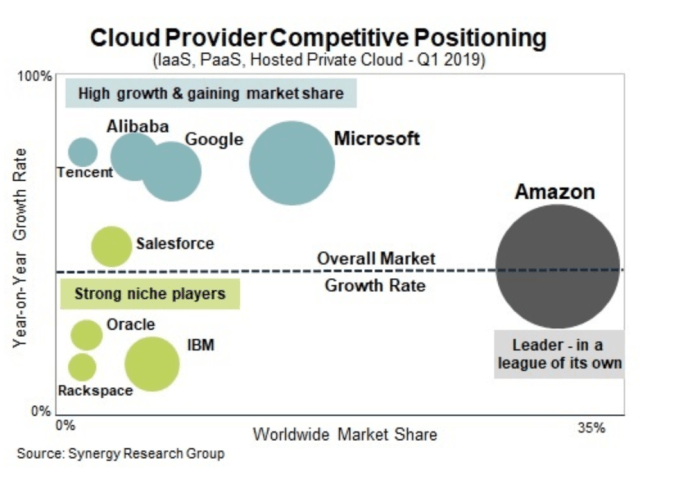
While this is from Q1, it illustrates the relative positions of companies in the cloud market. Chart: Synergy Research
It would be hard to do any year-end review of AWS without discussing JEDI. From the moment the Department of Defense announced its decade-long, $10 billion cloud RFP, it has been one big controversy after another.
Powered by WPeMatico