Enterprise
Auto Added by WPeMatico
Auto Added by WPeMatico
Epsagon, an Israeli startup that wants to help monitor modern development environments like serverless and containers, announced a $16 million Series A today.
U.S. Venture Partners (USVP), a new investor, led the round. Previous investors Lightspeed Venture Partners and StageOne Ventures also participated. Today’s investment brings the total raised to $20 million, according to the company.
CEO and co-founder Nitzan Shapira says that the company has been expanding its product offerings in the last year to cover not just its serverless roots, but also provide deeper insights into a number of forms of modern development.
“So we spoke around May when we launched our platform for microservices in the cloud products, and that includes containers, serverless and really any kind of workload to build microservices apps. Since then we have had a few significant announcements,” Shapira told TechCrunch.
For starters, the company announced support for tracing and metrics for Kubernetes workloads, including native Kubernetes, along with managed Kubernetes services like AWS EKS and Google GKE. “A few months ago, we announced our Kubernetes integration. So, if you’re running any Kubernetes workload, you can integrate with Epsagon in one click, and from there you get all the metrics out of the box, then you can set up a tracing in a matter of minutes. So that opens up a very big number of use cases for us,” he said.
The company also announced support for AWS AppSync, a no-code programming tool on the Amazon cloud platform. “We are the only provider today to introduce tracing for AppSync and that’s [an area] where people really struggle with the monitoring and troubleshooting of it,” he said.
The company hopes to use the money from today’s investment to expand the product offering further with support for Microsoft Azure and Google Cloud Platform in the coming year. He also wants to expand the automation of some tasks that have to be manually configured today.
“Our intention is to make the product as automated as possible, so the user will get an amazing experience in a matter of minutes, including advanced monitoring, identifying different problems and troubleshooting,” he said
Shapira says the company has around 25 employees today, and plans to double headcount in the next year.
Powered by WPeMatico
Cyral, an early-stage startup that helps protect data stored in cloud repositories, announced an $11 million Series A today. The company also revealed a previous undisclosed $4.1 million angel investment, making the total $15.1 million.
The Series A was led by Redpoint Ventures. A.Capital Ventures, Costanoa VC, Firebolt, SV Angel and Trifecta Capital also participated in on the round.
Cyral co-founder and CEO Manav Mital says the company’s product acts as a security layer on top of cloud data repositories — whether databases, data lakes, data warehouse or other data repository — helping identify issues like faulty configurations or anomalous activity.
Mital says that unlike most security data products of this ilk, Cyral doesn’t use an agent or watch points to try to detect signals that indicate something is happening to the data. Instead, he says that Cyral is a security layer attached directly to the data.
“The core innovation of Cyral is to put a layer of visibility attached right to the data endpoint, right to the interface where application services and users talk to the data endpoint, and in real time see the communication,” Mital explained.
As an example, he says that Cyral could detect that someone has suddenly started scanning rows of credit card data, or that someone was trying to connect to a database on an unencrypted connection. In each of these cases, Cyral would detect the problem, and depending on the configuration, send an alert to the customer’s security team to deal with the problem, or automatically shut down access to the database before informing the security team.
It’s still early days for Cyral, with 15 employees and a handful of early access customers. Mital says for this round he’s working on building a product to market that’s well-designed and easy to use.
He says that people get the problem he’s trying to solve. “We could walk into any company and they are all worried about this problem. So for us getting people interested has not been an issue. We just want to make sure we build an amazing product,” he said.
Powered by WPeMatico
Hello and welcome back to our regular morning look at private companies, public markets and the gray space in between.
Today we’re continuing our exploration of companies that have reached material scale, usually viewed through the lens of annual recurring revenue (ARR). We’ve looked at companies that have reached the $100 million ARR mark and a few that haven’t quite yet, but are on the way.
Today, a special entry. We’re looking at a company that isn’t yet at the $100 million ARR mark. It’s 60% of the way there, but with a twist. The company is bootstrapped. Yep, from pre-life as a consultancy that built a product to fit its own needs, Cloudinary is cruising toward nine-figure recurring revenue and an IPO under its own steam.
Powered by WPeMatico
Google Cloud today announced the launch of its premium support plans for enterprise and mission-critical needs. This new plan brings Google’s support offerings for the Google Cloud Platform (GCP) in line with its premium G Suite support options.
“Premium Support has been designed to better meet the needs of our customers running modern cloud technology,” writes Google’s VP of Cloud Support, Atul Nanda. “And we’ve made investments to improve the customer experience, with an updated support model that is proactive, unified, centered around the customer, and flexible to meet the differing needs of their businesses.”
The premium plan, which Google will charge for based on your monthly GCP spent (with a minimum cost of what looks to be about $12,500 per month), promises a 15-minute response time for P1 cases. Those are situations when an application or infrastructure is unusable in production. Other features include training and new product reviews, as well as support for troubleshooting third-party systems.
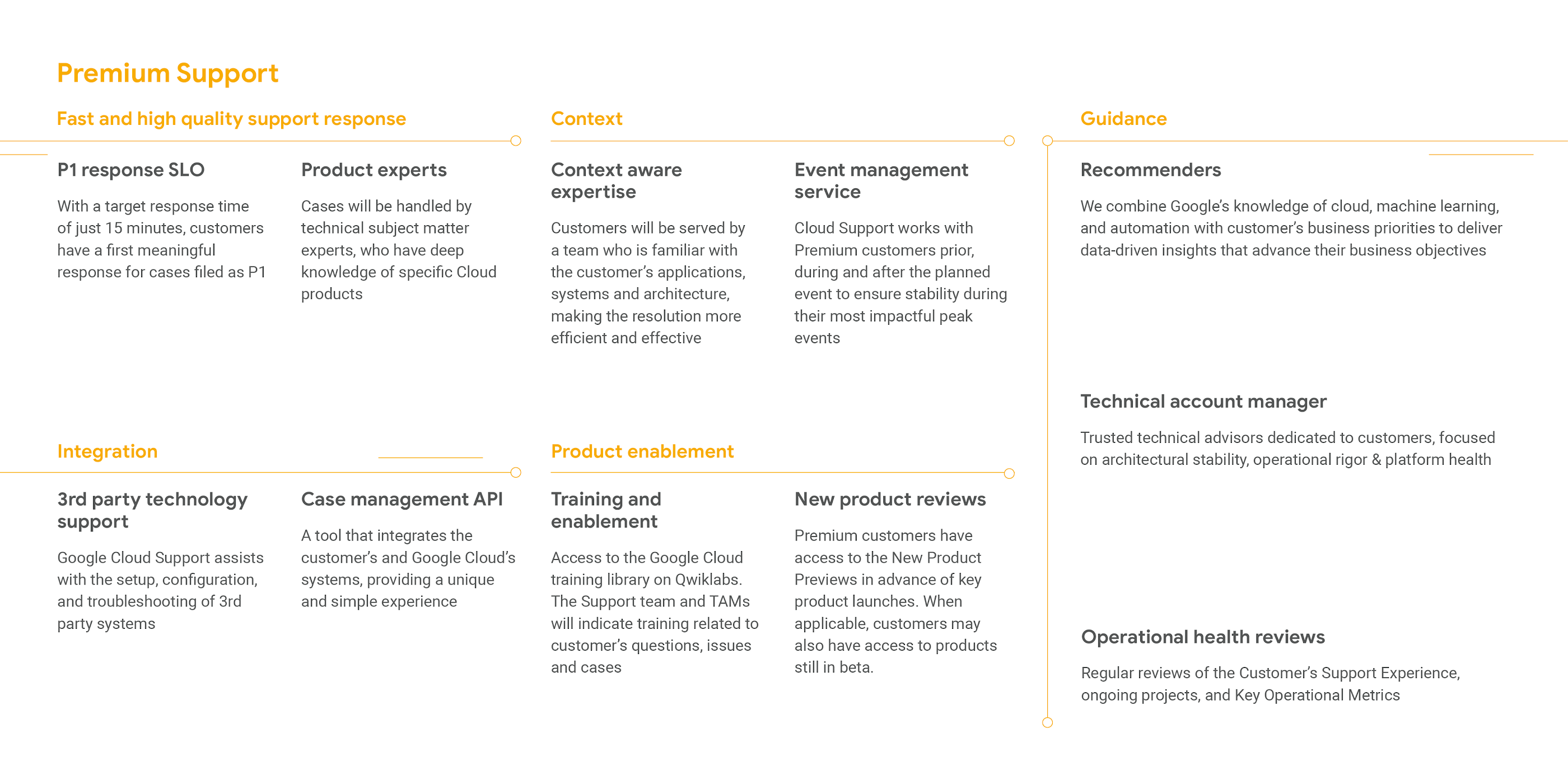 Google stresses that the team that will answer a company’s calls will consist of “content-aware experts” that know your application stack and architecture. As with similar premium plans from other vendors, enterprises will have a Technical Account manager who works through these issues with them. Companies with global operations can opt to have (and pay for) technical account managers available during business hours in multiple regions.
The idea here, however, is also to give GCP users more proactive support, which will soon include a site reliability engineering engagement, for example, that is meant to help customers “design a wrapper of supportability around the Google Cloud customer projects that have the highest sensitivity to downtime.” The Support team will also work with customers to get them ready for special events like Black Friday or other peak events in their industry. Over time, the company plans to add more features and additional support plans.
As with virtually all of Google’s recent cloud moves, today’s announcement is part of the company’s efforts to get more enterprises to move to its cloud. Earlier this week, for example, it launched support for IBM’s Power Systems architecture, as well as new infrastructure solutions for retailers. In addition, it also acquired no-code service AppSheet.
Powered by WPeMatico
For the last few years, blockchain startup Kadena has been working on a vision of bringing blockchain to the enterprise. Today it announced the final piece of that vision with the launch of the Kadena public blockchain.
In earlier releases, the company offered the ability to build private blockchains on AWS or Azure. Company co-founder and CEO Will Martino says the public network brings together for the first time public and private chains in a hybrid vision.
“The big exciting thing is that the public chain is out, smart contracts are about to turn on, and that allows us to then go and hit the market with what we’re calling these hybrid applications. These are applications that run both on a private blockchain, but have public smart contracts that allow people on the public side to interact with the private chain,” Martino explained.
The smart contracts are a set of rules that must be met and validated for the private and public chains to interact. Only valid actors and actions as defined in the smart contract and will be allowed to move between the two chains.
One of the major challenges with building a chain like this has been scaling it to meet the needs of enterprise users. Martino says that his company has solved this problem and can scale from the 10 chains today to 10,000 or more in the future as the company grows. He further claims that his company is the only one with a tractable roadmap capable of achieving this.
Martino says this could help push companies who have been dabbling in blockchain technology in the last couple of years to take a bigger leap. “This is a watershed moment for enterprises. Up until now, they’ve never had a platform that they could go and use on a public blockchain platform and know that it’s going to have the throughput they need if the product they deployed on that blockchain has legs and starts to take off.” Martino says this blockchain has that.
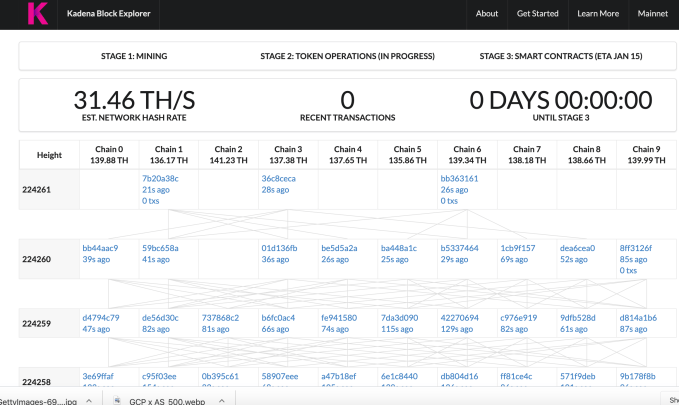
Kadena public blockchain in action
Kadena has also developed an open-source smart contract language called Pact that Martino says allows a lawyer with Excel-level programming understanding to write these contracts and place them on the chain.
“There are a lot of lawyers who are good with Excel, so you can actually hand the smart contracts to a lawyer and have them review them for compliance. And that’s a crazy idea, but we think it’s fundamental because when you’re representing core business workflows that are sensitive, you need to be absolutely certain they are compliant.”
The company is making all of the basic pieces available for free. That includes the private chain development tools on AWS and Azure, the public chain released today, along with the Pact smart contract language.
Martino says there are a couple of ways for the business to make money. For starters, it’s building partnerships where it helps companies in various sectors, from financial services to insurance and healthcare, build viable hybrid applications on the Kadena blockchain. When they make money, so will Kadena.
Secondly, they control a bushel of tokens on their public network, which have value, and if the vision comes to fruition, will have much more over time. They will be able to sell some of these tokens on the public market and make money. Right now he says the tokens have a value of between 20 cents and a dollar, but he expects that to increase as the network becomes more viable.
The blockchain has lost some of its luster as it has moved through the enterprise hype cycle in recent years, but if Kadena can succeed in building a fully decentralized, scalable blockchain, it could help push the technology deeper into the enterprise.
Powered by WPeMatico
Madrona Venture Group announced today that it has hired former Docker CEO Steve Singh as a managing director at the firm.
Singh stepped down as CEO of Docker last May and Seattle-based Madrona seems like a logical landing spot. He is a longtime resident of Seattle, and has been working behind the scenes with Madrona for many years as a strategic director and angel investor, according to the firm.
Singh says that while there are a number of areas he’s interested in, he wants to concentrate on intelligent applications in the enterprise. “While there are a number of broad themes we are excited about, I am particularly passionate about the potential of intelligent applications to transform business and our lives. Next-generation, cloud-native application companies such as Clari, HighSpot and Amperity have incredible opportunities to solve large-scale business challenges and become multi-billion-dollar businesses,” he said in a statement.
He certainly has broad enterprise experience. Beyond Docker, he was chairman and CEO at Concur for more than 20 years, and oversaw the company’s sale to SAP in 2014 for a hefty $8.3 billion. In addition, he sits on a variety of boards, including Clari, Talend, DocuSign and others.
Holger Mueller, an analyst with Constellation Research, says it was clear Singh wouldn’t stay on the sidelines for long with “Retired” on his LinkedIn profile. “Given Singh’s experience and connections, we expect him to be a force to be reckoned with in the VC space,” he told TechCrunch.
Singh joins S. Somasegar, who was a former corporate vice president at Microsoft, and Hope Cochran, who was a longtime CFO and helped take a couple of companies public, as managing directors added at the firm in recent years.
Madrona is celebrating its 25th anniversary in business this year, and can boast that one of its earliest investments was a Series A for a little Seattle startup called Amazon.
Powered by WPeMatico
ActionIQ co-founder and CEO Tasso Argyros knows there are plenty of companies promising to help businesses use their customer data to deliver personalized experiences — as he put it, “The space has gotten very, very hot over the last couple of years.”
But in the face of growing competition, ActionIQ (founded in 2014 and headquartered in New York) has attracted some impressive customers, like The New York Times, Conde Nast, American Eagle Outfitters, Vera Bradley and Pandora Media, as well as high-profile investors like Sequoia Capital and Andreessen Horowitz.
Today, it’s announcing that it has raised $32 million in Series C funding.
“At this point, we believe we are four to five years ahead of the market,” Argyros told me. “[Customer data platforms are] very hot, you see people really jumping into it, but nobody really has a product.”
He attributed the rise of these platforms to the growth in customer acquisition costs: “Everybody’s switched their focus from ‘How do we acquire more customers?’ to ‘How do you grow lifetime value?’ ”
The key, Argyros said, is “delivering personalized experiences at scale.” So if you’re a business trying to understand which customers need to be convinced to stick around, which customers are ready to upgrade to a paid subscription and so on, you need a platform like ActionIQ: “What’s common about all these questions is that they’re all data questions.”
He described ActionIQ’s approach as “product-first,” creating self-serve tools for enterprises rather than relying on consulting or IT services, and he said the product is designed to “drive intelligent actions activated through any channel.”
Argyros contrasted this approach with the large marketing clouds, where he said that stitching together products from various acquisitions has led to “a huge data gap between what marketing clouds promise and what they can actually deliver.” And he said other customer data platforms are limited to bringing the data together — but “just putting customer data in one place, that doesn’t mean business can use the customer data to drive value.”
March Capital Partners led the round, with participation from Cisco Ventures, as well as previous investors Sequoia, Andreessen and FirstMark Capital. Meredith Finn, a partner at March, is joining ActionIQ’s board of directors.
“From my professional experience at Salesforce and Twitter, when it comes to building a relationship with your customers, data is everything,” Finn said in a statement. “ActionIQ took a data-first approach from day one in contrast to many vendors that are now scrambling to address their data gaps by duct-taping data infrastructure to their existing point solutions. … The potential of such a platform is limitless, and spans well beyond traditional marketing channels to other areas of customer interactions including web and mobile app experiences, customer support and sales.”
ActionIQ has now raised a total of $75 million in funding. And while the Series C isn’t significantly larger that the $30 million that ActionIQ raised in 2017, Argyros said the company didn’t need to raise a huge round this time around, because it’s already built out the core product.
“A lot of dollars were invested heavily in the product way before the demand was there,” he said. “The Series B was pretty significant because there was so much upfront product investment. … Most of these funds are going towards expanding the business in sales and marketing.”
Powered by WPeMatico

Not the city, the $57 million-funded cryptocurrency custodian startup. When someone wants to keep safe tens or hundreds of millions of dollars in Bitcoin, Ethereum or other coins, they put them in Anchorage’s vault. And now they can trade straight from custody so they never have to worry about getting robbed mid-transaction.
With backing from Visa, Andreessen Horowitz and Blockchain Capital, Anchorage has emerged as the darling of the cryptocurrency security startup scene. Today it’s flexing its muscle and war chest by announcing its first acquisition, crypto risk modeling company Merkle Data.

Anchorage Founders
Anchorage has already integrated Merkle’s technology and team to power today’s launch of its new trading feature. It eliminates the need for big crypto owners to manually move assets in and out of custody to buy or sell, or to set up their own in-house trading. Instead of grabbing some undisclosed spread between the spot price and the price Anchorage quotes its clients, it charges a transparent per transaction fee of a tenth of a percent.
It’s stressful enough trading around digital fortunes. Anchorage gives institutions and token moguls peace of mind throughout the process while letting them stake and vote while their riches are in custody. Anchorage CEO Nathan McCauley tells me, “Our clients want to be able to fund a bank account with USD and have it seamlessly converted into crypto, securely held in their custody accounts. Shockingly, that’s not yet the norm — but we’re changing that.”
Founded in 2017 by leaders behind Docker and Square, Anchorage’s core business is its omnimetric security system that takes out of the equation passwords that can be lost or stolen. Instead, it uses humans and AI to review scans of your biometrics, nearby networks and other data for identity confirmation. Then it requires consensus approval for transactions from a set of trusted managers you’ve whitelisted.
With Anchorage Trading, the startup promises efficient order routing, transparent pricing and multi-venue liquidity from OTC desks, exchanges and market makers. “Because trading and custody are directly integrated, we’re able to buy and sell crypto from custody, without having to make risky external transfers or deal with multiple accounts from different providers,” says Bart Stephens, founder and managing partner of Blockchain Capital.
Trading isn’t Anchorage’s primary business, so it doesn’t have to squeeze clients on their transactions, and can instead try to keep them happy for the long-term. That also sets up Anchorage to be a foundational part of the cryptocurrency stack. It wouldn’t disclose the terms of the Merkle Data acquisition, but the Pantera Capital-backed company brings quantitative analysts to Anchorage to keep its trading safe and smart.
“Unlike most traditional financial assets, crypto assets are bearer assets: In order to do anything with them, you need to hold the underlying private keys. This means crypto custodians like Anchorage must play a much larger role than custodians do in traditional finance,” says McCauley. “Services like trading, settlement, posting collateral, lending and all other financial activities surrounding the assets rely on the custodian’s involvement, and in our view are best performed by the custodian directly.”
Anchorage will be competing with Coinbase, which offers integrated custody and institutional brokerage through its agency-only OTC desk. Fidelity Digital Assets combines trading and brokerage, but for Bitcoin only. BitGo offers brokerage from custody through a partnership with Genesis Global Trading. But Anchorage hopes its experience handling huge sums, clear pricing and credentials like membership in Facebook’s Libra Association will win it clients.
McCauley says the biggest threat to Anchorage isn’t competitors, though, but hazy regulation. Anchorage is building a core piece of the blockchain economy’s infrastructure. But for the biggest financial institutions to be comfortable getting involved, lawmakers need to make it clear what’s legal.
Powered by WPeMatico
Google announced today that it is buying AppSheet, an eight-year-old no-code mobile-application-building platform. The company had raised more than $17 million on a $60 million valuation, according to PitchBook data. The companies did not share the purchase price.
With AppSheet, Google gets a simple way for companies to build mobile apps without having to write a line of code. It works by pulling data from a spreadsheet, database or form, and using the field or column names as the basis for building an app.
It is integrated with Google Cloud already integrating with Google Sheets and Google Forms, but also works with other tools, including AWS DynamoDB, Salesforce, Office 365, Box and others. Google says it will continue to support these other platforms, even after the deal closes.
As Amit Zavery wrote in a blog post announcing the acquisition, it’s about giving everyone a chance to build mobile applications, even companies lacking traditional developer resources to build a mobile presence. “This acquisition helps enterprises empower millions of citizen developers to more easily create and extend applications without the need for professional coding skills,” he wrote.
In a story we hear repeatedly from startup founders, Praveen Seshadri, co-founder and CEO at AppSheet, sees an opportunity to expand his platform and market reach under Google in ways he couldn’t as an independent company.
“There is great potential to leverage and integrate more deeply with many of Google’s amazing assets like G Suite and Android to improve the functionality, scale, and performance of AppSheet. Moving forward, we expect to combine AppSheet’s core strengths with Google Cloud’s deep industry expertise in verticals like financial services, retail, and media and entertainment,” he wrote.
Google sees this acquisition as extending its development philosophy with no-code working alongside workflow automation, application integration and API management.
No code tools like AppSheet are not going to replace sophisticated development environments, but they will give companies that might not otherwise have a mobile app the ability to put something decent out there.
Powered by WPeMatico
Equinix announced today that it is acquiring bare metal cloud provider Packet, the New York City startup that had raised over $36 million on a $100 million valuation, according to PitchBook data.
Equinix has a set of data centers and co-location facilities around the world. Companies that may want to have more control over their hardware could use their services, including space, power and cooling systems, instead of running their own data centers.
Equinix is getting a unique cloud infrastructure vendor in Packet, one that can provide more customized kinds of hardware configurations than you can get from the mainstream infrastructure vendors like AWS and Azure. Company COO George Karidis described what separated his company from the pack in a September, 2018 TechCrunch article:
“We offer the most diverse hardware options,” he said. That means they could get servers equipped with Intel, ARM, AMD or with specific nVidia GPUs in whatever configurations they want. By contrast public cloud providers tend to offer a more off-the-shelf approach. It’s cheap and abundant, but you have to take what they offer, and that doesn’t always work for every customer.
In a blog post announcing the deal, company co-founder and CEO Zachary Smith had a message for his customers, who may be worried about the change in ownership. “When the transaction closes later this quarter, Packet will continue operating as before: same team, same platform, same vision,” he wrote.
He also offered the standard value story for a deal like this, saying the company could scale much faster under Equinix than it could on its own, with access to its new company’s massive resources, including 200+ data centers in 55 markets and 1,800 networks.
Sara Baack, chief product officer at Equinix, says bringing the two companies together will provide a diverse set of bare metal options for customers moving forward. “Our combined strengths will further empower companies to be everywhere they need to be, to interconnect everyone and integrate everything that matters to their business,” she said in a statement.
While the companies did not share the purchase price, they did hint that they would have more details on the transaction after it closes, which is expected in the first quarter this year.
Powered by WPeMatico