Enterprise
Auto Added by WPeMatico
Auto Added by WPeMatico
LumApps, the cloud-based social intranet for the enterprise, has closed $70 million in Series C funding. Leading the round is Goldman Sachs Growth, with participation from Bpifrance via its Growth Fund Large Venture.
Others participating include Idinvest Partners, Iris Capital, and Famille C (the family office of Courtin-Clarins). The round brings the total raised by the French company to around $100 million.
Founded in Paris back in 2012, before launching today’s proposition in 2015, LumApps has developed what it describes as a “social intranet” for enterprises to enable employees to better informed, connect and collaborate. The SaaS integrates with other enterprise software such as G Suite, Microsoft Office 365 and Microsoft SharePoint, to centralize access to corporate content, business applications and social features under a single platform. The central premise is to help companies “break down silos” and streamline internal communication.
LumApps customers include Airbus, Veolia, Valeo, Air Liquide, Colgate-Palmolive, The Economist, Schibsted, EA, Logitech, Toto, and Japan Airlines, and the company claims to have achieved year-on-year revenue growth of 100%.
“Our dream was to enable access to useful information in one click, from one place and for everyone,” LumApps founder and CEO Sébastien Ricard told TechCrunch when the company raised its Series B early last year. “We wanted to build a solution that bridged [an] intranet and social network, with the latest new technologies. A place that users will love.”
Since then, LumApps has added several new offices and has seven worldwide: Lyon, Paris, London, New York, Austin, San Francisco, and Tokyo. Armed with additional funding, the company will continue adding significant headcount, hiring across engineering, product, sales and marketing. There are also plans to expand to Canada, more of Asia Pacific, and Germany.
“We’re actually looking at hiring 200 people minimum,” Ricard tells me. “We’re growing fast and have ambitious plans to take the product to new heights, including fulfilling our vision of making LumApps a personal assistant powered by AI. This will require a significant investment in top engineering/AI talent globally”.
Asked to elaborate on what machine learning and AI could bring to a social intranet, Ricard says the vision is to make LumApps a personal assistant for all communications and workflows in the enterprise.
“We see a future where this personal assistant can make predictive suggestions based on historical data and actions. Applying AI to prompt authors with suggested content, flagging important items that demand attention, and auto-archiving old content, are a few examples. Managing the massive troves of content and data companies have today is critical”.
Ricard also sees AI playing a big role in data security. “Employees have a high-degree of control with regard to data sharing and AI can help manage what employees can share in the workplace. This is more long-term but it’s where we’re headed,” he says.
“In the short-term, we’re making investments in automating as many workflows as possible with the goal of reducing or eliminating administrative tasks that keep employees from more productive tasks, including team collaboration and knowledge sharing”.
Meanwhile, LumApps says it may also use part of the Series C for M&A activity. “We’re growing fast and we’re looking at different areas for expansion opportunities,” Ricard says. “This includes retail and manufacturing and some business functions like HR, marketing and communications. We don’t have concrete plans to acquire any companies at the moment but we are keeping our options open as acquiring best-in-breed technologies often makes more sense from a business perspective than building it yourself”.
Powered by WPeMatico
Shyft is announcing it has raised $15 million in Series A funding to make the moving process less painful — specifically in the situations where your employer is paying for the move.
Other startups are looking to offer concierge-type services for regular moving — I used a service called Moved last year and liked it. But Shyft co-founder and CEO Alex Alpert (who’s spent years in the moving business) told me there are no direct competitors focused on corporate relocation.
“Even at the highest levels, the process is totally jacked up,” Alpert said. “We saw an opportunity to partner with corporations and relocation management companies to build a customized, tech-driven experience with more choices, more flexibility and to be able to navigate the quoting process seamlessly.”
So when a company that uses Shyft decides to relocate you — whether you’re a new hire or just transferring to a new office — you should get an email prompting you to download the Shyft app, where you can chat with a “move coach” who guides you through the process.
You’ll also be able to catalog the items you want to move over a video call and get estimates from movers. And you’ll receive moving-related offers from companies like Airbnb, Wag, Common, Sonder and Home Chef.
And as Alpert noted, Shyft also partners with more traditional relocation companies like Graebel, rather than treating them as competitors.
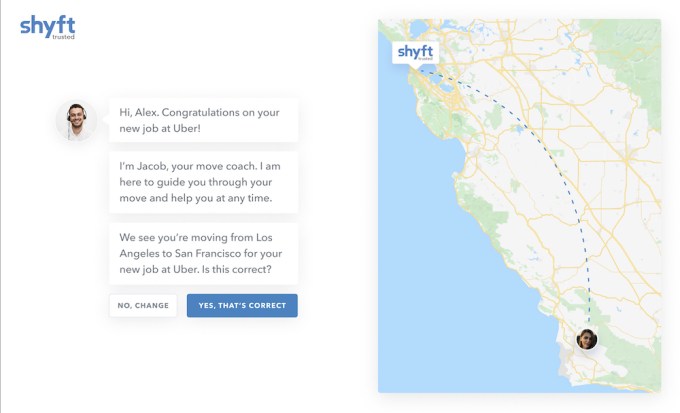
The company was originally called Crater and focused on building technology for creating accurate moving estimates via video. It changed its name and its business model back in 2018 (Alpert acknowledged, “It wasn’t a very popular pitch in the beginning: ‘Hey, we’re building estimation software for moving companies.’ “), but the technology remains a crucial differentiator.
“Our technology is within 95% accurate at identifying volume and weight of the move,” he said. “When moving companies know the information is reliable, they can bid very aggressively.”
As a result, Alpert said the employer benefits not just from having happier employees, but lower moving costs.
The new funding, meanwhile, was led by Inovia Capital, with participation from Blumberg Capital and FJ Labs.
“There’s a total misalignment between transactional relocation services and the many logistical, social, and lifestyle needs that come with moving to a new city,” Inovia partner Todd Simpson said in a statement. “As businesses shift towards more distributed workforces and talent becomes accustomed to personalized experiences, the demand for a curated moving offering will continue to grow.”
Powered by WPeMatico
Google’s strategy for bringing new customers to its cloud is to focus on the enterprise and specific verticals like healthcare, energy, financial service and retail, among others. Its healthcare efforts recently experienced a bit of a setback, with Epic now telling its customers that it is not moving forward with its plans to support Google Cloud, but in return, Google now got to announce two new customers in the travel business: Lufthansa Group, the world’s largest airline group by revenue, and Sabre, a company that provides backend services to airlines, hotels and travel aggregators.
For Sabre, Google Cloud is now the preferred cloud provider. Like a lot of companies in the travel (and especially the airline) industry, Sabre runs plenty of legacy systems and is currently in the process of modernizing its infrastructure. To do so, it has now entered a 10-year strategic partnership with Google “to improve operational agility while developing new services and creating a new marketplace for its airline, hospitality and travel agency customers.” The promise, here, too, is that these new technologies will allow the company to offer new travel tools for its customers.
When you hear about airline systems going down, it’s often Sabre’s fault, so just being able to avoid that would already bring a lot of value to its customers.
“At Google we build tools to help others, so a big part of our mission is helping other companies realize theirs. We’re so glad that Sabre has chosen to work with us to further their mission of building the future of travel,” said Google CEO Sundar Pichai . “Travelers seek convenience, choice and value. Our capabilities in AI and cloud computing will help Sabre deliver more of what consumers want.”
The same holds true for Google’s deal with Lufthansa Group, which includes German flag carrier Lufthansa itself, but also subsidiaries like Austrian, Swiss, Eurowings and Brussels Airlines, as well as a number of technical and logistics companies that provide services to various airlines.
“By combining Google Cloud’s technology with Lufthansa Group’s operational expertise, we are driving the digitization of our operation even further,” said Dr. Detlef Kayser, member of the executive board of the Lufthansa Group. “This will enable us to identify possible flight irregularities even earlier and implement countermeasures at an early stage.”
Lufthansa Group has selected Google as a strategic partner to “optimized its operations performance.” A team from Google will work directly with Lufthansa to bring this project to life. The idea here is to use Google Cloud to build tools that help the company run its operations as smoothly as possible and to provide recommendations when things go awry due to bad weather, airspace congestion or a strike (which seems to happen rather regularly at Lufthansa these days).
Delta recently launched a similar platform to help its employees.
Powered by WPeMatico
Canonical, the company behind the popular Ubuntu Linux distribution, today announced the launch of Anbox Cloud, a new platform that allows enterprises to run Android in the cloud.
On Anbox Cloud, Android becomes the guest operating system that runs containerized applications. This opens up a range of use cases, ranging from bespoke enterprise apps to cloud gaming solutions.
The result is similar to what Google does with Android apps on Chrome OS, though the implementation is quite different and is based on the LXD container manager, as well as a number of Canonical projects like Juju and MAAS for provisioning the containers and automating the deployment. “LXD containers are lightweight, resulting in at least twice the container density compared to Android emulation in virtual machines – depending on streaming quality and/or workload complexity,” the company points out in its announcements.
 Anbox itself, it’s worth noting, is an open-source project that came out of Canonical and the wider Ubuntu ecosystem. Launched by Canonical engineer Simon Fels in 2017, Anbox runs the full Android system in a container, which in turn allows you to run Android application on any Linux-based platform.
What’s the point of all of this? Canonical argues that it allows enterprises to offload mobile workloads to the cloud and then stream those applications to their employees’ mobile devices. But Canonical is also betting on 5G to enable more use cases, less because of the available bandwidth but more because of the low latencies it enables.
“Driven by emerging 5G networks and edge computing, millions of users will benefit from access to ultra-rich, on-demand Android applications on a platform of their choice,” said Stephan Fabel, director of Product at Canonical, in today’s announcement. “Enterprises are now empowered to deliver high performance, high density computing to any device remotely, with reduced power consumption and in an economical manner.”
Outside of the enterprise, one of the use cases that Canonical seems to be focusing on is gaming and game streaming. A server in the cloud is generally more powerful than a smartphone, after all, though that gap is closing.
Canonical also cites app testing as another use case, given that the platform would allow developers to test apps on thousands of Android devices in parallel. Most developers, though, prefer to test their apps in real — not emulated — devices, given the fragmentation of the Android ecosystem.
Anbox Cloud can run in the public cloud, though Canonical is specifically partnering with edge computing specialist Packet to host it on the edge or on-premise. Silicon partners for the project are Ampere and Intel .
Powered by WPeMatico
Snyk, the company that wants to help developers secure their code as part of the development process, announced a $150 million investment today. The company indicated the investment brings its valuation to more than $1 billion (although it did not share the exact figure).
Today’s round was led by Stripes, a New York City investment firm, with help from Coatue, Tiger Global, BoldStart,Trend Forward, Amity and Salesforce Ventures. The company reports it has now raised more than $250 million.
The idea behind Snyk is to fit security firmly in the development process. Rather than offloading it to a separate team, something that can slow down a continuous development environment, Snyk builds in security as part of the code commit.
The company offers an open-source tool that helps developers find open-source vulnerabilities when they commit their code to GitHub, Bitbucket, GitLab or any CI/CD tool. It has built up a community of more than 400,000 developers with this approach.
Snyk makes money with a container security product, and by making available to companies as a commercial product the underlying vulnerability database they use in the open-source product.
CEO Peter McKay, who came on board last year as the company was making a move to expand into the enterprise, says the open-source product drives the revenue-producing products and helped attract this kind of investment. “Getting to [today’s] funding round was the momentum in the open source model from the community to freemium to [land] and expand — and that’s where we are today,” he told TechCrunch.
He said the company wasn’t looking for this money, but investors came knocking and gave them a good offer, based on Snyk’s growing market momentum. “Investors said we want to take advantage of the market, and we want to make sure you can invest the way you want to invest and take advantage of what we all believe is this very large opportunity,” McKay said.
In fact, the company has been raising money at a rapid clip since it came out of the gate in 2016 with a $3 million seed round. A $7 million Series A and $22 million Series B followed in 2018, with a $70 million Series C last fall.
The company reports over 4X revenue growth in 2019 (without giving exact revenue figures), and some major customer wins, including the likes of Google, Intuit, Nordstrom and Salesforce. It’s worth noting that Salesforce thought enough of the company that it also invested in this round through its Salesforce Ventures investment arm.
Powered by WPeMatico

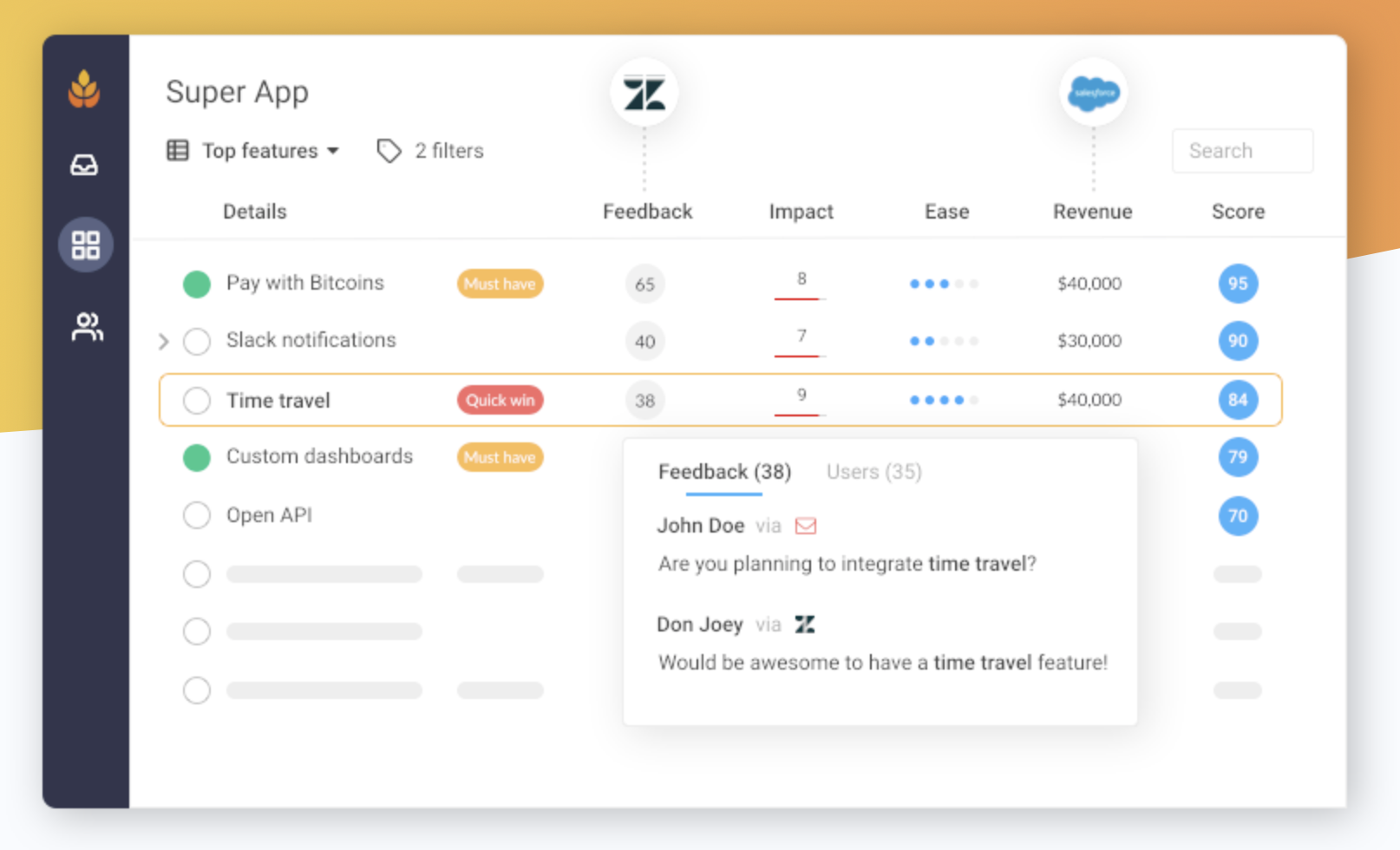
Meet Harvestr, a software-as-a-service startup that wants to help product managers centralize customer feedback from various places. Product managers can then prioritize outstanding issues and feature requests. Finally, the platform helps you get back to your customers once changes have been implemented.
The company just raised a $650,000 funding round led by Bpifrance, with various business angels also participating, such as 360Learning co-founders Nicolas Hernandez and Guillaume Alary, as well as Station F director Roxanne Varza through the Atomico Angel Programme.
Harvestr integrates directly with Zendesk, Intercom, Salesforce, Freshdesk, Slack and Zapier. For instance, if a user opens a ticket on Zendesk and another user interacts with your support team through an Intercom chat widget, everything ends up in Harvestr.
Once you have everything in the system, Harvestr helps you prioritize tasks that seem more urgent or that are going to have a bigger impact.
When you start working on a feature or when you’re about to ship it, you can contact your users who originally reached out to talk to you about it.
Eventually, Harvestr should help you build a strong community of power users around your product. And there are many advantages in pursuing this strategy.
First, you reward your users by keeping them in the loop. It should lead to higher customer satisfaction and lower churn. Your most engaged customers could also become your best ambassadors to spread the word around.
Harvestr costs $49 per month for five seats and $99 per month for 20 seats. People working for 360Learning, HomeExchange, Dailymotion and other companies are currently using it.
Powered by WPeMatico
The long-running contest between Microsoft and its Teams service and Slack’s eponymous application continued this morning, with Redmond announcing what it describes as its first “global” advertising push for its enterprise communication service.
Slack, a recent technology IPO, exploded in the back half of last decade, accreting huge revenues while burrowing into the tech stacks of the startup world. The former startup’s success continued as it increasingly targeted larger companies; it’s easier to stack revenue in enterprise-scale chunks than it is by onboarding upstarts.
Enterprise productivity software, of course, is a large percentage of Microsoft’s bread and butter. And as Slack rose — and Microsoft decided against buying the then-nascent rival — the larger company invested in its competing Teams service. Notably, today’s ad push is not the first advertising salvo between the two companies. Slack owns that record, having welcomed Microsoft to its niche in a print ad that isn’t aging particularly well.
Slack and Teams are competing through public usage announcements. Most recently, Teams announced that it has 20 million daily active users (DAUs); Slack’s most recent number is 12 million. Slack, however, has touted how active its DAUs are, implying that it isn’t entirely sure that Microsoft’s figures line up to its own. Still, the rising gap between their numbers is notable.
Microsoft’s new ad campaign is yet another chapter in the ongoing Slack vs. Teams. The ad push itself is only so important. What matters more is that Microsoft is choosing to expend some of its limited public attention bandwidth on Teams over other options.
While Teams is merely part of the greater Office 365 world that Microsoft has been building for some time, Slack’s product is its business. And since its direct listing, some air has come out of its shares.
Slack’s share price has fallen from the mid-$30s after it debuted to the low-$20s today. I’ve explored that repricing and found that, far from the public markets repudiating Slack’s equity, the company was merely mispriced in its early trading life. The company’s revenue multiple has come down since its first days as a public entity, but remains rich; investors are still pricing Slack like an outstanding company.
Ahead, Slack and Microsoft will continue to trade competing DAU figures. The question becomes how far Slack’s brand can carry it against Microsoft’s enterprise heft.
Powered by WPeMatico
Zendesk acquired Base CRM in 2018 to give customers a CRM component to go with its core customer service software. After purchasing the company, it changed the name to Sell, and today the company announced the launch of the new Sell Marketplace.
Officially called The Zendesk Marketplace for Sell, it’s a place where companies can share components that extend the capabilities of the core Sell product. Companies like MailChimp, HubSpot and QuickBooks are available at launch.
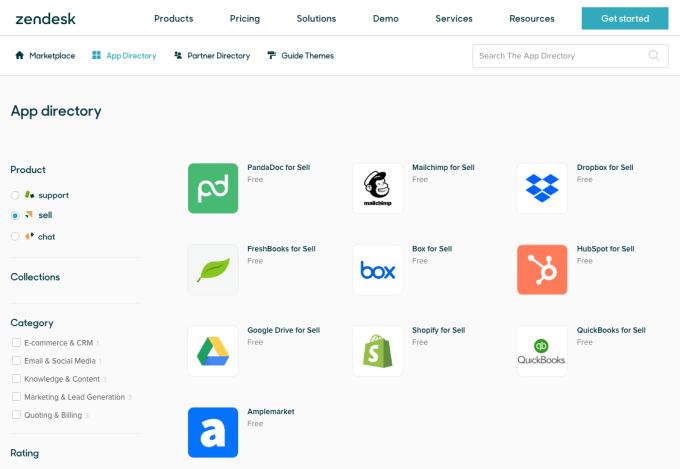
App directory in Sell Marketplace. Screenshot: Zendesk
Matt Price, SVP and general manager at Zendesk, sees the marketplace as a way to extend Sell into a platform play, something he thinks could be a “game changer.” He likened it to the impact of app stores on mobile phones.
“It’s that platform that accelerated and really suddenly [transformed smart phones] from being just a product to [launching an] industry. And that’s what the marketplace is doing now, taking Sell from being a really great sales tool to being able to handle anything that you want to throw at it because it’s extensible through apps,” Price explained.
Price says that this ability to extend the product could manifest in several ways. For starters, customers can build private apps with a new application development framework. This enables them to customize Sell for their particular environment, such as connecting to an internal system or building functionality that’s unique to them.
In addition, ISVs can build custom apps, something Price points out they have been doing for some time on the Zendesk customer support side. “Interestingly Zendesk obviously has a very large community of independent developers, hundreds of them, who are [developing apps for] our support product, and now we have another product that they can support,” he said.
Finally, industry partners can add connections to their software. For instance, by installing Dropbox for Sell, it gives sales people a way to save documents to Dropbox and associate them with a deal in Sell.
Of course, what Zendesk is doing here with Sell Marketplace isn’t new. Salesforce introduced this kind of app store concept to the CRM world in 2006 when it launched AppExchange, but the Sell Marketplace still gives Sell users a way to extend the product to meet their unique needs, and that could prove to be a powerful addition.
Powered by WPeMatico
After appointing a new CEO and CFO last summer, cloud infrastructure provider DigitalOcean is embarking on a wider reorganisation: the startup has announced a round of layoffs, with potentially between 30 and 50 people affected.
DigitalOcean has confirmed the news with the following statement:
“DigitalOcean recently announced a restructuring to better align its teams to its go-forward growth strategy. As part of this restructuring, some roles were, unfortunately, eliminated. DigitalOcean continues to be a high-growth business with $275M in [annual recurring revenues] and more than 500,000 customers globally. Under this new organizational structure, we are positioned to accelerate profitable growth by continuing to serve developers and entrepreneurs around the world.”
Before the confirmation was sent to us this morning, a number of footprints began to emerge last night, when the layoffs first hit, with people on Twitter talking about it, some announcing that they are looking for new opportunities and some offering help to those impacted. Inbound tips that we received estimate the cuts at between 30 and 50 people. With around 500 employees (an estimate on PitchBook), that would work out to up to 10% of staff affected.
It’s not clear what is going on here — we’ll update as and when we hear more — but when Yancey Spruill and Bill Sorenson were respectively appointed CEO and CFO in July 2019 (Spruill replacing someone who was only in the role for a year), the incoming CEO put out a short statement that, in hindsight, hinted at a refocus of the business in the near future:
“My aspiration is for us to continue to provide everything you love about DO now, but to also enhance our offerings in a way that is meaningful, strategic and most helpful for you over time.”
The company provides a range of cloud infrastructure services to developers, including scalable compute services (“Droplets” in DigitalOcean terminology), managed Kubernetes clusters, object storage, managed database services, Cloud Firewalls, Load Balancers and more, with 12 data centers globally. It says it works with more than 1 million developers across 195 countries. It has also been expanding the services that it offers to developers, including more enhancements in its managed database services, and a free hosting option for continuous code testing in partnership with GitLab.
All the same, as my colleague Frederic pointed out when DigitalOcean appointed its latest CEO, while developers have generally been happy with the company, it isn’t as hyped as it once was, and is a smallish player nowadays.
And in an area of business where economies of scale are essential for making good margins on a business, it competes against some of the biggest leviathans in tech: Google (and its Google Cloud Platform), Amazon (which as AWS) and Microsoft (with Azure). That could mean that DigitalOcean is either trimming down as it talks to investors for a new round; or to better conserve cash as it sizes up how best to compete against these bigger, deep-pocketed players; or perhaps to start thinking about another kind of exit.
In that context, it’s notable that the company not only appointed a new CFO last summer, but also a CEO with prior CFO experience. It’s been a while since DigitalOcean has raised capital. According to PitchBook data, DigitalOcean last raised money in 2017, an undisclosed amount from Mighty Capital, Glean Capital, Viaduct Ventures, Black River Ventures, Hanaco Venture Capital, Torch Capital and EG Capital Advisors. Before that, it took out $130 million in debt, in 2016. Altogether it has raised $198 million, and its last valuation was from a round in 2015, $683 million.
It’s been an active week for layoffs among tech startups. Mozilla laid off 70 employees this week; and the weed delivery platform Eaze is also gearing up for more cuts amid an emergency push for funding.
We’ll update this post as we learn more. Best wishes to those affected by the news.
Powered by WPeMatico
When Visa bought Plaid this week for $5.3 billion, a figure that was twice its private valuation, it was a clear signal that traditional financial services companies are looking for ways to modernize their approach to business.
With Plaid, Visa picks up a modern set of developer APIs that work behind the scenes to facilitate the movement of money. Those APIs should help Visa create more streamlined experiences (both at home and inside other companies’ offerings), build on its existing strengths and allow it to do more than it could have before, alone.
But don’t take our word for it. To get under the hood of the Visa-Plaid deal and understand it from a number of perspectives, TechCrunch got in touch with analysts focused on the space and investors who had put money into the erstwhile startup.
Powered by WPeMatico