Enterprise
Auto Added by WPeMatico
Auto Added by WPeMatico
When the Department of Defense finally made a decision in October on the decade-long, $10 billion JEDI cloud contract, it seemed that Microsoft had won. But nothing has been simple about this deal from the earliest days, so it shouldn’t come as a surprise that last night Amazon filed a motion to stop work on the project until the court decides on its protest of the DoD’s decision.
The company announced on November 22nd that it had filed suit in the U.S. Court of Federal Claims protesting the DoD’s decision to select Microsoft. Last night’s motion is an extension of that move to put the project on hold until the court decides on the merits of the case.
Sources tell us that AWS decided not protest the start of initial JEDI activities at the time of the court filing in November as an accommodation made at DoD’s request. DoD declined to comment on that.
As for why they are doing it now, an Amazon spokesperson had this to say in a statement last night: “It is common practice to stay contract performance while a protest is pending and it’s important that the numerous evaluation errors and blatant political interference that impacted the JEDI award decision be reviewed. AWS is absolutely committed to supporting the DoD’s modernization efforts and to an expeditious legal process that resolves this matter as quickly as possible.”
As we previously reported, the statement echoes sentiments AWS CEO Andy Jassy made at a press event during AWS re:Invent in December:
“I would say is that it’s fairly obvious that we feel pretty strongly that it was not adjudicated fairly,” he said. He added, “I think that we ended up with a situation where there was political interference. When you have a sitting president, who has shared openly his disdain for a company, and the leader of that company, it makes it really difficult for government agencies, including the DoD, to make objective decisions without fear of reprisal.”
This is just the latest turn in a contract procurement process for the ages. It will now be up to the court to decide if the project should stop or not, and beyond that if the decision process was carried out fairly.
Powered by WPeMatico

If you’ve ever entered a company’s office as a visitor or contractor, you probably know the routine: check in with a receptionist, figure out who invited you, print out a badge and get on your merry way. Brussels, Belgium and New York-based Proxyclick aims to streamline this process, while also helping businesses keep their people and assets secure. As the company announced today, it has raised a $15 million Series B round led by Five Elms Capital, together with previous investor Join Capital.
In total, Proxyclick says its systems have now been used to register more than 30 million visitors in 7,000 locations around the world. In the U.K. alone, more than 1,000 locations use the company’s tools. Current customers include L’Oréal, Vodafone, Revolut, PepsiCo and Airbnb, as well as a number of other Fortune 500 firms.
Gregory Blondeau, founder and CEO of Proxyclick, stresses that the company believes that paper logbooks, which are still in use in many companies, are simply not an acceptable solution anymore, not in the least because that record is often permanent and visible to other visitors.

Proxyclick’s founding team.
“We all agree it is not acceptable to have those paper logbooks at the entrance where everyone can see previous visitors,” he said. “It is also not normal for companies to store visitors’ digital data indefinitely. We already propose automatic data deletion in order to respect visitor privacy. In a few weeks, we’ll enable companies to delete sensitive data such as visitor photos sooner than other data. Security should not be an excuse to exploit or hold visitor data longer than required.”
What also makes Proxyclick stand out from similar solutions is that it integrates with a lot of existing systems for access control (including C-Cure and Lenel systems). With that, users can ensure that a visitor only has access to specific parts of a building, too.
In addition, though, it also supports existing meeting rooms, calendaring and parking systems, and integrates with Wi-Fi credentialing tools so your visitors don’t have to keep asking for the password to get online.
Like similar systems, Proxyclick provides businesses with a tablet-based sign-in service that also allows them to get consent and NDA signatures right during the sign-in process. If necessary, the system also can compare the photos it takes to print out badges with those on a government-issued ID to ensure your visitors are who they say they are.
Blondeau noted that the whole industry is changing, too. “Visitor management is becoming mainstream, it is transitioning from a local, office-related subject handled by facility managers to a global, security and privacy-driven priority handled by chief information security officers. Scope, decision drivers and key people involved are not the same as in the early days,” he said.
It’s no surprise then that the company plans to use the new funding to accelerate its roadmap. Specifically, it’s looking to integrate its solution with more third-party systems with a focus on physical security features and facial recognition, as well as additional new enterprise features.

Powered by WPeMatico
Google Cloud today announced Secret Manager, a new tool that helps its users securely store their API keys, passwords, certificates and other data. With this, Google Cloud is giving its users a single tool to manage this kind of data and a centralized source of truth, something that even sophisticated enterprise organizations often lack.
“Many applications require credentials to connect to a database, API keys to invoke a service, or certificates for authentication,” Google developer advocate Seth Vargo and product manager Matt Driscoll wrote in today’s announcement. “Managing and securing access to these secrets is often complicated by secret sprawl, poor visibility, or lack of integrations.”
With Berglas, Google already offered an open-source command-line tool for managing secrets. Secret Manager and Berglas will play well together and users will be able to move their secrets from the open-source tool into Secret Manager and use Berglas to create and access secrets from the cloud-based tool as well.
With KMS, Google also offers a fully managed key management system (as do Google Cloud’s competitors). The two tools are very much complementary. As Google notes, KMS does not actually store the secrets — it encrypts the secrets you store elsewhere. Secret Manager provides a way to easily store (and manage) these secrets in Google Cloud.
Secret Manager includes the necessary tools for managing secret versions and audit logging, for example. Secrets in Secret Manager are also project-based global resources, the company stresses, while competing tools often manage secrets on a regional basis.
The new tool is now in beta and available to all Google Cloud customers.
Powered by WPeMatico
International Business Machines is living a case study of a large, established company vying to transform. Over the last decade, the technology elder has struggled to move into areas like cloud and AI. IBM has leaned on a combination of its own R&D abilities and deep pockets to push into modern markets, but has struggled to turn them into revenue growth.
At one point, Big Blue posted 22 sequential quarters of falling revenue, a mind-boggling testament to how hard it can be to turn around a juggernaut. More recently, IBM shrank for another five consecutive quarters, a streak it broke with yesterday’s news that it had beat analyst expectations.
The quarter brought modest, but welcome revenue growth. Perhaps more importantly, the company’s top line expansion was co-led by the old IBM mainframe business and its newest champion, Red Hat.
IBM can be happy for the positive financial news, for now at least, but it needs to repeat the result. The challenge it faces moving forward will include finding a way to continue revenue growth while modernizing its product line and ensuring that its huge Red Hat purchase continues to perform.
Powered by WPeMatico

Front is raising a $59 million Series C funding round. Interestingly, the startup hasn’t raised with a traditional VC firm leading the round. A handful of super business angels are investing directly in the productivity startup and leading the round.
Business angels include Atlassian co-founder and co-CEO Mike Cannon-Brookes, Atlassian President Jay Simons, Okta co-founder and COO Frederic Kerrest, Qualtrics co-founders Ryan Smith and Jared Smith and Zoom CEO Eric Yuan. Existing investors Sequoia Capital, Initialized Capital and Anthos Capital are participating in this round, as well.
While Front doesn’t share its valuation, the company says that the valuation has quadrupled compared to the previous funding round. Annual recurring venue has also quadrupled over the same period.
The structure of this round is unusual, but it’s on purpose. Front, like many other startups, is trying to redefine the future of work. That’s why the startup wanted to surround itself with leaders of other companies who share the same purpose.
“First, because we didn’t need to raise (we still had two years of runway), and it’s always better to raise when we don’t need it. The last few months have given me much more clarity into our go-to-market strategy,” Front co-founder and CEO Mathilde Collin told me.

Front is a collaborative inbox for your company. For instance, if you want to share an email address with your co-workers (support@mycompany.com or jobs@mycompany.com), you can integrate those shared inboxes with Front and work on those conversations as a team.
It opens up a ton of possibilities. You can assign conversations to a specific person, @-mention your co-workers to send them a notification, start a conversation with your team before you hit reply, share a draft with other people, etc.
Front also supports other communication channels, such as text messages, WhatsApp messages, a chat module on your website and more. As your team gets bigger, Front helps you avoid double replies by alerting other users when you’re working on a reply.
In addition to those collaboration features, Front helps you automate your workload as much as possible. You can set up automated workflows so that a specific conversation ends up in front of the right pair of eyes. You can create canned responses for the entire team, as well.
Front also integrates with popular third-party services, such as Salesforce, HubSpot, Clearbit and dozens of others. Front customers include MailChimp, Shopify and Stripe.
While Front supports multiple channels, email represents the biggest challenge. If you think about it, email hasn’t changed much over the past decade. The last significant evolution was the rise of Gmail, G Suite and web-based clients. In other words, Front wants to disrupt Outlook and Gmail.
With today’s funding round, the company plans to iterate on the product front with Office 365 support for its calendar, an offline mode and refinements across the board. The company also plans to scale up its sales and go-to-market team with an office in Phoenix and a new CMO.

Powered by WPeMatico
TriggerMesh, a startup building on top of the open-source Kubernetes software to help enterprises go “serverless” across apps running in the cloud and traditional data centers, has raised $3 million in seed funding.
The round is led by Index Ventures and Crane Venture Partners. TriggerMesh says the investment will be used to scale the company and grow its development team in order to offer what it bills as the industry’s first “cloud native integration platform for the serverless era.”
Founded by two prominent names in the open-source community — Sebastien Goasguen (CEO) and Mark Hinkle (CMO), based in Geneva and North Carolina, respectively — TriggerMesh’s platform will enable organizations to build enterprise-grade applications that span multiple cloud and data center environments, therefore helping to address what the startup says is a growing pain point as serverless architectures become more prevalent.
TriggerMesh’s platform and serverless cloud bus is said to facilitate “application flow orchestration” to consume events from any data center application or cloud event source and trigger serverless functions.
“As cloud-native applications use a greater number of serverless offerings in the cloud, TriggerMesh provides a declarative API and a set of tools to define event flows and functions that compose modern applications,” explains the company.
One feature TriggerMesh is specifically talking up and very relevant to legacy enterprises is its integration functionality with on-premise software. Via its wares, it says it is easy to connect SaaS, serverless cloud offerings and on-premises applications to provide scalable cloud-native applications at a low cost and quickly.
“There are huge numbers of disconnected applications that are unable to fully benefit from cloud computing and increased network connectivity,” noted Scott Sage, co-founder and partner at Crane Venture Partners, in a statement. “Most companies have some combination of cloud and on-premises applications and with more applications around, often from different vendors, the need for integration has never been greater. We see TriggerMesh’s solution as the ideal fit for this need which made them a compelling investment.”
Powered by WPeMatico
Descartes Labs, a well–funded startup based in New Mexico, provides businesses with geospatial data and the tools to analyze it in order to make business decisions. Today, the company announced the launch of its Descartes Labs Platform, which promises to bring its data together with all of the tools data scientists — including those with no background in analyzing this kind of information — would need to work with these images to analyze them and build machine learning models based on the data in them.
Descartes Labs CEO Phil Fraher, who took this position only a few months ago, told me that the company’s current business often includes a lot of consulting work to get its customers started. These customers span the range from energy and mining companies to government agencies, financial services and agriculture businesses, but many don’t have the in-house expertise to immediately make use of the data that Descartes Labs provides.

“For the most part, we still have to evangelize how to use geospatial data to solve business problems. And so a lot of our customers rely on us to do consulting,” Fraher said. “But what’s really interesting is that even with some of our existing customers, we’re now seeing more early adopters, more business and analysis teams and data scientists being hired, that do focus on geospatial data. So what’s really exciting with this launch is we’re now going to put our platform tool in the hands of those particular individuals that now can do their own work.”
In many ways, this new platform gives these customers access to the tools and data that Descartes Labs’ own team uses and allows them to collaborate with the company to solve their problems and use the new modeling tools to build solutions for their individual businesses.
“Previously, a data science team at a company that’s interested in this kind of analysis would also have to know how to wrangle very large-scale or petabyte-scale Earth observation data sets,” Fraher said. “These are very unique and specific skillsets and because of that kind of barrier to entry, the adoption of some of this technology and data sources has been slow.”
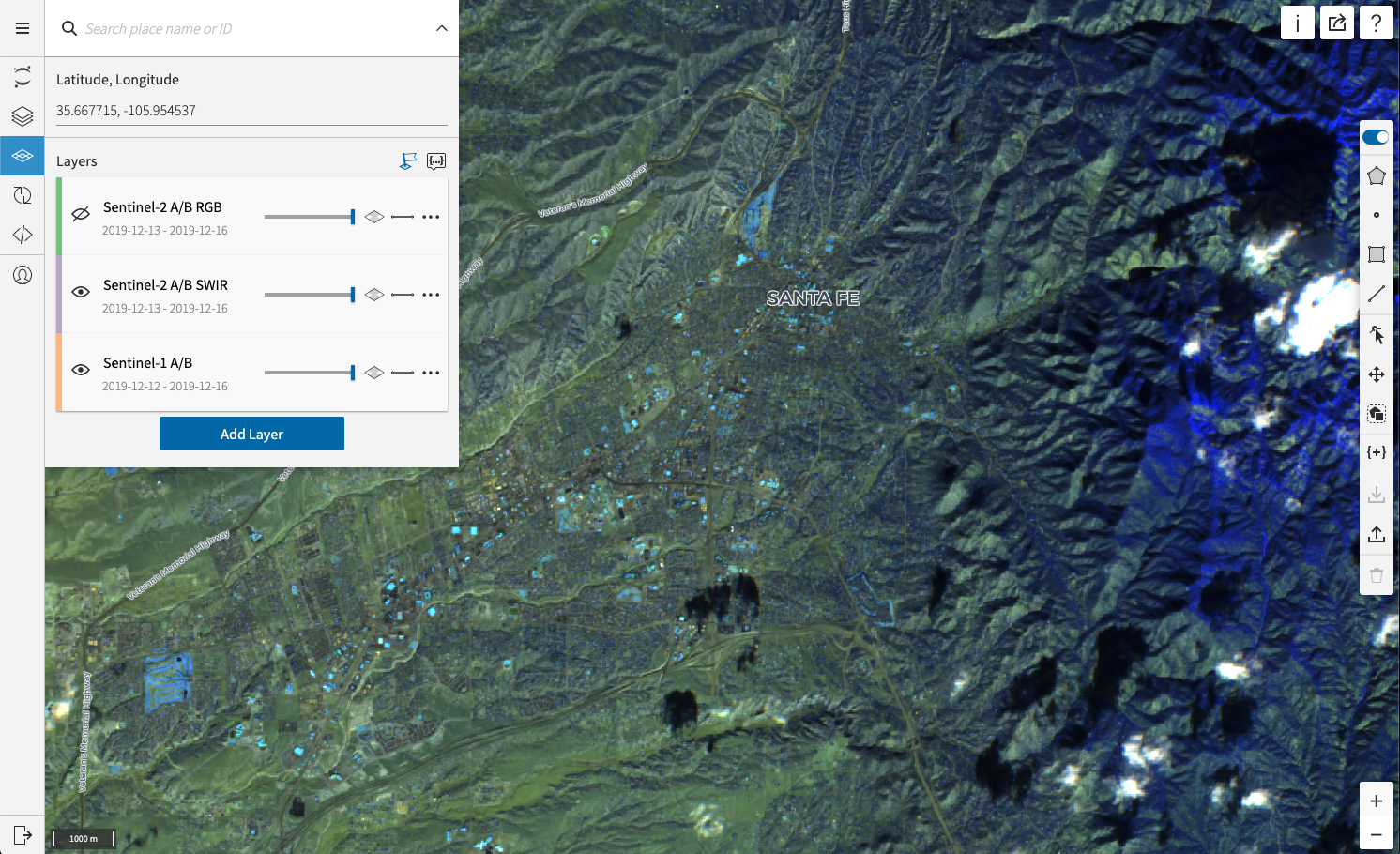
To enable more businesses to get started with working with this data (and become Descartes Labs customers), the company is betting on the standard tools in the industry, with hosted Jupyter notebooks, Python support and a set of APIs. It also includes tools to transform and clean the incoming data from Descartes’ third-party partners in order to make it usable for data scientists.
“It’s not just like some simple ETL-like data processing pipeline,” Descartes Labs’ head of Engineering Sam Skillman noted. “It’s something where we have to combine very in-depth data science, remote sensing and large-scale compute capabilities to bring all of that data in in a way that normalizes it and gets it ready for analysis.”
All of this analysis is handled in the cloud, of course.
The new platform is now available to businesses that want to give it a try.
Powered by WPeMatico
ServiceNow announced today that it has acquired Loom Systems, an Israeli startup that specializes in AIOps. The companies did not reveal the purchase price.
IT operations collects tons of data across a number of monitoring and logging tools, way too much for any team of humans to keep up with. That’s why there are startups like Loom turning to AI to help sort through it. It can find issues and patterns in the data that would be challenging or impossible for humans to find. Applying AI to operations data in this manner has become known as AIOps in industry parlance.
ServiceNow is first and foremost a company trying to digitize the service process, however that manifests itself. IT service operations is a big part of that. Companies can monitor their systems, wait until a problem happens and then try to track down the cause and fix it — or, they can use the power of artificial intelligence to find potential dangers to the system health and neutralize them before they become major problems. That’s what an AIOps product like Loom’s can bring to the table.
Jeff Hausman, vice president and general manager of IT Operations Management at ServiceNow, sees Loom’s strengths merging with ServiceNow’s existing tooling to help keep IT systems running. “We will leverage Loom Systems’ log analytics capabilities to help customers analyze data, automate remediation and reduce L1 incidents,” he told TechCrunch.
Loom co-founder and CEO Gabby Menachem not surprisingly sees a similar value proposition. “By joining forces, we have the unique opportunity to bring together our AI innovations and ServiceNow’s AIOps capabilities to help customers prevent and fix IT issues before they become problems,” he said in a statement.
Loom has raised $16 million since it launched in 2015, according to PitchBook data. Its most recent round for $10 million was in November 2019. Today’s deal is expected to close by the end of this quarter.
Powered by WPeMatico
Thundra, an early-stage serverless tooling startup, announced a $4 million Series A today led by Battery Ventures. The company spun out from Opsgenie after it was sold to Atlassian for $295 million in 2018.
York IE, Scale X Ventures and Opsgenie founder Berkay Mollamustafaoglu also participated in the round. Battery’s Neeraj Agarwal is joining the company’s board under the terms of the agreement.
The startup also announced that it had recently hired Ken Cheney as CEO, with technical founder Serkan Ozal becoming CTO.
Originally, Thundra helped run the serverless platform at Opsgenie. As a commercial company, it helps monitor, debug and secure serverless workloads on AWS Lambda. These three tasks could easily be separate tools, but Cheney says it makes sense to include them all because they are all related in some way.
“We bring all that together and provide an end-to-end view of what’s happening inside the application, and this is what really makes Thundra unique. We can actually provide a high-level distributed view of that constantly changing application that shows all of the components of that application, and how they are interrelated and how they’re performing. It can also troubleshoot down to the local service, as well as go down into the runtime code to see where the problems are occurring and let you know very quickly,” Cheney explained.
He says that this enables developers to get this very detailed view of their serverless application that otherwise wouldn’t be possible, helping them concentrate less on the nuts and bolts of the infrastructure, the reason they went serverless in the first place, and more on writing code.
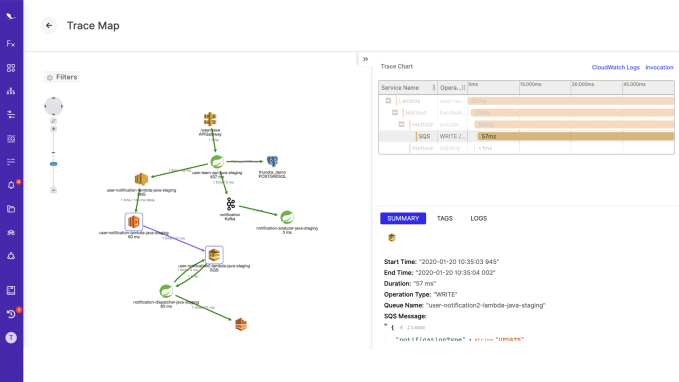
Serverless trace map in Thundra. Screenshot: Thundra
Thundra is able to do all of this in a serverless world, where there isn’t a fixed server and resources are ephemeral, making it difficult to identity and fix problems. It does this by installing an agent at the Lambda (AWS’ serverless offering) level on AWS, or at runtime on the container at the library level, he said.
Battery’s Neeraj Agarwal says having invested in Opsgenie, he knew the engineering team and was confident in the team’s ability to take it from internal tool to more broadly applicable product.
“I think it has to do with the quality of the engineering team that built Opsgenie. These guys are very microservices-oriented, very product-oriented, so they’re very quick at iterating and developing products. Even though this was an internal tool I think of it as very much productized, and their ability to now sell it to the broader market is very exciting,” he said.
The company offers a free version, then tiered pricing based on usage, storage and data retention. The current product is a cloud service, but it plans to add an on-prem version in the near future.
Powered by WPeMatico
Placer.ai, a startup that analyzes location and foot traffic analytics for retailers and other businesses, announced today that it has closed a $12 million Series A. The round was led by JBV Capital, with participation from investors including Aleph, Reciprocal Ventures and OCA Ventures.
The funding will be used on research and development of new features and to expand Placer.ai’s operation in the United States.
Launched in 2016, Placer.ai’s SaaS platform gives its clients real-time data that helps them make decisions like where to rent or buy properties, when to hold sales and promotions and how to manage assets.
Placer.ai analyzes foot traffic and also creates consumer profiles to help clients make marketing and ad spending decisions. It does this by collecting geolocation and proximity data from devices that are enabled to share that information. Placer.ai’s co-founder and CEO Noam Ben-Zvi says the company protects privacy and follows regulation by displaying aggregated, anonymous data and does not collect personally identifiable data. It also does not sell advertising or raw data.
The company currently serves clients in the retail (including large shopping centers), commercial real estate and hospitality verticals, including JLL, Regency, SRS, Brixmor, Verizon* and Caesars Entertainment.
“Up until now, we’ve been heavily focused on the commercial real estate sector, but this has very organically led us into retail, hospitality, municipalities and even [consumer packaged goods],” Ben-Zvi told TechCrunch in an email. “This presents us with a massive market, so we’re just focused on building out the types of features that will directly address the different needs of our core audience.”
He adds that lack of data has hurt retail businesses with major offline operations, but that “by effectively addressing this gap, we’re helping drive more sustainable growth or larger players or minimizing the risk for smaller companies to drive expansion plans that are strategically aggressive.”
Others startups in the same space include Dor, Aislelabs, RetailNext, ShopperTrak and Density. Ben-Zvi says Placer.ai wants to differentiate by providing more types of real-time data analysis.
“While there are a lot of companies touching the location analytics space, we’re in a unique situation as the only company providing these deep and actionable insights for any location in the country in a real-time platform with a wide array of functionality,” he said.
*Disclosure: Verizon Media is the parent company of TechCrunch.
Powered by WPeMatico