Enterprise
Auto Added by WPeMatico
Auto Added by WPeMatico
Three former Uber engineers, who helped build the company’s Michelangelo machine learning platform, left the company last year to form Tecton.ai and build an operational machine learning platform for everyone else. Today the company announced a $20 million Series A from a couple of high-profile investors.
Andreessen Horowitz and Sequoia Capital co-led the round with Martin Casado, general partner at a16z and Matt Miller, partner at Sequoia joining the company board under the terms of the agreement. Today’s investment combined with the seed they used to spend the last year building the product comes to $25 million. Not bad in today’s environment.
But when you have the pedigree of these three founders — CEO Mike Del Balso, CTO Kevin Stumpf and VP of Engineering Jeremy Hermann all helped build the Uber system — investors will spend some money, especially when you are trying to solve a difficult problem around machine learning.
The Michelangelo system was the machine learning platform at Uber that looked at things like driver safety, estimated arrival time and fraud detection, among other things. The three founders wanted to take what they had learned at Uber and put it to work for companies struggling with machine learning.
“What Tecton is really about is helping organizations make it really easy to build production-level machine learning systems, and put them in production and operate them correctly. And we focus on the data layer of machine learning,” CEO Del Balso told TechCrunch.
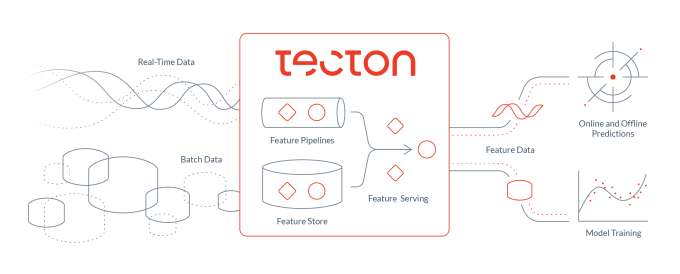
Image Credit: Tecton.ai
Del Balso says part of the problem, even for companies that are machine learning-savvy, is building and reusing models across different use cases. In fact, he says the vast majority of machine learning projects out there are failing, and Tecton wanted to give these companies the tools to change that.
The company has come up with a solution to make it much easier to create a model and put it to work by connecting to data sources, making it easier to reuse the data and the models across related use cases. “We’re focused on the data tasks related to machine learning, and all the data pipelines that are related to power those models,” Del Balso said.
Certainly Martin Casado from a16z sees a problem in search of a solution and he likes the background of this team and its understanding of building a system like this at scale. “After tracking a number of deep engagements with top ML teams and their interest in what Tecton was building, we invested in Tecton’s A alongside Sequoia. We strongly believe that these systems will continue to increasingly rely on data and ML models, and an entirely new tool chain is needed to aid in developing them…,” he wrote in a blog post announcing the funding.
The company currently has 17 employees and is looking to hire, particularly data scientists and machine learning engineers, with a goal of 30 employees by the end of the year.
While Del Balso is certainly cognizant of the current economic situation, he believes he can still build this company because he’s solving a problem that people genuinely are looking for help with right now around machine learning.
“From the customers we’re talking to, they need to solve these problems, and so we don’t see things slowing down,” he said.
Powered by WPeMatico

Checkly, a Berlin-based startup that is developing a monitoring and testing platform for DevOps teams, today announced that it has raised a $2.25 million seed round led by Accel. A number of angel investors, including Instana CEO Mirko Novakovic, Zeit CEO Guillermo Rauch and former Twilio CTO Ott Kaukver, also participated in this round.
The company’s SaaS platform allows developers to monitor their API endpoints and web apps — and it obviously alerts you when something goes awry. The transaction monitoring tool makes it easy to regularly test interactions with front-end websites without having to actually write any code. The test software is based on Google’s open-source Puppeteer framework and to build its commercial platform, Checkly also developed Puppeteer Recorder for creating these end-to-end testing scripts in a low-code tool that developers access through a Chrome extension.
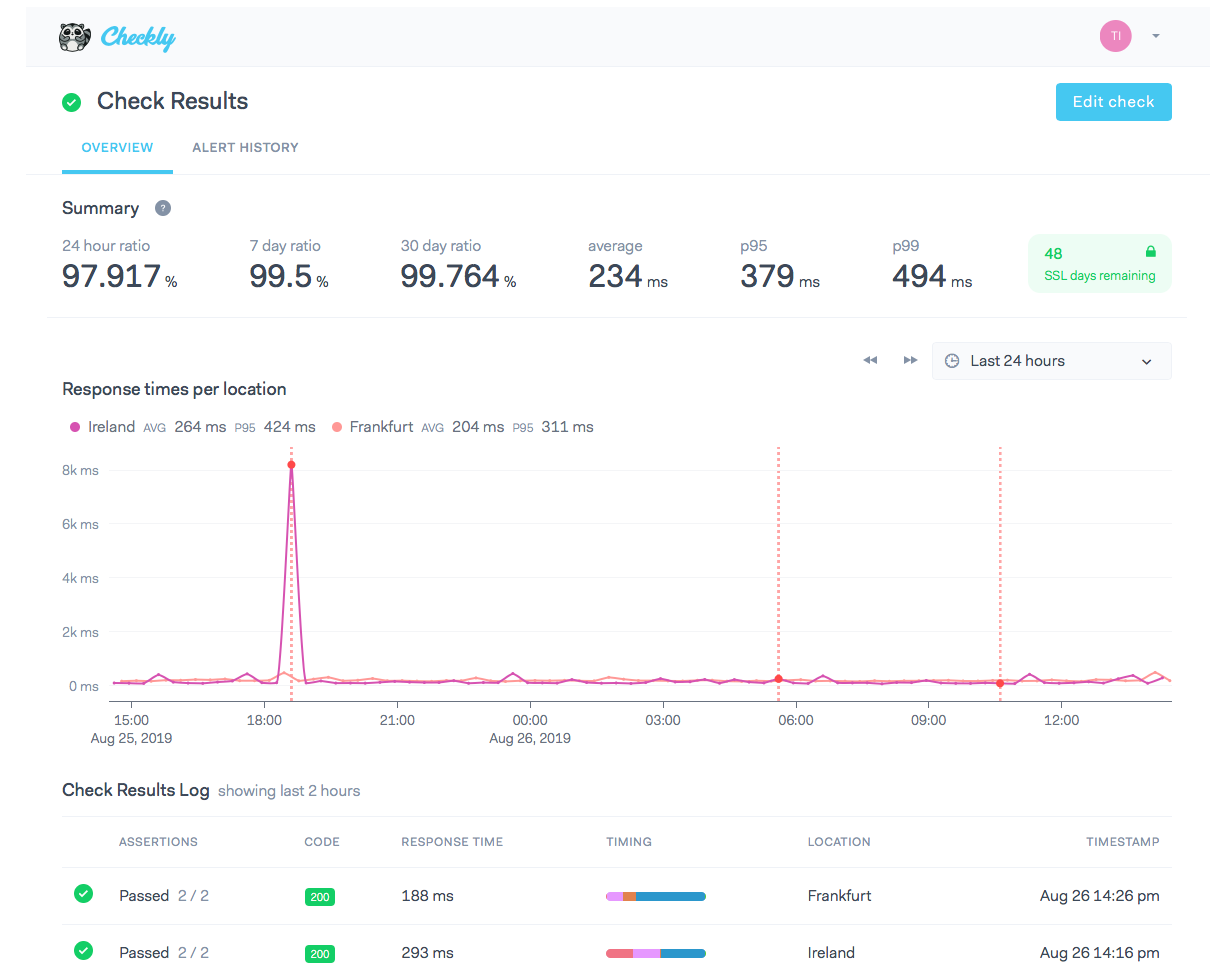
The team believes that it’s the combination of end-to-end testing and active monitoring, as well as its focus on modern DevOps teams, that makes Checkly stand out in what is already a pretty crowded market for monitoring tools.
 “As a customer in the monitoring market, I thought it had long been stuck in the 90s and I needed a tool that could support teams in JavaScript and work for all the different roles within a DevOps team. I set out to build it, quickly realizing that testing was equally important to address,” said Tim Nolet, who founded the company in 2018. “At Checkly, we’ve created a market-defining tool that our customers have been demanding, and we’ve already seen strong traction through word of mouth. We’re delighted to partner with Accel on building out our vision to become the active reliability platform for DevOps teams.”
Nolet’s co-founders are Hannes Lenke, who founded TestObject (which was later acquired by Sauce Labs), and Timo Euteneuer, who was previously Director Sales EMEA at Sauce Labs.
Tthe company says that it currently has about 125 paying customers who run about 1 million checks per day on its platform. Pricing for its services starts at $7 per month for individual developers, with plans for small teams starting at $29 per month.
Powered by WPeMatico
While human travel has become severely restricted in recent months, the movement of goods has remained a constant priority — and in some cases, has become even more urgent. Today, a startup out of Switzerland that builds hardware and operates a logistics network designed to transport one item in particular — pharmaceuticals — is announcing a significant round to fuel its growth.
SkyCell — a designer of “smart containers” powered by software to maintain constant conditions for drugs that need to be kept at strict temperatures, humidity levels, and levels of vibration, which are in turn used to transport pharmaceuticals around the globe on behalf of drug companies — is today announcing. that it has raised $62 million in growth funding.
This latest round is being led by healthcare investor MVM Partners, with participation also from family offices, a Swiss insurance company that declined to be named, as well as previous investors the Swiss Entrepreneurs Fund (managed by Credit Suisse and UBS), and the BCGE Bank’s growth fund.
The company was founded in 2012 Switzerland when Richard Ettl and Nico Ros were tasked to design a storage facility for one of the big Swiss pharma giants. The exec charged with overseeing the project brainstormed that the work they were putting in could potentially be applied to transportation containers, and thus SkyCell was born.
Today, Ettl (who is the CEO, while Ros is the CTO), said in an interview that the company now works with eight of the world’s biggest pharmaceutical companies and has been in validation trials with a further seven. These use SkyCell’s network of some 22,000 air freight pallets to move their products around the world.
The new capital will be used to expand that reach further, specifically in the U.S. and Asia, and to double its fleet to become the biggest pharmaceutical transportation company globally. With 30 of the 50 biggest-selling drugs in the world being temperature sensitive (and some generics for one of the biggest-selling, the arthritis medication Humira, now also coming out), this makes for a huge opportunity.
And unsurprisingly, several of SkyCell’s customers are working on COVID-19 medications, Ettl said, either to help ease symptoms or potentially to vaccinate or eradicate the virus, and so it’s standing at the ready to play a role in getting drugs to where they need to be.
“We are well positioned in case there is a vaccine developed. Out of the six pharma companies developing these right now, four of them are our customers, so there is a high likelihood we would transport something,” Ettl said.
For now, he said SkyCell has been involved in helping to transport “supportive” medications related to the outbreak, such as flu shots to make sure people are not falling ill with other viral infections at the same time.
SkyCell is not disclosing its valuation but we understand that it’s in the many hundreds of millions of dollars. The company had raised some $36 million in equity and debt before this, bringing the total outside funding now to $98 million.
In a market that’s estimated to be worth some $2.8 billion annually and growing at a rate of between 15% and 20% each year, there are a number of freight businesses that focus on the transportation of pharmaceuticals. They include not only freight companies but airlines themselves, which often buy in containers from third parties. (And for some more context, one of its competitors, Envirotainer, was acquired for over $1 billion in 2918; while another, CSafe, has raised significantly more funding.)
But there was virtually no innovation in the market, and most pharmaceutical companies factored in failure rates of between 4% and 12% depending on where the drugs were headed.
One key differentiator with SkyCell has been its containers, which are able to withstand temperatures as high as 60 degrees Celsius or as low as negative 10 degrees Celsius, and have tracking on them to better monitor their movements from A to B.
These came to the market at a time when incumbents were only able to (and some still are only able to) guarantee insulation for temperatures as high as 40 degrees, which was not as pressing an issue in the past as it is today, in part because of rising temperatures around the globe, and in part because of the growing sophistication of pharmaceuticals.
“We’ve found that the number of days where [one has to consider] temperature extremes has been going up,” Ettl said. “Last year, we had 30 days where it was warmer than 40 degrees Celsius across our network of countries.”
On top of the containers themselves, SkyCell has built a software platform that taps into the kind of big data analytics that are now part and parcel of how modern companies in the logistics industry work today, in order to optimise movement and best routing for packages.
The conditions it considers include not only the obvious ones around temperature, humidity and vibration, but distance and time of travel, as well as overall carbon emissions. SkyCell claims that its failure rate comes out at less than 0.1%, with CO2 emissions reduced by almost half on a typical shipment.
Together, the hardware and software are covered by some 100 patents, the company says.
Powered by WPeMatico
A startup that’s hoping to be a contender in the very large and fragmented market of human resources software has captured the eye of a big investor out of the US and become its first investment in Spain.
Barcelona-based Factorial, which is building an all-in-one HR automation platform aimed at small and medium businesses that manages payroll, employee onboarding, time off and other human resource functions, has raised €15 ($16 million) in a Series A round of funding led by CRV, with participation also from existing investors Creandum, Point Nine and K Fund.
The money comes on the heels of Factorial — which has customers in 40 countries — seeing eightfold growth in revenues in 2019, with more than 60,000 customers now using its tools.
Jordi Romero, the CEO who co-founded the company with Pau Ramon (CTO) and Bernat Farrero (head of corporate), said in an interview that the investment will be used both to expand to new markets and add more customers, as well as to double down on tech development to bring on more features. These will include RPA integrations to further automate services, and to move into more back-office product areas such as handling expenses,
Factorial has now raised $18 million and is not disclosing its valuation, he added.
The funding is notable on a couple of levels that speak not just to the wider investing climate but also to the specific area of human resources.
In addition to being CRV’s first deal in Spain, the investment is being made at a time when the whole VC model is under a lot of pressure because of the global coronavirus pandemic — not least in Spain, which has a decent, fledgling technology scene but has been one of the hardest-hit countries in the world when it comes to COVID-19.
“It made the closing of the funding very, very stressful,” Romero said from Barcelona last week (via video conference). “We had a gentleman’s agreement [so to speak] before the virus broke out, but the money was still to be wired. Seeing the world collapse around you, with some accounts closing, and with the bigger business world in a very fragile state, was very nerve wracking.”
Ironically, it’s that fragile state that proved to be a saviour of sorts for Factorial.
“We target HR leaders and they are currently very distracted with furloughs and layoffs right now, so we turned around and focused on how we could provide the best value to them,” Romero said.
The company made its product free to use until lockdowns are eased up, and Factorial has found a new interest from businesses that had never used cloud-based services before but needed to get something quickly up and running to use while working from home. He noted that among new companies signing up to Factorial, most either previously kept all their records in local files or at best a “Dropbox folder, but nothing else.”
The company also put in place more materials and other tools specifically to address the most pressing needs those HR people might have right now, such as guidance on how to implement furloughs and layoffs, best practices for communication policies and more. “We had to get creative,” Romero said.
At $16 million, this is at the larger end of Series A rounds as of January 2020, and while it’s definitely not as big as some of the outsized deals we’ve seen out of the US, it happens to be the biggest funding round so far this year in Spain.
Its rise feels unlikely for another reason, too: it comes at a time when we already have dozens (maybe even hundreds) of human resources software businesses, with many an established name — they include PeopleHR, Workday, Infor, ADP, Zenefits, Gusto, IBM, Oracle, SAP, Rippling, and many others — in a market that analysts project will be worth $38.17 billion by 2027 growing at a CAGR of over 11%.
But as is often the case in tech, status quo breeds disruption, and that’s the case here. Factorial’s approach has been to build HR tools specifically for people who are not HR professionals per se: companies that are small enough not to have specialists, or if they do, they share a lot of the tasks and work with other managers who are not in HR first and foremost.
It’s a formula that Romero said could potentially see the company taking on bigger customers, but for now, investors like it for having built a platform approach for the huge but often under-served SME market.
“Factorial was built for the users, designed for the modern web and workplace,” said Reid Christian, General Partner at CRV, in a statement. “Historically the HR software market has been one of the most lucrative categories for enterprise tech companies, and today, the HR stack looks much different. As we enter the third generation of cloud HR products, with countless point solutions, there’s a strong need for an underlying platform to integrate work across these.”
Powered by WPeMatico
The job of an early-stage startup founder is challenging in good times, never mind a crash like the one we are experiencing today.
While most expect private investing to slow down, it’s clear that some investments are still happening in spite of the pandemic, if the stories we are writing on TechCrunch are any indication.
But the downturn is bound to have an impact on the types of deals that receive funding; any startup that offers a good or service requiring human interaction or installation will face an uphill battle, at least in the short term. That said, enterprise SaaS vendors, especially ones that solve hard problems, help with work-from-home or collaboration, or better yet, help increase efficiency and save money, are still very much in demand.
Nobody can do anything about the CIO who is hunkering down until things improve — but that’s not everyone. Companies might be thinking twice about where they spend money, but some are still helping drive the net-new, post-COVID-19 investments happening from seed to late stage across many sectors.
We looked at data and spoke to a couple of enterprise-focused, NYC-based seed investors to better understand their investing cadence. Nobody painted a rosy picture of today’s climate, but seed investors were never about immediate gratification, especially where enterprise startups are concerned. That means, if a seed-stage investor believes in the founders and their vision and the company can ride out today’s economic upset, there’s still money in the till — at least for now.
Powered by WPeMatico
At a time when more transactions than ever are happening online, payments behemoth Stripe is announcing three new features to continue expanding its reach.
The company today announced that it will now offer card issuing services directly to businesses to let them in turn make credit cards for customers tailored to specific purposes. Alongside that, it’s going to expand the number of accepted local, large card networks to cut down some of the steps it takes to make transactions in international markets. And finally, it’s launching a “revenue optimization” feature that essentially will use Stripe’s AI algorithms to reassess and approve more flagged transactions that might have otherwise been rejected in the past.
Together the three features underscore how Stripe is continuing to scale up with more services around its core payment processing APIs, a significant step in the wake of last week announcing its biggest fundraise to date: $600 million at a $36 billion valuation.
The rollouts of the new products are specifically coming at a time when Stripe has seen a big boost in usage among some (but not all) of its customers, said John Collison, Stripe’s co-founder and president, in an interview. Instacart, which is providing grocery delivery at a time when many are living under stay-at-home orders, has seen transactions up by 300% in recent weeks. Another newer customer, Zoom, is also seeing business boom. Amazon, Stripe’s behemoth customer that Collison would not discuss in any specific terms except to confirm it’s a close partner, is also seeing extremely heavy usage.
But other Stripe users — for example, many of its sea of small business users — are seeing huge pressures, while still others, faced with no physical business, are just starting to approach e-commerce in earnest for the first time. Stripe’s idea is that the launches today can help it address all of these scenarios.
“What we’re seeing in the COVID-19 world is that the impact is not minor,” said Collison. “Online has always been steadily taking a share from offline, but now many [projected] years of that migration are happening in the space of a few weeks.”
Stripe is among those companies that have been very mum about when they might go public — a state of affairs that only become more set in recent times, given how the IPO market has all but dried up in the midst of a health pandemic and economic slump. That has meant very little transparency about how Stripe is run, whether it’s profitable and how much revenues it makes.
But Stripe did note last week that it had some $2 billion in cash and cash reserves, which at least speaks to a level of financial stability. And another hint of efficiency might be gleaned from today’s product news.
While these three new services don’t necessarily sound like they are connected to each other, what they have underpinning them is that they are all building on top of tech and services that Stripe has previously rolled out. This speaks to how, even as the company now handles some 250 million API requests daily, it’s keeping some lean practices in place in terms of how it invests and maximises engineering and business development resources.
The card issuing service, for example, is built on a card service that Stripe launched last year. Originally aimed at businesses to provide their employees with credit cards — for example to better manage their own work-related expenses, or to make transactions on behalf of the business — now businesses can use the card issuing platform to build out aspects of its customer-facing services.
For example, Stripe noted that the first customer, Zipcar, will now be placing credit cards in each of its vehicles, which drivers can use to fuel up the vehicles (that is, the cards can only be used to buy gas). Another example Collison gave for how these could be implemented would be in a food delivery service, for example for a Postmates delivery person to use the card to pay for the meal that a customer has already paid Postmates to pick up and deliver to them.
Collison noted that while other startups like Marqeta have built big businesses around innovative card issuing services, “this is the first time it’s being issued on a self-serving basis,” meaning companies that want to use these cards can now set this up more quickly as a “programmatic card” experience, akin to self-serve, programmatic ads online.
It seems also to be good news for investors. “Stripe Issuing is a big step forward,” said Alex Rampell, general partner at Andreessen Horowitz, in a statement. “Not just for the millions of businesses running on Stripe, but for credit cards as a fundamental technology. Businesses can now use an API to create and issue cards exactly when and where they need them, and they can do it in a few clicks, not a few months. As investors, we’re excited by all the potential new companies and business models that will emerge as a result.”
Meanwhile, the revenue “optimization” engine that Stripe is rolling out is built on the same machine learning algorithms that it originally built for Radar, its fraud prevention tool that originally launched in 2016 and was extended to larger enterprises in 2018. This makes a lot of sense, since oftentimes the reason transactions get rejected is because of the suspicion of fraud. Why it’s taken four years to extend that to improve how transactions are approved or rejected is not entirely clear, but Stripe estimates that it could enable a further $2.5 billion in transactions annually.
One reason why the revenue optimization may have taken some time to roll out was because while Stripe offers a very seamless, simple API for users, it’s doing a lot of complex work behind the scenes knitting together a lot of very fragmented payment flows between card issuers, banks, businesses, customers and more in order to make transactions possible.
The third product announcement speaks to how Stripe is simplifying a bit more of that. Now, it’s able to provide direct links into six big card networks — Visa, Mastercard, American Express, Discover, JCB and China Union Pay, which effectively covers the major card networks in North and Latin America, Southeast Asia and Europe. Previously, Stripe would have had to work with third parties to integrate acceptance of all of these networks in different regions, which would have cut into Stripe’s own margins and also given it less flexibility in terms of how it could handle the transaction data.
Launching the revenue optimization by being able to apply machine learning to the transaction data is one example of where and how it might be able to apply more innovative processes from now on.
While Stripe is mainly focused today on how to serve its wider customer base and to just help business continue to keep running, Collison noted that the COVID-19 pandemic has had a measurable impact on Stripe beyond just boosts in business for some of its customers.
The whole company has been working remotely for weeks, including its development team, making for challenging times in building and rolling out services.
And Stripe, along with others, is also in the early stages of piloting how it will play a role in issuing small business loans as part of the CARES Act, he said.
In addition to that, he noted that there has been an emergence of more medical and telehealth services using Stripe for payments.
Before now, many of those use cases had been blocked by the banks, he said, for reasons of the industries themselves being strictly regulated in terms of what kind of data could get passed across networks and the sensitive nature of the businesses themselves. He said that a lot of that has started to get unblocked in the current climate, and “the growth of telemedicine has been off the charts.”
Powered by WPeMatico
Miro is a company in the right place at the right time. The makers of a digital whiteboard are seeing usage surge right now as businesses move from the workplace and physical whiteboards. Today, the company announced a hefty $50 million Series B.
Iconiq Capital led the round with help from Accel and a slew of individual investors. Today’s investment brings the total raised to around $75 million, according to the company. Among the company’s angel investors was basketball star Steph Curry.
What’s attracting this level of investment is that this is a product made for a moment when workers are forced to stay home. One of the primary complaints about working at home is the inability to sit in the same room with colleagues and brainstorm around a whiteboard. This reproduces that to an extent.
What’s more, Miro isn’t simply light-weight add-in like you might find built into a collaboration tool like Zoom or Microsoft Teams; it’s more of a platform play designed to integrate with many different enterprise tools, much like Slack does for communications.
Miro co-founder and CEO Andrey Khusid said the company planned the platform idea from its earliest days. “The concept from day one was building something for real-time collaboration and the platform thing is very important because we expect that people will build on top of our product,” Khusid told TechCrunch.

Image Credit: Miro
That means that people can build integrations to other common tools and customize the base tool to meet the needs of an individual team or organization. It’s an approach that seems to be working as the company reports it’s profitable with more than 21,000 customers including 80% of the Fortune 100. Customers include Netflix, Salesforce, PwC, Spotify, Expedia and Deloitte.
Khusid says usage has been skyrocketing among both business and educational customers as the pandemic has forced millions of people to work at home. He says that has been a challenge for his engineering team to keep up with the demand, but one that the company has been able to meet to this point.
The startup just passed the 300 employee mark this week, and it will continue to hire with this new influx of money. Khusid expects to have another 150 employees before the end of the year to keep up with increasing demand for the product.
“We understand that we need to come out strong from this situation. The company is growing much faster than we expected, so we need to have a very strong team to maintain the growth at the same pace after the crisis ends.”
Powered by WPeMatico
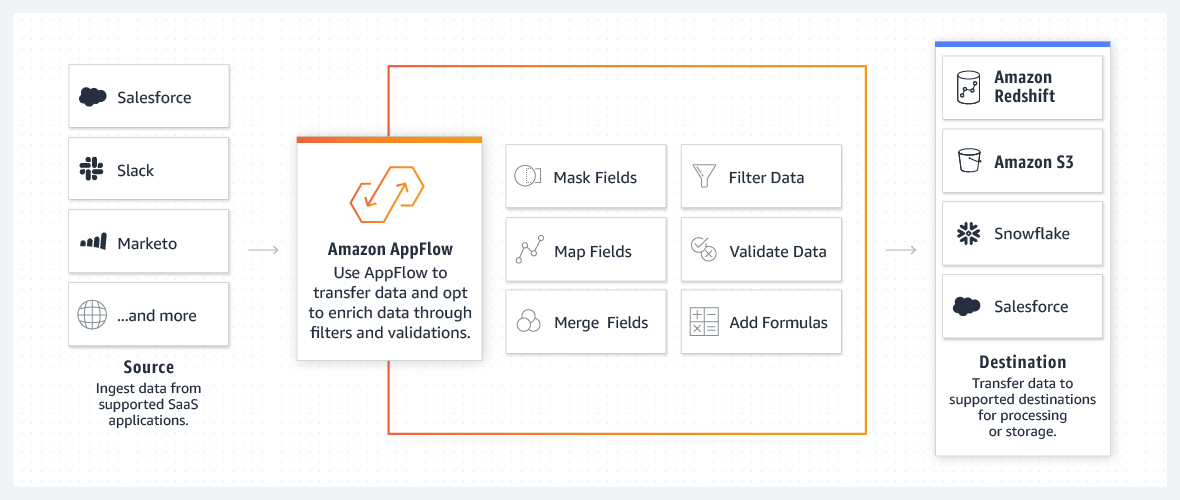
AWS today launched Amazon AppFlow, a new integration service that makes it easier for developers to transfer data between AWS and SaaS applications like Google Analytics, Marketo, Salesforce, ServiceNow, Slack, Snowflake and Zendesk. Like similar services, including Microsoft Azure’s Power Automate, for example, developers can trigger these flows based on specific events, at pre-set times or on-demand.
Unlike some of its competitors, though, AWS is positioning this service more as a data transfer service than a way to automate workflows, and, while the data flow can be bi-directional, AWS’s announcement focuses mostly on moving data from SaaS applications to other AWS services for further analysis. For this, AppFlow also includes a number of tools for transforming the data as it moves through the service.
“Developers spend huge amounts of time writing custom integrations so they can pass data between SaaS applications and AWS services so that it can be analysed; these can be expensive and can often take months to complete,” said AWS principal advocate Martin Beeby in today’s announcement. “If data requirements change, then costly and complicated modifications have to be made to the integrations. Companies that don’t have the luxury of engineering resources might find themselves manually importing and exporting data from applications, which is time-consuming, risks data leakage, and has the potential to introduce human error.”
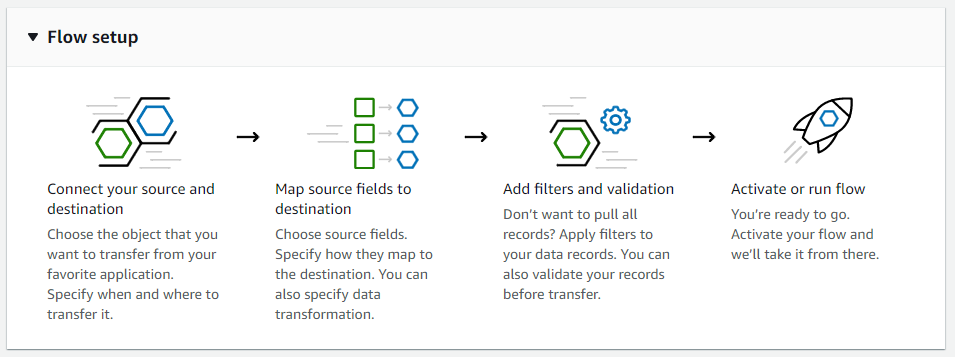 Every flow (which AWS defines as a call to a source application to transfer data to a destination) costs $0.001 per run, though, in typical AWS fashion, there’s also cost associated with data processing (starting at 0.02 per GB).
“Our customers tell us that they love having the ability to store, process, and analyze their data in AWS. They also use a variety of third-party SaaS applications, and they tell us that it can be difficult to manage the flow of data between AWS and these applications,” said Kurt Kufeld, vice president, AWS. “Amazon AppFlow provides an intuitive and easy way for customers to combine data from AWS and SaaS applications without moving it across the public internet. With Amazon AppFlow, our customers bring together and manage petabytes, even exabytes, of data spread across all of their applications — all without having to develop custom connectors or manage underlying API and network connectivity.”
At this point, the number of supported services remains comparatively low, with only 14 possible sources and four destinations (Amazon Redshift and S3, as well as Salesforce and Snowflake). Sometimes, depending on the source you select, the only possible destination is Amazon’s S3 storage service.
Over time, the number of integrations will surely increase, but for now, it feels like there’s still quite a bit more work to do for the AppFlow team to expand the list of supported services.
AWS has long left this market to competitors, even though it has tools like AWS Step Functions for building serverless workflows across AWS services and EventBridge for connections applications. Interestingly, EventBridge currently supports a far wider range of third-party sources, but as the name implies, its focus is more on triggering events in AWS than moving data between applications.
Powered by WPeMatico

A year ago, back in the days of in-person conferences, Google officially announced the launch of its Anthos multi-cloud application modernization platform at its Cloud Next conference. The promise of Anthos was always that it would allow enterprises to write their applications once, package them into containers and then manage their multi-cloud deployments across GCP, AWS, Azure and their on-prem data centers.
Until now, support for AWS and Azure was only available in preview, but today, the company is making support for AWS and on-premises generally available. Microsoft Azure support remains in preview, though.
“As an AWS customer now, or a GCP customer, or a multi-cloud customer, […] you can now run Anthos on those environments in a consistent way, so you don’t have to learn any proprietary APIs and be locked in,” Eyal Manor, the GM and VP of engineering in charge of Anthos, told me. “And for the first time, we enable the portability between different infrastructure environments as opposed to what has happened in the past where you were locked into a set of APIs.”
 Manor stressed that Anthos was designed to be multi-cloud from day one. As for why AWS support is launching ahead of Azure, Manor said that there was simply more demand for it. “We surveyed the customers and they said, ‘hey, we want, in addition to GCP, we want AWS,’ ” he said. But support for Azure will come later this year and the company already has a number of preview customers for it. In addition, Anthos will also come to bare metal servers in the future.
Looking even further ahead, Manor also noted that better support for machine learning workloads is on the way. Many businesses, after all, want to be able to update and run their models right where their data resides, no matter what cloud that may be. There, too, the promise of Anthos is that developers can write the application once and then run it anywhere.
“I think a lot of the initial response and excitement was from the developer audiences,” Jennifer Lin, Google Cloud’s VP of product management, told me. “Eric Brewer had led a white paper that we did to say that a lot of the Anthos architecture sort of decouples the developer and the operator stakeholder concerns. There hadn’t been a multi-cloud shared software architecture where we could do that and still drive emerging and existing applications with a common shared software stack.”
She also noted that a lot of Google Cloud’s ecosystem partners endorsed the overall Anthos architecture early on because they, too, wanted to be able to write once and run anywhere — and so do their customers.
Plaid is one of the launch partners for these new capabilities. “Our customers rely on us to be always available and as a result we have very high reliability requirements,” said Naohiko Takemura, Plaid’s head of engineering. “We pursued a multi-cloud strategy to ensure redundancy for our critical KARTE service. Google Cloud’s Anthos works seamlessly across GCP and our other cloud providers preventing any business disruption. Thanks to Anthos, we prevent vendor lock-in, avoid managing cloud-specific infrastructure, and our developers are not constrained by cloud providers.”
With this release, Google Cloud is also bringing deeper support for virtual machines to Anthos, as well as improved policy and configuration management.
Over the next few months, the Anthos Service Mesh will also add support for applications that run in traditional virtual machines. As Lin told me, “a lot of this is is about driving better agility and taking the complexity out of it so that we have abstractions that work across any environment, whether it’s legacy or new or on-prem or AWS or GCP.”
Powered by WPeMatico
Google Meet, like all video chat products, is seeing rapid growth in user numbers right now, so it’s no surprise that Google is trying to capitalize on this and is quickly iterating on its product. Today, it is officially launching a set of new features that include a more Zoom-like tiled layout, a low-light mode for when you have to make calls at night and the ability to present a single Chrome tab instead of a specific window or your entire screen. Soon, Meet will also get built-in noise cancellation so nobody will hear your dog bark in the background.
If all of this sounds a bit familiar, it’s probably because G Suite exec Javier Soltero already talked to Reuters about these features last week. Google PR is usually pretty straightforward, but in this case, it moved in mysterious ways. Today, though, these features are actually starting to roll out to users, a Google spokesperson told me, and today’s announcement does actually provide more details about each of these features.
For the most part, what’s being announced here is obvious. The tiled layout allows web users to see up to 16 participants at once. Previously, that number was limited to four and Google promises it will offer additional layouts for larger meetings and better presentation layouts, as well as support for more devices in the future.
For the most part, having this many people stare at me from my screen doesn’t seem necessary (and more likely to induce stress than anything else), but the ability to present a single Chrome tab is surely a welcome new feature for many. But what’s probably just as important is that this means you can share higher-quality video content from these tabs than before.
If you often take meetings in the dark, low-light mode uses AI to brighten up your video. Unlike some of the other features, this one is coming to mobile first and will come to web users in the future.
Personally, I’m most excited about the new noise cancellation feature. Typically, noise cancellation works best for noises that repeat and are predictable. Think about the constant drone of an airplane or your neighbor’s old lawnmower. But Google says Meet can now go beyond this and also cancel out barking dogs and your noisy keystrokes. That has increasingly become table stakes, with even Discord offering similar capabilities and Nvidia RTX Voice now making this available in a slew of applications for users of its high-end graphics cards, but it’s nice to see this as a built-in feature for Meet now.
This feature will only roll out in the coming weeks and will initially be available to G Suite Enterprise and G Suite Enterprise for Education users on the web, with mobile support coming later.
Powered by WPeMatico