Enterprise
Auto Added by WPeMatico
Auto Added by WPeMatico
Env0, a startup that wants to help companies bring some order to delivery of Infrastructure as Code, announced a $3.3 million seed investment today and the release of the Beta of the company’s first product.
Boldstart Ventures and Grove Ventures co-led the round with participation from several angel investors including Guy Podjarny of Snyk.
Company co-founder and CEO Ohad Maislish says the ability of developers to deliver code quickly is a blessing and a curse, and his company wants to give IT some control over how and when code gets committed.
“The challenge companies have is how to balance between self-service and oversight of cloud resources in a cloud native kind of way, and to balance this with visibility, predictability, and most importantly, governance around cloud security and costs,” Maislish said.
The product lets companies define when it’s OK for developers to deliver code and how much they can spend instead of letting them deliver anything, at any time, at any cost. You do this by giving overall control of the process to an administrator, who can then define templates and projects. The templates define which repositories and products you can use for a given cloud vendor and the projects correlate to the users allowed to access those templates.
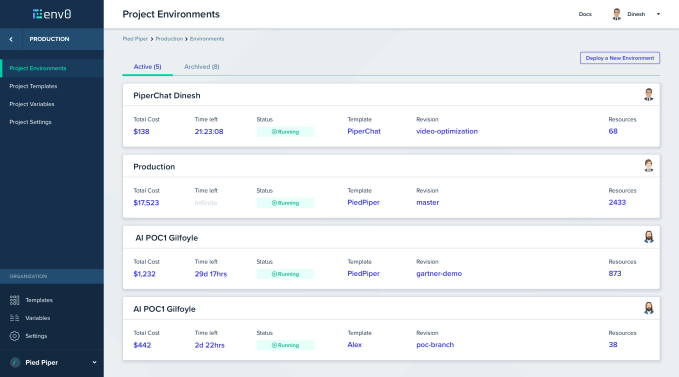
Image Credit: Env0
Ed Sim, founder and managing partner at Boldstart says the startup has been able to find a good balance between governance and the need for speed that today’s developers require in a continuous delivery environment. “Env0 is the first SaaS solution that meets all of those needs by offering self-service cloud environments with centralized governance,” Sim said in a statement.
It’s not easy launching an early-stage company in the middle of the current economic situation, but Maislish believes his company is in a decent position as it provides a way to control self-service development, something that is even more important when your developers are working from home outside of the purview of IT and security.
The company launched 18 months ago and has been in private beta for some time. Today marks the launch of the public beta. It currently has 10 employees.
Powered by WPeMatico
For better or worse, digital identity management services — the process of identifying and authenticating users on networks to access services — has become a ubiquitous part of interacting on the internet, all the more so in the recent weeks as we have been asked to carry out increasingly more of our lives online.
Used correctly, they help ensure that it’s really you logging into your online banking service; used badly, you feel like you can’t innocently watch something silly on YouTube without being watched yourself. Altogether, they are a huge business: worth $16 billion today according to Gartner but growing at upwards of 30% and potentially as big as $30.5 billion by 2024, according to the latest forecasts.
Now, a company called ForgeRock, which has built a platform that is used to help make sure that those accessing services really are who they say are, and help organizations account for how their services are getting used, is announcing a big round of funding to continue expanding its business amid a huge boost in demand.
The company is today announcing that it has raised $93.5 million in funding, a Series E it will use to continue expanding its product and take it to its next step as a business, specifically investing in R&D, cloud services and its ForgeRock Identity Cloud, and general global business development.
The round is being led by Riverwood Capital, and Accenture Ventures, as well as previous investors Accel, Meritech Capital, Foundation Capital and KKR Growth, also participated.
Fran Rosch, the startup’s CEO, said in an interview that this will likely be its final round of funding ahead of an IPO, although given the current static of affairs with a lot of M&A, there is no timing set for when that might happen. (Notably, the company had said its last round of funding — $88 million in 2017 — would be its final ahead of an IPO, although that was under a different CEO.)
This Series E brings the total raised by the company to $230 million. Rosch confirmed it was raised as a material upround, although he declined to give a valuation. For some context, the company’s last post-money valuation was $646.50 million per PitchBook, and so this round values the company at more than $730 million.
ForgeRock has annual recurring revenues of more than $100 million, with annual revenues also at over $100 million, Rosch said. It operates in an industry heavy with competition, with some of the others vying for pole position in the various aspects of identity management including Okta, LastPass, Duo Serurity and Ping Identity.
But within that list it has amassed some impressive traction. In total it has 1,100 enterprise customers, who in turn collectively manage 2 billion identities through ForgeRock’s platform, with considerably more devices also authenticated and managed on top of that.
Customers include the likes of the BBC — which uses ForgeRock to authenticate and log not just 45 million users but also the devices they use to access its iPlayer on-demand video streaming service — Comcast, a number of major banks, the European Union and several other government organizations. ForgeRock was originally founded in Norway about a decade ago, and while it now has its headquarters in San Francisco, it still has about half its employees and half its customers on the other side of the Atlantic.
Currently ForgeRock provides services to businesses related to identity management including password and username creation, identity governance, directory services, privacy and consent gates, which they in turn provide both to their human customers as well as to devices accessing their services, but we’re in a period of change right now when it comes to identity management. It stays away from direct-to-consumer password management services and Rosch said there are no plans to move into that area.
These days, we’ve become more aware of privacy and data protection. Sometimes, it’s been because of the wrong reasons, such as giant security breaches that have leaked some aspect of our personal information into a giant database, or because of a news story that has uncovered how our information has unwittingly been used in ‘legit’ commercial schemes, or other ways we never imagined it would.
Those developments, combined with advances in technology, are very likely to lead us to a place over time where identity management will become significantly more shielded from misuse. These could include more ubiquitous use of federated identities, “lockers” that store our authentication credentials that can be used to log into services but remain separate from their control, and potentially even applications of blockchain technology.
All of this means that while a company like ForgeRock will continue to provide its current services, it’s also investing big in what it believes will be the next steps that we’ll take as an industry, and society, when it comes to digital identity management — something that has had a boost of late.
“There are a lot of interesting things going on, and we are working closely behind the scenes to flesh them out,” Rosch said. “For example, we’re looking at how best to break up data links where we control identities to get access for a temporary period of time but then pull back. It’s a powerful trend that is still about four to five years out. But we are preparing for this, a time when our platform can consume decentralised identity, on par with logins from Google or Facebook today. That is an interesting area.”
He notes that the current market, where there has been an overall surge for all online services as people are staying home to slow the speed of the coronavirus pandemic, has seen big boosts in specific verticals.
Its largest financial services and banking customers have seen traffic up by 50%, and digital streaming has been up by 300% — with customers like the BBC seeing spikes in usage at 5pm every day (at the time of the government COVID-19 briefing) that are as high as its most popular primetime shows or sporting events — and use of government services has also been surging, in part because many services that hadn’t been online are now developing online presences or seeing much more traffic from digital channels than before. Unsurprisingly, its customers in hotel and travel, as well as retail, have seen drops, he added.
“ForgeRock’s comprehensive platform is very well-positioned to capitalize on the enormous opportunity in the Identity & Access Management market,” said Jeff Parks, co-founder and managing partner of Riverwood Capital, in a statement. “ForgeRock is the leader in solving a wide range of workforce and consumer identity use cases for the Global 2000 and is trusted by some of the largest companies to manage millions of user identities. We have seen the growth acceleration and are thrilled to partner with this leadership team.” Parks is joining the board with this round.
Powered by WPeMatico
It would be easy to assume that Verizon’s purchase last week of video-conferencing tool BlueJeans was an opportunistic move to capitalize on the sudden shift to remote work, but the ball began rolling last June and has implications far beyond current work-from-home requirements.
The video-chat darling of the moment is Zoom, but BlueJeans is considered by many to be the enterprise tool of choice. The problem, it seems, is that it had grown as far as it could on its own and went looking for a larger partner to help it reach the next level.
BlueJeans started working with Verizon (which owns this publication) as an authorized reseller before the talks turned toward a deeper relationship that culminated in the acquisition. Assuming the deal passes regulatory scrutiny, Verizon will use its emerging 5G technology to produce much more advanced video-conferencing scenarios.
We spoke to the principals involved in this deal and several industry experts to get a sense of where this could lead. As with any large company buying a startup, outcomes are uncertain; sometimes the acquired company gets lost in the larger corporate bureaucracy, and sometimes additional resources will help grow the company much faster than it could have on its own.
Powered by WPeMatico
Meet Leverice: A team messenger and collaboration platform that’s aiming to compete with b2b giants like Slack by tackling an issue that continues to plague real-time messaging — namely, ‘always-on’ information overload. This means these tools can feel like they’re eating into productivity as much as aiding it. Or else leave users stressed and overwhelmed about how to stay on top of the work comms firehose.
Leverice’s pitch is that it’s been built from the ground up to offer a better triage structure so vital bits of info aren’t lost in rushing rivers of chatter than flow across less structured chat platforms.
It does this by giving users the ability to organize chat content into nested subchannels. So its theory is that hyper structured topic channels will let users better direct and navigate info flow, freeing them from the need to check everything or perform lots of searches in order to find key intel. Instead they can just directly drill down to specific subchannels, tuning out the noise.
The overarching aim is to bring a little asynchronicity to the world of real-time collaboration platforms, per co-founder and COO Daniel Velton.
“Most messaging and collaboration tools are designed for and built around synchronous communications, instant back-and-forth. But most members of remote teams communicate at their own pace — and there was no go-to messaging tool built around asynchronous communications,” he tells TechCrunch.
“We set out to solve that problem, to build a messenger and collaboration platform that breaks rivers down into rivulets. To do that, we needed a tech stack and unique architecture that would allow teams to efficiently work with hundreds of channels and subchannels distributed between scores of channel branches of varying depths. Having that granularity ensures that each little shelf maintains topical integrity.
“We’re not discussing Feature 2.1.1 and 2.1.2 and 2.1.3 and 2.1.4 inside a single ‘Features’ channel, where the discussions would blend together. Each has its own little home.”
Of course Slack isn’t blind to the info-overload issues its platform can generate. Last month it announced “a simpler, more organized Slack”, which includes the ability for users to organize channels, messages and apps into “custom, collapsible sections”. Aka folders.
So how is Leverice’s subchannel architecture a great leap forward on the latest version of Slack — which does let users organize themselves (and is now in the process of being rolled out across its user-base)?
“All structuring (including folders) on other popular messengers is essentially an individual preference setting,” says Velton. “It does not reflect on a teamwide channel tree. It’s definitely a step in the right direction but it’s about each user adding a tiny bit of structure to their own private interface, not having a structure that affects and improves the way an entire team communicates.
“Leverice architecture is based on structuring of channels and subchannels into branches of unlimited depth. This kind of deep structuring is not something you can simply ‘overlay’ on top of an existing messenger that was designed around a single layer of channels. A tremendous number of issues arise when you work with a directory-like structure of infinite depth, and these aren’t easily solved or addressed unless the architecture is built around it.”
“Sure, in Leverice you can build the ‘6-lane autobahns’,” he adds, using an analogy of vehicle traffic on roads to illustrate the concept of a hierarchy of topic channels. “But we are the only messenger where you can also construct a structured network of ‘country roads’. It’s more ‘places’ but each ‘place’ is so narrow and topical that working through it all becomes more manageable, quick and pleasant, and it’s something you can do at your own pace without fear of missing important kernels of information as they fly by on the autobahn.”
To be clear, while Slack has now started letting users self-organize — by creating a visual channel hierarchy that suits them — Leverice’s structure means the same structured tree of channels/subchannels applies for the whole team.
“At the end of the day, for communications to work, somebody on a team needs to be organized,” argues Velton. “What we allow is structuring that affects the channel tree for an entire team, not just an individual preference that reflects only on a user’s local device.”
Leverice has other features in the pipeline which it reckons will further help users cut through the noise — with a plan to apply AI-powered prioritization to surface the most pressing inbound comms.
There will also be automated alerts for conversation forks when new subchannels are created. (Though generating lots of subchannel alerts doesn’t sound exactly noise-free…)
“We have features coming that alert users to forks in a conversation and nudge the user toward those new subchannels. At this stage those forks are created manually, although our upcoming AI module will have nudges based on those forks,” says Velton.
“The architecture (deep structuring) also opens the door to scripting of automated workflows and open source plug-ins,” he adds.
Leverice officially launched towards the end of February after a month-long beta which coincided with the coronavirus-induced spike in remote work.
At this stage they have “members of almost 400 teams” registered on the platform, per Velton, with initial traction coming from mid-size tech companies — who he says are either unhappy with the costs of their current messaging platform or with distraction/burnout caused by “channel fatigue”; or who are facing info fragmentation as internal teams are using different p2p/messaging tools and lack a universal choice.
“We have nothing but love and respect for our competitors,” he adds. “Slack, Teams, WhatsApp, Telegram, Skype, Viber, etc.: each have their own benefits and many teams are perfectly content to use them. Our product is for teams looking for more focus and structure than existing solutions offer. Leverice’s architecture is unique on the market, and it opens the door to powerful features that are neither technically nor practically feasible in a messenger with a single layer containing a dozen or two dozen channels.”
Other differentiating features he highlights as bringing something fresh to the team messaging platform conversation are a whiteboard feature that lets users collaborate in the app for brainstorming or listing ideas, prorities; and a Jira integration for managing and discussing tasks in the project- and issue-tracking tool. The team is planning further integrations including with Zoom, Google Docs and “other services you use most”.
The startup — which was founded by CEO Rodion Zhitomirsky in Minsk but is now headquartered in San Jose, California, also with offices in Munich, Germany — has been bootstrapping development for around two years, taking in angel investment of around $600,000.
“We are three friends who managed complex project-based teams and personally felt the pains of all the popular messengers out there,” says Velton, discussing how they came to set up the business. “We used all the usual suspects, and even tried using p2p messengers as substitutes. They all led us and our teams to the same place: we couldn’t track large amounts of communications unless we were in “always-on” mode. We knew there had to be a better way, so we set out to build Leverice.”
The third co-founder is Dennis Dokutchitz.
Leverice’s business model is freemium, with a free tier, a premium tier, and a custom enterprise tier. As well as offering the platform as SaaS via the cloud, they do on-premise installations — for what Velton describes as “the highest level of security and privacy”.
On the security front the product is not end-to-end encrypted but he says the team is developing e2e encrypted channels to supplement the client-server encryption it applies as standard.
Velton notes these forthcoming channels would not support the usual search features, while AI analysis would be limited to “meta-information analysis”, i.e. excluding posts’ content.
“We don’t process customer or message data for commercial purposes, only for internal analytics and features to improve the product for users,” he adds when asked about any additional uses made of customer data. (Leverice’s Privacy Policy can be found here.)
With remote work the order of the day across most of the globe because of the COVID-19 pandemic, it seems likely there will be a new influx of collaboration tools being unboxed to help home workers navigate a new ‘professionally distant’ normal.
“We’ve only been on the market for 6 weeks and have no meaningful revenue to speak of as of yet,” adds Velton.
Powered by WPeMatico

Another startup has turned to downsizing and fund raising to help weather the uncertainty around the economy amid the global coronavirus health pandemic. People.ai, a predictive sales startup backed by Andreessen Horowitz, Iconic, Lightspeed and other investors and last year valued at around $500 million, has laid off around 30 people, working out to about 18% of staff, TechCrunch has learned and confirmed.
Alongside that, the company has quietly raised a debt round in the “tens of millions of dollars” to make strategic investments in new products and potentially other moves.
Oleg Rogynskyy, the founder and CEO, said the layoffs were made not because business has slowed down, but to help the company shore up for whatever may lie ahead.
“We still have several years of runway with what we’ve raised,” he noted (it has raised just under $100 million in equity to date). “But no one knows the length of the downturn, so we wanted to make sure we could sustain the business through it.”
Specifically, the company is reducing its international footprint — big European customers that it already has on its books will now be handled from its U.S. offices rather than local outposts — and it is narrowing its scope to focus more on the core verticals that make up the majority of its current customer base.
He gave as an example the financial sector. “We create huge value for financial services industry but have moved the functionality for them out to next year so that we can focus on our currently served industries,” he said.
People.ai’s software tracks the full scope of communication touch points between sales teams and customers, supposedly negating the tedious manual process of activity logging for SDRs. The company’s machine learning tech is also meant to generate the average best way to close a deal — educating customer success teams about where salespeople may be deviating from a proven strategy.
People.ai is one of a number of well-funded tech startups that is making hard choices on business strategy, costs and staffing in the current climate.
Layoffs.fyi, which has been tallying those losing their jobs in the tech industry in the wake of the coronavirus (it’s based primarily on public reports with a view to providing lists of people for hire), says that as of today, there have been nearly 25,000 people laid off from 258 tech startups and other companies. With companies like Opendoor laying off some 600 people earlier this week, the numbers are ratcheting up quickly: just seven days ago, the number was just over 16,000.
In that context, People.ai cutting 30 may be a smaller increment in the bigger picture (even if for the individuals impacted, it’s just as harsh of an outcome). But it also underscores one of the key business themes of the moment.
Some businesses are getting directly hit by the pandemic — for example, house sales and transportation have all but halted, leaving companies in those categories scrambling to figure out how to get through the coming weeks and months and prepare for a potentially long haul of life and consumer and business behavior not looking like it did before January.
But other businesses, like People.ai, which provides predictive sales tools to help salespeople do their jobs better, is (for now at least) falling into that category of IT still in demand, perhaps even more than ever in a shrinking economy. In People.ai’s case, software to help salespeople have better sales conversations and ultimately conversions at a time when many customers might not be as quick to buy things is an idea that sells right now (so to speak).
Rogynskyy noted that more than 90% of customers that are up for renewal this quarter have either renewed or expanded their contracts, and it has been adding new large customers in recent weeks and months.
The company has also just closed a round of debt funding in the “tens of millions” of dollars to use for strategic investments.
It’s not disclosing the lender right now, but it opted for debt in part because it still has most of its most recent round — $60 million raised in May 2019 led by Iconic — in the bank. Although investors would have been willing to invest in another equity round, given that the company is in a healthy position right now, Rogynskyy said he preferred the debt option to have the money without the dilution that equity rounds bring.
The money will be used for strategic purposes and considering how to develop the product in the current climate. For example, with most people now working from home, and that looking to be a new kind of “normal” in office life (if not all the time, at least more of the time), that presents a new opportunity to develop products tailored for these remote workers.
There have been some M&A moves in tech in the last couple of weeks, and from what we understand People.ai has been approached as well as a possible buyer, target and partner. All of that for now is not something the company is considering, Rogynskyy said. “We’re focused on our own future growth and health and making sure we are here for a long time.”

Powered by WPeMatico
Verizon makes a move into videoconferencing, Jeff Bezos discusses a plan to test Amazon employees for COVID-19 and Apple is reportedly working on new over-ear headphones. Here’s your Daily Crunch for April 16, 2020.
1. Verizon is buying b2b videoconferencing firm BlueJeans
TechCrunch’s parent company is buying veteran videoconferencing platform BlueJeans Network — shelling out less than $500 million on the acquisition, according to the Wall Street Journal. (A Verizon spokeswoman confirmed that the price-tag is sub-$500 million but did not provide a more exact figure.)
“Customers will benefit from a BlueJeans enterprise-grade video experience on Verizon’s high-performance global networks,” the company said in a statement. “In addition, the platform will be deeply integrated into Verizon’s 5G product roadmap, providing secure and real-time engagement solutions for high growth areas such as telemedicine, distance learning and field service work.”
2. Bezos details Amazon’s COVID-19 testing plans in shareholder letter
Jeff Bezos dropped Amazon’s annual shareholder letter today, which includes more information on the Amazon-built testing labs that were announced last week. Bezos said the company is considering “regular testing of all Amazonians, including those showing no symptoms.”
3. Apple said to be working on modular, high-end, noise-cancelling over-ear headphones
Bloomberg reports that Apple is developing its own competitors to popular over-ear noise-cancelling headphones like those made by Bose and Sony, but with similar technology to that used in the AirPod and AirPod Pro lines.
4. Unicorn layoffs keep piling up as the economy gets worse
Yesterday, news broke that a trio of well-known, heavily-backed unicorns — Carta, Zume and Opendoor — were cutting staff.
5. Punitive liquidation preferences return to VC — don’t do it
VC Pascal Levensohn says that several of his current portfolio companies have recently proposed “emergency bridge” convertible note financings of between $5 million and $15 million, each featuring a painful feature for non-participants. (Extra Crunch membership required.)
6. DoD Inspector General report finds everything was basically hunky-dory with JEDI cloud contract bid
While controversy has dogged the $10 billion, decade-long JEDI contract since its earliest days, a report by the Department of Defense’s Inspector General’s Office concluded that the contract procurement process was fair and legal.
7. Google Play adds a ‘Teacher Approved’ section to its app store
All apps found in this section are vetted by a panel of reviewers, including more than 200 teachers across the U.S., and meet Google’s existing requirements (around government regulation and advertising) for its “Designed for Families” program.
The Daily Crunch is TechCrunch’s roundup of our biggest and most important stories. If you’d like to get this delivered to your inbox every day at around 9am Pacific, you can subscribe here.

Powered by WPeMatico
In today’s grim economic climate, companies are looking for ways to automate wherever they can. Bridgecrew, an early-stage startup that makes automated cloud security tooling aimed at engineers, announced a $14 million Series A today.
Battery Ventures led the round with participation from NFX, the company’s $4 million seed investor. Sorensen Ventures, DNX Ventures, Tectonic Ventures, and Homeward Ventures also participated. A number of individual investors also helped out. The company has raised a total of $18 million.
Bridgecrew CEO and co-founder Idan Tendler says that it is becoming easier to provision cloud resources, but that security tends to be more challenging. “We founded Bridgecrew because we saw that there was a huge bottleneck in security engineering, in DevSecOps, and how engineers were running cloud infrastructure security,” Tendler told TechCrunch.
They found that a lot issues involved misconfigurations, and while there were security solutions out there to help, they were expensive, and they weren’t geared towards the engineers who were typically being charged with fixing the security issues, he said.
The company decided to solve that problem by coming up with a solution geared specifically for the way engineers think and operate. “We do that by codifying the problem, by codifying what the engineers are doing. We took all the tasks that they needed to do to protect around remediation of their cloud environment and we built a playbook,” he explained.
The playbooks are bits of infrastructure as code that can resolve many common problems quickly. When they encounter a new problem, they build a playbook and then that becomes part of the product. He says that 90% of the issues are fairly generic like following AWS best practices or ensuring SOC-2 compliance, but the engineers are free to tweak the code if they need to.
Tendler says he is hiring and sees his product helping companies looking to reduce costs through automation. “We are planning to grow fast. The need is huge and the COVID-19 implications mean that more and more companies will be moving to cloud and trying to reduce costs, and we help them do that by reducing the barriers and bottlenecks for cloud security.”
The company was founded 14 months ago and has 100 playbooks available. It’s keeping the crew lean for now with 16 employees, but it has plans to double that by the end of the year.
Powered by WPeMatico

US carrier Verizon* has splashed out to buy veteran B2B videoconferencing platform, BlueJeans Network — shelling out less than $500 million on the acquisition, according to the Wall Street Journal which first reported the news.
A Verizon spokeswoman confirmed to TechCrunch that the price-tag is sub-$500M but did not provide a more exact figure. Videoconferencing platform Blue Jeans has raised ~$175M since being founded around a decade ago, per Crunchbase, with US investor NEA leading a Series E round back in 2015.
In a press release announcing the deal, Verizon said it has entered into a definitive agreement to acquire the enterprise-grade videoconferencing and event platform in order to expand its “immersive unified communications portfolio”.
“Customers will benefit from a BlueJeans enterprise-grade video experience on Verizon’s high-performance global networks. In addition, the platform will be deeply integrated into Verizon’s 5G product roadmap, providing secure and real-time engagement solutions for high growth areas such as telemedicine, distance learning and field service work,” it wrote.
“As the way we work continues to change, it is absolutely critical for businesses and public sector customers to have access to a comprehensive suite of offerings that are enterprise ready, secure, frictionless and that integrate with existing tools,” added Tami Erwin, CEO of Verizon Business, in a supporting statement. “Collaboration and communications have become top of the agenda for businesses of all sizes and in all sectors in recent months. We are excited to combine the power of BlueJeans’ video platform with Verizon Business’ connectivity networks, platforms and solutions to meet our customers’ needs.”
The acquisition comes at a time when videoconferencing is seeing a massive uptick in usage as white collar workers around the world log on to meetings from home during the coronavirus pandemic.
Although it’s BlueJeans’ rival, Zoom, that’s been the most high profile name linked to the viral videoconferencing boom in recent weeks. The latter recently revealed that daily meeting participants on its platform jumped from a modest 10M in December to 200M in March.
However such booming growth and consumer usage has brought increased scrutiny for Zoom — leading to a spate of warnings (and even some bans), related to security and privacy concerns. And earlier this month the company said it would freeze product dev to focus on the laundry list of issues that have surfaced as users have piled in and kicked its tires, taking a little of the shine off of surging growth.
On the sheer usage front BlueJeans is certainly small fish in comparison to Zoom — having remained b2b focused. A BlueJeans spokeswoman told us it has more than $100M ARR and over 15,000 customers at this point. (Some notable users include Facebook and Disney.)
But it’s paying users that are likely of most interest to Verizon, hence talk of telemedicine, distance learning and field service work — areas ripe for coronavirus-accelerated digitization. Carriers generally, meanwhile, haven’t been able to translate increased usage during the pandemic into a revenue growth story — as a result of a combination of fixed costs, debt and market disruption that’s been hitting their shares during the coronavirus crisis, per Reuters. Bolting on more b2b tools looks to be one way of growing network revenues.
“The combination of BlueJeans’ world class enterprise video collaboration platform and trusted brand with Verizon Business’ next generation edge computing innovation will deliver highly differentiated and compelling solutions to our joint customers,” said Quentin Gallivan, BlueJeans CEO, in a statement. “We are very excited about joining the Verizon team and we truly believe the future of business communications starts today!”
Verizon said today that said BlueJeans founders and “key management” will join the company as part of the acquisition, with BlueJeans employees set to become Verizon employees immediately following the close of the deal — which is expected in the second quarter, pending customary closing conditions.
BlueJeans co-founder Krish Ramakrishnan has a history of exits, selling a couple of his previous startups to networking giant Cisco — where he has also worked, in between spinning out his own companies.
*Disclosure: Verizon is also TechCrunch’s parent company
Powered by WPeMatico
Anodot, a startup that helps customers monitor business operations against a set of KPIs, announced a $35 million Series C investment today.
Intel Capital led this round with a lot of help. New investors SoftBank Ventures Asia, Samsung NEXT and La Maison also participated along with existing investors Disruptive Technologies L.P., Aleph Venture Capital and Redline Capital. Today’s investment brings the total raised to $62.5 million, according to the company.
Anodot lets you take any kind of data, whatever your company finds important, and it tracks it automatically and reports on changes that would have an impact on the business, according to David Drai, CEO and co-founder.
“We take any kind of normalized data into our platform and learn all the behavior of the data against normal behavior. When I say normal behavior, it means any time-based data in what is called a time series. And we understand all the trends of that data, and we do this autonomously without any configuration, except defining what is interesting for you,” Drai explained.
That means that the platform will let you know, for example, of any drop in your business, any drop in your conversions, any spike in your costs — and so forth. What you track depends on your vertical and what’s important to your business.
He compares it to applications performance monitoring, but instead of monitoring the company’s technology systems, it’s monitoring the systems that run the business. Just as you don’t want to miss signals that your servers could be going down, neither do you want to let factors that could cost your business money go unnoticed.

This dashboard lets you monitor unusual changes in cloud costs. Image Credit: Anodot
The way it works is you connect to the systems that matter, and Anodot can review those systems, learn what constitutes a level of normal behavior, then identify when anomalies occur. It does this by mapping against your KPIs, and this can involve thousands or even tens of thousands of KPIs based on an individual company.
As Drai points out, an eCommerce company with 1000 products in 50 countries, will have 50,000 KPIs, one for each product in each country, and you can track these in Anodot.
He says that under the current economic conditions, he is taking a two-pronged approach to building his business involving both offense and defense. On defense, he will take a cautious approach to hiring, but he sees his product helping companies understand and control costs, so he will continue to sell the product as a cost-saving device at a time when that is of increasing importance to businesses everywhere.
The company was founded in 2014. It currently has 70 employees and 100 paying customers including Atlassian, T Mobile, Lyft and Pandora.
Powered by WPeMatico
VAST Data, a startup that has come up with a cost-effective way to deliver flash storage, announced a $100 million Series C investment today on a $1.2 billion valuation, both unusually big numbers for an enterprise startup in Series C territory.
Next47, the investment arm of Siemens, led the round with participation from existing investors 83North, Commonfund Capital, Dell Technologies Capital, Goldman Sachs, Greenfield Partners, Mellanox Capital and Norwest Venture Partners. Today’s investment brings the total raised to $180 million.
That’s a lot of cash any time, but especially in the middle of a pandemic. Investors believe that VAST is solving a difficult problem around scaled storage. It’s one where customers tend to deal with petabytes of data and storage price tags beginning at a million dollars, says company founder and CEO Renen Hallak.
As Hallak points out, traditional storage is delivered in tiers with fast, high-cost flash storage at the top of the pyramid all the way down to low-cost archival storage at the bottom. He sees this approach as flawed, especially for modern applications driven by analytics and machine learning that rely on lots of data being at the ready.
VAST built a system they believe addresses these issues around the way storage has traditionally been delivered.”We build a single system. This as fast or faster than your tier one, all-flash system today and as cost effective, or more so, than your lowest tier five hard drives. We do this at scale with the resilience of the entire [traditional storage] pyramid. We make it very, very easy to use, while breaking historical storage trade-offs to enable this next generation of applications,” Hallak told TechCrunch.
The company, which was founded in 2016 and came to market with its first solution in 2018, does this by taking advantage of some modern tools like Intel 3D XPoint technology, a kind of modern non-volatile memory along with consumer-grade QLC flash, NVMe over Fabrics protocol and containerization.
“This new architecture, coupled with a lot of algorithmic work in software and types of metadata structures that we’ve developed on top of it, allows us to break those trade-offs and allows us to make much more efficient use of media, and also allows us to move beyond scalability limits, resiliency limits and problems that other systems have in terms of usability and maintainability,” he said.
They have a large average deal size; as a result, the company can keep its cost of sales and marketing to revenue ratio low. They intend to use the money to grow quickly, which is saying something in the current economic climate.
But Hallak sees vast opportunity for the kinds of companies with large amounts of data who need this kind of solution, and even though the cost is high, he says ultimately switching to VAST should save companies money, something they are always looking to do at this kind of scale, but even more so right now.
You don’t often see a unicorn valuation at Series C, especially right now, but Hallak doesn’t shy away from it at all. “I think it’s an indication of the trust that our investors put in our growth and our success. I think it’s also an indication of our very fast growth in our first year [with a product on the market], and the unprecedented adoption is an indication of the product-market fit that we have, and also of our market efficiency,” he said.
They count The National Institute of Health, General Dynamics and Zebra as customers.
Powered by WPeMatico