Enterprise
Auto Added by WPeMatico
Auto Added by WPeMatico
Material Bank, a logistics platform for the architectural and design industry, has announced the close of a $28 million Series B financing today, led by Bain Capital Ventures. Bain’s Merritt Hummer led the round on behalf of the firm and will join the board of directors at Material Bank, along with Jeff Sine, cofounder and partner at The Raine Group.
Existing investors Raine Ventures and Starwood Capital Group cofounder, Chairman and CEO Barry Sternlicht also participated in the round.
Material Bank launched in January 2019, founded by Adam I. Sandow. Its platform is meant to serve designers, architects and others who source and purchase the very building blocks of our physical world: materials.
Most architectural firms and designers have their own physical library of materials in their office, like carpet swatches, wall covering samples, tiles, and hardwoods for flooring. These libraries are nearly impossible to keep up to date — not only do styles change over time (just like clothes or anything else) but architects pull this or that binder of wall coverings or carpets and there’s no telling if or when that binder returns to the library, or if the binder will still be complete when it does return.
The other big obstacle for designers and architects is that there’s no real aggregation across the many, many manufacturers of these materials.
Sandow likens it to searching for a flight in the old days.
“We all used to book airline travel through an agent, and then the airlines offered websites,” said Sandow. “We thought ‘this is great! I can just go to AA.com or Delta.com to book my flights.’ Until we wanted to price shop. Then you had to search four or five different websites and write down all the prices and by the time you found the price you wanted, it may be gone.”
Then came Expedia and Hotwire.
That’s how Sandow thinks of Material Bank for the architectural industry.
Material Bank aggregates materials across hundreds of vendors, giving users the ability to filter around multiple parameters to find a selection of materials in minutes instead of hours.
But aggregation and powerful search are only half the battle. Designers and architects are also burdened by the time it takes to get their samples. One package may arrive tomorrow, with two others in the next three days, and still more coming in one week.
This leads to a confusing experience of getting all these samples together to show a client, and is a huge environmental waste with dozens of boxes arriving at the same exact location over several days.
To combat this waste, Material Bank built a facility in Memphis directly next door to FedEx’s sorting center. This facility is the very last stop that FedEx makes each night before sorting and sending off its overnight packages by plane.
That means that Material Bank users can place an order by midnight EST and get their samples, from any vendor on Material Bank, by 10am ET the next morning. These samples come in a single box with a tray that can be repurposed into a return package to send back unneeded samples.
Obviously, Material Bank’s facility would require hundreds of workers to turn around orders that come in late to be picked up by FedEx if it weren’t for advancements in robotics. Material Bank partners with Locus Robotics in its facility, and is thus able to pay $17.50 an hour to its human workers in the building.
Sandow says that coronavirus has not hampered the business at all, with the company seeing record revenues in March and with expectations to beat that record in April. That is partially due to the fact that those physical sample libraries in architectural and design firms are no longer accessible to employees who have had to shift to working from home.
Material Bank doesn’t charge architects or designers for the service, but does have a hybrid SaaS model in place for manufacturers and vendors on the platform. Manufacturers pay a monthly fee to access and use the platform, listing their SKUs, as well as a transactional fee to get access to the architects and designers placing orders for samples of their materials. Essentially, the manufacturers pay for the lead generation and hand-off to potential customers.
Sandow spent the last two decades growing a media network of architectural and design-focused magazines and knew early on that a reliance on advertising wouldn’t cut it as media moved online, with plans to build tools and services instead.
Material Bank was born out of that effort, and spun out of Sandow group relatively early on in its life.
The company has raised a total of $55 million since inception.
Powered by WPeMatico
Okta released a special COVID-19 edition of its app usage report today, and you don’t need a Ph. D. in statistics to guess what they found. Indeed, Zoom surged 110% on the Okta network, leading the way in usage growth just as you would expect, but another whole class of tools besides collaboration also saw huge increases in usage.
As Okta wrote in the report, “We see growth in two major areas: collaboration tools, especially video conferencing apps, and network security tools such as VPNs that extend secure access to remote workers.”
These plumbing tools might not be as sexy as the collaboration tools or boast triple digit growth like Zoom did, but they are seeing a substantial increase in usage as company IT departments try to bring some order to a widely distributed workforce.
As Okta pointed out in the report, bad actors have been looking to take advantage of the situation, as they tend to do, and these folks do love to sew some chaos.
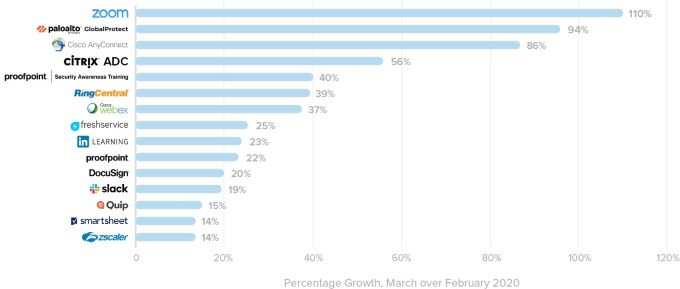
Image Credit: Okta
The biggest winners here beyond collaboration tools were VPN businesses with Palo Alto Networks GlobalProtect and Cisco AnyConnect coming in at 94% and 86% usage increases respectively. But they weren’t the only tools growing, as Okta reported the Citrix ADC load balancing tool and ProofPoint’s security training apps also showed strong gains.
It’s probably not surprising that these kinds of tools are seeing an increase in usage with so many employees working from home, but it is interesting to see which vendors are benefiting from the move.
It’s also worth noting that Okta can point to a clear demarcation date when usage began to tick up. It’s easy to forget now, but March 6th was the last day of “normal” app usage before we started to see usage of these tools start to surge.

Image Credit: Okta
While reports of this kind are somewhat limited because of the focus on a particular set of customers and the tools they use, it does give you a sense of general trends in technology involving 8,000 Okta customers and 6,500 app integrations.

Powered by WPeMatico
Microsoft today announced a slew of updates to various parts of its Microsoft 365 ecosystem. A lot of these aren’t all that exciting (though that obviously depends on your level of enthusiasm for products like Microsoft Endpoint Manager), but the overall thrust behind this update is to make life easier for the IT admins that help provision and manage corporate Windows — and Mac — machines, something that’s even more important right now, given how many companies are trying to quickly adapt to this new work-from-home environment.
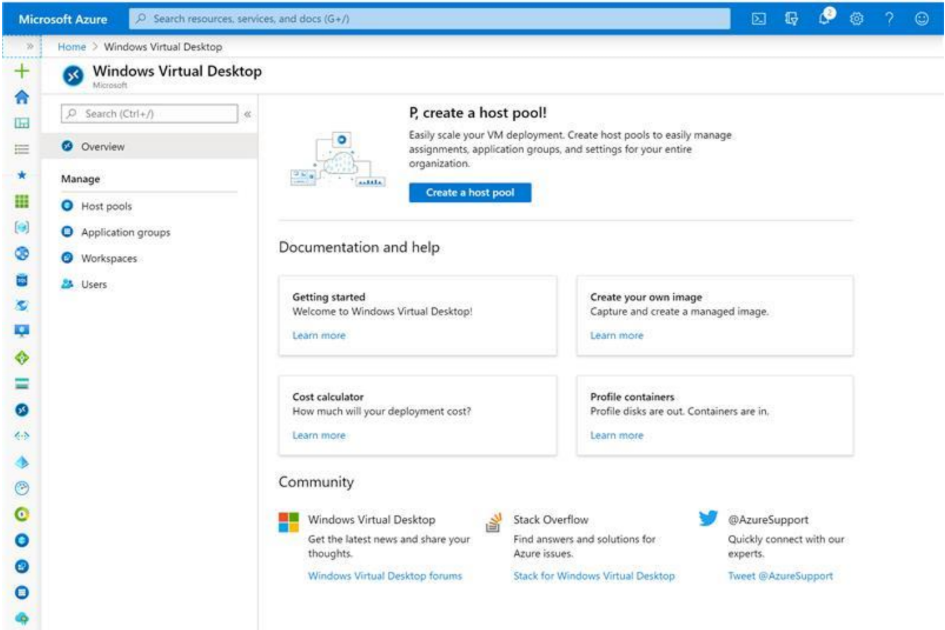
For them, the highlight of today’s set of announcements is surely an update to Windows Virtual Desktop, Microsoft’s service for giving employees access to a virtualized desktop environment on Azure and that allows IT departments to host multiple Windows 10 sessions on the same hardware. The company is launching a completely new management experience for this service that makes getting started significantly easier for admins.
Ahead of today’s announcement, Brad Anderson, Microsoft’s corporate VP for Microsoft 365, told me that it took a considerable amount of Azure expertise to get started with this service. With this update, you still need to know a bit about Azure, but the overall process of getting started is now significantly easier. And that, Anderson noted, is now more important than ever.
“Some organizations are telling me that they’re using on-prem [Virtual Desktop Infrastructure]. They had to go do work to basically free up capacity. In some cases, that means doing away with disaster recovery for some of their services in order to get the capacity,” Anderson said. “In some cases, I hear leaders say it’s going to take until the middle or the end of May to get the additional capacity to spin up the VDI sessions that are needed. In today’s world, that’s just unacceptable. Given what the cloud can do, people need to have the ability to spin up and spin down on demand. And that’s the unique thing that a Windows Virtual Desktop does relative to traditional VDI.”
Anderson also believes that remote work will remain much more common once things go back to normal — whenever that happens and whatever that will look like. “I think the usage of virtualization where you are virtualizing running an app in a data center in the cloud and then virtualizing it down will grow. This will introduce a secular trend and growth of cloud-based VDI,” he said.
In addition to making the management experience easier, Microsoft is now also making it possible to use Microsoft Teams for video meetings in these virtual desktop environments, using a feature called ‘A/V redirection’ that allows users to connect their local audio and video hardware and virtual machines with low latency. It’ll take another month or so for this feature to roll out, though.
Also new is the ability to keep service metadata about Windows Virtual Desktop usage within a certain Azure region for compliance and regulatory reasons.
For those of you interested in Microsoft Endpoint Manager, the big news here is better support for macOS-based machines. Using the new Intune MDM agent for macOS, admins can use the same tool for managing repetitive tasks on Windows 10 and macOS.
Productivity Score — a product only an enterprise manager would love — is also getting an update. You can now see how people in an organization are reading, authoring and collaborating around content in OneDrive and SharePoint, for example. And if they aren’t, you can write a memo and tell them they should collaborate more.
There are also new dashboards here for looking at how employees work across devices and how they communicate. It’s worth noting that this is aggregate data and not another way for corporate to look at what individual employees are doing.
The one feature here that does actually seem really useful, especially given the current situation, is a new Network Connectivity category that helps IT to figure out where there are networking challenges.
Powered by WPeMatico
Atlassian is about as ubiquitous to software engineers as Google is to the rest of us. The Sydney-based company, which launched in 2002, develops tools and services for enterprise collaboration and marched efficiently to a public offering in 2015.
So it goes without saying that we’re thrilled to have Atlassian co-founder and co-CEO Mike Cannon-Brookes join us at Disrupt SF 2020, which runs September 14 to September 16.
As far as entrepreneurship goes, Cannon-Brookes is on a very short list of founders who have led a company from founding to public offering, and all the steps in between.
Atlassian was one of the early players in enterprise collaboration, particularly for engineering and development teams, and has over the years introduced a robust product suite, including Jira, Confluence and HipChat.
Cannon-Brookes has been at the helm for the entire journey, from raising early funding to product development to acquisitions (including Trello) to public offering and beyond. All the while, Cannon-Brookes kept the company’s HQ, and all invoicing, in its home country of Australia, becoming the most successful tech startup to ever launch out of the nation down under.
One of the more interesting features of the company? Unlike Microsoft and IBM and other big enterprise software companies, Atlassian has always operated without a proper sales team, using a fraction of spend on sales and marketing compared to other enterprise software giants.
“We had a hunch early on that salespeople break software companies,” Cannon-Brookes told the Australian Financial Review in 2015. “But convincing people this model would work has probably been the biggest struggle we’ve had. We’ve had a lot of smart people who wouldn’t join the company or give us money or advise us because it made no sense to them.”
The company developed an enormously successful distribution flywheel built on the back of one necessary ingredient: remarkable products. Great products at low prices mean that you can sell to everyone, and if you sell to everyone you have to do it online and with transparent pricing and a great free trial. But if you offer a free trial, you better have a remarkable product, and the flywheel spins on and on.
It has worked.
Atlassian products are used by more than 160,000 large and small organizations across the globe, including Spotify, NASA, Sotheby’s and Visa.
Cannon-Brookes is also a tech investor across sectors like software, fintech, agriculture and energy, with a seat on the board of Zoox.
We’re excited to sit down with Cannon-Brookes and hear more about the company’s trajectory over the last two decades and hear what comes next for the behemoth.
Disrupt SF 2020 runs September 14 to September 16 at the Moscone Center right in the heart of San Francisco. For folks who can’t make it in person, we have several Digital Pass options to be part of the action or to exhibit virtually, which you can check out here.
We’ll be announcing more speakers over the coming weeks, so stay tuned.
(Editor’s Note: We’re watching the developing situation around the novel coronavirus very closely and will adapt as we go. You can find out the latest on our event schedule plans here.)
Powered by WPeMatico
Puppet, the Portland-based infrastructure automation company, today announced that it has named former Cloud Foundry Foundation executive director Abby Kearns as its new CTO.
Current Puppet CTO Deepak Giridharagopal will remain in his role and focus on R&D and leading new projects, while Kearns will focus on expanding the company’s product portfolio and communicating with enterprise audiences.
Kearns stepped down from her role at the Cloud Foundry Foundation earlier this month after holding that position since 2016. At the time, she wasn’t quite ready to reveal her next move, though, and her taking the CTO job at Puppet comes as a bit of a surprise. Despite a lot of usage and hype in its early days, Puppet isn’t often seen as an up-and-coming company anymore, after all. But Kearns argues that a lot of this is due to perception.
“Puppet had great technology and really drove the early DevOps movement, but they kind of fell off the face of the map,” she said. “Nobody thought of them as anything other than config management, and so I was like, well, you know, problem number one: fix that perception problem if that’s no longer the reality or otherwise, everyone thinks you’re dead.”
Since Kearns had already started talking to Puppet CEO Yvonne Wassenaar, who took the job in January 2019, she joined the product advisory board about a year ago and the discussion about Kearns joining the company became serious a few months later.
“We started talking earlier this year,” said Kearns. “She said: ‘You know, wouldn’t it be great if you could come help us? I’m building out a brand new executive team. We’re really trying to reshape the company.’ And I got really excited about the team that she built. She’s got a really fantastic new leadership team, all of them are there for less than a year. they have a new CRO, new CMO. She’s really assembled a fantastic team of people that are super smart, but also really thoughtful people.”
Kearns argues that Puppet’s product has really changed, but that the company didn’t really talk about it enough, despite the fact that 80% of the Global 5,000 are customers.
Given the COVID-19 pandemic, Kearns has obviously not been able to meet the Puppet team yet, but she told me that she’s starting to dig deeper into the company’s product portfolio and put together a strategy. “There’s just such an immensely talented team here. And I realize every startup tells you that, but really, there’s actually a lot of talented people here that are really nice. And I guess maybe it’s the Portland in them, but everyone’s nice,” she said.
“Abby is keenly aware of Puppet’s mission, having served on our Product Advisory Board for the last year, and is a technologist at heart,” said Wassenaar. “She brings a great balance to this position for us – she has deep experience in the enterprise and understands how to solve problems at massive scale.”
In addition to Kearns, former Cloud Foundry Foundation VP of marketing Devin Davis also joined Puppet as the company’s VP of corporate marketing and communications.
Update: we updated the post to clarify that Deepak Giridharagopal will remain in his role.
Powered by WPeMatico

Google today announced that it is making Meet, its video meeting tool for businesses that directly competes with the likes of Zoom, available for free to everyone. Until now, you could participate in a Meet call without being a paying user, but you needed a paid G Suite account to start calls.
You won’t be able to schedule free Meet calls right away, though. Google is opening up access to Meet to free users gradually, starting next week. It may take a few weeks before everybody has access to it.
After September, free accounts will be limited to meetings that don’t run longer than 60 minutes, but until then, you can chat for as long as you want. The only other real limit is that meetings can’t have more than 100 participants. You still get screen sharing, real-time captions and the new tiled layout the company introduced only a few days ago.

Users will need a Google account to participate in meetings, though, which isn’t likely to be a major barrier for most people, but it does add more friction than simply clicking on a Zoom link.
Google argues that in return, you get a safer platform, not just because it’s hard to guess meeting codes for Meet (which makes “Meet-bombing” a non-starter), but also because Meet runs in the browser and is hence less vulnerable to security threats.
“With COVID, video conferencing is really becoming an essential service and we have seen video conferencing usage really go up,” Smita Hashim, the Director of Product Management at Google Cloud, told me. Because the need for these tools continues to increase, Google decided to bring Meet to individual users now, though Hashim noted that some of this had been on the company’s roadmap before.
“We are accelerating what we are doing, given the crisis and given the need for video conferencing at this point,” she said. “We still have the Google Hangouts product but Google Meet availability we are accelerating. This is a newer product designed to scale to many more participants and that has features like closed captioning and those kinds of things.”
So for the time being, Hangouts for consumers and also Google Duo aren’t going away. But at least for consumer Hangouts, which has been on life support for a long time, this move may accelerate its deprecation.
Clearly, Google saw that Zoom caught on among consumers and that Microsoft announced plans for a consumer edition of Teams. Without a free and easily accessible version of Meet, Google wasn’t able to fully capitalize on what has become a breakout time for video conferencing tools, so it makes sense for the company to make a push to get this new edition out of the door as fast as possible.

“From a leadership perspective, the message was really: how can Google be more and more helpful,” Hashim said when I asked her what the discussion about this move was like inside the company. “That was the direction we got. So from our side, video conferencing is the product which is really hugely accelerated usage and Google Meet in particular. So that’s why we first launched the advanced features, then we did the safety controls and then we said, ‘okay, let’s accelerate some of these other features,’ but we kept seeing that need, so it felt like a very natural next step for us to take and make it available to all our users.”
In addition to free access to Google Meet for everyone, Google is also launching a new edition of G Suite, dubbed G Suite Essentials. This new edition, which is meant for small teams and includes access to Google Drive, Docs, Sheet, Slides and, of course, Meet, will be available for free until September 30. After that, Google will start charging, but as Hashim told me, the company hasn’t decided on pricing yet.
For enterprise users, Google is also adding a few perks through September 30. These include free access to advanced Meet features for all G Suite customers, including the ability to live stream to up to 100,000 viewers within their domains, as well as free additional Meet licenses without the need for an amended contract, and free G Suite Essentials for enterprise customers.
Google also used today’s announcement to share a few new stats around Meet. As of last week, Meet’s daily meeting participants surpassed 100 million, for example, and with that, Meet now plays host to 3 billion minutes of video meetings. Daily peak usage is up 30x since January. That’s a lot of time spent in meetings.
Powered by WPeMatico
Rapid7 announced today after the closing bell that it will be acquiring DivvyCloud, a cloud security and governance startup, for $145 million in cash and stock.
With Divvy, the company moves more deeply into the cloud, something that Lee Weiner, chief innovation officer, says the company has been working toward, even before the pandemic pushed that agenda.
Like any company looking at expanding its offering, it balanced building versus buying and decided that buying was the better way to go. “DivvyCloud has a fantastic platform that really allows companies the freedom to innovate as they move to the cloud in a way that manages their compliance and security,” Weiner told TechCrunch.
CEO Corey Thomas says it’s not possible to make a deal right now without looking at the economic conditions due to the pandemic, but he says this was a move they felt comfortable making.
“You have to actually think about everything that’s going on in the world. I think we’re in a fortunate position in that we have had the benefit of both growing in the past couple years but also getting the business more efficient,” Thomas said.
He said that this acquisition fits in perfectly with what he’s been hearing from customers about what they need right now. “One area of new projects that is actually going forward is how people are trying to figure out how to digitize their operations in a world where they aren’t sure how soon employees will be able to congregate and work together. And so from that context, focusing on the cloud and supporting our customers’ journey to the cloud has become an even more important priority for the organization,” he said.
Brian Johnson, CEO and co-founder at DivvyCloud, says that is precisely what his company offers, and why it should fit in well with the Rapid7 family. “We help customers achieve rapid innovation in the cloud while ensuring they remain secure, well governed and compliant,” he said. That takes a different playbook than when customers were on prem, particularly requiring automation and real-time remediation.
With DivvyCloud, Rapid 7 is getting a 7-year-old company with 70 employees and 54 customers. It raised $27.5 million on an $80 million post-money valuation, according to PitchBook data. All of the employees will become part of the Rapid7 organization when the deal closes, which is expected to happen some time this quarter.
The companies say that as they come together, they will continue to support existing Divvy customers, while working to integrate it more deeply into the Rapid7 platform.
Powered by WPeMatico
The world has been turned upside down the past few weeks, but one lesson of business remains as important as ever: treating your customers well is the best avenue to future business strength, particularly at a moment of extreme stress.
As businesses come to terms with the economic crisis underway, executives are moving resources from customer acquisition to customer retention — and that’s proving very lucrative to startups that service the customer success market.
Case in point: New York City-based Catalyst, which I profiled just last summer following its $15 million Series A led by Accel’s Vas Natarajan, has seen huge revenue growth the past few months. The data-driven customer success platform has seen its revenue grow by 380% since the Series A financing according to CEO Edward Chiu.
Steep revenue growth is (unsurprisingly) attractive to investors, and in a moment of fortuitous timing, the company signed a $25 million Series B term sheet with Spark Capital just as the COVID-19 crisis was getting underway.
Chiu said Catalyst wasn’t seeking the investment, having much of its Accel round still in the bank, but he ultimately decided that having the extra capital in hand through a looming economic recession was the right decision. The capital officially hit the bank account at the end of March, and was led by the firm’s growth investor Will Reed.
While the company didn’t disclose the valuation, a source with knowledge of the matter quoted a valuation of $125 million. That’s a serious valuation for a company that launched just two years ago in April of 2018.
Outside of more funding, the core story of the company’s product remains the same. Catalyst wants to bring together all the data sources and team members who interact with customers — everyone from designers and engineers to customer success managers — into one dashboard to ensure that everyone has accurate and up-to-date access to all the information they need on the health of every customer.
The one airbrush: the company’s previous URL of getcatalyst.io has become catalyst.io, and officially re-launched this morning.
One growth area that the company is exploring outside of the B2B space of its existing customers is in healthcare, where the company has seen some inbound interest. Chiu says that Catalyst is exploring the steps required to reach HIPAA compliance with its platform, and hopes to expand to more sectors over time with the capital from its Series B.

The Catalyst team. Photo via Catalyst.
When we last checked in with the company, Catalyst had 19 employees and was targeting 40 employees by July 2020. Chiu said that Catalyst is already at 35 employees, and will likely hit 60 to 70 employees by the end of the year.
Powered by WPeMatico
With the company growing in leaps and bounds, Zoom went shopping for a cloud infrastructure vendor to help it with its growing scale problem. In a surprising choice, the company went with Oracle Cloud Infrastructure.
Zoom has become the go-to video conferencing service as much of the world has shut down due to the pandemic, and life needs to go on somehow. It has gone on via video conferencing with Zoom growing from 200 million active users in February to 300 million in March. That kind of growth puts a wee bit of pressure on your infrastructure, and Zoom clearly needed to beef up its game.
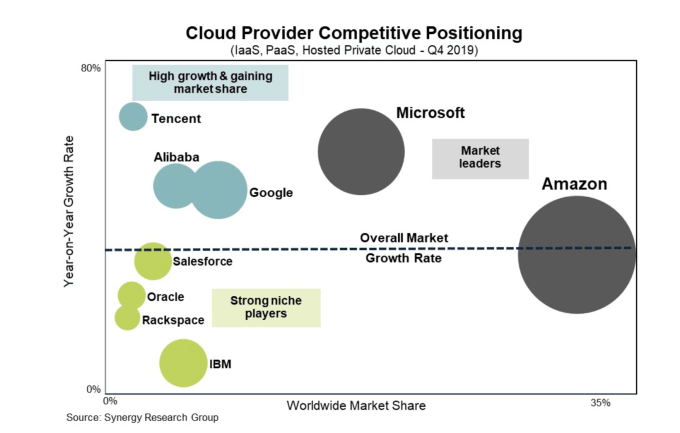
What’s surprising is that it chose Oracle, a company whose infrastructure market share registers as a strong niche player in Synergy Research’s latest survey in February. It is well behind market leaders including Amazon, Microsoft, Google, and even IBM (and that’s saying something).
Brent Leary, who is founder at CRM Essentials, says he sees this as a move to show that Zoom can move beyond the SMB market to power enterprise customers, no matter what they demand.
“I think Zoom went with Oracle because they are proven in the enterprise in terms of mission critical apps built on Oracle databases running on Oracle hardware in the cloud. Zoom needs to prove to enterprises that they are able to handle scale and data security needed to beyond what SMBs typically require,” Leary told TechCrunch.
In addition, Leary speculated that Oracle might have given Zoom a good deal to get a hot company into the fold and beat rivals like Amazon and Microsoft.
It’s worth noting that CNBC reported a couple of weeks ago that Oracle chairman Larry Ellison called Zoom an “essential service” for his business, as well as others. It certainly seems in hindsight that was hardly a coincidence, as he was praising up his new prize customer.
Others have speculated that it might have to do with keeping business away from a potential rival given that Amazon with Chime, Google with Hangouts and Microsoft with Teams all have competing products. However, none of them have become synonymous with online meetings as Zoom has during this crisis.
Zoom went public last year and has become the darling of the video conference market since in spite of a set of security issues that have developed as the company scaled, which they have been working to address.
The stock market is apparently not impressed with the choice. As we went to publish, the stock was down 3.38% or $5.56.
Powered by WPeMatico
Celonis has made its name as a process discovery company, helping companies understand the way work flows through its systems to expose inefficiencies, but up until now the company has left it to others to solve those problems. Today it announced the first products that help companies improve those workflows automatically.
Alexander Rinke, founder and CEO at Celonis, says customers have been asking the company to go beyond process discovery to something that really helps solve the problems and bottlenecks they were finding.
“Where customers were really pushing us is to take the company from a software that’s showing you all the insights around your business processes, where the friction points are, where things aren’t going as they should be going…” he told TechCrunch.
To that end, the company acquired Banyas last year to give it a way to connect to internal ERP systems more easily, as they were thinking about how to create some process improvement automation apps. The Banyas acquisition gave the company some tools to start thinking about this more deeply.
“We put all of this together — the intelligence, the action, the automation and we solve business goals for certain departments,” Rinke said.
For starters, that involves supply chain and finance, but there are plans for building even more applications this year and beyond. The way it works for starters, is it connects to the company’s transactions systems, whether that’s SAP or Oracle or something similar. This is where the Banyas acquisition really comes into play,
“You can basically put these applications on top of your transaction systems and tell them which business goals you have — like I want to preserve cash or I want to pay on time — and then we analyze the enterprise’s entire processes towards these business goals, and then drive everything, automate things towards these business goals intelligently,” he said.
In addition to the two apps, the company is also announcing that it’s making the platform that the engineering team used to build these apps more broadly available to allow third parties to build their own apps on top of Celonis, and then they will be able to share them in an app marketplace.
If you’re thinking this is moving Celonis into Robotic Process Automation (RPA), Rinke disagrees As he sees it, RPA is about automating all-computer processes. He says the Celonis solutions often have human stopping points in a process, and he sees that as a big difference.
Celonis was founded in 2011 and has raised more than $367 million, according to Crunchbase data. Rinke reports the company has more than 1000 employees now.
Powered by WPeMatico