Enterprise
Auto Added by WPeMatico
Auto Added by WPeMatico
Michael Ovitz didn’t invent the idea of a talent agency, but one might argue that he perfected it. He founded the CAA in 1975, and grew it into the world’s leading talent agency, serving as chairman for 20 years. Now, Ovitz is investing in a brand new type of talent agency called Human Capital.
Human Capital is a hybrid organization, one part VC fund, one part recruiting business and one part creative agency. (Human Capital did not invest in its agency startup from its VC fund.) The Human Capital VC fund has $210 million in assets under management.
The Human Capital recruitment/agency company, founded by former General Catalyst associate Armaan Ali and Stanford grad Baris Akis, looks to provide for tech engineers the same services that Ovitz provided to actors and creatives back in the 70s, 80s and 90s. Engineers are some of the most sought-after talent in Silicon Valley and across the globe. And while big corporations and high-growth startups duke it out over these young engineers, the candidates themselves have little to no guidance around where they should go, what they should expect during the process, and, in some cases, what they should expect to earn.
Ovitz — alongside Qasar Younis, founder of Applied Intuition and former partner and COO of YC; Adam Zoia, founder and chairman of Glocap; Stephen Ehikian, co-founder and CEO of Airkit; and other financial institutions and LPs — recently injected $15 million into Human Capital, which is valued in the hundreds of millions according to the company.
Human Capital looks to pair the brightest engineers with the right company for them, while giving startups a new way to approach recruitment. Thus far, the company has 5,000 members (engineers) and has placed them at startups like Brex, Grammarly, Robinhood and more.
Human Capital starts by doing outreach on university campuses with outstanding engineering programs, setting up coffee with engineers who have been recommended or referred by alumni of the program. Once accepted as a member, the engineer explains to Human Capital what type of role they’re interested in, whether it’s at a big corporation, a high-growth startup or an early-stage company where they have the opportunity to build something from scratch.
The recruitment team at Human Capital then coaches the engineer through the interview process and beyond, helping with decision-making around promotions, understanding equity and negotiating new offers.
The org never charges the engineer, but rather takes a commission on the engineer’s annual income for the first year from the startup that recruited them.
Ali explained to TechCrunch how Human Capital is operating during the coronavirus pandemic, describing a situation in which the top talent that is in the market right now has a level of uncertainty about the future, leading them to seek positions at huge companies like Facebook and Google.
“Our hypothesis when we started this was that there are amazing businesses that are being run better at an earlier stage and have a proxy for that same type of stability [at a Google or Facebook] via their access to capital, alongside other foundational pieces of business security, such as their business model, unit economics, long-term vision for the company, gross margin rate, and growth opportunities for individuals at those companies.”
He said that Human Capital believed that, if a macro event occurred in the market place — we’re right in the middle of one of the least predictable and most impactful macro economic events ever — some of those “stable” earlier-stage businesses wouldn’t be hit in the same way as public companies who have to worry about short-term profitability.
“The issue is that you have to know a lot about those businesses in order to be able to discern that, and that’s our job,” said Ali. “And what we’ve seen is that a number of the companies in that position are actually ramping up recruiting right now.”
There is no mandatory link between Human Capital’s venture capital fund and their recruiting/agency entity, though the fund does like to invest in engineers who have gone through the program and move on to start their own businesses. Those types of investments include Brex, Bolt and Qualia, among others. Human Capital also invests in companies for whom they’ve recruited, such as Livongo, Snowflake, Clumio, Wildlife and Trackonomy. Human Capital has a preference for leading rounds only for companies that are started by its engineer members.
The model isn’t unlike SignalFire or Glocap, founded by Adam Zoia (investor in Human Capital). The idea is that VC funds are great for capital injections, but with the cut-throat recruiting atmosphere and a finite number of engineers, that money can be relatively useless if it can’t be used to bring on the best talent. So firms like SignalFire (in the tech world) and Glocap (in the business/finance world) put recruitment front and center in their value proposition. (Glocap doesn’t invest, but is the premier recruitment platform in the financial sector.)
Human Capital is also starting to look at potential acquisitions that can beef up its agency business, recently acqui-hiring Khonvo Corporation, a recruitment agency founded by Archit Bhise and Andrew Rising.
Ovitz explained to TechCrunch that his ultra-successful career as an agent stemmed from his ability to make decisions about people and projects quickly. He sees the same type of intuition in Ali and Akis at a much younger age and with less experience than he had.
“It’s a checklist in your head,” said Ovitz. “It’s a combination of when your brain meets your stomach, your intellect meets your gut that lets you know you’ve hit a winner. The thing that’s allowed Ali and Akis to build a company that’s worth the hundreds of millions in such a short period of time is that they had that when I met them without having an enormous amount of experience.”
He added that access to the internet, which he did not have during his agency days, is an amazing learning tool and an “epic crutch” that, when paired with good instincts, can accelerate the learning curve on building a business.
(It’s worth noting that this isn’t Ovitz’s first foray into Silicon Valley. The entertainment powerhouse was one of the earliest advisors to Marc Andreessen and Ben Horowitz during the formation of the legendary VC firm a16z, helping them model the firm after CAA itself. Ovitz has been quietly investing in and advising tech startups for the past 15 years.)
Powered by WPeMatico
As companies increasingly look to find ways to cut costs, Granulate, an early-stage Israeli startup, has come up with a clever way to optimize infrastructure usage. Today it was rewarded with a tidy $12 million Series A investment.
Insight Partners led the round with participation from TLV Partners and Hetz Ventures. Lonne Jaffe, managing director at Insight Partners, will be joining the Granulate board under the terms of the agreement. Today’s investment brings the total raised to $15.6 million, according to the company.
The startup claims it can cut infrastructure costs, whether on-prem or in the cloud, from between 20% and 80%. This is not insignificant if they can pull this off, especially in the economic maelstrom in which we find ourselves.
Asaf Ezra, co-founder and CEO at Granulate, says the company achieved the efficiency through a lot of studying about how Linux virtual machines work. Over six months of experimentation, they simply moved the bottleneck around until they learned how to take advantage of the way the Linux kernel operates to gain massive efficiencies.
It turns out that Linux has been optimized for resource fairness, but Granulate’s founders wanted to flip this idea on its head and look for repetitiveness, concentrating on one function instead of fair allocation across many functions, some of which might not really need access at any given moment.
“When it comes to production systems, you have a lot of repetitiveness in the machine, and you basically want it to do one thing really well,” he said.
He points out that it doesn’t even have to be a VM. It could also be a container or a pod in Kubernetes. The important thing to remember is that you no longer care about the interactivity and fairness inherent in Linux; instead, you want that the machine to be optimized for certain things.
“You let us know what your utility function for that production system is, then our agents. basically optimize all the decision making for that utility function. That means that you don’t even have to do any code changes to gain the benefit,” Ezra explained.
What’s more, the solution uses machine learning to help understand how the different utility functions work to provide greater optimization to improve performance even more over time.
Insight’s Jaffe certainly recognized the potential of such a solution, especially right now.
“The need to have high-performance digital experiences and lower infrastructure costs has never been more important, and Granulate has a highly differentiated offering powered by machine learning that’s not dependent on configuration management or cloud resource purchasing solutions,” Jaffe said in a statement.
Ezra understands that a product like his could be particularly helpful at the moment. “We’re in a unique position. Our offering right now helps organizations survive the downturn by saving costs without firing people,” he said.
The company was founded in 2018 and currently has 20 employees. They plan to double that by the end of 2020.
Powered by WPeMatico
M&A has largely slowed down in the current market, but there remain pockets of activity when the timing and price are right. Today, Medallia — a customer experience platform that scans online reviews, social media, and other sources to provide better insights into what a company is doing right and wrong and what needs to get addressed — announced that it would acquire Voci Technologies, a speech-to-text startup, for $59 million in cash.
Medallia plans to integrate the startup’s AI technology so that voice-based interactions — for example from calls into call centers — can be part of the data crunched by its analytics platform. Despite the rise of social media, messaging channels, and (currently) a shift for people to do a lot more online, voice still accounts for the majority of customer interactions for a business, so this is an important area for Medallia to tackle.
“Voci transcribes 100% of live and recorded calls into text that can be analyzed quickly to determine customer satisfaction, adding a powerful set of signals to the Medallia Experience Cloud,” said Leslie Stretch, president and CEO of Medallia, in a statement. “At the same time, Voci enables call analysis moments after each interaction has completed, optimizing every aspect of call center operations securely. Especially important as virtual and remote contact center operations take shape.”
While there are a lot of speech-to-text offerings in the market today, the key with Voci is that it is able to discern a number of other details in the call, including emotion, gender, sentiment, and voice biometric identity. It’s also able to filter out personal identifiable information to ensure more privacy around using the data for further analytics.
Voci started life as a spinout from Carnegie Mellon University (its three founders were all PhDs from the school), and it had raised a total of about $18 million from investors that included Grotech Ventures, Harbert Growth Parnters, and the university itself. It was last valued at $28 million in March 2018 (during a Series B raise), meaning that today’s acquisition was slightly more than double that value.
The company seems to have been on an upswing with its business. Voci has to date processed some 2 billion minutes of speech, and in January, the company published some momentum numbers that said bookings had grown some 63% in the last quarter, boosted by contact center customers.
In addition to contact centers, the company catered to companies in finance, healthcare, insurance and others areas of business process outsourcing, although it does not disclose names. As with all companies and organizations that have products that cater to offering services remotely, Voci has seen stronger demand for its business in recent weeks, at a time when many have curtailed physical contact due to COVID-19-related movement restrictions.
“Our whole company is delighted to be joining forces with experience management leader Medallia. We are thrilled that Voci’s powerful speech to text capabilities will become part of Medallia Experience Cloud,” said Mike Coney, CEO of Voci, in a statement. “The consolidation of all contact center signals with video, survey and other critical feedback is a game changer for the industry.”
It’s not clear whether Voci had been trying to raise money in the last few months, or if this was a proactive approach from Medallia. But more generally, M&A has found itself in a particularly key position in the world of tech: startups are finding it more challenging right now to raise money, and one big question has been whether that will lead to more hail-mary-style M&A plays, as one route for promising businesses and technologies to avoid shutting down altogether.
For its part, Medallia, which went public in July 2019 after raising money from the likes of Sequoia, has seen its stock hit like the rest of the market in recent weeks. Its current market cap is at around $2.8 billion, just $400 million more than its last private valuation.
The deal is expected to close in May 2020, Medallia said.
Powered by WPeMatico
As we get further along in the new way of working, the new normal if you will, finding more efficient ways to do just about everything is becoming paramount for companies looking at buying new software services. To that end, Comet.ml announced a $4.5 million investment today as it tries to build a more efficient machine learning platform.
The money came from existing investors Trilogy Equity Partners, Two Sigma Ventures and Founder’s Co-op. Today’s investment comes on top of an earlier $2.3 million seed.
“We provide a self-hosted and cloud-based meta machine learning platform, and we work with data science AI engineering teams to manage their work to try and explain and optimize their experiments and models,” company co-founder and CEO Gideon Mendels told TechCrunch.
In a growing field with lots of competitors, Mendels says his company’s ability to move easily between platforms is a key differentiator.
“We’re essentially infrastructure agnostic, so we work whether you’re training your models on your laptop, your private cluster or on many of the cloud providers. It doesn’t actually matter, and you can switch between them,” he explained.
The company has 10,000 users on its platform across a community product and a more advanced enterprise product that includes customers like Boeing, Google and Uber.
Mendels says Comet has been able to take advantage of the platform’s popularity to build models based on data customers have made publicly available. The first one involves predicting when a model begins to show training fatigue. The Comet model can see when this happening and signal data scientists to shut the model down 30% faster than this kind of fatigue would normally surface.
The company launched in Seattle at TechStars/Alexa in 2017. The community product debuted in 2018.
Powered by WPeMatico
Philadelphia-based Fishtown Analytics, the company behind the popular open-source data engineering tool dbt, today announced that it has raised a $12.9 million Series A round led by Andreessen Horowitz, with the firm’s general partner Martin Casado joining the company’s board.
“I wrote this blog post in early 2016, essentially saying that analysts needed to work in a fundamentally different way,” Fishtown founder and CEO Tristan Handy told me, when I asked him about how the product came to be. “They needed to work in a way that much more closely mirrored the way the software engineers work and software engineers have been figuring this shit out for years and data analysts are still like sending each other Microsoft Excel docs over email.”
The dbt open-source project forms the basis of this. It allows anyone who can write SQL queries to transform data and then load it into their preferred analytics tools. As such, it sits in-between data warehouses and the tools that load data into them on one end, and specialized analytics tools on the other.
As Casado noted when I talked to him about the investment, data warehouses have now made it affordable for businesses to store all of their data before it is transformed. So what was traditionally “extract, transform, load” (ETL) has now become “extract, load, transform” (ELT). Andreessen Horowitz is already invested in Fivetran, which helps businesses move their data into their warehouses, so it makes sense for the firm to also tackle the other side of this business.
“Dbt is, as far as we can tell, the leading community for transformation and it’s a company we’ve been tracking for at least a year,” Casado said. He also argued that data analysts — unlike data scientists — are not really catered to as a group.
Before this round, Fishtown hadn’t raised a lot of money, even though it has been around for a few years now, except for a small SAFE round from Amplify.
But Handy argued that the company needed this time to prove that it was on to something and build a community. That community now consists of more than 1,700 companies that use the dbt project in some form and over 5,000 people in the dbt Slack community. Fishtown also now has over 250 dbt Cloud customers and the company signed up a number of big enterprise clients earlier this year. With that, the company needed to raise money to expand and also better service its current list of customers.
“We live in Philadelphia. The cost of living is low here and none of us really care to make a quadro-billion dollars, but we do want to answer the question of how do we best serve the community,” Handy said. “And for the first time, in the early part of the year, we were like, holy shit, we can’t keep up with all of the stuff that people need from us.”
The company plans to expand the team from 25 to 50 employees in 2020 and with those, the team plans to improve and expand the product, especially its IDE for data analysts, which Handy admitted could use a bit more polish.
Powered by WPeMatico
For the past month, VC investment pace seems to have slacked off in the U.S., but deal activities in China are picking up following a slowdown prompted by the COVID-19 outbreak.
According to PitchBook, “Chinese firms recorded 66 venture capital deals for the week ended March 28, the most of any week in 2020 and just below figures from the same time last year,” (although 2019 was a slow year). There is a natural lag between when deals are made and when they are announced, but still, there are some interesting trends that I couldn’t help noticing.
While many U.S.-based VCs haven’t had a chance to focus on new deals, recent investment trends coming out of China may indicate which shifts might persist after the crisis and what it could mean for the U.S. investor community.

Image Credits: PitchBook
Powered by WPeMatico
Seattle-based Pulumi has quickly made a name for itself as a modern platform that lets developers specify their infrastructure through writing code in their preferred programming language — and not YAML. With the launch of Pulumi 2.0, those languages now include JavaScript, TypeScript, Go and .NET, in addition to its original support for Python. It’s also now extending its reach beyond its core infrastructure features to include deeper support for policy enforcement, testing and more.
As the company also today announced, it now has over 10,000 users and more than 100 paying customers. With that, it’s seeing a 10x increase in its year-over-year annual run rate, though without knowing the exact numbers, it’s obviously hard to know what exactly to make of that number. Current customers include the likes of Cockroach Labs, Mercedes-Benz and Tableau .
When the company first launched, its messaging was very much around containers and serverless. But as Pulumi founder and CEO Joe Duffy told me, today the company is often directly engaging with infrastructure teams that are building the platforms for the engineers in their respective companies.
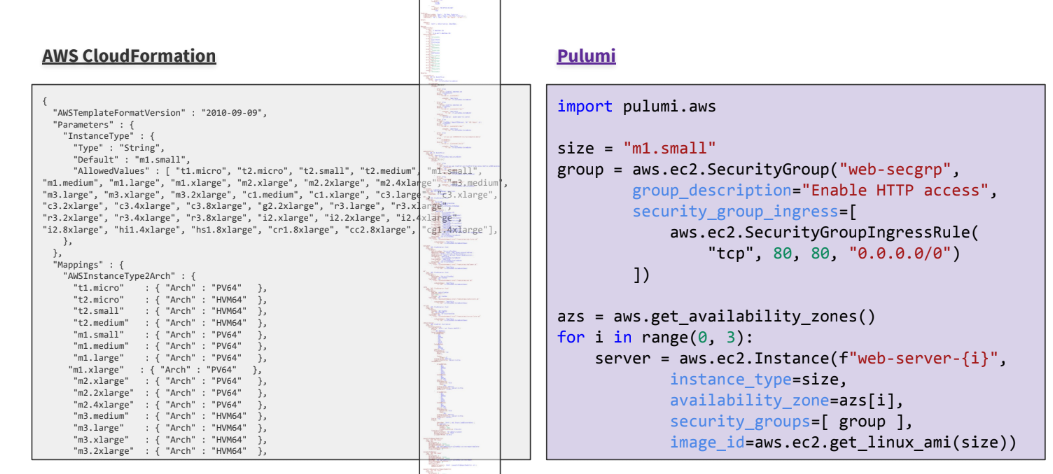
As for Pulumi 2.0, Duffy says that “this is really taking the original Pulumi vision of infrastructure as code — using your favorite language — and augmenting it with what we’re calling superpowers.” That includes expanding the product’s overall capabilities from infrastructure provisioning to the adjacent problem spaces. That includes continuous delivery, but also policy-as-code. This extends the original Pulumi vision beyond just infrastructure but now also lets developers encapsulate their various infrastructure policies as code, as well.
Another area is testing. Because Pulumi allows developers to use “real” programming languages, they can also use the same testing techniques they are used to from the application development world to test the code they use to build their underlying infrastructure and catch mistakes before they go into production. And with all of that, developers can also use all of the usual tools they use to write code for defining the infrastructure that this code will then run on.
“The underlying philosophy is taking our heritage of using the best of what we know and love about programming languages — and really applying that to the entire spectrum of challenges people face when it comes to cloud infrastructure, from development to infrastructure teams to security engineers, really helping the entire organization be more productive working together,” said Duffy. “I think that’s the key: moving from infrastructure provisioning to something that works for the whole organization.”
Duffy also highlighted that many of the company’s larger enterprise users are relying on Pulumi to encode their own internal architectures as code and then roll them out across the company.
“We still embrace what makes each of the clouds special. AWS, Azure, Google Cloud and Kubernetes,” Duffy said. “We’re not trying to be a PaaS that abstracts over all. We’re just helping to be the consistent workflow across the entire team to help people adopt the modern approaches.”
Powered by WPeMatico
AWS and Facebook today announced two new open-source projects around PyTorch, the popular open-source machine learning framework. The first of these is TorchServe, a model-serving framework for PyTorch that will make it easier for developers to put their models into production. The other is TorchElastic, a library that makes it easier for developers to build fault-tolerant training jobs on Kubernetes clusters, including AWS’s EC2 spot instances and Elastic Kubernetes Service.
In many ways, the two companies are taking what they have learned from running their own machine learning systems at scale and are putting this into the project. For AWS, that’s mostly SageMaker, the company’s machine learning platform, but as Bratin Saha, AWS VP and GM for Machine Learning Services, told me, the work on PyTorch was mostly motivated by requests from the community. And while there are obviously other model servers like TensorFlow Serving and the Multi Model Server available today, Saha argues that it would be hard to optimize those for PyTorch.
“If we tried to take some other model server, we would not be able to quote optimize it as much, as well as create it within the nuances of how PyTorch developers like to see this,” he said. AWS has lots of experience in running its own model servers for SageMaker that can handle multiple frameworks, but the community was asking for a model server that was tailored toward how they work. That also meant adapting the server’s API to what PyTorch developers expect from their framework of choice, for example.
As Saha told me, the server that AWS and Facebook are now launching as open source is similar to what AWS is using internally. “It’s quite close,” he said. “We actually started with what we had internally for one of our model servers and then put it out to the community, worked closely with Facebook, to iterate and get feedback — and then modified it so it’s quite close.”
Bill Jia, Facebook’s VP of AI Infrastructure, also told me, he’s very happy about how his team and the community has pushed PyTorch forward in recent years. “If you look at the entire industry community — a large number of researchers and enterprise users are using AWS,” he said. “And then we figured out if we can collaborate with AWS and push PyTorch together, then Facebook and AWS can get a lot of benefits, but more so, all the users can get a lot of benefits from PyTorch. That’s our reason for why we wanted to collaborate with AWS.”
As for TorchElastic, the focus here is on allowing developers to create training systems that can work on large distributed Kubernetes clusters where you might want to use cheaper spot instances. Those are preemptible, though, so your system has to be able to handle that, while traditionally, machine learning training frameworks often expect a system where the number of instances stays the same throughout the process. That, too, is something AWS originally built for SageMaker. There, it’s fully managed by AWS, though, so developers never have to think about it. For developers who want more control over their dynamic training systems or to stay very close to the metal, TorchElastic now allows them to recreate this experience on their own Kubernetes clusters.
AWS has a bit of a reputation when it comes to open source and its engagement with the open-source community. In this case, though, it’s nice to see AWS lead the way to bring some of its own work on building model servers, for example, to the PyTorch community. In the machine learning ecosystem, that’s very much expected, and Saha stressed that AWS has long engaged with the community as one of the main contributors to MXNet and through its contributions to projects like Jupyter, TensorFlow and libraries like NumPy.
Powered by WPeMatico
In a surprising move, SAP ended its co-CEO experiment yesterday when the company announced Jennifer Morgan will be exiting stage left on April 30th, leaving Christian Klein as the lone CEO.
The pair took over at the end of last year when Bill McDermott left the company to become CEO at ServiceNow, and it looked like SAP was following Oracle’s model of co-CEOs, which had Safra Catz and Mark Hurd sharing the job for several years before Hurd passed away last year.
SAP indicated that Morgan and the board came to a mutual decision, and that it felt that it would be better moving forward with a single person at the helm. The company made it sound like going with a single CEO was always in the plans, and they were just speeding up the time table, but it feels like it might have been a bit more of a board decision and a bit less Morgan, as these things tend to go.
“More than ever, the current environment requires companies to take swift, determined action which is best supported by a very clear leadership structure. Therefore, the decision to transfer from Co-CEO to sole CEO model was taken earlier than planned to ensure strong, unambiguous steering in times of an unprecedented crisis,” the company wrote in a statement announcing the change.
The move also means that the company is moving away from having a woman at the helm, something that’s unfortunately still rare in tech. Why the company decided to move on from the shared role isn’t clear, beyond using the current economic situation as cover. Neither is it clear why they chose to go with Klein over Morgan, but it seems awfully soon to be making a move like this when the two took over so recently.
Powered by WPeMatico
The pandemic may feel all-encompassing at the moment, but Confluent announced a $250 million Series E today, showing that major investment continues in spite of the dire economic situation at the moment. The company is now valued at $4.5 billion.
Today’s round follows last year’s $125 million Series D. At that point the company was valued at a mere $2.5 billion. Investors obviously see a lot of potential here.
Coatue Management led the round, with help from Altimeter Capital and Franklin Templeton. Existing investors Index Ventures and Sequoia Capital also participated. Today’s investment brings the total raised to $456 million.
The company is based on Apache Kafka, the open-source streaming data project that emerged from LinkedIn in 2011. Confluent launched in 2014 and has gained steam, funding and gaudy valuations along the way.
CEO and co-founder Jay Kreps reports that growth continued last year when sales grew 100% over the previous year. A big part of that is the cloud product the company launched in 2017. It added a free tier last September, which feels pretty prescient right about now.
But the company isn’t making money giving stuff away, so much as attracting users, who can become customers at some point as they make their way through the sales funnel. The beauty of the cloud product is that you can buy by the sip.
The company has big plans for the product this year. Although Kreps was loath to go into detail, he says that there will be a series of changes coming up this year that will add significantly to the product’s capabilities.
“As part of this we’re going to have a major new set of capabilities for our cloud service, and for open-source Kafka, and for our product that we’re going to announce every month for the rest of the year,” Kreps told TechCrunch. These will start rolling out the first week in May.
While he wouldn’t get specific, he says that it relates to the changing nature of cloud infrastructure deployment. “This whole infrastructure area is really evolving as it moves to the cloud. And so it has to become much, much more elastic and scalable as it really changes how it works. And we’re going to have announcements around what we think are the core capabilities of event streaming in the cloud,” he said.
While a round this big with a valuation this high and an institutional investor like Franklin Templeton involved typically means an IPO could be the next step, Kreps was not ready to talk about that, except to say the company does plan to begin behaving in the cadence of a public company with a set of quarterly earnings, just not for public consumption yet.
The company was founded in 2014. It has 1,000 employees and has plans to continue to hire and to expand the product. Kreps sees plenty of opportunity here in spite of the current economics.
“I don’t think you want to just turtle up and hang on to your existing customers and not expand if you’re in a market that’s really growing. What really got this round of investors excited is the fact that we’re onto something that has a huge market, and we want to continue to advance, even in these really weird uncertain times,” he said.
Powered by WPeMatico