Enterprise
Auto Added by WPeMatico
Auto Added by WPeMatico
Cockroach Labs, the NYC enterprise database company, announced an $86.6 million Series D funding round today. The company was in no mood to talk valuations, but was happy to have a big chunk of money to help build on its recent success and ride out the current economic malaise.
Altimeter Capital and Bond co-led the round with participation from Benchmark, GV, Index Ventures, Redpoint Ventures, Sequoia Capital, Tiger Capital and FirstMark Capital. Today’s funding comes on top of a $55 million Series C last August, and brings the total raised to $195 million, according to the company.
Cockroach has a tough job. It’s battling both traditional databases like Oracle and modern ones from the likes of Amazon, but investors see a company with a lot of potential market building an open source, on prem and cloud database product. In particular, the open source product provides a way to attract users and turn some percentage of those into potential customers, an approach investors tend to favor.
CEO and co-founder Spenser Kimball says that the company had been growing fast before the pandemic hit. “I think the biggest change between now and last year has just been our go to market which is seeing pretty explosive growth. By number of customers, we’ve grown by almost 300%,” Kimball told TechCrunch.
He says having that three-pronged approach of open source, cloud an on-prem products has really helped fuel that growth. The company launched the cloud service in 2018, and it has helped expand its market. Whereas the on-prem version was mostly aimed at larger customers, the managed service puts Cockroach in reach of individual developers and teams who might not want to deal with all of the overhead of managing a complex database on their own.
Kimball says it’s really too soon to say what impact the pandemic will have on his business. He recognizes that certain verticals like travel, hospitality and some retail business are probably going to suffer, but other businesses that are accelerating in the crisis could make use of a highly scalable database like CockroachDB.
“Obviously it’s a new world right now. I think there are going to be some losers and some winners, but on balance I think [our] momentum will continue to grow for something that really does represent a best in class solution for businesses, whether they are startups or big enterprises, as they’re trying to figure out how to build for a cloud native future,” Kimball said.
The company intends to keep hiring through this, but is being careful and regularly evaluating what its needs are much more carefully than it might have done prior to this crisis with a much more open mind toward remote work.
Kimball certainly recognizes that it’s not an easy time to be raising this kind of cash, and he is grateful to have the confidence of investors to keep growing his company, come what may.
Powered by WPeMatico
Orca Security, an Israeli cloud security firm that focuses on giving enterprises better visibility into their multi-cloud deployments on AWS, Azure and GCP, today announced that it has raised a $20 million Series A round led by GGV Capital. YL Ventures and Silicon Valley CISO Investments also participated in this round. Together with its seed investment led by YL Ventures, this brings Orca’s total funding to $27 million.
One feature that makes Orca stand out is its ability to quickly provide workload-level visibility without the need for an agent or network scanner. Instead, Orca uses low-level APIs that allow it to gain visibility into what exactly is running in your cloud.
The founders of Orca all have a background as architects and CTOs at other companies, including the likes of Check Point Technologies, as well as the Israeli army’s Unit 8200. As Orca CPO and co-founder Gil Geron told me in a meeting in Tel Aviv earlier this year, the founders were looking for a big enough problem to solve and it quickly became clear that at the core of most security breaches were misconfigurations or the lack of security tools in the right places. “What we deduced is that in too many cases, we have the security tools that can protect us, but we don’t have them in the right place at the right time,” Geron, who previously led a security team at Check Point, said. “And this is because there is this friction between the business’ need to grow and the need to have it secure.”
Orca delivers its solution as a SaaS platform and on top of providing work level visibility into these public clouds, it also offers security tools that can scan for vulnerabilities, malware, misconfigurations, password issues, secret keys in personally identifiable information.
“In a software-driven world that is moving faster than ever before, it’s extremely difficult for security teams to properly discover and protect every cloud asset,” said GGV managing partner Glenn Solomon . “Orca Security’s novel approach provides unparalleled visibility into these assets and brings this power back to the CISO without slowing down engineering.”
Orca Security is barely a year and a half old, but it also counts companies like Flexport, Fiverr, Sisene and Qubole among its customers.
Powered by WPeMatico

At its Think Digital conference, IBM and Red Hat today announced a number of new services that all center around 5G edge and AI. The fact that the company is focusing on these two areas doesn’t come as a surprise, given that both edge and AI are two of the fastest-growing businesses in enterprise computing. Virtually every telecom company is now looking at how to best capitalize on the upcoming 5G rollouts, and most forward-looking enterprises are trying to figure out how to best plan around this for their own needs.
As IBM’s recently minted president Jim Whitehurst told me ahead of today’s announcement, he believes that IBM (in combination with Red Hat) is able to offer enterprises a very differentiated service because, unlike the large hyper clouds, IBM isn’t interested in locking these companies into a homogeneous cloud.
“Where IBM is competitively differentiated, is around how we think about helping clients on a journey to what we call hybrid cloud,” said Whitehurst, who hasn’t done a lot of media interviews since he took the new role, which still includes managing Red Hat. “Honestly, everybody has hybrid clouds. I wish we had a more differentiated term. One of the things that’s different is how we’re talking about how you think about an application portfolio that, by necessity, you’re going to have in multiple ways. If you’re a large enterprise, you probably have a mainframe running a set of transactional workloads that probably are going to stay there for a long time because there’s not a great alternative. And there’s going to be a set of applications you’re going to want to run in a distributed environment that need to access that data — all the way out to you running a factory floor and you want to make sure that the paint sprayer doesn’t have any defects while it’s painting a door.”

BARCELONA, CATALONIA, SPAIN – 2019/02/25: The IBM logo is seen during MWC 2019. (Photo by Paco Freire/SOPA Images/LightRocket via Getty Images)
He argues that IBM, at its core, is all about helping enterprises think about how to best run their workloads software, hardware and services perspective. “Public clouds are phenomenal, but they are exposing a set of services in a homogeneous way to enterprises,” he noted, while he argues that IBM is trying to weave all of these different pieces together.
Later in our discussion, he argued that the large public clouds essentially force enterprises to fit their workloads to those clouds’ service. “The public clouds do extraordinary things and they’re great partners of ours, but their primary business is creating these homogeneous services, at massive volumes, and saying ‘if your workloads fit into this, we can run it better, faster, cheaper etc.’ And they have obviously expanded out. They’ve added services. They are not saying we can put a box on-premise, but you’re still fitting into their model.”
On the news side, IBM is launching new services to automate business planning, budgeting and forecasting, for example, as well as new AI-driven tools for building and running automation apps that can handle routine tasks either autonomously or with the help of a human counterpart. The company is also launching new tools for call-center automation.
The most important AI announcement is surely Watson AIOps, though, which is meant to help enterprises detect, diagnose and respond to IT anomalies in order to reduce the effects of incidents and outages for a company.
On the telco side, IBM is launching new tools like the Edge Application Manager, for example, to make it easier to enable AI, analytics and IoT workloads on the edge, powered by IBM’s open-source Open Horizon edge computing project. The company is also launching a new Telco Network Cloud manager built on top of Red Hat OpenShift and the ability to also leverage the Red Hat OpenStack Platform (which remains to be an important platform for telcos and represents a growing business for IBM/Red Hat). In addition, IBM is launching a new dedicated IBM Services team for edge computing and telco cloud to help these customers build out their 5G and edge-enabled solutions.
Telcos are also betting big on a lot of different open-source technologies that often form the core of their 5G and edge deployments. Red Hat was already a major player in this space, but the acquisition has only accelerated this, Whitehurst argued. “Since the acquisition […] telcos have a lot more confidence in IBM’s capabilities to serve them long term and be able to serve them in mission-critical context. But importantly, IBM also has the capability to actually make it real now.”
A lot of the new telco edge and hybrid cloud deployments, he also noted, are built on Red Hat technologies but built by IBM, and neither IBM nor Red Hat could have really brought these to fruition in the same way. Red Hat never had the size, breadth and skills to pull off some of these projects, Whitehurst argued.
Whitehurst also argued that part of the Red Hat DNA that he’s bringing to the table now is helping IBM to think more in terms of ecosystems. “The DNA that I think matters a lot that Red Hat brings to the table with IBM — and I think IBM is adopting and we’re running with it — is the importance of ecosystems,” he said. “All of Red Hat’s software is open source. And so really, what you’re bringing to the table is ecosystems.”
It’s maybe no surprise then that the telco initiatives are backed by partners like Cisco, Dell Technologies, Juniper, Intel, Nvidia, Samsung, Packet, Equinix, Hazelcast, Sysdig, Turbonomics, Portworx, Humio, Indra Minsait, EuroTech, Arrow, ADLINK, Acromove, Geniatech, SmartCone, CloudHedge, Altiostar, Metaswitch, F5 Networks and ADVA.
In many ways, Red Hat pioneered the open-source business model and Whitehurst argued that having Red Hat as part of the IBM family means it’s now easier for the company to make the decision to invest even more in open source. “As we accelerate into this hybrid cloud world, we’re going to do our best to leverage open-source technologies to make them real,” he added.
Powered by WPeMatico
During this period of shelter-in-place, people have had to seek out new forms of entertainment and social interaction. Many have turned to a niche party series made by a company best known for an irreverent trivia game in the ’90s called “You Don’t Know Jack.”
Since 2014, the annual release of the Jackbox Party Pack has delivered 4-5 casual party games that run on desktop, mobile and consoles that can be played in groups as small as two and as large as 10. In a clever twist, players use smartphones as controllers, which is perfect for typing in prompts, selecting options, making drawings, etc.
The games are tons of fun and perfect for playing with friends over video conference, and their popularity has skyrocketed, as indicated by Google Trends. I polled my own Twitter following and found that nearly half of folks had played in the last month, though a full third hadn’t heard of Jackbox at all.
Have you played Jackbox Games in the last month?
— Jason Shen (@JasonShen) April 9, 2020
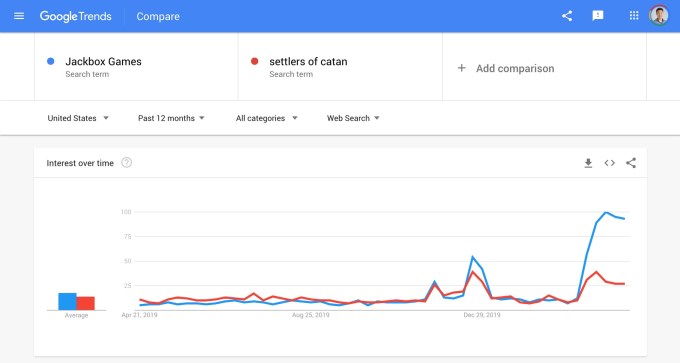
There are more than 20 unique games across Jackbox Party Packs 1-6, too many to explain — but here are three of the most popular:
Powered by WPeMatico

Nvidia today announced its plans to acquire Cumulus Networks, an open-source-centric company that specializes in helping enterprises optimize their data center networking stack. Cumulus offers both its own Linux distribution for network switches, as well as tools for managing network operations. With Cumulus Express, the company also offers a hardware solution in the form of its own data center switch.
The two companies did not announce the price of the acquisition, but chances are we are talking about a considerable amount, given that Cumulus had raised $134 million since it was founded in 2010.
 Mountain View-based Cumulus already had a previous partnership with Mellanox, which Nvidia acquired for $6.9 billion. That acquisition closed only a few days ago. As Mellanox’s Amit Katz notes in today’s announcement, the two companies first met in 2013, and they formed a first official partnership in 2016. Cumulus, it’s worth noting, was also an early player in the OpenStack ecosystem.
Having both Cumulus and Mellanox in its stable will give Nvidia virtually all the tools it needs to help enterprises and cloud providers build out their high-performance computing and AI workloads in their data centers. While you may mostly think about Nvidia because of its graphics cards, the company has a sizable data center group, which delivered close to $1 billion in revenue in the last quarter, up 43% from a year ago. In comparison, Nvidia’s revenue from gaming was just under $1.5 billion.
“With Cumulus, NVIDIA can innovate and optimize across the entire networking stack from chips and systems to software including analytics like Cumulus NetQ, delivering great performance and value to customers,” writes Katz. “This open networking platform is extensible and allows enterprise and cloud-scale data centers full control over their operations.”
Powered by WPeMatico
Ransomware is getting sneakier and smarter.
The latest example comes from ExecuPharm, a little-known but major outsourced pharmaceutical company that confirmed it was hit by a new type of ransomware last month. The incursion not only encrypted the company’s network and files, hackers also exfiltrated vast amounts of data from the network. The company was handed a two-for-one threat: pay the ransom and get your files back or don’t pay and the hackers will post the files to the internet.
This new tactic is shifting how organizations think of ransomware attacks: it’s no longer just a data-recovery mission; it’s also now a data breach. Now companies are torn between taking the FBI’s advice of not paying the ransom or the fear their intellectual property (or other sensitive internal files) are published online.
Because millions are now working from home, the surface area for attackers to get in is far greater than it was, making the threat of ransomware higher than ever before.
That’s just one of the stories from the week. Here’s what else you need to know.
Education giant Chegg confirmed its third data breach in as many years. The latest break-in affected past and present staff after a hacker made off with 700 names and Social Security numbers. It’s a drop in the ocean when compared to the 40 million records stolen in 2018 and an undisclosed number of passwords taken in a breach at Thinkful, which Chegg had just acquired in 2019.
Those 700 names account for about half of its 1,400 full-time employees, per a filing with the Securities and Exchange Commission. But Chegg’s refusal to disclose further details about the breach — beyond a state-mandated notice to the California attorney general’s office — makes it tough to know exactly went wrong this time.
Powered by WPeMatico
It’s fair to say that even before the impact of COVID-19, companies had begun a steady march to the cloud. Maybe it wasn’t fast enough for AWS, as Andy Jassy made clear in his 2019 Re:invent keynote, but it was happening all the same and the steady revenue increases across the cloud infrastructure market bore that out.
As we look at the most recent quarter’s earnings reports for the main players in the market, it seems the pandemic and economic fall out has done little to slow that down. In fact, it may be contributing to its growth.
According to numbers supplied by Synergy Research, the cloud infrastructure market totaled $29 billion in revenue for Q12020.
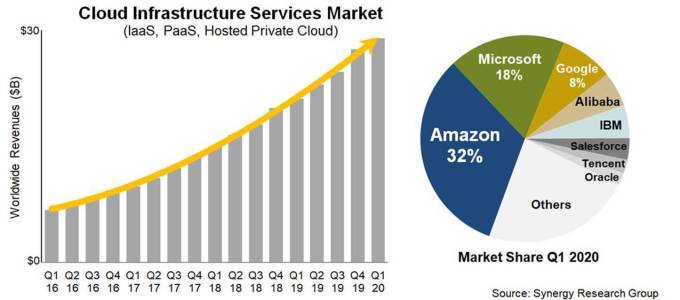
Image Credit: Synergy Research
Synergy’s John Dinsdale, who has been watching this market for a long time, says that the pandemic could be contributing to some of that growth, at least modestly. In spite of the numbers, he doesn’t necessarily see these companies getting out of this unscathed either, but as companies shift operations from offices, it could be part of the reason for the increased demand we saw in the first quarter.
“For sure, the pandemic is causing some issues for cloud providers, but in uncertain times, the public cloud is providing flexibility and a safe haven for enterprises that are struggling to maintain normal operations. Cloud provider revenues continue to grow at truly impressive rates, with AWS and Azure in aggregate now having an annual revenue run rate of well over $60 billion,” Dinsdale said in a statement.
AWS led the way with a third of the market or more than $10 billion in quarterly revenue as it continues to hold a substantial lead in market share. Microsoft was in second, growing at a brisker 59% for 18% of the market. While Microsoft doesn’t break out its numbers, using Synergy’s numbers, that would work out to around $5.2 billion for Azure revenue. Meanwhile Google came in third with $2.78 billion.
If you’re keeping track of market share at home, it comes out to 32% for AWS, 18% for Microsoft and 8% for Google. This split has remained fairly steady, although Microsoft has managed to gain a few percentage points over the last several quarters as its overall growth rate outpaces Amazon.
Powered by WPeMatico
AWS, the cloud arm of Amazon, would be a pretty successful business on its own. Today, the company announced it has passed $10 billion for the quarter, putting the cloud business on an impressive run rate of more than $40 billion.
It was a bright spot for the company in an earnings report that saw it report net income of $2.5 billion, down $1 billion from a year ago.
Still, most companies would take that for the entire business, but AWS, which started off as kind of a side hustle for Amazon back in 2006, has grown into a powerful business all on its own. With a growth rate of 33%, it’s still growing briskly, even if it’s slowing down a bit as the law of large numbers begins to work against it.
Even though Microsoft has grown more quickly — in yesterday’s report Microsoft reported that Azure was growing at a 59% clip — AWS had such a big head start and controls a big chunk of the market share.
To give you a sense of how quickly this business has grown, Bloomberg’s Jon Erlichman tweeted the Q1 numbers for AWS since 2014, and it’s pretty amazing growth:
Amazon’s cloud revenue in Q1:
(Amazon Web Services)
Q1 2020: $10.2 billion
Q1 2019: $7.7 billion
Q1 2018: $5.4 billion
Q1 2017: $3.7 billion
Q1 2016: $2.6 billion
Q1 2015: $1.6 billion
Q1 2014: $1.1 billion— Jon Erlichman (@JonErlichman) April 30, 2020
In 2014, it was a $4 billion a year business. Today it is 9.1x that and still going strong. The good news for everyone involved is that this is a huge market, and while nobody could ever characterize the pandemic and it’s economic fall-out as good news for anyone, the fact is that it is forcing companies to move to the cloud faster than they might have wanted to go.
That should bode well for all the cloud infrastructures vendors, even as the economy shrinks, the kinds of services these vendors offer should be in more demand than ever, and that means these numbers could just keep growing for some time.
Powered by WPeMatico
When former Red Hat CEO Jim Whitehurst moved on to become president at parent company IBM earlier this month, the logical person to take his place was long-time executive Paul Cormier. As he takes over in the most turbulent of times, he still sees a company that is in the right place to help customers modernize their approach to development as they move more workloads to the cloud.
We spoke to Cormier yesterday via video conference, and he appeared to be a man comfortable in his new position. We talked about the changes his new role has brought him personally, how he his helping his company navigate the current situation and how his relationship with IBM works.
One thing he stressed was that even as part of the IBM family, his company is running completely independently, and that includes no special treatment for IBM. It’s just another customer, an approach he says is absolutely essential.
He says that he felt fully prepared for the role having run the gamut of jobs over the years, from engineering to business units to CTO. The big difference for him as CEO is that in all of his previous roles he could be the technical guy speaking a certain engineering language with his colleagues. As CEO, things have changed, especially during a time when communication has become paramount.
This has been an even bigger challenge in the midst of the pandemic. Instead of traveling to offices for meetings, chatting over informal coffees and having more serendipitous encounters, he has had to be much more deliberate in his communication to make sure his employees feel in the loop, even when they are out of the office.
“I have a company-wide meeting every two weeks. You can’t over communicate right now because it just doesn’t happen [naturally in the course of work]. I’ve got to consciously do it now, and that’s probably the biggest thing,” he said.
While Cormier sees little change on the engineering side, where many folks have been working remotely for some time, the go-to-market team could face more serious hurdles as they try to engage with customers.
“The go-to-market and sales side is going to be the challenge because we don’t know how our customers will come out of this. Everybody’s going to have different strategies on how they’re coming out of this, and that will drive a lot,” he said.
This week was Cormier’s first Red Hat Summit as CEO, one that like so many conferences had to pivot from a live event to virtual fairly quickly. Customers have been nervous, and this was the first chance to really reconnect with them since things have shut down. He says that he was pleasantly surprised how well it worked, even allowing more people to attend than might pay to travel to a live event.
Conferences are a place for the sales team to really shine and lay the groundwork for future sales. Not being there in person had to be a big change for them, but he says this week went better than he expected, and they learned a ton about running virtual events that they will carry forth into the future.
“We all miss the face-to-face for sure, but I think we’ve learned new things, and I think our team did an amazing job in pulling this off,” he said.
As he navigates his role inside the IBM family, he says that new CEO Arvind Krishna has effectively become his board of directors, now that the company has gone private. When IBM paid $34 billion for Red Hat in 2018, it was looking for a way to modernize the company and to become a real player in the hybrid cloud market.
Hybrid involves finding a way to manage infrastructure that lives on premises as well as in the cloud without having to use two sets of tools. While IBM is all-in on Red Hat, Cormier says it’s absolutely essential to their relationship with customers that they don’t show them any favoritism, and that includes no special pricing deals.
Not only that, he says that he has the freedom to run the company the way he sees fit. “IBM doesn’t set our product strategy. They don’t set our priorities. They know that over time our open-source products could eat into what they are doing with their proprietary products, and they are okay with that. They understand that,” he said.
He says that doing it any other way could begin to erode the reason that IBM spent all that money in the first place, and it’s up to Cormier to make sure that they continue to do what they were doing and keep customers comfortable with that. So far, the company seems to be heading in the same upward trajectory it was on as a public company.
In the most recent earnings report in January, IBM reported Red Hat income of $1.07 billion, up from $863 million the previous year when it was still a private company. That’s a run rate of over $4 billion, putting it well within reach of the $5 billion goal Whitehurst set a few years ago.
Now it’s Cormier’s job to get them there and beyond. The pandemic certainly makes it more challenging, but he’s ready to lead the company to that next level, all while walking the line as the CEO of a company that lives under the IBM family umbrella and all that entails.
Powered by WPeMatico
Figma, the design platform that lets folks work collaboratively and in the cloud, has today announced the close of a $50 million Series D financing. The round was led by Andreessen Horowitz, with partner Peter Levine and cofounding partner Marc Andreessen managing the deal for the firm. New angel investors, including Henry Ellenbogen from Durable Capital, also participated in the round alongside existing investors Index, Greylock, KPCB, Sequoia and Founders Fund.
Forbes reports that the latest funding round values Figma at $2 billion.
Dylan Field, Figma founder and CEO, told TechCrunch that discussions between a16z and Figma actually began towards the end of the fundraising cycle for the company’s Series C, which closed in February of 2019.
“It felt a bit like a shotgun wedding,” said Field, explaining that both parties instead opted to get to know each other better. They’ve been building their relationship over the past year, leading to today’s Series D close. Field also added that he has not met other investors in this round in person, and the vast majority of the deal was done over Zoom.
“When you think about the future of Silicon Valley, there is an interesting question around capital infrastructure being here and people not being able to access that if they’re not here, too,” said Field. “I got to see firsthand how a deal done online can work and I think more and more investors aren’t going to worry about whether you’re in Silicon Valley or not.”
Figma launched in 2015 after nearly six years of development in stealth. The premise was to create a collaborative, cloud-based design tool that would be the Google Docs of design.
Since, Figma has built out the platform to expand access and usability for individual designers, small firms and giant enterprise companies alike. For example, the company launched plug-ins in 2019, allowing developers to build in their own tools to the app, such as a plug-in for designers to automatically rename and organize their layers as they work (Rename.it) and one that gives users the ability to add placeholder text that they can automatically find and replace later (Content Buddy).
The company also launched an educational platform called Community, which gives designers the ability to share their work and let other users ‘remix’ that design, or simply check out how it was built, layer by layer.
A spokesperson told TechCrunch that this deal was “opportunistic,” and that the company was in a strong cash position pre-financing. The new funding expands Figma’s runway during these uncertain times, with coronavirus halting a lot of enterprise purchasing and ultimately slowing growth of some rising enterprise players.
Field explained that Figma’s data is counter to the expected narrative around enterprise purchasing because Figma is specifically built to let teams collaborate in the cloud.
“We’re actually seeing a lot of acceleration for bigger deals on the sales side,” said Field. “Figma is a tool that can help right now.”
The company says that one interesting change they’ve seen in the COVID era is a significant jump in user engagement from teams to collaborate more in Figma. The firm has also seen an uptick in whiteboarding, note taking, slide deck creation and diagramming, as companies start using Figma as a collaborative tool across an entire organization rather than just within a team of designers.
This latest deal brings Figma’s total funding to $132.9 million. Field added that, though the company is not yet profitable, this latest financing gives the company three to four years of runway, even with aggressive scaling and hiring efforts moving forward.
Powered by WPeMatico