Enterprise
Auto Added by WPeMatico
Auto Added by WPeMatico
Microsoft and Amazon are at it again as the fight for the Defense Department JEDI contract continues. In a recent series of increasingly acerbic pronouncements, the two companies continue their ongoing spat over the $10 billion, decade-long JEDI contract spoils.
As you may recall (or not), last fall in a surprise move, the DoD selected Microsoft as the winning vendor in the JEDI winner-take-all cloud infrastructure sweepstakes. The presumed winner was always AWS, but when the answer finally came down, it was not them.
To make a very long story short, AWS took exception to the decision and went to court to fight it. Later it was granted a stay of JEDI activities between Microsoft and the DoD, which as you can imagine did not please Microsoft . Since then, the two companies have been battling in PR pronouncements and blog posts trying to get the upper hand in the war for public opinion.
That fight took a hard turn this week when the two companies really went at it in dueling blog posts after Amazon filed its latest protest.
First there was Microsoft with PR exec Frank Shaw taking exception to AWS’s machinations, claiming the company just wants a do-over:
This latest filing – filed with the DoD this time – is another example of Amazon trying to bog down JEDI in complaints, litigation and other delays designed to force a do-over to rescue its failed bid.
Amazon’s Drew Herdner countered in a blog post published this morning:
Recently, Microsoft has published multiple self-righteous and pontificating blog posts that amount to nothing more than misleading noise intended to distract those following the protest.
The bottom line is that Microsoft believes it won the contract fair and square with a more competitive bid, while Amazon believes it should have won on technical superiority, and that there was political interference from the president because he doesn’t like Amazon CEO Jeff Bezos, who also owns the Washington Post.
If you’ve been following this story from the beginning (as I have), you know it has taken a series of twists and turns. It’s had lawsuits, complaints, drama and intrigue. The president has inserted himself into it, too. There have been accusations of conflicts of interest. There have been investigations, lawsuits and more investigations.
Government procurement tends to be pretty bland, but from the start when the DoD chose to use the cutesy Star Wars-driven acronym for this project, it has been anything but. Now it’s come down to two of the world’s largest tech companies exchanging angry blog posts. Sooner or later this is going to end right?
Powered by WPeMatico
If you’ve ever been stuck using a health provider’s clunky online patient portal or had to make multiple calls to transfer medical records, you know how difficult it is to access your health data.
In an era when control over personal data is more important than ever before, the healthcare industry has notably lagged behind — but that’s about to change. This past month, the U.S. Department of Health and Human Services (HHS) published two final rules around patient data access and interoperability that will require providers and payers to create APIs that can be used by third-party applications to let patients access their health data.
This means you will soon have consumer apps that will plug into your clinic’s health records and make them viewable to you on your smartphone.
Critics of the new rulings have voiced privacy concerns over patient health data leaving internal electronic health record (EHR) systems and being surfaced to the front lines of smartphone apps. Vendors such as Epic and many health providers have publicly opposed the HHS rulings, while others, such as Cerner, have been supportive.
While that debate has been heated, the new HHS rulings represent a final decision that follows initial rules proposed a year ago. It’s a multi-year win for advocates of greater data access and control by patients.
The scope of what this could lead to — more control over your health records, and apps on top of it — is immense. Apple has been making progress with its Health Records app for some time now, and other technology companies, including Microsoft and Amazon, have undertaken healthcare initiatives with both new apps and cloud services.
It’s not just big tech that is getting in on the action: startups are emerging as well, such as Commure and Particle Health, which help developers work with patient health data. The unlocking of patient health data could be as influential as the unlocking of banking data by Plaid, which powered the growth of multiple fintech startups, including Robinhood, Venmo and Betterment.
What’s clear is that the HHS rulings are here to stay. In fact, many of the provisions require providers and payers to provide partial data access within the next 6-12 months. With this new market opening up, though, it’s time for more health entrepreneurs to take a deeper look at what patient data may offer in terms of clinical and consumer innovation.
Powered by WPeMatico
Enterprise startups UIPath and Scale have drawn huge attention in recent years from companies looking to automate workflows, from RPA (robotic process automation) to data labeling.
What’s been overlooked in the wake of such workflow-specific tools has been the base class of products that enterprises are using to build the core of their machine learning (ML) workflows, and the shift in focus toward automating the deployment and governance aspects of the ML workflow.
That’s where MLOps comes in, and its popularity has been fueled by the rise of core ML workflow platforms such as Boston-based DataRobot. The company has raised more than $430 million and reached a $1 billion valuation this past fall serving this very need for enterprise customers. DataRobot’s vision has been simple: enabling a range of users within enterprises, from business and IT users to data scientists, to gather data and build, test and deploy ML models quickly.
Founded in 2012, the company has quietly amassed a customer base that boasts more than a third of the Fortune 50, with triple-digit yearly growth since 2015. DataRobot’s top four industries include finance, retail, healthcare and insurance; its customers have deployed over 1.7 billion models through DataRobot’s platform. The company is not alone, with competitors like H20.ai, which raised a $72.5 million Series D led by Goldman Sachs last August, offering a similar platform.
Why the excitement? As artificial intelligence pushed into the enterprise, the first step was to go from data to a working ML model, which started with data scientists doing this manually, but today is increasingly automated and has become known as “auto ML.” An auto-ML platform like DataRobot’s can let an enterprise user quickly auto-select features based on their data and auto-generate a number of models to see which ones work best.
As auto ML became more popular, improving the deployment phase of the ML workflow has become critical for reliability and performance — and so enters MLOps. It’s quite similar to the way that DevOps has improved the deployment of source code for applications. Companies such as DataRobot and H20.ai, along with other startups and the major cloud providers, are intensifying their efforts on providing MLOps solutions for customers.
We sat down with DataRobot’s team to understand how their platform has been helping enterprises build auto-ML workflows, what MLOps is all about and what’s been driving customers to adopt MLOps practices now.
Powered by WPeMatico
There’s something to be said for consistency through good times and bad, and one company that has had a staggeringly consistent track record is international data center vendor, Equinix. It just recorded its 69th straight positive quarter, according to the company.
That’s an astonishing record, and covers over 17 years of positive returns. That means this streak goes back to 2003. Not too shabby.
The company had a decent quarter, too. Even in the middle of an economic mess, it was still up 6% YoY to $1.445 billion and up 2% over last quarter. The company runs data centers where companies can rent space for their servers. Equinix handles all of the infrastructure providing racks, wiring and cooling — and customers can purchase as many racks as they need.
If you’re managing your own servers for even part of your workload, it can be much more cost-effective to rent space from a vendor like Equinix than trying to run a facility on your own.
Among its new customers this quarter are Zoom, which is buying capacity all over the place, having also announced a partnership with Oracle earlier this month, and TikTok. Both of those companies deal in video and require lots of different types of resources to keep things running.
This report comes against a backdrop of a huge increase in resource demand for certain sectors like streaming video and video conferencing, with millions of people working and studying at home or looking for distractions.
And if you’re wondering if they can keep it going, they believe they can. Their guidance calls for 2020 revenue of $5.877-$5.985 billion, a 6-8% increase over the previous year.
You could call them the anti-IBM. At one point Big Blue recorded 22 straight quarters of declining revenue in an ignominious streak that stretched from 2012 to 2018 before it found a way to stop the bleeding.
When you consider that Equnix’s streak includes the period of 2008-2010, the last time the economy hit the skids, it makes the record even more impressive, and certainly one worth pointing out.
Powered by WPeMatico
We find ourselves in a time when certain businesses are being asked to scale to levels they never imagined. Sometimes that increased usage comes in bursts, which means you don’t want to pay for permanent extra capacity you might not always need. Today, Confluent introduced a new scale-on-demand feature for its Apache Kafka cloud service that will scale up and down as needed, automatically.
Confluent CEO Jay Kreps says that elasticity is arguably one of the most important features of cloud computing, and this ability to scale up and down is one of the primary factors that has attracted organizations to the cloud. By automating that capability, they give DevOps one less major thing to worry about.
“This new functionality allows users to dynamically scale Kafka and the other key ecosystem components like KSQL and Kafka Connect. This is a key missing capability that no other service provides,” Kreps explained.
He points out that this is particularly relevant right now with people working at home. Systems are being taxed more than perhaps ever before, and this automated elasticity is going to come in handy, making it more cost-effective and efficient than was previously possible.
“These capabilities let customers add capacity as they need it, or scale down to save money, all without having to pre-plan in advance,” he said.
The new elasticity feature in Confluent is part of a series of updates to the platform, known as Project Metamorphosis, that Confluent is planning to roll out throughout this year on a regular basis.
“Through the rest of the year we’ll be doing a sequence of releases that bring the capabilities of modern cloud data systems to the Kafka ecosystem in Confluent Cloud. We’ll be announcing one major capability each month, starting with elasticity,” he said.
Kreps first announced Metamorphosis last month when the company also announced a massive $250 million funding round on a $4.5 billion valuation. In spite of the current economic situation, driven by the ongoing pandemic, Confluent plans to continue to build out the product, as today’s announcement attests.
Powered by WPeMatico
In spite of being in the midst of a pandemic sowing economic uncertainty, one area that continues to thrive is cloud computing. Perhaps that explains why Microsoft, which saw Azure grow 59% in its most recent earnings report, announced plans to open a new data center in New Zealand once it receives approval from the Overseas Investment Office.
“This significant investment in New Zealand’s digital infrastructure is a testament to the remarkable spirit of New Zealand’s innovation and reflects how we’re pushing the boundaries of what is possible as a nation,” Vanessa Sorenson, general manager at Microsoft New Zealand said in a statement.
The company sees this project against the backdrop of accelerating digital transformation that we are seeing as the pandemic forces companies to move to the cloud more quickly with employees often spread out and unable to work in offices around the world.
As CEO Satya Nadella noted on Twitter, this should help companies in New Zealand that are in the midst of this transformation. “Now more than ever, we’re seeing the power of digital transformation, and today we’re announcing a new datacenter region in New Zealand to help every organization in the country build their own digital capability,” Nadella tweeted.
The company wants to do more than simply build a data center. It will make this part of a broader investment across the country, including skills training and reducing the environmental footprint of the data center.
Once New Zealand comes on board, the company will boast 60 regions covering 140 countries around the world. The new data center won’t just be about Azure, either. It will help fuel usage of Office 365 and the Dynamics 365 back-office products, as well.
Powered by WPeMatico

Under different circumstances, GitHub would be hosting its Satellite conference in Paris this week. Like so many other events, GitHub decided to switch Satellite to a virtual event, but that isn’t stopping the Microsoft-owned company from announcing quite a bit of news this week.
The highlight of GitHub’s announcement is surely the launch of GitHub Codespaces, which gives developers a full cloud-hosted development environment in the cloud, based on Microsoft’s VS Code editor. If that name sounds familiar, that’s likely because Microsoft itself rebranded Visual Studio Code Online to Visual Studio Codespaces a week ago — and GitHub is essentially taking the same concepts and technology and is now integrating it directly inside its service. If you’ve seen VS Online/Codespaces before, the GitHub environment will look very similar.
“Contributing code to a community can be hard. Every repository has its own way of configuring a dev environment, which often requires dozens of steps before you can write any code,” writes Shanku Niyogi, GitHub’s SVP of Product, in today’s announcement. “Even worse, sometimes the environment of two projects you are working on conflict with one another. GitHub Codespaces gives you a fully-featured cloud-hosted dev environment that spins up in seconds, directly within GitHub, so you can start contributing to a project right away.”
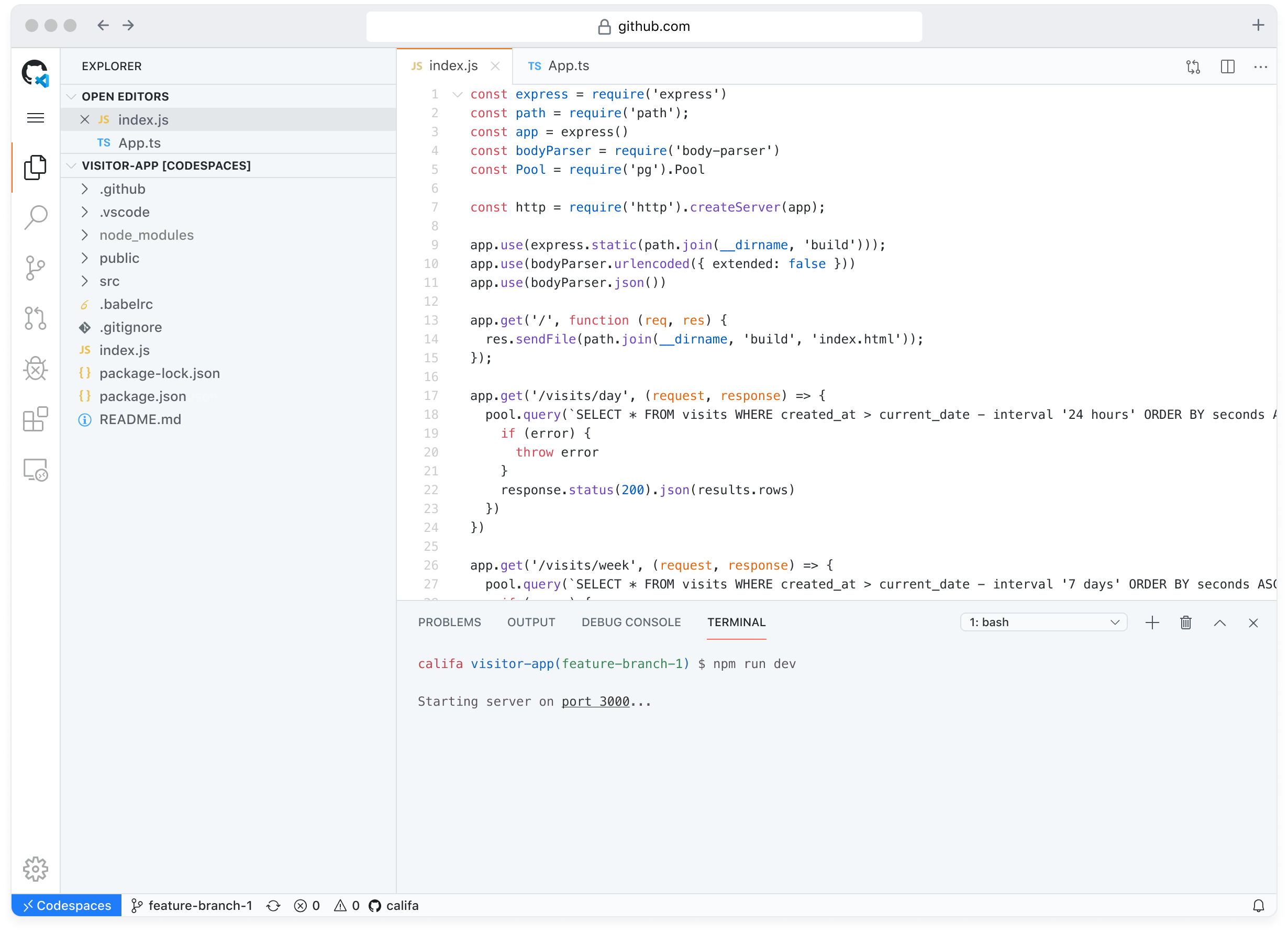
Currently, GitHub Codespaces is in beta and available for free. The company hasn’t set any pricing for the service once it goes live, but Niyogi says the pricing will look similar to that of GitHub Actions, where it charges for computationally intensive tasks like builds. Microsoft currently charges VS Codespaces users by the hour and depending on the kind of virtual machine they are using.

The other major new feature the company is announcing today is GitHub Discussions. These are essentially discussion forums for a given project. While GitHub already allowed for some degree of conversation around code through issues and pull requests, Discussions are meant to enable unstructured threaded conversations. They also lend themselves to Q&As, and GitHub notes that they can be a good place for maintaining FAQs and other documents.
Currently, Discussions are in beta for open-source communities and will be available for other projects soon.

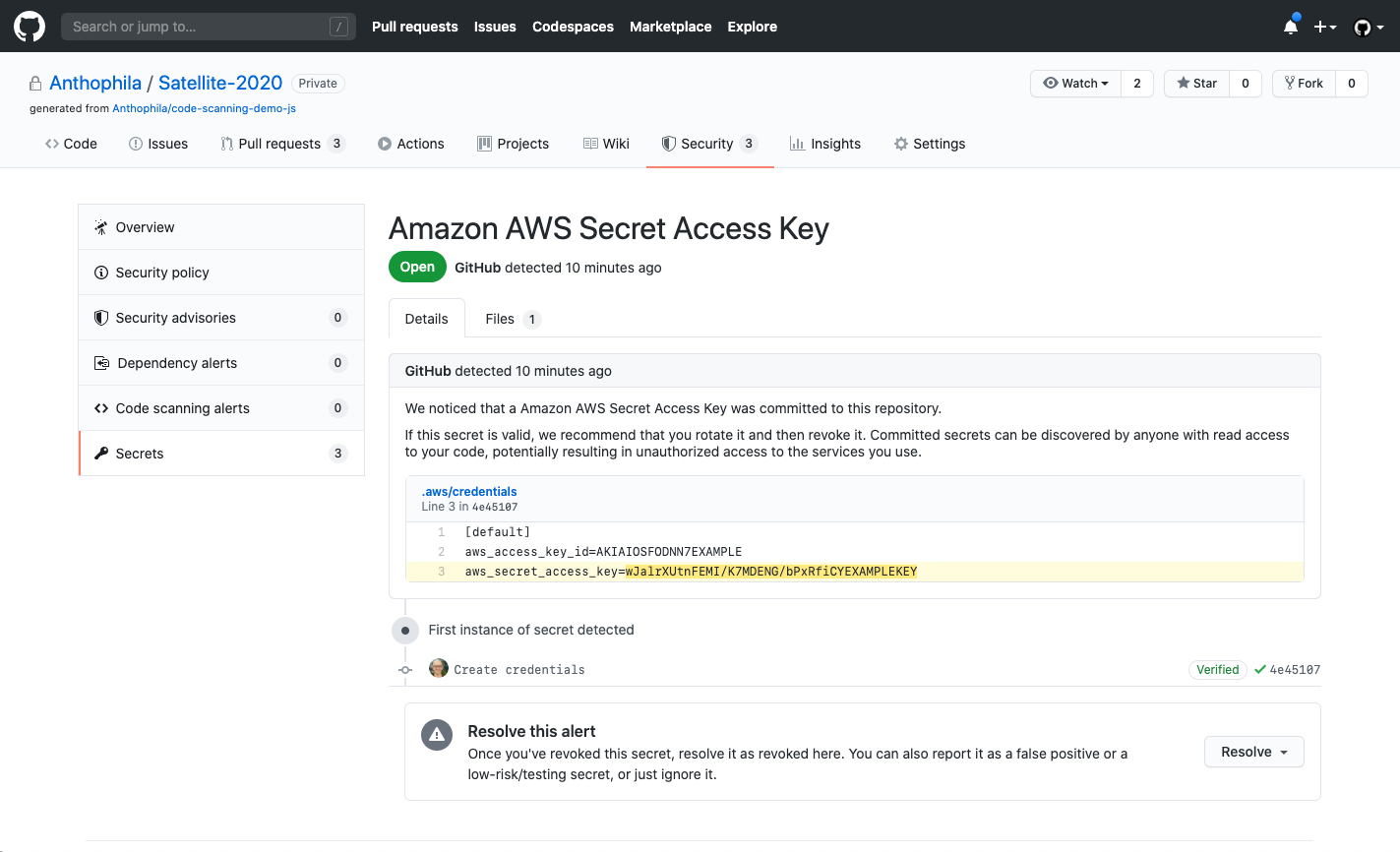
On the security front, GitHub is also announcing two new features: code scanning and secret scanning. Code scanning checks your code for potential security vulnerabilities. It’s powered by CodeQL and free for open-source projects. Secret scanning is now available for private repositories (a similar feature has been available for public projects since 2018). Both of these features are part of GitHub Advanced Security.
As for GitHub’s enterprise customers, the company today announced the launch of Private Instances, a new fully managed service for enterprise customers that want to use GitHub in the cloud but know that their code is fully isolated from the rest of the company’s users. “Private Instances provides enhanced security, compliance, and policy features including bring-your-own-key encryption, backup archiving, and compliance with regional data sovereignty requirements,” GitHub explains in today’s announcement.
Powered by WPeMatico
In the early 2000s, VMware introduced the world to virtual servers that allowed IT to make more efficient use of idle server capacity. Today, Run:AI is introducing that same concept to GPUs running containerized machine learning projects on Kubernetes.
This should enable data science teams to have access to more resources than they would normally get were they simply allocated a certain number of available GPUs. Company CEO and co-founder Omri Geller says his company believes that part of the issue in getting AI projects to market is due to static resource allocation holding back data science teams.
“There are many times when those important and expensive computer sources are sitting idle, while at the same time, other users that might need more compute power since they need to run more experiments and don’t have access to available resources because they are part of a static assignment,” Geller explained.
To solve that issue of static resource allocation, Run:AI came up with a solution to virtualize those GPU resources, whether on prem or in the cloud, and let IT define by policy how those resources should be divided.
“There is a need for a specific virtualization approaches for AI and actively managed orchestration and scheduling of those GPU resources, while providing the visibility and control over those compute resources to IT organizations and AI administrators,” he said.
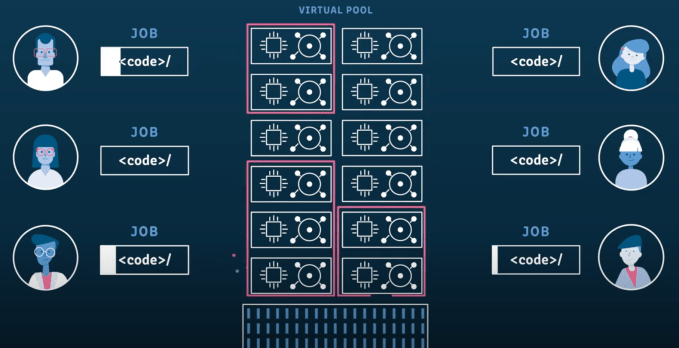
Run:AI creates a resource pool, which allocates based on need. Image Credits Run:AI
Run:AI built a solution to bridge this gap between the resources IT is providing to data science teams and what they require to run a given job, while still giving IT some control over defining how that works.
“We really help companies get much more out of their infrastructure, and we do it by really abstracting the hardware from the data science, meaning you can simply run your experiment without thinking about the underlying hardware, and at any moment in time you can consume as much compute power as you need,” he said.
While the company is still in its early stages, and the current economic situation is hitting everyone hard, Geller sees a place for a solution like Run:AI because it gives customers the capacity to make the most out of existing resources, while making data science teams run more efficiently.
He also is taking a realistic long view when it comes to customer acquisition during this time. “These are challenging times for everyone,” he says. “We have plans for longer time partnerships with our customers that are not optimized for short term revenues.”
Run:AI was founded in 2018. It has raised $13 million, according to Geller. The company is based in Israel with offices in the United States. It currently has 25 employees and a few dozen customers.
Powered by WPeMatico
Sleuth, an early stage startup from three former Atlassian employees, wants to bring some much-needed order to the continuous delivery process. Today, the company announced it has raised a $3 million seed round.
CRV led the round with participation from angel investors from New Relic, Atlassian and LaunchDarkly.
“Sleuth is a deployment tracker built to solve the confusion that comes when companies have adopted continuous delivery,” says CEO and co-founder Dylan Etkin. The company’s founders recognized that more and more companies were making the move to continuous delivery deployment, and they wanted to make it easier to track those deployments and figure out where the bottle necks were.
He says that typically, on any given DevOps team, there are perhaps two or three people who know how the entire system works, and with more people spread out now, it’s more important than ever that everyone has that capability. Etkin says Sleuth lets everyone on the team understand the underlying complexity of the delivery system with the goal of helping them understand the impact of a given change they made.
“Sleuth is trying to make that better by targeting the developer and really giving them a communications platform, so that they can discuss the [tools] and understand what is changing and who has changed what. And then more importantly, what is the impact of my change,” he explained.
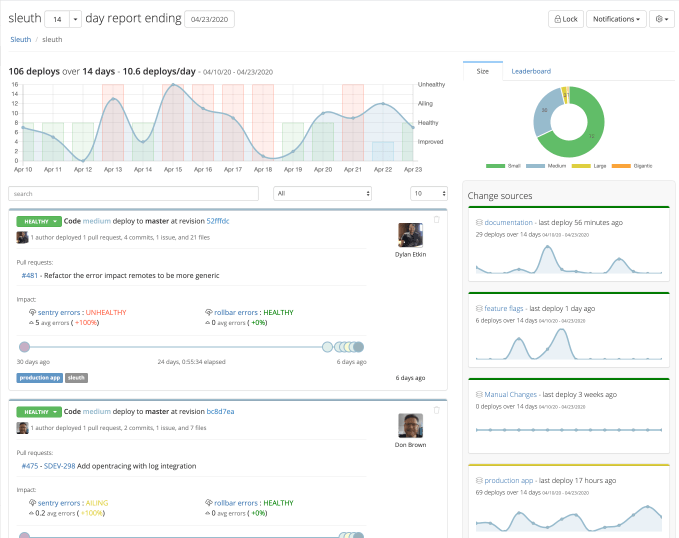
Image Credit: Sleuth
The company was founded by three former Atlassian alumni — Ektin along with Michael Knighten and Don Brown — all of whom were among the first 50 employees at the now tremendously successful development tools company.
That kind of pedigree tends to get the attention of investors like CRV, but it is also telling that three companies including their former employer saw enough potential here to invest in the company, and be using the product.
Etkin recognizes this is a tricky time to launch an early-stage startup. He said that when he first entered the lock down, his inclination was to hunker down, but they concluded that their tool would have even greater utility at the moment. “The founders took stock and we were always building a tool that was great for remote teams and collaboration in general, and that hasn’t changed… if anything, I think it’s becoming more important right now.”
The company plans to spend the next 6-9 months refining the product, adding a few folks to the five person team and finding product-market fit. There is never an ideal time to start a company, but Sleuth believes now is its moment. It may not be easy, but they are taking a shot.
Powered by WPeMatico
M&A activity has generally slowed down in the weeks since the novel coronavirus took a grip on the world, but there have been some pockets of activity in the tech industry when the price is right or when the divestment/acquisition just makes sense.
The world of messaging brings us the latest development in that theme: SAP, the CRM and enterprise software giant, is selling its Digital Interconnect messaging business to Sinch, a Swedish cloud voice, video and messaging company.
Sinch said it is paying €225 million (around $250 million) on a cash and debt-free basis for the business, which has 1,500 enterprise customers that use it for various messaging services, such as the now-popular option of running “omnichannel” conversations with customers over SMS, push, email, WhatsApp, WeChat and Viber; and messaging technology for carriers.
The deal will give Sinch, based in Sweden, a foothold in the US market — the Digital Interconnect business is headquartered in Silicon Valley — and access to a trove of customers using the kind of messaging technology that Sinch develops and sells.
The significance here is that messaging continues to be a very popular and high-volume, but low-margin (or even no-margin in some cases), business. So it makes sense for Sinch to pursue a bigger strategy for more economy of scale, a trend that I think will continue to play out. As a case in point: Sinch has been on an acquisition spree in the last month, and other deals have included Latin American messaging provider Wavy ($119 million, announced March 26), and ChatLayer ($6 million, announced April 20).
“With SAP Digital Interconnect now becoming a part of Sinch, we build on our scale, focus and capabilities to truly redefine how businesses engage with their customers, throughout the world,” comments Oscar Werner, Sinch CEO, in a statement. “The transaction strengthens our direct connectivity globally. Plus, it enables us to expand and accelerate a range of business-critical services to mobile operators, including products for person-to-person messaging, reporting and analytics.”
The news caps off nearly a month of speculation that SAP was gearing up for a sale of the legacy unit as part of a bigger strategy to focus more squarely on its CRM and newer enterprise IT services. It comes amid a particularly challenging economic environment, and that’s before considering all the IT, security and other challenges companies were facing even before COVID-19. SAP also has other fish to fry. It acquired Qualtrics in November 2018 for $8 billion, spearheading a stronger move into employee and customer experience, surveys and research; and other SAP exits this year have included shuttering travel business Hipmunk, which was part of Concur (another acquisition made by SAP), back in January.
Between then and now SAP has also seen a very notable personnel change. Its co-CEO Jennifer Morgan stepped away from the company by mutual agreement with the board, leaving Christian Klein as sole CEO (the two had been in the co-CEO roles for only six months). At the time, the company said that the abrupt change — a mere 10 days between late-Friday announcement and departure — was in response to “the current environment [which] requires companies to take swift, determined action which is best supported by a very clear leadership structure.”
It would appear that this sale is an example of the kind of swift and determined action that the board was hoping to see.
SAP’s messaging unit has been around in one form or another for years. It became a part of SAP in 2010 as part of its acquisition of Sybase, but even before that Sybase acquired Mobile 365, which had developed the messaging technology that ultimately became SAP Digital Interconnect, back in 2006.
At the time, the messaging business was the primary part of Mobile 365, and Sybase paid $417 million for that company. In that regard, it might look like SAP is now selling it for a loss, although you could also argue that 15+ year-old technology in the fast-moving world of messaging would have depreciated at this point.
The business itself is very typical of messaging: huge volumes but not huge revenues.
In 2019, SAP said that the enterprise messaging business processed 18 billion messages, while its carrier services processed 292 billion carrier messages. The Bloomberg report that broke the news about the intent to sell the division said that it made $50 million in EBITDA and $250 million in revenue last year. But actually this is small relatively speaking: SAP altogether had revenues of nearly $30 billion in the same period. In other words, it’s an okay business but not really core to SAP and where it’s going.
On the other hand, it’s a better fit for Sinch. The company originally spun out from low-cost IP calling company Rebtel, was then acquired by publicly-traded CLX, which subsequently rebranded as Sinch. It is a much smaller company than SAP — market cap of about $3.1 billion (30.82 billion Swedish krona), versus SAP’s market cap of $139 billion — but is squarely focused on messaging services similar to those that the former SAP division offers.
“SAP Digital Interconnect is a leader in its area showing profitable growth and reaching 99 percent of the world’s mobile subscribers. Looking at Sinch’s innovation and investment strategy in the area of cloud communication platforms, we welcome them as the new owner of SDI. Sinch is perfectly positioned to unleash further growth potential we
M&A continues on in the wider European region even while so much else has slowed down or stopped in the current market. This deal follows on the heels of Intel acquiring Israel’s Moovit for $900 million this week, and Avira in Germany getting acquired by Investcorp at a $180 million valuation several weeks ago.
Powered by WPeMatico