Enterprise
Auto Added by WPeMatico
Auto Added by WPeMatico

SirionLabs, a startup that provides contract management software to enterprises, has raised $44 million in a new financing round as it looks to expand and handle surge in demand from clients.
Tiger Global and Avatar Growth Capital led the Seattle-headquartered startup’s Series C round. The eight-year-old startup, which was founded in India, has raised $66 million to date. The new round values the startup at about $250 million. Indian VC fund Avatar has long invested in SaaS startups in India, an area that Tiger Global has also made serious bets on in recent quarters.
Enterprises broadly handle two kinds of contracts, one when they are buying things from a supplier for which they use a procurement contract, and the other when they are selling things to customers, when a sales contract comes into play.
A significant number of companies today handle these contracts manually with different teams within an organization often dealing with the same entity, which leads to discrepancies in their promises. Teams work in silos and often don’t know the terms others in the organization have already agreed upon.
That’s where SirionLabs comes into the picture. “We use artificial intelligence and natural language processing to connect the dots between contracts and what happens after the contract has been signed,” explained Ajay Agrawal, cofounder, chairman and chief executive of the startup, in an interview with TechCrunch.
“For us, it’s not just creating a contract, but also realizing the promises that have been made in those contracts,” he said. SirionLabs also audits the invoice of suppliers, which has enabled its customers to save a significant amount of money.
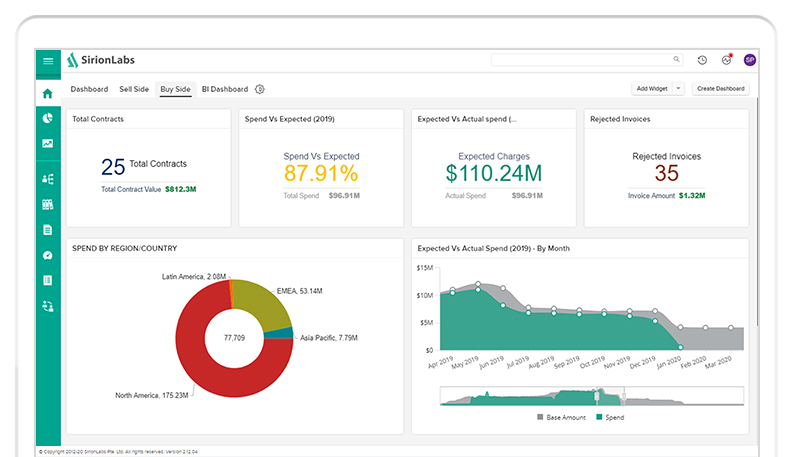
SirionLabs today hosts contracts in over 40 languages for more than 200 of the world’s largest companies including Credit Suisse, Vodafone, EY, Unilever, Abbvie, BP, and Fujitsu.
Agrawal said the startup has seen a 4X growth in the number of customers it has signed up in the last 18 months. Part of the new capital would go into handling their demand. He said the coronavirus crises has resulted in many companies becoming more cautious about what they promise in their contracts.
The startup, which just opened a technology center in Seattle, also plans to open an AI laboratory in the Washington state to fuel technology innovation and grow sales.
It has also hired several industry veterans including the appointment of Amol Joshi as chief revenue officer, Anu Engineer as chief technology officer, Mahesh Unnikrishnan as chief product officer, and Vijay Khera, who will serve as chief customer officer.
Vishal Bakshi, founder and managing partner at Avatar Growth Capital, said he expects SirionLabs, which competes with Apttus and Icertis among other firms, to “capture massive network effects as the platform continues to scale.”
Powered by WPeMatico
Atlassian announced today that it was acquiring Halp, an early-stage startup that enables companies to build integrated help desk ticketing and automated answers inside Slack. The companies did not disclose the purchase price.
It was a big day for Halp, which also announced its second product today, called Halp Answers. The new tool will work hand in glove with its previous entry Halp Tickets, which lets Slack users easily create a Help Desk ticket without leaving the tool.
“Halp Answers enables your teams to leverage the knowledge that already exists within your company to automatically answer tickets right in Slack . That knowledge can be pulled in from Slack messages, Confluence articles or any piece of knowledge in your organization,” the company wrote in a blog post announcing the deal.
Note that integration with Confluence, which is an Atlassian tool. The company also sees it integrating with Jira support for other enterprise communications tools down the road. “Existing Halp users can look forward to deeper (and new) integrations with Jira and Confluence. We’re committed to supporting Microsoft Teams customers as well,” Atlassian wrote in a blog post.
Halp is selling early, having just launched last year. The company had raised a $2 million seed round in April 2019 on a $9.5 million post valuation, according to PitchBook data. The startup sees an opportunity with Atlassian that it apparently didn’t think it could achieve alone.
“We’ll be able to harness the vast resources at Atlassian to continue with our mission to make Halp the best tool for any team collaborating on requests with other teams. Our team will grow and be able to focus on making the core experience of Halp even more powerful. We’ll also develop a deeper integration with the Atlassian suite — improving our existing Jira and Confluence integrations and discovering the possibilities of Halp generating alerts in Opsgenie, cards in Trello, and much more,” the company wrote.
Halp’s founders promise that it won’t be abandoning its existing customers as it joins the larger organization. As a matter of fact, Halp is bringing with them a slew of big-name customers, including Adobe, VMware, GitHub and Slack.
Powered by WPeMatico
With a large part of the working world doing jobs from home when possible these days, the focus right now is on how best to recreate the atmosphere of an office virtually, and how to replicate online essential work that used to be done in person. Today, href=”http://linkedin.com” target=”_blank” rel=”noopener noreferrer”>LinkedIn announced a couple of big new feature updates that point to how it’s trying to play a part in both of these: it’s launching a new Polls feature for users to canvas opinions and get feedback; and it’s launching a new “LinkedIn Virtual Events” tool that lets people create and broadcast video events via its platform.
Despite now being owned by Microsoft, interestingly it doesn’t seem that the Virtual Events service taps into Teams or Skype, Microsoft’s two other big video products that it has been pushing hard at a time when use of video streaming for work, education and play is going through the roof.
The polls feature — you can see an example of one in the picture below, or respond to that specific poll here — is a quick-fire and low-bar way of asking a question and encouraging engagement: LinkedIn says that a poll takes only about 30 seconds to put together, and responding doesn’t require thinking of something to write, but gives the respondent more of a ‘voice’ than he or she would get just by providing a “like” or other reaction.
But as with some of the other social features that LinkedIn has implemented over the years, its timing has not been quite right. With polls, you might say it’s been frustratingly late… or you might say it left the party too early.
The feature was first spotted by developer and app digger Jane Manchun Wong a couple of weeks ago, but it comes years after Twitter and Facebook have had polls in place on their platforms. I’d say it’s taken LinkedIn years to catch up, but actually it had polls in place years ago, yet chose to sunset the feature, back in 2014.
You could argue that LinkedIn miscalled the direction that social would go with engagement, or that it took too long to resuscitate the experience, or that the novelty of the concept that now worn off. Or you might say that LinkedIn has picked just the right time to bring it back, at a time when people are spending more time online than ever and are looking for more ways of varying the experience and interacting.
Those creating polls will be given the option in the menu of items when starting a new post. They can add four choices/options into the poll answers, and decide how long they would like for the poll to stay up, in a range of 24 hours to two weeks. You can also write an introduction post to accompany your poll with hashtags to come up in more searches.
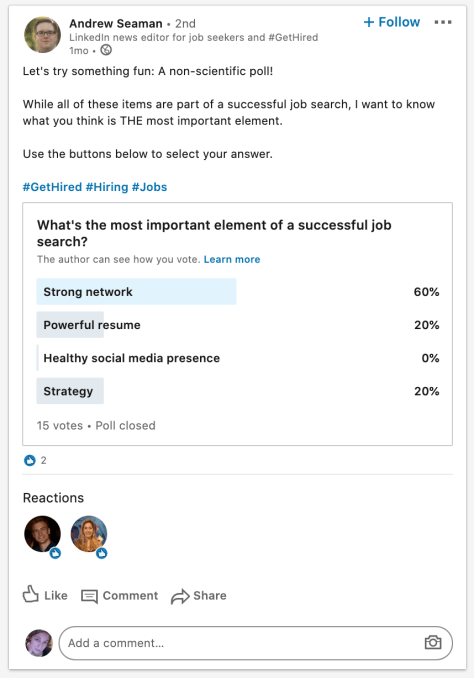
Two important distinctions with LinkedIn Polls as you can see above are that you are polling a very specific audience of people in your professional circle, and those people can both respond to the poll but also include comments and reactions. Both of these set the feature as it works on LinkedIn apart from the others and should give it some… engagement.
The polls feature is getting rolled out (again) starting today.
The LinkedIn Virtual Events feature, meanwhile, falls into a similar placement as polls: it’s a way of getting people to engage more on LinkedIn, it taps into trends that are huge outside of the platform — in this case, videoconferencing — and it’s something that is coming surprisingly late to LinkedIn, given its existing product assets.
But is also potentially — potentially, because Live is still in an invite-only phase — going to prove very popular because it’s filling a very specific need.
LinkedIn Virtual Events is a merger of two products that LinkedIn launched last year, a live video broadcasting tool called LinkedIn Live, and its efforts to foster a sideline in offline, in person networking with LinkedIn Events. The idea here is that while physical events have been put on pause in the current climate — many cities have made group activities illegal in an attempt to slow the spread of the novel coronavirus — you can continue to use LinkedIn Events to plan them, but now carry them out over the Live platform.
Given how huge the conferencing industry has become, I am guessing that we will be seeing a lot of attempts at recreating something of those events in a virtual, online context. LinkedIn’s take on the challenge — via Virtual Events — could therefore become a strong contender to host these.
When LinkedIn first launched Events I did ask the company whether it planned to expand them online using live, and indeed that did seem to be the plan. LinkedIn now says that it “accelerated” its product roadmap — unsurprising, given the current market — to merge the two products for targeted audiences.
That’s why we accelerated our product roadmap to bring you a tighter integration between LinkedIn Events and LinkedIn Live, turning these two products into a new virtual events solution that enables you to stay connected to your communities and meet your customers wherever they are. This new offering is designed to help you strengthen relationships with more targeted audiences.
This is not a simple integration, I should point out: LinkedIn is working with third-party broadcasting partners — the initial list includes Restream, Wirecast, Streamyard and Socialive — to raise the level of production quality, which will be essential especially if you are asking people to pay for events, and if you have any hope of replicating some of the networking other features that are cornerstones of conferencing and other in-person events.
It’s also building on what has been a successful product so far for LinkedIn: the company says that Live has 23X more comments per post and 6X more reactions per post than simple native video.
Powered by WPeMatico
UpKeep, a mobile-first platform for maintenance and operations collaboration, has today announced the close of a $36 million Series B financing round. The round was led by Insight Partners, with participation from existing investors Emergence Capital, Battery Ventures, Y Combinator, Mucker Capital and Fundersclub.
UpKeep was founded by Ryan Chan. Chan worked at Trisep Corporation, a chemical manufacturing company, before founding UpKeep and saw first-hand how plant maintenance was handled. Despite the fact that the plant had purchased software for facilities maintenance and operations, most of the data was written down on pen and paper before being input into the system because that software was desktop only.
The idea for UpKeep was born.
UpKeep meets maintenance workers where they are, which could be just about anywhere.
With any maintenance job, from changing a lightbulb in an office building to repairing a complicated piece of machinery on the floor of a manufacturing plant, there are usually three parties involved: the requester, the facilities manager, and the technician.
Before UpKeep, the requester would either send an email to the facilities manager or perhaps use some other software to let them know of the problem. The facilities manager would prioritize the various requests of the day and send out technicians to resolve them.
Technicians have to log plenty of information when they’re out on the job, but this usually involved writing this info down on paper and then returning to a desk to input the data into the system.
With UpKeep, the requester can use the app itself to notify the facilities manager of problems, or send an email that flows directly into the UpKeep system. Facilities managers use UpKeep to prioritize and assign issues to their team of technicians, who then receive the work orders right on UpKeep.
Instead of logging information on paper, these technicians can take pictures of the problem and note the parts they need or other details of the job right in the app. No duplication of effort.
UpKeep operates on a freemium model, allowing technicians to manage their own work for free. Collaborative use of the product across an organization costs on a per user on both an annual or monthly basis. The company offers various tiers, from a Starter Plan ($35/month/user) to an Enterprise Plan ($180/month/user).
Higher tier plans offer more in-depth reporting and analysis around the work that gets done. Chan explained that these reports are not necessarily about tracking people, though.
“Yes, we track technicians and it’s a tool to manage work done by people,” said Chan. “But a manufacturing facility really cares much more about the equipment. They can use UpKeep to manage things like how many hours of downtime a piece of equipment has, etc. It’s more targeted toward the actual asset and the equipment versus the person completing their work.”
Chan said that around 80 percent of the company’s 400,000 users are on the free version of the app. Some brands on the app include Unilever, Siemens, DHL, McDonald’s, and Jet.com. Chan said UpKeep saw a 206 percent increase in revenue in 2019.
Important to the company’s future, UpKeep is working with OSHA and a group called SQF (Safe Quality Food) to offer templates around best practices during the pandemic. Now, maintenance workers and facilities staffs have a whole new checklist around sanitation and safety that many businesses are just getting up to speed on. UpKeep is working to make these new practices easier to adopt by providing those checklists directly to facilities managers.
This latest funding round brings UpKeep’s total funding to $48.8 million.
Powered by WPeMatico
Krishna Rangasayee, founder and CEO, at SiMa.ai, has 30 years of experience in the semiconductor industry. He decided to put that experience to work in a startup and launched SiMa.ai last year with the goal of building an ultra low-power software and chip solution for machine learning at the edge.
Today he announced a $30 million Series A led by Dell Technologies Capital with help from Amplify Partners, Wing Venture Capital and +ND Capital. Today’s investment brings the total raised to $40 million, according to the company.
Rangasayee says in his years as a chip executive he saw a gap in the machine learning market for embedded devices running at the edge and he decided to start the company to solve that issue.
“While the majority of the market was serviced by traditional computing, machine learning was beginning to make an impact and it was really amazing. I wanted to build a company that would bring machine learning at significant scale to help the problems with embedded markets,” he told TechCrunch.
The company is trying to focus on efficiency, which it says will make the solution more environmentally friendly by using less power. “Our solution can scale high performance at the lowest power efficiency, and that translates to the highest frames per second per watt. We have built out an architecture and a software solution that is at a minimum 30x better than anybody else on the frames per second,” he explained.
He added that achieving that efficiency required them to build a chip from scratch because there isn’t a solution available off the shelf today that could achieve that.
So far the company has attracted 20 early design partners, who are testing what they’ve built. He hopes to have the chip designed and the software solution in Beta in the Q4 timeframe this year, and is shooting for chip production by Q2 in 2021.
He recognizes that it’s hard to raise this kind of money in the current environment and he’s grateful to the investors, and the design partners who believe in his vision. The timing could actually work in the company’s favor because it can hunker down and build product while navigating through the current economic malaise.
Perhaps by 2021 when the product is in production, the market and the economy will be in better shape and the company will be ready to deliver.
Powered by WPeMatico
For a few years now, Microsoft has offered Azure Cache for Redis, a fully managed caching solution built on top of the open-source Redis project. Today, it is expanding this service by adding Redis Enterprise, Redis Lab’s commercial offering, to its platform. It’s doing so in partnership with Redis Labs and while Microsoft will offer some basic support for the service, Redis Labs will handle most of the software support itself.
Julia Liuson, Microsoft’s corporate VP of its developer tools division, told me that the company wants to be seen as a partner to open-source companies like Redis Labs, which was among the first companies to change its license to prevent cloud vendors from commercializing and repackaging their free code without contributing back to the community. Last year, Redis Labs partnered with Google Cloud to bring its own fully managed service to its platform and so maybe it’s no surprise that we are now seeing Microsoft make a similar move.
Liuson tells me that with this new tier for Azure Cache for Redis, users will get a single bill and native Azure management, as well as the option to deploy natively on SSD flash storage. The native Azure integration should also make it easier for developers on Azure to integrate Redis Enterprise into their applications.
It’s also worth noting that Microsoft will support Redis Labs’ own Redis modules, including RediSearch, a Redis-powered search engine, as well as RedisBloom and RedisTimeSeries, which provide support for new datatypes in Redis.
“For years, developers have utilized the speed and throughput of Redis to produce unbeatable responsiveness and scale in their applications,” says Liuson. “We’ve seen tremendous adoption of Azure Cache for Redis, our managed solution built on open source Redis, as Azure customers have leveraged Redis performance as a distributed cache, session store, and message broker. The incorporation of the Redis Labs Redis Enterprise technology extends the range of use cases in which developers can utilize Redis, while providing enhanced operational resiliency and security.”
Powered by WPeMatico
Enterprise search has always been a tough nut to crack. The Holy Grail has always been to operate like Google, but in-house. You enter a few keywords and you get back that nearly perfect response at the top of the list of the results. The irony of trying to do search locally has been a lack of content.
While Google has the universe of the World Wide Web to work with, enterprises have a much narrower set of responses. It would be easy to think that should make it easier to find the ideal response, but the fact is that it’s the opposite. The more data you have, the more likely you’ll find the correct document.
Amazon is trying to change the enterprise search game by putting it into a more modern machine learning-driven context to use today’s technology to help you find that perfect response just as you typically do on the web.
Today the company announced the general availability of Amazon Kendra, its cloud enterprise search product that the company announced last year at AWS re:Invent. It uses natural language processing to allow the user to simply ask a question, then searches across the repositories connected to the search engine to find a precise answer.
“Amazon Kendra reinvents enterprise search by allowing end-users to search across multiple silos of data using real questions (not just keywords) and leverages machine learning models under the hood to understand the content of documents and the relationships between them to deliver the precise answers they seek (instead of a random list of links),” the company described the new service in a statement.
AWS has tuned the search engine for specific industries including IT, healthcare and insurance. It promises energy, industrial, financial services, legal, media and entertainment, travel and hospitality, human resources, news, telecommunications, mining, food and beverage and automotive will be coming later this year.
This means any company in one of those industries should have a head start when it comes to searching because the system will understand the language specific to those verticals. You can drop your Kendra search box into an application or a website, and it has features like type ahead you would expect in a tool like this.
Enterprise search has been around for a long time, but perhaps by bringing AI and machine learning to bear on it, we can finally solve it once and for all.
Powered by WPeMatico
As a number of startups get back into fundraising in earnest, one that is on a growth tear has closed a substantial debt round to hold on to more equity in the company as it inches to being cash-flow positive. MemSQL — the relational, real-time database used by organisations to query and analyse large pools of fast-moving data across cloud, hybrid and on-premise environments (customers include major banks, telecoms carriers, ridesharing giants and even those building COVID-19 tracing apps) — has secured $50 million in debt, money that CEO Raj Verma says should keep it “well-capitalised for the next several years” and puts it on the road to an IPO or potential private equity exit.
The funding is coming from Hercules Capital, which has some $4.3 billion under management and has an interesting history. On the one hand, it has invested in companies that include Facebook (this was back in 2012, when Facebook was still a startup), but it has also been in the news because its CEO was one of the high fliers accused in the college cheating scandal of 2019.
MemSQL does not disclose its valuation, but Verma confirmed it is now significantly higher than it was at its last equity raise of $30 million in 2018, when it was valued at about $270 million, per data from PitchBook.
Why raise debt rather than equity? The company is already backed by a long list of impressive investors, starting with Y Combinator and including Accel, Data Collective, DST, GV (one of Google-owner Alphabet’s venture capital vehicles), Khosla, IA Ventures, In-Q-Tel (the CIA-linked VC) and many more. Verma said in an interview with TechCrunch that the startup had started to look at this fundraise before the pandemic hit.
It had “multiple options to raise an equity round” from existing and new investors, which quickly produced some eight term sheets. Ultimately, it took the debt route mainly because it didn’t need the capital badly enough to give up equity, and terms “are favourable right now,” making a debt facility the best option. “Our cash burn is in the single digits,” he said, and “we still have independence.”
The company has been on a roll in recent times. It grew 75% last year (note it was 200% in 2018) with cash burn of $8-9 million in that period, and now has annual recurring revenues of $40 million. Customers include three of the world’s biggest banks, which use MemSQL to power all of its algorithmic trading, major telecoms carriers, mapping providers (Verma declined to comment on whether investor Google is a customer), and more. While Verma today declines to talk about specific names, previous named customers have included Uber, Akamai, Pinterest, Dell EMC and Comcast.
And if the current health pandemic has put a lot of pressure on some companies in the tech world, MemSQL is one of the group that’s been seeing a strong upswing in business.
Verma noted that this is down to multiple reasons. First, its customer base has not had a strong crossover with sectors like travel that have been hit hard by the economic slowdown and push to keep people indoors. Second, its platform has actually proven to be useful precisely in the present moment, with companies now being forced to reckon with legacy architecture and move to hybrid or all-cloud environments just to do business. And others like True Digital are specifically building contact-tracing applications on MemSQL to help address the spread of the novel coronavirus.
The company plays in a well-crowded area that includes big players like Oracle and SAP. Verma said that its tech stands apart from these because of its hybrid architecture and because it can provide speed improvements of some 30x with technology that — as we have noted before — allows users to push millions of events per day into the service while its users can query the records in real time.
It also helps to have competitive pricing. “We are a favourable alternative,” Verma said.
“This structured investment represents a significant commitment from Hercules and provides an example of the breadth of our platform and our ability to finance growth-orientated, institutionally-backed technology companies at various stages. We are impressed with the work that the MemSQL management team has accomplished operationally and excited to begin our partnership with one of the promising companies in the database market,” said Steve Kuo, senior managing director technology group head for Hercules, in a statement.
Powered by WPeMatico
In an episode of Extra Crunch Live last week, Roelof Botha expressed excitement not only about the shift to teleconference platforms like Zoom, but the apps and bots that may spring up on top of the Zoom ecosystem.
Interestingly, Zoom just announced the results of its Marketplace App competition, with Docket taking first place.
Docket was founded in January of 2019 with a mission to bring common sense to meetings. The company claims that more than 70% of meetings, both in-person and remote, happen without an agenda circulated before the meeting begins.
Docket starts from the premise that every meeting should have a prioritized, circulated agenda and then kicks it up a notch. The platform allows you to build and share that agenda, as well as take notes on meeting minutes and decisions made to share those after the fact. Docket also has a Task Manager feature, so users can share action items after the meeting to the folks that need to get things done.
Of course, Docket manages in an archive the notes, to-do lists and agendas from each respective meeting so you can go back and review the important information you need, as well as evaluate the productivity of individual meetings.
Docket integrates with Evernote, Slack and Zoom (of course). With the Docket Bot for Zoom, much of the platform’s functionality actually lives within Zoom. The agenda and recap notes appear directly in the Zoom chat, and meeting guests can take collaborative notes about the meeting without ever leaving their Zoom chat window.
Docket also retrieves the Zoom transcription and recording and attaches it directly to the respective Docket meeting as an artifact, letting you go back and search for the exact wording around a decision or meeting topic.
According to Crunchbase, Docket has $1.5 million in seed funding from startup studio High Alpha, Simon Equity Partners, Elevate Ventures and Allos Ventures. Emergence Capital, Zoom’s largest investor, invested in High Alpha in 2015.
Zoom’s Marketplace App competition was announced at Zoomtopia in October of 2019. The winner, in this case Docket, was selected by Zoom, as well as a variety of Zoom’s investors, including Emergence, Horizons Ventures, Maven Ventures and Sequoia Capital.
Docket will receive up to $2 million in funding from these venture capital orgs, as well as an advisory session with Zoom’s top product leaders. The prize also includes priority development support from Zoom, a DTEN D7 55” all-in-one interactive whiteboard with a three-year Zoom Rooms license and 10 Zoom Pro licenses for three years.
Finalists from the competition include Ambition, Bloom, Discuss.io, Friday, iScribeHealth, Pledgeling, Session, Social27 and Tiled. All the finalists received a Logitech Pro Personal Video Collaboration Kit via a Logitech sponsorship of the competition.
Editor’s Note: This post has been updated to reflect Docket’s investment from High Alpha, which itself has investment from Emergence Capital.
Powered by WPeMatico
“I just think change unfairly favors the startup, the nimble small company,” says Roelof Botha.
The Sequoia partner, whose portfolio includes Unity, 23andMe, Instagram, Instacart, Xoom and YouTube, says he’s hopeful about the opportunities this pandemic has created for companies across a variety of sectors, including healthcare, cloud computing, social and others.
We spoke for an hour with Botha about several topics, including how user behavior is rapidly evolving, trends he’s seeing, his outlook on economic recovery, how he’s evaluating new investments and how fundraising itself is changing. Fun fact: Sequoia has made 10 investments over Zoom since the coronavirus pandemic forced us to stay at home.
The full conversation was broadcast on YouTube, and the embed appears below.
Side note: Extra Crunch Live is our new virtual speaker series for Extra Crunch members. Folks can ask their own questions live during the chat, with guests that include Aileen Lee, Kirsten Green, Mark Cuban and many, many more. You can check out the schedule here.
Below, you’ll find a lightly edited transcript of our recent chat with Botha. Enjoy!
When you’re listening to a seed-stage company, it’s often about the story. The founders paint a vision of the future. That’s part of what I love about my job, by the way. You’re sitting there and you’re trying to imagine what the world is going to look like one day and whether this company is on the right side of history. Or is it implausible that this will happen? It’s so much fun to sit there and think about that. At the seed stage, it’s about the story.
As you get to a Series A or Series B stage, the company will definitely start to have some metrics: usage numbers, early adoption numbers. If it’s an enterprise company, what are people willing to pay for your product? You start to get a sense of the metrics that back up the story. If the metrics don’t support the story, then you start to wonder if that company makes sense. In the long run, you need to have financials that flow from the metrics. But that’s typically at a Series C or later stage. And clearly, by the time a company goes public, you need to have connected story to metrics to financials.
Powered by WPeMatico