Enterprise
Auto Added by WPeMatico
Auto Added by WPeMatico

Over the course of the last few years, Microsoft started adding the concept of “data types” to Excel; that is, the ability to pull in geography and real-time stock data from the cloud, for example. Thanks to its partnership with Wolfram, Excel now features more than 100 of these data types that can flow into a spreadsheet. But you won’t be limited to only these pre-built data types for long. Soon, Excel will also let you bring in your own data types.
That means you can have a “customer” data type, for example, that can bring in rich customer data from a third-party service into Excel. The conduit for this is either Power BI, which now allows Excel to pull in any data you previously published there, or Microsoft’s Power Query feature in Excel that lets you connect to a wide variety of data sources, including common databases like SQL Server, MySQL and PostreSQL, as well as third-party services like Teradata and Facebook.

Image Credits: Microsoft
“Up to this point, the Excel grid has been flat… it’s two dimensional,” Microsoft’s head of product for Excel, Brian Jones, writes in today’s announcement. “You can lay out numbers, text, and formulas across the flexible grid, and people have built amazing things with those capabilities. Not all data is flat though and forcing data into that 2D structure has its limits. With Data Types we’ve added a 3rd dimension to what you can build with Excel. Any cell can now contain a rich set of structured data… in just a single cell.”
The promise here is that this will make Excel more flexible, and I’m sure a lot of enterprises will adapt these capabilities. These companies aren’t likely to move to Airtable or similar Excel-like tools anytime soon, but have data analysis needs that are only increasing now that every company gathers more data than it knows what to do with. This is also a feature that none of Excel’s competitors currently offer, including Google Sheets.

Image Credits: Microsoft
Powered by WPeMatico
The Utah Jazz, an NBA basketball team based in Salt Lake City, announced today that Qualtrics CEO and co-founder Ryan Smith was buying a majority stake in the team, along with other properties. ESPN is reporting the deal is worth $1.6 billion.
Smith can afford it. He sold Qualtrics, which is based in Provo, Utah, in 2018 to SAP for $8 billion just before the startup was about to go public. Earlier this year, SAP announced plans to spin out Qualtrics as a public company.
In addition to The Jazz, he’s also getting Vivint Smart Home Arena, the National Basketball Association (NBA) G League team Salt Lake City Stars and management of the Triple-A baseball affiliate Salt Lake Bees. Smith is buying the properties from the Miller family, who have run them for more than three decades.
Smith was over the moon about being able to buy into a franchise he has supported over the years. “My wife and I are absolutely humbled and excited about the opportunity to take the team forward far into the future – especially with the greatest fans in the NBA. The Utah Jazz, the state of Utah, and its capital city are the beneficiaries of the Millers’ tremendous love, generosity and investment. We look forward to building upon their lifelong work,” he said in a statement.
The deal is pending approval of the NBA Board of Governors, but once that happens, Smith will have full decision-making authority over the franchise.
Qualtrics, which makes customer survey tools, was founded in 2002 and raised more than $400 million from firms like Accel, Insight Partners and Sequoia before selling the company two years ago to SAP.
Smith is not the first tech billionaire to buy a basketball team. He joins Mark Cuban, who bought the Dallas Mavericks in 1999 after selling Broadcast.com to Yahoo for $5.7 billion that same year, and former Microsoft CEO Steve Ballmer, who bought the Los Angeles Clippers in 2014 for $2 billion.
Powered by WPeMatico
VPNs, or virtual private networks, are a mainstay of corporate network security (and also consumers trying to stream Netflix while pretending to be from other countries). VPNs create an encrypted channel between your device (a laptop or a smartphone) and a company’s servers. All of your internet traffic gets routed through the company’s IT infrastructure, and it’s almost as if you are physically located inside your company’s offices.
Despite its ubiquity though, there are significant flaws with a VPN’s architecture. Corporate networks and VPNs were designed assuming that most workers would be physically located in an office most of the time, and the exceptional device would use a VPN. As the pandemic has made abundantly clear, fewer and fewer people work in a physical office with a desktop computer attached to ethernet. That means the vast majority of devices are now outside the corporate perimeter.
Worse, VPNs can have massive performance problems. By routing all traffic through one destination, VPNs not only add latency to your internet experience, they also transmit all of your non-work traffic through your corporate servers as well. From a security perspective, VPNs also assume that once a device joins, it’s reasonably safe and secure. VPNs don’t actively check network requests to make sure that every device is only accessing the resources that it should.
Twingate is fighting directly to defeat VPNs in the workplace with an entirely new architecture that assumes zero trust, works as a mesh and can segregate work and non-work internet traffic to protect both companies and employees. In short, it may dramatically improve the way hundreds of millions of people work globally.
It’s a bold vision from an ambitious trio of founders. CEO Tony Huie spent five years at Dropbox, heading up international and new market expansion in his final role at the file-sharing juggernaut. He’s most recently been a partner at venture capital firm SignalFire . Chief Product Office Alex Marshall was a product manager at Dropbox before leading product at lab management program Quartzy. Finally, CTO Lior Rozner was most recently at Rakuten, and before that Microsoft.

Twingate founders Alex Marshall, Tony Huie and Lior Rozner. Photo via Twingate.
The startup was founded in 2019, and is announcing today the public launch of its product, as well as its Series A funding of $17 million from WndrCo, 8VC, SignalFire and Green Bay Ventures. Dropbox’s two founders, Drew Houston and Arash Ferdowsi, also invested.
The idea for Twingate came from Huie’s experience at Dropbox, where he watched its adoption in the enterprise and saw firsthand how collaboration was changing with the rise of the cloud. “While I was there, I was still just fascinated by this notion of the changing nature of work and how organizations are going to get effectively re-architected for this new reality,” Huie said. He iterated on a variety of projects at SignalFire, eventually settling on improving corporate networks.
So what does Twingate ultimately do? For corporate IT professionals, it allows them to connect an employee’s device into the corporate network much more flexibly than a VPN. For instance, individual services or applications on a device could be set up to securely connect with different servers or data centers. So your Slack application can connect directly to Slack, your JIRA site can connect directly to JIRA’s servers, all without the typical round-trip to a central hub that a VPN requires.
That flexibility offers two main benefits. First, internet performance should be faster, since traffic is going directly where it needs to rather than bouncing through several relays between an end-user device and the server. Twingate also says that it offers “congestion” technology that can adapt its routing to changing internet conditions to actively increase performance.
More importantly, Twingate allows corporate IT staff to carefully calibrate security policies at the network layer to ensure that individual network requests make sense in context. For instance, if you are a salesperson in the field and suddenly start trying to access your company’s code server, Twingate can identify that request as highly unusual and outright block it.
“It takes this notion of edge computing and distributed computing [and] we’ve basically taken those concepts and we’ve built that into the software we run on our users’ devices,” Huie explained.
All of that customization and flexibility should be a huge win for IT staff, who get more granular controls to increase performance and safety, while also making the experience better for employees, particularly in a remote world where people in, say, Montana might be very far from an East Coast VPN server.
Twingate is designed to be easy to onboard new customers according to Huie, although that is almost certainly dependent on the diversity of end users within the corporate network and the number of services to which each user has access. Twingate integrates with popular single sign-on providers.
“Our fundamental thesis is that you have to balance usability, both for end users and admins, with bulletproof technology and security,” Huie said. With $17 million in the bank and a newly debuted product, the future is bright (and not for VPNs).
Powered by WPeMatico
Kandji, a mobile device management (MDM) startup, launched last October. That means it was trying to build the early-stage company just as the pandemic hit earlier this year. But a company that helps manage devices remotely has been in demand in this environment, and today it announced a $21 million Series A.
Greycroft led the round, with participation from new investors Okta Ventures and B Capital Group, and existing investor First Round Capital. Today’s investment brings the total raised to $28.4 million, according to the company.
What Kandji is building is a sophisticated zero-touch device management solution to help larger companies manage their fleet of Apple devices, including keeping them in compliance with a particular set of rules. As CEO and co-founder Adam Pettit told TechCrunch at the time of his seed investment last year:
We’re the only product that has almost 200 of these one-click policy frameworks we call parameters. So an organization can go in and browse by compliance framework, or we have pre-built templates for companies that don’t necessarily have a specific compliance mandate in mind.
Monty Gray, SVP of corporate development at Okta, says Okta Ventures is investing because it sees this approach as a valuable extension of the company’s mission.
“Kandji’s device management streamlines the most common and complex tasks for Apple IT administrators and enables distributed workforces to get up and running quickly and securely,” he said in a statement.
It seems to be working. Since the company’s launch last year it reports it has gained hundreds of new paying customers and grown from 10 employees at launch to 40 today. Pettit says that he has plans to triple that number in the next 12 months. As he builds the company, he says finding and hiring a diverse pool of candidates is an important goal.
“There are ways to extend out into different candidate pools so that you’re not just looking at the same old candidates that you normally would. There are certain ways to reduce bias in the hiring process. So again, I think we look at this as absolutely critical, and we’re excited to build a really diverse company over the next several years,” he said.
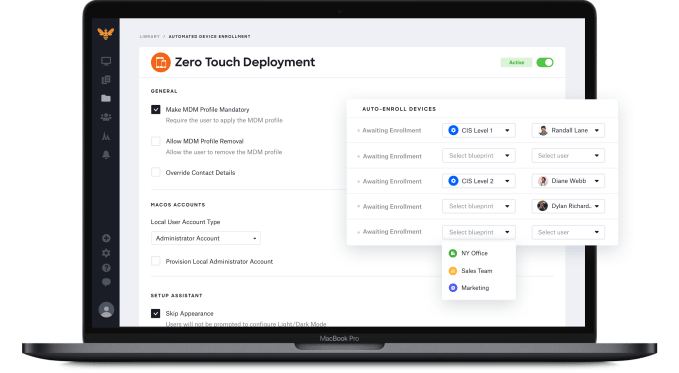
Image Credits: Kandji
He notes that the investment will not only enable him to build the employee base, but also expand the product too, and in the past year, it has already taken it from basic MDM into compliance, and there are new features coming as they continue to grow the product.
“If someone saw our product a year ago, it’s a very different product today, and it’s allowed us to move up market into the enterprise, which has been very exciting for us,” he said.
Powered by WPeMatico
Zoom adds a much-requested feature (but with a catch), TikTok partners with Shopify and Jack Dorsey lays out his argument for tomorrow’s Senate hearing. This is your Daily Crunch for October 27, 2020.
The big story: Zoom adds end-to-end encryption to free calls
Zoom was criticized earlier this year for saying it would only offer end-to-end encryption to paid users. Now it says free users will have the option as well, starting in Zoom 5.4.0 on both desktop and mobile.
There are, however, a few catches. If you use end-to-end encryption in a free meeting, features like cloud recording, live transcription and meeting reactions will not be available, nor will participants be able to join the call by phone.
In addition, you’ll need to provide a phone number and billing information. And you’ll need to use the Zoom app rather than joining a meeting via web browser.
The tech giants
TikTok partners with Shopify on social commerce — At launch, the agreement allows Shopify merchants to create, run and optimize their TikTok marketing campaigns directly from the Shopify dashboard.
How Jack Dorsey will defend Twitter in tomorrow’s Senate hearing on Section 230 — In his opening statement, the Twitter CEO calls Section 230 “the Internet’s most important law for free speech and safety” and focuses on the kind of cascading effects that could arise if tech’s key legal shield comes undone.
Microsoft stock flat despite better-than-expected earnings, strong Azure growth — In the three months ending September 30, Microsoft had revenues of $37.2 billion and per-share profit of $1.82.
Startups, funding and venture capital
Next-gen skincare, silk without spiders and pollution for lunch: Meet the biotech startups pitching at IndieBio’s Demo Day — Starting in 2015, IndieBio has provided resources to founders solving complex challenges with biotech, from fake meat to sustainability.
SpaceX launches Starlink app and provides pricing and service info to early beta testers — In terms of pricing, SpaceX says the cost for participants in this beta program will be $99 per month, plus a one-time cost of $499 for hardware.
SimilarWeb raises $120M for its AI-based market intelligence platform for sites and apps — The company will expand through acquisitions and its own R&D, with a focus on providing more analytics services to larger enterprises.
Advice and analysis from Extra Crunch
Five startup theses that will transform the 2020s — Danny Crichton lays out five clusters: wellness, climate, data society, creativity and fundamentals.
Ten favorite startups from Techstars’ October 2020 class — Ten favorites culled from the Atlanta, Los Angeles and New York City cohorts, as well as its accelerator with Western Union.
(Reminder: Extra Crunch is our membership program, which aims to democratize information about startups. You can sign up here.)
Everything else
Hands-on: Sony’s DualSense PS5 controller could be a game changer — The question is whether developers will truly embrace the new haptics and audio features.
T-Mobile launches new TVision streaming bundles, pricing starts at $10 per month — The carrier is launching new skinny bundles of live TV and streaming services to compete with expensive cable subscriptions.
The Daily Crunch is TechCrunch’s roundup of our biggest and most important stories. If you’d like to get this delivered to your inbox every day at around 3pm Pacific, you can subscribe here.

Powered by WPeMatico
Rockset, a cloud-native analytics company, announced a $40 million Series B investment today led by Sequoia with help from Greylock, the same two firms that financed its Series A. The startup has now raised a total of $61.5 million, according to the company.
As co-founder and CEO Venkat Venkataramani told me at the time of the Series A in 2018, there is a lot of manual work involved in getting data ready to use and it acts as a roadblock to getting to real insight. He hoped to change that with Rockset.
“We’re building out our service with innovative architecture and unique capabilities that allows full-featured fast SQL directly on raw data. And we’re offering this as a service. So developers and data scientists can go from useful data in any shape, any form to useful applications in a matter of minutes. And it would take months today,” he told me in 2018.
In fact, “Rockset automatically builds a converged index on any data — including structured, semi-structured, geographical and time series data — for high-performance search and analytics at scale,” the company explained.
It seems to be resonating with investors and customers alike as the company raised a healthy B round and business is booming. Rockset supplied a few metrics to illustrate this. For starters, revenue grew 290% in the last quarter. While they didn’t provide any foundational numbers for that percentage growth, it is obviously substantial.
In addition, the startup reports adding hundreds of new users, again not nailing down any specific numbers, and queries on the platform are up 313%. Without specifics, it’s hard to know what that means, but that seems like healthy growth for an early stage startup, especially in this economy.
Mike Vernal, a partner at Sequoia, sees a company helping to get data to work faster than other solutions, which require a lot of handling first. “Rockset, with its innovative new approach to indexing data, has quickly emerged as a true leader for real-time analytics in the cloud. I’m thrilled to partner with the company through its next phase of growth,” Vernal said in a statement.
The company was founded in 2016 by the creators of RocksDB. The startup had previously raised a $3 million seed round when they launched the company and the $18.5 million A round in 2018.
Powered by WPeMatico
Lightyear, a New York City startup that wants to make it easier for large companies to procure networking infrastructure like internet and SD-WAN, announced a $3.7 million seed round today.
Amplo led the round with help from Susa Ventures, Ludlow Ventures, Mark Cuban, David Adelman and Operator Partners. While it was at it, the company announced that it was emerging from stealth and offering its solution in public beta.
Company CEO and co-founder Dennis Thankachan says that while so much technology buying has moved online, networking technology procurement still involves phone calls for price quotes that could sometimes take weeks to get. Thankachan says that when he was working at a hedge fund specializing in telecommunications he witnessed this first hand and saw an opportunity for a startup to fill the void.
“Our objective is to make the process of buying telecom infrastructure, kind of like buying socks on Amazon, providing a real consumer-like experience to the enterprise and empowering buyers with data because information asymmetry and a lack of transparent data on what things should cost, where providers are available, and even what’s existing already in your network is really at the core of the problem for why this is frustrating for enterprise buyers,” Thankachan explained.
The company offers the ability to simply select a service and find providers in your area with costs and contract terms if it’s a simple purchase, but he recognizes that not all enterprise purchases will be that simple and the startup is working to digitize the corporate buying process into the Lightyear platform.
To provide the data that he spoke of, the company has already formed relationships with over 400 networking providers worldwide. The pricing model is in flux, but could involve a monthly subscription or a percentage of the sale. That is something they are working out, but they are using the latter during beta testing to keep the product free for now.
The company already has 10 employees and flush with the new investment, it plans to double that in the next year. Thankachan says as he builds the company, particularly as a person of color himself, he takes diversity and inclusion extremely seriously and sees it as part of the company’s core values.
“Trying to enable people from non-traditional backgrounds to succeed will be really important to us, and I think providing economic opportunity to people that traditionally would not have been afforded several aspects of economic opportunity is the biggest ways to fix the opportunity gap in this country,” he said.
The company, which launched a year ago has basically grown up during the pandemic. That means he has yet to meet any of his customers or investors in person, but he says he has learned to adapt to that approach. While he is based in NYC, his investors are are in the Bay Area and so that remote approach will remain in place for the time being.
As he makes his way from seed to a Series A, he says that it’s up to him to stay focused and execute with the goal of showing product-market fit across a variety of company types. He believes if the startup can do this, it will have the data to take to investors when it’s time to take the next step.
Powered by WPeMatico
Vimeo Record is a new product that allows teams to communicate through video messages.
Vimeo CEO Anjali Sud said that while the pandemic has prompted many offices to embrace digital communication tools like Zoom, “There’s a whole host of work communication that needs asynchronous messaging.”
Besides, sometimes a video can get your message across more effectively, rather than “scheduling another call or writing a long email or Slack thread.”
Sud said that since she became CEO of the IAC-owned video platform in 2017, Vimeo has shifted its focus from being a destination site that competed with YouTube to providing video tools for businesses: “We really want to be the single corporate video solution for the modern organization.”
Vimeo Record is an extension of that strategy. During the pandemic, Vimeo’s revenue has already been growing 40% to 50% year-over-year each month, but Sud said this product been in the works since before then, reflecting the long-term trend that “more and more teams are distributed, and they need ways to communicate.”
Collaborate better remotely with Vimeo Record from Vimeo Staff on Vimeo.
So Vimeo created a Google Chrome extension that allows users to easily record their screen or their face, share and comment on those recordings, organize them into folders with different permissions and receive notifications when someone watches.
Sud said around 400 companies have already been beta testing the feature. Teams are using it to review design and code, to work together to resolve customer support tickets, to share messages from company leadership and more.
Asked whether there’s been a learning curve for recording effective video messages, Sud said, “The biggest barrier is just making it not feel intimidating. The easiest way [to do that] is for people to receive a video message themselves. If a colleague sends you something that’s not perfect, it lowers that intimidation factor.”
She also noted that Vimeo Record fits into the company’s freemium business model. Anyone can send unlimited messages for free, but Vimeo will charge for premium features like the ability to host videos on a third-party, custom-branded video platform.
“My team is using Vimeo Record to share product demos internally and to give our customers a preview of what’s launching soon,” said Mailchimp’s director of product marketing Trevor Wolfe in a statement. “We love it! It adds a personal touch that you just can’t replicate with email or a chatroom message.”
Powered by WPeMatico
Israeli startup SimilarWeb has made a name for itself with an AI-based platform that lets sites and apps track and understand traffic not just on their own sites, but those of its competitors. Now, it’s taking the next step in its growth. The startup has raised $120 million, funding it will use to continue expanding its platform both through acquisitions and investing in its own R&D, with a focus on providing more analytics services to larger enterprises alongside its current base of individuals and companies of all sizes that do business on the web.
But not, it seems, necessarily an IPO at the moment.
Co-led by ION Crossover Partners and Viola Growth, the round doubles the total amount that the startup has raised to date to $240 million. Offer said that it was not disclosing its valuation this time around except to say that his company is now “playing in the big pool.” It counts more than half of the Fortune 100 as customers, with Walmart, P&G, Adidas and Google, among them.
For some context, it hit an $800 million valuation in its last equity round, in 2017.
SimilarWeb’s technology competes with other analytics and market intelligence providers ranging from the likes of Nielsen and ComScore through to the Apptopias of the world in that, at its most basic level, it provides a dashboard to users that provides insights into where people are going on desktop and mobile. Where it differs, Offer said, is in how it gets to its information, and what else it’s doing in the process.
For starters, it focuses not just how many people are visiting, but also a look into what is triggering the activity — the “why”, as it were — behind the activity. Using a host of AI tech such as machine learning algorithms and deep learning — like a lot of tech out of Israel, it’s being built by people with deep expertise in this area — Offer says that SimilarWeb is crunching data from a number of different sources to extrapolate its insights.
He declined to give much detail on those sources but told me that he cheered the arrival of privacy gates and cookie lists for helping ferret out, expose and sometimes eradicate some of the more nefarious “analytics” services out there, and said that SimilarWeb has not been affected at all by that swing to more data protection, since it’s not an analytics service, strictly speaking, and doesn’t sniff data on sights in the same way. It’s also exploring widening its data pool, he added:
“We are always thinking about what new signals we could use,” he said. “Maybe they will include CDNs. But it’s like Google with its rankings in search. It’s a never ending story to try to get the highest accuracy in the world.”
The global health pandemic has driven a huge amount of activity on the web this year, with people turning to sites and apps not just for leisure — something to do while staying indoors, to offset all the usual activities that have been cancelled — but for business, whether it be consumers using e-commerce services for shopping, or workers taking everything online and to the cloud to continue operating.
That has also seen a boost of business for all the various companies that help the wheels turn on that machine, SimilarWeb included.
“Consumer behavior is changing dramatically, and all companies need better visibility,” said Offer. “It started with toilet paper and hand sanitizer, then moved to desks and office chairs, but now it’s not just e-commerce but everything. Think about big banks, whose business was 70% offline and is now 70-80% online. Companies are building and undergoing a digital transformation.”
That in turn is driving more people to understand how well their web presence is working, he said, with the basic big question being: “What is my marketshare, and how does that compare to my competition? Everything is about digital visibility, especially in times of change.”
Like many other companies, SimilarWeb did see an initial dip in business, Offer said, and to that end the company has taken on some debt as part of Israel’s Paycheck Protection Program, to help safeguard some jobs that needed to be furloughed. But he added that most of its customers prior to the pandemic kicking off are now back, along with customers from new categories that hadn’t been active much before, like automotive portals.
That change in customer composition is also opening some doors of opportunity for the company. Offer noted that in recent months, a lot of large enterprises — which might have previously used SimilarWeb’s technology indirectly, via a consultancy, for example — have been coming to the company direct.
“We’ve started a new advisory service [where] our own expert works with a big customer that might have more deep and complex questions about the behaviour we are observing. They are questions all big businesses have right now.” The service sounds like a partly-educational effort, teaching companies that are not necessarily digital-first be more proactive, and partly consulting.
New customer segments, and new priorities in the world of business, are two of the things that drove this round, say investors.
“SimilarWeb was always an incredible tool for any digital professional,” said Gili Iohan of ION Crossover Partners, in a statement. “But over the last few months it has become apparent that traffic intelligence — the unparalleled data and digital insight that SimilarWeb offers — is an absolute essential for any company that wants to win in the digital world.”
As for acquisitions, SimilarWeb has historically made these to accelerate its technical march. For example, in 2015 it acquired Quettra to move deeper into mobile analytics and it acquired Swayy to move into content discovery insights (key for e-commerce intelligence). Offer would not go into too much detail about what it has identified as a further target but given that there are quite a lot of companies building tech in this area currently, that there might be a case for some consolidation around bigger platforms to combine some of the features and functionality. Offer said that it was looking at “companies with great data and digital intelligence, with a good product. There are a lot of opportunities right now on the table.”
The company will also be doing some hiring, with the plan to be to add 200 more people globally by January (it has around 600 employees today).
“Since we joined the company three years ago, SimilarWeb has executed a strategic transformation from a general-purpose measurement platform to vertical-based solutions, which has significantly expanded its market opportunity and generated immense customer value,” said Harel Beit-On, Founder and General Partner at Viola Growth, in a statement. “With a stellar management team of accomplished executives, we believe this round positions the company to own the digital intelligence category, and capitalize on the acceleration of the digital era.”
Powered by WPeMatico
The chip industry consolidation dance continued this morning as AMD has entered into an agreement to buy Xilinx for $35 billion, giving the company access to a broad set of specialized workloads.
AMD sees this deal as combining two companies that complement each other’s strengths without cannibalizing its own markets. CEO Lisa Su believes the acquisition will help make her company the high performance chip leader.
“By combining our world-class engineering teams and deep domain expertise, we will create an industry leader with the vision, talent and scale to define the future of high performance computing,” Su said in a statement.
In an article earlier this year, TechCrunch’s Darrell Etherington described Xilinx new satellite focused chips as offering a couple of industry firsts:
It’s the first 20nm process that’s rated for use in space, offering power and efficiency benefits, and it’s the first to offer specific support for high performance machine learning through neural network-based inference acceleration.
What’s more, the chips are designed to handle radiation and the rigors of launch, using a thick ceramic packaging.
In a call with analysts this morning, Su pointed to these kinds of specialized workloads as one of Xilinx’s strengths. “Xilinx has also built deep strategic partnerships across a diverse set of growing markets in 5G communications, data center, automotive, industrial, aerospace and defense. Xilinx is establishing themselves as a strategic technology partner to a broad set of industry leaders,” she said.
The success of these kinds of mega deals tend to hinge on whether the combined companies can work well together. Su pointed out that the two companies have been partnering for a number of years and already have a relationship, and the two company leaders share a common vision.
“Both AMD and Xilinx share common culture, focused on innovation, execution and collaborating deeply with customers. From a leadership standpoint, Victor and I have a shared vision of where we can take high performance and adaptive computing in the future,” Su said.
In a nod to shareholders of both companies, she said, “This is truly a compelling combination that will create significant value for all stakeholders, including AMD and Xilinx shareholders who will benefit from the future growth and upside potential of the combined company.”
So far stockholders aren’t impressed with AMD stock down over 4% in pre-trading, while Xilinx stock is up over 11% in pre-trading. Xilinx has a market cap over $28 billion compared with AMD’s $96.5 billion, creating a massive combined company.
This deal comes on the heels of last month’s ARM acquisition by Nvidia for $40 billion. With two deals in less than two months totaling $75 million, the industry is looking at the bigger is better theory. Meanwhile Intel took a hit earlier this month after its earnings report showed weakness in its data center business.
While the deal has been approved by both company’s boards of directors, it still has to pass muster with shareholders and regulators, and is not expected to close until the end of next year.
When that happens Su will be chairman of the combined company, while Xilinx president and CEO, Victor Peng will join AMD as president, where he will be in charge of the Xilinx business and strategic growth initiatives.
It’s worth noting that the Wall Street Journal first reported that a deal between these two companies could be coming together earlier this month.
Powered by WPeMatico