Enterprise
Auto Added by WPeMatico
Auto Added by WPeMatico

Contrast, a developer-centric application security company with customers that include Liberty Mutual Insurance, NTT Data, AXA and Bandwidth, today announced the launch of its security observability platform. The idea here is to offer developers a single pane of glass to manage an application’s security across its lifecycle, combined with real-time analysis and reporting, as well as remediation tools.
“Every line of code that’s happening increases the risk to a business if it’s not secure,” said Contrast CEO and chairman Alan Naumann. “We’re focused on securing all that code that businesses are writing for both automation and digital transformation.”
Over the course of the last few years, the well-funded company, which raised a $65 million Series D round last year, launched numerous security tools that cover a wide range of use cases, from automated penetration testing to cloud application security and now DevOps — and this new platform is meant to tie them all together.
DevOps, the company argues, is really what necessitates a platform like this, given that developers now push more code into production than ever — and the onus of ensuring that this code is secure is now also often on that.
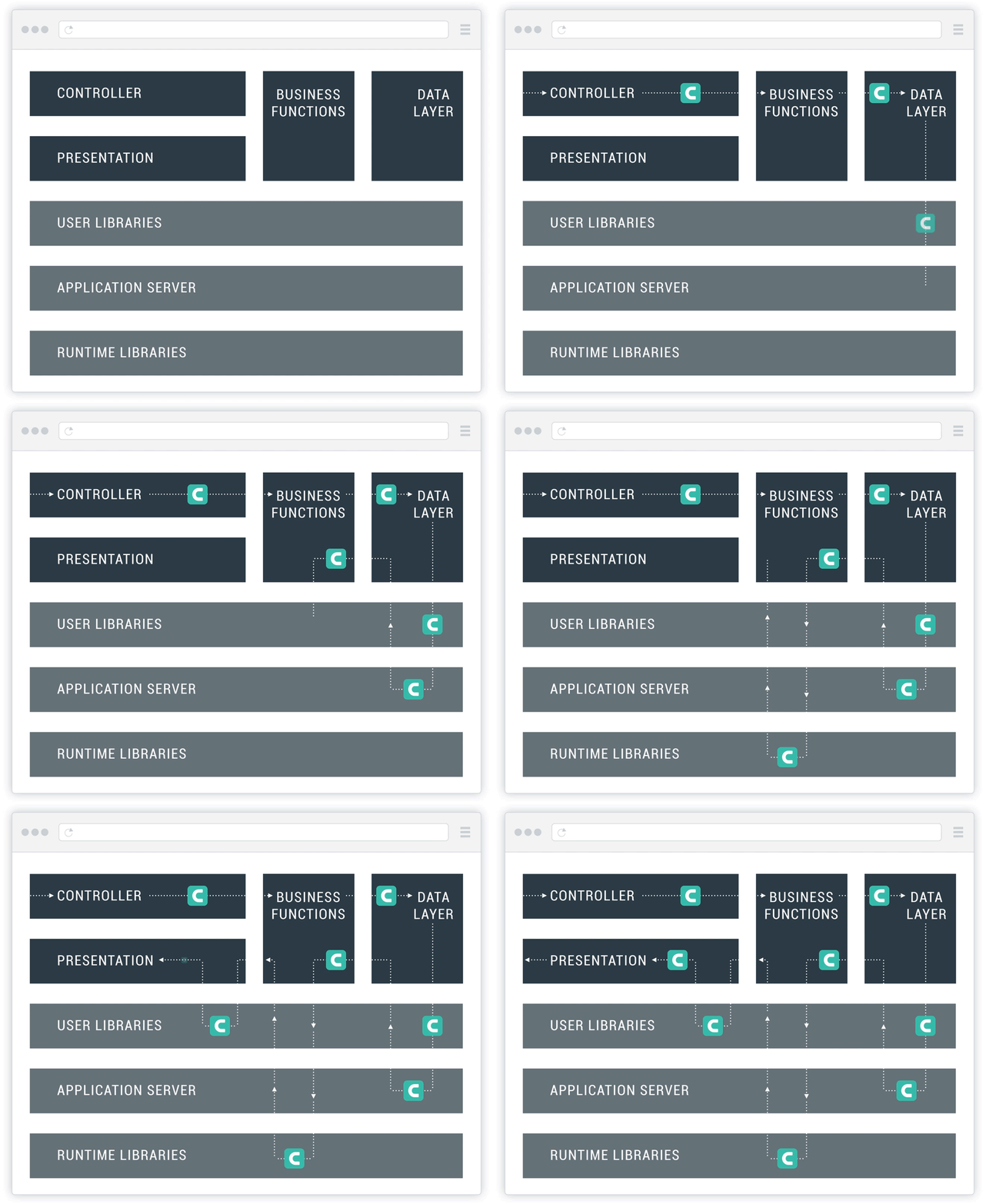
Image Credits: Contrast
Traditionally, Naumann argues, security services focused on the code itself and looking at traffic.
“We think at the application layer, the same principles of observability apply that have been used in the IT infrastructure space,” he said. “Specifically, we do instrumentation of the code and we weave security sensors into the code as it’s being developed and are looking for vulnerabilities and observing running code. […] Our view is: the world’s most complex systems are best when instrumented, whether it’s an airplane, a spacecraft, an IT infrastructure. We think the same is true for code. So our breakthrough is applying instrumentation to code and observing for security vulnerabilities.”
With this new platform, Contrast is aggregating information from its existing systems into a single dashboard. And while Contrast observes the code throughout its lifecycle, it also scans for vulnerabilities whenever a developers check code into the CI/CD pipeline, thanks to integrations with most of the standard tools like Jenkins. It’s worth noting that the service also scans for vulnerabilities in open-source libraries. Once deployed, Contrast’s new platform keeps an eye on the data that runs through the various APIs and systems the application connects to and scans for potential security issues there as well.
The platform currently supports all of the large cloud providers, like AWS, Azure and Google Cloud, and languages and frameworks, like Java, Python, .NET and Ruby.
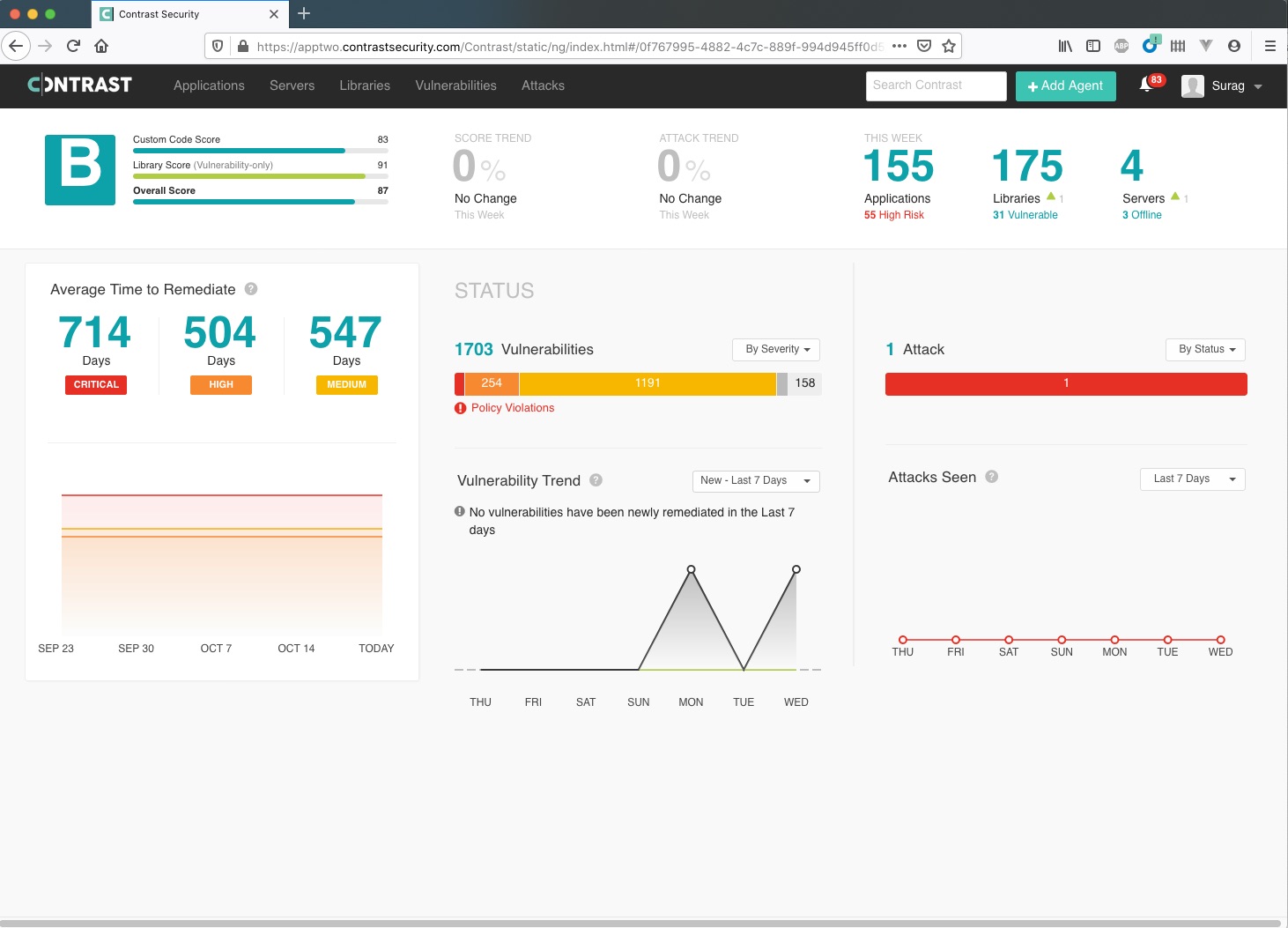
Image Credits: Contrast
Powered by WPeMatico
Project management service Wrike today announced at its user conference a major update to its platform that includes a lot of new AI smarts for keeping individual projects on track and on time, as well as new solutions for marketers and project management offices in large corporations. In addition, the company also launched a new budgeting feature and tweaks to the overall user experience.
The highlight of the launch, though, is, without doubt, the launch of the new AI and machine learning capabilities in Wrike . With more than 20,000 customers and over 2 million users on the platform, Wrike has collected a trove of data about projects that it can use to power these machine learning models.

Image Credits: Wrike
The way Wrike is now using AI falls into three categories: project risk prediction, task prioritization and tools for speeding up the overall project management workflow.
Figuring out the status of a project and knowing where delays could impact the overall project is often half the job. Wrike can now predict potential delays and alert project and team leaders when it sees events that signal potential issues. To do this, it uses basic information like start and end dates, but more importantly, it looks at the prior outcomes of similar projects to assess risks. Those predictions can then be fed into Wrike’s automation engine to trigger actions that could mitigate the risk to the project.
Task prioritization does what you would expect and helps you figure out what you should focus on right now to help a project move forward. No surprises there.
What is maybe more surprising is that the team is also launching voice commands (through Siri on iOS) and Gmail-like smart replies (in English for iOS and Android). Those aren’t exactly core features of a project management tool, but as the company notes, these features help remove the overall friction and reduce latencies. Another new feature that falls into this category is support for optical character recognition to allow you to scan printed and handwritten notes from your phones and attach them to tasks (iOS only).
“With more employees working from home, work and personal life are becoming intertwined,” the company argues. “As workers use AI in their personal lives, team managers and everyday users expect the smarts they’re accustomed to in consumer devices and apps to help them manage their work as well. Wrike Work Intelligence is the most comprehensive machine learning foundation that taps into tens of millions of work-related user engagements to power cross-functional collaboration to help organizations achieve operational efficiency, create new opportunities and accelerate digital transformation. Teams can focus on the work that matters most, predict and minimize delays, and cut communication latencies.”
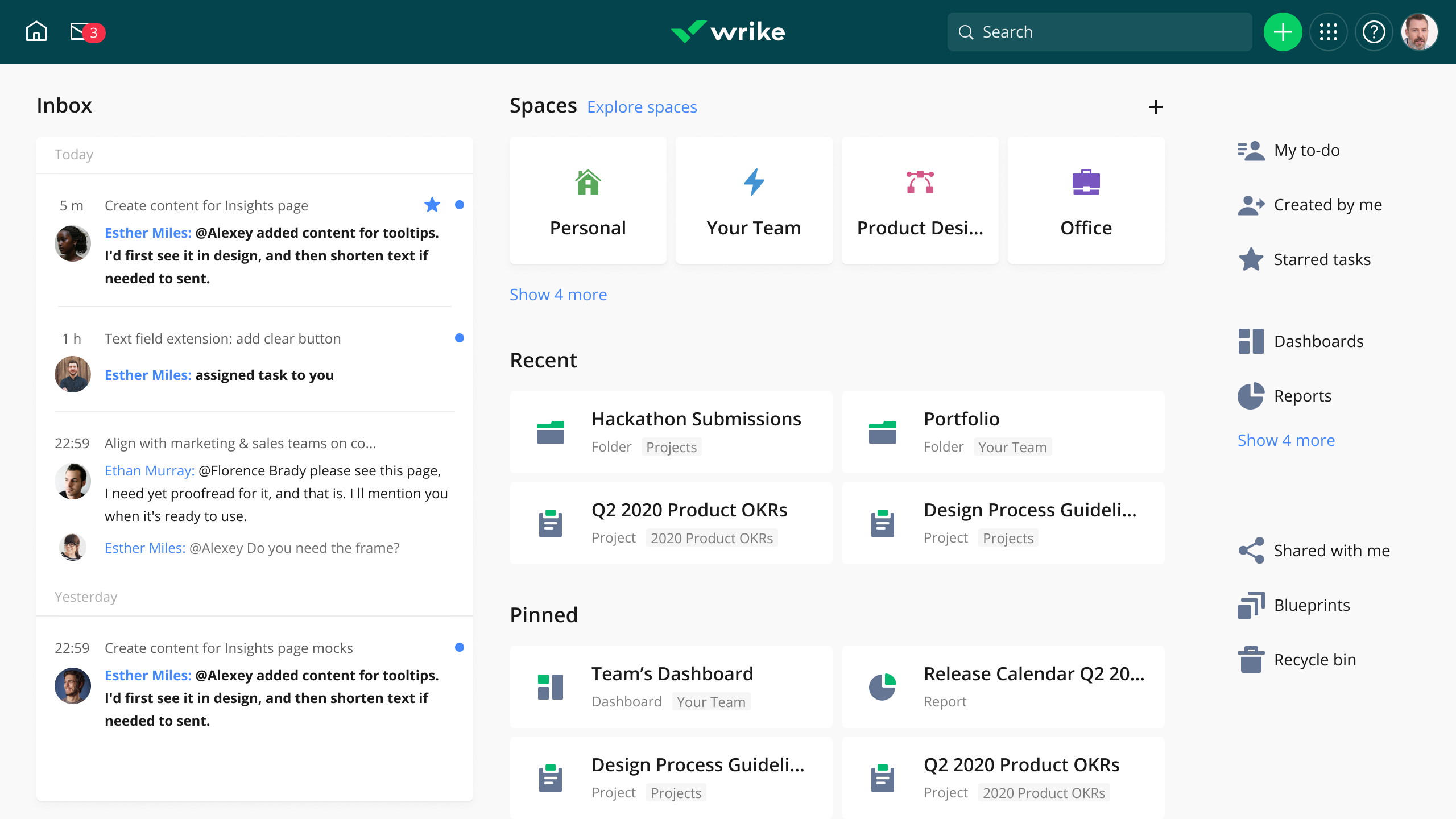
Image Credits: Wrike
The other major new feature — at least if you’re in digital marketing — is Wrike’s new ability to pull in data about your campaigns from about 50 advertising, marketing automation and social media tools, which is then displayed inside the Wrike experience. In a fast-moving field, having all that data at your fingertips and right inside the tool where you think about how to manage these projects seems like a smart idea.

Image Credits: Wrike
Somewhat related, Wrike’s new budgeting feature also now makes it easier for teams to keep their projects within budget, using a new built-in rate card to manage project pricing and update their financials.
“We use Wrike for an extensive project management and performance metrics system,” said Shannon Buerk, the CEO of engage2learn, which tested this new budgeting tool. “We have tried other PM systems and have found Wrike to be the best of all worlds: easy to use for everyone and savvy enough to provide valuable reporting to inform our work. Converting all inefficiencies into productive time that moves your mission forward is one of the keys to a culture of engagement and ownership within an organization, even remotely. Wrike has helped us get there.”
Powered by WPeMatico
Last night Datto priced its IPO at $27 per share, the top end of its range that TechCrunch covered last week. The data and security-focused software company had targeted a $24 to $27 per-share IPO price range, meaning that its final per-share value was at the top of its estimates.
The Exchange explores startups, markets and money. Read it every morning on Extra Crunch, or get The Exchange newsletter every Saturday.
The Datto IPO won’t draw lots of attention; its business is somewhat dull, as selling software to managed service providers rarely excites. But, the public offering matters for a different reason: It gives us a fresh lens into today’s IPO market.
That lens is the perspective of slower, more profitable growth. What is that worth?
 The value of quickly growing and unprofitable software and cloud companies is well known. Snowflake made a splash earlier this year on the back of huge growth and enormous losses. Investors ate its shares up, pushing its valuation to towering heights. This year we’ve even seen rapid growth and profits valued by public investors in the form of JFrog’s IPO.
But slower growth, software margins and profitability? Datto’s financial picture feels somewhat unique among the IPOs that TechCrunch has covered this year.
It’s a similar bet to the one that Egnyte is making; the enterprise software company crested $100 million ARR last year and announced that it grew by around 22% in the first half of 2020. And, it is profitable on an EBITDA basis. Therefore, the Datto IPO could provide a clue as to whether companies like Egnyte and the rest of the late-stage startup crop should be content to grow more slowly, but with the benefit of actually making money.
Here are the deal’s nuts and bolts:
Powered by WPeMatico
The pandemic has put stress on companies dealing with a workforce that is mostly — and sometimes suddenly — working from home. That has led to rising needs for security and governance tooling, something that Egnyte is looking to meet with new features aimed at helping companies cope with file management during the pandemic.
Egnyte helps customers manage files wherever they live — on premises or in the cloud. Over the years, it has added security and governance tooling to bring collaboration around files together with security and governance on a single platform.
“It’s no surprise that there’s been a rapid shift to remote work, which has I believe led to mass adoption of multiple applications running on multiple clouds, and tied to that has been a nonlinear reaction of exponential growth in data security and governance concerns,” Vineet Jain, co-founder and CEO at Egnyte, explained.
Egnyte’s announcements today are in part a reaction to the changes that COVID has brought, a mix of net-new features and capabilities that were on its road map, but accelerated to meet the needs of the changing technology landscape.
The company is introducing a new feature called Smart Cache to make sure that content (wherever it lives) that an individual user accesses most will be ready whenever they need it.
“Smart Cache uses machine learning to predict the content most likely to be accessed at any given site, so administrators don’t have to anticipate usage patterns. The elegance of the solution lies in that it is invisible to the end users,” Jain said. The end result of this capability could be lower storage and bandwidth costs, because the system can make this content available in an automated way only when it’s needed.
Another new feature is email scanning and governance. As Jain points out, email is often a company’s largest data store, but it’s also a conduit for phishing attacks and malware. So Egnyte is introducing an email governance tool that keeps an eye on this content, scanning it for known malware and ransomware and blocking files from being put into distribution when it identifies something that could be harmful.
As companies move more files around it’s important that security and governance policies travel with the document, so that policies can be enforced on the file wherever it goes. This was true before COVID-19, but has only become more true as more folks work from home.
Finally, Egnyte is using machine learning for auto-classification of documents to apply policies to documents without humans having to touch them. By identifying the document type automatically, whether it has personally identifying information or it’s a budget or planning document, Egnyte can help customers auto-classify and apply policies about viewing and sharing to protect sensitive materials.
Egnyte is reacting to the market needs as it makes changes to the platform. While the pandemic has pushed this along, these are features that companies with documents spread out across various locations can benefit from regardless of the times.
The company is over $100 million ARR today, and grew 22% in the first half of 2020. Whether the company can accelerate that growth rate in H2 2020 is not yet clear. Regardless, Egnyte is a budding IPO candidate for 2021 if market conditions hold.
Powered by WPeMatico
As companies have moved to work from home this year, working on the internet has become the norm, and it turns out that Chrome OS was an operating system built for cloud-based applications. But most enterprise use cases are a bit more complex, and Google introduced some new features today to make it easier for IT to distribute machines running Chrome OS.
While the shift to the cloud has been ongoing over the last few years, the pandemic has definitely pushed companies to move faster, says John Maletis, project manager for engineering and UX for Chrome OS. “With COVID-19, the need for that productive, distributed workforce with some employees in office, but mostly [working from home] is really in the sights of businesses everywhere, and it is rapidly accelerating that move,” Maletis told TechCrunch.
To that end, Cyrus Mistry, group product manager at Google says that they want to make it easier for IT to implement Chrome OS and they’ve added a bunch of features to help. For starters, they have created a free readiness tool that lets IT get the lay of the land of which applications are ready to run on Chrome OS, and which aren’t. The tools issues a report with three colors: green is good to go, yellow is probable and red is definitely not ready.
To help with the latter categories, the company also announced the availability of Parallels for Chrome OS, which will enable companies with Windows applications that can’t run on Chrome OS to run them natively in Windows in a virtual machine. Mistry acknowledges that companies running Windows this way will need to issue higher-end Chromebooks with the resources to handle this approach, but for companies with critical Windows applications, this is a good way to extend the usage of Chromebooks to a broader population of users.
“We can do what’s called zero touch, which is the devices can be already enrolled by the manufacturers, which means they will know the domain and they can now drop ship directly,” Mistry explained. That means these machines are equipped with the right settings, policies, applications, certificates and so forth, as though IT had set up the machine for the user.
In another nod to making life easier for IT, Google is offering a new set of certified applications like Salesforce, Zoom and Palo Alto Networks that have been certified to work well on Chrome OS. Finally, the company announced that it will be enabling multiple virtual work areas with the ability to drag-and-drop between them, along with the ability to group tabs and search for tabs in the Chrome browser, which should be ready in the next couple of months.
As Maletis pointed out, the company may have been ahead of the market when it released Chrome OS almost a decade ago, but this year has shown that companies need the cloud to stay in operation and Chrome OS is an operating system built from the ground up for the cloud.
Powered by WPeMatico
Invoca, which helps companies extract and use data from customer phone calls, is expanding today with the launch of products for e-commerce, customer experience and sales teams, as well as a new Invoca Exchange, where businesses can find all of the platform’s third-party integrations.
The company is making these announcements as part of its virtual Invoca Summit. Ahead of the event, CEO Gregg Johnson (previously an executive at Salesforce) told me that customers have been asking Invoca to expand beyond its previous focus on providing “conversation intelligence” to marketing teams.
“‘We need to get aligned on how we support the revenue journey,’” Johnson recalled businesses telling him. “We were already going down this path, but when COVID hit, we tripled down on it.”
He argued that the data that Invoca provides has become even more important during the pandemic and related lockdowns, when businesses only had “two sources of feedback” — digital interactions and customer conversations. And while there are plenty of analytics tools for tracking online behavior, Johnson said, “Customer conversations are really important because they get at why” people are behaving in a certain way.
And at the same time, Johnson said call center teams have had to shift to working at home, which meant that they had to switch to online software and “everything broke,” while supervisors “no longer had any visibility into how agents were performing.”
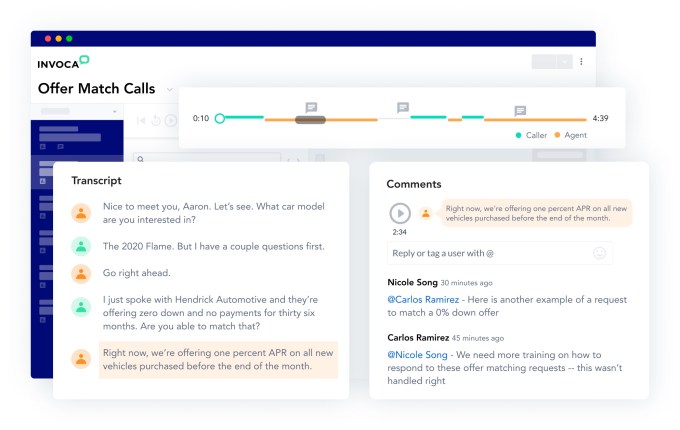
Image Credits: Invoca
Invoca is trying to address these issues by making sure that marketing, sales, customer experience and e-commerce teams all have access to the same call data.
For example, he said that agents at Invoca customer BBQGuys need data to understand what products to recommend for their customers if the specific grill that they want isn’t available. Or a healthcare provider might use call data to predict and prepare when COVID cases might be rising in their area.
“We’ve always viewed ourselves as an application and a platform,” Johnson added. “We already give you ability to use this data at Invoca to automatically apply these insights without any human intervention at all. So for us, we thought through use cases to feed this data into other tools and created four solutions … that are really joined at the hip.”
Invoca for eCommerce, Invoca for Customer Experience and the existing Invoca for Marketing product are all available now, while Invoca for Sales is currently signing up beta testers for November.
The Invoca Exchange, meanwhile, already includes more than 40 integrations, including Google, Salesforce, Facebook, Adobe, Tealium, and Five9. The company is also announcing new partnerships with FullStory and Criteo.
Powered by WPeMatico
Stampli, a collaborative invoice management software company, introduced a payments product today called Stampli Direct Pay.
The startup launched back in 2015 with a mission to simplify invoice management through collaboration (and a dash of AI). Interestingly, Stampli said it was uninterested at the time in providing a payments product alongside its collaborative suite, focusing instead on the process of procure to pay.
This latest announcement marks a shift in the company’s thinking. Cofounder and CEO Eyal Feldman explained that conversations with customers revealed just how frustrated many organizations are with the current B2B payments landscape.
Organizations have several options: cut and mail their own paper checks, use ACH, or sign on with a payments provider to use ‘e-payments.’
Cutting and mailing checks is a pre-historic, time-intensive activity that doesn’t really belong in 2020, while ACH (which comes at a very low, flat cost) often groups multiple transactions into a single sum, making it difficult for accounting to reconcile individual line item purchases.
“Under the misleading banner of “e-payments,” [payments providers] offer AP departments a rebate and promise vendors faster payment,” explained Feldman in a blog post. “However, in order for vendors to get the payment, they must accept payments as virtual credit cards, which come with up to a 3.5% credit card fee per transaction.”
And many payments providers do not provide the data extracted from invoices and transactions back to the organization as a way to stay sticky.
Stampli’s customers illuminated these problems for the startup, which used to be payments agnostic. With the launch of Stampli Direct Pay, the company is still payments flexible, letting organizations work with their existing or different payments providers. But Stampli now offers an option that aims to resolve many of these industry issues.
Because Stampli’s core product already tracks all the contextual and relevant info for every transaction, that information is readily available during payment approval. Direct Pay also offers ACH as a payment option, but separates individual transactions out for easy reconciliation. And for customers who want to stick with checks, Stampli Direct Pay offers a service that allows customers to approve digital checks which come directly from their bank account with their signature, with Stampli handling printing, stamping, and mailing.
Stampli also offers a vendor payment portal that extracts the needed data for each vendor and lets the customer own that data, which can be downloaded and taken to another payment provider.
The company has spent the last four years solving an entirely different problem.
Usually, teams purchase products or services and those invoices end up in the finance department with little to no context, setting off a game of duck duck goose within the organization as accountants try to get the information and approvals they need to pay out that vendor.
Stampli, which has raised $32 million to date, built out a collaborative platform that allows non-accountants to participate in the invoice management process in a way that’s straightforward and simple. Each invoice becomes a communications hub, allowing folks across various departments fill in the blanks and. answer questions about the purchase. Stampli also uses machine learning to recognize patterns around allocating costs, managing approval workflows, and the data that needs to be extracted from invoices.
Each invoice is turned into its own communications hub, allowing people across departments to fill in the blanks and answer questions so that payments are handled as efficiently as possible. Moreover, Stampli uses machine learning to recognize patterns around how the organization allocates cost, manages approval workflows and what data is extracted from invoices.
With the launch of Direct Pay, Stampli is poised to take on a variety of new competitors with an obvious differentiator. The company has processed more than $13 billion in invoices annually.
The team has also grown to more than 100 employees. Fifty-six percent of the company’s US workforce is non-white and 33 percent of the executive leadership team is female, according to Feldman.
Powered by WPeMatico

Microsoft is taking its Azure cloud computing platform to the final frontier — space. It now has a dedicated business unit called Azure Space for that purpose, made up of industry heavyweights and engineers who are focused on space-sector services, including simulation of space missions, gathering and interpreting satellite data to provide insights and providing global satellite networking capabilities through new and expanded partnerships.
One of Microsoft’s new partners for Azure Space is SpaceX, the progenitor and major current player in the so-called “New Space” industry. SpaceX will be providing Microsoft with access to its Starlink low-latency satellite-based broadband network for Microsoft’s new Azure Modular Datacenter (MDC) — essentially an on-demand container-based data center unit that can be deployed in remote locations, either to operate on their own or boost local capabilities.

Image Credits: Microsoft
The MDC is a contained unit, and can operate off-grid using its own satellite network connectivity add-on. It’s similar in concept to the company’s work on underwater data centres, but keeping it on the ground obviously opens up more opportunities in terms of locating it where people need it, rather than having to be proximate to an ocean or sea.
The other big part of this announcement focuses on space preparedness via simulation. Microsoft revealed the Azure Orbital Emulator today, which provides in a computer emulated environment the ability to test satellite constellation operations in simulation, using both software and hardware. It’s basically aiming to provide as close to in-space conditions as are possible on the ground in order to get everything ready for coordinating large, interconnected constellations of automated satellites in low Earth orbit, an increasing need as more defense agencies and private companies pursue this approach versus the legacy method of relying on one, two or just a few large geosynchronous spacecraft.

Image Credits: Microsoft
Microsoft says the goal with the Orbital Emulator is to train AI for use on orbital spacecraft before those spacecraft are actually launched — from the early development phase, right up to working with production hardware on the ground before it takes its trip to space. That’s definitely a big potential competitive advantage, because it should help companies spot even more potential problems early on while they’re still relatively easy to fix (not the case on orbit).
This emulated environment for on-orbit mission prep is already in use by Azure Government customers, the company notes. It’s also looking for more partners across government and industry for space-related services, including communication, national security, satellite services including observation and telemetry and more.
SpaceX confirms Starlink internet private beta underway, showing low latency and speeds over 100Mbps
Powered by WPeMatico

Data platform Splunk today announced that it has acquired two startups, Plumbr and Rigor, to build out its new Observability Suite, which is also launching today. Plumbr is an application performance monitoring service, while Rigor focuses on digital experience monitoring, using synthetic monitoring and optimization tools to help businesses optimize their end-user experiences. Both of these acquisitions complement the technology and expertise Splunk acquired when it bought SignalFx for over $1 billion last year.
Splunk did not disclose the price of these acquisitions, but Estonia-based Plumbr had raised about $1.8 million, while Atlanta-based Rigor raised a debt round earlier this year.
When Splunk acquired SignalFx, it said it did so in order to become a leader in observability and APM. As Splunk CTO Tim Tully told me, the idea here now is to accelerate this process.
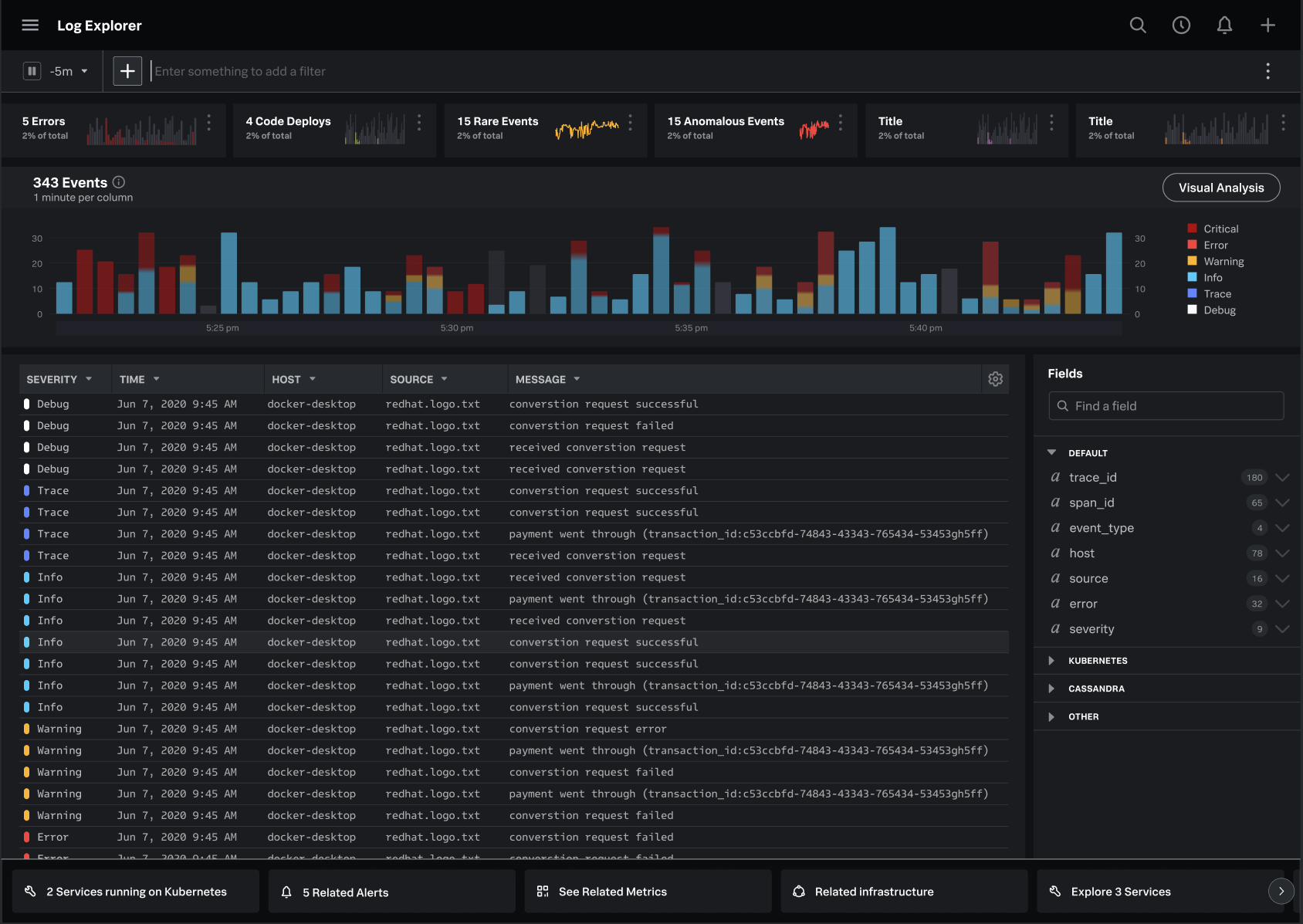
Image Credits: Splunk
“Because a lot of our users and our customers are moving to the cloud really, really quickly, the way that they monitor [their] applications changed because they’ve gone to serverless and microservices a ton,” he said. “So we entered that space with those acquisitions, we quickly folded them together with these next two acquisitions. What Plumbr and Rigor do is really fill out more of the portfolio.”
He noted that Splunk was especially interested in Plumbr’s bytecode implementation and its real-user monitoring capabilities, and Rigor’s synthetics capabilities around digital experience monitoring (DEM). “By filling in those two pieces of the portfolio, it gives us a really amazing set of solutions because DEM was the missing piece for our APM strategy,” Tully explained.
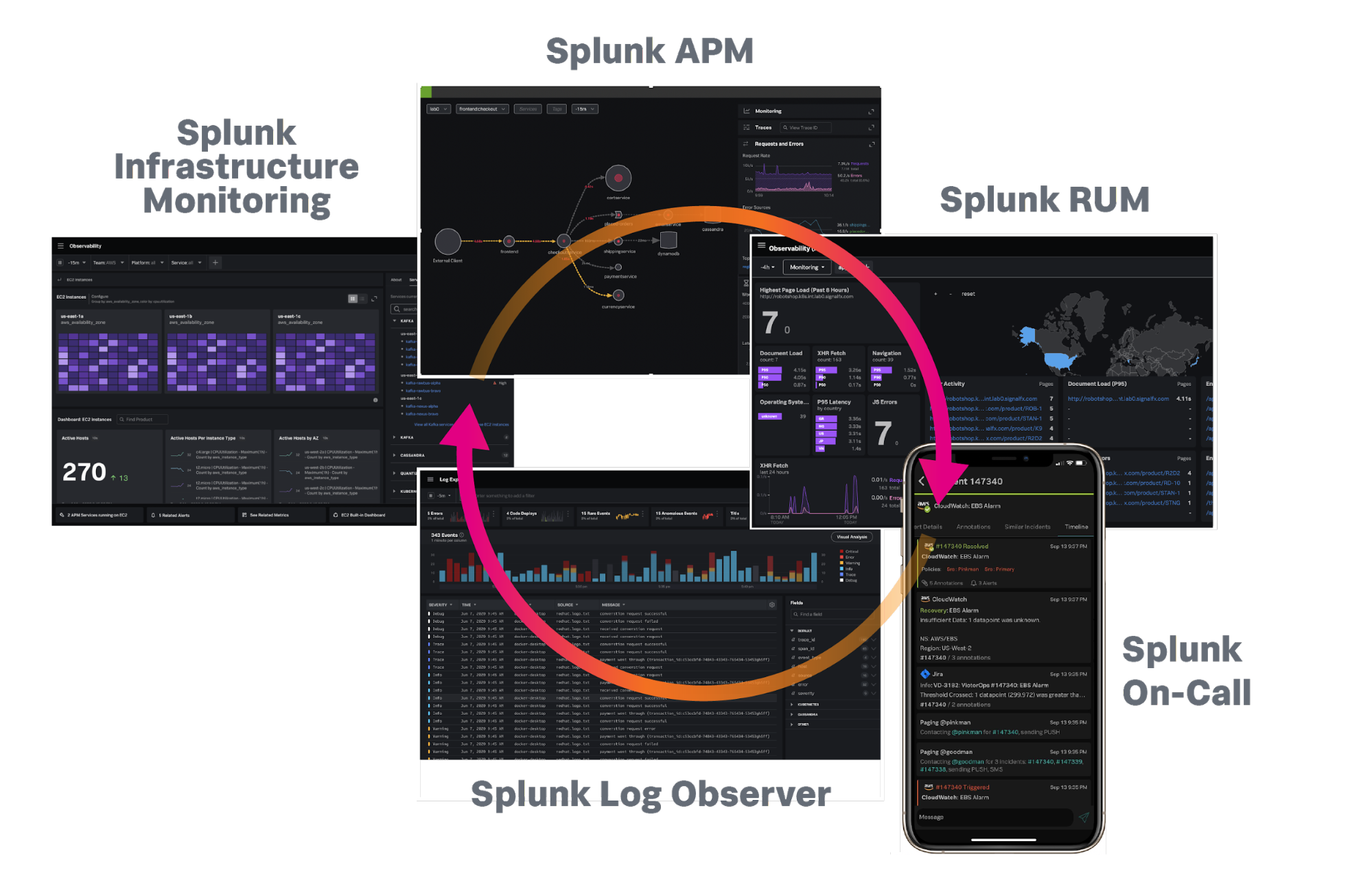
Image Credits: Splunk
With the launch of its Observability Suite, Splunk is now pulling together a lot of these capabilities into a single product — which also features a new design that makes it stand apart from the rest of Splunk’s tools. It combines logs, metrics, traces, digital experience, user monitoring, synthetics and more.
“At Yelp, our engineers are responsible for hundreds of different microservices, all aimed at helping people find and connect with great local businesses,” said Chris Gordon, Technical Lead at Yelp, where his team has been testing the new suite. “Our Production Observability team collaborates with Engineering to improve visibility into the performance of key services and infrastructure. Splunk gives us the tools to empower engineers to monitor their own services as they rapidly ship code, while also providing the observability team centralized control and visibility over usage to ensure we’re using our monitoring resources as efficiently as possible.”
Powered by WPeMatico
One big technology by-product of the Covid-19 pandemic has been a much stronger focus on online education solutions — providing the tools for students to continue learning when the public health situation is preventing them from going into physical classrooms. As it happens, that paradigm also applies to the business world.
Today, a startup out of Dublin called LearnUpon, which has been building e-learning solutions not for schools but corporates to use for development and training, has raised $56 million to feed a growth in demand for its tools, particularly in the U.S. market, which currently accounts for 70% of LearnUpon’s sales.
The funding is coming from a single investor, Summit Partners . LearnUpon’s CEO and co-founder Brendan Noud said the capital will be used in two areas. First, to add more people to the startup’s engineering and product teams (it has 180 employees currently) to continue expanding in areas like data analytics, providing more insights to its customers on how their training materials are used on via its learning management system (commonly referred to as LMS in the industry). Second, to bring on more people to help sell the product particularly in countries where it is currently growing fast, like the U.S., to larger corporate clients.
LearnUpon already has some 1,000 customers globally, including Booking.com, Twilio, USA Football and Zendesk. And notably, eight-year-old LearnUpon was profitable and had only raised $1.5 million before now.
“We’ve been growing organically pretty fast since we started but especially for the last 4-5 years using a SaaS model, but now we’re at a scale where the opportunity is vast, especially with more people working from home,” he said. “We want to give ourselves firepower.”
Corporate learning has followed similar but not identical trajectory to that of online education for K-12 and higher learning. In common, especially in the last 8 months. has been a growing need to engage and connect with learners at a time when it’s been challenging, or in some cases impossible, to see each other in person.
What’s different is that corporate learning was already a very established market, with organizations widely investing in online tools to manage training and personal development for years before any pandemic necessitated it.
Areas like employee onboarding, personnel development, customer training, training on new products, partner training, sales development, compliance, and building training services that you then sell to third parties are all areas that count as corporate learning. One researcher estimated that the corporate learning market was valued at an eye-watering $64 billion in 2019, with LMS investments alone at over $9 billion that year, and both are growing.
That has been a boost for companies like LearnUpon, which provides services in all of those categories and says that annual recurring revenues have grown by more than 50% year-on-year for each of the last 12 quarters.
But that also underscores the challenge in the market.
“It’s definitely a very crowded space, with maybe over 1000 LMS’s out there,” said Noud, although he added that it only has about 10-15 actually direct competitors (which to me still sounds like quite a lot). They include the likes of Cornerstone, TalentLMS from the Greek startup Epignosis, the Candian publicly-traded Docebo, and 360Learning from France.
But also consider those that have moved into corporate learning from other directions. LinkedIn has made big moves into learning to complement its bigger recruitment and professional development profile; and companies originally built to target the education sector, such as Coursera and Kahoot, have also expanded into business training and education. Both represent further competitive fronts for companies like LearnUpon natively built to service the business market.
Noud said that one reason why LearnUpon is finding some traction against the rest of the pack, and why it’s better, is because it’s a more comprehensive platform. Users can run live or asynchronous (on-demand) learning or training, and the SaaS LMS is designed to handle material and learning environments for multiple “students” — be they internal users, partners of the organization, or customers. In contrast, he said that many other solutions are more narrow in their scope, requiring organizations to manage multiple systems.
“And the legacy platforms are overly bloated, with bad customer support, which was a key area for us,” he said, recalling back to eight years ago when he and co-founder Des Anderson were first starting LearnUpon. “Our first hire was in customer support, and that has carried through to how we have grown.”
One area where LearnUpon not doing anything right now is in content development. It does offer tools to construct tests and surveys, but users can also import content created with other e-learning authoring tools, Noud said. Similarly, it’s not in the business of building its own live teaching platforms: you can import links from others like Zoom to provide the platform where people will teach and engage.
That’s not going to be a focus for now for the company, but given that others it competes with are providing a one-stop shop, for those that are looking to simplify procurement and have a more direct hand in building training as well as managing it, you can see how this might be an area that LearnUpon might develop down the line.
“In today’s knowledge economy, we believe corporate learning has become a key requirement for all organizations of scale – and the added challenge of remote working has only accelerated the importance of delivering learning digitally,” said Antony Clavel, a Principal with Summit Partners, in a statement. “With its modern, cloud-based learning management system, strong product development organization, demonstrated dedication to customer success and capital efficient go-to-market model, we believe LearnUpon is strongly positioned to serve this growing and increasingly critical market need. We are thrilled to support Brendan and the LearnUpon team in this next phase of growth.”
Clavel is joining the LearnUpon Board of Directors with this round. The startup is not disclosing its valuation.
Powered by WPeMatico