Enterprise
Auto Added by WPeMatico
Auto Added by WPeMatico
Materialize, the SQL streaming database startup built on top of the open-source Timely Dataflow project, announced a $32 million Series B investment led by Kleiner Perkins, with participation from Lightspeed Ventures.
While it was at it, the company also announced a previously unannounced $8 million Series A from last year, led by Lightspeed, bringing the total raised to $40 million.
These firms see a solid founding team that includes CEO Arjun Narayan, formerly of Cockroach Labs, and chief scientist Frank McSherry, who created the Timely Dataflow project on which the company is based.
Narayan says that the company believes fundamentally that every company needs to be a real-time company, and it will take a streaming database to make that happen. Further, he says the company is built using SQL because of its ubiquity, and the founders wanted to make sure that customers could access and make use of that data quickly without learning a new query language.
“Our goal is really to help any business to understand streaming data and build intelligent applications without using or needing any specialized skills. Fundamentally what that means is that you’re going to have to go to businesses using the technologies and tools that they understand, which is standard SQL,” Narayan explained.
Bucky Moore, the partner at Kleiner Perkins leading the B round, sees this standard querying ability as a key part of the technology. “As more businesses integrate streaming data into their decision-making pipelines, the inability to ask questions of this data with ease is becoming a non-starter. Materialize’s unique ability to provide SQL over streaming data solves this problem, laying the foundation for them to build the industry’s next great data platform,” he said.
They would naturally get compared to Confluent, a streaming database built on top of the Apache Kafka open-source streaming database project, but Narayan says his company uses straight SQL for querying, while Confluent uses its own flavor.
The company still is working out the commercial side of the house and currently provides a typical service offering for paying customers with support and a service agreement (SLA). The startup is working on a SaaS version of the product, which it expects to release some time next year.
They currently have 20 employees with plans to double that number by the end of next year as they continue to build out the product. As they grow, Narayan says the company is definitely thinking about how to build a diverse organization.
He says he’s found that hiring in general has been challenging during the pandemic, and he hopes that changes in 2021, but he says that he and his co-founders are looking at the top of the hiring funnel because otherwise, as he points out, it’s easy to get complacent and rely on the same network of people you have been working with before, which tends to be less diverse.
“The KPIs and the metrics we really want to use to ensure that we really are putting in the extra effort to ensure a diverse sourcing in your hiring pipeline and then following that through all the way through the funnel. That’s I think the most important way to ensure that you have a diverse [employee base], and I think this is true for every company,” he said.
While he is working remotely now, he sees having multiple offices with a headquarters in NYC when the pandemic finally ends. Some employees will continue to work remotely, with the majority coming into one of the offices.
Powered by WPeMatico
We are hearing that a COVID-19 vaccine could be on the way sooner than later, and that means we could be returning to normal life some time in 2021. That’s the good news. The perplexing news, however, is that each time some positive news emerges about a vaccine — and believe me I’m not complaining — Wall Street punishes stocks it thinks benefits from us being stuck at home. That would be companies like Zoom and Peloton.
While I’m not here to give investment advice, I’m confident that these companies are going to be fine even after we return to the office. While we surely pine for human contact, office brainstorming, going out to lunch with colleagues and just meeting and collaborating in the same space, it doesn’t mean we will simply return to life as it was before the pandemic and spend five days a week in the office.
One thing is clear in my discussions with startups born or growing up during the pandemic: They have learned to operate, hire and sell remotely, and many say they will continue to be remote-first when the pandemic is over. Established larger public companies like Dropbox, Facebook, Twitter, Shopify and others have announced they will continue to offer a remote-work option going forward. There are many other such examples.
It’s fair to say that we learned many lessons about working from home over this year, and we will carry them with us whenever we return to school and the office — and some percentage of us will continue to work from home at least some of the time, while a fair number of businesses could become remote-first.
On November 9, news that the Pfizer vaccine was at least 90% effective threw the markets for a loop. The summer trade, in which investors moved capital from traditional, non-tech industries and pushed it into software shares, flipped; suddenly the stocks that had been riding a pandemic wave were losing ground while old-fashioned, even stodgy, companies shot higher.
Powered by WPeMatico
As IBM makes a broad shift in strategy, Bloomberg reported this morning that the company would be cutting around 10,000 jobs in Europe. This comes on the heels of last month’s announcement that the organization will be spinning out its infrastructure services business next year. While IBM wouldn’t confirm the layoffs, a spokesperson suggested there were broad structural changes ahead for the company as it concentrates fully on a hybrid cloud approach.
IBM had this to say in response to a request for comment on the Bloomberg report: “Our staffing decisions are made to provide the best support to our customers in adopting an open hybrid cloud platform and AI capabilities. We also continue to make significant investments in training and skills development for IBMers to best meet the needs of our customers.”
Unfortunately, that means basically if you don’t have the currently required skill set, chances are you might not fit with the new version of IBM. IBM CEO Arvind Krishna alluded to the changing environment in an interview with Jon Fortt at the CNBC Evolve Summit earlier this month when he said:
The Red Hat acquisition gave us the technology base on which to build a hybrid cloud technology platform based on open-source, and based on giving choice to our clients as they embark on this journey. With the success of that acquisition now giving us the fuel, we can then take the next step, and the larger step, of taking the managed infrastructure services out. So the rest of the company can be absolutely focused on hybrid cloud and artificial intelligence.
The story has always been the same around IBM layoffs, that as they make the transition to a new model, it requires eliminating positions that don’t fit into the new vision, and today’s report is apparently no different, says Holger Mueller, an analyst at Constellation Research.
“IBM is in the biggest transformation of the company’s history as it moves from services to software and specialized hardware with Quantum. That requires a different mix of skills in its employee base and the repercussions of that manifest itself in the layoffs that IBM has been doing, mostly quietly, for the last 5+ years,” he said.
None of this is easy for the people involved. It’s never a good time to lose your job, but the timing of this one feels worse. In the middle of a recession brought on by COVID, and as a second wave of the virus sweeps over Europe, it’s particularly difficult.
We have reported on a number of IBM layoffs over the last five years. In May, it confirmed layoffs, but wouldn’t confirm numbers. In 2015, we reported on a 12,000 employee layoff.
Powered by WPeMatico
When you launch an application in the public cloud, you usually put everything on one provider, but what if you could choose the components based on cost and technology and have your database one place and your storage another?
That’s what Cast.ai says that it can provide, and today it announced a healthy $7.7 million seed round from TA Ventures, DNX, Florida Funders and other unnamed angels to keep building on that idea. The round closed in June.
Company CEO and co-founder Yuri Frayman says that they started the company with the idea that developers should be able to get the best of each of the public clouds without being locked in. They do this by creating Kubernetes clusters that are able to span multiple clouds.
“Cast does not require you to do anything except for launching your application. You don’t need to know […] what cloud you are using [at any given time]. You don’t need to know anything except to identify the application, identify which [public] cloud providers you would like to use, the percentage of each [cloud provider’s] use and launch the application,” Frayman explained.
This means that you could use Amazon’s RDS database and Google’s ML engine, and the solution decides how to make that work based on your requirements and price. You set the policies when you are ready to launch and Cast will take care of distributing it for you in the location and providers that you desire, or that makes most sense for your application.
The company takes advantage of cloud-native technologies, containerization and Kubernetes to break the proprietary barriers that exist between clouds, says company co-founder Laurent Gil. “We break these barriers of cloud providers so that an application does not need to sit in one place anymore. It can sit in several [providers] at the same time. And this is great for the Kubernetes application because they’re kind of designed with this [flexibility] in mind,” Gil said.
Developers use the policy engine to decide how much they want to control this process. They can simply set location and let Cast optimize the application across clouds automatically, or they can select at a granular level exactly the resources they want to use on which cloud. Regardless of how they do it, Cast will continually monitor the installation and optimize based on cost to give them the cheapest options available for their configuration.
The company currently has 25 employees with four new hires in the pipeline, and plans to double to 50 by the end of 2021. As they grow, the company is trying keep diversity and inclusion front and center in its hiring approach; they currently have women in charge of HR, marketing and sales at the company.
“We have very robust processes on the continuous education inside of our organization on diversity training. And a lot of us came from organizations where this was very visible and we took a lot of those processes [and lessons] and brought them here,” Frayman said.
Frayman has been involved with multiple startups, including Cujo.ai, a consumer firewall startup that participated in TechCrunch Disrupt Battlefield in New York in 2016.
Powered by WPeMatico
Proxyclick began life by providing an easy way to manage visitors in your building with an iPad-based check-in system. As the pandemic has taken hold, however, customer requirements have changed, and Proxyclick is changing with them. Today the company announced Proxyclick Flow, a new system designed to check in employees during the time of COVID.
“Basically when COVID hit, our customers told us that actually our employees are the new visitors. So what you used to ask your visitors, you are now asking your employees — the usual probing questions, but also when are you coming and so forth. So we evolved the offering into a wider platform,” Proxyclick co-founder and CEO Gregory Blondeau explained.
That means instead of managing a steady flow of visitors — although it can still do that — the company is focusing on the needs of customers who want to open their offices on a limited basis during the pandemic, based on local regulations. To help adapt the platform for this purpose, the company developed the Proovr smartphone app, which employees can use to check in prior to going to the office, complete a health checklist, see who else will be in the office and make sure the building isn’t over capacity.
When the employee arrives at the office, they get a temperature check, and then can use the QR code issued by the Proovr app to enter the building via Proxyclick’s check-in system or whatever system they have in place. Beyond the mobile app, the company has designed the system to work with a number of adjacent building management and security systems so that customers can use it in conjunction with existing tooling.
They also beefed up the workflow engine that companies can adapt based on their own unique entrance and exit requirements. The COVID workflow is simply one of those workflows, but Blondeau recognizes not everyone will want to use the exact one they have provided out of the box, so they designed a flexible system.
“So the challenge was technical on one side to integrate all the systems, and afterwards to group workflows on the employee’s smartphone, so that each organization can define its own workflow and present it on the smartphone,” Blondeau said.
Once in the building, the systems registers your presence and the information remains on the system for two weeks for contact tracing purposes should there be an exposure to COVID. You check out when you leave the building, but if you forget, it automatically checks you out at midnight.
The company was founded in 2010 and has raised $18.5 million. The most recent raise was a $15 million Series B in January.
Powered by WPeMatico
Consumer drones have over the years struggled with an image of being no more than expensive and delicate toys. But applications in industrial, military and enterprise scenarios have shown that there is indeed a market for unmanned aerial vehicles, and today, a startup that makes drones for some of those latter purposes is announcing a large round of funding and a partnership that provides a picture of how the drone industry will look in years to come.
Percepto, which makes drones — both the hardware and software — to monitor and analyze industrial sites and other physical work areas largely unattended by people, has raised $45 million in a Series B round of funding.
Alongside this, it is now working with Boston Dynamics and has integrated its Spot robots with Percepto’s Sparrow drones, with the aim being better infrastructure assessments, and potentially more as Spot’s agility improves.
The funding is being led by a strategic backer, Koch Disruptive Technologies, the investment arm of industrial giant Koch Industries (which has interests in energy, minerals, chemicals and related areas), with participation also from new investors State of Mind Ventures, Atento Capital, Summit Peak Investments and Delek-US. Previous investors U.S. Venture Partners, Spider Capital and Arkin Holdings also participated. (It appears that Boston Dynamics and SoftBank are not part of this investment.)
Israel-based Percepto has now raised $72.5 million since it was founded in 2014, and it’s not disclosing its valuation, but CEO and founder Dor Abuhasira described as “a very good round.”
“It gives us the ability to create a category leader,” Abuhasira said in an interview. It has customers in around 10 countries, with the list including ENEL, Florida Power and Light and Verizon.
While some drone makers have focused on building hardware, and others are working specifically on the analytics, computer vision and other critical technology that needs to be in place on the software side for drones to work correctly and safely, Percepto has taken what I referred to, and Abuhasira confirmed, as the “Apple approach”: vertical integration as far as Percepto can take it on its own.
That has included hiring teams with specializations in AI, computer vision, navigation and analytics as well as those strong in industrial hardware — all strong areas in the Israel tech landscape, by virtue of it being so closely tied with its military investments. (Note: Percepto does not make its own chips: these are currently acquired from Nvidia, he confirmed to me.)
“The Apple approach is the only one that works in drones,” he said. “That’s because it is all still too complicated. For those offering an Android-style approach, there are cracks in the complete flow.”
It presents the product as a “drone-in-a-box”, which means in part that those buying it have little work to do to set it up to work, but also refers to how it works: its drones leave the box to make a flight to collect data, and then return to the box to recharge and transfer more information, alongside the data that is picked up in real time.
The drones themselves operate on an on-demand basis: they fly in part for regular monitoring, to detect changes that could point to issues; and they can also be launched to collect data as a result of engineers requesting information. The product is marketed by Percepto as “AIM”, short for autonomous site inspection and monitoring.
News broke last week that Amazon has been reorganising its Prime Air efforts — one sign of how some more consumer-facing business applications — despite many developments — may still have some turbulence ahead before they are commercially viable. Businesses like Percepto’s stand in contrast to that, with their focus specifically on flying over, and collecting data, in areas where there are precisely no people present.
It has dovetailed with a bigger focus from industries on the efficiencies (and cost savings) you can get with automation, which in turn has become the centerpiece of how industry is investing in the buzz phrase of the moment, “digital transformation.”
“We believe Percepto AIM addresses a multi-billion-dollar issue for numerous industries and will change the way manufacturing sites are managed in the IoT, Industry 4.0 era,” said Chase Koch, president of Koch Disruptive Technologies, in a statement. “Percepto’s track record in autonomous technology and data analytics is impressive, and we believe it is uniquely positioned to deliver the remote operations center of the future. We look forward to partnering with the Percepto team to make this happen.”
The partnership with Boston Dynamics is notable for a couple of reasons: it speaks to how various robotics hardware will work together in tandem in an automated, unmanned world, and it speaks to how Boston Dynamics is pulling up its socks.
On the latter front, the company has been making waves in the world of robotics for years, specifically with its agile and strong dog-like (with names like “Spot” and “Big Dog”) robots that can cover rugged terrain and handle tussles without falling apart.
That led it into the arms of Google, which acquired it as part of its own secretive moonshot efforts, in 2013. That never panned out into a business, and probably gave Google more complicated optics at a time when it was already being seen as too powerful. Then, SoftBank stepped in to pick it up, along with other robotics assets, in 2017. That hasn’t really gone anywhere either, it seems, and just this month it was reported that Boston Dynamics was reportedly facing yet another suitor, Hyundai.
All of this is to say that partnerships with third parties that are going places (quite literally) become strong signs of how Boston Dynamics’ extensive R&D investments might finally pay off with enterprising dividends.
Indeed, while Percepto has focused on its own vertical integration, longer term and more generally there is an argument to be made for more interoperability and collaboration between the various companies building “connected” and smart hardware for industrial, physical applications.
It means that specific industries can focus on the special equipment and expertise they require, while at the same time complementing that with hardware and software that are recognised as best-in-class. Abuhasira said that he expects the Boston Dynamics partnership to be the first of many.
That makes this first one an interesting template. The partnership will see Spot carrying Percepto’s payloads for high-resolution imaging and thermal vision “to detect issues including hot spots on machines or electrical conductors, water and steam leaks around plants and equipment with degraded performance, with the data relayed via AIM.” It will also mean a more thorough picture, beyond what you get from the air. And, potentially, you might imagine a time in the future when the data that the combined devices source results even in Spot (or perhaps a third piece of autonomous hardware) carrying out repairs or other assistance.
“Combining Percepto’s Sparrow drone with Spot creates a unique solution for remote inspection,” said Michael Perry, VP of Business Development at Boston Dynamics, in a statement. “This partnership demonstrates the value of harnessing robotic collaborations and the insurmountable benefits to worker safety and cost savings that robotics can bring to industries that involve hazardous or remote work.”
Powered by WPeMatico
AvePoint, a company that gives enterprises using Microsoft Office 365, SharePoint and Teams a control layer on top of these tools, announced today that it would be going public via a SPAC merger with Apex Technology Acquisition Corporation in a deal that values AvePoint at around $2 billion.
The acquisition brings together some powerful technology executives, with Apex run by former Oracle CFO Jeff Epstein and former Goldman Sachs head of technology investment banking Brad Koenig, who will now be working closely with AvePoint’s CEO Tianyi Jiang. Apex filed for a $305 million SPAC in September 2019.
Under the terms of the transaction, Apex’s balance of $352 million plus a $140 million additional private investment will be handed over to AvePoint. Once transaction fees and other considerations are paid for, AvePoint is expected to have $252 million on its balance sheet. Existing AvePoint shareholders will own approximately 72% of the combined entity, with the balance held by the Apex SPAC and the private investment owners.
Jiang sees this as a way to keep growing the company. “Going public now gives us the ability to meet this demand and scale up faster across product innovation, channel marketing, international markets and customer success initiatives,” he said in a statement.
AvePoint was founded in 2001 as a company to help ease the complexity of SharePoint installations, which at the time were all on-premise. Today, it has adapted to the shift to the cloud as a SaaS tool and primarily acts as a policy layer enabling companies to make sure employees are using these tools in a compliant way.
The company raised $200 million in January this year led by Sixth Street Partners (formerly TPG Sixth Street Partners), with additional participation from prior investor Goldman Sachs, meaning that Koenig was probably familiar with the company based on his previous role.
The company has raised a total of $294 million in capital before today’s announcement. It expects to generate almost $150 million in revenue by the end of this year, with ARR growing at over 30%. It’s worth noting that the company’s ARR and revenue has been growing steadily since Q12019. The company is projecting significant growth for the next two years with revenue estimates of $257 million and ARR of $220 million by the end of 2022.
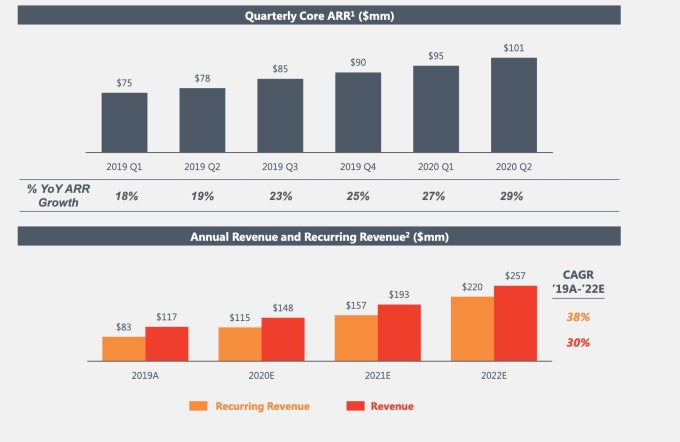
Image Credits: AvePoint
The deal is expected to close in the first quarter of next year. Upon close the company will continue to be known as AvePoint and be publicly traded on Nasdaq under the new ticker symbol AVPT.
Powered by WPeMatico
Friday, an app looking to make remote work more efficient, has announced the close of a $2.1 million seed round led by Bessemer Venture Partners. Active Capital, Underscore, El Cap Holdings, TLC Collective and New York Venture Partners also participated in the round, among others.
Founded by Luke Thomas, Friday sits on top of the tools that teams already use — GitHub, Trello, Asana, Slack, etc. — to surface information that workers need when they need it and keep them on top of what others in the organization are doing.
The platform offers a Daily Planner feature, so users can roadmap their day and share it with others, as well as a Work Routines feature, giving users the ability to customize and even automate routine updates. For example, weekly updates or daily standups done via Slack or Google Hangouts can be done via Friday app, eliminating the time spent by managers, or others, jotting down these updates or copying that info over from Slack.
Friday also lets users set goals across the organization or team so that users’ daily and weekly work aligns with the broader OKRs of the company.
Plus, Friday users can track their time spent in meetings, as well as team morale and productivity, using the Analytics dashboard of the platform.
Friday has a free-forever model, which allows individual users or even organizations to use the app for free for as long as they want. More advanced features like Goals, Analytics and the ability to see past three weeks of history within the app are paywalled for a price of $6/seat/month.
Thomas says that one of the biggest challenges for Friday is that people automatically assume it’s competing with an Asana or Trello, as opposed to being a layer on top of these products that brings all that information into one place.
“The number one problem is that we’re in a noisy space,” said Thomas. “There are a lot of tools that are saying they’re a remote work tool when they’re really just a layer on top of Zoom or a video conferencing tool. There is certainly increased amount of interest in the space in a good and positive way, but it also means that we have to work harder to cut through the noise.”
The Friday team is small for now — four full-time staff members — and Thomas says that he plans to double the size of the team following the seed round. Thomas declined to share any information around the diversity breakdown of the team.
Following a beta launch at the beginning of 2020, Friday says it is used by employees at organizations such as Twitter, LinkedIn, Quizlet, Red Hat and EA, among others.
This latest round brings the company’s total funding to $2.5 million.
Powered by WPeMatico
Onit, a workflow software company based in Houston, announced this week that it has acquired 2018 TechCrunch Disrupt Battlefield alum McCarthyFinch. Onit intends to use the startup’s AI skills to beef up its legal workflow software offerings.
The companies did not share the purchase price.
After evaluating a number of companies in the space, Onit focused on McCarthyFinch, which gives it an artificial intelligence component the company’s legal workflow software had been lacking. “We evaluated about a dozen companies in the AI space and dug in deep on six of them. McCarthyFinch stood out from the pack. They had the strongest technology and the strongest team,” Eric M. Elfman, CEO and co-founder of Onit told TechCrunch.
The company intends to inject that AI into its existing Aptitude workflow platform. “Part of what really got me excited about McCarthyFinch was the very first conversation I had with their CEO, Nick Whitehouse. They considered themselves an AI platform, which complemented our approach and our workflow automation platform, Aptitude,” Elfman said.
McCarthyFinch CEO and co-founder Whitehouse says the startup was considering whether to raise more money or look at being acquired earlier this year when Onit made its interest known. At first, he wasn’t really interested in being acquired and was hoping to go the partner route, but over time that changed.
“I was very much on the partner track, and was probably quite dismissive to begin with because I was quite focused on that partner strategy. But as we talked, all egos aside, it just made sense [to move to acquisition talks],” Whitehouse said.
The talks heated up in May and the deal officially closed last week. With Onit headquartered in Houston and McCarthyFinch in New Zealand the negotiations and meetings all happened on Zoom. The two companies’ principals have never met in person. The plan is for McCarthyFinch to stay in place, even after the pandemic ends. Whitehouse expects to make a trip to Houston whenever it is safe to do so.
Whitehouse says his experience with Battlefield has had a huge influence on him. “Just the insights that we got through Battlefield, the coaching that we got, those things have stuck with me and they’ll stick with me for the rest of my life,” he said.
The company had 45 customers and 17 employees at the time of the acquisition. It raised US$5 million along the way. Now it becomes part of Onit as the journey continues.
Powered by WPeMatico
The security sector is ever frothy and acquisitive. Just last week Palo Alto Networks grabbed Expanse for $800 million. Today it was FireEye’s turn, snagging Respond Software, a company that helps customers investigate and understand security incidents, while reducing the need for highly trained (and scarce) security analysts. The deal has closed, according to the company.
FireEye had its eye on Respond’s Analyst product, which it plans to fold into its Mandiant Solutions platform. Like many companies today, FireEye is focused on using machine learning to help bolster its solutions and bring a level of automation to sorting through the data, finding real issues and weeding out false positives. The acquisition gives them a quick influx of machine learning-fueled software.
FireEye sees a product that can help add speed to its existing tooling. “With Mandiant’s position on the front lines, we know what to look for in an attack, and Respond’s cloud-based machine learning productizes our expertise to deliver faster outcomes and protect more customers,” Kevin Mandia, FireEye CEO said in a statement announcing the deal.
Mike Armistead, CEO at Respond, wrote in a company blog post that today’s acquisition marks the end of a four-year journey for the startup, but it believes it has landed in a good home with FireEye. “We are proud to announce that after many months of discussion, we are becoming part of the Mandiant Solutions portfolio, a solution organization inside FireEye,” Armistead wrote.
While FireEye was at it, it also announced a $400 million investment from Blackstone Tactical Opportunities fund and ClearSky (an investor in Respond), giving the public company a new influx of cash to make additional moves like the acquisition it made today.
It didn’t come cheap. “Under the terms of its investment, Blackstone and ClearSky will purchase $400 million in shares of a newly designated 4.5% Series A Convertible Preferred Stock of FireEye (the ‘Series A Preferred’), with a purchase price of $1,000 per share. The Series A Preferred will be convertible into shares of FireEye’s common stock at a conversion price of $18.00 per share,” the company explained in a statement. The stock closed at $14.24 today.
Respond, which was founded in 2016, raised $32 million, including a $12 million Series A in 2017 led by CRV and Foundation Capital and a $20 million Series B led by ClearSky last year, according to Crunchbase data.
Powered by WPeMatico