Enterprise
Auto Added by WPeMatico
Auto Added by WPeMatico
BeyondID, a cloud identity consulting firm, announced a $9 million Series A today led by Tercera. It marked the first investment from Tercera, a firm that launched earlier this month with the goal of investing in service startups like Beyond.
The company focuses on helping clients manage security and identity in the cloud, taking aim specifically at Okta customers. In fact, the firm is a platinum partner for Okta. As they describe their goals, they help clients in a variety of areas, including identity and access management, secure app modernization, Zero Trust security, cloud migration and integration services.
CEO and co-founder Arun Shrestha has a deep background in technology, including working with Okta from its early days. Shrestha came on board in 2012 as the head of customer success. When he began, the startup was in early days, with just 50 customers. When he left five years later just before the IPO, it had more than 3,500.
Along the way, he gained a unique level of expertise in the Okta tool set, and he decided to put that to work to help Okta customers implement and maximize Okta usage, especially in companies with complex implementations. He launched BeyondID in 2018 with the intention of focusing on systems integrations and managing a company’s identity in the cloud.
“We believe we are becoming a managed identity service provider, so managing anything identity, anything related to cybersecurity. We’re helping these companies by being a one-stop shop for companies acquiring, deploying and managing identity services,” Shrestha explained.
It seems to be working. The last couple of years the company revenues grew at 300% and as it matures, and the growth rates settle a bit, it’s still expected to grow between 70 and 100% this year. The firm has 250 customers, including FedEx, Major League Baseball, Bain Capital and Biogen.
It currently has 75 employees serving those customers with plans to grow that number in the next year with the help from today’s investment. As Shrestha adds new employees, he sees building a diverse workforce as a crucial goal for his company.
“Diversity is absolutely critical to our long-term sustainable success, and it’s also the right thing to do,” he said. He says that building an organization that promotes women and people of color is a key goal of his as the leader of the company and something he is committed to.
Chris Barbin, who is managing partner and founder at lead investor Tercera, says that he chose BeyondID as the firm’s first investment because he believes identity is central to the notion of digital transformation. As more companies move to the cloud, they need help understanding how security and identity work differently in a cloud context, and he sees BeyondID playing a critical role in helping clients get there.
“BeyondID is in a rapidly growing space and has an impressive customer list that represents nearly every industry. Arun and the leadership team have a strong vision for the firm, deep ties into Okta and they’re incredibly passionate about what they do,” he said.
Powered by WPeMatico
Automattic, the for-profit company tied to open-source web publishing platform WordPress, is announcing that it has acquired analytics provider Parse.ly.
Specifically, Parse.ly is now part of WPVIP, the organization within Automattic that offers enterprise hosting and support to publishers, including TechCrunch. (We use Parse.ly, too.)
WPVIP CEO Nick Gernert described this as the organization’s first large enterprise software acquisition, reflecting a strategy that has expanded beyond news and media organizations — businesses like Salesforce (whose venture arm invested $300 million in Automattic back in 2019), the NBA, Condé Nast, Facebook and Microsoft now use WPVIP for their content and marketing needs.
Both companies, Gernert said, come from similar backgrounds, with “roots” in digital publishing and a “heavy focus on understanding the impact of content.”
“We’ve really started to shift more towards content marketing and starting to think more deeply beyond just what traditional page analytics provide,” he continued. That means doing more than measuring pageviews and time on site and “really starting to look more deeply at things like conversation, attribution, areas … that from a marketer’s perspective are impactful.”
WordPress and Parse.ly already work well together, but the plan is to make WPVIP features available to Parse.ly customers while also making more Parse.ly data available to WPVIP publishers. And Gernert said there are also opportunities to add more commerce-related data to Parse.ly, since Automattic also owns WooCommerce.
The goal, he said, is to “make Parse.ly better for WordPress and best for WPVIP.”
At the same time, he added, “There’s no plans here to make Parse.ly the only analytics solution that runs on our platform. We want to preserve the flexibility and interoperability [of WordPress], and we want to make sure from a Parse.ly perspective that it still exists as a standalone product. That’s key to its future and we will continue to invest in it.”
Parse.ly was founded in 2009 and has raised $12.9 million in funding from investors including Grotech Ventures and Blumberg Capital, according to Crunchbase. Parse.ly founders Sachin Kamdar and Andrew Montalenti are joining WPVIP, with Kamdar leading go-to-market strategy for Parse.ly and Montalenti leading product.
“We’ve always had deep admiration for WPVIP’s market position as the gold standard for enterprise content teams, and we’re thrilled to be able to join together,” Kamdar said in a statement. “From the culture and people, to the product, market and vision, we’re in lockstep to create more value for our customers. This powerful combination of content and intelligence will push the industry forward at an accelerated pace.”
The financial terms of the acquisition were not disclosed.
Powered by WPeMatico
We often hear about companies working to improve the customer experience, but for IT their customers are the company’s employees. Nexthink, a late-stage startup that wants to help IT serve its internal constituents better, announced a $180 million Series D today on a healthy $1.1 billion valuation.
The firm, which was founded in Lausanne, Switzerland and has offices outside of Boston, received funding from Permira with help from Highland Europe and Index Ventures. The company has now raised more than $336 million, according to Crunchbase data.
As you might imagine, understanding how folks are using a company’s technology choices internally is always going to be useful, but when the pandemic hit and offices closed, having access to this type of data became even more important.
Nexthink CEO and co-founder Pedro Bados says that most monitoring tools are focused on figuring out if the systems are working correctly and finding ways to fix them. Nexthink takes a different approach, looking at how employees are adopting the tools a company is offering.
“What we do at Nexthink is to take the [monitoring] problem from a completely different perspective. We say that we’re going to give your IT department a real-time understanding of how employees are experiencing IT [at your company],” Bados told me.
He says they do this by looking at the problem from the employees’ perspective. “At the end of the day we’re giving all the insights to IT departments to make sure they can improve the digital experience of their employees,” he said.
This could involve querying the user base in the same way that HR and marketing survey tools allow companies to check the pulse of employees or customers. By gathering this type of data, it helps IT understand how employees are using the company’s technology choices.
This software is aimed at larger organizations with at least 5,000 employees. Today, the company has more than 1,000 of these customers, including Best Buy, Fidelity, Liberty Mutual and 3M. What’s more, the company has surpassed $100 million in annual recurring revenue, a success benchmark for SaaS companies like Nexthink.
Nexthink currently has 700 employees with plans to reach 900 by the end of this year, and as a maturing startup, Bados has given a lot of thought on how to build a diverse workforce. Just being spread out in two countries gives an element of geographic diversity, but he says it takes more than that, and it all starts with recruitment.
“The way to make sure we get more diversity is we look at recruitment and make sure that we have a balanced pipeline. That’s something we measure as a company,” he said. They also have a diversity committee, which is charged with delivering diversity training and figuring out ways to hire a more diverse and inclusive workforce.
While the company has a healthy valuation and a good amount of money in the bank, Bados doesn’t see an IPO for at least a couple of years. He says he wants to double or triple the business before taking that step. For now, though, with $180 million in additional runway and a $100 million in ARR, the company is well-positioned for whatever future moves it chooses to make.
Powered by WPeMatico
Before he was a partner at Lightspeed Venture Partners, Gaurav Gupta had his eye on Grafana Labs, the company that supports open-source analytics platform Grafana. But Raj Dutt, Grafana’s co-founder and CEO, played hard to get.
This week on Extra Crunch Live, the duo explained how they came together for Grafana’s Series A — and eventually, its Series B. They also walked us through Grafana’s original Series A pitch deck before Gupta shared the aspects that stood out to him and how he communicated those points to the broader partnership at Lightspeed.
Gupta and Dutt also offered feedback on pitch decks submitted by audience members and shared their thoughts about what makes a great founder presentation, pulling back the curtain on how VCs actually consume pitch decks.
We’ve included highlights below as well as the full video of our conversation.
We record new episodes of Extra Crunch Live each Wednesday at 12 p.m. PST/3 p.m. EST/8 p.m. GMT. Check out the February schedule here.
As soon as Gupta joined Lightspeed in June 2019, he began pursuing Dutt and Grafana Labs. He texted, called and emailed, but he got little to no response. Eventually, he made plans to go meet the team in Stockholm but, even then, Dutt wasn’t super responsive.
The pair told the story with smiles on their faces. Dutt said that not only was he disorganized and not entirely sure of his own travel plans to see his co-founder in Stockholm, Grafana wasn’t even raising. Still, Gupta persisted and eventually sent a stern email.
“At one point, I was like ‘Raj, forget it. This isn’t working’,” recalled Gupta. “And suddenly he woke up.” Gupta added that he got mad, which “usually does not work for VCs, by the way, but in this case, it kind of worked.”
When they finally met, they got along. Dutt said they were able to talk shop due to Gupta’s experience inside organizations like Splunk and Elastic. Gupta described the trip as a whirlwind, where time just flew by.
“One of the reasons that I liked Gaurav is that he was a new VC,” explained Dutt. “So to me, he seemed like one of the most non-VC VCs I’d ever met. And that was actually quite attractive.”
To this day, Gupta and Dutt don’t have weekly standing meetings. Instead, they speak several times a week, conversing organically about industry news, Grafana’s products and the company’s overall trajectory.
Dutt shared Grafana’s pre-Series A pitch deck — which he actually sent to Gupta and Lightspeed before they met — with the Extra Crunch Live audience. But as we know now, it was the conversations that Dutt and Gupta had (eventually) that provided the spark for that deal.
Powered by WPeMatico
Microsoft tries to improve corporate intranet, Google will offer new smartphone health measurements and 23andMe is going public via SPAC. This is your Daily Crunch for February 4, 2021.
The big story: Microsoft rethinks corporate intranet
Microsoft launched what it’s calling a new “employee experience platform,” designed to reinvent those corporate intranet sites that large companies use to share content with their employees.
What makes this new platform, called Viva, any different? Well, it integrates with Microsoft’s other collaboration tools like SharePoint and Yammer, along with LinkedIn Learning and other training services, and it also includes team analytics.
In a pre-recorded video, CEO Satya Nadella said Microsoft is launching this because, “We have participated in the largest at-scale remote work experiment the world has seen and it has had a dramatic impact on the employee experience. As the world recovers, there is no going back. Flexibility in when, where and how we work will be key.”
The tech giants
Venmo to gain crypto, budgeting, savings and Honey integrations this year — The Venmo mobile payments app is going to look very different in 2021 as it inches closer to neobank territory.
Google to offer heart and respiratory rate measurements using just your smartphone’s camera — Google is introducing features that will allow users to take vital health measurements using just the camera they already have on their smartphone.
HubSpot acquires media startup The Hustle — HubSpot says content is an increasingly important part of its business, with customers finding its products through things like YouTube videos and HubSpot Academy.
Startups, funding and venture capital
23andMe set to go public via a Virgin Group SPAC merger — The transaction is expected to result in 23andMe having around $984 million in cash available at close.
Accel backs Mexican startup Flink’s effort to bring consumer investing to Latin America — Since launching its first brokerage product in July of 2020, Flink has surpassed 1 million users and 800,000 active brokerage accounts.
Tovala, the smart oven and meal kit service, heats up with $30M more in funding — This is the second round of funding for the startup in the space of six months.
Advice and analysis from Extra Crunch
Four strategies for deep tech founders who are fundraising — Step one: Use storytelling to highlight your big vision.
Why one Databricks investor thinks the company may be undervalued — The recent Databricks funding round, a $1 billion investment at a $28 billion valuation, was one of the year’s most notable private investments so far.
Extra Crunch is now hiring for reporter, editor and project manager positions — Extra Crunch is about to turn two years old and we now have a lot of demanding subscribers. (We love them, of course.)
(Extra Crunch is our membership program, which helps founders and startup teams get ahead. You can sign up here.)
Everything else
A growing number of startups are creating APIs to assess and offset corporate carbon emissions — It was only a matter of time before application programming interfaces came for the carbon credit offsets.
The cloud infrastructure market hit $129B in 2020 — That’s up from around $97 billion in 2019, according to data from Synergy Research Group.
China’s national blockchain network embraces global developers — Last year, an ambitious, government-backed blockchain infrastructure network launched in China.
The Daily Crunch is TechCrunch’s roundup of our biggest and most important stories. If you’d like to get this delivered to your inbox every day at around 3pm Pacific, you can subscribe here.

Powered by WPeMatico
Google today announced the launch of Apigee X, the next major release of the Apgiee API management platform it acquired back in 2016.
“If you look at what’s happening — especially after the pandemic started in March last year — the volume of digital activities has gone up in every kind of industry, all kinds of use cases are coming up. And one of the things we see is the need for a really high-performance, reliable, global digital transformation platform,” Amit Zavery, Google Cloud’s head of platform, told me.
He noted that the number of API calls has gone up 47% from last year and that the platform now handles about 2.2 trillion API calls per year.
At the core of the updates are deeper integrations with Google Cloud’s AI, security and networking tools. In practice, this means Apigee users can now deploy their APIs across 24 Google Cloud regions, for example, and use Google’s caching services in more than 100 edge locations.
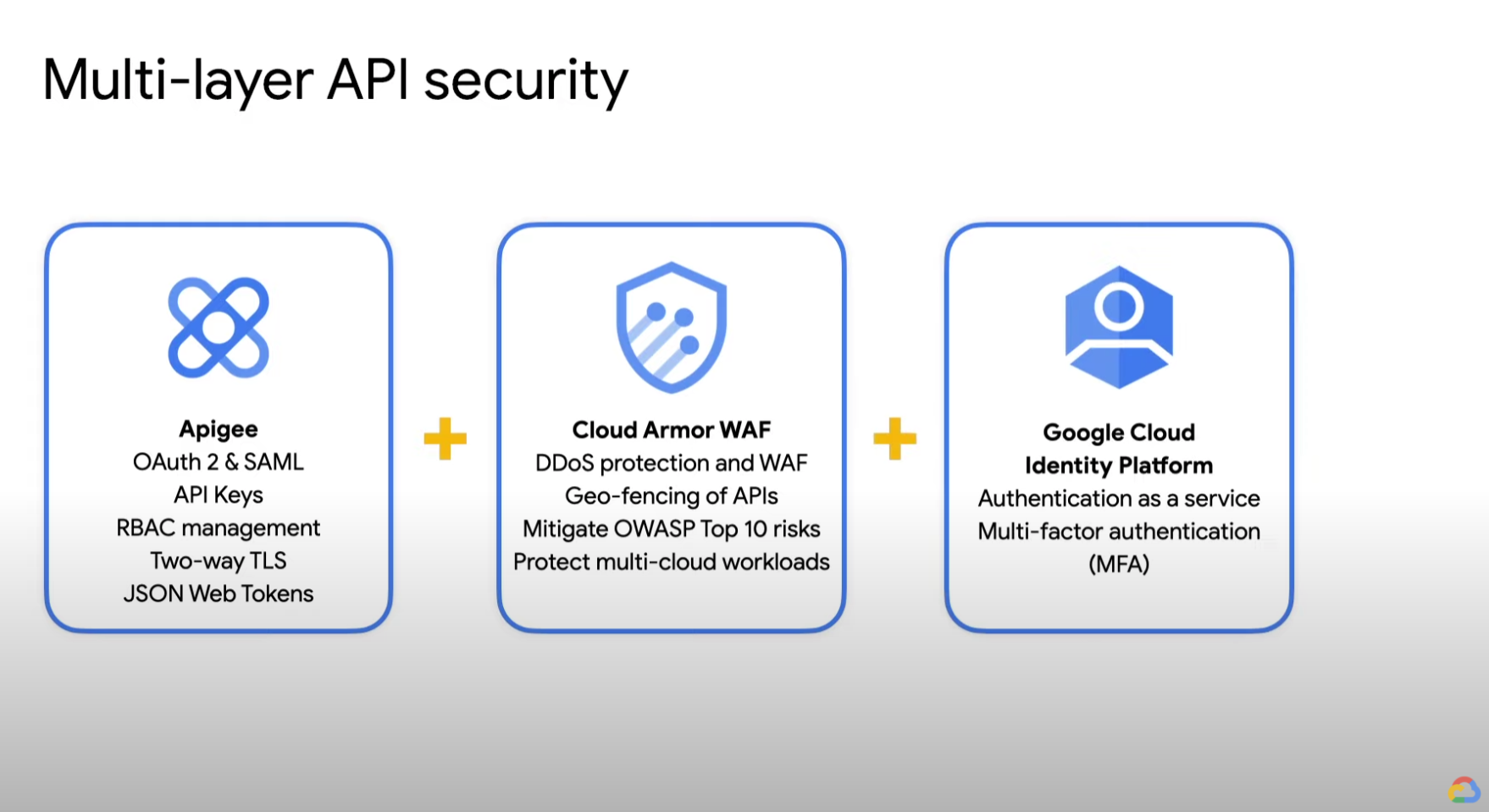
Image Credits: Google
In addition, Apigee X now integrates with Google’s Cloud Armor firewall and its Cloud Identity Access Management platform. This also means that Apigee users won’t have to use third-party tools for their firewall and identity management needs.
“We do a lot of AI/ML-based anomaly detection and operations management,” Zavery explained. “We can predict any kind of malicious intent or any other things which might happen to those API calls or your traffic by embedding a lot of those insights into our API platform. I think [that] is a big improvement, as well as new features, especially in operations management, security management, vulnerability management and making those a core capability so that as a business, you don’t have to worry about all these things. It comes with the core capabilities and that is really where the front doors of digital front-ends can shine and customers can focus on that.”
The platform now also makes better use of Google’s AI capabilities to help users identify anomalies or predict traffic for peak seasons. The idea here is to help customers automate a lot of the standards automation tasks and, of course, improve security at the same time.
As Zavery stressed, API management is now about more than just managing traffic between applications. But more than just helping customers manage their digital transformation projects, the Apigee team is now thinking about what it calls “digital excellence.” “That’s how we’re thinking of the journey for customers moving from not just ‘hey, I can have a front end,’ but what about all the excellent things you want to do and how we can do that,” Zavery said.
“During these uncertain times, organizations worldwide are doubling-down on their API strategies to operate anywhere, automate processes, and deliver new digital experiences quickly and securely,” said James Fairweather, chief innovation officer at Pitney Bowes. “By powering APIs with new capabilities like reCAPTCHA Enterprise, Cloud Armor (WAF), and Cloud CDN, Apigee X makes it easy for enterprises like us to scale digital initiatives, and deliver innovative experiences to our customers, employees and partners.”
Powered by WPeMatico

Marketing software company HubSpot is acquiring The Hustle, the business and tech media startup behind the popular newsletter of the same name.
Axios broke the news of the deal and reported that it values the startup at around $27 million. HubSpot declined to comment on the deal price, and while tweeting about the acquisition, The Hustle CEO Sam Parr wrote, “Early in my career I was transparent with money. But I didn’t like the result of sharing that stuff. So we’re not disclosing the price and HubSpot has agreed. I’m taking it to the grave!”
In its press release about the acquisition, HubSpot noted that customers are finding its products through content like its YouTube videos and HubSpot Academy.
“By acquiring The Hustle, we’ll be able to better meet the needs of these scaling companies by delivering educational, business and tech trend content in their preferred formats,” said HubSpot’s senior vice president of marketing Kieran Flanagan in a statement. “Sam and his team have a proven ability to create content that entrepreneurs, startups and scaling companies are deeply passionate about, and I’m excited to bring them on board to take that work to the next level.”
BUYERS
We’ve had lots of media co’s try to buy us. We said no. Most ad 1st media companies are dying. And I don’t want to join a sinking, clickbait ship.
I always thought a b2b SAAS biz should buy us. But never thought they’d be bold enough to try.
But HubSpot came along.
— Sam Parr
(@theSamParr) February 3, 2021
HubSpot says The Hustle’s flagship newsletter has 1.5 million subscribers. It also has a subscription offering called Trends and a podcast called My First Million.
“The goal is to build the largest business content network in the world,” Parr tweeted. “Soon, we’ll expand to a variety of mediums on a bunch of different topics and will have really innovative products coming out. We’re also going to hire the best content creators in the world.”
Powered by WPeMatico
The cloud infrastructure market in 2020 reflected society itself, with the richest companies getting richer and the ones at the bottom of the market getting poorer. It grew to $129 billion for the year, according to data from Synergy Research Group. That’s up from around $97 billion in 2019.
Synergy also reported that the cloud infra market reached $37 billion in the fourth quarter, up from $33 billion in the third quarter, and 35% from a year ago.
I’ve heard from every founder under the sun for the last nine months that the pandemic was accelerating digital transformation, and that a big part of that was an expedited shift to the cloud. These numbers would seem to bear that out.
As usual the big three were Amazon, Microsoft and Google, with Alibaba now firmly entrenched in fourth place and IBM falling back to fifth. But Microsoft grew more quickly than rival Amazon, reaching 20% market share at the end of 2020 for the first time. Keep in mind that the Redmond-based software giant has now doubled its share since 2017. That’s remarkably rapid rapid growth. Meanwhile Google and Alibaba took home 9% and 6%, respectively.
Here’s what that all looks like in chart form:
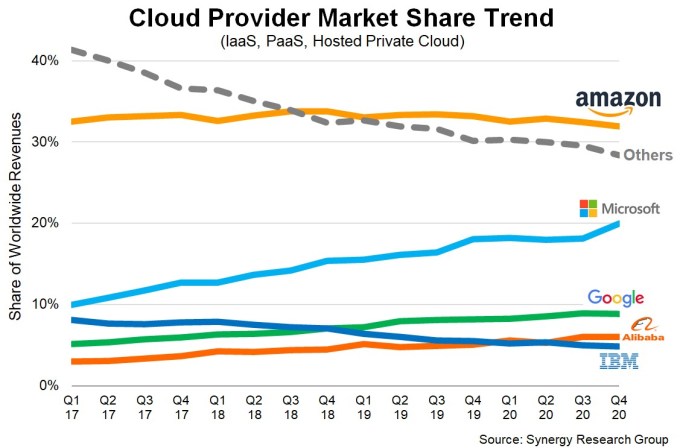
Image Credits: Synergy Research
Amazon is an interesting case in that it has plateaued at around 33% for four straight years of Synergy data, but because it’s one-third share of an increasingly growing market, that means that it has kept growing its public cloud revenues as the category itself has expanded.
Amazon closed out the year with $12.74 billion in Q4 AWS revenue, putting it on a run rate of just over $50 billion for the first time. That was up from $11.6 billion the prior quarter. While Microsoft’s numbers are always difficult to parse from its earning’s reports, doing the math of 20% of $37 billion, it came in with $7.4 billion up from $5.9 billion last quarter.
Google brought in $3.3 billion, up from $2.98 billion in Q3 2020, and Alibaba pulled in $2.22 billion, up from $1.65 billion over the same time frame.
John Dinsdale, principal analyst at Synergy, says the leaders are pretty firmly entrenched at this point with huge absolute market numbers and also huge gaps between the cloud providers. “AWS has been a great success story for over 10 years now and it remains in an extremely strong market position despite increasing competition from a broad swathe of strong IT industry companies. That is a great testament both to Amazon and to the AWS leadership team and you’d have to suspect that will not change with the new regime,” he told me.
He sees Microsoft as a worthy rival, but one that is bound to hit a growth wall at some point. “It is certainly feasible that Microsoft will continue to narrow the gap between itself and Amazon, but the bigger Microsoft Azure becomes the tougher it is to maintain really high growth rates. That is just the law of large numbers.”
Meanwhile, market share at the bottom of the cloud infrastructure space continued to decline even while the number of dollars at stake have continued to expand dramatically. “The market share losers have been the large group of smaller cloud providers, who collectively have lost 13 percentage points of market share over the last 16 quarters,” Synergy wrote in a statement.
Dinsdale says all is not lost for these players, however. “Regarding the smaller players (or the big companies that have only a small market share), they can either focus on specific market niches (can be based around geography, service type or customer vertical) or they can try to offer a broad range of cloud services to a broad range of customers. Companies doing the former can do quite well, while companies doing the latter will find it extremely tough,” Dinsdale told me.
It’s worth noting that Canalys has slightly different numbers with a total market of around $142 billion and almost $40 billion for the quarter, but the percentages are in line with Synergy’s:
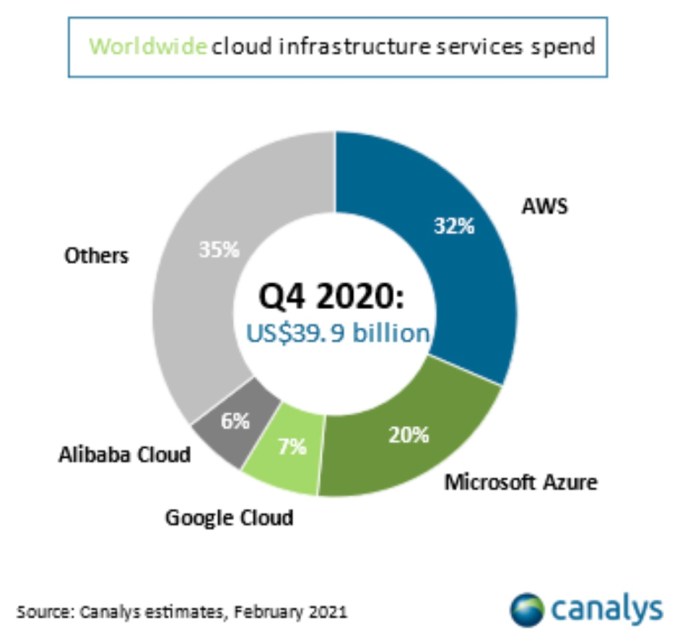
Image Credits: Canalys
At some point the numbers get so big they almost cease to have meaning, but as large as the public cloud revenue numbers become, they remain a relatively small percentage of overall worldwide IT spend. According to Gartner estimates, worldwide IT spend in 2020 was $3.6 trillion (with a T). That means that the cloud infrastructure market accounted for just 3.85% of total spend in 2020.
Think about that for a moment: less than 4% of IT spend currently is on cloud infrastructure, leaving so much room for growth and for those billions to grow ever bigger in the coming years.
It would certainly make it more interesting if someone could come in and disrupt the leaders, but for now at least they are going to be hard to push out of the way unless something unforeseen and dramatic happens to the way we think about computing.
Powered by WPeMatico

Microsoft today launched Viva, a new “employee experience platform,” or, in non-marketing terms, its new take on the intranet sites most large companies tend to offer their employees. This includes standard features like access to internal communications built on integrations with SharePoint, Yammer and other Microsoft tools. In addition, Viva also offers access to team analytics and an integration with LinkedIn Learning and other training content providers (including the likes of SAP SuccessFactors), as well as what Microsoft calls Viva Topics for knowledge sharing within a company.
If you’re like most employees, you know that your company spends a lot of money on internal communications and its accompanying intranet offerings — and you then promptly ignore that in order to get actual work done. But Microsoft argues that times are changing, as remote work is here to stay for many companies, even after the pandemic (hopefully) ends. Even if a small percentage of a company’s workforce remains remote or opts for a hybrid approach, those workers still need to have access to the right tools and feel like they are part of the company.
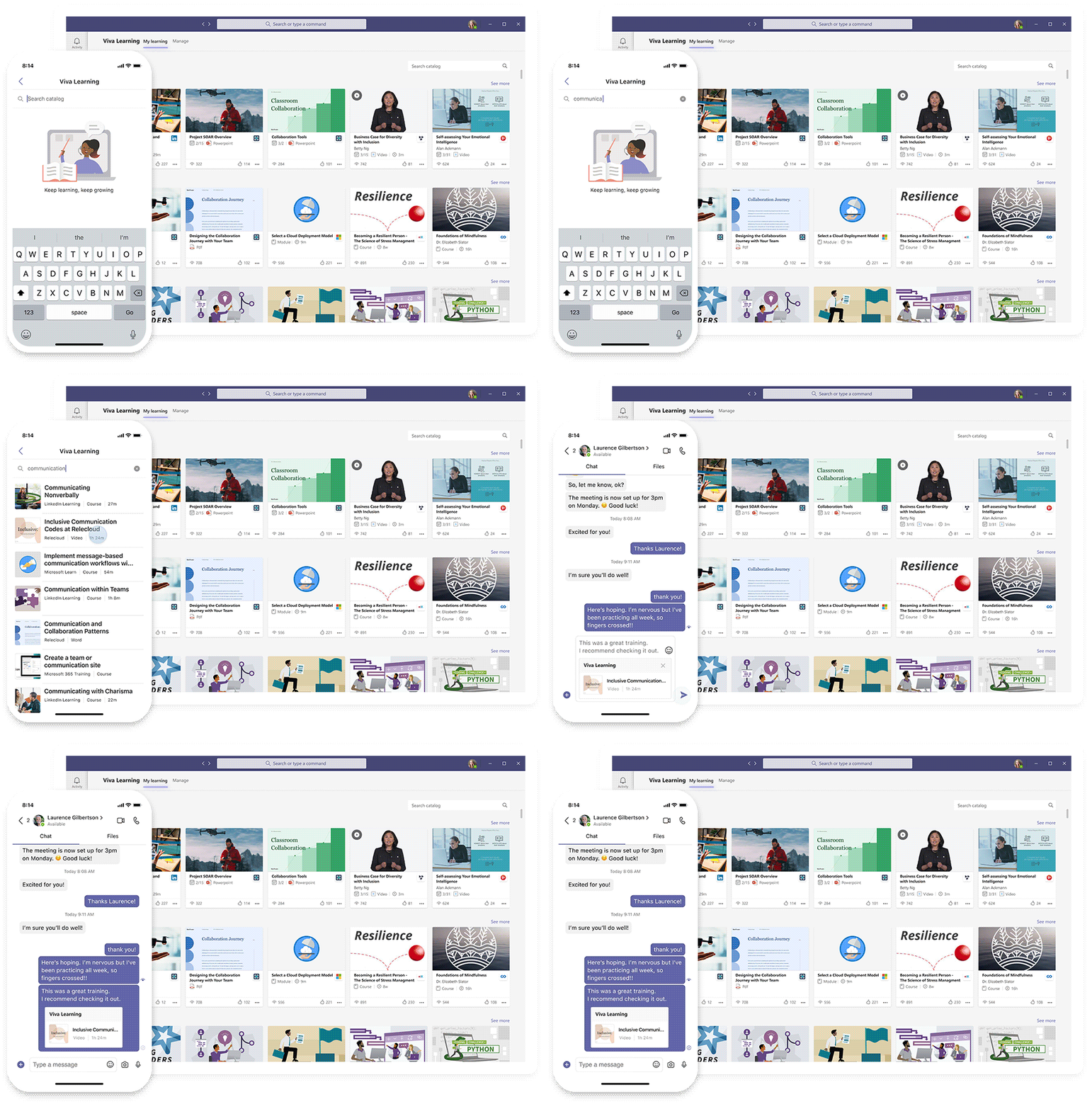
Image Credits: Microsoft
“We have participated in the largest at-scale remote work experiment the world has seen and it has had a dramatic impact on the employee experience,” Microsoft CEO Satya Nadella said in a pre-recorded video. “As the world recovers, there is no going back. Flexibility in when, where and how we work will be key.”
He argues that every organization will require a unified employee experience platform that supports workers from their onboarding process to collaborating with their colleagues and continuing their education within the company. Yet as employees work remotely, companies are now struggling to keep their internal culture and foster community among employees. Viva aims to fix this.
Unsurprisingly, Viva is powered by Microsoft 365 and all of the tools that come with that, as well as integrations with Microsoft Teams, the company’s flagship collaboration service, and even Yammer, the employee communication tool it acquired back in 2012 and continues to support.
There are several parts to Viva: Viva Connections for accessing company news, policies, benefits and internal communities (powered by Yammer); Viva Learning for, you guessed it, accessing learning resources; and Viva Topics, the service’s take on company-wide knowledge sharing. For the most part, that’s all standard fair in any modern intranet, whether it’s from a startup provider or an established player like Jive.
Viva Insights feels like the odd one out here, especially after Microsoft’s kerfuffle around its Productivity Score. The idea here is to give managers insights into whether their team (but not individual team members) are at risk of burnout, for example, in order to encourage them to turn off notifications or set daily priorities (a good manager, I’d hope, could do this without analytics, but here we are, in 2021). It’s also meant to help company leaders “address complex challenges and respond to change by shedding light on organizational work patterns and trends.” Sure.
Because this is Microsoft in 2021, there’s also a lot of talk about employee well-being in today’s announcement. For most employees, that means fewer meetings, more focus time and turning off notifications after work. Obviously there are technical tools to help with that, but it’s really a question of company culture and management. I’m not sure you need analytics integrated with LinkedIn’s Glint for that, but you can now have those, too.
“As the world of work changes, the next horizon of innovation will come from a focus on creativity, engagement and well-being so organizations can build cultures of resilience and ingenuity,” said Jared Spataro, corporate vice president, Microsoft 365. “Our vision is to deliver a platform for the employee experience that helps organizations create a thriving culture with engaged employees and inspiring leaders.”
Powered by WPeMatico
We talk a lot these days about the future of work and the proliferation of new and better tools for distributed workforces, but companies focused on developing fleet management software — even if they have not really been viewed as “tech startups” — have been working on this problem for many years already. Today, one of the older players in the field is announcing its first significant round of investment, a sign both of how investors are taking more notice of these B2B players, and how the companies themselves are seeing a new opportunity for growth.
BigChange, a U.K. startup that builds fleet management software to help track and direct jobs to those on the go whose “offices” tend to be vehicles, has closed a round of £75 million ($102 million at today’s rates). U.S. investor Great Hill Partners led the round.
The company has built a business by tapping into the advances of technology to build apps for field service engineers and those back at the mothership who run operations and help manage their jobs, workers who in the past might have used phone calls, paperwork and lots of extra round trips between offices and sites in order to run things.
“I founded BigChange to revolutionise mobile workforce management and bring it into the 21st century. Our platform eliminates paperwork, dramatically cuts carbon, creates efficiency, promotes safer driving and means that engineers are spending less time on the roads or filling out forms and more time completing jobs,” said founder and CEO Martin Port in a statement. “We are incredibly excited to partner with Great Hill and leverage their successful track-record scaling vertical and enterprise software companies both in the U.K. and overseas.”
BigChange said that Great Hill’s stake values the company at £100 million (or $136 million). One report points to part of that funding being a secondary transaction, with Port pocketing £48 million of that. The company has been around since 2012 and appears to be profitable. It has raised very little in funding (around $2 million) before this, at one point trying to raise an angel round but cancelling the process before it completed, according to filings tracked by PitchBook.
As the technology industry continues to become essentially a part of every other industry in the world, this deal is notable as a sign of how its boundaries are expanding and getting more blurred.
BigChange is not a London startup, nor from the Cambridge or Oxford areas, nor from Bristol or anywhere in the south. It’s from the north, specifically Leeds — a city that has an impressive number of startups in it even if these have not had anything like the funding or attention that startups in cities and areas in the South have attracted. (One eye-catching exception is the online store Pharmacy2U: the Leeds startup has been backed by Atomico, BGF and others: given the interest of companies like Amazon to grow in this space, it’s likely one to watch.)
One of the big themes in technology right now is how a lot of the action is getting decentralised — a result of many of us now working remotely to stave off the spread of COVID-19, many people using that situation to reconsider whether they need to be living in any specific place at all, and subsequently choosing to relocate from expensive regions like the Bay Area to other places for better quality of life.
There are of course other cities, like Manchester, Edinburg, Cardiff and more in the U.K., with technology ecosystems (just as there have been across many cities in the U.S. for years). But when one of these, this time out of Leeds, attracts a significant funding round, it points to the potential of something similar playing out in the U.K., too, with not just talent but more money going into regions beyond the usual suspects.
The other part of the decentralisation story here focuses on what BigChange is actually building.
Here, it’s one of the many companies that have dived into the area of building apps and larger pieces of software aimed not at “knowledge workers” but those who do not sit at desks, are on the move and tend to work with their hands. For those who are on the road, it has apps to better manage their jobs and routes (which it calls JourneyWatch). For those back in the dispatch part of the operations, it has an app to track them better and use the software to balance the jobs and gain further analytics from the work (sold as JobWatch). These work on ruggedised devices and lean on SaaS architecture for distribution, and there are some 50,000 people across some 1,500 organizations using its apps today, with those customers located around the world, but with a large proportion of them in the U.K. itself.
BigChange is not the only company targeting workers in the field. We covered a significant funding round for another one of them out of North America, Jobber, which builds software for service professionals, just last month. Others tapping into the opportunity of bringing tech to a wider audience beyond knowledge workers include Hover (technology and a wider set of tools for home repair people to source materials, make pricing and work estimates, and run the administration of their businesses) and GoSite (a platform to help all kinds of SMBs — the key factor being that many of them are coming online for the first time — build out and run their businesses). Others in this specific area include Klipboard, Azuga, ServiceTitan, ServiceMax and more.
You might recognise the name Great Hill Partners as the PE firm that has taken majority stakes in a range of media companies like Gizmodo, Ziff Davis (way back when) and Storyblocks, and backed companies like The RealReal and Wayfair. In this case, the company was attracted by how BigChange was being adopted by a very wide range of industries that fall under “field service” as part of their workload.
“Unlike niche players that focus on smaller customers and specific sub-verticals, Martin and his accomplished team have built a flexible, all-in-one platform for field service professionals and operators,” said Drew Loucks, a partner at Great Hill Partners, in a statement. “BigChange’s technology is differentiated not only by its ability to serve commercial and residential clients of nearly any scale or vertical, but also by its award-winning product development and customer service capabilities.”
Powered by WPeMatico