Enterprise
Auto Added by WPeMatico
Auto Added by WPeMatico
Weights & Biases, a startup building tools for machine learning practitioners, is announcing that it has raised $45 million in Series B funding.
The company was founded by Lukas Biewald, Chris Van Pelt and Shawn Lewis — Biewald and Van Pelt previously founded CrowdFlower/Figure Eight (acquired by Appen). Weights & Biases says it now has more than 70,000 users at more than 200 enterprises.
Biewald (whom I’ve known since college) argued that while machine learning practitioners are often compared to software developers, “they’re more like scientists in some ways than engineers.” It’s a process that involves numerous experiments, and Weights & Biases’ core product allows practitioners to track those experiments, while the company also offers tools around data set versioning, model evaluation and pipeline management.
“If you have a model that’s controlling a self-driving car and the car crashes, you really want to know what happened,” Biewald said. “If you built that model years ago and you’ve run all these experiments since then, it can be hard to systematically trace through what happened” unless you’re using experiment tracking.
He described the startup as “an early leader” in this market, and as competing tools emerge, he said it’s also differentiated because it is “completely focused on the ML practitioner” rather than top-down enterprise sales. Similarly, he said that as machine learning has been adopted more widely, Weights & Biases is occasionally confronted by a “high-class problem.”
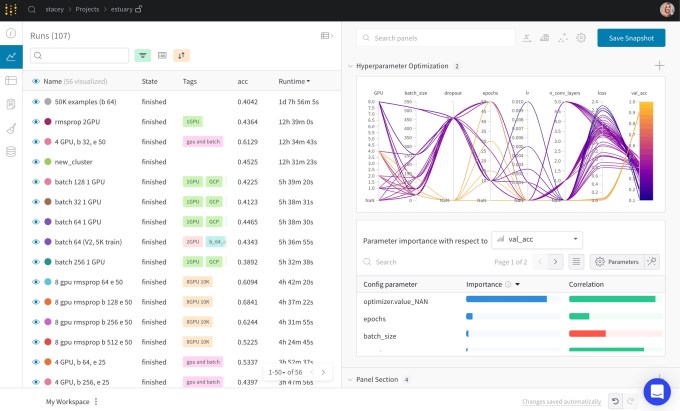
Image Credits: Weights & Biases
“We’re not interested in selling to companies that are doing machine learning for machine learning’s sake,” Biewald said. “With some companies, there’s a mandate from the CEO to sprinkle some machine learning in the company. That’s just really depressing to me, to not have any impact. But I would actually say the vast majority of companies that we talk to really do something useful.”
For example, he said agriculture giant John Deere is using the startup’s platform to continually improve the way it uses robotics to spray fertilizer, rather than pesticides, to kill weeds and pests. And there are pharmaceutical companies using the platform for how they model how different molecules will behave.
Weights & Biases previously raised $20 million in funding. The new round was led by Insight Partners, with participation from Coatue, Trinity Ventures and Bloomberg Beta. Insight’s George Mathew is joining the board of directors.
“I’ve never seen a MLOps category leader with such a high NPS and deep customer focus as Weights and Biases,” Mathew said in a statement. “It’s an honor to make my first investment at Insight to serve an ML practitioner user-base that grew 60x these last two years.”
The startup says it will use the funding to continue hiring in engineering, growth, sales and customer success.
Powered by WPeMatico
Many founders only know their own experience fundraising and don’t hear much about what other founders went through. On Extra Crunch Live on Wednesday, we’re going to remedy that.
Grafana Labs has raised upward of $75 million since it launched in 2014. Lightspeed Venture Partners, and partner Gaurav Gupta to be specific, led both the startup’s Series A and Series B rounds. As far as commitments go, that’s a pretty significant one.
The new and improved Extra Crunch Live pairs founders and the investors who led their earlier rounds to talk about how the deal went down, from the moment they met to the conversations they had (including some disagreements) to the relationship as it exists today. Hell, we may even take a peek at the original pitch deck that made it all happen.
Then, we’ll turn our eyes back to you, the audience. That same founder/investor duo (in this case, Grafana Labs CEO Raj Dutt and LVP’s Gaurav Gupta) will take a look at your pitch decks and give their own feedback. (If you haven’t yet submitted a pitch deck to be torn down on Extra Crunch Live, you can do so here.)
The hour-long episode is sandwiched between two 30-minute rounds of networking. From start to finish, it goes from 11:30 a.m. PST/2:30 p.m. EST to 1:30 p.m. PST/4:30 p.m. EST. And Extra Crunch Live will come to you at the same time, every week, with a new pair of speakers.
So let’s learn a little bit more about Gupta and Dutt.
Before becoming an investor, Gupta enjoyed a rich career in the product development sphere, holding positions at Elastic (where he led product management), Splunk (VP of Products), as well as Google, Gateway and the McKenna Group. He joined Lightspeed in 2019 as a partner, focusing primarily on enterprise software. He’s led investments in Impira, Blameless, Hasura and Panther, and of course, Grafana. He sits on the board of the last three companies in that list.
Dutt is the co-founder and CEO at Grafana Labs, but the fast-growing company isn’t his first go at entrepreneurialism. Dutt also founded and led Voxel, a cloud-hosting startup that was acquired by Internap for $30 million in 2012.
We’re absolutely thrilled to have Gupta and Dutt join us on our first episode of Extra Crunch Live in 2021. As a reminder, Extra Crunch Live is for Extra Crunch members only. We’re coming to you with a new pair of speakers every week, and you can catch everything you missed on-demand if you can’t join us live. It’s worth the cost of the subscription on its own, but EC members also get access to our premium content, including market maps and investor surveys. Long story short? Subscribe, smarty. You won’t regret it.
Oh, and here’s a look at other speakers you can expect to see on Extra Crunch Live:
Aydin Senkut (Felicis) + Kevin Busque (Guideline) — February 10
Steve Loughlin (Accel) + Jason Boehmig (Ironclad) — February 17
Matt Harris (Bain Capital Ventures) + Isaac Oates (Justworks) — February 24
And that’s just the February slate!
All the details to register for this upcoming episode (and more) are available below. Can’t wait to see you there!
Powered by WPeMatico
Boston-based security operations company Rapid7 has been making moves into the cloud recently, and this morning it announced that it has acquired Kubernetes security startup Alcide for $50 million.
As the world shifts to cloud native using Kubernetes to manage containerized workloads, it’s tricky ensuring that the containers are configured correctly to keep them safe. What’s more, Kubernetes is designed to automate the management of containers, taking humans out of the loop and making it even more imperative that the security protocols are applied in an automated fashion as well.
Brian Johnson, SVP of Cloud Security at Rapid7 says that this requires a specialized kind of security product and that’s why his company is buying Alcide. “Companies operating in the cloud need to be able to identify and respond to risk in real time, and looking at cloud infrastructure or containers independently simply doesn’t provide enough context to truly understand where you are vulnerable,” he explained.
“With the addition of Alcide, we can help organizations obtain comprehensive, unified visibility across their entire cloud infrastructure and cloud-native applications so that they can continue to rapidly innovate while still remaining secure,” he added.
Today’s purchase builds on the company’s acquisition of DivvyCloud last April for $145 million. That’s almost $200 million for the two companies that allow Rapid7 to help protect cloud workloads in a fairly broad way.
It’s also part of an industry trend with a number of Kubernetes security startups coming off the board in the last year as bigger companies look to enhance their container security chops by buying talent and technology. This includes VMware nabbing Octarine last May, Cisco getting PortShift in October and Red Hat buying StackRox last month.
Alcide was founded in 2016 in Tel Aviv, part of the active Israeli security startup scene. It raised about $12 million along the way, according to Crunchbase data.
Powered by WPeMatico
For American importers, finding suppliers these days can be challenging not only due to COVID-19 travel restrictions. The U.S. government’s entity list designations, human-rights-related sanctions, among other trade blacklists targeting Chinese firms have also rattled U.S. supply chains.
One young company called International Compliance Workshop, or ICW, is determined to make sourcing easier for companies around the world as it completed a fresh round of funding. The Hong Kong-based startup has just raised $5.75 million as part of its Series A round, boosting its total funding to around $10 million, co-founder and CEO Garry Lam told TechCrunch.
ICW works like a matchmaker for suppliers and buyers, but unlike existing options like Alibaba’s B2B platform or international trade shows, ICW also vets suppliers over compliance, product quality and accreditation. It gathers all that information into its growing database of over 40,000 suppliers — 80% of which are currently in China — and recommends them to customers based on individual needs.
Founded in 2016, ICW’s current client base includes some of the world’s largest retailers, including Ralph Lauren, Prenatal Retail Group, Blokker, Kmart and a major American pharmacy chain that declined to be named.
ICW’s latest funding round was led by Infinity Ventures Partners with participation from Integrated Capital and existing investors MindWorks Capital and the Hong Kong government’s $2 billion Innovation and Technology Venture Fund.
In line with the ongoing shift of sourcing outside China, in part due to the U.S.-China trade war and China’s growing labor costs, ICW has seen more customers diversifying their supply chains. But the transition has limitations in the short run.
“It’s still very difficult to find suppliers of certain product categories, for example, Bluetooth devices and power banks, in other countries,” observed Lam. “But for garment and textile, the transition already began to happen a decade ago.”
In Southeast Asia, which has been replacing a great deal of Chinese manufacturing activity, each country has its slight specialization. Whereas Vietnam abounds with wooden furniture suppliers, Thailand is known for plastic goods and Malaysia is a good source for medical supplies, said Lam.
When it comes to trickier compliance burdens, such as human rights sanctions, ICW relies on third-party certification institutes to screen and verify suppliers.
“There is a [type of] qualification standard that verifies whether a supplier has fulfilled its corporate social responsibility … like whether the factory fulfills the labor law, the minimum labor rights or the payroll, everything,” Lam explained.
ICW plans to use the fresh proceeds to further develop its products, including its compliance management system, product testing platform and B2B-sourcing site.
Powered by WPeMatico

Edtech is so widespread, we already need more consumer-friendly nomenclature to describe the products, services and tools it encompasses.
I know someone who reads stories to their grandchildren on two continents via Zoom each weekend. Is that “edtech?”
Similarly, many Netflix subscribers sought out online chess instructors after watching “The Queen’s Gambit,” but I doubt if they all ran searches for “remote learning” first.
Edtech needs to reach beyond underfunded public school systems to become more sustainable, which is why more investors and founders are focusing on lifelong learning.
Besides serving traditional students with field trips and art classes, a maturing sector is now branching out to offer software tutors, cooking classes and singing lessons.
For our latest investor survey, Natasha Mascarenhas polled 13 edtech VCs to learn more about how “employer-led up-skilling and a renewed interest in self-improvement” is expanding the sector’s TAM.
Here’s who she spoke to:
Full Extra Crunch articles are only available to members
Use discount code ECFriday to save 20% off a one- or two-year subscription
In other news: Extra Crunch Live, a series of interviews with leading investors and entrepreneurs, returns next month with a full slate of guests. This year, we’re adding a new feature: Our guests will analyze pitch decks submitted by members of the audience to identify their strengths and weaknesses.
If you’d like an expert eye on your deck, please sign up for Extra Crunch and join the conversation.
Thanks very much for reading! I hope you have a fantastic weekend — we’ve all earned it.
Walter Thompson
Senior Editor, TechCrunch
@yourprotagonist

Image Credits: Bryce Durbin

Image Credits: Nigel Sussman (opens in a new window)
After falling into yesterday’s wild news cycle, Alex Wilhelm returned to The Exchange this morning with a close look at venture capital activity across Africa in 2020.
“Comparing aggregate 2020 figures to 2019 results, it appears that last year was a somewhat robust year for African startups, albeit one with fewer large rounds,” he found.
For more context, he interviewed Dario Giuliani, the director of research firm Briter Bridges, which focuses on emerging markets in Africa, Asia and Latin America.

Image Credits: MCCAIG (opens in a new window) / Getty Images
New cybersecurity ecosystems are popping up in different parts of the world.
Some of of that growth has been fueled by an exodus from the Bay Area, but many early-stage security startups already have deep roots in East Coast cities like Boston and New York.
In the United Kingdom and Europe, government innovation programs have helped entrepreneurs close higher numbers of Series A and B rounds.
Investor interest and expertise is migrating out of Silicon Valley: This post will help you understand where it’s going.

Image Credits: NurPhoto (opens in a new window) / Getty Images
Today’s smartphones are unfathomably feature-rich and durable, so it’s logical that sales have slowed.
A phone purchased 18 months ago is probably “good enough” for many consumers, especially in times of economic uncertainty.
Then again, of the record $111.4 billion in revenue Apple earned last quarter, $65.68 billion came from phone sales, largely driven by the release of the iPhone 12.
Even though “Apple’s success this quarter was kind of a perfect storm,” writes Hardware Editor Brian Heater, “it’s safe to project a rebound for the industry at large in 2021.”

Image Credits: Randy Faris (opens in a new window) / Getty Images
Finmark co-founder and CEO Rami Essaid wrote a post for Extra Crunch that candidly describes the traps he laid for himself that made him a less-effective entrepreneur.
As someone who’s worked closely with founders at several startups, each of the points he raised resonated deeply with me.
In my experience, many founders have a hard time delegating, which can quickly create cultural and operational problems. Rami’s experience bears this out:
“I became a human GPS: People could follow my directions, but they struggled to find the way themselves. Independent thinking suffered.”

Image Credits: Bryce Durbin/TechCrunch
Dear Sophie:
I just got my U.S. citizenship! My husband and I want to bring my mom and her husband to the U.S. to help us take care of our preschooler and toddler.
My biological dad passed away several years ago when I was an adult and my mom has since remarried.
— Appreciative in Aptos

Next month, Extra Crunch Live returns with a lineup of guests who are extremely well-qualified to discuss early-stage startups.
Each Wednesday at noon PPST/3 p.m. EST, join a conversation with founders and the investors who backed their companies:
February 3:
Gaurav Gupta (Lightspeed Venture Partners) + Raj Dutt (Grafana Labs)
February 10:
Aydin Senkut (Felicis Ventures) + Kevin Busque (Guideline)
February 17:
Steve Loughlin (Accel) + Jason Boehmig (Ironclad)
February 24:
Matt Harris (Bain Capital) + Isaac Oates (Justworks)
Also, we’re adding a new feature to Extra Crunch Live — our guests will offer advice and feedback on pitch decks submitted by Extra Crunch members in the audience!

Image Credits: Aleksandar Nakic (opens in a new window) / Getty Images
Since the pandemic disrupted the social rhythms of work and school, many of us have compensated by changing our relationship to digital media.
For instance, I purchased a new sofa and thicker living room curtains several months ago when I realized we have no idea when movie theaters will reopen.
Last year, podcast sponsors spent almost $800 million to reach listeners, but ad revenue is estimated to surpass $1 billion this year. Clearly, I’m not the only person who used a discount code to buy a new product in 2020.
At this point, I can scarcely keep track of the multiple streaming platforms I’m subscribed to, but a new voice-activated remote control that comes with my basic cable plan makes it easier to browse my options.
Media reporter Anthony Ha spoke to10 VCs who invest in media startups to learn more about where they see digital media heading in the months ahead. For starters, how much longer can we expect traditional advertising models to persist?
And in a world with hundreds of channels, how are creators supposed to compete for our attention? What sort of discovery tools can we expect to help us navigate between a police procedural set in a Scandinavian village and a 90s sitcom reboot?
Here’s who Anthony interviewed:
Normally, we list each investor’s responses separately, but for this survey, we grouped their responses by question. Some readers say they use our surveys to study up on an individual VC before pitching them, so let us know which format you prefer.

Image Credits: Nigel Sussman (opens in a new window)
Data analytics platform Databricks is reportedly raising new capital that could value the company between $27 billion and $29 billion.
By the end of Q3 2020, Databricks had surpassed a $350 million run rate — a $150 million YoY increase, reports Alex Wilhelm.
At the time, he described the company as “an obvious IPO candidate” with “broad private-market options.”
Which begs the question: “Can we come up with a set of numbers that help make sense of Databricks at $27 billion?”

Image Credits: Natalia Timchenko (opens in a new window) / Getty Images
Rapid shifts in the way we buy goods and services disrupted old-school marketplaces like local newspapers and the Yellow Pages.
Today, I can use my phone to summon a plumber, a week’s worth of groceries or a ride to a doctor’s office.
End-to-end operators like Netflix, Peloton and Lemonade take a lot of time and energy to reach scale, but “the additional capital required is often outweighed by the value captured from owning the entire experience.”

Image Credits: Nigel Sussman (opens in a new window)
On January 25, Social Capital CEO Chamath Palihapitiya tweeted that he was making two blank-check deals.
Enterprise SaaS company Latch makes keyless entry systems; Sunlight Financial helps consumers finance residential solar power installations.
“There are nearly 300 SPACs in the market today looking for deals,” noted Alex Wilhelm, who unpacked both transactions.
“There’s no escaping SPACs for a bit, so if you are tired of watching blind pools rip private companies into the public markets, you are not going to have a very good next few months.”

Image Credits: dan tarradellas (opens in a new window) / Getty Images
On Monday, we published the Matrix Fintech Index, a three-part study that weighs liquidity, public markets and e-commerce trends to create a snapshot of an industry in perpetual flux.
For four years running, the S&P 500 and incumbent financial services companies have been outperformed by companies like Afterpay, Square and Bill.com.
In light of steady VC investment, increasing consumer adoption and a crowded IPO pipeline, “fintech represents one of the most exciting major innovation cycles of this decade.”

Image Credits: Acquia
On January 15, 2001, then-college student Dries Buytaert released Drupal 1.0.0, an open-source content-management platform. At the time, about 7% of the world’s population was online.
After raising more than $180 million, Buytaert exited to Vista Equity Partners for $1 billion in 2019.
Enterprise reporter Ron Miller interviewed Buytaert to learn more about his 18-year journey.
“His story is compelling, but it also offers lessons for startup founders who also want to build something big,” says Ron.
Powered by WPeMatico
Software buying has evolved. The days of executives choosing software for their employees based on IT compatibility or KPIs are gone. Employees now tell their boss what to buy. This is why we’re seeing more and more SaaS companies — Datadog, Twilio, AWS, Snowflake and Stripe, to name a few — find success with a usage-based pricing model.
The usage-based model allows a customer to start at a low cost, while still preserving the ability to monetize a customer over time.
The usage-based model allows a customer to start at a low cost, minimizing friction to getting started while still preserving the ability to monetize a customer over time because the price is directly tied with the value a customer receives. Not limiting the number of users who can access the software, customers are able to find new use cases — which leads to more long-term success and higher lifetime value.
While we aren’t going 100% usage-based overnight, looking at some of the megatrends in software — automation, AI and APIs — the value of a product normally doesn’t scale with more logins. Usage-based pricing will be the key to successful monetization in the future. Here are four top tips to help companies scale to $100+ million ARR with this model.
Usage-based pricing is in all layers of the tech stack. Though it was pioneered in the infrastructure layer (think: AWS and Azure), it’s becoming increasingly popular for API-based products and application software — across infrastructure, middleware and applications.
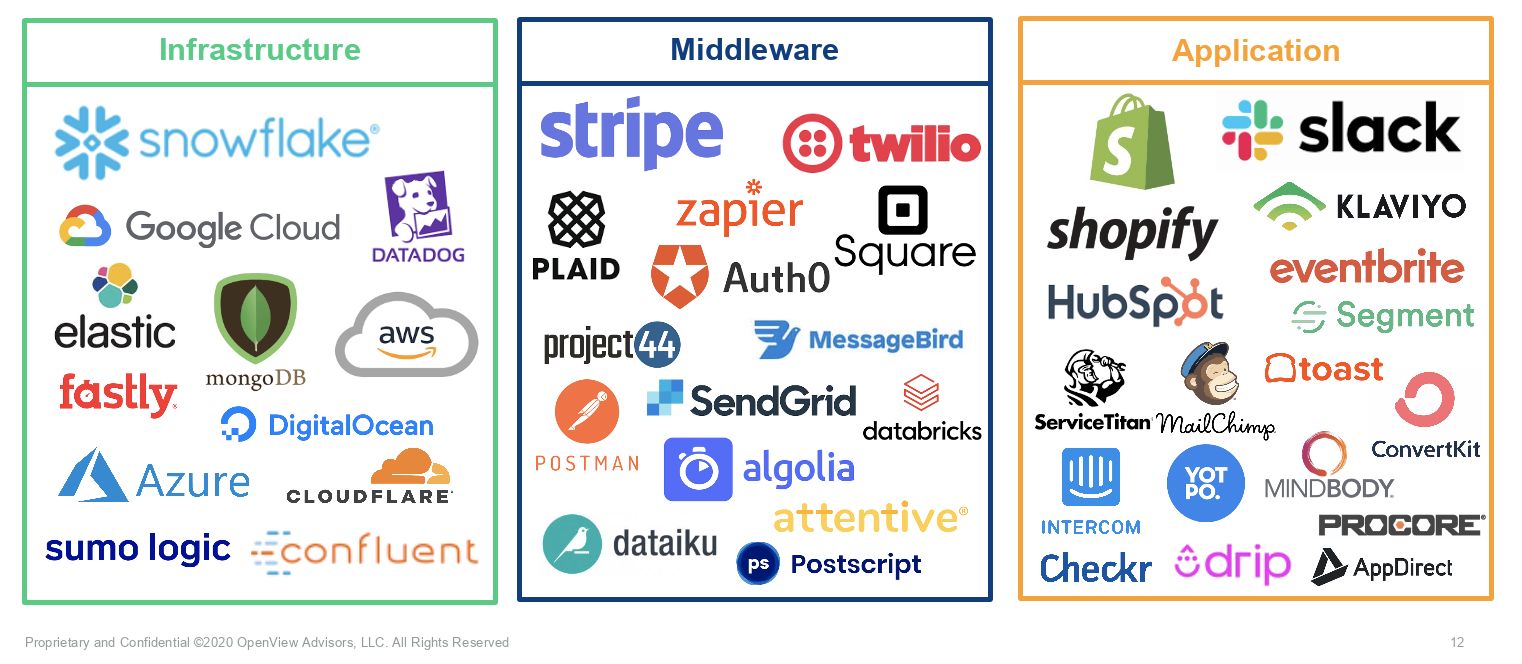
Image Credits: Kyle Povar / OpenView
Some fear that investors will hate usage-based pricing because customers aren’t locked into a subscription. But, investors actually see it as a sign that customers are seeing value from a product and there’s no shelf-ware.
In fact, investors are increasingly rewarding usage-based companies in the market. Usage-based companies are trading at a 50% revenue multiple premium over their peers.
Investors especially love how the usage-based pricing model pairs with the land-and-expand business model. And of the IPOs over the last three years, seven of the nine that had the best net dollar retention all have a usage-based model. Snowflake in particular is off the charts with a 158% net dollar retention.
Powered by WPeMatico
Each year Okta processes millions of SaaS logons via its authentication system. It kindly aggregates that data to find the most popular apps and publishes an annual report. This year it found that the most popular tool by far was Microsoft Office 365.
It’s worth noting that while app usage popularity varied by region, Office 365 was number one with a bullet across the board, whether globally or when the report broke it down by geographic area. That wasn’t true of any other product in this report, so Office 365 has extensive usage across the world (at least among companies that use Okta).
But as with everything cloud, it’s not a simple matter to say that because lots of people signed onto Office 365, Microsoft is the clear winner in a broader sense. In reality, the cloud is a complex marketplace, and just because people use one tool doesn’t preclude them from using tools that compete directly with it.
As a case in point, consider that the report found that 36% of Microsoft 365 customers were also using Google Workspace (formerly known as G Suite), which offers a similar set of office productivity tools. Further, Okta found that 42% of Office 365 customers were using Zoom and 32% were using Slack.
This is pretty remarkable when you consider that Office 365 bundles Teams with similar functionality for free. What’s more, so does Google with Google Hangouts, so people use the tool they want when they want, and sometimes it seems they use competing versions of the same tool. The report also found that of those Office 365 users, 44% are using Salesforce, 41% AWS, 15% Smartsheet and 14% Tableau (which is owned by Salesforce). Microsoft has products in all those categories.
Microsoft is clearly a big company with a lot of products, but the report blows a hole in the idea that because people like Office 365, they are going to be big fans of other Microsoft products, or that they can count on any kind of brand loyalty across the range of products or even exclusivity within the same product category.
All of this, and much of the other data in this report makes tremendously interesting reading as far as it goes. It’s not a definitive window on the state of SaaS. It’s a definitive reading on the state of Okta customers’ use of SaaS, on the Okta Integration Network (OIN), a point the company readily acknowledges in the report’s methodology section.
“As you read this report, keep in mind that this data is representative of Okta’s customers, the applications and integrations we connect to through the OIN, and the ways in which users access these tools through our service,” the report stated.
But it is a way to look at the state of SaaS taking advantage of the 9400 Okta customers using the network and the 6,500 integrations to the world’s most popular SaaS tools. That gives the company a unique view into the world of SaaS. What you can conclude is that the cloud is complicated, and it’s not a zero-sum game by any means. In fact, being a winner in one area is not a guarantee of winning across the board.
Powered by WPeMatico
Amidst all of the the sturm und drang of l’affaire GameStop, Qualtrics went public today.
After pricing its stock above its raised IPO range, the company received a warm welcome from public investors. After starting its trading life worth $41.85, Qualtrics closed the day worth $45.50, up some 51.67%.
Qualtrics did everything that it said it was going to.
The software company’s debut comes after a lengthy path to the public markets; Qualtrics sold to SAP on the eve of its first run at a public listing back in 2018. Now, SAP has completed spinning the company out, though the software giant remains the Utah unicorn’s largest shareholder.
That Qualtrics’ IPO might perform well was presaged in its pricing run, having prices far above its initial valuation estimates; there was evidence of strong demand even before its shares started to trade.
But did Qualtrics misprice, given its strong first-day performance? TechCrunch spoke with Qualtrics CEO Zig Serafin, and its founder and current executive chairman Ryan Smith about its public offering, hoping to learn a bit about what is next for the company.
Having spoken to myriad folks on IPO days, I’ve learned the best way to kick off is to ask about emotions. Most CEOs and other execs are tied up in what they can (and cannot) say. And they are well-trained by communications experts regarding what to repeat and emphasize. You can sometimes loosen them up a little, however, by asking them how they feel.
In response to that question, Serafin described a feeling of gratitude and Smith brought up the long game. Qualtrics, he said, had been told that it couldn’t bootstrap, that it couldn’t build in Utah, that SAP had overpaid, that SAP had messed up and so forth.
Powered by WPeMatico
Workday started the work day with some big news today. It’s acquiring employee feedback platform Peakon for $700 million in cash.
One thing we have learned during the pandemic is that organizations need to find new ways to build stronger connections with their employees, and that’s precisely what Peakon provides. “Bringing Peakon into the Workday family will be very compelling to our customers — especially following an extraordinary past year that has magnified the importance of having a constant pulse on employee sentiment in order to keep people engaged and productive,” Workday co-founder and co-CEO Aneel Bhusri, said in a statement.
Without the ability to have face-to-face meetings with employees, managers have struggled throughout 2020 to understand how COVID, working from home and all the trials and tribulations of the last year have affected the workforce.
But this ability to check the pulse of employees goes beyond this crisis period. Managers of large organizations know that the bigger and more spread out your firm becomes, the more challenging it is to understand what’s happening across the company. The company uses weekly surveys to ask specific questions about the organization. For them it’s all about getting good data, and so far customers have used the platform to ask over 153 million questions since inception six years ago.
Peakon CEO and co-founder Phil Chambers sees Workday as a logical partner. “Workday excels at helping enable customers to leverage their data. Together, we’ll be able to help drive greater productivity, talent development and employee retention for our customers — and unify how employees interact with their organizations,” he said in a Workday blog post announcing the deal.
Peakon was founded in Copenhagen in 2014 and has raised $68 million along the way, according to Crunchbase data. Its most recent round was a $35 million Series B in March 2019. The deal is expected to close by the end of this quarter subject to typical regulatory review.
Powered by WPeMatico
Rumors have been flying this week that SAP was going to buy Berlin business process automation startup Signavio, and sure enough the company made it official today. The companies did not reveal the purchase price, but Bloomberg reported earlier this week that the deal could be worth $1.2 billion.
With Signavio SAP gets a cloud-native business process management tool. SAP CFO Luka Mucic sees a world where understanding and automating businesses processes has become a key part of a company’s digital transformation efforts.
“I cannot overstress the importance for companies to be able to design, benchmark, improve and transform business processes across the enterprise to support new capabilities and business models,” he said in a statement.
While traditional enterprise BPA tools have existed for years, having a cloud-native tool gives SAP a much more modern approach to attacking this problem, and being able to automate business processes via the cloud has become more important during the pandemic when many employees are working entirely from home.
SAP also sees Signavio as a key missing piece in the company’s business process intelligence unit. “The combination of business process intelligence from SAP and Signavio creates a leading end-to-end business process transformation suite to help our customers achieve the requirements needed to gain a competitive edge,” he said.
SAP has been making moves into process automation of late. In fact at SAP TechEd in December, the company announced SAP Intelligent Robotic Process Automation, its foray into the RPA space. This should fit in nicely alongside it.
Dr. Gero Decker, Savigno co-founder and CEO, sees SAP resources helping push the company beyond what it could have done on its own. “Considering the positioning of SAP, its geographical coverage and financial muscle, SAP is the biggest and best platform to bring process intelligence to every organization,” he said in a statement.
The increased resources and reach argument is one that just about every acquired company CEO makes, but being pulled into a company the size of SAP can be a double-edged sword. Yes, it has vast resources, but it also can be hard for an acquired company to find its place in such a large pond. How well they fit in and make that transition from startup to big company cog, will go a long way in determining the success of this transaction in the long run.
Signavio launched in 2009 in Berlin and has raised almost $230 million, according to Crunchbase data. Investors include Apax Digital and Summit Partners. The most recent investment was a July 2019 Series C for $177 million, which came in at a $400 million valuation.
Customers include Comcast, Bosch, Liberty Mutual and yes SAP. Perhaps it will be getting a discount now.
Powered by WPeMatico