Enterprise
Auto Added by WPeMatico
Auto Added by WPeMatico
The running line from any CEO of an acquired company is that the company can do so much more with resources of the company that acquired it than it could on its own. Just seven months after being acquired, Drone co-founder Brad Rydzewski says that his company really has benefited greatly from being part of Harness, and today the company announced a significant overhaul of the open-source project.
The artist formerly known as Drone is now called “Harness CI Community Edition” and Rydzewski says the Harness CEO and founder Jyoti Bansal kept his word when he said he was 100% committed to continue developing the open-source Drone product.
“Over the past seven months since the acquisition, a lot of community work has been around taking advantage of the resources that Harness has been able to afford us as a project — like having access to a designer, having access to professional writers — these are luxuries for most open-source projects,” Rydzewski told me.
He says that having access to these additional resources has enabled him to bring a higher level of polish to the project that just wouldn’t have been possible without joining Harness. At the same time, he says the CI team, which has grown from the project’s two co-founders to 15 people, has also been able to build out the professional CI tool as it has become part of the Harness toolset.
Chief among the updates to the community edition is a new sleeker interface that has a much more professional look and feel, according to Rydzewski. In addition, developers can see how projects move along the pipeline in a visualization tool, while benefiting from real-time debugging tools and new governance and security features.
All of this is an embarrassment of riches for Rydzewski, who was used to working on a shoestring budget prior to joining Harness. “Drone came from very humble beginnings as an open-source project, but now I think it can hold its own next to any product in the market today, even products that have raised hundreds of millions of dollars,” he said.
Early Stage is the premier “how-to” event for startup entrepreneurs and investors. You’ll hear firsthand how some of the most successful founders and VCs build their businesses, raise money and manage their portfolios. We’ll cover every aspect of company building: Fundraising, recruiting, sales, product-market fit, PR, marketing and brand building. Each session also has audience participation built-in — there’s ample time included for audience questions and discussion. Use code “TCARTICLE” at checkout to get 20% off tickets right here.
Powered by WPeMatico
SecurityScorecard has been helping companies understand the security risk of its vendors since 2014 by providing each one with a letter grade based on a number of dimensions. Today, the company announced a $180 million Series E.
The round includes new investors Silver Lake Waterman, T. Rowe Price, Kayne Anderson Rudnick and Fitch Venture, along with existing investors Evolution Equity Partners, Accomplice, Riverwood Capital, Intel Capital, NGP Capital, AXA Venture Partners, GV (Google Ventures) and Boldstart Ventures. The company reports it has now raised $290 million.
Co-founder and CEO Aleksandr Yampolskiy says the company’s mission has not changed since it launched. “The idea that we started the company was a realization that when I was CISO and CTO I had no metrics at my disposal. I invested in all kinds of solutions where I was completely in the dark about how I’m doing compared to the industry and how my vendors and suppliers were doing compared to me,” Yampolskiy told me.
He and his co-founder COO Sam Kassoumeh likened this to a banker looking at a mortgage application and having no credit score to check. The company changed that by starting a system of scoring the security posture of different companies and giving them a letter grade of A-F just like at school.
Today, it has ratings on more than 2 million companies worldwide, giving companies a way to understand how secure their vendors are. Yampolskiy says that his company’s solution can rate a new company not in the data set in just five minutes. Every company can see its own scorecard for free along with advice on how to improve that score.
He notes that the disastrous SolarWinds hack was entirely predictable based on SecurityScorecard’s rating system. “SolarWinds’ score has been lagging below the industry average for quite a long time, so we weren’t really particularly surprised about them,” he said.
The industry average is around 85 or a solid B in the letter grade system, whereas SolarWinds was sitting at 70 or a C for quite some time, indicating its security posture was suspect, he reports.
While Yampolskiy didn’t want to discuss valuation or revenue or even growth numbers, he did say the company has 17,000 customers worldwide, including 7 of the 10 top pharmaceutical companies in the world.
The company has reached a point where this could be the last private fundraise it does before going public, but Yampolskiy kept his cards close on timing, saying it could happen some time in the next couple of years.
Powered by WPeMatico
Saleor, a Poland and U.S.-based startup that offers a “headless” e-commerce platform to make it easier for developers to build better online shopping experiences, has raised $2.5 million in seed funding.
The round is led by Berlin’s Cherry Ventures, with participation from various angels. They include Guillermo Rauch (Vercel CEO and inventor of Next.js), Chris Schagen (former CMO of Contentful) and Kevin Mahaffey (co-founder of Lookout).
Saleor says the injection of capital will be invested in further developing Saleor‘s headless e-commerce platform, including a soon-to-launch cloud product and GraphQL API for front-end engineers.
Founded in 2020 but with a history going back to 2013, years before founders Mirek Mencel and Patryk Zawadzki spun out the product separate from their agency, Saleor is described as an “API-first” e-commerce platform that takes a “headless” approach. The idea is that the platform does the back-end heavy lifting so that developers can focus on the front end where most of the value is created for users.
“Saleor was born of necessity when our agency work at Mirumee Software required more modular, flexible and scalable e-commerce software,” Saleor co-founder Mirek Mencel recalls. “Most solutions for bigger brands came with proprietary baggage like vendor lock-in, slow adoption of new technologies and commercial certification programs. On the open-source side, we didn’t enjoy Magento’s developer experience and felt alternatives weren’t viable at scale”.
And so Saleor was conceived as an open-source platform focused on “technical excellence and quality” that could deliver greater scalability and extensibility than existing proprietary software. By 2016, the product had grown from something Mencel and Zawadzki’s agency used internally into a platform used by developers around the world.
“We could have stopped there, but saw brands pressing for more revolutionary front-end experiences,” Mencel says. “Decoupling Saleor’s core from its presentation layer was the obvious path to revolutionary front-ends. As difficult as it was, we tore down what was a rather good open-source e-commerce platform and rebuilt it API-first”.
Beyond their early headless conviction, the pair also came to the realisation that GraphQL delivered “more power, precision and developer happiness” than REST. Reasoning that most developers prefer “a few things done superbly to many things done well,” they committed exclusively to Saleor’s GraphQL API. “We have never looked back,” says Mencel.
In 2018, the original six-person team shipped Saleor 2.0. Now with a headcount of 20, Mencel says Saleor has a simple vision of developer-first commerce: open-source, GraphQL and “fair-priced” cloud — a vision that Cherry Ventures has clearly bought into.
“We are currently witnessing a paradigm shift with developers switching to headless commerce solutions, allowing more flexible, differentiated shopping experiences,” says Filip Dames, founding partner of Cherry. “Mirek, Patryk, and their team are at the forefront of this development and will enable innovative merchants to build state-of-the-art shopping experiences that scale across all consumer touch points and devices”.
“We decided to pursue venture backing as a way to increase the Saleor core team size and accelerate buildout of Saleor Cloud, which we’ll launch this year,” adds Mencel.
Powered by WPeMatico
Amazon is apparently pleased with how its Amazon Care pilot in Seattle has gone, since it announced this morning that it will be expanding the offering across the U.S. this summer, and opening it up to companies of all sizes, in addition to its own employees. The Amazon Care model combines on-demand and in-person care, and is meant as a solution from the search giant to address shortfalls in current offerings for employer-sponsored healthcare.
In a blog post announcing the expansion, Amazon touted the speed of access to care made possible for its employees and their families via the remote, chat and video-based features of Amazon Care. These are facilitated via a dedicated Amazon Care app, which provides direct, live chats via a nurse or doctor. Issues that then require in-person care are then handled via a house call, so a medical professional is actually sent to your home to take care of things like administering blood tests or doing a chest exam, and prescriptions are delivered to your door as well.
The expansion is being handled differently across both in-person and remote variants of care; remote services will be available starting this summer to Amazon’s own employees, as well as other companies that sign on as customers, starting this summer. The in-person side will be rolling out more slowly, starting with availability in Washington, D.C., Baltimore, and “other cities in the coming months” according to the company.
As of today, Amazon Care is expanding in its home state of Washington to begin serving other companies. The idea is that others will sign on to make Amazon Care part of an overall benefits package for employees. Amazon is touting as a major strength of the service the speed advantages of testing services, including results delivery, for things including COVID-19.
The Amazon Care model has a surprisingly Amazon twist, too — when using the in-person care option, the app will provide an updated ETA for when to expect your physician or medical technician, which is eerily similar to how its primary app treats package delivery.
While the Amazon Care pilot in Washington only launched a year-and-a-half ago, the company has had its collective mind set on upending the corporate healthcare industry for some time now. It announced a partnership with Berkshire Hathaway and JPMorgan back at the beginning of 2018 to form a joint venture specifically to address the gaps they saw in the private corporate healthcare provider market.
That deep pocketed all-star team ended up officially disbanding at the outset of this year, after having done a whole lot of not very much in the three years in between. One of the stated reasons that Amazon and its partners gave for unpartnering was that each had made a lot of progress on its own in addressing the problems it had faced anyway. While Berkshire Hathaway and JPMorgan’s work in that regard might be less obvious, Amazon was clearly referring to Amazon Care.
It’s not unusual for large tech companies with lots of cash on the balance sheet and a need to attract and retain top-flight talent to spin up their own healthcare benefits for their workforces. Apple and Google both have their own on-campus wellness centers staffed by medical professionals, for instance. But Amazon’s ambitions have clearly exceeded those of its peers, and it looks intent on making a business line out of the work it did to improve its own employee care services — a strategy that isn’t too dissimilar from what happened with AWS, by the way.
Powered by WPeMatico
OctoML, a Seattle-based startup that offers a machine learning acceleration platform built on top of the open-source Apache TVM compiler framework project, today announced that it has raised a $28 million Series B funding round led by Addition. Previous investors Madrona Venture Group and Amplify Partners also participated in this round, which brings the company’s total funding to $47 million. The company last raised in April 2020, when it announced its $15 million Series A round led by Amplify.
The promise of OctoML, which was founded by the team that also created TVM, is that developers can bring their models to its platform and the service will automatically optimize that model’s performance for any given cloud or edge device.
As Brazil-born OctoML co-founder and CEO Luis Ceze told me, since raising its Series A round, the company started onboarding some early adopters to its “Octomizer” SaaS platform.
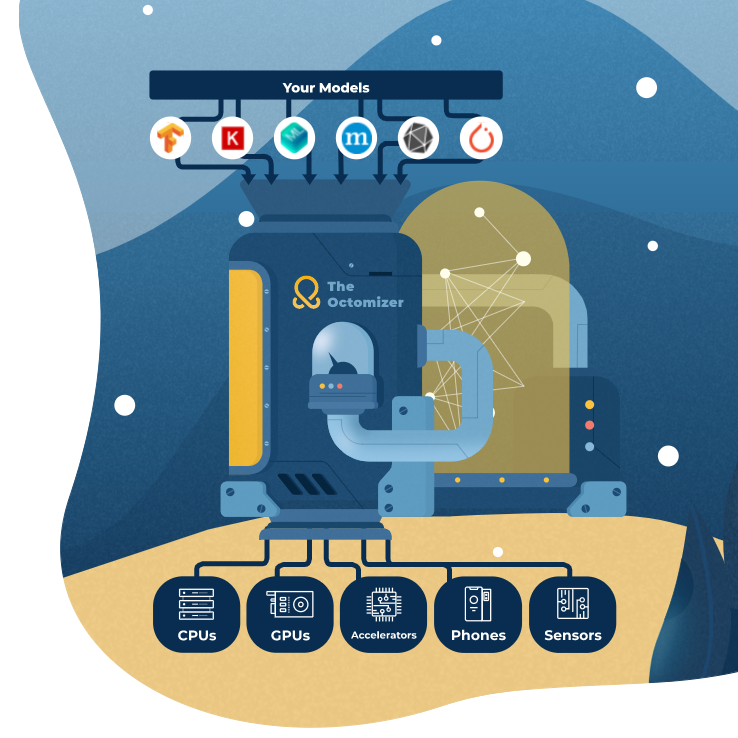
Image Credits: OctoML
“It’s still in early access, but we are we have close to 1,000 early access sign-ups on the waitlist,” Ceze said. “That was a pretty strong signal for us to end up taking this [funding]. The Series B was pre-emptive. We were planning on starting to raise money right about now. We had barely started spending our Series A money — we still had a lot of that left. But since we saw this growth and we had more paying customers than we anticipated, there were a lot of signals like, ‘hey, now we can accelerate the go-to-market machinery, build a customer success team and continue expanding the engineering team to build new features.’ ”
Ceze tells me that the team also saw strong growth signals in the overall community around the TVM project (with about 1,000 people attending its virtual conference last year). As for its customer base (and companies on its waitlist), Ceze says it represents a wide range of verticals that range from defense contractors to financial services and life science companies, automotive firms and startups in a variety of fields.
Recently, OctoML also launched support for the Apple M1 chip — and saw very good performance from that.
The company has also formed partnerships with industry heavyweights like Microsoft (which is also a customer), Qualcomm and AMD to build out the open-source components and optimize its service for an even wider range of models (and larger ones, too).
On the engineering side, Ceze tells me that the team is looking at not just optimizing and tuning models but also the training process. Training ML models can quickly become costly and any service that can speed up that process leads to direct savings for its users — which in turn makes OctoML an easier sell. The plan here, Ceze tells me, is to offer an end-to-end solution where people can optimize their ML training and the resulting models and then push their models out to their preferred platform. Right now, its users still have to take the artifact that the Octomizer creates and deploy that themselves, but deployment support is on OctoML’s roadmap.
“When we first met Luis and the OctoML team, we knew they were poised to transform the way ML teams deploy their machine learning models,” said Lee Fixel, founder of Addition. “They have the vision, the talent and the technology to drive ML transformation across every major enterprise. They launched Octomizer six months ago and it’s already becoming the go-to solution developers and data scientists use to maximize ML model performance. We look forward to supporting the company’s continued growth.”
Early Stage is the premier “how-to” event for startup entrepreneurs and investors. You’ll hear firsthand how some of the most successful founders and VCs build their businesses, raise money and manage their portfolios. We’ll cover every aspect of company building: Fundraising, recruiting, sales, product-market fit, PR, marketing and brand building. Each session also has audience participation built-in — there’s ample time included for audience questions and discussion. Use code “TCARTICLE at checkout to get 20% off tickets right here.
Powered by WPeMatico

In recent years, the publicly traded observability service New Relic started adding more machine learning-based tools to its platform for AI-assisted incident response when things don’t quite go as planned. Today, it is expanding this feature set with the launch of a number of new capabilities for what it calls its “New Relic Applied Intelligence Service.”
This expansion includes an anomaly detection service that is even available for free users, the ability to group alerts from multiple tools when the models think it’s a single issue that is triggering all of these alerts and new ML-based root cause analysis to help eliminate some of the guesswork when problems occur. Also new (and in public beta) is New Relic’s ability to detect patterns and outliers in log data that is stored in the company’s data platform.
The main idea here, New Relic’s director of product marketing Michael Olson told me, is to make it easier for companies of all sizes to reap the benefits of AI-enhanced ops.

Image Credits: New Relic
“It’s been about a year since we introduced our first set of AIops capabilities with New Relic Applied Intelligence to the market,” he said. “During that time, we’ve seen significant growth in adoption of AIops capabilities through New Relic. But one of the things that we’ve heard from organizations that have yet to foray into adopting AIops capabilities as part of their incident response practice is that they often find that things like steep learning curves and long implementation and training times — and sometimes lack of confidence, or knowledge of AI and machine learning — often stand in the way.”
The new platform should be able to detect emerging problems in real time — without the team having to pre-configure alerts. And when it does so, it’ll smartly group all of the alerts from New Relic and other tools together to cut down on the alert noise and let engineers focus on the incident.
“Instead of an alert storm when a problem occurs across multiple tools, engineers get one actionable issue with alerts automatically grouped based on things like time and frequency, based on the context that they can read in the alert messages. And then now with this launch, we’re also able to look at relationship data across your systems to intelligently group and correlate alerts,” Olson explained.
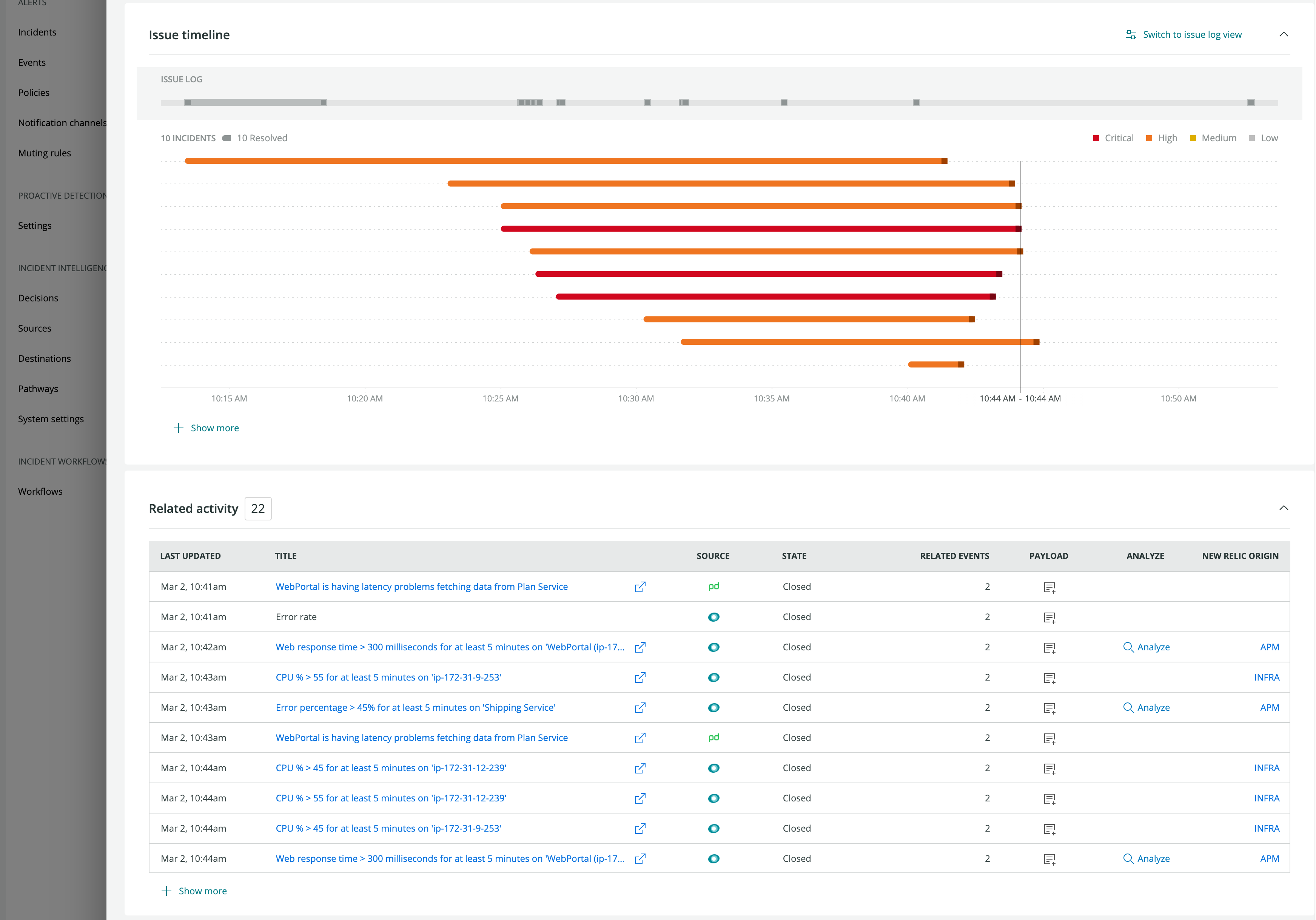
Image Credits: New Relic
Maybe the highlight for the ops teams that will use these new features, though, is New Relic’s ability to pinpoint the probable root cause of a problem. As Guy Fighel, the general manager of applied intelligence and vice president of product engineering at New Relic, told me, the idea here is not to replace humans but to augment teams.
“We provide a non-black-box experience for teams to craft the decisions and correlation and logic based on their own knowledge and infuse the system with their own knowledge,” Fighel noted. “So you can get very specific based on your environment and needs. And so because of that and because we see a lot of data coming from different tools — all going into New Relic One as the data platform — our probable root cause is very accurate. Having said that, it is still a probable root cause. So although we are opinionated about it, we will never tell you, ‘hey, go fix that, because we’re 100% sure that’s the case.’ You’re the human, you’re in control.”
The AI system also asks users for feedback, so that the model gets refined with every new incident, too.
Fighel tells me that New Relic’s tools rely on a variety of statistical analysis methods and machine learning models. Some of those are unique to individual users while others are used across the company’s user base. He also stressed that all of the engineers who worked on this project have a background in site reliability engineering — so they are intimately familiar with the problems in this space.
With today’s launch, New Relic is also adding a new integration with PagerDuty and other incident management tools so that the state of a given issue can be synchronized bi-directionally between them.
“We want to meet our customers where they are and really be data source agnostic and enable customers to pull in data from any source, where we can then enrich that data, reduce noise and ultimately help our customers solve problems faster,” said Olson.
Early Stage is the premier “how-to” event for startup entrepreneurs and investors. You’ll hear firsthand how some of the most successful founders and VCs build their businesses, raise money and manage their portfolios. We’ll cover every aspect of company building: Fundraising, recruiting, sales, product-market fit, PR, marketing and brand building. Each session also has audience participation built-in — there’s ample time included for audience questions and discussion. Use code “TCARTICLE at checkout to get 20% off tickets right here.
Powered by WPeMatico
Data is a gold mine for a company.
If managed well, it provides the clarity and insights that lead to better decision-making at scale, in addition to an important tool to hold everyone accountable.
However, most companies are stuck in Data 1.0, which means they are leveraging data as a manual and reactive service. Some have started moving to Data 2.0, which employs simple automation to improve team productivity. The complexity of crypto data has opened up new opportunities in data, namely to move to the new frontier of Data 3.0, where you can scale value creation through systematic intelligence and automation. This is our journey to Data 3.0.
The complexity of crypto data has opened up new opportunities in data, namely to move to the new frontier of Data 3.0, where you can scale value creation through systematic intelligence and automation.
Coinbase is neither a finance company nor a tech company — it’s a crypto company. This distinction has big implications for how we work with data. As a crypto company, we work with three major types of data (instead of the usual one or two types of data), each of which is complex and varied:
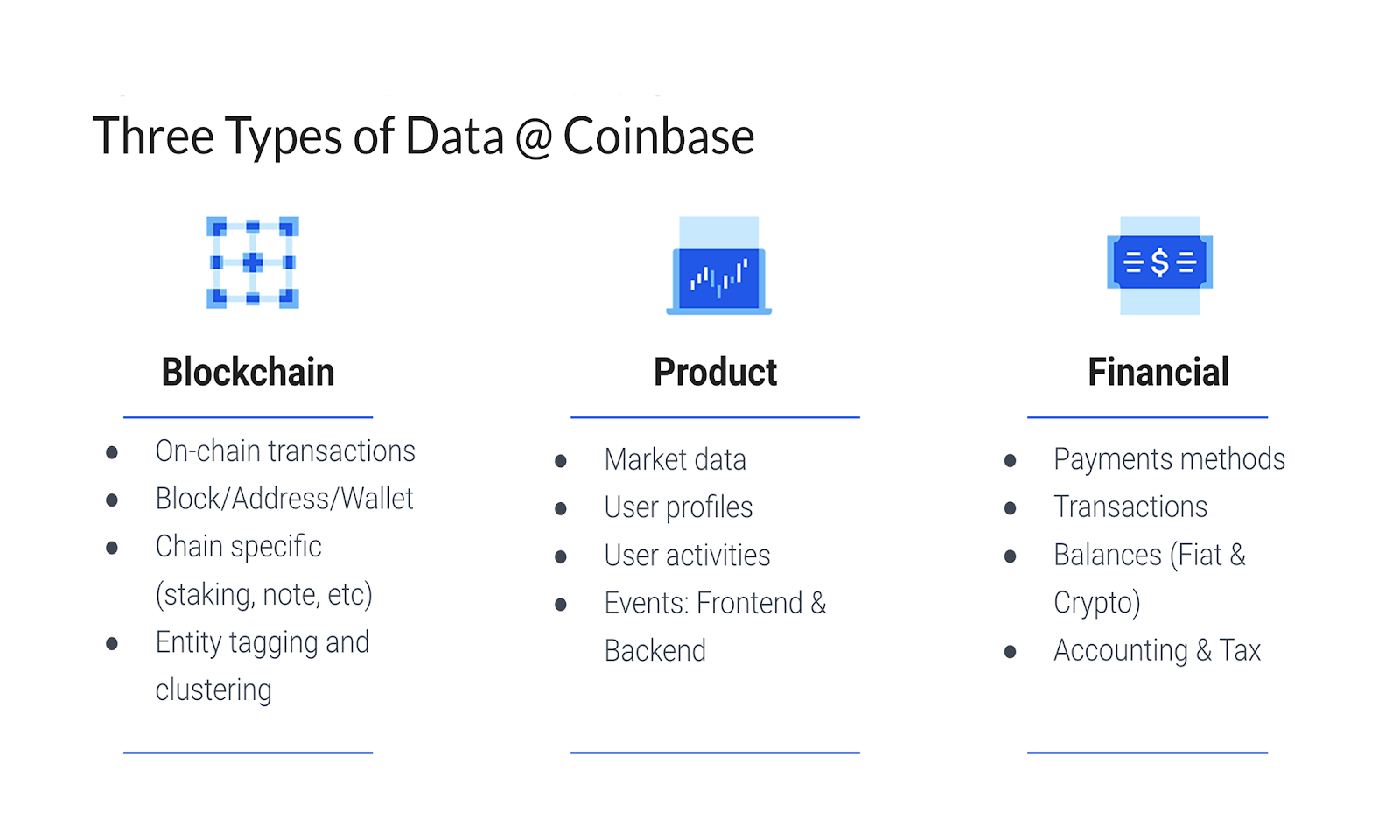
Image Credits: Michael Li/Coinbase
Our focus has been on how we can scale value creation by making this varied data work together, eliminating data silos, solving issues before they start and creating opportunities for Coinbase that wouldn’t exist otherwise.
Having worked at tech companies like LinkedIn and eBay, and also those in the finance sector, including Capital One, I’ve observed firsthand the evolution from Data 1.0 to Data 3.0. In Data 1.0, data is seen as a reactive function providing ad-hoc manual services or firefighting in urgent situations.
Powered by WPeMatico
It was easy to wonder what would become of Docker after it sold its enterprise business in 2019, but it regrouped last year as a cloud native container company focused on developers, and the new approach appears to be bearing fruit. Today, the company announced a $23 million Series B investment.
Tribe Capital led the round with participation from existing investors Benchmark and Insight Partners. Docker has now raised a total of $58 million including the $35 million investment it landed the same day it announced the deal with Mirantis.
To be sure, the company had a tempestuous 2019 when they changed CEOs twice, sold the enterprise division and looked to reestablish itself with a new strategy. While the pandemic made 2020 a trying time for everyone, Docker CEO Scott Johnston says that in spite of that, the strategy has begun to take shape.
“The results we think speak volumes. Not only was the strategy strong, but the execution of that strategy was strong as well,” Johnston told me. He indicated that the company added 1.7 million new developer registrations for the free version of the product for a total of more than 7.3 million registered users on the community edition.
As with any open-source project, the goal is to popularize the community project and turn a small percentage of those users into paying customers, but Docker’s problem prior to 2019 had been finding ways to do that. While he didn’t share specific numbers, Johnston indicated that annual recurring revenue (ARR) grew 170% last year, suggesting that they are beginning to convert more successfully.
Johnston says that’s because they have found a way to turn a certain class of developer in spite of a free version being available. “Yes, there’s a lot of upstream open-source technologies, and there are users that want to hammer together their own solutions. But we are also seeing these eight to 10 person ‘two-pizza teams’ who want to focus on building applications, and so they’re willing to pay for a service,” he said.
That open-source model tends to get the attention of investors because it comes with that built-in action at the top of the sales funnel. Tribe’s Arjun Sethi, whose firm led the investment, says his company actually was a Docker customer before investing in the company and sees a lot more growth potential.
“Tribe focuses on identifying N-of-1 companies — top-decile private tech firms that are exhibiting inflection points in their growth, with the potential to scale toward outsized outcomes with long-term venture capital. Docker fits squarely into this investment thesis [ … ],” Sethi said in a statement.
Johnston says as they look ahead post-pandemic, he’s learned a lot since his team moved out of the office last year. After surveying employees, they were surprised to learn that most have been happier working at home, having more time to spend with family, while taking away a grueling commute. As a result, he sees going virtual first, even after it’s safe to reopen offices.
That said, he is planning to offer a way to get teams together for in-person gatherings and a full company get-together once a year.
“We’ll be virtual first, but then with the savings of the real estate that we’re no longer paying for, we’re going to bring people together and make sure we have that social glue,” he said.
Early Stage is the premier “how-to” event for startup entrepreneurs and investors. You’ll hear firsthand how some of the most successful founders and VCs build their businesses, raise money and manage their portfolios. We’ll cover every aspect of company building: Fundraising, recruiting, sales, product-market fit, PR, marketing and brand building. Each session also has audience participation built in — there’s ample time included for audience questions and discussion. Use code “TCARTICLE at checkout to get 20% off tickets right here.
Powered by WPeMatico
Jennifer Dulski has held her fair share of leadership positions, from being president and COO of Change.org to serving as head of product for Google’s shopping and product ads to leading the team responsible for Facebook Groups.
But she’s identified a problem that most people managers will all too clearly understand: training and tools to be a great manager are at a shortage.
That’s why she founded Rising Team, which is today announcing the raise of a $3 million seed round led by Female Founders Fund, with participation from Peterson Ventures, Burst Capital, Xoogler Ventures, 500 Startups, Roble Ventures, Supernode Ventures and several angels.
Dulski explained that there are some tools for managers, like surveys from Gallup and Glint, and there are training options, like executive coaches. But there aren’t many options out there that combine the two.
“I was lucky enough to have the benefit of getting executive coaches or being sent to training, and those felt like being taught how to fish,” said Dulski. “But then it was like being dropped off at the lake with no fishing pole or bait, because I had learned all these things about how to be a good leader but I had no tools to implement what I had learned.”
Rising Team is a platform that combines tools and training to help managers motivate, organize and ultimately effectively lead their team.
The first layer of the platform is the tools suite, which includes proprietary assessments and 1:1 templates. Most employee surveys focus so heavily on the actual job, with questions about where employees can do their best work. With Rising Team, the assessments are geared toward who team members are personally, with a look at how they want to be appreciated or what they believe their talents and skills are.
This helps managers understand how to pair team members together, what tasks they should be assigned to and truly grasp what motivates each individual that works for them. Alongside these assessment tools, Rising Team also offers training in the form of videos, articles and audio resources. In the future, the company plans to add AI-based custom training tips that are powered by data from the assessments.
Rising Team is also building out a community that lets managers communicate with one another.
Interestingly, the startup is taking a bottom-up approach when it comes to revenue, pricing the product in a way that will allow individual managers to personally purchase the software, hopefully spreading the word to the rest of their team. But the door is open for organizations to get their full employee base on the product as well.
For now, Rising Team is in a free beta, so pricing has not yet been announced.
The team is currently made up of eight people, 60% of whom are female and 50% of whom are BIPOC.
“It’s really, really important to me and to our team as a whole that we build a diverse team from the start,” said Dulski. “I believe in that so firmly and all the data is really clear that more diverse teams are more successful.”
Early Stage is the premier “how-to” event for startup entrepreneurs and investors. You’ll hear firsthand how some of the most successful founders and VCs build their businesses, raise money and manage their portfolios. We’ll cover every aspect of company building: Fundraising, recruiting, sales, product-market fit, PR, marketing and brand building. Each session also has audience participation built-in — there’s ample time included for audience questions and discussion. Use code “TCARTICLE” at checkout to get 20% off tickets right here.
Powered by WPeMatico

Noogata, a startup that offers a no-code AI solution for enterprises, today announced that it has raised a $12 million seed round led by Team8, with participation from Skylake Capital. The company, which was founded in 2019 and counts Colgate and PepsiCo among its customers, currently focuses on e-commerce, retail and financial services, but it notes that it will use the new funding to power its product development and expand into new industries.
The company’s platform offers a collection of what are essentially pre-built AI building blocks that enterprises can then connect to third-party tools like their data warehouse, Salesforce, Stripe and other data sources. An e-commerce retailer could use this to optimize its pricing, for example, thanks to recommendations from the Noogata platform, while a brick-and-mortar retailer could use it to plan which assortment to allocate to a given location.
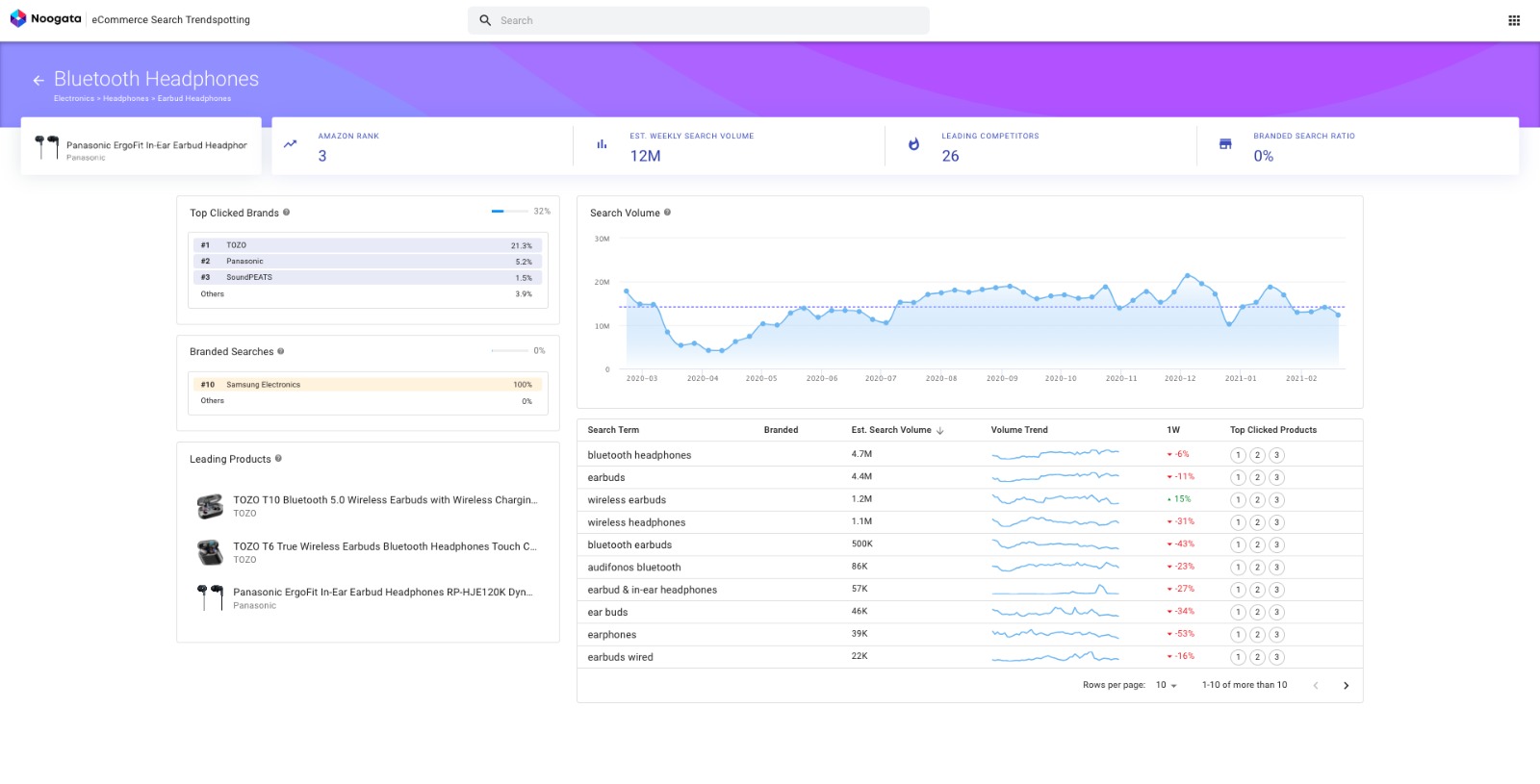
Image Credits: Noogata
“We believe data teams are at the epicenter of digital transformation and that to drive impact, they need to be able to unlock the value of data. They need access to relevant, continuous and explainable insights and predictions that are reliable and up-to-date,” said Noogata co-founder and CEO Assaf Egozi. “Noogata unlocks the value of data by providing contextual, business-focused blocks that integrate seamlessly into enterprise data environments to generate actionable insights, predictions and recommendations. This empowers users to go far beyond traditional business intelligence by leveraging AI in their self-serve analytics as well as in their data solutions.”
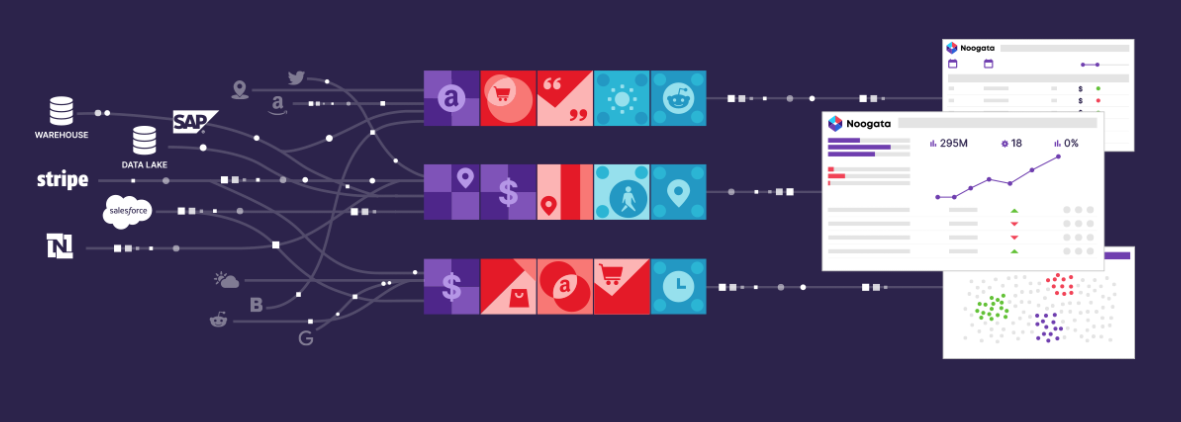
Image Credits: Noogata
We’ve obviously seen a plethora of startups in this space lately. The proliferation of data — and the advent of data warehousing — means that most businesses now have the fuel to create machine learning-based predictions. What’s often lacking, though, is the talent. There’s still a shortage of data scientists and developers who can build these models from scratch, so it’s no surprise that we’re seeing more startups that are creating no-code/low-code services in this space. The well-funded Abacus.ai, for example, targets about the same market as Noogata.
“Noogata is perfectly positioned to address the significant market need for a best-in-class, no-code data analytics platform to drive decision-making,” writes Team8 managing partner Yuval Shachar. “The innovative platform replaces the need for internal build, which is complex and costly, or the use of out-of-the-box vendor solutions which are limited. The company’s ability to unlock the value of data through AI is a game-changer. Add to that a stellar founding team, and there is no doubt in my mind that Noogata will be enormously successful.”
Early Stage is the premier “how-to” event for startup entrepreneurs and investors. You’ll hear firsthand how some of the most successful founders and VCs build their businesses, raise money and manage their portfolios. We’ll cover every aspect of company building: Fundraising, recruiting, sales, product-market fit, PR, marketing and brand building. Each session also has audience participation built-in — there’s ample time included for audience questions and discussion. Use code “TCARTICLE at checkout to get 20% off tickets right here.
Powered by WPeMatico