Enterprise
Auto Added by WPeMatico
Auto Added by WPeMatico
Auth0, a startup based in Seattle, has been helping developers with a set of APIs to build authentication into their applications for the last five years. It’s raised a fair bit of money along the way to help extend that mission, and today the company announced a $55 million Series D.
This round was led by led by Sapphire Ventures with help from World Innovation Lab, and existing investors Bessemer Venture Partners, Trinity Ventures, Meritech Capital and K9 Ventures. Today’s investment brings the total raised to $110 million. The company did not want to share its valuation.
CEO Eugenio Pace said the investment should help them expand further internationally. In fact, one of the investors, World Innovation Lab, is based in Japan and should help with their presence there. “Japan is an important market for us and they should help explain to us how the market works there,” he said.
The company offers an easy way for developers to build in authentication services into their applications, also known as Identification as a Service (IDaaS). It’s a lot like Stripe for payments or Twilio for messaging. Instead of building the authentication layer from scratch, they simply add a few lines of code and can take advantage of the services available on the Auth0 platform.
That platform includes a range of service such as single-sign on, two-factor identification, passwordless log-on and breached password detection.
They have a free tier, which doesn’t even require a credit card, and pay tiers based on the types of users — regular versus enterprise — along with the number of users. They also charge based on machine-to-machine authentication. Pace reports they have 3500 paying customers and tens of thousands of users on the free tier.
All of that has added up to a pretty decent business. While Pace would not share specific numbers, he did indicate the company doubled its revenue last year and expected to do so again this year.
With a cadence of getting funding every year for the last three years, Pace says this round may mark the end of that fundraising cycle for a time. He wasn’t ready to commit to the idea of an IPO, saying that is likely a couple of years away, but he says the company is close to profitability.
With the new influx of money, the company does plan to expand its workforce as moves into markets across the world . They currently have 300 employees, but within a year he expects to be between 400 and 450 worldwide.
The company’s last round was a $30 million Series C last June led by Meritech Capital Partners.
Powered by WPeMatico
Just days after Google announced that it would acquire Velostrata to help customers migrating more of their operations into cloud environments, HPE under its new CEO Antonio Neri is also upping its game in the same department. Today the company announced that it would acquire Plexxi, a specialist in software-defined data center solutions, aimed at optimising application performance for enterprises that are using hybrid cloud environments.
A spokesperson confirmed that the companies are not currently revealing the terms of the deal, which is expected to close in the third quarter of 2018 (ending July 31). Plexxi has 100 employees and all will be joining HPE, a spokesperson said. A role for Rich Napolitano, Plexxi’s CEO who joined after having been the president of EMC, “is still being finalized.”
For some context and a possible price range for this deal, Plexxi, founded in 2010, was last valued at around $267 million as of its last financing round, more than two years ago in January 2016, according to PitchBook. And the previous cloud infrastructure acquisition HPE made, of SimpliVity over a year ago, was for $650 million. Plexxi’s investors included GV (formerly Google Ventures), Lightspeed Venture Partners, Matrix and more.
Cloud services — propelled by the rise of mobile hardware with less on-device storage, advances at major platforms like AWS, Microsoft’s Azure and Google, and the rise of companies like Box to help manage cloud services — have exploded in their ubiquity as a way to deliver and store software and data among enterprises.
But many organizations are, in fact, not throwing all of their eggs into the clouds, so to speak, and are taking a more gradual path to migrate some or all of their IP out of on-premises-based solutions.
This, in turn, has given rise to a second market for hybrid cloud services, deployments that are more flexible and allow for a mix of legacy and on-premises hardware alongside more modern distributed architectures. HPE and Google are not the only ones building solutions to address that market: Microsoft, Dell, Accenture, NTT, and many more have also made large investments to cover these different bases.
And that has proven popular not just with vendors — but with enterprises as well. BCC today released a report that estimates hybrid cloud services could reach a market size of $98.8 billion globally by 2022.
Ric Lewis, the VP & GM of HPE’s software-defined and cloud group, said that the plan will be to integrate Plexxi into HPE’s existing products in two areas.
The first of these is in the company’s hyperconverged solutions business, where HPE’s acquisition of SimpliVity also sites. “Plexxi will enable us to deliver the industry’s only hyperconverged offering that incorporates compute, storage and data fabric networking into a single solution, with a single management interface and support,” he wrote in a blog post.
The second of these will be to bring Plexxi’s HCN tech to HPE Synergy and its composable infrastructure business. This, Lewis explained, is “a new category of infrastructure that delivers fluid pools of storage and compute resources that can be composed and recomposed as business needs dictate.” Plexxi will enable this approach to extend also to rack-based solutions in private clouds.
“Plexxi and HPE’s values and vision for the future are closely aligned,” Plexxi CEO Rich Napolitano wrote in his own announcement. “We share the same mission, to help the enterprise effectively leverage modern IT to accelerate their business in the digital age.”
While the two wait for the deal to close, it seems to be business as usual for Plexxi. Just earlier today, the company announced an expansion of its integrations with VMware.
Updated with more detail from Plexxi.
Powered by WPeMatico
Veridium Labs has been trying to solve a hard problem about how to trade carbon offset credits in an open market. The trouble is that more complex credits don’t have a simple value like a stock, and there hasn’t been a formula to determine their individual value. That has made accounting for them and selling them on open exchanges difficult or impossible. It’s a problem Veridium believes they can finally solve with tokens and the blockchain.
This week the company announced a partnership with IBM to sell carbon offset tokens on the Stellar blockchain. Each company has a role here with Veridium setting up the structure and determining the value formula. Stellar acts as the digital ledger for the transactions and IBM will handle the nuts and bolts of the trade activity of buying, selling and managing the tokens.
Todd Lemons, chairman at Veridium Labs, which is part of a larger environmental company called EnVision Corporation, says that even companies with the best of intentions have struggled with how to account for the complex carbon credits. There are simpler offset credits that are sold on exchanges, but ones that seek to measure the impact of a product through the entire supply chain are much more difficult to determine. As one example, how does a company making a candy bar source its cocoa and sugar. It’s not always easy to determine through a web of suppliers and sellers.
To partly solve this problem, another Envision company, InfiniteEARTH developed a way to account for them called the Redd+ forest carbon accounting methodology. It is widely accepted to the point that it has been incorporated in the Paris Climate Agreement, but it doesn’t provide a way to turn the credits into what are called fungible assets, that is an easily tradable one. The problem is the value of a given credit shifts according to the overall environmental impact of producing a good and getting it to market. That value can change according to the product.
Jared Klee, blockchain manager for token initiatives at IBM, says that buying and accounting for Redd+ credits on the company balance sheet has been a huge challenge for organizations. “It’s a major pain point. Today Redd+ credits are over the counter assets and there is no central exchange,” he said. That means they are essentially one-off transactions and the company is forced to hold these assets on the books with no easy way to account for their actual value. That often results in a big loss, he says, and companies are looking for ways to comply in a more cost-efficient way.
The three companies — Veridium, IBM and Stellar — have come together to solve this problem by creating a digital token that acts as a layer on top of the carbon credit to give it a value and make it easier to account for. In addition, the tokens can be bought and sold on the blockchain.
The blockchain provides all the usual advantages of a decentralized record keeping system, immutable records and encrypted transactions.
Veridium is working on the underlying formula for token valuation that measures “carbon density per dollar times product group,” Lemons explained. “That can be coded into a token and carried out automatically,” he added. They are working with various world bodies like the United Nations and The World Resource Institute to help figure out the values for each product group.
All of the details are still being worked out as the idea works its way through the various regulatory bodies, but the companies hope to be making the tokens available for sale some time later this year.
Ultimately this is about finding ways to help businesses comply with environmental initiatives and remove some of the complexity inherent in that process today. “We hope the tokens will provide less friction and a much higher adoption rate,” Lemons said.
Powered by WPeMatico
When Amazon introduced AWS Lambda in 2015, the notion of serverless computing was relatively unknown. It enables developers to deliver software without having to manage a server to do it. Instead, Amazon manages it all and the underlying infrastructure only comes into play when an event triggers a requirement. Today, the company released an app in the iOS App Store called AWS IoT 1-Click to bring that notion a step further.
The 1-click part of the name may be a bit optimistic, but the app is designed to give developers even quicker access to Lambda event triggers. These are designed specifically for simple single-purpose devices like a badge reader or a button. When you press the button, you could be connected to customer service or maintenance or whatever makes sense for the given scenario.
One particularly good example from Amazon is the Dash Button. These are simple buttons that users push to reorder goods like laundry detergent or toilet paper. Pushing the button connects to the device to the internet via the home or business’s WiFi and sends a signal to the vendor to order the product in the pre-configured amount. AWS IoT 1-Click extends this capability to any developers, so long as it is on a supported device.
To use the new feature, you need to enter your existing account information. You configure your WiFi and you can choose from a pre-configured list of devices and Lambda functions for the given device. Supported devices in this early release include AWS IoT Enterprise Button, a commercialized version of the Dash button and the AT&T LTE-M Button.
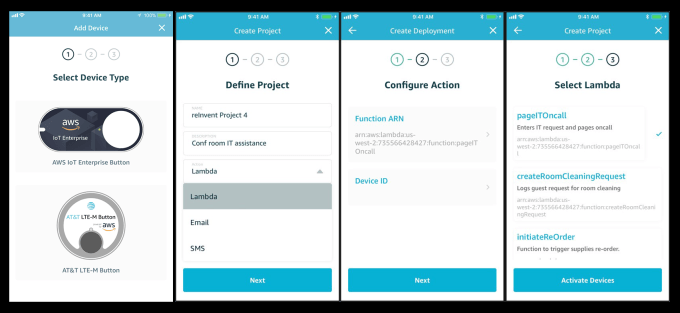
Once you select a device, you define the project to trigger a Lambda function, or send an SMS or email, as you prefer. Choose Lambda for an event trigger, then touch Next to move to the configuration screen where you configure the trigger action. For instance, if pushing the button triggers a call to IT from the conference room, the trigger would send a page to IT that there was a call for help in the given conference room.
Finally, choose the appropriate Lambda function, which should work correctly based on your configuration information.
All of this obviously requires more than one click and probably involves some testing and reconfiguring to make sure you’ve entered everything correctly, but the idea of having an app to create simple Lambda functions could help people with non-programming background configure buttons with simple functions with some training on the configuration process.
It’s worth noting that the service is still in Preview, so you can download the app today, but you have to apply to participate at this time.
Powered by WPeMatico
As old-school industries like oil and gas increasingly network entities like oil platforms, they become more vulnerable to hacking attacks that were impossible when they were stand-alone. That requires a new approach to security and Xage (pronounced Zage), a security startup that launched last year thinks it has the answer with a concept called ‘fingerprinting’ combined with the blockchain.
“Each individual fingerprint tries to reflect as much information as possible about a device or controller,” Duncan Greatwood, Xage’s CEO explained. They do this by storing configuration data from each device and controller on the network. That includes the hardware type, the software that’s installed on it, the CPU ID, the storage ID and so forth.
If someone were to try to inject malware into one of these controllers, the fingerprint identification would notice a change and shut it down until human technicians could figure out if it’s a legitimate change or not.
You may be wondering where the blockchain comes into this, but imagine a honey pot of these fingerprints were stored in a conventional database. If that database were compromised, it would mean hackers could have access to a company’s entire store of fingerprints, completely neutering that idea. That’s where the blockchain comes in.
Greatwood says it serves multiple purposes to prevent such a scenario from happening. For starters, it takes away that centralized honey pot. It also provides a means of authentication making it impossible to insert a fake fingerprint without explicit permission to do so.
But he says that Xage takes one more precaution unrelated to the blockchain to allow for legitimate updates to the controller. “We have a digital replica (twin) of the system we keep in the cloud, so if someone is changing the software or plans to change it on a device or controller, we will pre-calculate what the new fingerprint will be before we update the controller,” he said. That will allow them to understand when there is a sanctioned update happening and not an external threat agent trying to mimic one.
In this way they check the validity of every fingerprint and have checks and balances every step of the way. If the updated fingerprint matches the cloud replica, they can be reasonably assured that it’s authentic. If it doesn’t, he says they assume the fingerprint might have been hacked and shut it down for further investigation by the customer.
While this sounds like a complex way of protecting this infrastructure, Greatwood points out that these devices and controllers tend to be fairly simple in terms of their configuration, not like the complexities involved in managing security on a network of workstations with many possible access points for hackers.
The irony here is that these companies are networking their devices to simplify maintenance, but in doing so they have created a new set of issues. “It’s a very interesting problem. They are adopting IoT, so they don’t have to do [so many] truck rolls. They want that network capability, but then the risk of hacking is greater because it only takes one hack to get access to thousands of controllers,” he explained.
In case you are thinking they may be overstating the actual problem of oil rigs and other industrial targets getting hacked, a Department of Homeland Security report released in March suggests that the energy sector has been an area of interest for nation-state hackers in recent years.
Powered by WPeMatico
There isn’t a software company out there worth its salt that doesn’t have some kind of artificial intelligence initiative in progress right now. These organizations understand that AI is going to be a game-changer, even if they might not have a full understanding of how that’s going to work just yet.
In March at the Adobe Summit, I sat down with Adobe executive vice president and CTO Abhay Parasnis, and talked about a range of subjects with him including the company’s goal to build a cloud platform for the next decade — and how AI is a big part of that.
Parasnis told me that he has a broad set of responsibilities starting with the typical CTO role of setting the tone for the company’s technology strategy, but it doesn’t stop there by any means. He also is in charge of operational execution for the core cloud platform and all the engineering building out the platform — including AI and Sensei. That includes managing a multi-thousand person engineering team. Finally, he’s in charge of all the digital infrastructure and the IT organization — just a bit on his plate.
The company’s transition from selling boxed software to a subscription-based cloud company began in 2013, long before Parasnis came on board. It has been a highly successful one, but Adobe knew it would take more than simply shedding boxed software to survive long-term. When Parasnis arrived, the next step was to rearchitect the base platform in a way that was flexible enough to last for at least a decade — yes, a decade.
“When we first started thinking about the next generation platform, we had to think about what do we want to build for. It’s a massive lift and we have to architect to last a decade,” he said. There’s a huge challenge because so much can change over time, especially right now when technology is shifting so rapidly.
That meant that they had to build in flexibility to allow for these kinds of changes over time, maybe even ones they can’t anticipate just yet. The company certainly sees immersive technology like AR and VR, as well as voice as something they need to start thinking about as a future bet — and their base platform had to be adaptable enough to support that.
But Adobe also needed to get its ducks in a row around AI. That’s why around 18 months ago, the company made another strategic decision to develop AI as a core part of the new platform. They saw a lot of companies looking at a more general AI for developers, but they had a different vision, one tightly focussed on Adobe’s core functionality. Parasnis sees this as the key part of the company’s cloud platform strategy. “AI will be the single most transformational force in technology,” he said, adding that Sensei is by far the thing he is spending the most time on.”
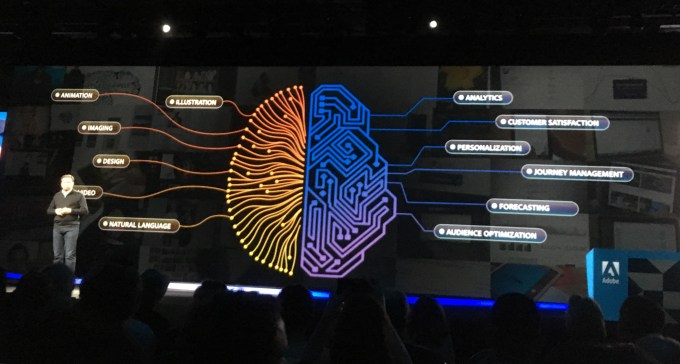
Photo: Ron Miller
The company began thinking about the new cloud platform with the larger artificial intelligence goal in mind, building AI-fueled algorithms to handle core platform functionality. Once they refined them for use in-house, the next step was to open up these algorithms to third-party developers to build their own applications using Adobe’s AI tools.
It’s actually a classic software platform play, whether the service involves AI or not. Every cloud company from Box to Salesforce has been exposing their services for years, letting developers take advantage of their expertise so they can concentrate on their core knowledge. They don’t have to worry about building something like storage or security from scratch because they can grab those features from a platform that has built-in expertise and provides a way to easily incorporate it into applications.
The difference here is that it involves Adobe’s core functions, so it may be intelligent auto cropping and smart tagging in Adobe Experience Manager or AI-fueled visual stock search in Creative Cloud. These are features that are essential to the Adobe software experience, which the company is packaging as an API and delivering to developers to use in their own software.
Whether or not Sensei can be the technology that drives the Adobe cloud platform for the next 10 years, Parasnis and the company at large are very much committed to that vision. We should see more announcements from Adobe in the coming months and years as they build more AI-powered algorithms into the platform and expose them to developers for use in their own software.
Parasnis certainly recognizes this as an ongoing process. “We still have a lot of work to do, but we are off in an extremely good architectural direction, and AI will be a crucial part,” he said.
Powered by WPeMatico
HubSpot is expanding beyond sales and marketing with the official launch of its Service Hub for managing customer service.
The product was first announced last fall, but now it’s moved out of beta testing.
HubSpot President and COO JD Sherman said this was a logical next step for the company. He argued that the Internet has “democratized” the ability of businesses to attract customers by creating their own content (using tools like HubSpot’s, natch), and while “that opportunity still exists, frankly, it’s getting harder due to the sheer volume of what’s going on.”
“It makes sense to take care of your customer,” Sherman said — both to keep them loyal and also to turn them into an advocate who might help you attract new customers.
Service Hub General Manager Michael Redbord and Go To Market Leader David Barron gave me a quick tour of the Service Hub. It includes an universal inbox for all your customer communications, a bot-builder to automate some of those customer interactions, tools for building a company knowledge base (which can then be fed into the bot-builder, which Redbord described as a more “customer-centric” way to present your content), tools for creating surveys and a dashboard to track how your service team is doing.
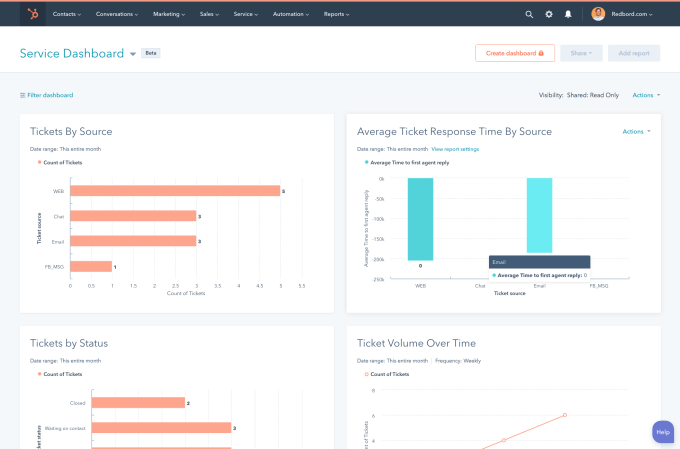
Redbord said he previously worked on HubSpot’s own service and support team, so every feature in ServiceHub has “a one-to-one relationship” with an issue that HubSpot has faced, or that he personally has faced, while trying to support customers.
Barron added that ServiceHub benefits from being integrated with HubSpot’s existing products, allowing businesses to track their interactions with a customer across sales, marketing and support.
“We’re a platform company,” he said. “When any of these conversations happens, whether it’s a chat with a human or a chat with a bot, that’s all logged on [a single record] in HubSpot, so there’s no data leakage between different teams.”
Powered by WPeMatico
Dropbox made its debut as a public company earlier this year and today passed through its first milestone of reporting its results to public investors, and it more or less beat expectations set for Wall Street on the top and bottom line.
The company reported more revenue and beat expectations for earnings that Wall Street set, bringing in $316.3 million in revenue and appearing to pick up momentum among its paying user base. It also said it had 11.5 million paying users, a jump from last year. However, the stock was largely flat in extended trading. One small negative signal — and it definitely appears to be a small one — was that its GAAP gross margin slipped slightly to 61.9% from 62.3% a year earlier. Dropbox is a software company that’s supposed to have great margins as it begins to ramp up its own hardware, but that slipping margin may end up being something that investors will zero in on going forward. Still, as the company continues to ramp up the enterprise component of its business, the calculus of its business may change over time.
This is a pretty important moment for the company, as it was a darling in Silicon Valley and rocketed to a $10 billion valuation in the early phases of the Web 2.0 era but began to face a ton of criticism as to whether it could be a robust business as larger companies started to offer cloud storage as a perk and not a business. Dropbox then found itself going up against companies like Box and Microsoft as it worked to create an enterprise business, but all this was behind closed doors — and it wasn’t clear if it was able to successfully maneuver its way into a second big business. Now the company is beholden to public shareholders and has to show all this in the open, and it serves as a good barometer of not just storage and collaboration businesses, but also some companies that are looking to drastically simplify workflow processes and convert that into a real business (like Slack, for example).
Here’s the final scorecard for the company:
(The GAAP and non-GAAP comparison is typically related to share-based compensation, which is a key component of employee compensation and retention.)
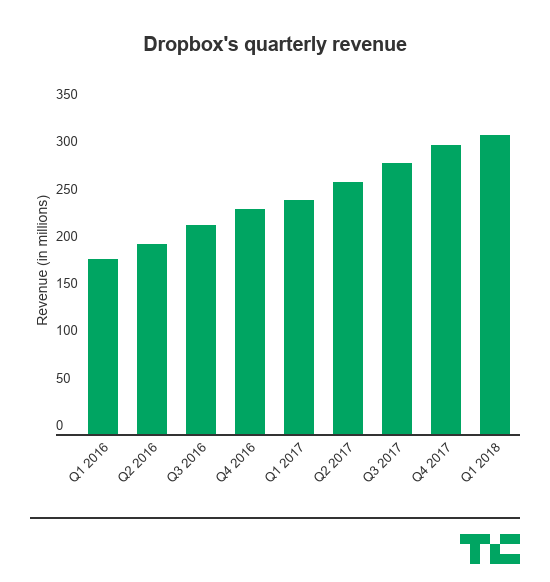
Dropbox was largely considered to be a successful IPO, rising more than 40% in its trading debut. That does mean that it may have left some money on the table, but its operating losses have been largely stable, even as it looks to woo larger enterprise customers as it — which is a bit of a taller order than its typical growth amid consumers that’s heavily driven by organic growth. Those larger enterprise customers offer more stable, and larger, revenue streams than a consumer base that faces a variety of options as many companies start to offer free storage. The company is now worth well over that original $10 billion valuation as a public company. Dropbox says it has more than 500 million users.
Since going public, the stock has had its ups and downs, but for the most part hasn’t dipped below that significant jump it saw from day one. Keeping that number propped up — and growing — is an important part of growing a business as a public company as it waves off more intense scrutiny and pressure for change from public shareholders, as well as offering competitive compensation packages for incoming employees in order to attract the best talent. It’s also good for morale as it offers a kind of grade for how the company is doing in the eyes of the public, though CEOs of companies often say they are committed toward long-term goals. The company’s shares are up around 11% since going public.
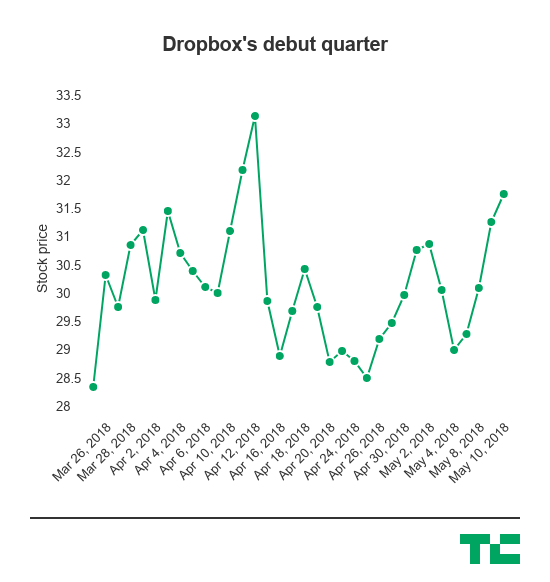
While there have been a wave of enterprise IPOs this year, including zScalar and Pluralsight’s upcoming IPO, Dropbox was largely considered to be a potential gauge of whether the IPO window was still open this year because of its hybrid nature. Dropbox started off as a consumer company based around a dead-simple approach of hosting and sharing files online, and used that to build a massive user base even as the cost of cloud storage was rapidly commoditized. But it also is building a robust enterprise-focus business, and continues to roll out a variety of tools to woo those businesses with consistent updates to products like its document tool Paper. Last month, the company started rolling out templates, as it looked to make traditional workflow processes easier and easier for companies in order to capture their interest much in the same way it captured the interest of consumers at large.
Powered by WPeMatico
ScopeAR, a graduate of the Y Combinator Summer 2015 class, came to the augmented reality game very early, launching in 2011 when there was very little hardware and most people didn’t understand the technology. But it has managed to hang around long enough for the market and the hardware to finally catch with the founders’ vision of using AR as an advanced training tool in the enterprise.
Today, the company offers a pair of tools. First of all, there is RemoteAR, which CEO and company co-founder Scott Montgomerie describes as “Facetime with AR on top of it.” It allows a technician to virtually look over the shoulder at what a local person is seeing and provide directions and feedback in real time remotely. For example, the expert could circle the cover the technician needs to remove and point to the screws with two virtual arrows.
This could have great utility in any situation where you have an experienced person in the office, who doesn’t want to go on the road on anymore, but can still provide detailed instructions to a novice, acting as a trainer and helper. This is an actual problem in many industries with aging workforces.

Technician working with RemoteAR. Photo: ScopeAR
The second product, called WorkLink, lets you import a 3D CAD model, then associate that model with real equipment. When you put on hardware like Microsoft Hololens, you can see the 3D representation of the equipment and follow along with instructions on how to repair it. It also works with iOS, Android and Windows devices.
One big change since the company was established in 2011 is the variety of platforms you can use for augmented reality. “Last year was the thing where AR took off. Apple got into it with ARKit and Google with ARCore and awareness happened and people saw it was viable,” Montgomerie said.
By creating enterprise use cases like remote assistance and work instructions, the company has been gaining momentum over the last year, and reports tripling its revenue in 2017. Although they aren’t sharing a specific number, it’s fair to say they are growing quickly.
They developed an augmented reality training product early on that resonated with a mining company, and that along with consulting working with the likes of NASA, Boeing and Toyota, helped them stay afloat until things began to really click around AR in recent years, Montgomerie explained.
They also took some time to be part of the Y Combinator Summer 2015 class, and even scored a spot on TechCrunch’s list of favorite Demo Day 2 startups. During the YC experience, they developed the first version of RemoteAR. WorkLink followed a year later.
So far the company has taken on a fairly modest amount of investment with Montgomerie reporting three seed rounds including $2 million right after Y Combinator, $1.7 million last May and another $2 million this past December. If the company continues to grow at this rate, it’s a good bet they will be looking for a Series A at some point to help scale the company further.
Powered by WPeMatico
Google announced today it was going to acquire Israeli cloud migration startup, Velostrata. The companies did not share the purchase price.
Velostrata helps companies migrate from on-premises datacenters to the cloud, a common requirement today as companies try to shift more workloads to the cloud. It’s not always a simple matter though to transfer those legacy applications, and that’s where Velostrata could help Google Cloud customers.
As I wrote in 2014 about their debut, the startup figured out a way to decouple storage and compute and that had wide usage and appeal. “The company has a sophisticated hybrid cloud solution that decouples storage from compute resources, leaving the storage in place on-premises while running a virtual machine in the cloud,” I wrote at the time.
But more than that, in a hybrid world where customer applications and data can live in the public cloud or on prem (or a combination), Velostrata gives them control to move and adapt the workloads as needed and prepare it for delivery on cloud virtual machines.
“This means [customers] can easily and quickly migrate virtual machine-based workloads like large databases, enterprise applications, DevOps, and large batch processing to and from the cloud,” Eyal Manor VP of engineering at Google Cloud wrote in the blog post announcing the acquisition.
This of course takes Velostrata from being a general purpose cloud migration tool to one tuned specifically for Google Cloud in the future, but one that gives Google a valuable tool in its battle to gain cloud marketshare.
In the past, Google Cloud head Diane Greene has talked about the business opportunities they have seen in simply “lifting and shifting” data loads to the cloud. This acquisition gives them a key service to help customers who want to do that with the Google Cloud.
Velostrata was founded in 2014. It has raised over $31 million from investors including Intel Capital and Norwest Venture partners.
Powered by WPeMatico