Enterprise
Auto Added by WPeMatico
Auto Added by WPeMatico

As Slack tries to graduate beyond a Silicon Valley darling to the go-to communications platform within a company, it’s had to find ways to increasingly pitch itself as an intelligent Swiss Army knife for companies — and not just a simple chat app — and it is trying to continue that today once again with a new feature called Actions.
Companies can now bake in a user experience of their own directly into the Slack application that isn’t yet another chatbot that’s tied into their services. Developers can essentially create a customized prompt for any kind of action, like submitting a support ticket, within the Slack core chat experience through a drop-down window called an Action. While Slackbots may have been an early incarnation of this, Slack’s platform has grown to include more than 200,000 developers, and there’s still constant need for robust tools internally. This offers partners and developers a little more flexibility when it comes to figuring out what experience makes the most sense for people that sit in Slack all day, but have to keep porting information to and from their own tools.
“There’s such a demand for specialized software, and for great tools that are easy to use and interoperable with all applications you use,” Slack chief product officer April Underwood said. “We think this is good, and we think more tools means customers have more choice. Ultimately there’s more competition in the marketplace, that means the best tools, the ones that truly help companies do their best work, rise to the top. But your work experience becomes increasingly siloed. Slack needs to be highly configurable, but in doing so we believe Slack is the collaboration hub that brings all this together.”
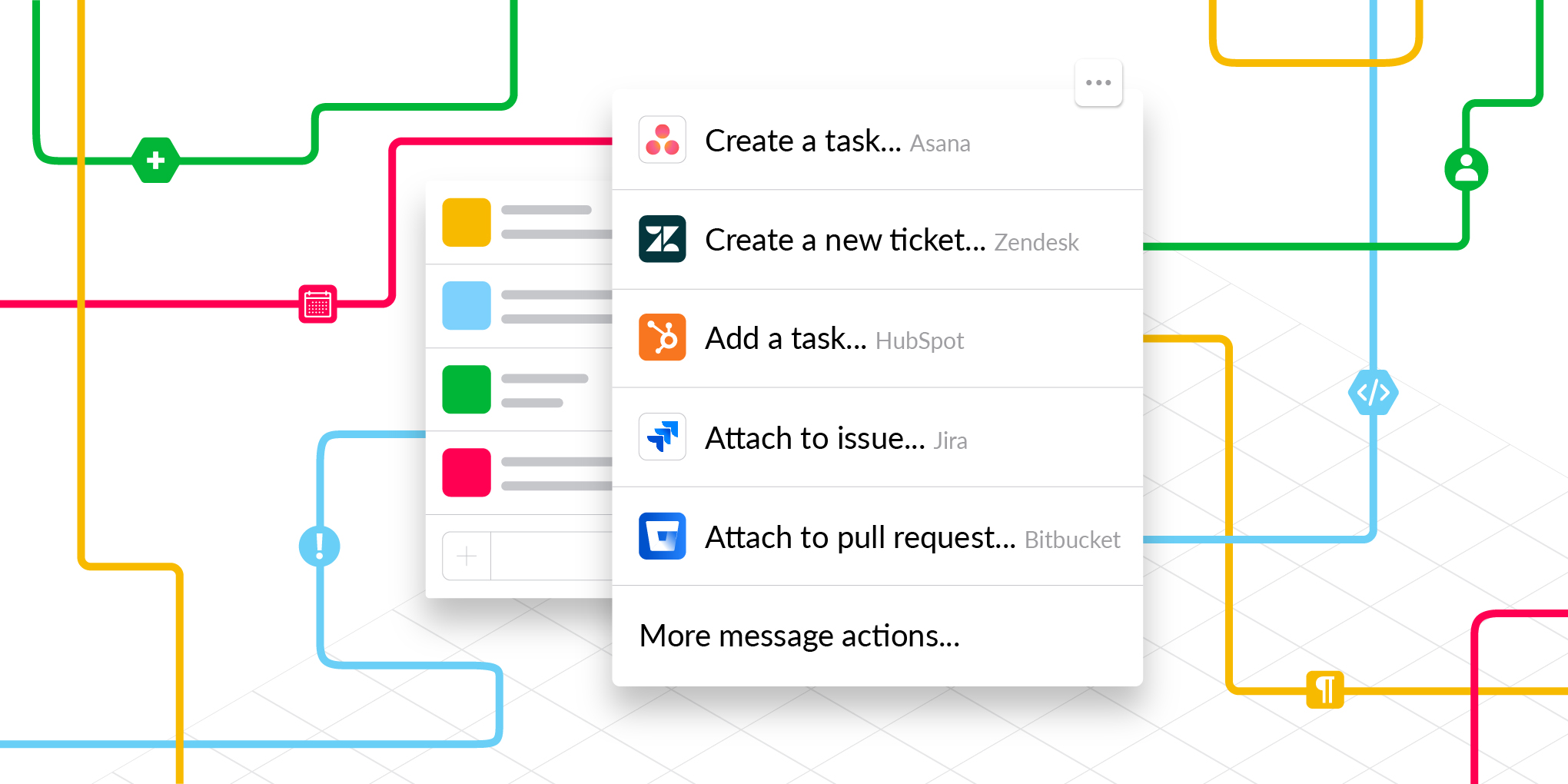
Each company that wants to build in an integration — like Asana for task management or Zendesk for ticket management — works to create a new flow within the core Slack experience, which includes a new dropdown inside a message and a prompt to bake something into the chat flow. Once that happens, all that information is then ported over to the integration and created in the same way an employee would create it within that environment. If someone creates a Zendesk ticket through an action in Slack, Zendesk automatically generates the ticket on their side.
Slack has sprawled out over time, and especially as companies using it get larger and larger, the company has to figure out a way to show that it can remain a dead-simple app without turning into a bloated window filled with thousands of instant messages. Actions is one potential approach to that, where users can know from the get-go where to coordinate certain activities like equipment procurement or managing some customer information — and not have to go anywhere else.
The other advantage here is that it makes the destination for completing a task not necessarily a “what,” but also a “who.” Slack is leaning on its machine learning tool to make it easier and easier to find the right people with the right answers, whether those questions are already answered somewhere or they know who can get you the information right away. Actions is another extension here, as well, as users can get accustomed to going to certain coworkers with the intent of completing tasks — such as their IT head in their office that they walk by every morning on the way to grabbing coffee.
The company says it’s also working on what it’s calling the Block Kit, which integrates those tasks and other elements directly into the Slack chat flow in a way that looks a little more user friendly from a kind of visual sense. The idea here is, again, to create an intuitive flow for people that goes beyond just a simple chat app, but also offers some additional way of interactivity that turns Slack into a more sensible feed rather than just a window with people talking to each other. Actions are available from Jira, Bitbucket, Asana, Zendesk, HubSpot, and several others.
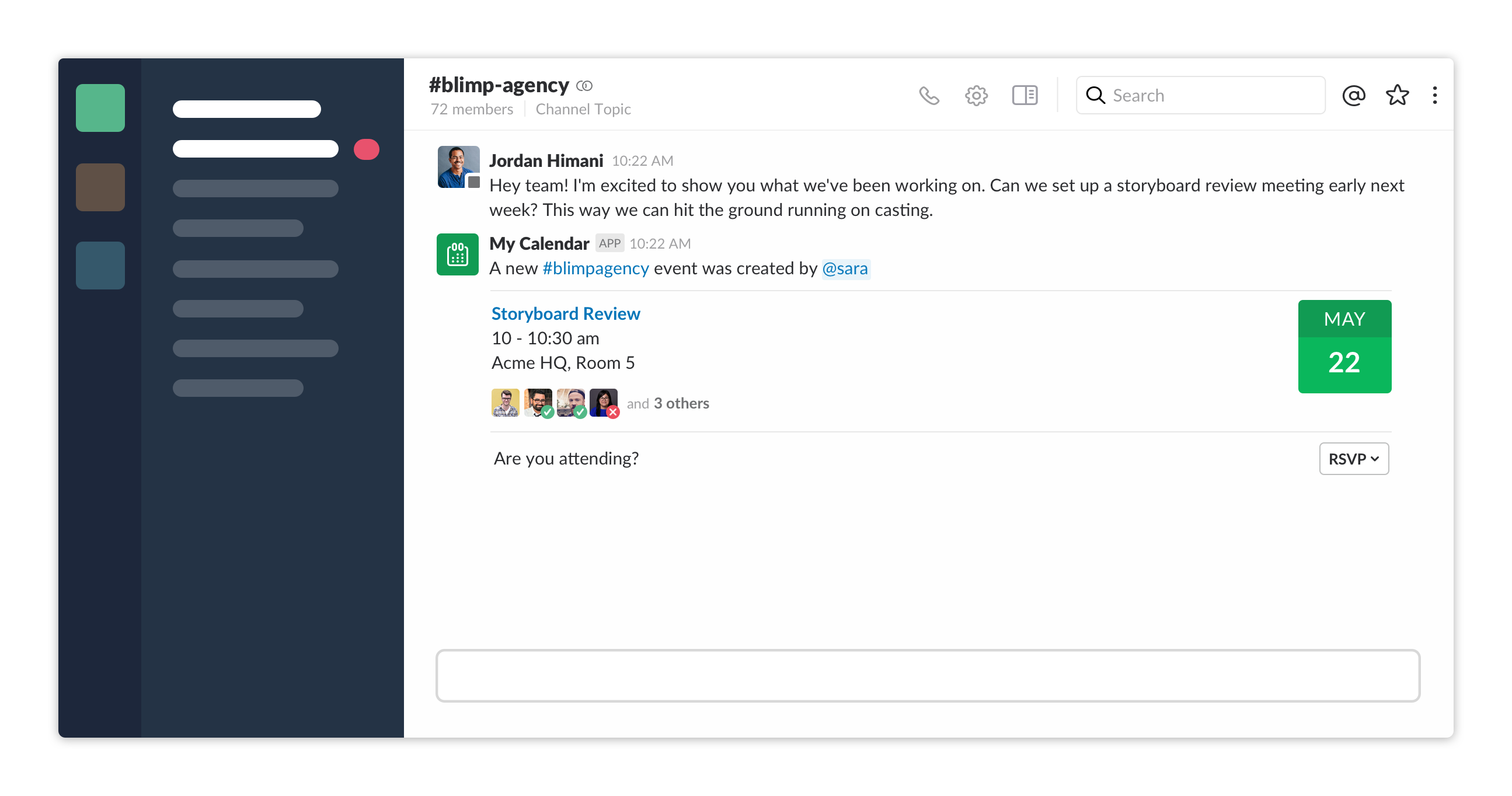
Actions is a tool that Slack is unveiling at its own developer conference, Spec, this morning. That in of itself is yet another example of Slack looking to graduate beyond just a simpler information feed that works well with smaller companies. Developers are often the ones that figure out the best niche use cases for any platform, as it means Slack can focus on trying to figure out how all these integrations fit into its design ethos. The company has to figure out how to convince larger companies that they need a tool like this and it won’t get out of hand, and also ensure that smaller companies don’t graduate into something a little more flexible that can serve those niche cases as they get larger.
To be sure, Slack is growing. The company said it hit 8 million daily active users with 3 million paid users earlier this month. That’s helped it quickly jump to a $5.1 billion valuation (as of its most recent funding round), and the company has been carefully rolling out tools that might make communication within larger companies a little easier — including the long-awaited launch of threads a little more than a year ago.
But Slack also faces increasing competition as time goes on, not only from the traditional companies looking to build more robust but simpler tools, but also from companies that have spent a lot of time working on collaboration tools and are now exploring communication. Atlassian’s opened up its communications platform Stride to developers in February this year. Microsoft, too continues to update its Teams product. Slack was able to expose pent-up demand for this kind of an approach, but it also has to defend that approach — and making it a little more flexible without feature-creeping is going to be its biggest challenge going forward.
Powered by WPeMatico
Dropbox announced several enhancements today designed to beef up its mobile offering and help employees on the go keep up with changes to files stored in Dropbox .
In a typical team scenario, a Dropbox user shared a file with a team member for review or approval. If they wanted to check the progress of this process, the only way to do it up until now was to send an email or text message explicitly asking if the person looked at it yet — not a terribly efficient workflow.
Dropbox recognized this and has built in a fix in the latest mobile release. Now users can can simply see who has looked at or taken action on a file directly from the mobile application without having to leave the application.
In addition, those being asked to review files can see those notifications right at the top of the Home screen in the mobile app, making the whole feedback cycle much more organized.

Photo: Dropbox
Joey Loi, product manager at Dropbox says this is a much more streamlined way to understand activity inside of Dropbox. “With this feature, we think about the closing loop on collaboration. At its heart, collaboration is feedback flows. When I change something on a file, there are a few steps before [my co-worker] knows I’ve changed it,” Loi explained. With this feature that feedback loop can close much faster.
The company also changed the way it organizes and displays files putting the files that you opened most recently at the top of the Home screen, which is somewhat like Recents in Google Drive. It also provides a way to favorite a file and puts those files that are most important at the top of the list, making it easier to find the files that are likely most important to you more quickly when you access the mobile app.
Finally you can now drag and drop a file from an email into a Dropbox folder in a mobile context.
While none of these individual updates are earth shattering changes by any means, they do make it easier for users to access, share and work with files in Dropbox on a mobile device. “All the features are to help teams collaborate and be efficient on mobile,” Loi said.
Powered by WPeMatico
When you’re trying to build apps, there is a very tedious point where you have to stare at a wireframe and then laboriously turn it into code. Actually, the process itself is highly repetitive and ought to be much easier. The traditional software development from front-end design to front-end html/css development to working code is expensive, time-consuming, tedious and repetitive.
But most approaches to solving this problem have been more complex than they need to be. What if you could just turn wireframes straight into code and then devote your time to the more complex aspects of a build?
That’s the idea behind a Copenhagen-based startup called Uizard.
Uizard’s computer vision and AI platform claims to be able to automatically turn design mockups — and this could be on the back of napkin — into source code that developers can plug into their backend code.
It’s now raised an $800,000 pre-seed round led by New York-based LDV Capital with co-investors ByFounders, The Nordic Web Ventures, 7percent Ventures, New York Venture Partners, entrepreneur Peter Stern (co-founder of Datek) and Philipp Moehring and Andy Chung from AngelList . This fundraising will be used to grow the team and launch the beta product.
The company received interest in June 2017 when they released their first research milestone dubbed “pix2code” and implementation on GitHub was the second-mosttrending project of June 2017 ahead of Facebook Prepack and Google TensorFlow.
Powered by WPeMatico
There are few open-source projects as complex as OpenStack, which essentially provides large companies with all the tools to run the equivalent of the core AWS services in their own data centers. To build OpenStack’s various systems the team also had to develop some of its own DevOps tools, and, in 2012, that meant developing Zuul, an open-source continuous integration and delivery (CI/CD) platform. Now, with the release of Zuul v3, the team decided to decouple Zuul from OpenStack and run it as an independent project. It’s not quite leaving the OpenStack ecosystem, though, as it will still be hosted by the OpenStack Foundation.
Now all of that may seem a bit complicated, but at this point, the OpenStack Foundation is simply the home of OpenStack and other related infrastructure projects. The first one of those was obviously OpenStack itself, followed by the Kata Containers project late last year. Zuul is simply the third of these projects.
The general concept behind Zuul is to provide developers with a system for automatically merging, building and testing new changes to a project. It’s extensible and supports a number of different development platforms, including GitHub and the Gerrit code review and project management tool.
Current contributors include BMW, GitHub, GoDaddy, Huawei, Red Hat and SUSE. “The wide adoption of CI/CD in our software projects is the foundation to deliver high-quality software in time by automating every integral part of the development cycle from simple commit checks to full release processes,” said BMW software engineer Tobias Henkel. “Our CI/CD development team at BMW is proud to be part of the Zuul community and will continue to be active contributors of the Zuul OSS project.”
The spin-off of Zuul comes at an interesting time in the CI/CD community, which is currently spoiled for choice. Spinnaker, Google and Netflix are betting on an open source CD platform that solves some of the same problems as Zuul, for example, while Jenkins and similar projects continue to go strong, too. The Zuul project notes that its focus is more strongly on multi-repo gating, which makes it ideal handling very large and complex projects. A number of representatives of all of these open-source projects are meeting at the OpenDev conference in Vancouver, Canada that’s running in parallel with the semi-annual OpenStack Summit there, and my guess is that we’ll hear quite a bit more about all of these projects in the coming days and weeks.
Powered by WPeMatico
Rackspace today announced that it has acquired RelationEdge, a Salesforce implementation partner and digital agency. The companies did not disclose the financial details of the acquisition.
At first, this may sound like an odd acquisition. Rackspace is still best known for its hosting and managed cloud and infrastructure services, after all, and RelationEdge is all about helping businesses manage their Salesforce SaaS implementations. The company clearly wants to expand its portfolio, though, and add managed services for SaaS applications to its lineup. It made the first step in this direction with the acquisition of TriCore last year, another company in the enterprise application management space. Today’s acquisition builds upon this theme.
Gerard Brossard, the executive VP and general manager of Rackspace Application Services, told me that the company is still in the early days of its application management practice, but that it’s seeing good momentum as it’s gaining both new customers thanks to these offerings and as existing customers look to Rackspace for managing more than their infrastructure. “This allows us to jump into that SaaS management practice, starting with the leaders in the market,” he told me.
Why sell RelationEdge, a company that has gained some good traction and now has about 125 employees? “At the end of the day, we’ve accomplished a tremendous amount organically with very little funding,” RelationEdge founder and CEO Matt Stoyka told me. “But there is a huge opportunity in the space that we can take advantage of. But to do that, we needed more than was available to us, but we needed to find the right home for our people and our company.” He also noted that the two companies seem to have a similar culture and mission, which focuses more on the business outcomes than the technology itself.
For the time being, the RelationEdge brand will remain and Rackspace plans to run the business “with considerable independence under its current leadership.” Brossard noted that the reason for this is RelationEdge’s existing brand recognition.
Powered by WPeMatico

It’s been about two years since Built.io launched Contentstack, a headless content management system for the enterprise. Contentstack was always a bit of an odd product at Built.io, which mostly focuses on providing integration tools like Flow for large companies (think IFTTT, but for enterprise workflows). Contentstack is pretty successful in its own right, though, with customers ranging from the Miami Heat to Cisco and Best Buy. Because of this, Built.io decided to spin out the service into its own business at the beginning of this year, and now it’s doubling down on serving modern enterprises that want to bring their CMS strategy into the 21st century.
As Built.io COO Matthew Baier told me, the last few years were quite good to Contentstack . The company doubled its deal sizes since January, for example, and it’s now seeing hockey-stick growth. Contentstack now has about 40 employees and a dedicated support team and sales staff. Why spin it out as its own company? “This has been a red-hot space for us,” Baier said. “What we decided to do last year was to do both opportunities justice and really double down on Contentstack as a separate business.”
Back when Contentstack launched, the service positioned itself as an alternative to Drupal and WordPress. Now, the team is looking at it more in terms of Adobe’s CMS tools.
And these days, it’s all about headless CMS, which essentially decouples the backend from the front-end presentation. That’s a relatively new trend in the world of CMS, but one that enables companies to bring their content (be that text, images or video and audio) to not just the web but also mobile apps and new platforms like Amazon’s Alexa and Google’s Assistant. Using this model, the CMS essentially becomes another API the front-end developers can use. Contentstack likes to call this “Content-as-a-Service,” but I’m tired of X-as-a-Service monikers, so I won’t do that. It is worth noting that in this context, “content” can be anything from blog posts to the descriptions and images that go with a product on an e-commerce site.
“Headless CMS is exciting because it is modernizing the space,” explained Baier. “It’s probably the most exciting thing to happen in this space in 25 years. […] We are doing for CMS what Salesforce did for CRM.”
Not every company needs this kind of system that’s ready for an omni-channel strategy, of course, but even for companies that still mostly focus on the web — or whose website is the main product — a service like Contentstack makes sense because it allows them to quickly iterate on the front end without having to worry about the backend service that powers it.
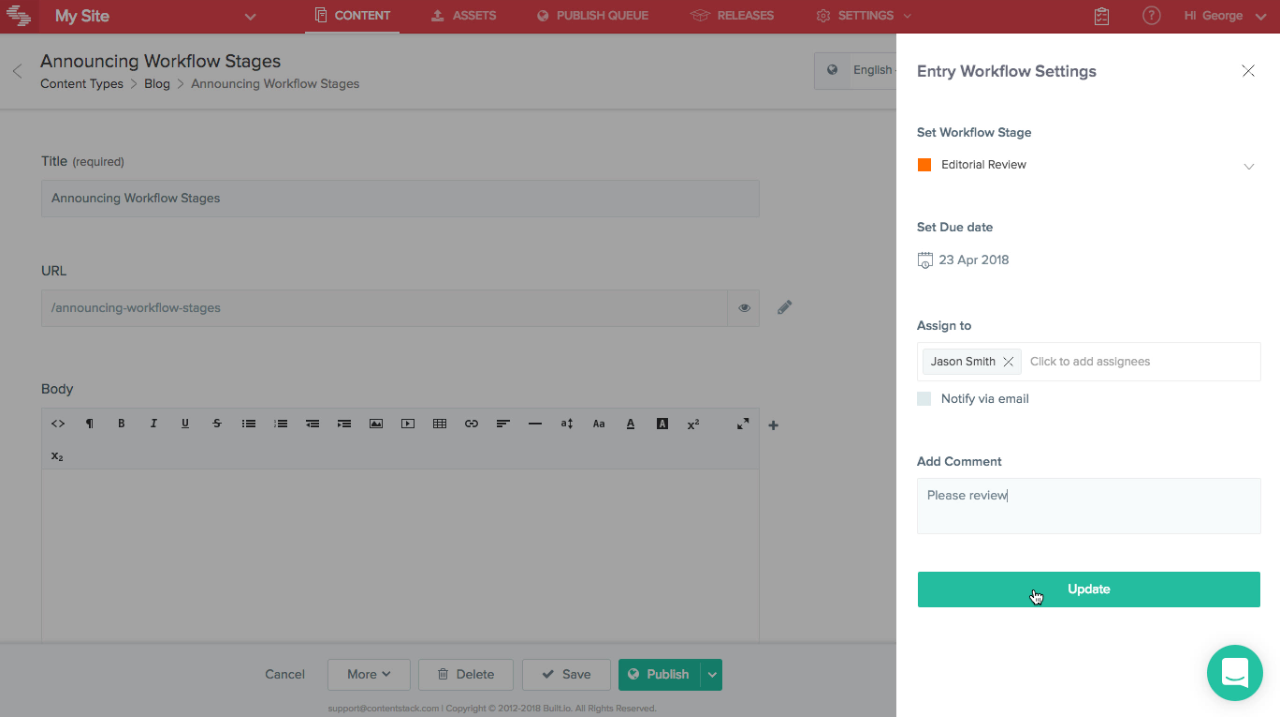
The latest version of Contentstack introduces a number of new features for content editors, including a better workflow management system that streamlines the creating, review and deployment of content in the system, as well as support for publishing rules that ensure only approved content makes it into the official channels (it wouldn’t be an enterprise product if it didn’t have some role-based controls, right?). Also new in today’s update is the ability to bundle content together and then release it en masse, maybe to coincide with a major release, promotional campaign or other event.
Looking ahead, Baier tells me that the team wants to delve a bit deeper into how it can integrate with more third-party services. Given that this is Built.io’s bread and butter, that’s probably no major surprise, but in the CMS world, integrations are often a major paint point. It’s those integrations, though, that users really need as they now rely on more third-party services than ever to run their businesses. “We believe the future is in these composable stacks,” Baier noted.
The team is also looking at how it can best use AI and machine learning, especially in the context of SEO.
One thing Contentstack and Built.io have never done is take outside money. Baier says “never say never,” but it doesn’t look like the company is likely to look for outside funding anytime soon.
Powered by WPeMatico
Sprinklr, the unicorn startup best known for helping customers interpret social signals has been moving into the broader customer experience market in the last year. Today it announced is was hiring a heavy hitter as Chief Operating Officer, bringing in former federal CIO and Salesforce executive Vivek Kundra. He began working at his new position just this week.
Kundra says that he sees a company that is in a good position and poised for growth. It will be part of his job to work with CEO Ragy Thomas to make sure that happens. “When I look at the 1200 customers we have today, I see a massive opportunity to provide technology to change the way [our users] interact with customers,” Kundra told TechCrunch.
He says that, with his background, whether working under President Obama or with Salesforce CEO Marc Benioff, the focus has always been on the customer, however you defined that, whether in the context of delivering government services or selling cloud software.
He said that to achieve that you have to be ruthlessly focused on execution. “Ideas are cheap, but how do you bring them to life in a way that inspires and motivates? I think that’s really important,” he said.
It’s worth noting that Kundra is not the first COO, however. The company hired Tim Page, who was a founder and COO at VCE before joining Sprinklr in 2016. That was apparently not a good fit.
Thomas says that landing Kundra was part of an extensive 9-month executive search where they looked at people who had worked at SaaS companies that had scaled over a billion dollars in revenue, concentrating on Salesforce, Workday and ServiceNow. “If you look at people in the driver’s seat at those companies, there is a finite number of people. Salesforce is a great company and a great partner. That experience is relevant and unique,” Thomas said.
Kundra pointed out that as part of his responsibilities at Salesforce he built a business unit from scratch that included driving adoption for the company’s Government Cloud and other verticals. “Now I have ability to draw on those experiences,” he said.
Firming up the COO position, much like the CFO, is crucial ahead of going public. With the company valued at $1.8 billion in 2016, they would seem to be of sufficient size to make that move, but Thomas wasn’t ready to commit to anything definitive (much as you would expect).
Instead, he talked of building a strong foundation as preparation to become a public company at some point. “It’s a question of when, not if [we go public], but for a company of our size and scale, it’s logical for us to go public. We aren’t talking about when and how, and we are trying to pour a strong foundation [before we do]” he said. Bringing in Kundra appears to be part of that.
Powered by WPeMatico
Pluralsight priced the shares in its IPO at $15 this afternoon, above its previously set target range of between $12 and $14, and will raise as much as $357 million ahead of its public debut tomorrow morning.
Pluralsight offers software development courses, specifically ones targeting employees that are looking to advance in their careers by acquiring new skills in order to transition to higher-level roles. As knowledge workers become increasingly valuable, especially in larger enterprises with sprawling workforces, companies like Pluralsight have found a sweet spot in building tools that enable companies to help identify talent in their own workforce and train them, rather than have to aggressively search outside the company to satisfy their needs. The company has raised $310.5 million in its IPO, with underwriters having the option to purchase an additional 3.1 million shares and bring that up to $357 million.
The company is one of a continuing wave of enterprise IPOs this year, including multiple successful ones like zScalar and Dropbox — the latter of which was more of a flagship as both a hotly-anticipated one and as a company that possesses a unique business model. But nonetheless, it’s shown that there’s an appetite for enterprise startups looking to go public, which offers those companies a way to raise capital in addition to offering their employees liquidity.
Pluralsight will be another of an increasing pack of unicorns in the Utah tech scene that are on their way to going public. Founded in 2004, Pluralsight was largely bootstrapped until its first financing round in 2013 where it raised $27.5 million from Insight Venture Partners. That firm is the company’s largest shareholder, and since then Pluralsight has raised nearly $200 million in financing.
Its The company’s IPO tomorrow will once again test the appetite for fresh IPOs among public investors. Enterprise companies generally offer a more stable batch for venture portfolios, with predictable and reliable growth that eventually carries it to an IPO with varying levels of success. They’re smaller than blockbuster consumer-ish IPOs, but they are the ones that can provide a stable return for funds like IVP.
Powered by WPeMatico
As we increasingly hear about automation, artificial intelligence and robots taking away industrial jobs, Parsable, a San Francisco-based startup sees a different reality, one with millions of workers who for the most part have been left behind when it comes to bringing digital transformation to their jobs.
Parsable has developed a Connected Worker platform to help bring high tech solutions to deskless industrial workers who have been working mostly with paper-based processes. Today, it announced a $40 million Series C cash injection to keep building on that idea.
The round was led by Future Fund with help from B37 and existing investors Lightspeed Venture Partners, Airbus Ventures and Aramco Ventures. Today’s investment brings the total to nearly $70 million.
The Parsable solution works on almost any smartphone or tablet and is designed to enter information while walking around in environments where a desktop PC or laptop simply wouldn’t be practical. That means being able to tap, swipe and select easily in a mobile context.

Photo: Parsable
The challenge the company faced was the perception these workers didn’t deal well with technology. Parsable CEO Lawrence Whittle says the company, which launched in 2013, took its time building its first product because it wanted to give industrial workers something they actually needed, not what engineers thought they needed. This meant a long period of primary research.
The company learned, it had to be dead simple to allow the industry vets who had been on the job for 25 or more years to feel comfortable using it out of the box, while also appealing to younger more tech-savvy workers. The goal was making it feel as familiar as Facebook or texting, common applications even older workers were used to using.
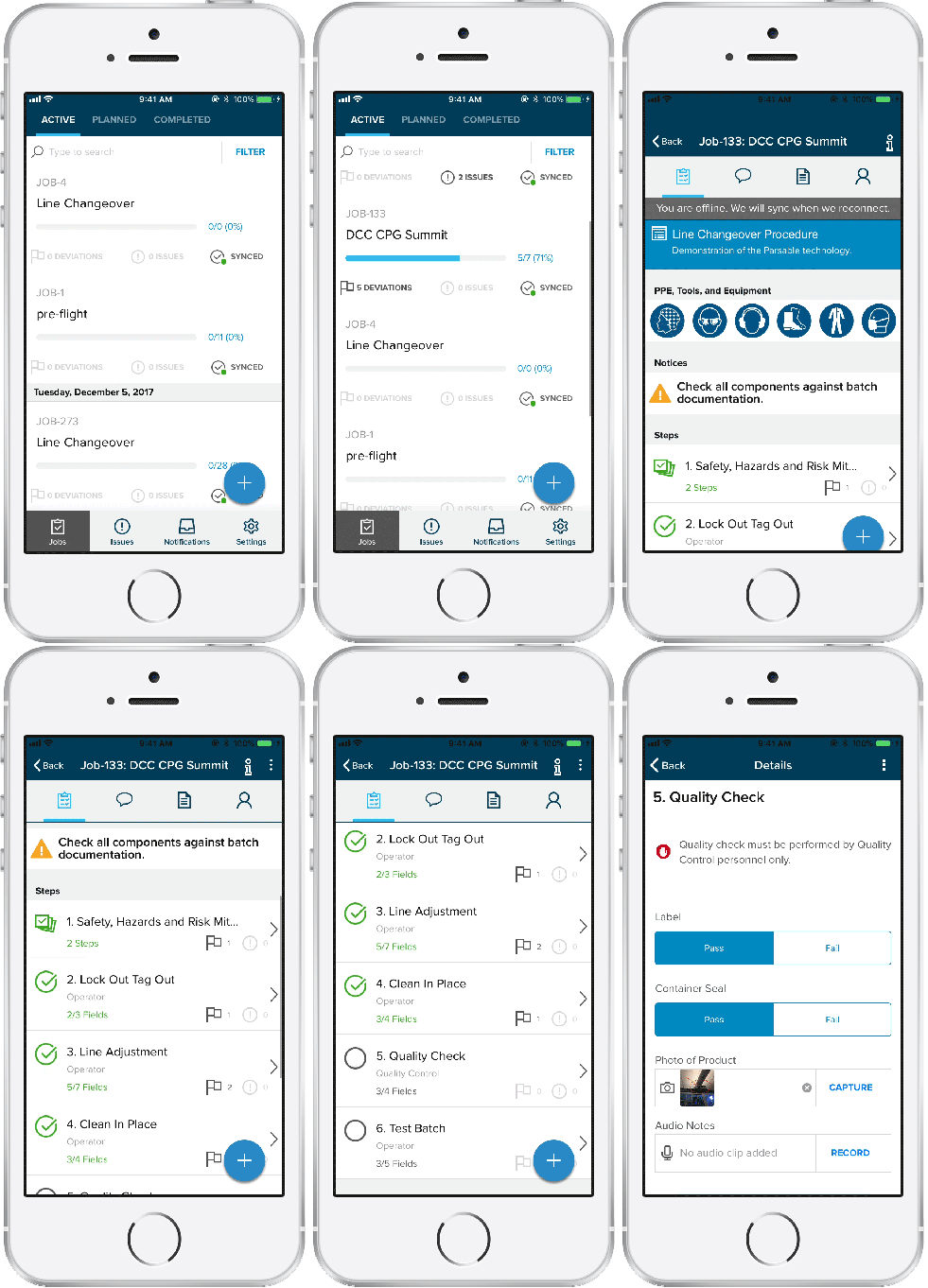 “What we are doing is getting rid of [paper] notebooks for quality, safety and maintenance and providing a digital guide on how to capture work with the objective of increasing efficiency, reducing safety incidents and increasing quality,” Whittle explained.
He likens this to the idea of putting a sensor on a machine, but instead they are putting that instrumentation into the hands of the human worker. “We are effectively putting a sensor on humans to give them connectivity and data to execute work in the same way as machines,” he says.
The company has also made the decision to make the platform flexible to add new technology over time. As an example they support smart glasses, which Whittle says accounts for about 10 percent of its business today. But the founders recognized that reality could change and they wanted to make the platform open enough to take on new technologies as they become available.
Today the company has 30 enterprise customers with 30,000 registered users on the platform. Customers include Ecolab, Schlumberger, Silgan and Shell. They have around 80 employees, but expect to hit 100 by the end of Q3 this year, Whittle says.
Powered by WPeMatico
MemSQL, a company best known for the real-time capabilities of its eponymous in-memory database, today announced that it has raised a $30 million Series D round, bringing the company’s overall funding to $110 million. The round was led by GV (the firm you probably still refer to as Google Ventures) and Glynn Capital. Existing investors Accell, Caffeinated Capital, Data Collective and IA Ventures also participated.
The MemSQL database offers a distributed, relational database that uses standard SQL drivers and queries for transactions and analytics. Its defining feature is the combination of its data ingestions technology that allows users to push millions of events per day into the service while its users can query the records in real time. The company recently showed that its tools can deliver a scan rate of over a trillion rows per second on a cluster with 12 servers.
The database is available for deployments on the major public clouds and on-premises.
MemSQL recently announced that it saw its fourth-quarter commercial booking hit 200 percent year-over-year growth — and that’s typically the kind of growth that investors like to see, even as MemSQL plays in a very competitive market with plenty of incumbents, startups and even open-source projects. Current MemSQL users include the likes of Uber, Akamai, Pinterest, Dell EMC and Comcast.
“MemSQL has achieved strong enterprise traction by delivering a database that enables operational analysis at unique speed and scale, allowing customers to create dynamic, intelligent applications,” said Adam Ghobarah, general partner at GV, in today’s announcement. “The company has demonstrated measurable success with its growing enterprise customer base and we’re excited to invest in the team as they continue to scale.”
Powered by WPeMatico