Enterprise
Auto Added by WPeMatico
Auto Added by WPeMatico
Dreamforce, Salesforce’s massive customer conference is coming later this month to San Francisco, but the news is starting already well ahead of the event. Today, the company announced updates to its core Sales Cloud with an emphasis toward automation and integration.
For starters, the company wants to simplify inside phone sales, giving the team not only a list of calls organized by those most likely to convert, but walking them through a sales process that’s been defined by management according to what they believe to be best practices.
High Velocity Sales is designed to take underlying intelligence from Salesforce Einstein and apply it to the sales process to give sales people the best chance to convert that prospect. That includes defining contact cadence and content. For calls, the content could be as detailed as call scripts with what to say to the prospect. For emails, it could provide key details designed to move the prospect closer to sale and how often to send that next email.
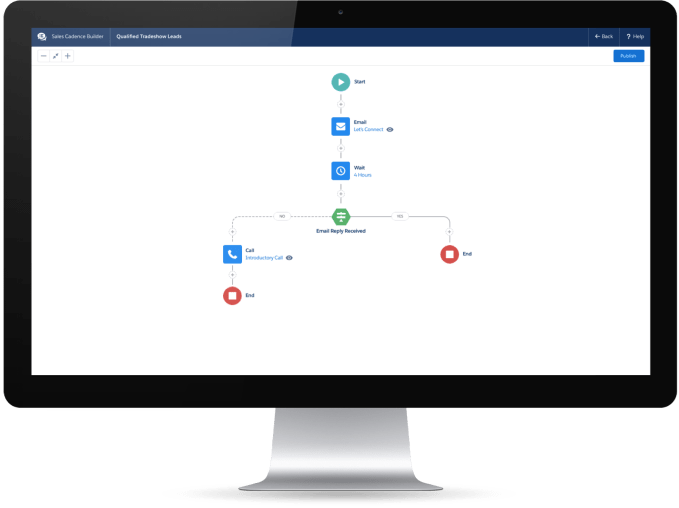
Defining sales cadence workflow in Sales Cloud. Photo: Salesforce
Once the sales teams begins to move that sale towards a close, Salesforce CPQ (configure, price, quote) capabilities come into play. That product has its roots in the company’s SteelBrick acquisition several years ago, and it too gets a shiny new update for Dreamforce this year.
As sales inches toward a win, it typically moves the process to the the proposal stage where pricing and purchases are agreed upon, and if all goes well a contract gets signed. Updates to CPQ are designed to automate this to the extent possible, pulling information from notes and conversations into an automated quote, or relying on the sales person when it gets more complex.
The idea though is to help sales automate the quote and creation of bill once the quote has been accepted to the extent possible, even providing a mechanism for automatic renewal when a subscription is involved.
The last piece involves Pardot Einstein, a sales and marketing tool, designed to help find the best prospects that come through a company’s marketing process. This is also getting some help from the intelligence layer in a couple of ways.
Einstein Campaign Insights looks at the range of marketing campaigns that are coming out of the marketing organization, determining which campaigns are performing — and those that aren’t — and pushing the art of campaign creation using data science to help determine which types of activities are most likely to succeed in helping convert that shopper into a buyer.
The other piece is called Einstein Behavior Score, which again is using the company’s underlying artificial intelligence tooling to analyze buying behavior based on intent. In other words, which people coming through your web site and apps are most likely to actually buy based on their behaviors — pages they visit, items they click and so forth.
Salesforce recognized the power of artificial intelligence to drive a more automated sales process early on, introducing Einstein in 2016. In typical Salesforce fashion, it has built upon that initial announcement and tried to use AI to automate and drive more successful sales.
The core CRM tool that is the center of the Sales Cloud, is simply a system of record of the customers inside any organization, but the company is trying to automate and integrate across its broad family of products whenever possible to make connections between products and services that might be difficult for humans to make on their own.
While it’s easy to get lost in AI marketing hype — and calling their AI layer by the name “Einstein” certainly doesn’t help in that regard — the company is trying to take advantage of the technology to help customers drive more sales faster, which is the goal of any sales team. It will be up to Salesforce’s customers to decide how well it works.
Powered by WPeMatico

Forethought, a 2018 TechCrunch Disrupt Battlefield participant, has a modern vision for enterprise search that uses AI to surface the content that matters most in the context of work. Its first use case involves customer service, but it has a broader ambition to work across the enterprise.
The startup takes a bit of an unusual approach to search. Instead of a keyword-driven experience we are used to with Google, Forethought uses an information retrieval model driven by artificial intelligence underpinnings that they then embed directly into the workflow, company co-founder and CEO Deon Nicholas told TechCrunch. They have dubbed their answer engine ‘Agatha.’
Much like any search product, it begins by indexing relevant content. Nicholas says they built the search engine to be able to index millions of documents at scale very quickly. It then uses natural language processing (NLP) and natural language understanding (NLU) to read the documents as a human would.
“We don’t work on keywords. You can ask questions without keywords and using synonyms to help understand what you actually mean, we can actually pull out the correct answer [from the content] and deliver it to you,” he said.
One of first use cases where they are seeing traction in is customer support. “Our AI, Agatha for Support, integrates into a company’s help desk software, either Zendesk, Salesforce Service Cloud, and then we [read] tickets and suggest answers and relevant knowledge base articles to help close tickets more efficiently,” Nicholas explained. He claims their approach has increased agent efficiency by 20-30 percent.
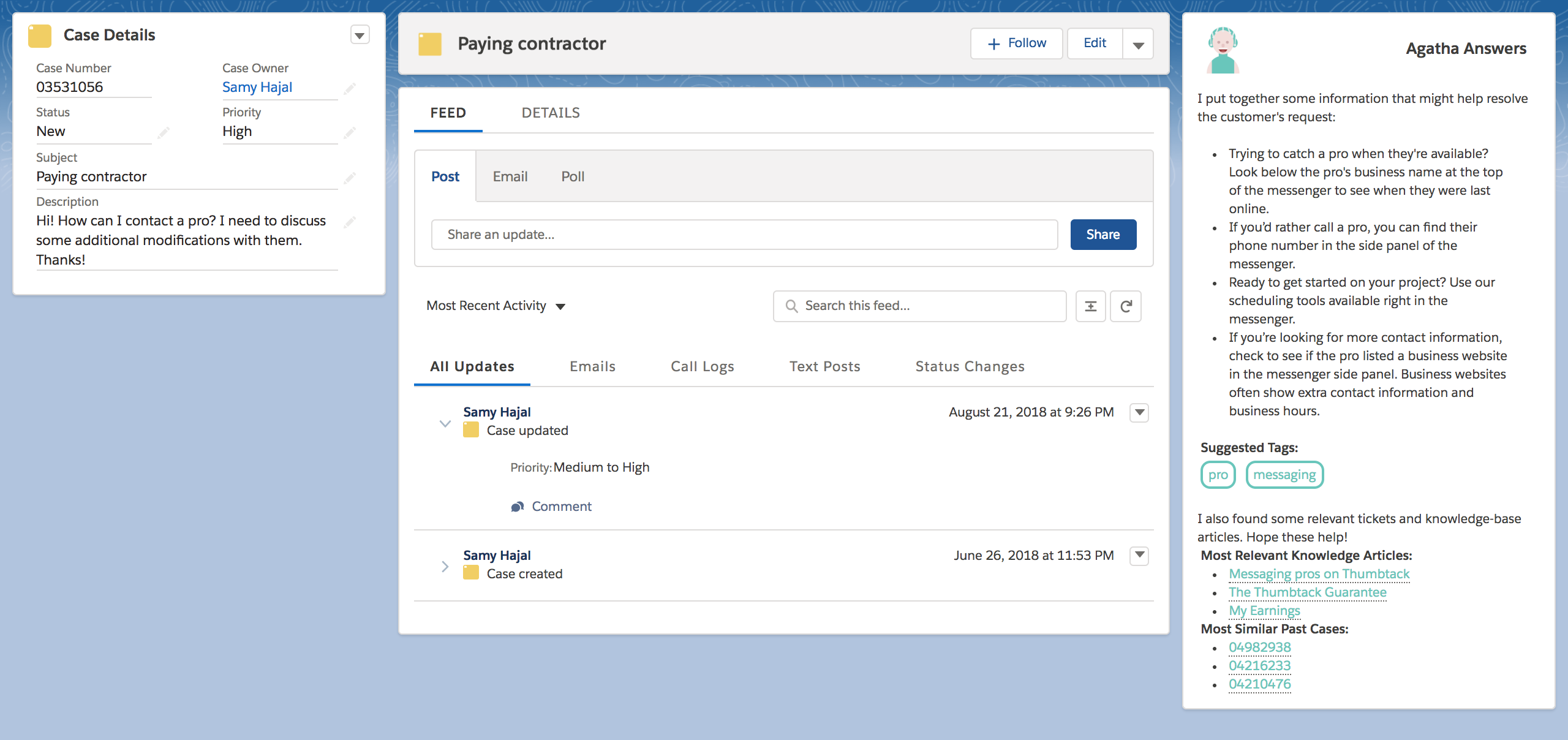
Forethought at work in Salesforce Service Cloud. Screenshot: Forethought
The plan is to eventually expand beyond the initial customer service use case into other areas of the enterprise and follow a similar path of indexing documents and embedding the solution into the tools that people are using to do their jobs.
When they reach Beta or general release, they will operate as a cloud service where customers sign up, enter their Zendesk or Salesforce credentials (or whatever other products happen to be supported at that point) and the product begins indexing the content.

Forethought in Zendesk. Screenshot: Forethought
The founding team, all in their mid-20s, have had a passion for artificial intelligence since high school. In fact, Nicholas built an AI program to read his notes and quiz him on history while still in high school. Later at the University of Waterloo he published a paper on machine learning and had internships at Palantir, Facebook and Dropbox. His first job out of school was at Pure Storage. All these positions had a common thread of working with data and AI.
The company launched last year and they debuted Agatha in private Beta 4 months ago. They currently have six companies participating, the first of which has been converted to a paying customer.
They have closed a pre-seed round of funding too, and although they weren’t prepared to share the amount, the investment was led by K9 Ventures. While Village Global, Original Capital and other unnamed investors also participated.
Powered by WPeMatico
McCarthyFinch sounds a bit like a law firm — and with good reason. The startup has developed an AI as a Service platform aimed at the legal profession. This week, it’s competing in the 2018 TechCrunch Disrupt Battlefield in San Francisco.
The company began life as a project at a leading New Zealand law firm, MinterEllisonRuddWatts. They wanted to look at how they could take advantage of AI to automate legal processes to make them more efficient, cost-effective and faster, according to company president Richard DeFrancisco.
“They were working on leveraging technology to become the law firm of the future, and they realized there were some pretty tremendous gaps,” he explained. They found a bunch of Ph.Ds working on artificial intelligence who worked with more than 30 lawyers over time to address those gaps by leveraging AI technology.
That internal project was spun out as a startup last year, emerging as an AI platform with 18 services. MinterEllison, along with New Zealand VC Goat Ventures, gave the fledgling company US$2.5 million in pre-seed money to get started.
The company looked at automating a lot of labor-intensive tasks related to legal document review and discovery such as document tagging. “Lawyers spend a lot of time tagging things with regards to what’s relevant and not relevant, and it’s not a good use of their time. We can go through millions of documents very quickly,” DeFrancisco said. He claims they can lower the time it takes to tag a set of documents in a lawsuit from weeks to minutes.
He says that one of their key differentiators is their use of natural language processing (NLP), which he says allows the company to understand language and nuance to interpret documents with a high level of accuracy, even when there are small data sets. Instead of requiring thousands of documents to train their models, which he says law firms don’t have time to do, they can begin to understand the gist of a case in as little as two or three documents with 90 percent accuracy, based on their tests.
They don’t actually want to sell their platform directly to law firms. Instead, they hope to market their artificial intelligence skills as a service to other software vendors with a legal bent who are looking to get smarter without building their own AI from scratch.
“What we are doing is going to technology service providers and talking to them about using our solution. We have restful APIs to integrate into their technology and do a Powered By-model,” DeFrancisco explained.
The startup currently has 10 trials going on. While he couldn’t name them, he did say that they include the largest law firm in Europe, largest global provider of legal information and the fastest growing SaaS company in history. They are also working on agreements with large systems integrators including Deloitte and Accenture to act as resellers of their solution.
While they are based in New Zealand, they plan to open a U.S. office in the Los Angeles area shortly after Disrupt. The engineering team will remain in New Zealand, and DeFrancisco will build the rest of the company in the U.S as it seeks to expand its reach. They also plan to start raising their next round of funding.
Powered by WPeMatico
Meet PoLTE, a Dallas-based startup that wants to make location-tracking more efficient. Thanks to PoLTE’s software solution, logistics and shipment companies can much more easily track packages and goods. The startup is participating in TechCrunch’s Startup Battlefield at Disrupt SF.
If you want to use a connected device to track a package, you currently need a couple of things — a way to determine the location of the package, and a way to transmit this information over the air. The most straightforward way of doing it is by using a GPS chipset combined with a cellular chipset.
Systems-on-chip have made this easier as they usually integrate multiple modules. You can get a GPS signal and wireless capabilities in the same chip. While GPS is insanely accurate, it also requires a ton of battery just to position a device on a map. That’s why devices often triangulate your position using Wi-Fi combined with a database of Wi-Fi networks and their positions.
And yet, using GPS or Wi-Fi as well as an LTE modem doesn’t work if you want to track a container over multiple weeks or months. At some point, your device will run out of battery. Or you’ll have to spend a small fortune to buy a ton of trackers with big batteries.
PoLTE has developed a software solution that lets you turn data from the cell modem into location information. It works with existing modems and only requires a software update. The company has been working with Riot Micro for instance.
Behind the scene PoLTE’s magic happens on their servers. IoT devices don’t need to do any of the computing. They just need to send a tiny sample of LTE signals and PoLTE can figure out the location from their servers. Customers can then get this data using an API.
It only takes 300 bytes of data to get location information with precision of less than a few meters. You don’t need a powerful CPU, Wi-Fi, GPS or Bluetooth.
“We offer 80 percent cost reduction on IoT devices together with longer battery life,” CEO Ed Chao told me.
On the business side, PoLTE is using a software-as-a-service model. You can get started for free if you don’t need a lot of API calls. You then start paying depending on the size of your fleet of devices and the number of location requests.
It doesn’t really matter if the company finds a good business opportunity. PoLTE is a low-level technology company at heart. Its solution is interesting by itself and could help bigger companies that are looking for an efficient location-tracking solution.
Powered by WPeMatico
Elastic, the provider of subscription-based data search software used by Dell, Netflix, The New York Times and others, has unveiled its IPO filing after confidentially submitting paperwork to the SEC in June. The company will be the latest in a line of enterprise SaaS businesses to hit the public markets in 2018.
Headquartered in Mountain View, Elastic plans to raise $100 million in its NYSE listing, though that’s likely a placeholder amount. The timing of the filing suggests the company will transition to the public markets this fall; we’ve reached out to the company for more details.
Elastic will trade under the symbol ESTC.
The business is known for its core product, an open-source search tool called ElasticSearch. It also offers a range of analytics and visualization tools meant to help businesses organize large data sets, competing directly with companies like Splunk and even Amazon — a name it mentions 14 times in the filing.
“Amazon offers some of our open source features as part of its Amazon Web Services offering. As such, Amazon competes with us for potential customers, and while Amazon cannot provide our proprietary software, the pricing of Amazon’s offerings may limit our ability to adjust,” the company wrote in the filing, which also lists Endeca, FAST, Autonomy and several others as key competitors.
This is our first look at Elastic’s financials. The company brought in $159.9 million in revenue in the 12 months ended July 30, 2018, up roughly 100 percent from $88.1 million the year prior. Losses are growing at about the same rate. Elastic reported a net loss of $18.5 million in the second quarter of 2018. That’s an increase from $9.9 million in the same period in 2017.
Founded in 2012, the company has raised about $100 million in venture capital funding, garnering a $700 million valuation the last time it raised VC, which was all the way back in 2014. Its investors include Benchmark, NEA and Future Fund, which each retain a 17.8 percent, 10.2 percent and 8.2 percent pre-IPO stake, respectively.
A flurry of business software companies have opted to go public this year. Domo, a business analytics company based in Utah, went public in June raising $193 million in the process. On top of that, subscription biller Zuora had a positive debut in April in what was a “clear sign post on the road to SaaS maturation,” according to TechCrunch’s Ron Miller. DocuSign and Smartsheet are also recent examples of both high-profile and successful SaaS IPOs.
Powered by WPeMatico
Rugged smartphones, the kind of devices that business can give to their employees who work in harsh environments, are a bit of a specialty market. Few consumers, after all, choose their smartphones based on how well they survive six-foot drops. But there is definitely a market there, and IDC currently expects that the market for Android -based rugged devices will grow at 23 percent annually over the next five years.
 It’s maybe no surprise that Google is now expanding its Android Enterprise Recommended program to include rugged devices, too. Chances are you’ve never heard of many of the manufacturers in this first batch (or thought of them as smartphone manufacturers): Zebra, Honeywell, Sonim, Point Mobile, Datalogic. Panasonic, which has a long history of building rugged devices, will also soon become part of this program.
The minimum requirements for these devices are pretty straightforward: they have to support Android 7+, offer security updates within 90 days of release from Google and, because they are rugged devices, after all, be certified for ingress protection and rated for drop testing. They’ll also have to support at least one more major OS release.
“Today’s launch continues our commitment to improving the enterprise experience for customers,” Google writes in today’s announcement. “We hope these devices will serve existing use cases and also enable companies to pursue new mobility use cases to help them realize their goals.“
Powered by WPeMatico
After two years operating in stealth, Mint .com founder Aaron Patzer’s new startup Vital Software is open for business.
Patzer made the announcement Wednesday while on the Next Stage at Disrupt SF.
Patzer’s company, which he co-founded with Dr. Justin Schrager of Emory University, is an enterprise software business that aims to make emergency rooms visits easier and more efficient for patients and doctors. The company is tackling the ER experience first and sees opportunity for the software in a hospital or health care facility, Patzer said.
“It’s a terrible experience, and not just because of the emergency,” Patzer said while on stage.
The software features an easy patient check-in system and uses AI natural language processing to find out more from the incoming patient. The system is dynamic, meaning it can ask follow up questions to the incoming patient to gather more information. By the time nurses see the patient, they’re already equipped with the information they need. The software also provides updates to the patient, such as possible wait times.
The idea is to give doctors and nurses software that is useable, Patzer said, noting that software found in hospitals is outdated. “It’s literally Windows 98 software.”
The company is self-funded, although Patzer noted off stage that they plan to raise funds next year. The company has one customer, a large hospital system he couldn’t name, that is now trialing the software.
In his view, software is constant need for disruption. His timeline: about every 10 years. That just happens to put Mint.com, he said, in a spot ripe disruption.
Powered by WPeMatico
Wunder Mobility, the Hamburg-based startup that provides a range of mobility services, from carpooling to electric scooter rentals, has raised $30 million in Series B funding. The round was led by KCK Group, with participation from previous backer Blumberg Capital and other non-disclosed investors.
The German company says the investment will be used to expand the company’s engineering team in its home country and to establish an international B2B sales organisation. Currently, Wunder Mobility has 70 employees working from four offices in Asia, Germany, and South America. The aim is to add another 100 employees over the next twelve months in the areas of product development and B2B sales.
Founded in Hamburg in 2014, but now with an international focus, including emerging markets, Wunder Mobility supplies software, hardware, and operational services for various “future-oriented” mobility concepts. These span smart shuttles, fleet management and carpooling, reaching more than two million users in a dozen countries, including France, Germany, Spain, Brazil, India, and the Philippines.
 “We are enabling communities on four continents to address the global traffic challenge and to deploy more sustainable mobility options faster by hosting a full-stack urban mobility tech platform,” explains founder and CEO Gunnar Froh.
“Our three product lines either allow private people to share empty seats with people headed in the same direction (Wunder Carpool), match professional drivers with passengers in 6-10 seater vans (Wunder Shuttle), or give travellers the option to rent vehicles (electric scooters, cars) by the minute (Wunder Fleet)”.
In recent months, transport companies as well as customers from the automotive industry in Japan, Europe and America have committed to using Wunder technology. The company is already processing around one million trips per month worldwide.
To that end, Froh describes Wunder Mobility’s typical B2C customers as the emerging middle class in mega cities such as Rio de Janeiro, Manila or Dehli.
“Many of these customers commute to work every day for several hours, are often first-time car owners and are open to sharing empty seats in their cars in order save on gas and car expenses,” he says.
On the B2B side, the startup’s customers are large OEMs, and public transit companies or suppliers, such as the Japanese conglomerate Marubeni. “We are working with Marubeni on ambitious new mobility services worldwide,” adds Froh.
Meanwhile, Wunder Mobility’s competitors are cited as Via in New York on the shuttle side. In Europe it perhaps competes most directly with Berlin’s Door2Door, and Vulog in Paris.
Powered by WPeMatico
Apttus, a quote-to-cash vendor built on top of the Salesforce platform that looked to be heading toward an IPO in recent years has taken a different tack, instead being acquired by private equity firm Thoma Bravo today.
The company did not reveal the purchase price, but said it could be ready to share more details about the arrangement after the deal closes, probably next month. “What we can say is that Apttus views this development positively and believes Thoma Bravo can instill greater operational excellence, strengthen our market leadership and allow us to continue providing indispensable value to our customers,” a company spokesperson told TechCrunch.
They are describing this not as a full on acquisition, but as ‘taking a majority stake’. However you describe it, it probably wasn’t the ending the company envisioned after taking $404 million in investment since launching in 2006, one of the earliest startups to build a business on top of the Salesforce platform.
If the company believed that Salesforce would eventually buy it, that never happened. In fact, that dream probably went out the window when Salesforce bought SteelBrick, a similar company also built on Salesforce, at the end of 2015 for $360 million.
In spite of this, in an interview in 2016, CEO Kirk Krappe still was confident that an exit was coming, either by IPO or a possibly a Salesforce acquisition.
“We will be IPOing this year. That may be a function to figure what Salesforce wants to do and they may think about that [after purchasing SteelBrick at the end of last year]. There’s no reason they can’t buy us too. For me, I have to run the business, and we’re growing 100 percent year on year. If Salesforce came to the table, that would be great if the numbers work. If not, we have an amazingly strong business,” he said at the time.
That never came to pass of course, and the company tried to separate itself from Salesforce in April of 2016 when it released a version of Apttus that would work on Microsoft Dynamics. Krappe saw this as a way to show investors he wasn’t completely married to the Salesforce platform.
While Salesforce provided a system of record around the customer information and all that involved, once the salesperson actually closed in on a sale, that’s when software like Apttus came into play, allowing the company to generate a detailed proposal, a contract once the deal was agreed upon and finally collecting and recording the money from the sale.
Apttus took its last funding rounds in Sept 2017 for $55 million and later a debt financing round for another $75 million in February this year, according to data on Crunchbase.
Thoma Bravo has bought a number of enterprise software products over the years including Qlik, Sailpoint, Dynatrace, Solar Winds and others. Apttus should fit in well with that family of companies.
Powered by WPeMatico

Atlassian today announced the first beta of a new edition of its flagship Jira project and issue tracking tool that is meant to help ops teams handle incidents faster and more efficiently.
Jira Ops integrates with tools like OpsGenie, PagerDuty, xMatters, Statuspage, Slack and others. Many teams already use these tools when their services go down, but Atlassian argues that most companies currently use a rather ad hoc approach to working with them. Jira Ops aims to be the glue that keeps everybody on the same page and provides visibility into ongoing incidents.
Update: after Atlassian announced Jira Ops, it also announced that it has acquired OpsGenie for $295 million.
This is obviously not the first time Atlassian is using Jira to branch out from its core developer audience. Jira Service Desk and Jira Core, for example, aim at a far broader audience. Ops, however, goes after a very specific vertical.

“Service Desk was the first step,” Jens Schumacher, Head of Software Teams at Atlassian, told me. And we were looking at what are the other verticals that we can attack with Jira.” Schumacher also noted that Atlassian built a lot of tools for its internal ops teams over the years to glue together all the different pieces that are necessary to track and manage incidents. With Jira Ops, the company is essentially turning its own playbook into a product.
In a way, though, using Jira Ops adds yet another piece to the puzzle. Schumacher, however, argues that the idea here is to have a single place to manage the process. “The is that when an incident happens, you have a central place where you can go, where you can find out everything about the incident,” he said. “You can see who has been paged and alerted; you can alert more people if you need to right from there; you know what Slack channel the incident is being discussed in.”
Unlike some of Atlassian’s other products, the company doesn’t currently have any plans to launch a self-hosted version of Jira Ops. The argument here is pretty straightforward: if your infrastructure goes down, then Jira Opes could also go do down — and then you don’t have a tool for managing that downtime.
Jira Ops is now available for free for early access beta users. The company expects to launch version 1.0 in early 2019. By then Atlassian will surely also have figured out a pricing plan, something it didn’t announce today.
Powered by WPeMatico