Enterprise
Auto Added by WPeMatico
Auto Added by WPeMatico
VMware is hosting its VMworld customer conference in Las Vegas this week, and to get things going it announced that it’s acquiring Boston-based CloudHealth Technologies. They did not disclose the terms of the deal, but Reuters is reporting the price is $500 million.
CloudHealth provides VMware with a crucial multi-cloud management platform that works across AWS, Microsoft Azure and Google Cloud Platform, giving customers a way to manage cloud cost, usage, security and performance from a single interface.
Although AWS leads the cloud market by a large margin, it is a vast and growing market and most companies are not putting their eggs in a single vendor basket. Instead, they are looking at best of breed options for different cloud services.
This multi-cloud approach is great for customers in that they are not tied down to any single provider, but it does create a management headache as a consequence. CloudHealth gives multi-cloud users a way to manage their environment from a single tool.

CloudHealth multi-cloud management. Photo: CloudHealth Technologies
VMware’s chief operating officer for products and cloud services, Raghu Raghuram, says CloudHealth solves the multi-cloud operational dilemma. “With the addition of CloudHealth Technologies we are delivering a consistent and actionable view into cost and resource management, security and performance for applications across multiple clouds,” Raghuram said in a statement.
CloudHealth began offering support for Google Cloud Platform just last month. CTO Joe Kinsella told TechCrunch why they had decided to expand their platform to include GCP support: “I think a lot of the initiatives that have been driven since Diane Greene joined Google [at the end of 2015] and began really driving towards the enterprise are bearing fruit. And as a result, we’re starting to see a really substantial uptick in interest.”
It also gave them a complete solution for managing across the three of the biggest cloud vendors. That last piece very likely made them an even more attractive target for a company like VMware, who apparently was looking for a solution to buy that would help customers manage across a hybrid and multi-cloud environment.
The company had been planning future expansion to manage not just the public cloud, but also private clouds and data centers from one place, a strategy that should fit well with what VMware has been trying to do in recent years to help companies manage a hybrid environment, regardless of where their virtual machines live.
With CloudHealth, VMware not only gets the multi-cloud management solution, it gains its 3000 customers which include Yelp, Dow Jones, Zendesk and Pinterest.
CloudHealth was founded in 2012 and has raised over $87 million. Its most recent round was a $46 million Series D in June 2017 led by Kleiner Perkins. Other lead investors across earlier rounds have included Sapphire Ventures, Scale Venture Partners and .406 Ventures.
Powered by WPeMatico
In tech circles, it would be easy to assume that the world of high-impact charitable giving is a rich man’s game where deals are inked at exclusive black tie galas over fancy hors d’oeuvre. Both Mark Zuckerberg and Marc Benioff have donated to SF hospitals that now bear their names. Gordon Moore has given away $5B – including $600M to Caltech – which was the largest donation to a university at the time. And of course, Bill Gates has already donated $27B to every cause imaginable (and co-founded The Giving Pledge, a consortium of billionaires pledging to donate most of their net worth to charity by the end of their lifetime.)
For Bill, that means he has about $90B left to give.
For the average working American, this world of concierge giving is out of reach, both in check size, and the army of consultants, lawyers and PR strategists that come with it. It seems that in order to do good, you must first do well. Very well.
Bright Funds is looking to change that. Founded in 2012, this SF-based startup is looking to democratize concierge giving to every individual so they “can give with the same effectiveness as Bill and Melinda Gates.” They are doing to philanthropy what Vanguard and Wealthfront have done for asset management for retail investors.
In particular, they are looking to unlock dollars from the underutilized corporate benefit of matching funds for donations, which according to Bright Funds is offered by over 60% of medium to large enterprises, but only used by 13% of employees at these companies. The need for such a service is clear — these programs are cumbersome, transactional, and often offline. Make a donation, submit a receipt, and wait for it to churn through the bureaucratic machine of accounting and finance before matching funds show up weeks later.
Bright Funds is looking to make your company’s matching funds benefit as accessible and important to you as your free lunches or massages. Plus, Bright Funds charges companies per seat, along with a transaction fee to cover the cost of payment processing, sparing employees any expense.
It’s a model that is working. According to Bright Fund’s CEO Ty Walrod, Bright Funds customers see on average a 40% year-over-year increase in funds donated through the platform. More importantly, Bright Funds not only transforms an employee’s relationship to personal philanthropy, but also to the company they work for.
This model of bottoms-up giving is a welcome change from the big foundation model which has recently been rocked by scandal. The Silicon Valley Community Foundation was the go-to foundation for The Who’s Who of Silicon Valley elite. It rode the latest tech boom to become the largest community foundation in eleven short years with generous stock donations from donors like Mark Zuckerberg ($1.8 billion), GoPro’s Nicholas Woodman ($500 million), and WhatsApp co-founder Jan Koum ($566 million). Today, at $13.5 billion, it surpasses the 80+ year old Ford Foundation in endowment size.
However, earlier this year, their star fundraiser Mari Ellen Loijens (credited with raising $8.3B of the $13.5B) was accused of repeatedly bullying and sexually harassing coworkers, allegations that the Foundation had “known about for years” but failed to act upon. In 2017, a similar case occurred when USC’s star fundraiser David Carrera stepped down on charges of sexual harassment after leading the university’s historic $6 billion fundraising campaign.
While large foundations and endowments do important work, their structure relies too much on whale hunting for big checks, giving an inordinate amount of power to the hands of a small group of talented fund raisers.
This stands in contrast to Bright Funds’ ethos — to lead a grassroots movement in empowering individual employees to make their dollar of giving count.
Bright Funds is the latest iteration of a lineup of workplace giving platforms. MicroEdge and Cybergrants paved the way in the 80s and 90s by digitizing the giving experience, but was mainly on-premise, and lacked a focus on user experience. Benevity and YourCause arrived in 2007 to bring workplace giving to the cloud, but they were still not turnkey solutions that could be easily implemented.
Bright Funds started as a consumer platform, and has retained that heritage in its approach to product design, aiming to reduce friction for both employee and company adoption. This is why many of their first customers were midsized tech startups with limited resources and looking for a turnkey solution, including Eventbrite, Box, Github, and Contently . They are now finding their way upmarket into larger, more established enterprises like Cisco, VMWare, Campbell’s Soup Company, and Sunpower.
Bright Funds approach to product has brought a number of innovations to this space.
The first is the concept of a cause-focused “fund.” Similar to a mutual fund or ETF, these funds are portfolios of nonprofits curated by subject-matter experts tailored to a specific cause area (e.g. conservation, education, poverty, etc.). This solves one of the chief concerns of any donor — is my dollar being put to good use towards the causes I care about? Passionate about conservation? Invest with Jim Leape from the Stanford Woods Institute for the Environment, who brings over three decades of conservation experience in choosing the six nonprofits in Bright Fund’s conservation portfolio. This same expertise is available across a number of cause areas.
Additionally, funds can also be created by companies or employees. This has proven to be an important rallying point for emergency relief during natural disasters, where employees at companies can collectively assemble a list of nonprofits to donate to. In 2017, Cisco employees donated $1.8 million (including company matching) through Bright Funds to Hurricanes Harvey, Maria, and Irma as well as the central Mexico earthquakes, the current flooding in India and many more.
The second key feature of their product is the impact timeline, a central news feed to understand where your dollars are going across all your cause areas. This transforms giving from a black box transaction to an ongoing dialogue between you and your charities.
Lastly, Bright Funds wants to take away all the administrative burden that might come with giving and volunteering — everything from tracking your volunteer opportunities and hours, to one-click tax reporting across all your charitable donations. In short, no more shoeboxes of receipts to process through in April.
Although Bright Funds is focused on transforming the individual giving experience, it’s paying customer at the end of the day is the enterprise.
And although it is philanthropic in nature, Bright Funds is not exempt from the procurement gauntlet that every enterprise software startup faces — what’s in it for the customer? What impact does workplace giving and volunteering have on culture and the bottom line?
To this end, there is evidence to show that corporate social responsibility has a an impact on recruiting the next generation of workers. A study by Horizon Media found that 81% of millennials expect their companies to be good corporate citizens. A separate 2015 study found that 62% of millennials said they’d take a pay cut to work for a company that’s socially responsible.
Box, one of Bright Fund’s early customers, has seen this impact on recruiting firsthand (disclosure: Box is one of my former employers). Like most tech companies competing for talent in the Valley, Box used to give out lucrative bonuses for candidate referrals. They recently switched to giving out $500 in Bright Funds gift credit. Instead of seeing employee referrals dip, Box saw referrals “skyrocket,” according to Box.org Executive Director Bryan Breckenridge. This program has now become “one of the most cherished cultural traditions at Box,” he said.
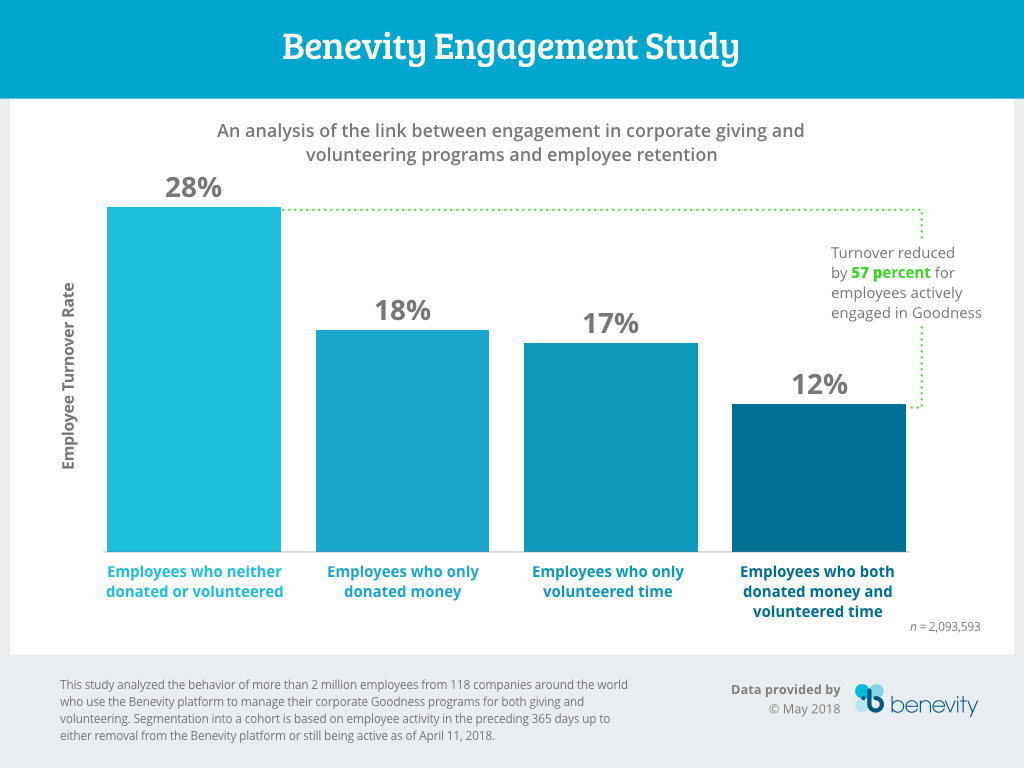
Additionally, like any corporate benefit, there should be metrics tied to employee retention. Benevity released a study of 2 million employees across 118 companies on their platform that showed a 57% reduction in turnover for employees engaged in corporate giving or volunteering efforts. VMware, one of Bright Fund’s customers, has seen an astonishing 82% of their 22,000 employees participate in their Citizen Philanthropy program of giving and volunteering, according to VMware Foundation Director Jessa Chin. Their full-time voluntary turnover rate (8%) is well below the software industry average of 13.2%.
Bright Funds still has a lot of work to do. CEO Walrod says that one of his top priorities is to expand the platform beyond US charities, finding ways to evaluate and incorporate international nonprofits.
They have also not given up their dream of becoming a truly consumer platform, perhaps one day competing in the world of donor-advised funds, which today is largely dominated by big names like Fidelity and Schwab who house over $85B of assets. In the short term, Walrod wants to make every Bright Funds account similar to a 401K account. It goes wherever you work, and is a lasting record of the causes you care about, and the time and resources you’ve invested in them.
Whether the impetus is altruism around giving or something more utilitarian like retention, companies are increasingly realizing that their employees represent a charitable force that can be harnessed for the greater good. Bright Funds has more work to do like any startup, but it is empowering the next set of donors who can give with the same effectiveness as Gates, and one day, at the same scale as him as well.
Powered by WPeMatico
Amazon has a big target on its back these days, and because of its size, scope and impact on local business, critics are right to look closely at tax breaks and other subsidies they receive. There is nothing wrong with digging into these breaks to see if they reach the goals governments set in terms of net new jobs. But Amazon isn’t alone here by any means. Many states have a big tech subsidy story to tell, and it isn’t always a tale that ends well for the subsidizing government.
In fact, a recent study by the watchdog group, Good Jobs First, found states are willing to throw millions at high tech companies to lure them into building in their communities. They cited three examples in the report including Tesla’s $1.25 billion 20-year deal to build a battery factory in Nevada, Foxconn’s $3 billion break to build a display factory in Wisconsin and the Apple data center deal in Iowa, which resulted in a $214 million tax break.
Good Jobs First executive director Greg LeRoy doesn’t think these subsidies are justifiable and they take away business development dollars from smaller businesses that tend to build more sustainable jobs in a community.
“The “lots of eggs in one basket” strategy is especially ill-suited. But many public leaders haven’t switched gears yet, often putting taxpayers at great risk, especially because some tech companies have become very aggressive about demanding big tax breaks. Companies with famous names are even more irresistible to politicians who want to look active on jobs,” LeRoy and his colleague Maryann Feldman wrote in a Guardian commentary last month.
While these deals are designed to attract the company to an area and generate jobs, that doesn’t always happen. The Apple-Iowa deal, for example, involved 550 construction jobs to build the $1.3 billion state-of-the-art facility, but will ultimately generate only 50 full-time jobs. It’s worth noting that in this case, Apple further sweetened the pot by contributing “up to $100 million” to a local public improvement fund, according to information supplied by the company.
One thing many lay people don’t realize, however, is that in spite of the size, cost and amount of real estate of these mega data centers, they are highly automated and don’t require a whole lot of people to run. While Apple is giving back to the community around the data center, in the end, if the goal of the subsidy is permanent high-paying jobs, there aren’t very many involved in running a data center.
It’s not hard to find projects that didn’t work out. A $2 million tax subsidy deal between Massachusetts and Nortel Networks in 2008 to keep 2200 jobs in place and add 800 more failed miserably. By 2010 there were just 145 jobs left at the facility and the tax incentive lasted another 4 years, according to a Boston.com report.
More recent deals come at a much higher price. The $3 billion Foxconn deal in Wisconsin was expected to generate 3000 direct jobs (and another 22,000 related ones). That comes out to an estimated cost of between $15,000 and $19,000 per job annually, much higher than the typical cost of $2457 per job, according to data in the New York Times.
Meanwhile states are falling all over themselves with billions in subsidies to give Amazon whatever its little heart desires to build HQ2, which could generate up to 50,000 jobs over a decade if all goes according to plan. The question, as with the Foxconn deal, is whether the states can truly justify the cost per job and the impact on infrastructure and housing to make it worth it?
What’s more, how do you ensure that you get a least a modest return on that investment? In the case of the Nortel example in Massachusetts, shouldn’t the Commonwealth have protected itself against a catastrophic failure instead of continuing to give the tax break for years after it was clear Nortel wasn’t able to live up to its side of the agreement?
Not every deal needs to be a home run, but you want to at least ensure you get a decent number of net new jobs out of it, and that there is some fairness in the end, regardless of the outcome. States also need to figure out the impact of any subsidy on other economic development plans, and not simply fall for name recognition over common sense.
These are questions every state needs to be considering as they pour money into these companies. It’s understandable in post-industrial America, where many factory jobs have been automated away that states want to lure high-paying high tech jobs to their communities, but it’s still incumbent upon officials to make sure they are doing due diligence on the total impact of the deal to be certain the cost is justified in the end.
Powered by WPeMatico
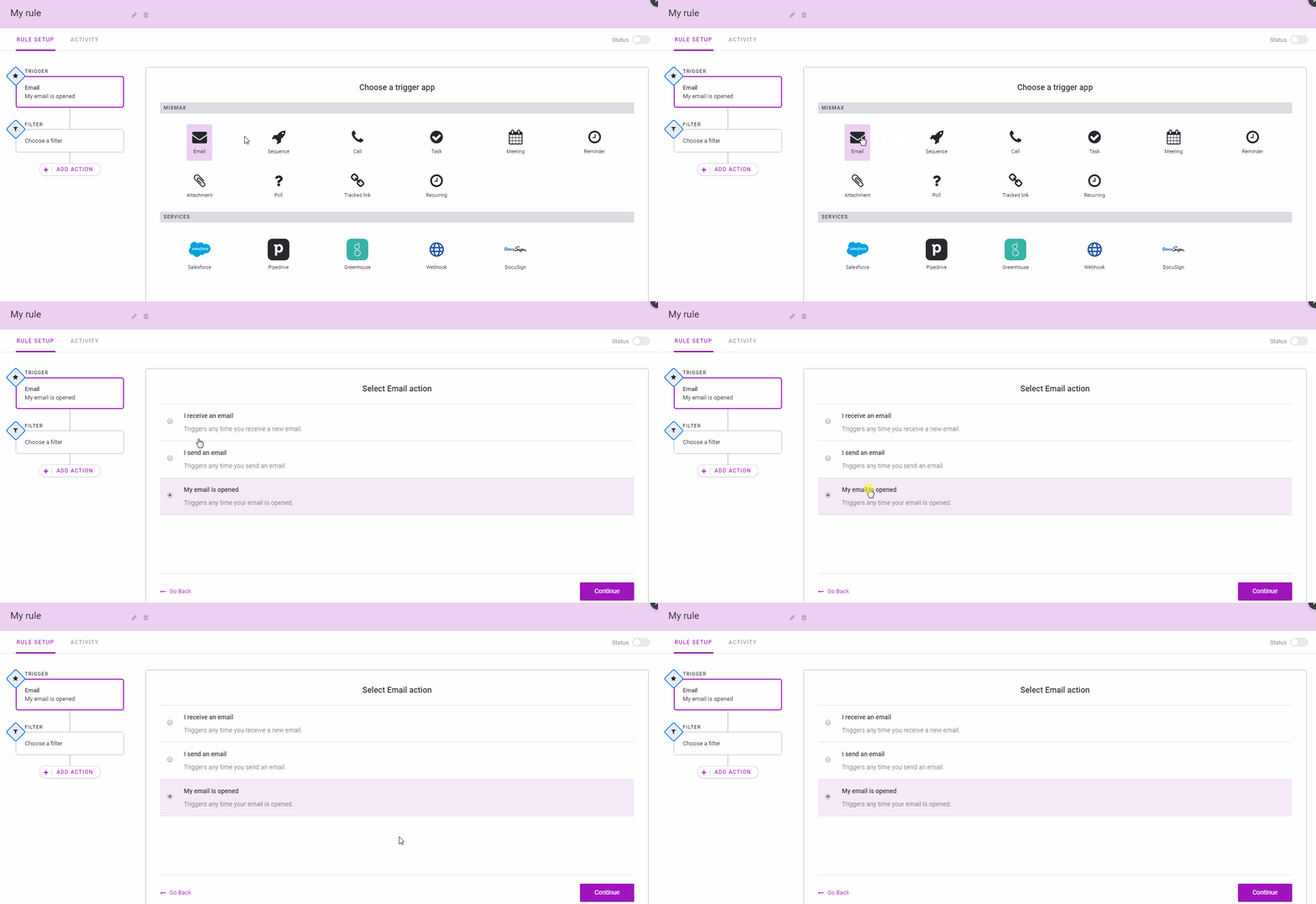
Mixmax, a service that aims to make email and other outbound communications more usable and effective, today announced the official launch of its new IFTTT-like rules for automating many of the most repetitive aspects of your daily email workflow.
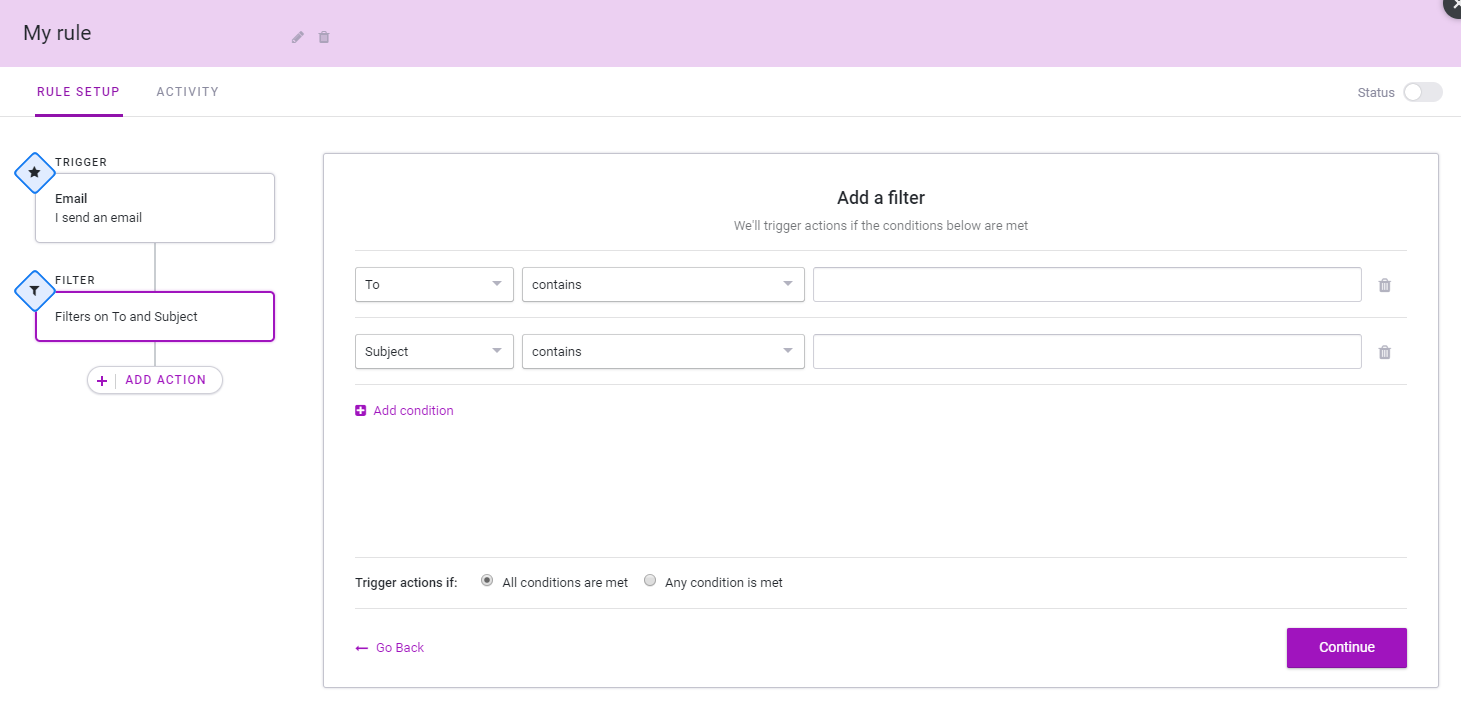
On the one hand, this new feature is a bit like your standard email filter on steroids (and with connections to third-party tools like Slack, Salesforce, DocuSign, Greenhouse and Pipedrive). Thanks to this, you can now receive an SMS when a customer who spends more than $5,000 a month emails you, for example.
But rules also can be triggered by any of the third-party services the company currently supports. Maybe you want to send out a meeting reminder based on your calendar entries, for example. You can then set up a rule that always emails a reminder a day before the meeting, together with all the standard info you’d want to send in that email.
“One way we think about Mixmax is that we want to do for externally facing teams and people who talk a lot of customers what GitHub did for engineering and what Slack did for internal team communication,” Mixmax co-founder and CEO Olof Mathé told me. “That’s what we do for external communication.”
While the service started out as a basic Chrome extension for Gmail, it’s now a full-blown email automation system that offers everything from easy calendar sharing to tracking when recipients open an email and, now, building rules around that. Mathé likened it to an executive assistant, but he stressed that he doesn’t think Mixmax is taking anybody’s jobs away. “We’re not here to replace other people,” he said. “We amplify what you are able to do as an individual and give you superpowers so you can become your own personal chief of staff so you get more time.”
The new rules feature takes this to the next level and Mathé and his team plan to build this out more over time. He teased a new feature called “beast mode” that’s coming in the near future and that will see Mixmax propose actions you can take across different applications, for example.
Many of the new rules and connectors will be available to all paying users, though some features, like access to your Salesforce account, will only be available to those on higher-tier plans.
Powered by WPeMatico
Armory, a startup that has built a CI/CD platform on top the open source Spinnaker project, announced a $10 million Series A today led by Crosslink Capital. Other investors included Bain Capital Ventures, Javelin Venture Partners, Y Combinator and Robin Vasan.
Software development certainly has changed over the last several years, going from long cycles between updates to a continuous delivery model. The concept is actually called CI/CD or continuous integration/continuous delivery. Armory’s product is designed to eliminate some of the complexity associated with deploying this kind of solution.
When they started the company, the founders made a decision to hitch their wagon to Spinnaker, a project that had the backing of industry heavyweights like Google and Netflix. “Spinnaker would become an emerging standard for enabling truly multi-cloud deployments at scale. Instead of re-creating the wheel and building another in-house continuous delivery platform, we made a big bet on having Spinnaker at the core of Armory’s Platform,” company CEO and co-founder Daniel R. Odio wrote in a blog post announcing the funding.
The bet apparently paid off and the company’s version of Spinnaker is widely deployed enterprise solution (at least according to them). The startup’s ultimate goal is to help Fortune 2000 companies deploy software much faster — and accessing and understanding CI/CD is a big part of that.
As every company out there becomes a software company, they find themselves outside their comfort zones. While Google and Netflix and other hyper-scale organizations have learned to deploy software at startling speed using state of the art methodologies, it’s not so easy for most companies with much smaller engineering teams to pull off.
That’s where a company like Armory could come into play. It takes this open source project and it packages it in such a way that it simplifies (to an extent) the complex world that these larger companies operate in on a regular basis, putting Spinnaker and CI/CD concepts in reach of organizations whose core competency might not involve sophisticated software deployment.
All of this relates to multi-cloud and cloud-native approaches to software development, which lets you manage your applications and infrastructure wherever they live across any cloud vendor or even on-prem in consistent way. Being able to manage continuous deployment is part of that.
Armory launched in 2016 and is based in the Bay area. It has raised a total of $14 million with a $4 million seed round coming last year. They were also a member of the Y Combinator Winter 2017 class and count Y Combinator as an investor in this round.
Powered by WPeMatico
It used to be a one-vendor, stack-driven world in the enterprise. Today, the cloud has changed that and best of breed and interoperability are the watchwords of the day. Two enterprise cloud stalwarts have announced a new integration that brings Box content directly into ServiceNow.
For ServiceNow customers, it means that they can access Box content without leaving a ServiceNow application and changing focus. Company CTO Allan Leinwand says the two share a lot of common customers, and it made sense to bring them together.
“When you’re inside of a ServiceNow record, for example, you’re looking at an incident or problem or a knowledge base article, you are going to link to directly with a Box document or save files directly to Box from ServiceNow. There’s a lot of very practical things that help people get their work done faster,” he explained.
Jeetu Patel, Box’s Chief Strategy and Chief Product officer says the two companies are working to drive innovation inside organizations and that means working with multiple products to solve organizational issues.
“Our goal has been to be a neutral central content layer for every business process. Part of that ambition is to be able to plug into best of breed applications like ServiceNow. Companies already use these tools, and use Box, and they want to be sure they work seamlessly with each other,” Patel said.
On a practical level, customers can grab the Box plug-in from the ServiceNow Store. It comes with some prebuilt workflows for typical ServiceNow product usage scenarios, but the integration is flexible and allows customization. As an example, in an HR scenario, the ServiceNow administrator might build a workflow for onboarding a new employee in ServiceNow’s HR application. Using the company’s Flow Designer workflow-building tool, they can pull in all the documents a new employee needs to sign with other tasks into a single workflow.
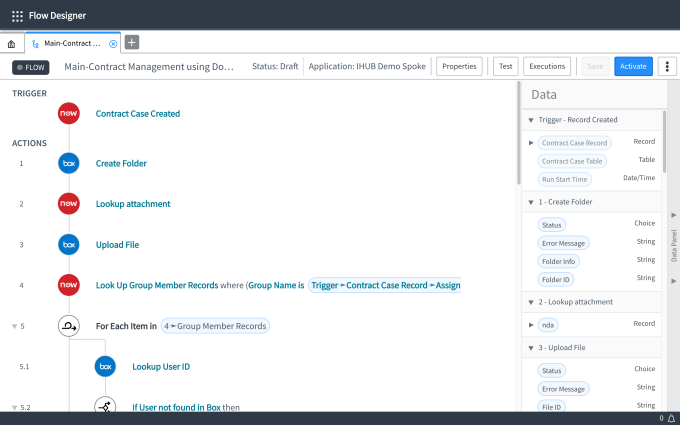
Contract workflow with Box content in ServiceNow Flow Designer. Screenshot: ServiceNow
It comes down to helping customers work more efficiently. “We’re both cloud companies, and we’re both driving digital transformation for our customers. And we’ve really seen a lot of synergy between the way people work in Box, and how people are working in ServiceNow. We think we can integrate together and make work get done better,” Leinwand said.
Powered by WPeMatico

Encrypted collaboration app Wickr has added a feather to its cap with a partnership with Psiphon, provider of smart VPN tools. Wickr will use Psiphon’s tech to guarantee your packets get where they need to go regardless of whether you’re at home, at a cafe with bad Wi-Fi or at a cafe with bad Wi-Fi in China.
The idea is that the user shouldn’t have to be auditing their own connection to be sure their apps will work properly. That can be a matter of safety, such as a poorly secured access point; connectivity, such as one where certain ports or apps are inoperable; or censorship, like requesting data from a service banned in the country you’re visiting.
Wickr already encrypts all your traffic, so there are no worries on that account, but if the connection you’re using were to block video calls or certain traffic patterns, there’s not much the company can do about that.
Psiphon, however, is in the business of circumventing deliberate or accidental blockages with a suite of tools that analyze the network and attempt to find a way to patch you through. Whether that’s anonymizing your traffic, bouncing it off non-blocked servers, doing automatic port forwarding or some other method, the idea is the packets get through one way or another.
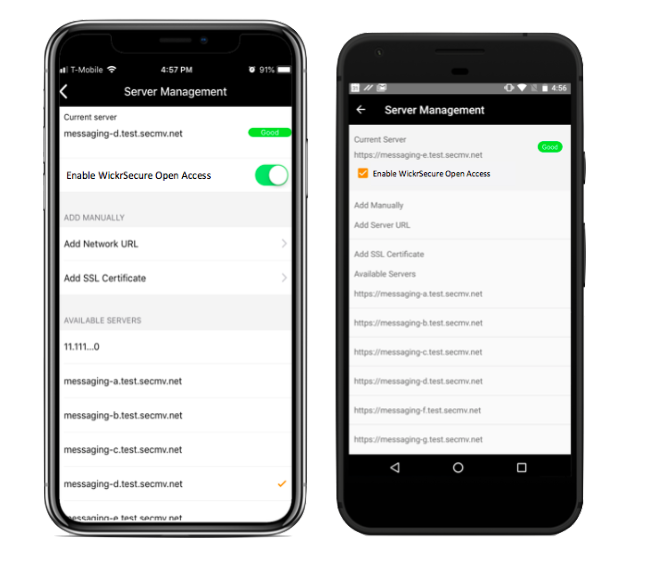 There’s a cost in latency and throughput, of course, but while that may matter for online gaming or video streaming, it’s far less important for something like uploading an image, chatting with colleagues and the other functions Wickr provides. At all events you can turn the feature on or off at will.
There will be a monetary cost too, of course, in the form of premiums added to paid plans. Enterprise customers will be the first to receive the Psiphon-powered traffic handling, today in fact, and the feature will then trickle its way down to other paid users and free users over the next few weeks.
Powered by WPeMatico
It was quite a week for Slack, wasn’t it? The enterprise communications platform confirmed this publication’s earlier report that it had scored another $427 million investment on an over-the-moon valuation of over $7 billion. Slack took a market that had once been in the doldrums and turned it into something significant by making itself more than a communications tool.
It changed the game by making itself a work hub. Through APIs and UI updates, it has made it simple for countless third parties (like Evernote) to integrate with Slack and provide the long-sought workplace hub for the enterprise. Instead of task switching, you can work mostly in one place and keep your focus on your work.
It’s quite a value proposition and it has enabled Slack to raise $1.2 billion (with a b) across 11 funding rounds, according to data on Crunchbase. They have grown to 8 million daily active users. They boast 70,000 teams paying to use it. Whatever they are doing, it’s working.
That said, Slack’s success has always been a bit surprising because it’s facing off against giants like Microsoft, Facebook, Google, Cisco, Salesforce and many others, all gunning for this upstart’s market. In fact, Microsoft is giving Teams away for free to Office 365 customers. You could say it’s hard to compete with free, yet Slack continues to hold its own (and also offers a free version, for the record).
Perhaps that’s because it doesn’t require customers to use any particular toolset. Microsoft Teams is great for Microsoft users. Google Hangouts is great for G Suite users. You’re already signed in and it’s all included in the package, and there is a huge convenience factor there, but Slack works on anything and with anything and companies have shown there is great value in that.
The question is can Slack continue to play David to these corporate behemoths or will patience, bushels of cash on hand and a long view allow these traditional tech companies to eventually catch up and pass the plucky newbie. Nobody can see into the future, but obviously investors recognize it takes a lot of capital to keep up with what the competition is bringing to the table.
They also clearly have some confidence in the company’s ability to keep growing and keep the titans at bay or they wouldn’t have thrown all of that moolah at them. Up until now, they seem to have always found a way, but they need to step up if they are going to keep it going.
Alan Lepofsky, an analyst with Constellation Research, who keeps a careful eye on the enterprise collaboration market, says in a recent video commentary that it’s great they got all this money, but now that someone has shown them all of this dough, they have to prove they know what to do with it.
“For Slack to continue to be successful, they need to expand beyond what they are currently doing and really, truly redefine the way people communicate, collaborate, coordinate around their work. They need to branch out to project management, task management, content creation — all sorts of things more than just collaboration.”
Lepofsky says this could happen via a build or buy scenario, or even partnering, but they need to use their money strategically to differentiate the product from the hefty competition and stay ahead in this market.
The other elephant in the room is the idea that one of the competing mega corporations could make a run at them and try to acquire them. It would take a boat load of money to make that happen, but if someone had the cojones to do it, they would be getting the state of the art, the market share, the engineering, the whole package.
For now, that’s pure speculation. For now, Slack is sitting comfortably on a huge cash pile, and perhaps they should go shopping and expand their product set with their newly found wealth, as Lepofsky suggests. If they can do that, maybe they can keep the technology wolves from the door and make their way down the path to their seemingly inevitable IPO.
Powered by WPeMatico
When you’re working in a key business tool like Slack or Salesforce, you don’t want to switch focus by opening up another application to pull additional information. Evernote Business has let you access Evernote content from these applications for some time, and today it announced some refinements to enhance those integrations.
The Slack integration had worked with the old slash commands to display Evernote content directly within Slack, but Slack has changed that to allow you to access applications like Evernote in a more visual way, says Erik Wrobel, chief product officer at Evernote.
“Earlier this year, Slack announced something called Slack Actions. It allows you to surface an application in a more visual way, so discoverability and ease of use is better to reduce friction,” he said.
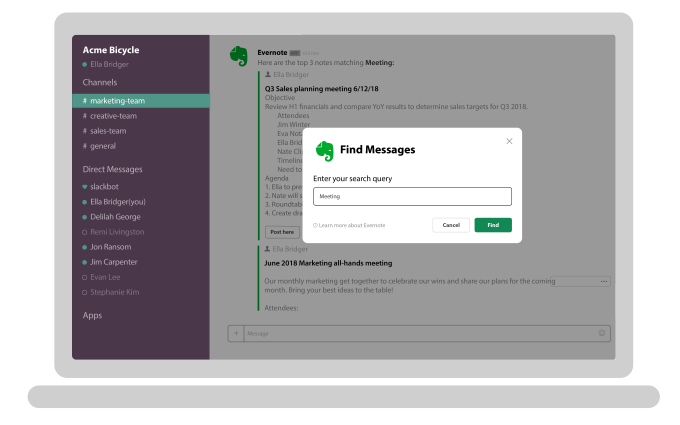
Evernote embedded inside Slack. Screenshot: Evernote
Evernote has take advantage of this new capability in this release to get away from the command interface style that Slack had previously used and make it easier for their core knowledge workers to access Evernote content inside of Slack.
Users can take an Evernote note in Slack, which will then show up in Evernote automatically in a “Notes from Slack” folder. From there, users can edit the notes and move them to other folders (or tag them) to further organize them in any way they see fit. Similarly you can save a conversation you’re having in Slack to Evernote as a note and move it or edit from Evernote later on.
While Salesforce deals with structured systems of record, Evernote works with unstructured content and bringing the two together can be useful and powerful for users. Typically, a team member interacting with the customer on the phone or in the field, will take notes in Evernote, and they want to share that information with other members of the team in the Salesforce record, Wrobel explained.
The user who took the note can link one or more notes inside Salesforce, so they essentially become part of the customer record. The newer version improves the technical connections between the two cloud applications including the ability to “pin” a note to a record. What’s more, once a note is linked there is two-way sync, which means regardless of whether you change that note in Salesforce or Evernote, it will update in both places (because the integration is a live version of Evernote).
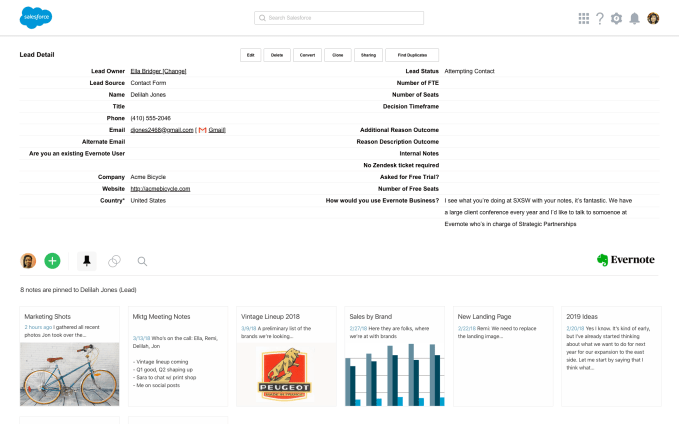
Evernote notes embedded in Salesforce record. Screenshot: Evernote
Evernote also surfaces related content automatically at the bottom of the customer record to help users find other Evernote subject matter connected to the record. While you can’t link a note to Salesforce directly from Evernote yet, that is a requested feature and Wrobel said they are working on it for a future release.
These updates are available today for Slack and Salesforce customers using Evernote Business.
Powered by WPeMatico
Talla is taking aim at the customer service industry with its latest release, an AI-infused knowledge base. Today, the company released version 2.0 of the Talla Intelligent Knowledge Base.
The company also announced that Paula Long, most recently CEO at Data Gravity, has joined the company as SVP of engineering.
This tool combines customer content with automation, chatbots and machine learning. It’s designed to help teams who work directly with customers get at the information they need faster and the machine learning element should allow it to improve over time.
You can deploy the product as a widget on your website to give customers direct access to the information, but Rob May, company founder and CEO says the most common use case involves helping sales, customer service and customer success teams get access to the most relevant and current information, whether that’s maintenance or pricing.
The information can get into the knowledge base in several ways. First of all you can enter elements like product pages and FAQs directly in the Talla product as with any knowledge base. Secondly if an employee asks a question and there isn’t an adequate answer, it exposes the gaps in information.

Talla Knowledge Base gap list. Screenshot: Talla
“It really shows you the unknown unknowns in your business. What are the questions people are asking that you didn’t realize you don’t have content for or you don’t have answers for. And so that allows you to write new content and better content,” May explained.
Finally, the company can import information into the knowledge base from Salesforce, ServiceNow, Jira or wherever it happens to live, and that can be added to a new page or incorporated into existing page as appropriate.
Employees interact with the system by asking a bot questions and it supplies the answers if one exists. It works with Slack, Microsoft Teams or Talla Chat.
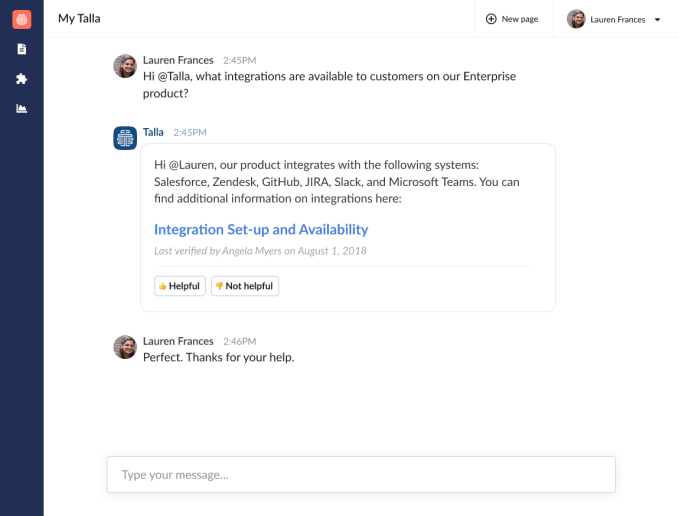
Talla bot in action in Talla Chat. Screenshot: Talla
Customer service remains a major pain point for many companies. It is the direct link to customers when they are having issues. A single bad experience can taint a person’s view of a brand, and chances are when a customer is unhappy they let their friends know on social media, making an isolated incident much bigger. Having quicker access to more accurate information could help limit negative experiences.
Today’s announcement builds on an earlier version of the product that took aim at IT help desks. Talla found customers kept asking for a solution that provided similar functionality with customer-facing information and they have tuned it for that.
May launched Talla in 2015 after selling his former startup Backupify to Datto in 2014. The company, which is based near Boston, has raised $12.3 million.
Powered by WPeMatico