Enterprise
Auto Added by WPeMatico
Auto Added by WPeMatico
A recent user survey sent out by Dropbox confirms the company is considering the addition of an electronic signature feature to its Dropbox Professional product, which it refers to simply as “E-Signature from Dropbox.” The point of the survey is to solicit feedback about how likely users are to use such a product, how often, and if they believe it would add value to the Dropbox experience, among other things.
While a survey alone doesn’t confirm the feature is in the works, it does indicate how Dropbox is thinking about its professional product.
According to the company’s description of E-Signature, the feature would offer “a simple, intuitive electronic signature experience for you and your clients” where documents could be sent to others to sign in “just a few clicks.”
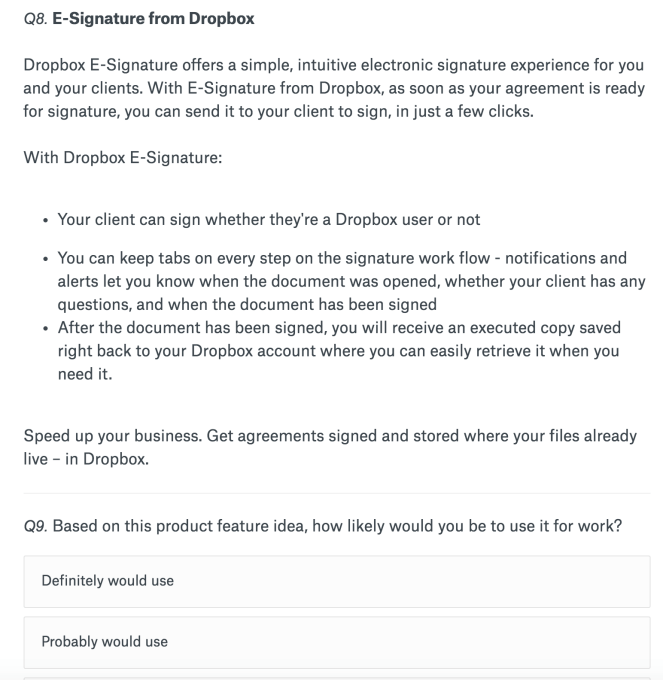
The clients also wouldn’t have to be Dropbox users to sign, the survey notes. And the product would offer updates on every step of the signature workflow, including notifications and alerts about the document being opened, whether the client had questions, and when the document was signed. After the signed document is returned, the user would receive the executed copy saved right in their Dropbox account for easy access, the company says.
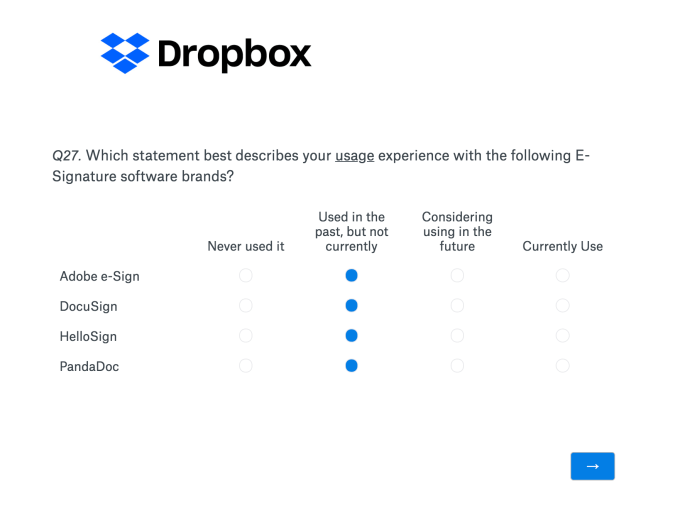
In addition to soliciting general feedback about the product, Dropbox also asked survey respondents about their usage of other e-signature brands, like Adobe e-Sign, DocuSign, HelloSign, and PandaDoc, as well as their usage other more traditional methods, like in-person signing and documents sent over mail.
Given the numerous choices on the market today, it’s unclear if Dropbox will choose to move forward and launch such a product. However, if it did, the benefit of having its own E-Signature service would be its ability to be more tightly integrated into Dropbox’s overall product experience. It could also push more business users to upgrade from a basic consumer account to the Professional tier.
This kind of direct integration would make sense in the context of Dropbox’s business workflows. If, for instance, a company is working on a contract workflow, being able to move to the signature phase without changing context (or to share with a user who doesn’t use Dropbox) could add tremendous value over and above simply storing the document.
Companies like Dropbox have been looking for ways to move beyond pure storage to give customers the ability to collaborate and share that content, particularly without forcing them to leave the application to complete a job. This ability to do work without task switching is something that Dropbox has been working on with Dropbox Paper.
While it remains to be seen how they would implement such a solution, it might be a case where it would make more sense to partner with existing vendors or buy a smaller player than it would be build such functionality from scratch — although it’s not clear from a simple survey what their ultimate goal would be at this point.
Dropbox has not yet responded to requests for comment.
Powered by WPeMatico
Anaxi‘s mission is to bring more transparency to the software development process. The tool, which is now live for iOS, with web and Android versions planned for the near future, connects to GitHub to give you actionable insights about the state of your projects and manage your projects and issues. Support for Atlassian’s Jira is also in the works.
The new company was founded by former Apple engineering manager and Docker EVP of product development Marc Verstaen and former CodinGame CEO John Lafleur. Unsurprisingly, this new tool is all about fixing the issues these two have seen in their daily lives as developers.
 “I’ve been doing software for 40 years,” Verstaen told me.” And every time is the same. You start with a small team and it’s fine. Then you grow and you don’t know what’s going on. It’s a black box.” While the rest of the business world now focuses on data and analytics, software development never quite reached that point. Verstaen argues that this was acceptable until 10 or 15 years ago because only software companies were doing software. But now that every company is becoming a software company, that’s not acceptable anymore.
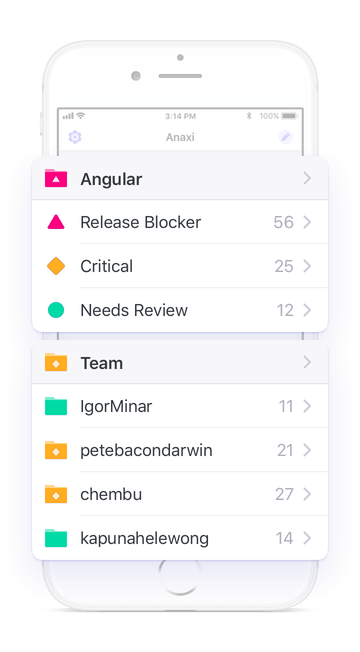
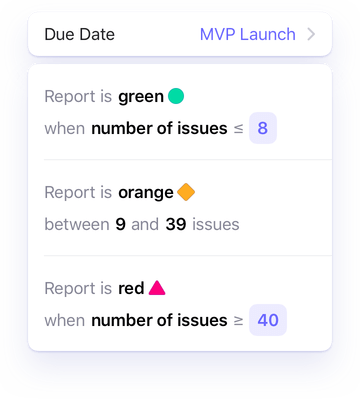
Using Anaxi, you can easily see all issue reports and pull requests from your GitHub repositories, both public and private. But you also get visual status indicators that tell you when a project has too many blockers, for example, as well as the ability to define your own labels. You also can define due dates for issues.
 One interesting aspect of Anaxi is that it doesn’t store all of this information on your phone or on a proprietary server. Instead, it only caches as little information as necessary (including your handles) and then pulls the rest of the information from GitHub as needed. That cache is encrypted on the phone, but for the most part, Anaxi simply relies on the GitHub API to pull in data when needed. There’s a bit of a trade-off here in terms of speed, but Verstaen noted that this also means you always get the most recent data and that GitHub’s API is quite fast and easy to work with.
The service is currently available for free. The company plans to introduce pricing plans in the future, with prices based on the number of developers that use the product inside a company.
Powered by WPeMatico

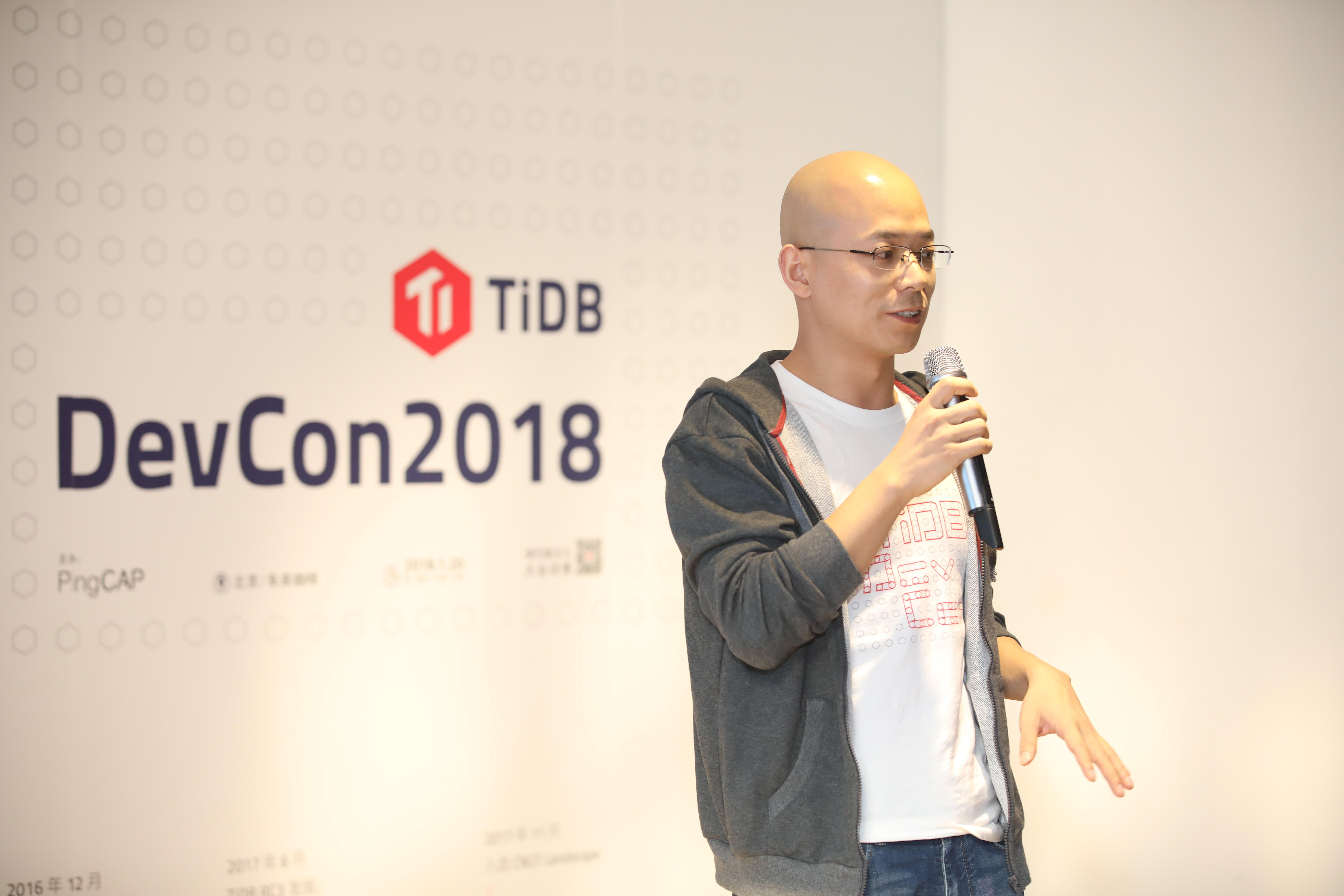
PingCAP co-founder and CEO Max Liu
PingCAP, the company behind MySQL-compatible distributed database TiDB, said today that it plans its global operations after raising a $50 million Series C. The round was led by Chinese venture capital firms Fosun and Morningside Venture Capital, with participation from returning investors including China Growth Capital, Yunqi Partners and Matrix Partners.
Based in Beijing, the company says it will also use the new capital to build more cross-cloud products. PingCAP is focusing on the North American market since it is the most mature cloud market, said Kevin Xu, the company’s general manager of U.S. strategy and operations, in an email.
Founded in 2015 by Dylan Cui, Edward Huang and Max Liu, PingCAP has raised about $72 million so far, including its $15 million Series B announced in June 2017. TiDB is an open-source hybrid transactional and analytical database targeted at companies that need to handle large volumes of data and plan to scale up quickly, but still want to be able to use the same database. Many of its users come from the financial, e-commerce, gaming and travel industries and currently include Mobike, Bank of Beijing, Hulu, Lenovo and Ele.me.
In terms of other distributed databases, TiDB is often compared to CockroachDB and FoundationDB. Xu says one of the main things that differentiatese TiDB from CockroachDB is its ability to handle hybrid transactional and analytical processing workloads at scale, in addition online transaction processing. It is also MySQL compatible, while CockroachDB is PostgreSQL compatible. He adds that FoundationDB is more comparable to TiKV, the key-value storage layer developed by PingCAP that recently became a Cloud Native Computing Foundation project, because FoundationDB is not a relational database like TiDB with a SQL interface.
In a press statement, Morningside Venture Capital managing director Richard Liu said “The database industry has always been a competitive arena, and PingCAP has secured a prominent spot in this crowded field by becoming the go-to solution for many large-scale Internet companies and financial services enterprises in China. Thus, we are glad to grow with PingCAP and continue building the TiDB ecosystem together.”
Powered by WPeMatico
In a world where large hyperscale companies like Amazon, Microsoft and Google dominate the public cloud, it would seem foolhardy for a startup to try to carve out a space, but Packet has an alternative customized cloud vision, and investors have taken notice. Today, the company announced a $25 million Series B led by Third Point Ventures.
An interesting mix of strategic and traditional investors joined the round including Battery Ventures, JA Mitsui Leasing and Samsung Next. Existing investors SoftBank Corp. and Dell Technologies Capital also participated. The company has now raised over $36 million.
The company also showed some signs of maturing by bringing in Ihab Tarazi as CTO and George Karidis as COO. Tarazi, who came over from Equinix, likes what he sees in Packet .
He says they offer several advantages over the public providers. First of all, customers can buy whatever hardware they want. “We offer the most diverse hardware options,” he said. That means they could get servers equipped with Intel, ARM, AMD or with specific nVidia GPUs in whatever configurations they want. By contrast public cloud providers tend to offer a more off-the-shelf approach. It’s cheap and abundant, but you have to take what they offer, and that doesn’t always work for every customer.
Another advantage Packet bring to the table, according to Tarazi, is that they support a range of open source software options, letting customers build whatever applications they want on top of that custom hardware.
They currently have 18 locations around the world, but Tarazi said they will soon be adding 50 more, also adding geographic diversity to the mix.
Finally, each customer gets their own bare metal offering, providing them with a single tenant private option inside Packet’s data center. This gives them the advantages of a privately run data center but where Packet handles all of the management, configuration and upkeep.
Tarazi doesn’t see Packet competing directly with the hyperscale players. Instead, he believes there will be room for both approaches. “I think you have a combination of both happening where people are trying to take advantage of all these hardware options to optimize performance across specific applications,” he explained.
The company, which launched in 2014, currently has about 50 employees with headquarters in New York City and offices in Palo Alto. They are also planning on opening an operations center in Dallas soon. The number should swell to 100 employees over the next year as they expand operations.
Powered by WPeMatico
Zendesk has mostly confined itself to customer service scenarios, but it seems that’s not enough anymore. If you want to truly know the customer behind the interaction, you need a customer system of record to go with the customer service component. To fill that need, Zendesk announced it was acquiring Base, a startup that has raised over $50 million.
The companies did not share the purchase price, but Zendesk did report that the acquisition should not have a significant impact on revenue.
While Base might not be as well known as Salesforce, Microsoft or Oracle in the CRM game, it has created a sophisticated sales force automation platform, complete with its own artificial intelligence underpinnings. CEO Uzi Shmilovici claimed his company’s AI could compete with its more well-heeled competitors when it was released in 2016 to provide salespeople with meaningful prescriptive advice on how to be more successful.
Zendesk CEO Mikkel Svane certainly sees the value of adding a company like Base to his platform. “We want to do for sales what Zendesk has already done for customer service: give salespeople tools built around them and the customers they serve,” he said in a statement.
If the core of customer data includes customer service, CRM and marketing, Base gives Zendesk one more of those missing components, says Brent Leary, owner at CRM Essentials, a firm that keeps close watch on this market.
“Zendesk has a great position in customer service, but now to strengthen their position with midmarket/enterprise customers looking for integrated platforms, Base adds a strong mobile sales force automation piece to their puzzle,” Leary told TechCrunch.
As he points out, we have seen HubSpot make a similar move with HubSpot Apps, while SugarCRM, which was recently sold to Accel-KKR, could be shopping too, with its new owner’s deeper pockets. “This is almost like a CRM enterprise software Hunger Games going on,” he joked. But he indicates that we should be expecting more consolidation here as these companies try to acquire missing pieces of their platforms to offer more complete solutions.
Matt Price, who previously had the title of senior vice president for product portfolio at Zendesk will lead the Base team moving forward.
Base was founded in 2009 and boasts more than 5,000 customers. It’s worth pointing out that Base was already available for sale in the company app marketplace, so there was some overlap here, but the company intends to try to move existing customers to Base, of course.
Zendesk has indicated it will continue to support all Base customers. In addition, Base’s 125 employees have been invited to join Zendesk, so there will be no blood-letting here.
Powered by WPeMatico
Intel today is announcing another acquisition as it continues to pick up talent and IP to bolster its next generation of computing chips beyond legacy PCs. The company has acquired NetSpeed Systems, a startup that makes system-on-chip (SoC) design tools and interconnect fabric intellectual property (IP). The company will be joining Intel’s Silicon Engineering Group, and its co-founder and CEO, Sundari Mitra, herself an Intel vet, will be coming on as a VP at Intel where she will continue to lead her team.
Terms of the deal are not being disclosed, but for some context, during NetSpeed’s last fundraise in 2016 (a $10 million Series C) it had a post-money valuation of $60 million, according to data from PitchBook.
SoC is a central part of how newer connected devices are being made. Moving away from traditional motherboards to create all-in-one chips that include processing, memory, input/output and storage is an essential cornerstone when building ever-smaller and more efficient devices. This is an area where Intel is already active but against others like Nvidia and Qualcomm many believe it has some catching up to do, and so this acquisition in important in that context.
“Intel is designing more products with more specialized features than ever before, which is incredibly exciting for Intel architects and for our customers,” said Jim Keller, senior vice president and general manager of the Silicon Engineering Group at Intel, in a statement. “The challenge is synthesizing a broader set of IP blocks for optimal performance while reining in design time and cost. NetSpeed’s proven network-on-chip technology addresses this challenge, and we’re excited to now have their IP and expertise in-house.”
Intel has made a series of acquisitions to speed up development of newer chips to work in connected objects and smaller devices beyond the PCs that helped the company make its name. Another recent acquisition in the same vein include eASIC for IoT chipsets, which Intel acquired in July. Intel has also been acquiring startups in other areas where it hopes to make a bigger mark, such as deep learning (case in point: its acquisition of Movidius in August).
NetSpeed has been around since 2011 and Intel was one of its investors and customers.
“Intel has been a great customer of NetSpeed’s, and I’m thrilled to once again be joining the company,” said Mitra, in a statement. “Intel is world class at designing and optimizing the performance of custom silicon at scale. As part of Intel’s silicon engineering group, we’re excited to help invent new products that will be a foundation for computing’s future.”
Intel said it will to honor NetSpeed’s existing customer contracts, but it also sounds like it the company will not be seeking future business as Intel integrates the company into its bigger business.
Powered by WPeMatico
New Relic CEO Lew Cirne was feeling a bit nostalgic last week when he called to discuss the announcements for the company’s FutureStack conference taking place tomorrow in San Francisco. It had been 10 years since he first spoke to TechCrunch about his monitoring tool. A lot has changed in a decade including what his company is monitoring these days.
Cirne certainly recognizes that his company has come a long way since those first days. The monitoring world is going through a seismic shift as the ways we develop apps changes. His company needs to change with it to remain relevant in today’s market.
In the early days, they monitored Ruby on Rails applications, but gone are the days of only monitoring a fixed virtual machine. Today companies are using containers and Kubernetes, and beyond that, serverless architecture. Each of these approaches brings challenges to a monitoring company like New Relic, particularly the ephemeral nature and the sheer volume associated with these newer ways of working.
‘We think those changes have actually been an opportunity for us to further differentiate and further strengthen our thesis that the New Relic way is really the most logical way to address this.” He believes that his company has always been centered on the code, as opposed to the infrastructure where it’s delivered, and that has helped it make adjustments as the delivery mechanisms have changed.
Today, the company introduced a slew of new features and capabilities designed to keep the company oriented toward the changing needs of its customer base. One of the ways they are doing that is with a new feature called Outlier Detection, which has been designed to address changes in key metrics wherever your code happens to be deployed.
Further, Incident Context lets you see exactly where the incident occurred in the code so you don’t have to go hunting and pecking to find it in the sea of data.
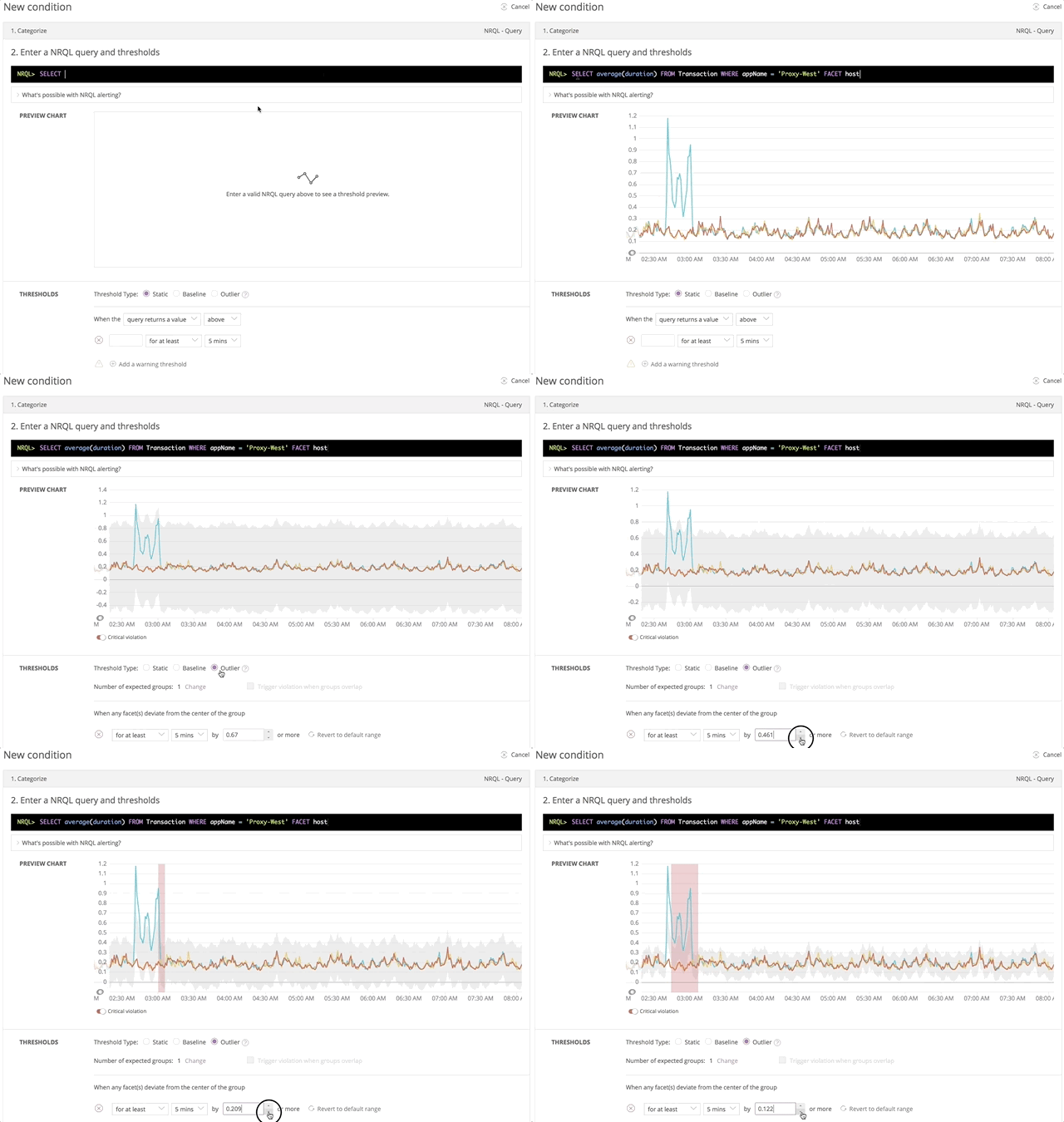
Outlier Detection in action. Gif: New Relic
The company also introduced developer.newrelic.com, a site that extends the base APIs to provide a central place to build on top of the New Relic platform and give customers a way to extend the platform’s functionality. Cirne said each company has its own monitoring requirements, and they want to give them ability to build for any scenario.
In addition, they announced New Relic Query Language (NRQL) data, which leverages the New Relic GraphQL API to help deliver new kinds of customized, programmed capabilities to customers that aren’t available out of the box.”What if I could program New Relic to take action when a certain thing happens. When an application has a problem, it could post a notice to the status page or restart the service. You could automate something that has been historically done manually,” he explained.
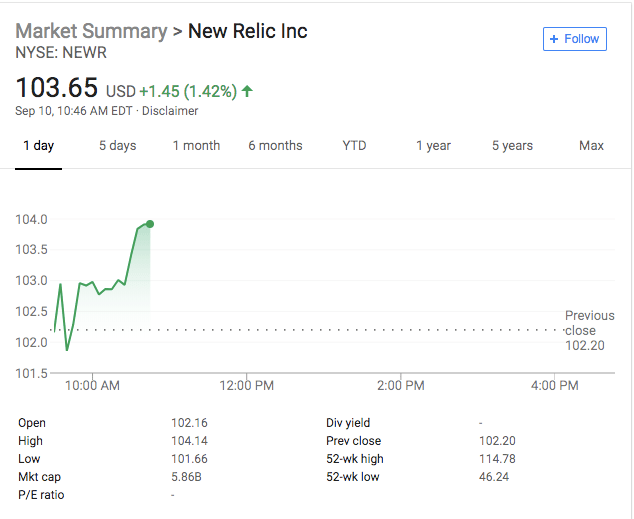
Whatever the company is doing it appears to be working It went public in 2014 with an IPO share price of $30.14 and a market cap of $1.4 billion. Today, the share price was $103.65 with a market cap of $5.86 billion (as of publishing).
Powered by WPeMatico
For years, marketers have been trying to optimize the online shopping experience to better understand their customers and deliver more customized interactions that ultimately drive more sales. Artificial intelligence was supposed to accelerate that, and today Adobe announced enhancements to Adobe Target and Adobe Experience Manager that attempt to deliver at least partly on that promise.
Adobe has been trying to lift the enterprise side of its business for some time, and even though they are well on their way to becoming a $10 billion company, the potential for even more revenue from the enterprise side of the business remains tantalizing. They are counting on AI to help push that along.
Adobe’s Loni Stark says companies are looking for more sophisticated solutions around customization and optimization. Part of that involves using Adobe’s intelligence layer, which they call Sensei, to help marketers as they tweak these programs to drive better experiences.
For starters, the company wants to help users choose the best algorithms for any given set of tasks. Adobe is bringing AI in to assist with a tool it released last year called Auto-Target. “One of the challenges marketers face has been which algorithms do you use, and how do you map them to your personalization strategy. We are enabling Adobe Sensei to choose the best algorithm for them.” She says giving them a smart assistant to help choose should make this task much less daunting for marketers.
Adobe is also bringing some smarts to layout design with a new tool called Smart Layouts, first introduced in March at Adobe Summit. The idea here is to deliver the right layout at any given time to allow marketing teams to scale personalization and increase the likelihood of action, which in marketing speak means buying something.
Once again the company is letting AI guide the process to generate different layouts automatically for different segments, depending on visitor behavior at any given moment. That means a retailer should be able to deliver ever more granular pages based on what it knows about visitors as they move through the shopping process. The more customized the experience, the more likely the shopper turns into a buyer.
Adobe is also looking at new delivery channels, particularly voice, as devices like the Amazon Alexa become increasingly popular. As with the web, mobile, print and other delivery approaches, marketers need to be able apply basic tasks like A/B testing on different voices or workflows, and the company is building these into their tools.
All of these new features are part of Adobe’s ongoing attempt to streamline its marketing tools to make life easier for its customers. By using artificial intelligence to help guide the workflow, they hope to drive more revenue from the digital experience side of the house. While these tools should help, Adobe still makes the vast majority of its money from Creative Cloud. The Digital segment still lags at $586 million (up 18 percent YoY) out of total quarterly revenue of 2.20 billion in the most recent report in June.
The company spent a hefty $1.68 billion in May to snag Magento. They are due to report their next quarterly report on September 18th, and it will be interesting to see if the Magento acquisition and increasing use of artificial intelligence can help continue to grow this side of the business.
Powered by WPeMatico
PagerDuty, the popular service that helps businesses monitor their tech stacks, manage incidents and alert engineers when things go sideways, today announced that it has raised a $90 million Series D round at a valuation of $1.3 billion. With this, PagerDuty, which was founded in 2009, has now raised well over $170 million.
The round was led by T. Rowe Price Associates and Wellington Management . Accel, Andreessen Horowitz and Bessemer Venture Partners participated. Given the leads in this round, chances are that PagerDuty is gearing up for an IPO.
“This capital infusion allows us to continue our investments in innovation that leverages artificial intelligence and machine learning, enabling us to help our customers transform their companies and delight their customers,” said Jennifer Tejada, CEO at PagerDuty in today’s announcement. “From a business standpoint, we can strengthen our investment in and development of our people, our most valuable asset, as we scale our operations globally. We’re well positioned to make the lives of digital workers better by elevating work to the outcomes that matter.”
Currently PagerDuty users include the likes of GE, Capital One, IBM, Spotify and virtually every other software company you’ve ever heard of. In total, more than 10,500 enterprises now use the service. While it’s best known for its alerting capabilities, PagerDuty has expanded well beyond that over the years, though it’s still a core part of its service. Earlier this year, for example, the company announced its new AIOps services that aim to help businesses reduce the amount of noisy and unnecessary alerts. I’m sure there’s a lot of engineers who are quite happy about that (and now sleep better).
Powered by WPeMatico
Microsoft wants to make life easier for enterprise customers. Starting today, it is committing to fix any custom applications that may break as a result of updates to Windows 10 or the Office 365 product suite.
Most large companies have a series of custom applications that play a crucial role inside their organizations. When you update Windows and Office 365, Murphy’s Law of updates says one or more of those applications is going to break.
Up until this announcement when that inevitably happened, it was entirely the problem of the customer. Microsoft has taken a huge step today by promising to help companies understand which applications will likely break when you install updates, and working to help fix them if it ultimately happens anyway.
One of the reasons the company can afford to be so generous is they have data that suggests the vast majority of applications won’t break when customers move from Windows 7 to Windows 10. “Using millions of data points from customer diagnostic data and the Windows Insider validation process, we’ve found that 99 percent of apps are compatible with new Windows updates,” Microsoft’s Jared Spataro wrote in a blog post announcing these programs.
To that end, they have a new tool called Desktop Deployment Analytics, which creates a map of your applications and predicts using artificial intelligence which of them are most likely to have problems with the update.
“You now have the ability with the cloud to have intelligence in how you manage these end points and get smart recommendations around how you deploy Windows,” Spataro, who is corporate vice president of Microsoft 365, told TechCrunch.
Even with that kind of intelligence-driven preventive approach, things still break, and that’s where the next program, Desktop App Assure, comes into play. It’s a service designed to address any application compatibility issues with Windows 10 and Office 365 ProPlus. In fact, Microsoft has promised to assign an engineer to a company to fix anything that breaks, even if it’s unique to a particular organization.
That’s quite a commitment, and Spataro recognizes that there will be plenty of skeptics where this program in particular is concerned. He says that it’s up to Microsoft to deliver what it’s promised.
Over the years, organizations have spent countless resources getting applications to work after Windows updates, sometimes leaving older versions in place for years to avoid incompatibility problems. These programs theoretically completely remove that pain point from the equation, placing the burden to fix the applications squarely on Microsoft.
“We will look to make changes in Windows or Office before we ask you to make changes in your custom application,” Spataro says, but if that doesn’t solve it, they have committed to helping you fix it.
Finally, the company heard a lot of complaints from customers when they announced they were ending extended support for Windows 7 in 2020. Spataro said Microsoft listened to its customers, and has now extended paid support until 2024, letting companies change at their own pace. Theoretically, however, if they can assure customers that updating won’t break things, and they will commit to fixing them if that happens, it should help move customers to Windows 10, which appears to be the company’s goal here.
They also made changes to the standard support and update cadence for Windows 10 and Office 365:

All of these programs appear to be a major shift in how Microsoft has traditionally done business, showing a much stronger commitment to servicing the requirements of enterprise customers, while shifting the cost of fixing custom applications from the customer to Microsoft when updates to its core products cause issues. But they have done so knowing that they can help prevent a lot of those incompatibility problems before they happen, making it easier to commit to this type of program.
Powered by WPeMatico