Enterprise
Auto Added by WPeMatico
Auto Added by WPeMatico
Microsoft HoloLens mixed reality glasses have always been interesting technology, but it’s never been clear how the company would move from novelty device to actual viable business use cases. Today, it made a move toward the latter, announcing a couple of applications designed to put the HoloLens to work in Dynamics 365, giving it a real business purpose.
Dynamics 365 is Microsoft’s one-stop shop for CRM and ERP, where a company can work on some of its key business software functions including field service in an integrated fashion. The company has been looking at for HoloLens to bring computing power to a group of field workers like repair technicians for whom even a tablet would be awkward because they have to work with both hands free.
For these people, having a fully functioning Windows 10 computer you can wear on your face could be a big advantage and that’s what Microsoft is hoping to provide with HoloLens. The problem was finding use cases where this would make sense. One idea is providing remote assistance for people out in the field to get help from subject experts back at the office, and today the company announced Dynamics 365 Remote Assist.
In this scenario, the worker is wearing a HoloLens either to understand the repair scenario before they go to the site or to get remote help from a subject expert while they are at the site. The expert can virtually see what the technician is seeing through the HoloLens, and walk them through the repair without leaving the office, even circling parts and providing other annotations in real time.

Microsoft Remote Assist in action with expert walking the technician through the task. Photo: Microsoft
Microsoft is not the first company to create such a solution. ScopeAR announced RemoteAR 4 months ago, a similar product, but Microsoft has the advantage of building it natively into Windows 10 and all that entails including data integration to update the various repositories with information after the repair is complete.
The other business scenario the company is announcing today is called Dynamics 365 Layout. A designer can create a 3D representation of something like a store or factory layout in CAD software, view the design in 3D in HoloLens, and adjust it in real time before the design goes live. As Microsoft’s Lorraine Bardeen, who has the cool title of General Manager for Microsoft Mixed Reality says, instead of creating cardboard mockups and adjusting your 3D CAD drawing on your computer as you find issues in your design, you can put on your HoloLens and make adjustments in a virtual representation of the layout and it adjusts the CAD drawing for you as you make changes.

Laying out the pieces on a factory floor using Dynamics 365 Layout. Photo: Microsoft
Bardeen says the company has worked with customers to find real-world use cases that would save time, effort and money using mixed reality with HoloLens. They cite companies like Chevron, Ford and ThyssenKrupp Elevators as organizations actively embracing this kind of technology, but it still not clear if HoloLens and mixed reality will become a central component of business in the future. These two solutions GA on October 1st and we will begin the process of finding out.
Powered by WPeMatico
UiPath is bringing automation to repetitive processes inside large organizations and it seems to have landed on a huge pain point. Today it announced a massive $225 million Series C on a $3 billion valuation.
The round was led by CapitalG and Sequoia Capital. Accel, which invested in the companies A and B rounds also participated. Today’s investment brings the total raised to $408 million, according to Crunchbase, and comes just months after a $153 million Series B we reported on last March. At that time, it had a valuation of over $1 billion, meaning the valuation has tripled in less than six months.
There’s a reason this company you might have never heard of is garnering this level of investment so quickly. For starters, it’s growing in leaps in bounds. Consider that it went from $1 million to $100 million in annual recurring revenue in under 21 months, according to the company. It currently has 1800 enterprise customers and claims to be adding 6 new ones a day, an astonishing rate of customer acquisition.
The company is part of the growing field of robotic process automation or RPA. While the robotics part of the name could be considered a bit of a misnomer, the software helps automate a series of mundane tasks that were typically handled by humans. It allows companies to bring a level of automation to legacy processes like accounts payable, employee onboarding, procurement and reconciliation without actually having to replace legacy systems.
Phil Fersht, CEO and chief analyst at HfS, a firm that watches the RPA market, says RPA isn’t actually that intelligent. “It’s about taking manual work, work-arounds and integrated processes built on legacy technology and finding way to stitch them together,” he told TechCrunch in an interview earlier this year.
It isn’t quite as simple as the old macro recorders that used to record a series of tasks and execute them with a keystroke, but it is somewhat analogous to that approach. Today, it’s more akin to a bot that may help you complete a task in Slack. RPA is a bit more sophisticated moving through a workflow in an automated fashion.
Ian Barkin from Symphony Ventures, a firm that used to do outsourcing, has embraced RPA. He says while most organizations have a hard time getting a handle on AI, RPA allows them to institute fundamental change around desktop routines without having to understand AI.
If you’re worrying about this technology replacing humans, it is somewhat valid, but Barkin says the technology is replacing jobs that most humans don’t enjoy doing. “The work people enjoy doing is exceptions and judgment based, which isn’t the sweet spot of RPA. It frees them from mundaneness of routine,” he said in an interview last year.
Whatever it is, it’s resonating inside large organizations and UiPath, is benefiting from the growing need by offering its own flavor of RPA. Today its customers include the likes of Autodesk, BMW Group and Huawei.
As it has grown over the last year, the number of employees has increased 3x and the company expects to reach 1700 employees by the end of the year.
Powered by WPeMatico
By now you’ve probably heard of the Defense Department’s massive winner-take-all $10 billion cloud contract dubbed the Joint Enterprise Defense Infrastructure (or JEDI for short).
Star Wars references aside, this contract is huge, even by government standards.The Pentagon would like a single cloud vendor to build out its enterprise cloud, believing rightly or wrongly that this is the best approach to maintain focus and control of their cloud strategy.
Department of Defense (DOD) spokesperson Heather Babb tells TechCrunch the department sees a lot of upside by going this route. “Single award is advantageous because, among other things, it improves security, improves data accessibility and simplifies the Department’s ability to adopt and use cloud services,” she said.
Whatever company they choose to fill this contract, this is about modernizing their computing infrastructure and their combat forces for a world of IoT, artificial intelligence and big data analysis, while consolidating some of their older infrastructure. “The DOD Cloud Initiative is part of a much larger effort to modernize the Department’s information technology enterprise. The foundation of this effort is rationalizing the number of networks, data centers and clouds that currently exist in the Department,” Babb said.
It’s possible that whoever wins this DOD contract could have a leg up on other similar projects in the government. After all it’s not easy to pass muster around security and reliability with the military and if one company can prove that they are capable in this regard, they could be set up well beyond this one deal.
As Babb explains it though, it’s really about figuring out the cloud long-term. “JEDI Cloud is a pathfinder effort to help DOD learn how to put in place an enterprise cloud solution and a critical first step that enables data-driven decision making and allows DOD to take full advantage of applications and data resources,” she said.

Photo: Mischa Keijser for Getty Images
The single vendor component, however, could explain why the various cloud vendors who are bidding, have lost their minds a bit over it — everyone except Amazon, that is, which has been mostly silent, happy apparently to let the process play out.
The belief amongst the various other players, is that Amazon is in the driver’s seat for this bid, possibly because they delivered a $600 million cloud contract for the government in 2013, standing up a private cloud for the CIA. It was a big deal back in the day on a couple of levels. First of all, it was the first large-scale example of an intelligence agency using a public cloud provider. And of course the amount of money was pretty impressive for the time, not $10 billion impressive, but a nice contract.
For what it’s worth, Babb dismisses such talk, saying that the process is open and no vendor has an advantage. “The JEDI Cloud final RFP reflects the unique and critical needs of DOD, employing the best practices of competitive pricing and security. No vendors have been pre-selected,” she said.
As the Pentagon moves toward selecting its primary cloud vendor for the next decade, Oracle in particular has been complaining to anyone who will listen that Amazon has an unfair advantage in the deal, going so far as to file a formal complaint last month, even before bids were in and long before the Pentagon made its choice.

Photo: mrdoomits for Getty Images (cropped)
Somewhat ironically, given their own past business model, Oracle complained among other things that the deal would lock the department into a single platform over the long term. They also questioned whether the bidding process adhered to procurement regulations for this kind of deal, according to a report in the Washington Post. In April, Bloomberg reported that co-CEO Safra Catz complained directly to the president that the deal was tailor made for Amazon.
Microsoft hasn’t been happy about the one-vendor idea either, pointing out that by limiting itself to a single vendor, the Pentagon could be missing out on innovation from the other companies in the back and forth world of the cloud market, especially when we’re talking about a contract that stretches out for so long.
As Microsoft’s Leigh Madden told TechCrunch in April, the company is prepared to compete, but doesn’t necessarily see a single vendor approach as the best way to go. “If the DOD goes with a single award path, we are in it to win, but having said that, it’s counter to what we are seeing across the globe where 80 percent of customers are adopting a multi-cloud solution,” he said at the time.
He has a valid point, but the Pentagon seems hell bent on going forward with the single vendor idea, even though the cloud offers much greater interoperability than proprietary stacks of the 1990s (for which Oracle and Microsoft were prime examples at the time).
Microsoft has its own large DOD contract in place for almost a billion dollars, although this deal from 2016 was for Windows 10 and related hardware for DOD employees, rather than a pure cloud contract like Amazon has with the CIA.
It also recently released Azure Stack for government, a product that lets government customers install a private version of Azure with all the same tools and technologies you find in the public version, and could prove attractive as part of its JEDI bid.
It’s also possible that the fact that Amazon controls the largest chunk of the cloud infrastructure market, might play here at some level. While Microsoft has been coming fast, it’s still about a third of Amazon in terms of market size, as Synergy Research’s Q42017 data clearly shows.
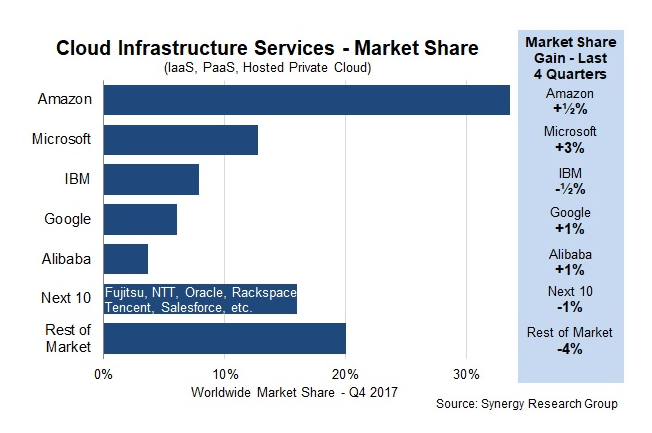
The market hasn’t shifted dramatically since this data came out. While market share alone wouldn’t be a deciding factor, Amazon came to market first and it is much bigger in terms of market than the next four combined, according to Synergy. That could explain why the other players are lobbying so hard and seeing Amazon as the biggest threat here, because it’s probably the biggest threat in almost every deal where they come up against each other, due to its sheer size.
Consider also that Oracle, which seems to be complaining the loudest, was rather late to the cloud after years of dismissing it. They could see JEDI as a chance to establish a foothold in government that they could use to build out their cloud business in the private sector too.
It’s worth pointing out that the actual deal has the complexity and opt-out clauses of a sports contract with just an initial two-year deal guaranteed. A couple of three-year options follow, with a final two-year option closing things out. The idea being, that if this turns out to be a bad idea, the Pentagon has various points where they can back out.

Photo: Henrik Sorensen for Getty Images (cropped)
In spite of the winner-take-all approach of JEDI, Babb indicated that the agency will continue to work with multiple cloud vendors no matter what happens. “DOD has and will continue to operate multiple clouds and the JEDI Cloud will be a key component of the department’s overall cloud strategy. The scale of our missions will require DOD to have multiple clouds from multiple vendors,” she said.
The DOD accepted final bids in August, then extended the deadline for Requests for Proposal to October 9th. Unless the deadline gets extended again, we’re probably going to finally hear who the lucky company is sometime in the coming weeks, and chances are there is going to be lot of whining and continued maneuvering from the losers when that happens.
Powered by WPeMatico
Drone operating system startup Airware today suddenly informed employees it will cease operations immediately despite having raised $118 million from top investors like Andreessen Horowitz, Google’s GV, and Kleiner Perkins. The startup ran out of money after trying to manufacture its own hardware that couldn’t compete with drone giants like China’s DJI. The company at one point had as many as 140 employees, all of which are now out of a job.
A source sent TechCrunch screenshots from the Airware alumni Slack channel detailing how the staff was told this morning that Airware would shut down.
Airware makes a cloud sofware system that helps enterprise customers like construction companies, mining operations, and insurance companies reviewing equipment for damages to use drones to collect and analyze aerial data. That allowed companies to avoid using expensive helicopters or dangerous rigs with humans on harnesses to make inspections and gauge work progress.
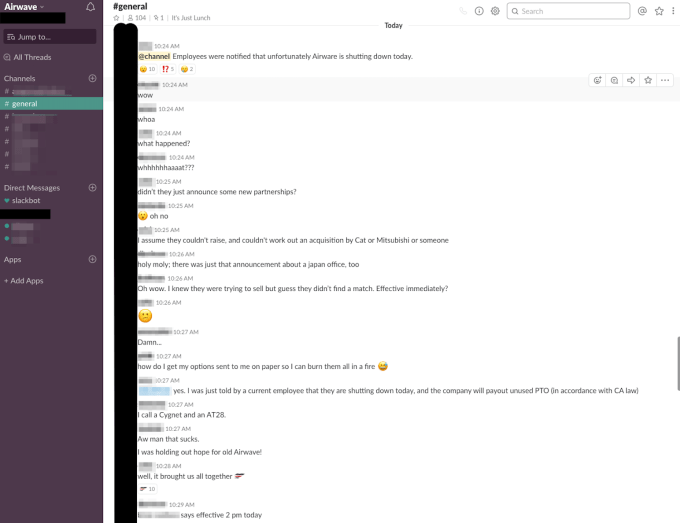
One ex-employee asked “How do I get my options sent to me on paper so I can burn them all in a fire? ”
”
Founded in 2011 by Jonathan Downey, the son of two pilots, Airware first built an autopilot system for programming drones to follow certain routes to collect data. It could help businesses check rooftops for damage, see how much of a raw material was coming out of a mine, or build constantly-updated maps of construction sites. Later it tried to build its own drones before pivoting to consult clients on how to most efficiently apply unmanned aerial vehicles.
 While flying high, Airware launched its own Commercial Drone Fund for investing in the market in 2015, and acquired 38-person drone analytics startup Redbird in 2016. In this pre-crypto, pre-AI boom, Airware scored a ton of hype from us and others as tried to prove drones could be more than war machines. But over time, the software that shipped with commercial drone hardware from other manufacturers was good enough to make Airware irrelevant, and a downward spiral of layoffs began over the past two years, culminating in today’s shutdown. Demonstating how sudden the shut down is, Airware opened a Tokyo headquarters alongside an investment and partnership from Mitsubishi just four days ago.
“Airware was ahead of the game trying to build their software. So far ahead that the drone hardware on the market wasn’t sophisticated enough to actually produce the granularity of data they needed to test out their software/train their algorithms” an ex-employee told TechCrunch (emphasis ours). “So they spent shitloads of money designing bespoke hardware, including two drones in-house, one multi-rotor called an AT-28, and one fixed-wing called Cygnet. Both projects were scuttled as hardware from DJI and Ebee caught up to needs, after sinking tons of engineering time and manufacturing into them.”
Following TechCrunch’s inquiry about the unnannounced news, Airware confirmed the shut down to us with this statement:
“History has taught us how hard it can be to call the timing of a market transition. We have seen this play out first hand in the commercial drone marketplace. We were the pioneers in this market and one of the first to see the power drones could have in the commercial sector. Unfortunately, the market took longer to mature than we expected. As we worked through the various required pivots to position ourselves for long term success, we ran out of financial runway. As a result, it is with a heavy heart that we notified our team, customers, and partners that we will wind down the business.
This is not the business outcome we had worked so hard for over the years and yet we are deeply proud of our company’s accomplishments and our leadership in driving the adoption of drone powered analytics to improve productivity, mitigate risks, and take workers out of harm’s way.
As we close the book of Airware; we want to thank the partners and customers who believed in us and helped us along the way. And, while it is difficult to say goodbye to our team, we want to thank them for all they have contributed to Airware and the industry. We look forward to seeing how they will take their learnings from Airware to fuel continued innovations in the world around us.”
[Update: Since we broke the news, Airware has put up a “thank you” note about the shutdown informing clients that “A representative from the Airware team will be in touch.”]

An Airware-hardware equipped drone
Employees will get one week’s severance, COBRA insurance until November, and payouts for unused paid time off. It appears the startup wasn’t able to raise necessary funding to save the company or secure an acquisition from one of its strategic partners like Catepillar.
Airware will serve as cautionary tale of startup overspending in hopes of finding product-market fit. Had it been more frugal, saved cash to extend its runway, and given corporate clients more time to figure out how to use drones, Airware might have stayed afloat. Sometimes, even having the most prestigious investors can’t save a startup from mismanagement.
Our ex-employee source concludes that “I think having $118M in the bank led Airware to charge ahead and sink tons of money into force-it-to-work methods rather than exercise a bit of patience and wait for the inevitable advance of hardware to catch up. They had a knack for hiring extremely talented and expensive people from places like Google, Autodesk, there was even SpaceX and NASA alumni there.
They spared no expense ever.”
Powered by WPeMatico
Adobe could be shopping for another piece of the digital marketing puzzle, as reports surfaced today that the company might be in talks with Vista Equity Partners to buy Marketo, a company the private equity firm purchased in May 2016 for $1.8 billion in cash. Reuters was first to report the rumor.
While the report states the talks are early, and nothing is imminent, and none of the companies involved would comment (understandably), it is a deal that makes sense for Adobe. The company has been trying to build out its digital marketing business for some time, including buying Magento in May for $1.8 billion to help beef up the ecommerce piece.
Assuming that Vista wants to flip Marketo for a profit, a good bet, it would likely need to come in at $2 billion at a minimum and probably more. There are only a few companies out there that could afford the price tag, who would be interested in a property like Marketo: Adobe, Salesforce, Microsoft, SAP and Oracle.
If Adobe really wanted to go for the digital marketing jugular, it could fork over the cash and buy Marketo. Brent Leary, who covers this industry as the principle at CRM Essentials, says this would be a way for Adobe to grab a chunk of enterprise marketing automation business at a time when the market is getting highly competitive.
“Marketo would give Adobe a leader in the marketing automation space at the enterprise customer level, particularly in the B2B space.” Leary explained.
While nothing is clear yet, Adobe has the resources if it wants to do it. The company currently has $6.3 billion in cash on hand, according to data on Yahoo finance, and has seen its stock price rise significantly in the last year from $156.24 to $269.58 (as of publication today).

Adobe Creative Cloud has always been the primary money maker for Adobe over the years, generating $1.3 billion in the last report (pdf) in June out of $2.2 billion in total revenue. Digital Experience, which includes marketing products, generated $586 million, and although it’s trending up, it has so much more potential.
We have been seeing more M&A action in this space as companies try to fill in various parts of the sale-service-marketing triumvirate. Just last week, we saw Zendesk, the company that concentrates on cloud customer service, enter the sales automation and CRM part of the space with the purchase of Base. Earlier this month, Thoma Bravo bought Apttus, a company which covers the quote-to-cash part of the sales cycle.
Adobe finds itself competing with other giant organizations with the previously mentioned companies all lining up for a piece of the digital marketing business. Getting Marketo certainly has the potential to help push that Digital Experience revenue line up further as the fight for marketshare gets ever more intense. Whether that happens remains to be seen, but Marketo is certainly a company that would match up well with Adobe if it wanted to make such a move.
It’s worth mentioning that Adobe will be reporting its latest earnings this afternoon.
Powered by WPeMatico
Cloud services — where our data, apps and computing power are all being managed in servers owned by others, many miles from where we are sitting — have taken off like a rocket in the decade with the rise of smaller devices, but in the business world, hybrid solutions — mixing cloud with on-premise architectures — remains the order of the day. And today, a provider of hybrid cloud services has raised a round of funding to capitalise on that. Datrium, a provider of back-up and other services for businesses that store and use data in hybrid environments, has raised $60 million in a Series D round of funding.
The company is not disclosing its valuation — we’re asking — but PitchBook estimates that it was at $222 million pre-money, putting it at $282 million post-money. This was an upround compared to previous raises, but it’s also playing on a more modest field than some of its competitors. As a point of comparison, another notable hybrid cloud back-up and data management startup, Rubrik, raised $180 million at a $1.3 billion valuation last year.
Interestingly, Datrium and Rubrik share an investor. This latest round was led by Samsung’s Catalyst Fund, with Icon Ventures, NEA and Lightspeed Venture Partners also participating. Lightspeed (whose investing partner founded and leads Rubrik) also backs Rubrik.
Large enterprises are gradually making the move to the cloud, but they are doing so while also continuing to use their legacy services and architectures — in part to continue sweating those assets, and in part because if something isn’t broken, it’s tempting fate to try to fix it. As a result of that, hybrid cloud services have been a big business up to now, with estimates that it will be a $44.6 billion market this year, and growing to $97.6 billion by 2023.
“As a world leader in memory and storage technologies, we’re always looking for novel and innovative ways to advance datacenter technology,” said Shankar Chandran, senior vice president and managing director, Samsung Catalyst Fund, in a statement. “At this unique moment in time—when data is powering the economy—cutting-edge infrastructure, like Datrium’s hybrid cloud platform, will help enterprises overcome major obstacles in data analysis and storage. We are excited to be an investor in their future.”
And with a market of that size, startups are not only ones targeting it. Google has gone all-in on hybrid; VMware is also interested; and HPE has made some acquisitions to expand its hybrid computing business, as has Microsoft (at least twice), and Cisco.
Datrium — with its flagship DVX platform — has been one of the hopefuls in providing a specific area of data services to enterprises operating hybrid environments: data management and data backup, with customers ranging from large players in healthcare and finance through to media and entertainment. Interestingly, it’s doing so at a time when others like Rubrik have gradually been building more cloud-only solutions to expand beyond hybrid environments customers relying on these.
With this round Michael Mullany of Icon Ventures — formerly a VP of marketing and products for VMware — is joining the board of Datrium.
“We are thrilled to partner with Samsung and Icon Ventures to expand our technical and geographical momentum,” said Tim Page, CEO of Datrium, in a statement. “Enterprises globally have the same problems in simplifying compute and data management across on-prem and cloud. Where SANs don’t even have a path to cloud, traditional HCI has too many tradeoffs for core datacenters – backup requires separate purchasing and administration, and cloud DR automation is seldom guaranteed. Larger enterprises are realizing that Datrium software offers them a simpler path.”
Powered by WPeMatico
In the 1990s when the web was young, companies like Yahoo, created directories of web pages to help make them more discoverable. Hacera wants to bring that same idea to blockchain, and today it announced the launch of the Hacera Network Registry.
CEO Jonathan Levi says that blockchains being established today risk being isolated because people simply can’t find them. If you have a project like the IBM -Maersk supply chain blockchain announced last month, how does an interested party like a supplier or customs authority find it and ask to participate? Up until the creation of this registry, there was no easy way to search for projects.
Early participants include heavy hitters like Microsoft, Hitachi, Huawei, IBM, SAP and Oracle, who are linking to projects being created on their platforms. The registry supports projects based on major digital ledger communities including Hyperledger, Quorum, Cosmos, Ethereum and Corda. The Hacera Network Registry is built on Hyperledger Fabric, and the code is open source. (Levi was Risk Manager for Hyperledger Fabric 1.0.)
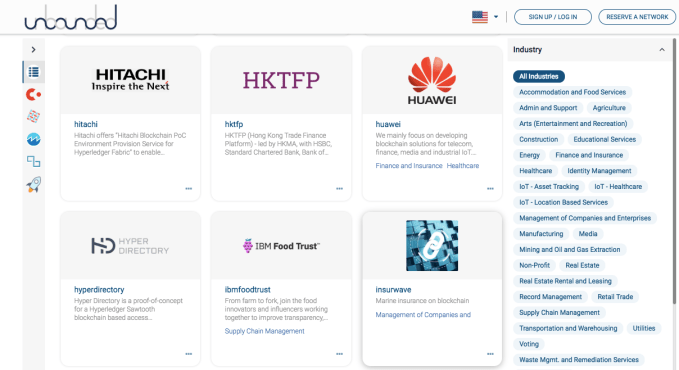
Hacera Network Registry page
While early sponsors of the project include IBM and Hyperledger Fabric, Levi stressed the network is open to all. Blockchain projects can create information pages, not unlike a personal LinkedIn page, and Hacera verifies the data before adding it to the registry. There are currently more than 70 networks in the registry, and Hacera is hoping this is just the beginning.
Jerry Cuomo, VP of blockchain technologies at IBM, says for blockchain to grow it will require a way to register, lookup, join and transact across a variety of blockchain solutions. “As the number of blockchain consortiums, networks and applications continues to grow we need a means to list them and make them known to the world, in order to unleash the power of blockchain,” Cuomo told TechCrunch. Hacera is solving that problem.
This is exactly the kind of underlying infrastructure that the blockchain requires to expand as a technology. Cuomo certainly recognizes this.”We realized from the start that you cannot do blockchain on your own; you need a vibrant community and ecosystem of like-minded innovators who share the vision of helping to transform the way companies conduct business in the global economy,” he said.
Hacera understands that every cloud vendor wants people using their blockchain service. Yet they also see that to move the technology forward, there need to be some standard ways of conducting business, and they want to provide that layer. Levi has a broader vision for the network beyond pure discoverability. He hopes eventually to provide the means to share data through the registry.
Powered by WPeMatico

Nvidia today announced its new GPU for machine learning and inferencing in the data center. The new Tesla T4 GPUs (where the ‘T’ stands for Nvidia’s new Turing architecture) are the successors to the current batch of P4 GPUs that virtually every major cloud computing provider now offers. Google, Nvidia said, will be among the first to bring the new T4 GPUs to its Cloud Platform.
Nvidia argues that the T4s are significantly faster than the P4s. For language inferencing, for example, the T4 is 34 times faster than using a CPU and more than 3.5 times faster than the P4. Peak performance for the P4 is 260 TOPS for 4-bit integer operations and 65 TOPS for floating point operations. The T4 sits on a standard low-profile 75 watt PCI-e card.
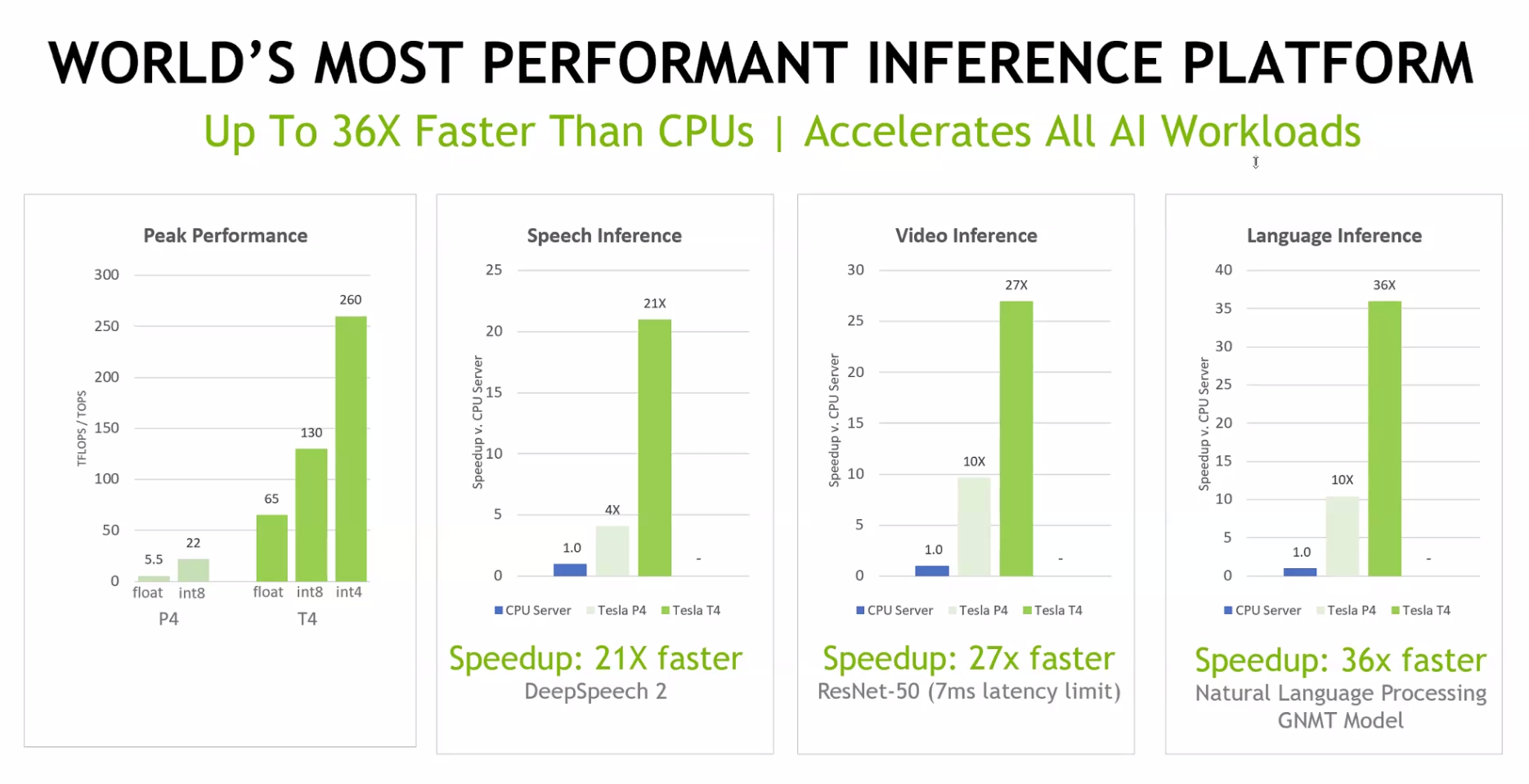
What’s most important, though, is that Nvidia designed these chips specifically for AI inferencing. “What makes Tesla T4 such an efficient GPU for inferencing is the new Turing tensor core,” said Ian Buck, Nvidia’s VP and GM of its Tesla data center business. “[Nvidia CEO] Jensen [Huang] already talked about the Tensor core and what it can do for gaming and rendering and for AI, but for inferencing — that’s what it’s designed for.” In total, the chip features 320 Turing Tensor cores and 2,560 CUDA cores.
In addition to the new chip, Nvidia is also launching a refresh of its TensorRT software for optimizing deep learning models. This new version also includes the TensorRT inference server, a fully containerized microservice for data center inferencing that plugs seamlessly into an existing Kubernetes infrastructure.

Powered by WPeMatico
Sisense, a company that helps customers understand and visualize their data across multiple sources, announced an $80 million Series E investment today led by Insight Venture Partners. They also announced that Zack Urlocker, former COO at Duo Security and Zendesk, has joined the organization’s board of directors.
The company has attracted a prestigious list of past investors, who also participated in the round, including Battery Ventures, Bessemer Venture Partners, DFJ Venture Capital, Genesis Partners and Opus Capital. Today’s investment brings the total raised to close to $200 million.
CEO Amir Orad says investors like their mission of simplifying complex data with analytics and business intelligence and delivering it in whatever way makes sense. That could be on screens throughout the company, desktop or smartphone, or via Amazon Alexa. “We found a way to make accessing data extremely simple, mashing it together in a logical way and embedding it in every logical place,” he explained.
It appears to be resonating. The company has over 1000 customers including Expedia, Oppenheimer and Phillips to name but a few. Orad says they are actually the analytics engine behind Nasdaq Corporate Solutions, which is the the main investor relations system used by CFOs.
He was not in the mood to discuss the company’s valuation, an exercise he called “an ego boost he doesn’t relate to.” He says that he would prefer to be measured by how efficiently he uses the money investors give him or by customer satisfaction scores. Nor would he deal with IPO speculation. All he would say on that front was, “When you focus on the value you bring, positive things happen.”
In spite of that, he was clearly excited about having Urlocker join the board. He says the two spent six months getting to know each other and he sees a guy who has brought several companies to successful exit joining his team, and perhaps someone who can help him bring his company across the finish line, however that ultimately happens. Just last month, Cisco bought Urlocker’s former company, Duo Security for $2.35 billion.
For now Sisense, which launched in 2010, has another $80 million in the bank. They plan to add to the nearly 500 employees already in place in offices in New York, Tel Aviv, Kiev, Tokyo and Arizona. In particular, they plan to grow their international presence more aggressively, especially adding employees to help with customer success and field engineering. Orad also said that he was also open to acquiring companies should the right opportunity come along, saying “Because of talent, technology and presence, it’s something you have to be on lookout for.”
When a company reaches Series E and a couple of hundred million raised, it’s often a point where an exit could be coming sooner than later. By adding an experienced executive like Urlocker, it just emphasizes that possibility, but for now the company appears to be growing and thriving, and taking the view that whatever will be, will be.
Powered by WPeMatico
Twilio, a company best known for supplying a communications APIs for developers has a product called Twilio Flex for building sophisticated customer service applications on top of Twilio’s APIs. Today, it announced it was acquiring Ytica (pronounced Why-tica) to provide an operational and analytical layer on top of the customer service solution.
The companies would not discuss the purchase price, but Twilio indicated it does not expect the acquisition to have a material impact on its “results, operations or financial condition.” In other words, it probably didn’t cost much.
Ytica, which is based in Prague, has actually been a partner with Twilio for some time, so coming together in this fashion really made a lot of sense, especially as Twilio has been developing Flex.
Twilio Flex is an app platform for contact centers, which offers a full stack of applications and allows users to deliver customer support over multiple channels, Al Cook, general manager of Twilio Flex explained. “Flex deploys like SaaS, but because it’s built on top of APIs, you can reach in and change how Flex works,” he said. That is very appealing, especially for larger operations looking for a flexible, cloud-based solution without the baggage of on-prem legacy products.
What the product was lacking, however, was a native way to manage customer service representatives from within the application, and understand through analytics and dashboards, how well or poorly the team was doing. Having that ability to measure the effectiveness of the team becomes even more critical the larger the group becomes, and Cook indicated some Flex users are managing enormous groups with 10,000-20,000 employees.
Ytica provides a way to measure the performance of customer service staff, allowing management to monitor and intervene and coach when necessary. “It made so much sense to join together as one team. They have huge experience in the contact center, and a similar philosophy to build something customizable and programmable in the cloud,” Cook said.
While Ytica works with other vendors beyond Twilio, CEO Simon Vostrý says that they will continue to support those customers, even as they join the Twilio family. “We can run Flex and can continue to run this separately. We have customers running on other SaaS platforms, and we will continue to support them,” he said.
The company will remain in Prague and become a Twilio satellite office. All 14 employees are expected to join the Twilio team and Cook says plans are already in the works to expand the Prague team.
Powered by WPeMatico