Enterprise
Auto Added by WPeMatico
Auto Added by WPeMatico
As large organizations grapple with adopting modern work practices without throwing out all of their legacy software, a company that works with them is making an acquisition that it hopes will help with that process. Citrix today is announcing that it has acquired Sapho, a startup that develops “micro apps” for legacy software so that workers could use them as they would more modern applications: in the cloud, on mobile and more.
We understand that the acquisition was for around $200 million in an all-cash deal. It’s a good return: Sapho had raised just under $28 million since 2014 from investors that included AME Cloud Ventures, Louie Alsop, Felicis Ventures and more. Including co-founders Fouad ElNaggar and Peter Yared, the whole team of 90 employees, based mainly in the Bay Area and a development office in Prague, will be joining Citrix.
Citrix, for its part, currently has a market cap of about $14 billion and has been seeing a surge of interest under new CEO David Henshall, who has repositioned it from focusing mainly on virtual private networking services to a more hybrid cloud model, following a wider trend in the world of enterprise IT.
Citrix will be bringing on all of Sapho’s existing business and products. The two companies already have a strong overlap in their customer bases, CEO ElNaggar said, and it was in fact several of those customers asking for more integrations with Citrix services that drove Citrix approaching Sapho for this deal.
“The largest companies in the world are using Citrix and have a massive hybrid environment where they need to provide a more engaging set of experiences for their employees,” Tim Minahan, EVP Business Strategy and CMO of Citrix, said in an interview. “It doesn’t mean they will rip everything out and put in new software, and Sappho provides a great way to leverage that infrastructure and make them more insightful in their decision making. We see it as a way to rethink the role that enterprise apps play in their environment.”
Typical tasks that Sapho today provides integrations for by tapping into legacy software include expense reporting, sales software, IT support tickets and HR tasks. It feeds data from these into services like Microsoft Teams, Microsoft Dynamics, Oracle’s EBS, Salesforce and SAP ERP, Workday, Google Drive and more.
Ahead of Citrix buying Sapho we’d heard that IBM and Microsoft had eyed up the company and entered into early talks, underscoring the work Sapho had done, the deals it was winning and the gap in the market that it was filling.
Powered by WPeMatico

It’s been 14 years since Mark Shuttleworth first founded and funded Canonical and the Ubuntu project. At the time, it was mostly a Linux distribution. Today, it’s a major enterprise player that offers a variety of products and services. Throughout the years, Shuttleworth self-funded the project and never showed much interest in taking outside money. Now, however, that’s changing.
As Shuttleworth told me, he’s now looking for investors as he looks to get the company on track to an IPO. It’s no secret that the company’s recent re-focusing on the enterprise — and shutting down projects like the Ubuntu phone and the Unity desktop environment — was all about that, after all. Shuttleworth sees raising money as a step in this direction — and as a way of getting the company in shape for going public.
“The first step would be private equity,” he told me. “And really, that’s because having outside investors with outside members of the board essentially starts to get you to have to report and be part of that program. I’ve got a set of things that I think we need to get right. That’s what we’re working towards now. Then there’s a set of things that private investors are looking for and the next set of things is when you’re doing a public offering, there’s a different level of discipline required.”

It’s no secret that Shuttleworth, who sports an impressive beard these days, was previously resistant to this, and he acknowledged as much. “I think that’s a fair characterization,” he said. “I enjoy my independence and I enjoy being able to make long-term calls. I still feel like I’ll have the ability to do that, but I do appreciate keenly the responsibility of taking other people’s money. When it’s your money, it’s slightly different.”
Refocusing Canonical on the enterprise business seems to be paying off already. “The numbers are looking good. The business is looking healthy. It’s not a charity. It’s not philanthropy,” he said. “There are some key metrics that I’m watching, which are the gate for me to take the next step, which would be growth equity.” Those metrics, he told me, are the size of the business and how diversified it is.
Shuttleworth likens this program of getting the company ready to IPO to getting fit. “There’s no point in saying: I haven’t done any exercise in the last 10 years but I’m going to sign up for tomorrow’s marathon,” he said.
The move from being a private company to taking outside investment and going public — especially after all these years of being self-funded — is treacherous, though, and Shuttleworth admitted as much, especially in terms of being forced to setting short-term goals to satisfy investors that aren’t necessarily in the best interest of the company in the long term. Shuttleworth thinks he can negotiate those issues, though.
Interestingly, he thinks the real danger is quite a different one. “I think the most dangerous thing in making that shift is the kind of shallowness of the unreasonably big impact that stock price has on people’s mood,” he said. “Today, at Canonical, it’s 600 people. You might have some that are having a really great day and some that are having a shitty day. And they have to figure out what’s real about both of those scenarios. But they can kind of support each other. […] But when you have a stock ticker, everybody thinks they’re having a great day, or everybody thinks they’re having a shitty day in a way that may be completely uncorrelated to how well they’re actually doing.”
Shuttleworth does not believe that IBM’s acquisition of its competitor Red Hat will have any immediate effect on its business, though. What he does think, however, is that this move is making a lot of people rethink for the first time in years the investment they’ve been making in Red Hat and its enterprise Linux distribution. Canonical’s promise is that Ubuntu, as well as its OpenStack tools and services, are not just competitive but also more cost-effective in the long run, and offer enterprises an added degree of agility. And if more businesses start looking at Canonical and Ubuntu, that can only speed up Shuttleworth’s (and his bankers’) schedule for hitting Canonical’s metrics for raising money and going public.
Powered by WPeMatico
The market for RPA — Robotic Process Automation — is getting a hat trick of news this week: Automation Anywhere has today announced that it has raised $300 million from the SoftBank Vision Fund. This funding, which values Automation Anywhere at $2.6 billion post-money, is an extension to the Series A the company announced earlier this year, which was at a $1.8 billion valuation. It brings the total size of the round to $550 million.
The news comes just a day after one of the startup’s bigger competitors, UiPath, announced a $265 million raise at a $3 billion valuation; and a week after Kofax, another competitor, announced it would be acquiring a division of Nuance for $400 million to beef up its business.
It’s also yet one more example of a one-two punch in funding. It was only in July that Automation Anywhere announced its $250 million raise.
This latest round adds some significant investors to the company’s cap table, specifically from the SoftBank Vision Fund, which counts a number of tech giants like Apple and Qualcomm as LPs, along with others. Specifically, the fund has been under fire for the last few weeks because of the fact that a large swathe of its backing comes from Saudi money.
The Saudi Arabian government has been in the spotlight over its involvement in the killing of journalist Jamal Khashoggi in its embassy in Turkey. By extension of that, there have been many questions raised in recent weeks over the ethics of taking money from the Vision Fund, with so many questions still in the air over that affair.
In an interview, Mihir Shukla, CEO and Co-Founder at Automation Anywhere, said that while what happened to Khashoggi was “not acceptable,” his conversations started with SoftBank before that and they did not impact the startup’s decision over whether to work with the Fund.
He declined to comment on the timing of the term sheet getting signed, when asked whether it was before or after the news broke of the murder.
What attracted us to SoftBank was that Masayoshi Son” — the CEO and founder of SoftBank — “has a vision and he is investing in foundational platforms that will change how we work and travel,” Shukla said. “We share that vision.”
He also pointed out that getting funding from SoftBank will “naturally” lead to more opportunities to partner with companies in SoftBank’s network of companies, which cover dozens of investments and outright ownerships.
While it feels like artificial intelligence is something that you see referenced at every turn these days in the tech world, RPA is an interesting area because it’s one of the more tangible applications of it, across a wide set of businesses.
In short, it’s a set of software-based “robots” that help companies automate mundane and repetitive tasks that would otherwise be done by human workers, employing AI-based technology in areas like computer vision and machine learning to get the work done.
Competition among companies to grab pole position in the space is fierce. Automation Anywhere has 1,400 organizations as customers, it says. By comparison, UiPath has 2,100 and claims an annual revenue run rate at the moment of $150 million. Shukla declined to disclose any financials for his company.
But in light of all that, the company will be using the funding to build out its business specifically ahead of rivals.
“With this additional capital, we are in a position to do far more than any other provider,” said Shukla in a statement. “We will not only continue to deliver the most advanced RPA to the market, but we will help bring AI to millions. Like the introduction of the PC, we see a world where every office employee will work alongside digital workers, amplifying human contributions. Today, employees must know how to use a PC and very soon employees will have to know how to build a bot.”
Automation Anywhere claims that its Bot Store is the industry’s largest marketplace for bot applications, designed both by itself and partners, to execute different business processes, with 65,000 users since launching in March 2018.
Powered by WPeMatico
We hear so much about managing the customer relationship, but companies have to manage the products they sell, too. Propel, a Santa Clara startup, is taking a modern cloud approach to the problem, and today it landed an $18 million Series B investment.
The round was led by Norwest Venture Partners. Previous investors Cloud Apps Capital Partners, Salesforce Ventures and SignalFire also participated. Today’s investment brings the total raised to more than $28 million.
“We are focused on helping companies design and launch products, based on how you go through the life cycle of a product from concept to design to make, model, sell, service where everybody in a company gets involved in product processes at different points in time,” company co-founder and CEO Ray Hein told TechCrunch.
Hein says the company has three core products to help customers track products through their life. For starters, there is the product life cycle management tool (PLM), used by engineering and manufacturing. Next, they have product information management for sales and marketing. Finally, they have service personnel using the quality management component.
The company is built on top of the Salesforce platform, which could account for Salesforce Ventures’ interest in the startup. While Propel looks purely at the product, Salesforce is more interested in the customer, whether from a sales, service or marketing perspective.
These same employees need to understand the products they are developing and selling and that is where Propel comes into play. For instance, when sales people are filling out an order, they need access to the product catalog to get the right numbers or marketing needs to understand the products they are adding to an online store in an e-commerce environment.
Traditional PLM tools from companies like SAP and Oracle are on-prem or have been converted from on-prem to cloud services. Propel was born in the cloud and Sean Jacobsohn, partner at Norwest Venture Partners, who will be joining the Propel board, sees this as a key differentiator for the startup.
“With Propel’s solution, companies can get up and running faster than with on-premise alternatives and pivot products in a matter of seconds based on real-time feedback gathered from marketing, engineering, sales, customers and the entire supply chain,” Jacobsohn said in a statement.
The company was founded in 2015. It currently has 35 employees; flush with these new funds, Hein intends to boost to 50 in the coming months.
Powered by WPeMatico
Docker and MuleSoft have announced a broad deal to sell products together and integrate their platforms. As part of it, Docker is getting an investment from Salesforce, the CRM giant that acquired MuleSoft for $6.5 billion last spring.
Salesforce is not disclosing the size of the stake it’s taking in Docker, but it is strategic: it will see its new MuleSoft working with Docker to connect containerized applications to multiple data sources across an organization. Putting the two companies together, you can connect these containerized applications to multiple data sources in a modern way, even with legacy applications.
The partnership is happening on multiple levels and includes technical integration to help customers more easily use the two toolsets together. It also includes a sales agreement to invite each company’s sales team when it makes sense, and to work with systems integrators and ISVs, who help companies put these kind of complex solutions to work inside large organizations.
Docker chief product officer Scott Johnston said it was really about bringing together two companies whose missions were aligned with what they were hearing from customers. That involves tapping into some broad trends around getting more out of their legacy applications and a growing desire to take an API-driven approach to developer productivity, while getting additional value out of their existing data sources. “Both companies have been working separately on these challenges for the last several years, and it just made sense as we listen to the market and listen to customers that we joined forces,” Johnston told TechCrunch.
Uri Sarid, MuleSoft’s CTO, agrees that customers have been using both products and it called for a more formal arrangement. “We have joint customers and the partnership will be fortifying that. So that’s a great motion, but we believe in acceleration. And so if there are things that we can do, and we now have plans for what we will do to make that even faster, to make that even more natural and built-in, we can accelerate the motion to this. Before, you had to think about these two concerns separately, and we are working on interoperability that makes you not have to think about them separately,” he explained.
This announcement comes at a time of massive consolidation in the enterprise. In the last couple of weeks, we have seen IBM buying Red Hat for $34 billion, SAP acquiring Qualtrics for $8 billion and Vista Equity Partners scooping up Apptio for $1.94 billion. Salesforce acquired MuleSoft earlier this year in its own mega deal in an effort to bridge the gap between data in the cloud and on-prem.
The final piece of today’s announcement is that investment from Salesforce Ventures. Johnston would not say how much the investment was for, but did say it was about aligning the two partners.
Docker had raised almost $273 million before today’s announcement. It’s possible it could be looking for a way to exit, and with the trend toward enterprise consolidation, Salesforce’s investment may be a way to test the waters for just that. If it seems like an odd match, remember that Salesforce bought Heroku in 2010 for $212 million.
Powered by WPeMatico
If data is the new oil, you might think of apps are the cars that need it to move. Now, a startup that has built a platform to let everyone — not just those with technical expertise — make and drive their own “cars” has raised a significant round of funding to grow its business. Airtable — which uses a simple interface built on spreadsheets and other tools familiar to knowledge workers as a frontend to produce apps and other web-based experiences — has raised $100 million in funding to expand its business with more talent and offices outside the US. Along with the funding, the company has now catapulted to a $1.1 billion valuation.
Catapult is the key word here: according to PitchBook the company was only valued at $152 million in its last round — eight months ago.
Airtable’s tools are now in use by some 80,000 businesses today, the company said, representing a real growth spurt. To put that into some context, when the company raised $52 million eight months ago, it said it had only 30,000 customers.
This latest round — a Series C — was led by Josh Kushner at Thrive Capital, Peter Fenton at Benchmark, and Philippe and Thomas Laffont at Coatue Management. Delphine Arnault, Emily Weiss, Alexa Von Tobel, Sarah Smith, Dan Rose, and previous investors CRV and Caffeinated Capital also participated — bringing the total raised by Airtable to $170 million.
Howie Liu, the CEO who co-founded Airtable with Emmett Nicholas (now CTO) and Andrew Ofstad, said that the initial idea for the product came out of their own experience. The tech world had already identified that many tools for building apps and other products were potentially too technical for the vast majority of knowledge workers in the tech industry (who might not have coding experience), but the solutions in the market for making things like apps were still “too expensive and complicated to use.”
“The vision was to democratise the value proposition,” he said. A database, the founders decided, “in its most flexible form, can be customised to what you need, and that would be better than using someone else’s existing database model.”
Airtable is not the only company that has identified the problem and tried to solve it by building powerful macros under the hood of otherwise standard-looking database interfaces.
DashDash is building a similar concept out of Europe focused specifically on spreadsheets, and we’re even seeing Microsoft and partners building more functionality into the world’s leading spreadsheet provider, Excel.
Indeed, that’s not seen as stiff competition, but a sign for Airtable’s investors of just how much opportunity there is in the space. “Airtable has established itself as the leader in what will become a very large market,” Josh Kushner, managing partner at Thrive Capital, said in a statement.
One of the important aspects of Airtable is its Slack-like approach to the task of using its platform to build things.
The company has a platform called Blocks that not only lets its users bring in data from a number of sources, but also to select a number of different kinds of outputs for how and where would like the data to be used, whether it is in a marketing campaign across text messaging, an AI-based bot, or a VR experience. Liu confirmed for me that for now Excel is not one of its integration partners, for now.
Another notable point is that Airtable is yet another example of how the most promising startups are racking up funding in rapid rounds at the moment.
Just yesterday, no less than four different startups — Service Titan, UiPath, Nikola, and SAM — announced rounds of funding coming on the heels of fundraising mere months earlier. It’s a sign of how the market is very hot at the moment: VCs and other investment firms have raised fuelled by large sums of cash that now need to be put to use, and they are all looking for strong bets to do just that.
Fast-growing startups in areas that are on the rise present safe harbours to these investors, and with tens and hundreds of billions of dollars at these funds still in play, we’ll probably continue to witness this funding trend for some time to come.
Powered by WPeMatico
When Oracle filed a protest in August with the Government Accountability Office (GAO) that the Pentagon’s $10 billion JEDI RFP process was unfair, it probably had little chance of succeeding. Today, the GAO turned away the protest.
The JEDI contract has been set up as a winner-take-all affair. With $10 billion on the table, there has been much teeth-gnashing and complaining that the deck has been stacked to favor one vendor, Amazon. The Pentagon has firmly denied this, but it hasn’t stopped Oracle and IBM from complaining loudly from the get-go that there were problems with the way the RFP was set up.
At least with the Oracle complaint, the GAO put that idea firmly to rest today. For starters, the GAO made it clear that the winner-take-all approach was just fine, stating “…the Defense Department’s decision to pursue a single-award approach to obtain these cloud services is consistent with applicable statutes (and regulations) because the agency reasonably determined that a single-award approach is in the government’s best interests for various reasons, including national security concerns, as the statute allows.”
The statement went on to say that the GAO didn’t find that the Pentagon favored any vendor during the RFP period. “GAO’s decision also concludes that the Defense Department provided reasonable support for all of the solicitation provisions that Oracle contended exceeded the agency’s needs.” Finally, the GAO found no evidence of conflict of interest on the DOD’s part as Oracle had suggested.
Oracle has been unhappy since the start of this process, going so far as having co-CEO Safra Catz steer her complaints directly to the president in a meeting last April long before the RFP period had even opened.
As I wrote in an article in September, Oracle was not the only vendor to believe that Amazon was the favorite:
The belief amongst the various other players, is that Amazon is in the driver’s seat for this bid, possibly because they delivered a $600 million cloud contract for the government in 2013, standing up a private cloud for the CIA. It was a big deal back in the day on a couple of levels. First of all, it was the first large-scale example of an intelligence agency using a public cloud provider. And of course the amount of money was pretty impressive for the time, not $10 billion impressive, but a nice contract.
Regardless, the RFP submission period ended last month. The Pentagon is expected to choose the vendor in April 2019, Oracle’s protest notwithstanding.
Powered by WPeMatico

PagerDuty, an eight-year-old, San Francisco-based company that sends companies information about their technology, doesn’t receive a fraction of the press that other fast-growing enterprise software companies receive. In fact, though it counts as customers heavyweight companies like Capital One, Spotify and Netflix; it employs 500 employees; and it has five offices around the world, it has largely operated out of the spotlight.
That’s changing. For one thing, the company is now a so-called unicorn, after raising $90 million in a September round led by Wellington and T. Rowe Price that brought its total funding to $173 million and its valuation to $1.3 billion. Crowded as the unicorn club may be these days, that number, and those backers, makes PagerDuty a startup of interest to a broader circle of industry watchers.
Another reason you’re likely to start hearing more about PagerDuty is its CEO of three years, Jennifer Tejada, who is rare in the world of enterprise startups because of her gender, but whose marketing background makes her even more of an anomaly — and an asset.
In a world that’s going digital fast, Tejada knows PagerDuty can appeal to a far wider array of customers by selling them a product they can understand.
It’s a trick she first learned at Proctor & Gamble, where she spent seven years after graduating from the University of Michigan with both a liberal arts and a business management degree. In fact, in her first tech job out of P&G, working for the bubble-era supply chain management startup I2 Technologies (it went public and was later acquired), Tejada says she became “director of dumb it down.”
Sitting in PagerDuty’s expansive second floor office space in San Francisco — space that the company will soon double by taking over the first floor — Tejada recalls acting “like a filter for very technical people who were very proud of the IP they’d created” but who couldn’t explain it to anyone without relying on jargon. “I was like, ‘How are you going to get someone to pay you $2 million for that?’”
Tejada found herself increasingly distilling the tech into plain English, so the businesspeople who have to sign big checks and “bet their careers on these investments” could understand what they were being pitched. She’s instilling that same ethos at PagerDuty, which was founded in 2009 to help businesses monitor their tech stacks, manage disruptions and alert engineers before things catch on fire but, under Tejada’s watch, is evolving into a service that flags opportunities for its customers, too.
As she tells it, the company’s technology doesn’t just give customers insights into their service ecosystem and their teams’ health, and it doesn’t just find other useful kernels, like about which operations teams are the most productive and why. PagerDuty is also helping its clients become proactive. The idea, she says, is that “if you see traffic spiking on a website, you can orchestrate a team of content marketers or growth hackers and get them in that traffic stream right then, instead of reading about it in a demand-gen report a week later, where you’re, like, ‘Great, we totally missed that opportunity.’”
The example is a bit analogous to what Tejada herself brings to the table, which includes strong people skills (she’s very funny) and a knack for understanding what consumers want to hear, but also a deep understanding of finance and enterprise software.
 As corny as it sounds, Tejada seems to have been working toward her current career her whole life.
Not that, like the rest of us, she knew exactly what she was doing at all times. On the contrary, one part of her path started when, after spending four years as the VP of global marketing for I2 — four years during which the dot-com bubble expanded wildly, then popped — Tejada quit her job, went home for the holidays and, while her baffled family looked on, booked a round-trip ticket to Australia to get away and learn about yachts.
She left the experience not only with her skipper certification but in a relationship with her now-husband of 16 years, an Australian with whom she settled in Sydney for roughly 12 years.
There, she worked for a private equity firm, then joined Telecom New Zealand as its chief marketing officer for a couple of years, then landed soon after at an enterprise software company that catered to asset-intensive industries, including mining, as its chief strategy officer. When that private-equity backed company was sold, Tejada took a breath, then was recruited to lead, for the first time, another company: Keynote Systems, a publicly traded internet and mobile cloud testing and monitoring company that she steered to a sale to the private equity firm Thomas Bravo a couple of years later.
The move gave her an opportunity to spend time with her now teenage daughter and husband, but she also didn’t have a job for the first time in many years, and Tejada seems to like work. Indeed, within one year, after talking with investors who’d gotten to know her over her various roles, as well as eager recruiters, Tejada — who says she is “not a founder but a great adoptive parent” — settled on the 50th of 51 companies she was asked to consider joining. It was PagerDuty.
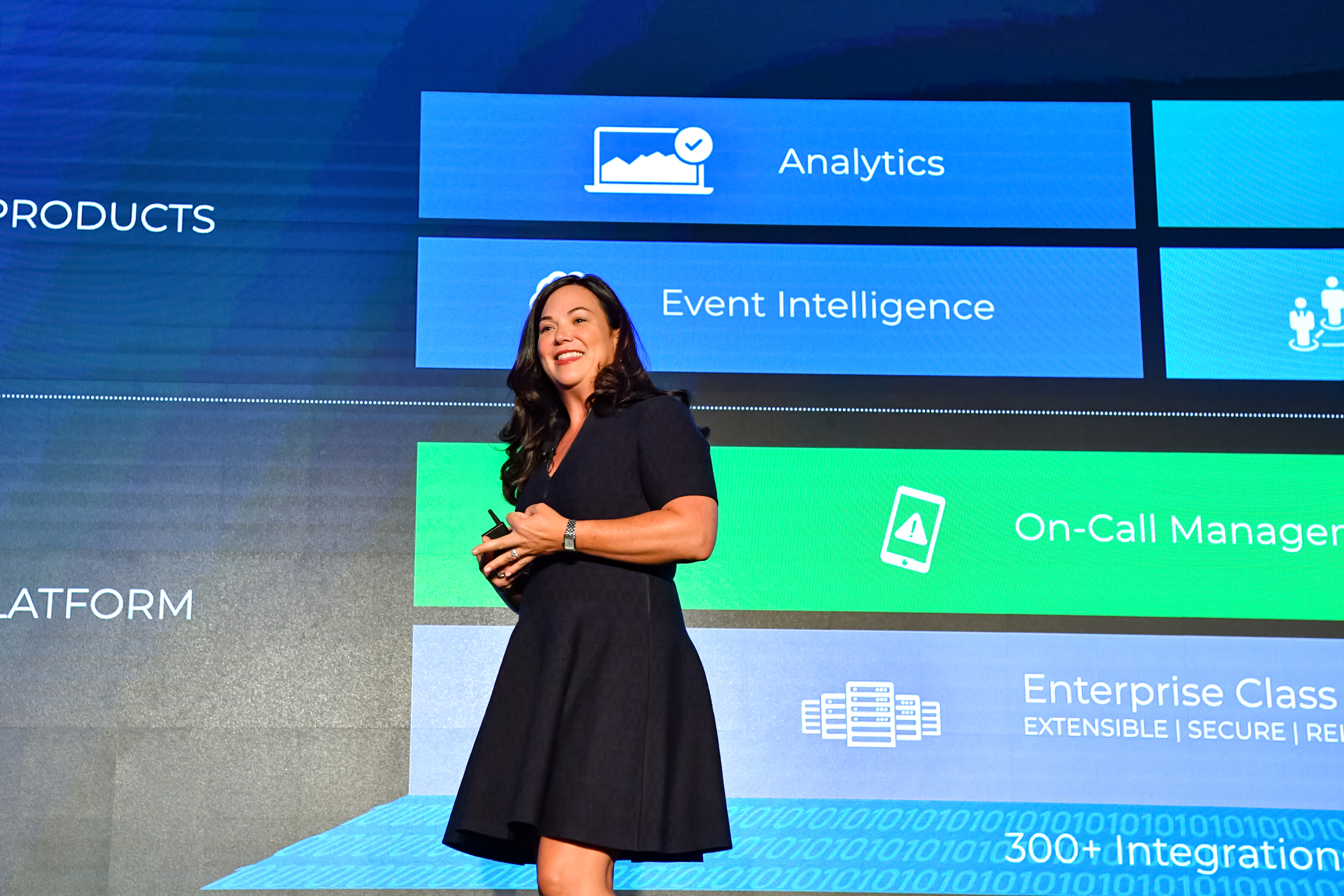 She has been overseeing wild growth ever since. The company now counts more than half of the Fortune 50 as its customers. It has also doubled its headcount a couple of times since she joined roughly 28 months ago, and many of its employees (upwards of 43 percent) are now women, as well as engineers from more diverse backgrounds than you might see at a typical Silicon Valley startup.
That’s no accident. Diversity breeds diversity, in Tejada’s view, and diversity is good for business.
“I wouldn’t say we market to women,” says Tejada, explaining that diversity to her is not just about gender but also age and ethnic background and lifestyle choice and location and upbringing and expertise.
“We’ve made a conscious effort to build an inclusive culture where all kinds of people want to work. And you send that message out into the market, there’s a lot of people who hear it and wonder if it could possibly be true. And then they come to a PagerDuty event, or they come into the office, and they see something different than they’ve seen before. They see people they can relate to.”
Why does it matter when it comes to writing code? Because a big part of coding is problem-solving for one thing, says Tejada. “When you have people from diverse backgrounds chunking through a big hairy problem together, those different perspectives will get you to a more insightful answer.” Tejada also believes there’s too much bias in application development and user experience. “There’s a lot of gobbledygook in our app that lots of developers totally understand but that isn’t accessible to everyone — men, women, different functional types of users, people of a different age. Like, how accessible is our mobile app to someone who’s not a native-first mobile user, who started out on an analog phone, moved to a giant desktop, then to a laptop and is now using a smartphone? You have to think about the accessibility of your design in that regard, too.”
What about the design of PagerDuty’s funding? Before parting ways, we ask Tejada about the money PagerDuty raised a couple of months ago, and what it means for the company.
Unsurprisingly, as to whether the company plans to go public any time soon, her answers are variously, “I’m just building an enduring company,” and, “We’re still enjoying the benefits of being a private company.”
But Tejada also seems mindful of not raising far more money for PagerDuty than it needs to scale, even while there’s an ocean of capital surrounding it.
“Going back to the early ’90s, in my career I have not seen a market where there has been more ready availability to capital, between tax reforms and sovereign cash and big corporates and low interest rates and huge venture funds, not to mention the increased willingness of big institutional investors to become LPs.” But even while the “underlying drivers and secular trends and leading indicators” suggest a healthy market for SaaS technology for a long time to come, that “doesn’t mean the labor markets are going to stay the same. It doesn’t mean the geopolitical environments are not going to change. When you let the scarcity issue in the market drive your valuation, you’re also responsible for growing into that valuation, no matter what happens in the macro environment.”
Where Tejada doesn’t necessarily want to be so measured is when it comes to PagerDuty’s place in its market.
And that can be challenging as the company gains more traction — and more attention.
“If you do the right thing for your customers, and you do the right thing by your employees, all the rest will fall into place,” she says. “But the minute you take your eye off the ball, the minute you don’t earn the trust of your customer every day, the minute you stop innovating in service of them, you’re gonna start going backwards,” she says with a shrug.
Tejada recalls a conversation she had with her executive team last week, including with Alex Solomon, the company’s CTO and the one of three PagerDuty founders who remains actively engaged with the company. (Co-founder Andrew Miklas moved on to venture capital last year; Baskar Puvanathasan meanwhile left the company in March.) “They probably wanted to kill me,” she says laughing. “I told them I don’t think we’re disrupting ourselves enough. They’re like, ‘Jenn, let up.’ But that’s what happens to companies. They have their first success and they miss that second wave or third wave, and the next thing you know, you’re Kodak.”
PagerDuty, she says, “is not going to be Kodak.”
Powered by WPeMatico
It’s not always easy to do the right thing or to make ethical decisions in a complex business environment. People get lost inside large organizations and group think can overwhelm even normally ethical individuals. Convercent has created a platform to help, and today it announced a new benchmarking dashboard to allow companies to measure just how well they are doing from an ethical perspective.
In recent times, we’ve witnessed the impact it has when companies don’t behave ethically. Convercent CEO Patrick Quinlan says there is real cost for behaving badly both in terms of dollars and reputation. He believes that it’s in a company’s best interest to stay on top of undesirable behavior before it spirals out of control.
Quinlan pointed out whether it’s the diesel scandal at Volkswagen or the sexual harassment revealed by Susan Fowler at Uber, it has changed the conversation about ethics. He says it’s no longer just about bottom-line financial results, how you behave as a company matters too in the court of public opinion and in financial markets.
He believes this can be measured, and the Convercent Ethics Dashboard is designed to provide metrics about how well your company is complying with a set of internal guidelines. The Convercent platform includes components to enable employees to safely report bad practices going on in a company such as bribery, corruption, sexual harassment and more. A more automated API driven system pulls in data from a variety of internal systems and analyzes that for ethical gaps.
Much like companies audit their financial systems, you can start to audit how ethical the organizational structure is and how negative behavior is being handled. The company not only looks at internal data, it can help customers benchmark against others in their industries. Quinlan says that it’s possible to spot a trend even before someone reports it.
“Sometimes you have this interactive code of conduct, where there’s a new vice president in a region and suddenly page views on the sexual harassment section of the Code of Conduct have increased 200% in the 90 days after he started. That’s easy, right? There’s a reason that’s happening, and our system will actually tell you what’s happening,” Quinlan explained.
He says trend reporting like this can help a company spot a problem before it spirals out of their control. In other cases, it may be more subtle, but Convercent can pick up less obvious trends as well.
Convercent, which launched in 2013, has raised almost $72 million. They have 630 customers with 6.4 million employees accessing the Convercent platform. Customers include Kimberly Clark, Microsoft, Capgemini and Under Armour.
Powered by WPeMatico
ServiceTitan, a startup out of Glendale, Calif. that has built a software platform for home services businesses — in areas like air conditioning, plumbing and electrical repairs — to manage their work, has raised $165 million in what it claims is the “largest software raise in Southern California history.”
(That distinction might be specifically for B2B software, since Snap, as one example, raised billions before it went public, when it was still known as the app startup Snapchat.)
The company has confirmed that its valuation is now at $1.65 billion — making it the newest unicorn out of the region (and fulfilling a prediction we made earlier this year).
This latest round, a Series D, was led by Index Ventures. New backers Dragoneer and T. Rowe Price also participated, along with existing investors Battery Ventures, Bessemer Venture Partners and ICONIQ Capital.
It’s coming just seven months after ServiceTitan raised its last round: rapid funding rounds of large sums of money, raised within months of each other, seems to be a trend at the moment, underscoring the current state of the market where VCs have themselves raised huge funds and are looking for safe harbors and fast-growing companies in which to invest them. (As two examples, just earlier today, UiPath announced another huge round, its third fundraising this year; and Nikola Trucking also raised its second round of the year.)
The funding will be used for bringing on more talent — it’s already hired from Google, Netflix, Adobe and Accel — as well as business development and to build more software to fill out a vision of becoming “the operating system for home services.” It’s also been making acquisitions, and this could help with that, too.
This is potentially a huge market, with some $400 billion spent on home service repairs annually in the U.S. alone.
ServiceTitan was co-founded by two Armenian Americans, Ara Mahdessian and Vahe Kuzoyan, in 2012, after they met on a ski trip organized by the Armenian student associations at Stanford and the University of Southern California when they were still were in college. The startup was borne out of work both were doing after college to build software to help their fathers, who worked in air conditioning contracting, run their businesses.
Small businesses often are some of the most overlooked when it comes to tech innovations, even more so when they come from relatively unsexy industries like air conditioning repair, but they need solutions as much as larger organizations. ServiceTitan’s rise has come from filling that gap in the market.
It says it is on track to double subscription revenues this year, with some 2,500 customers on board covering some 50,000 technicians and $10 billion of services in areas like plumbing, air conditioning, electrical and garage door repair, working out to nearly 20 percent of homes across the U.S. and Canada.
“The ServiceTitan mission has always been personal to us,” said Mahdessian, co-founder and CEO of ServiceTitan, in a statement. “Our software powers the tireless men and women of home services who ensure the world has the basic necessities of life: running water, relief from the scorching heat and biting cold, power and electricity, and more. We take it for granted today, until our toilets back up, our air conditioning goes out during the heat of summer, or our lights go out in the middle of the night. These are the heroes that come to our rescue, and we’re here to help them be more efficient and successful.”
ServiceTitan is not the only company eyeing up the space, of course: aggregators like Amazon and Angi Homeservices (formerly Angie’s List) are providing a way for independent contractors and small franchises to connect with customers, and they will inevitably also look to provide the accounting and other software to help these companies run their businesses in their two-sided marketplaces.
ServiceTitan believes it has an edge. “Our software helps our customers with nearly every workflow in their business, including CRM, scheduling, dispatch, mobile invoicing, payments, inventory, and more,” said Kuzoyan, co-founder and president of ServiceTitan, in a statement. “We’re now integrating with large partners to enable the future of home services, including real-time appointment booking integrations with partners like Yelp and others, as well as supply-chain integration with partners like Lennox and others.”
With this round, Index’s Nina Achadjian is joining the board. “Ara and Vahe started ServiceTitan because they wanted to solve the pain point they felt firsthand running their fathers’ businesses,” she said. “Since then, the company has revolutionized how plumbers, electricians, air conditioning technicians and thousands of others in other trades run their businesses. The best part is that ServiceTitan is just getting started. We could not be more excited to be a part of their journey to transform the $400 billion home services market.”
Powered by WPeMatico