Enterprise
Auto Added by WPeMatico
Auto Added by WPeMatico
Some consolidation and subsequent divestment are in play in the worlds of imaging and voice recognition. Today, Kofax and Nuance announced that Kofax would be acquiring Nuance’s imaging division, for $400 million in cash. The deal, which had been rumoured in recent days, is expected to close in Q1 2019.
The acquisition is a notable move for Kofax — itself acquired by Thoma Bravo last year in a $1.5 billion deal — as it continues to build up its business in Robotic Process Automation (RPA), the area of enterprise IT services that uses machine learning, computer vision and other AI-based tools to bring automation to repetitive or mundane back-office tasks that would have in the past been done by humans. (The idea is that this frees up the humans to make more sophisticated assessments in specific cases, or focus on entirely different tasks.)
On the side of Nuance, the company is a leader in voice recognition services that served as an early partner to the likes of Apple with Siri, and has also worked on a number of other AI-based solutions to improve how enterprises build services and work.
Publicly traded Nuance’s imaging division accounted for about 11 percent of its revenues last year, and it has stated would be making several changes in its business to rationalise it and focus on more profitable operations. The biggest parts of its $5 billion business today are healthcare solutions, enterprise and automotive.
Kofax is bringing on Nuance Document Imaging, as the division is officially called, specifically to bring more services in the area of imaging services, which include services like providing security and compliance around any image scanning or printing that takes place across an organization. NDI, Kofax said, is one of the biggest companies of its kind in the field, covering 6 million knowledge workers and over 100,000 active deployments of its Print Management solutions.
“Through the acquisition of Nuance’s document imaging division, Kofax will drive customer value by adding key technologies, including cloud compatibility, scan-to-archive, scan-to-workflow, print management and document security, to our end-to-end Intelligent Automation platform,” said Reynolds C. Bish, Chief Executive Officer of Kofax. “In addition we will now be able to combine the best capture and print management capabilities available in the market into one product portfolio.”
Kofax said this makes it the leader in this area globally: and indeed it is racing to keep ahead of competition.
RPA has been one of the fastest-growing areas in IT, fueled by the rising interest in bringing more AI into enterprise services. UiPath, one of the leading startups in the space, has raised close to $400 million in two separate rounds this year on the back of its rapid growth. Just last week, UiPath just last week expanded its own imaging capabilities.
Powered by WPeMatico
It seems that Sunday has become a popular day to announce large deals involving enterprise companies. IBM announced the $34 billion Red Hat deal two weeks ago. SAP announced its intent to buy Qualtrics for $8 billion last night, and Vista Equity Partners got into the act too, announcing a deal to buy Apptio for $1.94 billion, representing a 53 percent premium for stockholders.
Vista paid $38 per share for Apptio, a Seattle company that helps companies manage and understand their cloud spending inside a hybrid IT environment that has assets on-prem and in the cloud. The company was founded in 2007 right as the cloud was beginning to take off, and grew as the cloud did. It recognized that companies would have trouble understanding their cloud assets alongside on-prem ones. It turned out to be a company in the right place at the right time with the right idea.
Investors like Andreessen Horowitz, Greylock and Madrona certainly liked the concept, showering the company with $261 million before it went public in 2016. The stock price has been up and down since, peaking in August at $41.23 a share before dropping down to $24.85 on Friday. The $38 a share Vista paid comes close to the high-water mark for the stock.
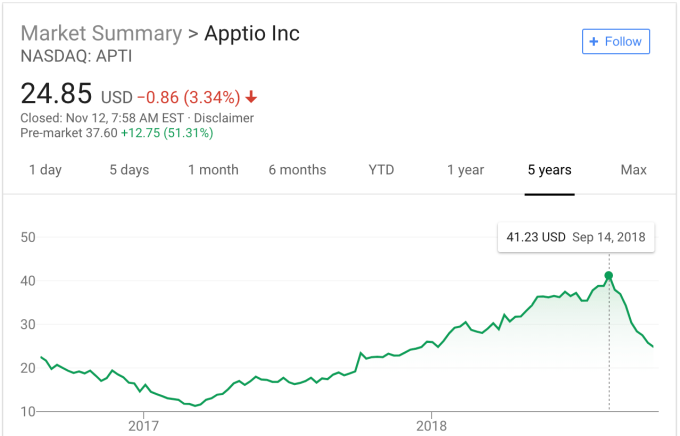
Stock Chart: Google
Sunny Gupta, co-founder and CEO at Apptio, liked the idea of giving his shareholders a good return while providing a good landing spot to take his company private. Vista has a reputation for continuing to invest in the companies it acquires and that prospect clearly excited him. “Vista’s investment and deep expertise in growing world-class SaaS businesses and the flexibility we will have as a private company will help us accelerate our growth…,” Gupta said in a statement.
The deal was approved by Apptio’s board of directors, which will recommend shareholders accept it. With such a high premium, it’s hard to imagine them turning it down. If it passes all of the regulatory hurdles, the acquisition is expected to close in Q1 2019.
It’s worth noting that the company has a 30-day “go shop” provision, which would allow it to look for a better price. Given how hot the enterprise market is right now and how popular hybrid cloud tools are, it is possible it could find another buyer, but it could be hard to find one willing to pay such a high premium.
Vista clearly likes to buy enterprise tech companies, having snagged Ping Identity for $600 million and Marketo for $1.8 billion in 2016. It grabbed Jamf, an Apple enterprise device management company and Datto, a disaster recovery company last year. It turned Marketo around for $4.75 billion in a deal with Adobe just two months ago.
Powered by WPeMatico
Ceph is an open source technology for distributed storage that gets very little public attention but that provides the underlying storage services for many of the world’s largest container and OpenStack deployments. It’s used by financial institutions like Bloomberg and Fidelity, cloud service providers like Rackspace and Linode, telcos like Deutsche Telekom, car manufacturers like BMW and software firms like SAP and Salesforce.
These days, you can’t have a successful open source project without setting up a foundation that manages the many diverging interests of the community and so it’s maybe no surprise that Ceph is now getting its own foundation. Like so many other projects, the Ceph Foundation will be hosted by the Linux Foundation.
“While early public cloud providers popularized self-service storage infrastructure, Ceph brings the same set of capabilities to service providers, enterprises, and individuals alike, with the power of a robust development and user community to drive future innovation in the storage space,” writes Sage Weil, Ceph co-creator, project leader, and chief architect at Red Hat for Ceph. “Today’s launch of the Ceph Foundation is a testament to the strength of a diverse open source community coming together to address the explosive growth in data storage and services.”
Given its broad adoption, it’s also no surprise that there’s a wide-ranging list of founding members. These include Amihan Global, Canonical, CERN, China Mobile, Digital Ocean, Intel, ProphetStor Data Service, OVH Hosting Red Hat, SoftIron, SUSE, Western Digital, XSKY Data Technology and ZTE. It’s worth noting that many of these founding members were already part of the slightly less formal Ceph Community Advisory Board.
“Ceph has a long track record of success what it comes to helping organizations with effectively managing high growth and expand data storage demands,” said Jim Zemlin, the executive director of the Linux Foundation. “Under the Linux Foundation, the Ceph Foundation will be able to harness investments from a much broader group to help support the infrastructure needed to continue the success and stability of the Ceph ecosystem.”
Ceph is an important building block for vendors who build both OpenStack- and container-based platforms. Indeed, two-thirds of OpenStack users rely on Ceph and it’s a core part of Rook, a Cloud Native Computing Foundation project that makes it easier to build storage services for Kubernetes-based applications. As such, Ceph straddles many different worlds and it makes sense for the project to gets its own neutral foundation now, though I can’t help but think that the OpenStack Foundation would’ve also liked to host the project.
Today’s announcement comes only days after the Linux Foundation also announced that it is now hosting the GraphQL Foundation.
Powered by WPeMatico


Ryan Smith of Qualtrics speaks onstage during TechCrunch Disrupt SF 2015
Enterprise software giant SAP announced today that it has agreed to acquire Qualtrics for $8 billion in cash, just before the survey and research software company was set to go public. The deal is expected to be completed in the first half of 2019. Qualtrics last round of venture capital funding in 2016 raised $180 million at a $2.5 billion valuation.
This is the second-largest ever acquisition of a SaaS company, after Oracle’s purchase of Netsuite for $9.3 billion in 2016.
In a conference call, SAP CEO Bill McDermott said Qualtrics’ IPO was already oversubscribed and that the two companies began discussions a few months ago. SAP claims its software touches 77 percent of the world’s transaction revenue, while Qualtrics’ products include survey software that enables its 9,000 enterprise users to gauge things like customer sentiment and employee engagement.
McDermott compared the potential impact of combining SAP’s operational data with Qualtrics’ customer and user data to Facebook’s acquisition of Instagram. “The legacy players who carried their ‘90s technology into the 21st century just got clobbered. We have made existing participants in the market extinct,” he said. (SAP’s competitors include Oracle, Salesforce.com, Microsoft, and IBM.)
SAP, whose global headquarters is in Walldorf, Germany, said it has secured financing of €7 billion (about $7.93 billion) to cover acquisition-related costs and the purchase price, which will include unvested employee bonuses and cash on the balance sheet at close.
Ryan Smith, who co-founded Qualtrics in 2002, will continue to serve as its CEO. After the acquisition is finalized, the company will become part of SAP’s Cloud Business Group, but retain its dual headquarters in Provo, Utah and Seattle, as well as its own branding and personnel.
According to Crunchbase, the company raised a total of $400 million in VC funding from investors including Accel, Sequoia, and Insight Ventures. It had intended to sell 20.5 million shares in its debut for $18 to $21, which could have potentially grossed up to about $495 million. This would have put its valuation between $3.9 billion to $4.5 billion, according to CrunchBase’s Alex Wilhelm.
This year, Qualtrics’ revenue grew 8.5 percent from $97.1 million in the second-quarter to $105.4 million in the third-quarter, according to its IPO filing. It reported third-quarter GAAP net income of $4.9 million. That represented an increase from the $975,000 it reported in the previous quarter, as well as its net profit in the same period a year ago of $4.7 million. Qualtrics grew its operating cash flow to $52.5 million in the first nine months of 2018, compared to $36.1 million during the same period in 2017.
In today’s announcement, Qualtrics said it expects its full-year 2018 revenue to exceed $400 million and forecasts a forward growth rate of more than 40 percent, not counting the potential synergies of its acquisition by SAP.
Qualtrics’ main competitors include SurveyMonkey, which went public in September.
Powered by WPeMatico

Eight months after bringing in a $40 million Series D, Moogsoft‘s co-founder and chief executive officer Phil Tee confirmed to TechCrunch that the IT incident management startup had shed 18 percent of its workforce or just over 30 employees.
The layoffs took place at the end of October; shortly after, Moogsoft announced two executive hires. Among the additions was Amer Deeba, who recently resigned from Qualys after the U.S. Securities and Exchange Commission charged him with insider trading.
Founded in 2012, San Francisco-based Moogsoft provides artificial intelligence for IT operations (AIOps) to help teams work more efficiently and avoid outages. The startup has raised $90 million in equity funding to date, garnering a $220 million valuation with its latest round, according to PitchBook. It’s backed by Goldman Sachs, Wing Venture Capital, Redpoint Ventures, Dell’s corporate venture capital arm, Singtel Innov8, Northgate Capital and others. Wing VC founder and long-time Accel managing partner Peter Wagner and Redpoint partner John Walecka are among the investors currently sitting on Moogsoft’s board of directors.
Tee, the founder of two public companies in Micromuse and Riversoft, admitted the layoffs affected several teams across the company. The cuts, however, are not a sign of a struggling business, he said, but rather a right of passage for a startup seeking venture scale.
“We are a classic VC-backed startup that has sort of grown up,” Tee told TechCrunch earlier today. “In pretty much every successful company, there is a point in time where there’s an adjustment in strategy … Unfortunately, when you do that, it becomes a question of do we have the right people?”
Moogsoft doubled revenue last year and added 50 Fortune 200 companies as customers, according to a statement announcing its latest capital infusion. Tee said he’s “extremely chipper” about the road ahead and the company’s recent C-suite hires.

Moogsoft’s newest hires, CFO Raman Kapur (left) and COO Amer Deeba (right).
Moogsoft announced its latest executive hires on Nov. 2, only one week after completing the round of layoffs, a common strategy for companies looking to cast a shadow on less-than-stellar news, like major staff cuts. Those hires include former Splunk vice president of finance Raman Kapur as Moogsoft’s first-ever chief financial officer and Amer Deeba, a long-time Qualys executive, as its chief operating officer.
Deeba spent the last 17 years at Qualys, a publicly-traded provider of cloud-based security and compliance solutions. In August, he resigned amid allegations of insider trading. The SEC announced its charges against Deeba on Aug. 30, claiming he had notified his two brothers of Qualys’ missed revenue targets before the company publicly announced its financial results in the spring of 2015.
“Deeba informed his two brothers about the miss and contacted his brothers’ brokerage firm to coordinate the sale of all of his brothers’ Qualys stock,” the SEC wrote in a statement. “When Qualys publicly announced its financial results, it reported that it had missed its previously-announced first-quarter revenue guidance and that it was revising its full-year 2015 revenue guidance downward. On the same day, Deeba sent a message to one of his brothers saying, ‘We announced the bad news today.’ The next day, Qualys’s stock price dropped 25%. Although Deeba made no profits from his conduct, Deeba’s brothers collectively avoided losses of $581,170 by selling their Qualys stock.”
Under the terms of Deeba’s settlement, he is ineligible to serve as an officer or director of any SEC-reporting company for two years and has been ordered to pay a $581,170 penalty.
Tee, for his part, said there was never any admission of guilt from Deeba and that he’s already had a positive impact on Moogsoft.
“[Deeba] is a tremendously impressive individual and he has the full confidence of myself and the board,” Tee said.
Powered by WPeMatico
LinkedIn, the Microsoft-owned social network for the working world with some 580 million users, took a big step into professional development and education when it acquired Lynda.com for $1.5 billion and used it as the anchor for LinkedIn Learning. Now, with 13,000 courses on the platform, LinkedIn is announcing two new developments to get more people using the service. It will now offer videos, tutorials and courses from third-parties such as Treehouse and the publishing division of Harvard Business School. And in a social twist, people who use LinkedIn Learning — the students and teachers — will now be able to ask and answer questions around LinkedIn Learning sessions, as well as follow instructors on LinkedIn, and see others’ feedback on courses.
Unlimited access to LinkedIn Learning comes when a person pays for LinkedIn’s Premium Career tier, which costs around $30/month, or when a company takes an enterprise team subscription for the Learning service. Today, LinkedIn tells me that it has around 11,000 enterprise customers; it doesn’t break out how much traffic it has overall on LinkedIn, but says that there has been a 64 percent growth in paid learners since the start of 2017 — a number that it’s clearly looking to boost with these new features.
James Raybould, the director of product for LinkedIn Learning, said that the third-party expansion will come slowly at first, with a handful of partners getting access to integrate with LinkedIn Learning. Over time, this could expand to be a public API for anyone to integrate content, he added, but for now, LinkedIn is doing the curating.
Notably, he also said that LinkedIn itself is not planning on curtailing the amount of content it will continue to produce for Learning: it’s currently adding more than 70 new courses each week on average, he said.
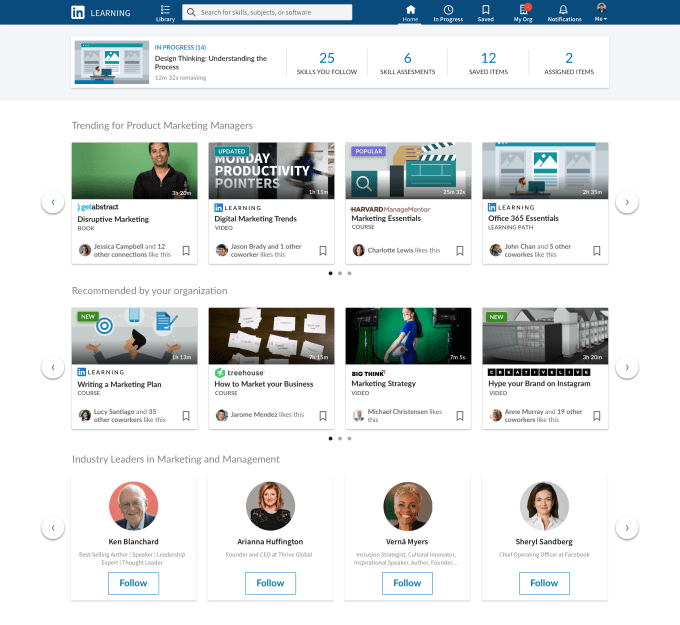
The content in this first wave of third-party providers feels like a natural extension of the influencer-based content that LinkedIn has been running in its main newsfeed: it runs the gamut from actual courses to learn new skills in specific disciplines, to the more nebulous area of professional development.
The first group includes Harvard Business Publishing (e.g. leadership development courses from Harvard Business School’s publishing arm); getAbstract (a Blinkist-style service that provides 10,000+ non-fiction book summaries plus TED talks); Big Think: 500 short-form videos on topics of the day (these are not so much “courses” as they are “life lessons” — subjects include organizing activism and an explainer on how to end bi-partisan politics); Treehouse, with courses on coding and product design skills; and Creative Live, with courses and tutorials for professionals in the creative industries to improve their skills and business acumen.
The fact that LinkedIn is adding more learning material that’s a natural extension of the kind of content it already offers to users in their timelines is not the only parallel between main LinkedIn and LinkedIn Learning. Raybould said that to help users discover content that might be most interesting to them, it uses data about what users browse and click on in the regular site.
“We have rich information about the network, including on engagement,” he said, and that helps LinkedIn’s algorithms suggest what to populate in individual learning libraries.
This is also, presumably, one of the reasons why third-parties will want to integrate: to get new audiences that are more targeted to the kind of content they are producing.
“At Harvard Business Publishing, we work to create the world’s best learning experiences to help organizations discover new ways to solve their most pressing leadership development challenges,” said Rich Gravelin, director of Partnerships and Alliances at Harvard Business Publishing, in a statement. “As an inaugural partner in the LinkedIn Learning Content Partner Program, we are bringing rich leadership development content to professionals across the globe, helping them navigate today’s complex business landscape. Thanks to the robust platform that LinkedIn Learning has built, we’re able to meet learners where they are and provide them with the unique and personalized learning experiences they need to succeed in their organizations.”
The social features also follow this model. Last year, LinkedIn rolled out a mentorship product across selected markets to pair users with people who steer them on their career development. That product set a precedent for how LinkedIn might use its wider social network and communication features to engage users in different ways, in the name of professional development.
The addition of Q&A features follows on from that, giving those taking courses or watching videos a way of interacting and following up with those who are doing the teaching. Adding that it could see more engagement across the whole of the Learning product.
It’s a surprise, in a way, that it’s taken this long for LinkedIn to add an interactive Q&A feature, considering that direct messaging and users interacting with each other has been a cornerstone of the product. On the other hand, it will be interesting to see if it proves to be a compelling enough feature to bring in more users to LinkedIn, luring them away from the Udemys and Skillsofts of the world.
Powered by WPeMatico
Abbyy has been around for a long time helping companies with scanning and workflow tools, but like many older vendors it has been looking for ways to extend its traditional business model. One way to do that is by teaming up with robotics process automation companies like UIPath. Today, the company announced it has launched the Abbyy FlexiCapture Connector in the UiPath Go! App store.
Bruce Orcutt, senior vice president for product marketing at Abbyy, says the connector provides the ability to pull content into UIPath or to take Abbyy content and push it to another part of the automated workflow in UIPath.
UIPath is on a tear these days. Just two months ago, it scored a $225 million Series C investment on a $3 billion valuation. It was able to grow from $1 million to $100 million in annual recurring revenue in just 21 months. As I wrote at the time of the funding, “[UIPath] allows companies to bring a level of automation to legacy processes like accounts payable, employee onboarding, procurement and reconciliation without actually having to replace legacy systems.”
Orcutt sees a natural connection to his company’s workflow roots, bringing it into a more modern context. “RPA simplifies the user experience. Abbyy brings content and context,” he told TechCrunch. He says that while they are still doing OCR to scrape unstructured content, it can do this in fully automated digital process and UIPath can take that content and move it through other parts of an automated workflow.
For Abbyy, UIPath is a big partner, but it’s part of a broader strategy to expand the company’s capabilities to RPA. He says they are working with a variety of RPA vendors beyond UIPath and also with systems integrators as they look to breathe new life into the company’s brand and products.
Orcutt says this is part of a significant focus and investment on the part of the company. RPA is clearly a natural fit for Abbyy, but he wasn’t willing to speculate on any deeper partnership. “We’re focusing on what we can do the best we can, and they can focus on merits of their platform. Abbyy can complement those capabilities.”
Powered by WPeMatico
Datacoral aims to make it easier for enterprises to build data products by abstracting away all of the complex infrastructure to organize and process data. The company today announced that it has raised a $10 million Series A financing round led by Madrona Venture Group, with participation from Social Capital, which also led its $4 million seed round in 2017.
Datacoral CEO Raghu Murthy tells me that the company plans to use the new funding to grow its business team in order to be able to reach more potential customers and to expand its engineering team.
The promise of Datacoral is to offer enterprises an end-to-end data infrastructure that will allow businesses and their data scientists to focus on generating insights over having to manage and integrate their data sources. Because nobody wants to move large amounts of data between clouds — and take the performance hit that comes with that — Datacoral sits right inside a company’s AWS systems. It’s still a fully managed service, though, but the data is encrypted and never leaves a customer’s virtual private cloud.
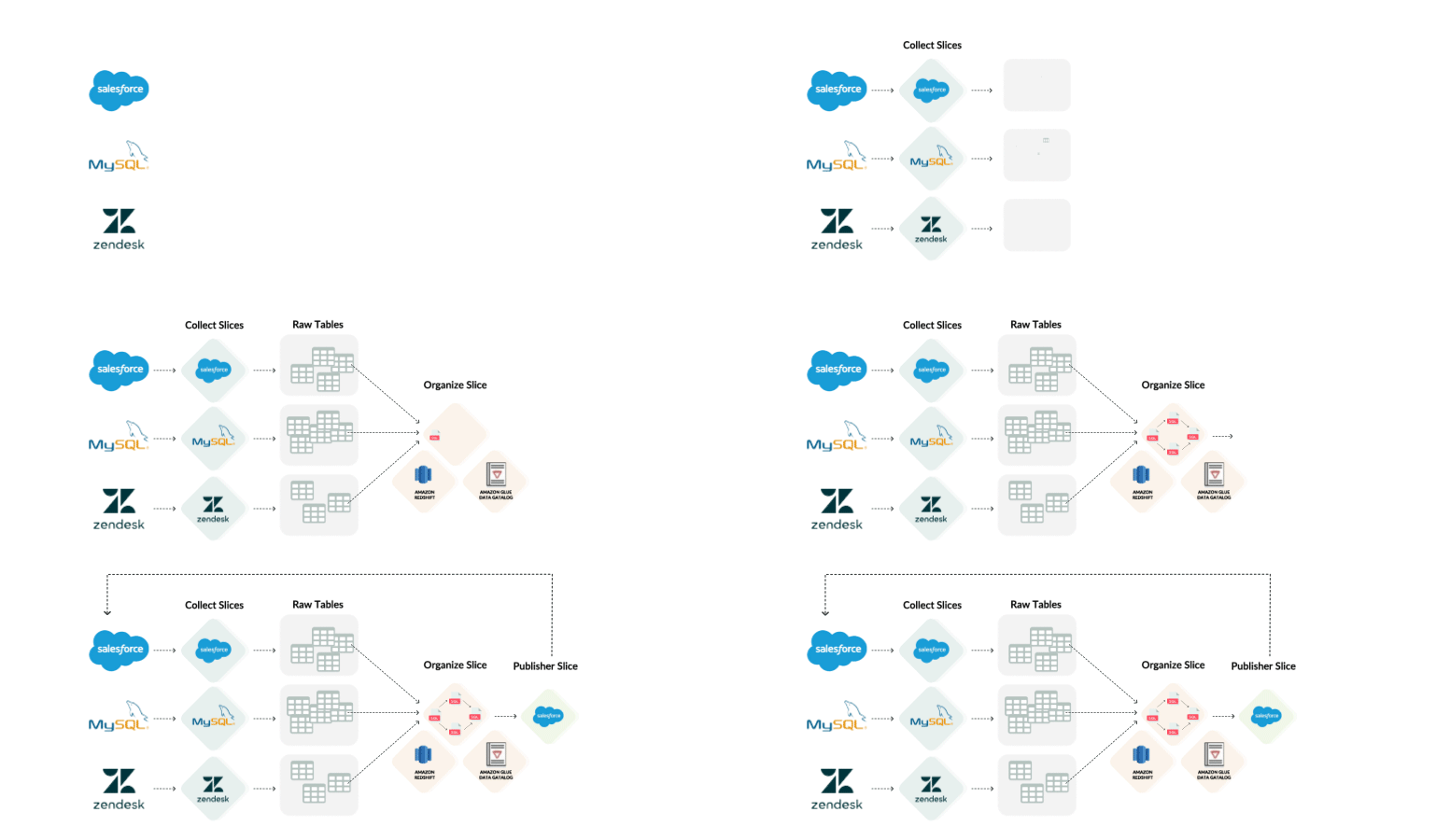
“As companies look to their data to deliver value – data practitioners are finding that configuring and managing their own data infrastructure is a time-consuming job that is expensive and fraught with errors,” said Murthy. “We have built a platform that easily and automatically brings together data from different applications and databases, organizes that data in any query engine and acts on insights that are critical to running their business. A crucial component is that it works securely and privately within the customer’s cloud, instead of us ingesting data from their systems.”
Murthy was an early engineer at Facebook and part of the team that was in charge of scaling that company’s data infrastructure and ran a part of the engineering team at Bebop, Diane Greene’s startup that was later acquired by Google.
To scale Datacoral, the team is betting on a serverless platform itself. It’s making extensive use of AWS Lambda and other PaaS solutions on Amazon’s cloud computing platform. That doesn’t mean Datacoral plans to only support AWS, though. Murthy tells me that Azure support is next. “We plan to work across all of the top cloud providers by leveraging their unique services and provide a consistent ‘data-centric interface’ to our customers — essentially be ‘cloud best’ instead of ‘cloud agnostic.’”
Current Datacoral users include Greenhouse, Front, Ezetap, Swing Education, mPharma and Mason Finance.
Powered by WPeMatico
Today, Google Cloud announced Kubeflow pipelines and AI Hub, two tools designed to help data scientists put to work across their organizations the models they create.
Rajen Sheth, director of product management for Google Cloud’s AI and ML products, says that the company recognized that data scientists too often build models that never get used. He says that if machine learning is really a team sport, as Google believes, models must get passed from data scientists to data engineers and developers who can build applications based on them.
To help fix that, Google is announcing Kubeflow pipelines, which are an extension of Kubeflow, an open-source framework built on top of Kubernetes designed specifically for machine learning. Pipelines are essentially containerized building blocks that people in the machine learning ecosystem can string together to build and manage machine learning workflows.
By placing the model in a container, data scientists can simply adjust the underlying model as needed and relaunch in a continuous delivery kind of approach. Sheth says this opens up even more possibilities for model usage in a company.
“[Kubeflow pipelines] also give users a way to experiment with different pipeline variants to identify which ones produce the best outcomes in a reliable and reproducible environment,” Sheth wrote in a blog post announcing the new machine learning features.
The company is also announcing AI Hub, which, as the name implies, is a central place where data scientists can go to find different kinds of ML content, including Kubeflow pipelines, Jupyter notebooks, TensorFlow modules and so forth. This will be a public repository seeded with resources developed by Google Cloud AI, Google Research and other teams across Google, allowing data scientists to take advantage of Google’s own research and development expertise.
But Google wanted the hub to be more than a public library — it also sees it as a place where teams can share information privately inside their organizations, giving it a dual purpose. This should provide another way to extend model usage by making essential building blocks available in a central repository.
AI Hub will be available in Alpha starting today with some initial components from Google, as well as tools for sharing some internal resources, but the plan is to keep expanding the offerings and capabilities over time.
Google believes if it provides easier ways to share model building blocks across an organization, the more likely they will be put to work. These tools are a step toward achieving that.
Powered by WPeMatico
DevOps platform CircleCI today announced a new partner program that will open up its platform and allow third-party tools to integrate with it. In addition, the company is launching Orbs, which it describes as “the world’s first package manager designed specifically for configuration of software delivery automation.”
Fresh off its $31 million funding round earlier this year, CircleCI is clearly on a mission to firmly plant its stake in the increasingly competitive continuous integration and delivery space. Its launch partners today include the likes of Cypress, JFrog, Pulumi, Sauce Labs, Sonatype and WhiteSource.
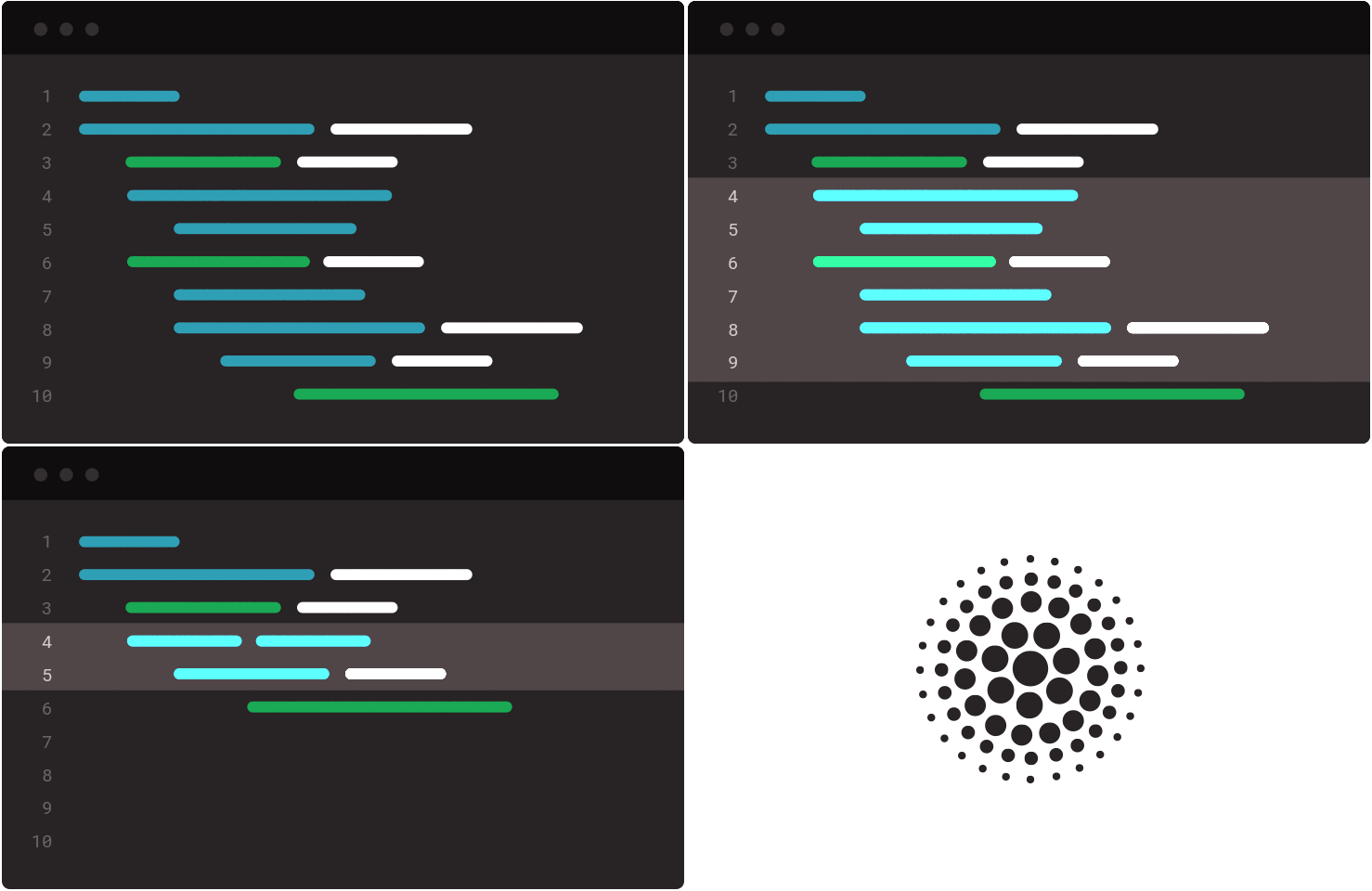
 That partner program, though, mostly sets the stage for Orbs. The idea behind Orbs is to give the company’s users the ability to share their preferred CI/CD configuration across teams and projects by allowing them to package their commands, executors and jobs into a few lines of code. It’s basically a way to allow teams to automate more of their build/test/deploy workflow and share their best practices for configuring their software pipelines. For new users, these Orbs will also make it easier to get started without having to write a lot of boilerplate code.
CircleCI will offer its own set of certified Orbs, as well as those written by its partners. Currently, there are Orbs for working with Heroku and Amazon’s S3 and CodeDeploy, for example, as well as the obligatory Slack notification Orb. In total, CircleCI is launching 25 packages today.
“CircleCI Orbs are the most exciting thing in the CI world since Docker containers,” said Gleb Bahmutov, VP of Engineering at Cypress and an early-access orbs customer and contributor. “From a developer’s standpoint, orbs are a much-needed improvement from the regular ‘read the docs, copy/paste example, tweak for 30 minutes until CI passes’ — an outdated workflow. It’s an absolutely incredible experience.”
Powered by WPeMatico