Enterprise
Auto Added by WPeMatico
Auto Added by WPeMatico

Meet Upflow a French startup that wants to help you deal with your outstanding invoices — the company first started at eFounders. If you’re running a small business, chances are you’re either wasting a ton of time or a ton of money on accounts receivable.
Most companies currently manage invoices using Excel spreadsheets, outdated banking interfaces and unnecessary conversations. Every time somebody signs a deal, they generate an invoice and file it in a spreadsheet somewhere.
Some companies will pay a few days later. But let’s be honest. Too many companies wait 30 days, 40 days or even more before even thinking about paying past due invoices. You end up sending emails, calling your clients and wasting a ton of time just collecting money. You might even feel bad about asking for money even though you already signed a deal.
In France, most companies use bank transfers to pay invoices. But business banking APIs are not there yet. It means that you have to log in to a slow banking website every day to check if somebody paid you. You can then tick a box in an Excel spreadsheet.
If everything I described resonates with you, Upflow wants to manage your invoices for you. It doesn’t replace your bank account, it doesn’t generate invoices for you. It integrates seamlessly with your existing workflow.

After signing up, you can send invoices to your client and cc Upflow in your email thread. Upflow then uses optical character recognition and automatically detects relevant data — the customer name, the amount, the due date, etc.
You can view all your outstanding invoices in Upflow’s interface to see where you stand. The service gives you a list of actionable tasks to get your money. For instance, Upflow tells you if you have overdue payments and tells you to contact your client again.
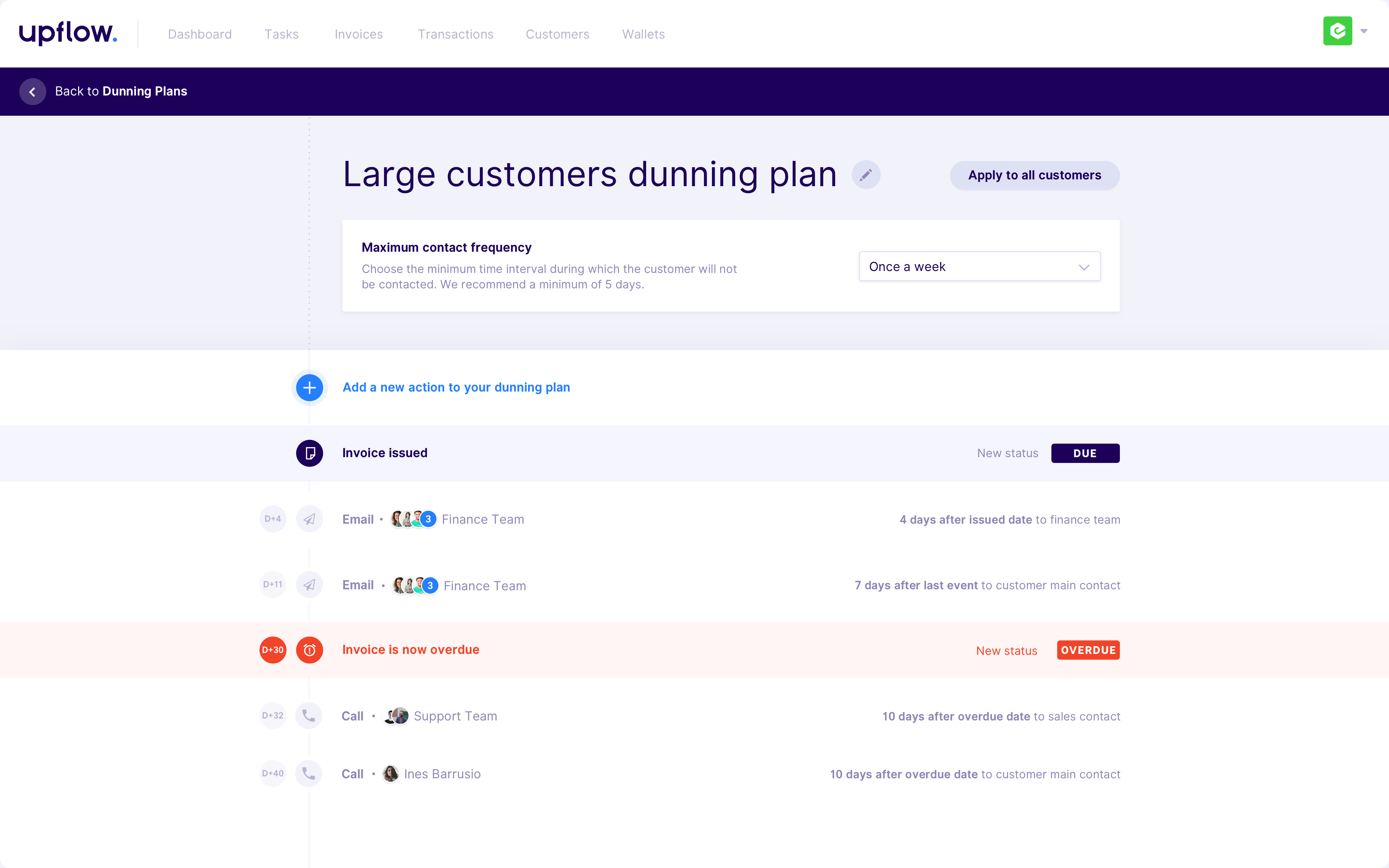
You can set up different rules depending on your clients. For instance, if you have many small clients, you can automate some of those messages. But if you only work with a handful of clients, you want to make sure that somebody has manually reviewed each message before Upflow sends them.
By default, you write your emails in Upflow so that your other team members can see what happened. You can browse invoices by client to see if somebody has multiple unpaid invoices. Upflow lets you assign actions to a particular team member if they’re more familiar with this specific client.
But all of this is just one part of the product. Upflow also generates banking information with the help of Treezor. This way, you can put your Upflow banking information on your invoices.
When a customer pays you, Upflow automatically matches invoices with incoming payments. This feature alone lets you save a ton of time. The startup transfers money back to your company’s bank account every day.
Upflow co-founder and CEO Alexandre Louisy drew me the following chart when we met. It’s probably easier to understand after reading my explanations:

In other words, Upflow has created a brick that sits between your company’s back office and your customers. Eventually, you could imagine more services built on top of this brick as Upflow is learning many things on your company.
According to Louisy, small and medium companies really need this kind of product — and not necessarily tech companies. Those companies don’t have a lot of money on their bank accounts, don’t have a big staff and need to save as much time as possible.
Now let’s see if it’s easy to sell a software-as-a-service solution to a family business that has been around for decades.
Powered by WPeMatico
Meet BlueCargo, a logistics startup focused on seaport terminals. The company was part of Y Combinator’s latest batch and recently raised a $3 million funding round from 1984 Ventures, Green Bay Ventures, Sound Ventures, Kima Ventures and others.
If you picture a terminal, chances are you see huge piles of containers. But current sorting methods are not efficient at all. Yard cranes end up moving a ton of containers just to reach a container sitting at the bottom of the pile.
BlueCargo wants to optimize those movements by helping you store containers at the right spot. The first container that is going to leave the terminal is going to be at the top of the pile.
“Terminals spend a lot of time making unproductive or undesired movements,” co-founder and CEO Alexandra Griffon told me. “And yet, terminals only generate revenue every time they unload or load a container.”
Right now, ERP-like solutions only manage containers according to a handful of business rules that don’t take into account the timeline of a container. Empty containers are all stored in one area, containers with dangerous goods are in another area, etc.
The startup leverages as much data as possible on each container — where it’s coming from, the type of container, if it’s full or empty, the cargo ship that carried it, the time of the year and more.
Every time BlueCargo works with a new terminal, the startup collects past data and processes it to create a model. The team can then predict how BlueCargo can optimize the terminal.
“At Saint-Nazaire, we could save 22 percent on container shifting,” Griffon told me.
The company will test its solution in Saint-Nazaire in December. It integrates directly with existing ERP solutions. Cranes already scan container identification numbers. BlueCargo could then instantly push relevant information to crane operators so that they know where to put down a container.
Saint-Nazaire is a relatively small port compared to the biggest European ports. But the company is already talking with terminals in Long Beach, one of the largest container ports in the U.S.
BlueCargo also knows that it needs to tread carefully — many companies already promised magical IT solutions in the past. But it hasn’t changed much in seaports.
That’s why the startup wants to be as seamless as possible. It only charges fees based on shifting savings — 30 percent of what it would have cost you with the old model. And it doesn’t want to alter workflows for people working at terminals — it’s like an invisible crane that helps you work faster.
There are six dominant players managing terminals around the world. If BlueCargo can convince those companies to work with the startup, it would represent a good business opportunity.
Powered by WPeMatico
A win for privacy on LinkedIn could be a big loss for businesses, recruiters and anyone else expecting to be able to export the email addresses of their connections. LinkedIn just quietly introduced a new privacy setting that defaults to blocking other users from exporting your email address. That could prevent some spam, and protect users who didn’t realize anyone who they’re connected to could download their email address into a giant spreadsheet. But the launch of this new setting without warning or even a formal announcement could piss off users who’d invested tons of time into the professional networking site in hopes of contacting their connections outside of it.
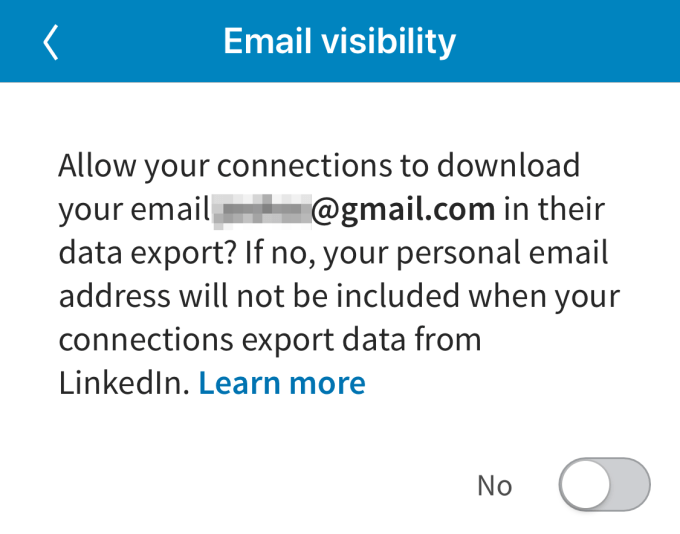
TechCrunch was tipped off by a reader that emails were no longer coming through as part of LinkedIn’s Archive tool for exporting your data. Now LinkedIn confirms to TechCrunch that “This is a new setting that gives our members even more control of their email address on LinkedIn. If you take a look at the setting titled ‘Who can download your email’, you’ll see we’ve added a more detailed setting that defaults to the strongest privacy option. Members can choose to change that setting based on their preference. This gives our members control over who can download their email address via a data export.”
That new option can be found under Settings & Privacy -> Privacy -> Who Can See My Email Address? This “Allow your connections to download your email [address of user] in their data export?” toggle defaults to “No.” Most users don’t know it exists because LinkedIn didn’t announce it; there’s merely been a folded up section added to the Help center on email visibility, and few might voluntarily change it to “Yes” as there’s no explanation of why you’d want to. That means nearly no one’s email addresses will appear in LinkedIn Archive exports any more. Your connections will still be able to see your email address if they navigate to your profile, but they can’t grab those from their whole graph.
Facebook came to the same conclusion about restricting email exports back when it was in a data portability fight with Google in 2010. Facebook had been encouraging users to import their Gmail contacts, but refused to let users export their Friends’ email addresses. It argued that users own their own email addresses, but not those of their Friends, so they couldn’t be downloaded — though that stance conveniently prevented any other app from bootstrapping a competing social graph by importing your Facebook friend list in any usable way. I’ve argued that Facebook needs to make friend lists interoperable to give users choice about what apps they use, both because it’s the right thing to do but also because it could deter regulation.
On a social network like Facebook, barring email exports makes more sense. But on LinkedIn’s professional network, where people are purposefully connecting with those they don’t know, and where exporting has always been allowed, making the change silently seems surreptitious. Perhaps LinkedIn didn’t want to bring attention to the fact it was allowing your email address to be slurped up by anyone you’re connected with, given the current media climate of intense scrutiny regarding privacy in social tech. But trying to hide a change that’s massively impactful to businesses that rely on LinkedIn could erode the trust of its core users.
Powered by WPeMatico

The Morgan Stanley Multicultural Innovation Lab, Morgan Stanley’s in-house accelerator focused on companies founded by multicultural and female entrepreneurs, hosted its second Annual Showcase and Demo Day. The event also featured companies from accelerators HearstLab, Newark Venture Partner Labs and PS27 Ventures. (Note: I was formerly employed by Morgan Stanley and have no financial ties.)
The showcase represented the culmination of the program’s second year, which followed an initial five company class that has already seen two acquisitions. Through the six-month program, Morgan Stanley provides early-stage companies with a wide range of benefits including an equity investment from Morgan Stanley, office space at Morgan Stanley headquarters, access to Morgan Stanley’s extensive network, and others. Applications are now open for its third cohort of companies with the application window closing on January 4th, 2019.
The 16 presenting startups, all led by a female or multicultural founder, offered solutions to structural inefficiencies across a wide array of categories including fintech, developer tools, and health. Though all of the companies offered impressive presentations and strong value propositions, here are three of the companies that stood out to us.
In hopes of democratizing software and app development, Hatch Apps provides a platform that allows users and companies to build iOS, Android and web applications without any code through pre-built templates and custom plug-and-play functions. In essence, Hatch Apps provides a solution for application building similar to what Squarespace or Wix provide for websites.
In the modern economy, every company is in one way or another a tech or tech-enabled company. Now the demand for strong engineers has made the fight for talent increasingly competitive and has made engineering quite costly, even when only needed for simple tasks.
For an implementation and subscription fee, Hatch Apps allows companies with less sophisticated engineering DNA to reduce entering costs by launch native apps on their own, across platforms, and often on faster timelines than those seen through third-party developers. Once an app is launched, Hatch Apps provides customers with detailed analytics and allows them to send targeted push notifications, export data and make in-app changes that can automatically go live in app stores.
The company initially took a bootstrapping approach to financing and raised funds by selling a 2016 election-themed “Cards Against Humanity”-style game created on the platform. Since then, Hatch Apps has already received funding from the Y Combinator Fellowship, Morgan Stanley, and a number of other investors.
While estate planning is a topic many don’t like to think about, it’s a critical issue for managing cross-generational wealth. But will drafting can often be very complex, time-consuming, and costly, requiring hours of legal consultation and coordination between various parties.
Founded by two former classmates at Stanford Business School, FreeWill looks to simplify the estate planning process by providing a free online platform that automates will drafting, in a similar function to what TurboTax does for taxes. Using FreeWill, users can quickly set allocations for their estate and select personal recipients, charitable donations, executor specifications, and other ancillary requests. The platform then creates a finalized legal document that is legally valid in all 50 states, which users can also quickly make changes to and replace without incurring expensive legal costs.
FreeWill is able to provide the platform to consumers for free due to the proceeds it receives from its non-profit customers, who pay to be featured on the platform as a partner organization. FreeWill offers a compelling value proposition for partnering companies. By acting as a channel to funnel user donations to listed organizations, FreeWill has been able to drive a 600% increase in charitable giving to partner organizations on average. FreeWill also provides partner organizations with backing analytics that allow non-profits to track bequests and donors through monthly reports.
FreeWill currently boasts an impressive roster of 75 paying non-profit partners that include American Red Cross, Amnesty International and many others. In the long-run hopes to be the go-to solution financial and legal end of life planning for investment advisors, life insurance and employee benefits providers.
Shoobs is looking to be the go-to platform for local “urban” events, which the company defined as events centered on local nightlife, comedy and concerts in the hip-hop, R&B, and reggae genres to name a few. But unlike the genre-agnostic, transaction-focused event management platforms that can make the space seem pretty crowded, Shoobs focused on providing genre-specific even discovery. Shoobs matches urban event goers with artists of their choice and related smaller scale events that can be harder to discover, acting as a form of curation, quality control and discovery.
For event organizers, Shoobs helps provide digital ticketing and promotion services, with event recommendation capabilities that target the most promising potential customers. Through its offering to event organizers, Shoobs is able to monetize its services through ticket sale commission, advertising and brand partnerships.
Since its initial launch in London, Shoobs notes it has become one of the top urban events platforms in the city, with an extensive base of recurring registered users and event organizers. After previously working with AEG for its London launch, Shoobs is looking to expand stateside with the help of organizers like Live Nation. Shoobs joins a long list of promising Y Combinator alumni companies with YC also acting as one of Shows initial investors
Morgan Stanley Multicultural Innovation Lab
Hearst Labs
Newark Venture Partners Labs
PS27 Ventures
 Cleaning System — a water free, detergent free, and chemical free plasma device that cleans items that are extremely hard or impossible to clean with a washer and dryer.”
Powered by WPeMatico
Autodesk announced plans to acquire PlanGrid for $875 million today. The San Francisco startup helped move blueprints from paper to the iPad when it launched in 2011.
This digitization of construction fits with Autodesk’s vision of digitizing design in general, and CEO Andrew Anagnost certainly recognized the transformational potential of the company he was buying. “There is a huge opportunity to streamline all aspects of construction through digitization and automation. The acquisition of PlanGrid will accelerate our efforts to improve construction workflows for every stakeholder in the construction process,” he said in a statement.
The company, which is a 2012 graduate of Y Combinator, raised just $69 million, so this appears to be a healthy exit for the them. PlanGrid took what was a paper-intensive task and shifted it to digital, taking a world of hand-written mark-ups and sticky notes onto the fledgling iPad.
In an interview with CEO and co-founder Tracy Young in 2015 at TechCrunch Disrupt in San Francisco, she said the industry was ripe for change. “The heart of construction is just a lot of construction blueprints information. It’s all tracked on paper right now and they’re constantly, constantly changing,” Young said at the time.
Those manual changes often resulted in errors she said, and that was costly for the contractors. As an engineer working for a construction company, who was at one time responsible for making the paper copies, she recognized that the process could be improved by moving it into the digital realm.

PlanGrid CEO Tracy Young onstage at TechCrunch Disrupt San Francisco in 2015
Her idea, which was kind of radical in 2011 when she started the company, was to move all that paper to the cloud and display it on an iPad. It’s important to remember that the enterprise was not rushing to the cloud in 2011, and most people considered the iPad at the time to be a consumer device, so what she and her co-founders were attempting was a true kind of industry transformation.
Young sees joining Autodesk as a way to continue building on that early vision. “PlanGrid has excelled at building beautiful, simple field collaboration software, while Autodesk has focused on connecting design to construction. Together, we can drive greater productivity and predictability on the jobsite,” she said in a statement.
PlanGrid currently has 400 employees, 12,000 customers and 120,000 paid users, and has been used on over a million construction projects worldwide, according to data provided by the companies. They believe that under Autodesk’s umbrella and combined with their existing product set, they can provide a complete construction solution and grow the business faster than PlanGrid could have on its own — pretty much the standard argument in an acquisition like this.
PlanGrid was efficient with the money it took. In fact the last raise was $40 million almost exactly three years ago. The deal is expected to close at the end of January pending the normal regulatory approval process.
Powered by WPeMatico
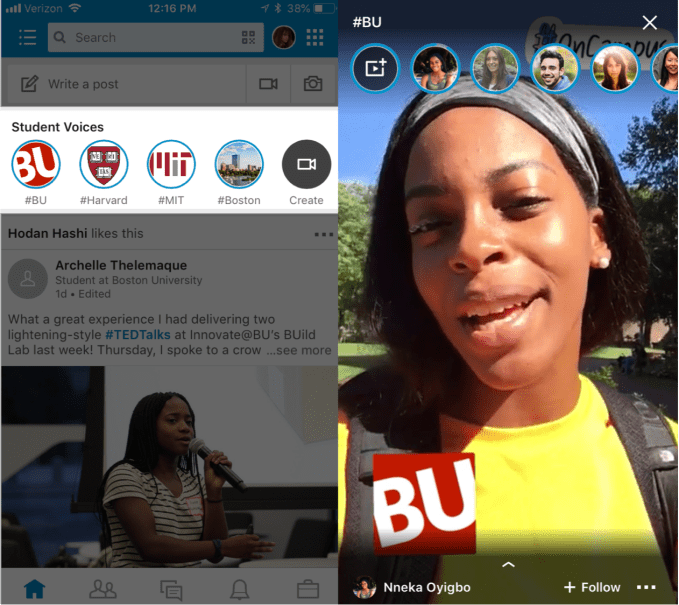
The social media singularity continues with the arrival of Snapchat Stories-style slideshows on LinkedIn as the app grasps for relevance with a younger audience. LinkedIn confirms to TechCrunch that it plans to build Stories for more sets of users, but first it’s launching “Student Voices” just for university students in the U.S. The feature appears atop the LinkedIn home screen and lets students post short videos to their Campus Playlist. The videos (no photos allowed) disappear from the playlist after a week while staying permanently visible on a user’s own profile in the Recent Activity section. Students can tap through their school’s own slideshow and watch the Campus Playlists of nearby universities.
LinkedIn now confirms the feature is in testing, with product manager Isha Patel telling TechCrunch “Campus playlists are a new video feature that we’re currently rolling out to college students in the US. As we know, students love to use video to capture moments so we’ve created this new product to help them connect with one another around shared experiences on campus to help create a sense of community.” Student Voices was first spotted by social consultant Carlos Gil, and tipped by Socially Contented’s Cathy Wassell to Matt Navarra.
A LinkedIn spokesperson tells us the motive behind the feature is to get students sharing their academic experiences like internships, career fairs and class projects that they’d want to show off to recruiters as part of their personal brand. “It’s a great way for students to build out their profile and have this authentic content that shows who they are and what their academic and professional experiences have been. Having these videos live on their profile can help students grow their network, prepare for life after graduation, and help potential employers learn more about them,” Patel says.
But unfortunately that ignores the fact that Stories were originally invented for broadcasting off-the-cuff moments that disappear so you DON’T have to worry about their impact on your reputation. That dissonance might confuse users, discourage them from posting to Student Voices or lead them to assume their clips will disappear from their profile too — which could leave embarrassing content exposed to hirers. “Authenticity” might not necessarily paint users in the best light to recruiters, so it seems more likely that students would post polished clips promoting their achievements… if they use it at all.

LinkedIn seems to be desperate to appeal to the next generation. Social app investigator and TechCrunch’s favorite tipster Jane Manchun Wong today spotted 10 minor new features LinkedIn is prototyping that include youth-centric options like GIF comments, location sharing in messages and Facebook Reactions-style buttons beyond “Like” such as “Clap,” “Insightful,” “Hmm,” and “Support.”
When users post to Student Stories, they’ll have their university’s logo overlaid as a sticker they can move around. LinkedIn will generate this plus a set of suggested hashtags like #OnCampus based on a user’s profile, including which school they say they attend, though users can also overlay their own text captions. Typically, users in the test phase were sharing videos of around 30 to 45 seconds. “Students are taking us to their school hackathons, showing us their group projects, sharing their student group activities and teaching us about causes they care about,” Patel explains. You can see an example video here, and watch a sizzle reel about the feature below.
For now, LinkedIn tells me it has no plans to insert ads between clips in Student Voices. But if the Stories content assists with discovering and vetting job candidates, it could make LinkedIn more unique and indispensable to recruiters who do pay for premium access. And if these Stories get a ton of views simply by being emblazoned atop the LinkedIn feed, users might return to the app more frequently to share them. As we’ve seen with the steady increase in popularity of Facebook Stories, if you give people a stage for narcissism, they will fill it.
LinkedIn’s start as a dry web tool for seeking jobs has made for a rocky transition as it tries to become a daily habit for users. Some tactical advice in its feed can be helpful, but much of LinkedIn’s content feels blatantly self-promotional, boring or transactional. Meanwhile, it’s encountering new competition as Facebook integrates career listings and job applications for blue-collar work into its social network that already sees over a billion people visit each day. It’s understandable why LinkedIn would try to latch on to the visual communication trend, as Facebook estimates Stories sharing will surpass feed sharing across all apps in 2019. But Student Voices nonetheless feels unabashedly “how do you do, fellow kids?”

Powered by WPeMatico
Back in September, Microsoft announced a virtual desktop solution that lets customers run Office 365 and Windows 10 in the cloud. They mentioned several partners in the announcement that were working on solutions with them. One of those was FSLogix, a Georgia virtual desktop startup. Today, Microsoft announced it has acquired FSLogix. It did not share the purchase price.
“FSLogix is a next-generation app-provisioning platform that reduces the resources, time and labor required to support virtualization,” Brad Anderson, corporate VP for Microsoft Office 365 and Julia White, corporate VP for Microsoft Azure, href=”https://blogs.microsoft.com/blog/2018/11/19/microsoft-acquires-fslogix-to-enhance-the-office-365-virtualization-experience/”>wrote in a joint blog post today.
When Microsoft made the virtual desktop announcement in September they named Citrix, CloudJumper, Lakeside Software, Liquidware, People Tech Group, ThinPrint and FSLogix as partners working on solutions. Apparently, the company decided it wanted to own one of those experiences and acquired FSLogix.
Microsoft believes by incorporating the FSLogix solution, it will provide a better virtual desktop experience for its customers by enabling better performance and faster load times, especially for Office 365 ProPlus customers.
Randy Cook, founder and CTO at FSLogix, said the acquisition made sense given how well the two companies have worked together over the years. “From the beginning, in working closely with several teams at Microsoft, we recognized that our missions were completely aligned. Both FSLogix and Microsoft are dedicated to providing the absolute best experience for companies choosing to deploy virtual desktops,” Cook wrote in a blog post announcing the acquisition.
Lots of companies have what are essentially dumb terminals running just the tools each employee needs, rather than a fully functioning standalone PC. Citrix has made a living offering these services. When employees come in to start the day, they sign in with their credentials and they get a virtual desktop with the tools they need to do their jobs. Microsoft’s version of this involves Office 365 and Windows 10 running on Azure.
FSLogix was founded in 2013 and has raised more than $10 million, according to data on Crunchbase. Today’s acquisition, which has already closed according to Microsoft, comes on the heels of last week’s announcement that the company was buying Xoxco, an Austin-based developer shop with experience building conversational bots.
Powered by WPeMatico
Diane Greene announced on Friday that she was stepping down after three years running Google’s cloud business. She will stay on until the first of the year to help her successor, Thomas Kurian in the transition. He left Oracle at the end of September after more than 20 years with the company, and is charged with making Google’s cloud division more enterprise-friendly, a goal that has oddly eluded the company.
Greene was brought on board in 2015 to bring some order and enterprise savvy to the company’s cloud business. While she did help move them along that path, and grew the cloud business, it simply hasn’t been enough. There have been rumblings for months that Greene’s time was coming to an end.
So the torch is being passed to Kurian, a man who spent over two decades at a company that might be the exact opposite of Google. He ran product at Oracle, a traditional enterprise software company. Oracle itself has struggled to make the transition to a cloud company, but Bloomberg reported in September that one of the reasons Kurian was taking a leave of absence at the time was a difference of opinion with Chairman Larry Ellison over cloud strategy. According to the report, Kurian wanted to make Oracle’s software available on public clouds like AWS and Azure (and Google Cloud). Ellison apparently didn’t agree and a couple of weeks later Kurian announced he was moving on.
Even though Kurian’s background might not seem to be perfectly aligned with Google, it’s important to keep in mind that his thinking was evolving. He was also in charge of thousands of products and helped champion Oracle’s move to the cloud. He has experience successfully nurturing products enterprises have wanted, and perhaps that’s the kind of knowledge Google was looking for in its next cloud leader.
Ray Wang, founder and principal analyst at Constellation Research says Google still needs to learn to support the enterprise, and he believes Kurian is the right person to help the company get there. “Kurian knows what’s required to make a cloud company work for enterprise customers,” Wang said.
If he’s right, perhaps an old-school enterprise executive is just what Google requires to turn its Cloud division into an enterprise-friendly powerhouse. Greene has always maintained that it was still early days for the cloud and Google had plenty of time to capture part of the untapped market, a point she reiterated in her blog post on Friday. “The cloud space is early and there is an enormous opportunity ahead,” she wrote.
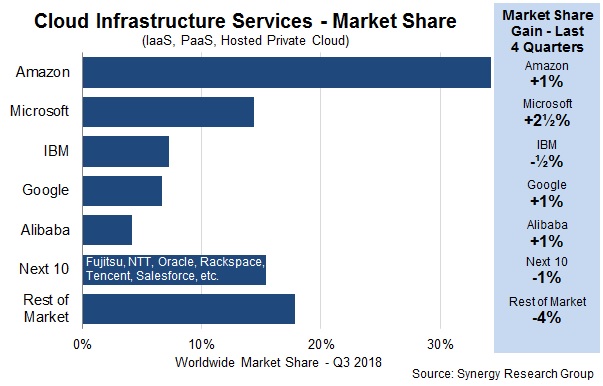
She may be right about that, but marketshare positions seem to be hardening. AWS, which was first to market, has an enormous marketshare lead with over 30 percent by most accounts. Microsoft is the only company with the market strength at the moment to give them a run for their money and the only other company with double digit market share numbers. In fact, Amazon has a larger marketshare than the next four companies combined, according to data from Synergy Research.

While Google is always mentioned in the Big 3 cloud companies with AWS and Microsoft, with around $4 billion revenue a year, it has a long way to go to get to the level of these other companies. Despite Greene’s assertions, time could be running out to make a run. Perhaps Kurian is the person to push the company to grab some of that untapped market as companies move more workloads to the cloud. At this point, Google is counting on him to do just that.
Powered by WPeMatico
Diane Greene announced in a blog post today that she would be stepping down as CEO of Google Cloud and will be helping transition former Oracle executive Thomas Kurian to take over early next year.
Greene took over the position almost exactly three years ago when Google bought Bebop, the startup she was running. The thinking at the time was that the company needed someone with a strong enterprise background and Greene, who helped launch VMware, certainly had the enterprise credentials they were looking for.
In the blog post announcing the transition, she trumpeted her accomplishments. “The Google Cloud team has accomplished amazing things over the last three years, and I’m proud to have been a part of this transformative work. We have moved Google Cloud from having only two significant customers and a collection of startups to having major Fortune 1000 enterprises betting their future on Google Cloud, something we should accept as a great compliment as well as a huge responsibility,” she wrote.

The company had a disparate set of cloud services when she took over, and one of the first things Greene did was to put them all under a single Google Cloud umbrella. “We’ve built a strong business together — set up by integrating sales, marketing, Google Cloud Platform (GCP), and Google Apps/G Suite into what is now called Google Cloud,” she wrote in the blog post.
As for Kurian, he stepped down as president of product development at Oracle at the end of September. He had announced a leave of absence earlier in the month before making the exit permanent. Like Greene before him, he brings a level of enterprise street cred, which the company needs as it continues to try to grow its cloud business.
After three years with Greene at the helm, Google, which has tried to position itself as the more open cloud alternative to Microsoft and Amazon, has still struggled to gain market share against its competitors, remaining under 10 percent consistently throughout Greene’s tenure.
As Synergy’s John Dinsdale told TechCrunch in an article on Google Cloud’s strategy in 2017, the company had not been particularly strong in the enterprise to that point. “The issues of course are around it being late to market and the perception that Google isn’t strong in the enterprise. Until recently Google never gave the impression (through words or deeds) that cloud services were really important to it. It is now trying to make up for lost ground, but AWS and Microsoft are streets ahead,” Dinsdale explained at the time. Greene was trying hard to change that perception.
Holger Mueller, an analyst at Constellation Research says Greene was able to shift the focus to enterprise more, but he likes what Kurian brings to the table, even if it will take a bit of a cultural shift from his many years at Oracle. “What Greene did not address has been how to tie the product portfolio of Google’s autonomous and disparate development teams together. Kurian is a great fit for that job, having lead 35k+ developers at Oracle, ending the trench warfare between product teams and divisions that has plagued Oracle a decade ago,” Mueller explained.
Google has not released many revenue numbers related to the cloud, but in February it indicated they were earning a billion dollars a quarter, a number that Greene felt put Google in elite company. Amazon and Google were reporting numbers like that for a quarter at the time. Google stopped reporting cloud revenue after that report.
Regardless, the company will turn to Kurian to continue growing those numbers now. “I will continue as CEO through January, working with Thomas to ensure a smooth transition. I will remain a Director on the Alphabet board,” Greene wrote in her blog post.
Interestingly enough, Oracle has struggled with its own transition to the cloud. Kurian gets a company that was born in the cloud, rather than one that has made a transition from on-prem software and hardware to one solely in the cloud. It will be up to him to steer Google Cloud moving forward.
Powered by WPeMatico
Uber announced today at the 2018 Uber Open Summit that it was joining the Linux Foundation as a Gold Member, making a firm commitment to using and contributing to open-source tools.
Uber CTO Thuan Pham sees the Linux Foundation as a place for companies like his to nurture and develop open-source projects. “Open source technology is the backbone of many of Uber’s core services and as we continue to mature, these solutions will become ever more important,” he said in a blog post announcing the partnership.
What’s surprising is not that they joined, but that it took so long. Uber has been long known for making use of open source in its core tools, working on over 320 open-source projects and repositories from 1,500 contributors involving over 70,000 commits, according to data provided by the company.
“Uber has made significant investments in shared software development and community collaboration through open source over the years, including contributing the popular open-source project Jaeger, a distributed tracing system, to the Linux Foundation’s Cloud Native Computing Foundation in 2017,” an Uber spokesperson told TechCrunch.
Linux Foundation Executive Director Jim Zemlin was certainly happy to welcome Uber into the fold. “Their expertise will be instrumental for our projects as we continue to advance open solutions for cloud native technologies, deep learning, data visualization and other technologies that are critical to businesses today,” Zemlin said in a statement.
The Linux Foundation is an umbrella group supporting myriad open-source projects and providing an organizational structure for companies like Uber to contribute and maintain open-source projects. It houses sub-organizations like the Cloud Native Computing Foundation, Cloud Foundry Foundation, The Hyperledger Foundation and the Linux operating system, among others.
These open-source projects provide a base on top of which contributing companies and the community of developers can add value if they wish and build a business. Others like Uber, which uses these technologies to fuel their backend systems, won’t sell additional services, but can capitalize on the openness to help fuel their own requirements in the future, while also acting as a contributor to give as well as take.
Powered by WPeMatico