Enterprise
Auto Added by WPeMatico
Auto Added by WPeMatico

It was only a year ago that AWS CEO Andy Jassy said that he wasn’t all that interested in blockchain services. Clearly something has changed over the course of the last year because today, the company is launching two new blockchain services: Quantum Ledger Database and Amazon Managed Blockchain.
As the name implies, AWS Managed Blockchain is a managed blockchain service. It supports Ethereum and Hyperledger Fabric.
“This service is going to make it much easier for you to use the two most popular blockchain frameworks,” said AWS CEO Andy Jassy. He noted that companies tend to use Hyperledger Fabric when they know the number of members in their blockchain network and want robust private operations and capabilities. AWS promises that the service will scale to thousands of applications and will allow users to run millions of transactions (though the company didn’t say with what kind of latency).
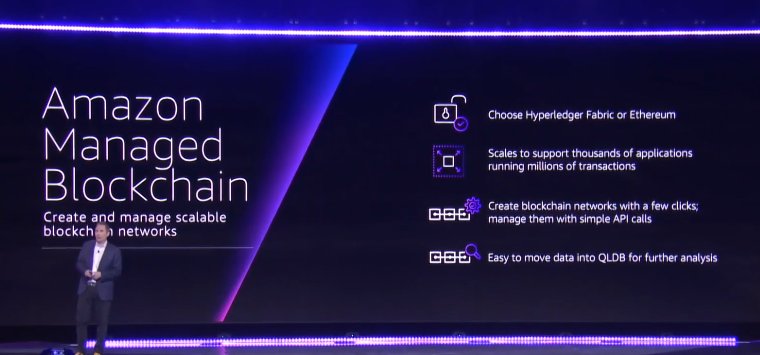
Support for Hyperledger Fabric is available today. Ethereum support is launching a few months from now.
Getting started with Managed Blockchain is a matter of using the AWS Console and configuring nodes, adding members and deploying applications.
“When we heard people saying ‘blockchain,’ we felt like there was their weird conveluting and conflating what they really wanted,” said Jassy. “And as we spent time working with customers and figuring out the jobs they were really trying to solve, this is what we think people are trying to do with blockchain.”

Powered by WPeMatico

AWS announced a new time series database today at AWS re:Invent in Las Vegas. The new product called DynamoDB On-Demand is a fully managed database designed to track items over time, which can be particularly useful for Internet of Things scenarios.
“With time series data each data point consists of a timestamp and one or more attributes and it really measures how things change over time and helps drive real time decisions,” AWS CEO Andy Jassy explained.
He sees a problem though with existing open source and commercial solutions, which says don’t scale well and hard to manage. This is of course a problem that a cloud service like AWS often helps solve.
Not surprising as customers were looking for a good time series database solution, AWS decided to create one themselves. “Today we are introducing Amazon DynamoDB on-demand, a flexible new billing option for DynamoDB capable of serving thousands of requests per second without capacity planning,” Danilo Poccia from AWS wrote in the blog post introducing the new service.
Jassy said that they built DynamoDB on-demand from the ground up with an architecture that organizes data by time intervals and enables time series specific data compression, which leads to less scanning and faster performance.
He claims it will be a thousand times faster at a tenth of cost, and of course it scales up and down as required and includes all of the analytics capabilities you need to understand all of the data you are tracking.
This new service is available across the world starting today.
Powered by WPeMatico

The concept of data lakes has been around for a long time, but being able to set up one of these systems, which store vast amounts of raw data in its native formats, was never easy. AWS wants to change this with the launch of AWS Lake Formation. At its core, this new service, which is available today, allows developers to create a secure data lake within a few days.
While “a few days” may still sound like a long time in this age of instant gratification, it’s nothing in the world of enterprise software.
“Everybody is excited about data lakes,” said AWS CEO Andy Jassy in today’s AWS re:Invent keynote. “People realize that there is significant value in moving all that disparate data that lives in your company in different silos and make it much easier by consolidating it in a data lake.”
Setting up a data lake today means you have to, among other things, configure your storage and (on AWS) S3 buckets, move your data, add metadata and add that to a catalog. And then you have to clean up that data and set up the right security policies for the data lake. “This is a lot of work and for most companies, it takes them several months to set up a data lake. It’s frustrating,” said Jassy.
Lake Formation is meant to handle all of these complications with just a few clicks. It sets up the right tags and cleans up and dedupes the data automatically. And it provides admins with a list of security policies to help secure that data.
“This is a step-level change for how easy it is to set up data lakes,” said Jassy.
Powered by WPeMatico

Amazon has had storage options for Linux file servers for some time, but it recognizes that a number of companies still use Windows file servers, and they are not content to cede that market to Microsoft. Today the company announced Amazon FSx for Windows File Server to provide a fully compatible Windows option.
“You get a native Windows file system backed by fully-managed Windows file servers, accessible via the widely adopted SMB (Server Message Block) protocol. Built on SSD storage, Amazon FSx for Windows File Server delivers the throughput, IOPS, and consistent sub-millisecond performance that you (and your Windows applications) expect,” AWS’s Jeff Barr wrote in a blog post introducing the new feature.
That means if you use this service, you have a first-class Windows system with all of the compatibility with Windows services that you would expect, such as Active Directory and Windows Explorer.
AWS CEO Andy Jassy introduced the new feature today at AWS re:Invent, the company’s customer conference going on in Las Vegas this week. He said that even though Windows File Server usage is diminishing as more IT pros turn to Linux, there are still a fair number of customers who want a Windows-compatible system and they wanted to provide a service for them to move their Windows files to the cloud.
Of course, it doesn’t hurt that it provides a path for Microsoft customers to use AWS instead of turning to Azure for these workloads. Companies undertaking a multi-cloud strategy should like having a fully compatible option.
Powered by WPeMatico
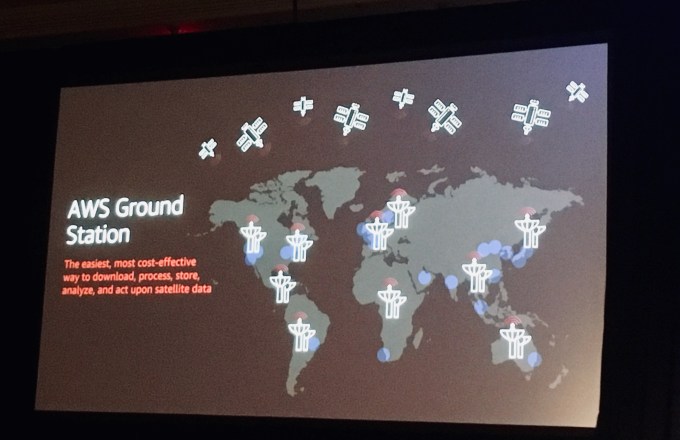
Today at AWS re:Invent in Las Vegas, AWS announced a new service for satellite providers with the launch of AWS Ground Station, the first fully managed ground station as a service.
With this new service, AWS will provide ground antennas through their existing network of worldwide availability zones, as well as data processing services to simplify the entire data retrieval and processing process for satellite companies, or for others who consume the satellite data.
Satellite operators need to get data down from the satellite, process it and then make it available for developers to use in applications. In that regard, it’s not that much different from any IoT device. It just so happens that these are flying around in space.
AWS CEO Andy Jassy pointed out that they hadn’t really considered a service like this until they had customers asking for it. “Customers said that we have so much data in space with so many applications that want to use that data. Why don’t you make it easier,” Jassy said. He said they thought about that and figured they could put their vast worldwide network to bear on the problem.
Prior to this service, companies had to build these base stations themselves to get the data down from the satellites as they passed over the base stations on earth wherever those base stations happened to be. It required that providers buy land and build the hardware, then deal with the data themselves. By offering this as a managed service, it greatly simplifies every aspect of the workflow.
Holger Mueller, an analyst at Constellation Research, says the service will help put the satellite data into the hands of developers faster. “To rule real-world application use cases you need to make maps and real-time spatial data available in an easy-to-consume, real-time and affordable way,” Mueller told TechCrunch. This is precisely the type of data you can get from satellites.
The value proposition of any cloud service has always been about reducing the resource allocation required by a company to achieve a goal. With AWS Ground Station, AWS handles every aspect of the satellite data retrieval and processing operation for the company, greatly reducing the cost and complexity associated with it.
AWS claims it can save up to 80 percent by using an on-demand model over ownership. They are starting with two ground stations today as they launch the service, but plan to expand it to 12 by the middle of next year.
Customers and partners involved in the Ground Station preview included Lockheed Martin, Open Cosmos, HawkEye360 and DigitalGlobe, among others.
Powered by WPeMatico
Red Hat is in the process of being acquired by IBM for a massive $34 billion, but that deal hasn’t closed yet and, in the meantime, Red Hat is still running independently and making its own acquisitions, too. As the company today announced, it has acquired Tel Aviv-based NooBaa, an early-stage startup that helps enterprises manage their data more easily and access their various data providers through a single API.
NooBaa’s technology makes it a good fit for Red Hat, which has recently emphasized its ability to help enterprise more effectively manage their hybrid and multicloud deployments. At its core, NooBaa is all about bringing together various data silos, which should make it a good fit in Red Hat’s portfolio. With OpenShift and the OpenShift Container Platform, as well as its Ceph Storage service, Red Hat already offers a range of hybrid cloud tools, after all.
“NooBaa’s technologies will augment our portfolio and strengthen our ability to meet the needs of developers in today’s hybrid and multicloud world,” writes Ranga Rangachari, the VP and general manager for storage and hyperconverged infrastructure at Red Hat, in today’s announcement. “We are thrilled to welcome a technical team of nine to the Red Hat family as we work together to further solidify Red Hat as a leading provider of open hybrid cloud technologies.”
While virtually all of Red Hat’s technology is open source, NooBaa’s code is not. The company says that it plans to open source NooBaa’s technology in due time, though the exact timeline has yet to be determined.
NooBaa was founded in 2013. The company has raised some venture funding from the likes of Jerusalem Venture Partners and OurCrowd, with a strategic investment from Akamai Capital thrown in for good measure. The company never disclosed the size of that round, though, and neither Red Hat nor NooBaa are disclosing the financial terms of the acquisition.
Powered by WPeMatico
Some consolidation is afoot in the world of business software. TechCrunch has learned that Parallels, the virtualization specialist with millions of users, is getting acquired by Corel, the Canadian company behind design apps like CorelDraw and other productivity apps like WordPerfect.
Some employees at Parallels have already been briefed on the acquisition, which is expected to be announced to the whole company today. Terms have not been disclosed but we understand it is an all-cash deal.
Corel has changed ownership and gone in and out of being listed publicly a number of times since being founded in the 1980s in Ottawa. It’s now owned by Vector Capital, which is essentially the one buying Parallels.
From what we understand, Corel will keep Parallels an independent product.
Parallels was originally founded in 1999 with roots in Russia and is currently headquartered in Bellevue, Washington. It has never made much of a fanfare around its financing or valuation. According to PitchBook its last funding round was in 2015, an undisclosed amount from Endeavour Vision, KG Investments, Maxfield Capital, Savano Capital Partners and others. It had raised $300 million from Ingram Micro the year before that.
It’s not fully clear what the rationale was for the sale, except it seems many investors were longstanding and looking to exit, while Corel has slowly been consolidating a number of sodtware businesses, most recently before this, Gravit Designer from Germany earlier this year.
Parallels provides a number of products that help people work seamlessly across multiple platforms, essentially letting people (and IT managers) run a unified workflow regardless of the device or operating system, ranging from Windows, Mac, iOS, Android, Chromebook, Linux, Raspberry Pi and cloud — a particularly compelling offering in the current, fragmented IT climate.
Corel once had designs to take on Microsoft in the world of software — to be the Pepsi to Microsoft’s Coke, as I once saw it described. That didn’t really pan out, with Microsoft at the time having a vice grip on platform and software (this was before the rise of Google, the rebirth of Apple, the rise of apps, and other big shifts in the industry). At one point, Microsoft signed a partnership with Corel that saw it investing in the company: a sell out, as one disappointed Canadian journalist described it at the time.
The two have also sparred over patents.
These days Corel is “highly profitable”, says Vector, selling software that includes CorelDraw, WordPerfect, WinZip, PaintShop Pro, and WinDVD. You could potentially imagine Parallels existing alongside that, or even perhaps helping increase the functionality and usefulness of Corel’s other apps with more cross-platform functionality.
The Parallels deal is expected to close next year, our source said.
We have written both to Corel and Parallels and will update this post as we learn more.
There have been a number of enterprise software acquisitions with a view to legacy businesses raising their game in open source, cloud and other newer developments. The most notable of these has been IBM announcing its intent to acquire Red Hat for $34 billion in October.
Powered by WPeMatico
Tonight at AWS re:Invent, the company announced a new tool called AWS Transit Gateway designed to help build a network topology inside of AWS that lets you share resources across accounts and bring together on premises and cloud resources in a single network topology.
Amazon already has a popular product called Amazon Virtual Private Cloud (VPC), which helps customers build private instances of their applications. The Transit Gateway is designed to help build connections between VPCs, which, up until now, has been tricky to do.
As Peter DeSantis, VP of global infrastructure and customer support at AWS speaking at an event Monday night at AWS Re:Invent explained, AWS Transit Gateway gives you a single set of controls that lets you connect to a centrally managed gateway to grow your network easily and quickly.
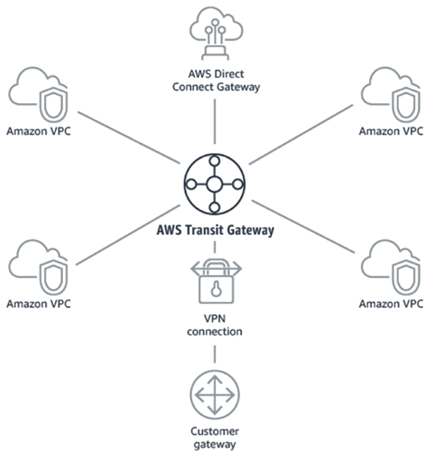
Diagram: AWS
DeSantis said that this tool also gives you the ability to traverse your AWS and on-premises networks. “A gateway is another way that we’re innovating to enable customers to have secure, easy-to-manage networking across both on premise and their AWS cloud environment,” he explained.
AWS Transit Gateway lets you build connections across a network wherever the resources live in a standard kind of network topology. “Today we are giving you the ability to use the new AWS Transit Gateway to build a hub-and-spoke network topology. You can connect your existing VPCs, data centers, remote offices, and remote gateways to a managed Transit Gateway, with full control over network routing and security, even if your VPCs, Active Directories, shared services, and other resources span multiple AWS accounts,” Amazon’s Jeff Barr wrote in a blog post announcing to the new feature.
For much of its existence, AWS was about getting you to the cloud and managing your cloud resources. This makes sense for a pure cloud company like AWS, but customers tend to have complex configurations with some infrastructure and software still living on premises and some in the cloud. This could help bridge the two worlds.
Powered by WPeMatico
Many AWS customers have to run in multiple zones for many reasons, including performance requirements, regulatory issues or fail-over management. Whatever the reason, AWS announced a new tool tonight called Global Accelerators designed to help customers route traffic more easily across multiple regions.
Peter DeSantis, VP of global infrastructure and customer support at AWS speaking at an event Monday night at AWS Re:Invent, explained that much of AWS customer traffic already flows over their massive network, and customers are using AWS Direct Connect to help applications get consistent performance and low network variability as customers move between AWS regions. He said what has been missing is a way to use the AWS global network to optimize their applications.
“Tonight I’m excited to announce AWS Global Accelerator. AWS Global Accelerator makes it easy for you to improve the performance and availability of your applications by taking advantage of the AWS global network,” he told the AWS re:Invent audience.
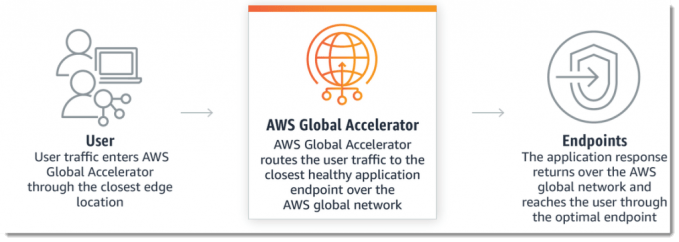
Graphic: AWS
“Your customer traffic is routed from your end users to the closest AWS edge location and from there traverses congestion-free redundant, highly available AWS global network. In addition to improving performance AWS Global Accelerator has built-in fault isolation, which instantly reacts to changes in the network health or your applications configuration,” DeSantis explained.
In fact, network administrators can route traffic based on defined policies such as health or geographic requirements and the traffic will move to the designated zone automatically based on those policies.
AWS plans to charge customers based on the number of accelerators they create. “An accelerator is the resource you create to direct traffic to optimal endpoints over the AWS global network. Customers will typically set up one accelerator for each application, but more complex applications may require more than one accelerator,” AWS’s Shaun Ray wrote in a blog post announcing the new feature.
AWS Global Accelerator is available today in several regions in the U.S., Europe and Asia.
Powered by WPeMatico
After focusing on Asian markets, particularly in Southeast Asia, Bangkok-based Eko Communications is getting ready to take on Slack, Microsoft Teams, and other enterprise messaging apps in Europe. The startup announced today that it has raised a Series B of $20 million and opened offices in London (which will serve as its new commercial headquarters), Amsterdam, and Berlin.
The funding, led by SMD Ventures, with participation from AirAsia’s digital investment arm Redbeat Ventures, Gobi Partners, East Ventures, and returning investors, brings Eko Communication’s total raised to $28.7 million. The company’s Series A was announced in 2015, followed by $2 million in strategic funding from Japanese conglomerate Itochu last year. Eko Communications (not to be confused with Eko, an interactive video startup) has already served clients like Thai mobile operator True, Radisson, and 7-Eleven.
Eko Communications’ Series B is earmarked for its ambitious global expansion plans in the first quarter of 2019. Korawad Chearavanont, the company’s CEO and co-founder, told TechCrunch in an email that it has already localized products for target markets including the UK, Ireland, Benelux, and the DACH region (Germany, Austria, and Switzerland).
Eko Communications wants to expand in the European Union and the United States because their economies are both significantly larger than Southeast Asia’s, said Chearavanont. This, plus the fact that both have larger enterprise IT markets thanks to higher spending on software by companies, means that “for Eko to achieve the necessary scale to become a global player in the mobile enterprise market, continued growth in these markets is critical,” he added.
The company claims that its revenues have more than tripled in the past year and that it now has more than 500,000 recurring paid users. Of course, any enterprise messaging startup has to contend with the specter of Slack and Microsoft Teams. Positioning Eko Communications as a rival to those services, however, isn’t totally accurate because they are aimed at different customers.
Slack and Microsoft Teams are “primarily utilized by ‘knowledge workers’ and these systems are priced for these types of users,” Chearavanont said. “Being a mobile-first company, we target companies that have a large presence of mobile-first staff traditionally in industries like retail and hospitality (the services sector in general).” Many employees in those sectors still rely on messaging apps like WhatsApp or email to communicate, so Eko Communications seeks to make it easy for companies to transition from their ad hoc communication methods to a more secure and efficient system with tools like APIs to help them integrate legacy systems.
Powered by WPeMatico