Enterprise
Auto Added by WPeMatico
Auto Added by WPeMatico
As hardware makers continue to work on ways of making wide-scale quantum computing a reality, a startup out of Australia that is building software to help reduce noise and errors on quantum computing machines has raised a round of funding to fuel its U.S. expansion.
Q-CTRL is designing firmware for computers and other machines (such as quantum sensors) that perform quantum calculations, firmware to identify the potential for errors to make the machines more resistant and able to stay working for longer (the Q in its name is a reference to qubits, the basic building block of quantum computing).
The startup is today announcing that it has raised $15 million, money that it plans to use to double its team (currently numbering 25) and set up shop on the West Coast, specifically Los Angeles.
This Series A is coming from a list of backers that speaks to the startup’s success to date in courting quantum hardware companies as customers. Led by Square Peg Capital — a prolific Australian VC that has backed homegrown startups like Bugcrowd and Canva, but also those further afield such as Stripe — it also includes new investor Sierra Ventures as well as Sequoia Capital, Main Sequence Ventures and Horizons Ventures.
Q-CTRL’s customers are some of the bigger names in quantum computing and IT, such as Rigetti, Bleximo and Accenture, among others. IBM — which earlier this year unveiled its first commercial quantum computer — singled it out last year for its work in advancing quantum technology.
The problem that Q-CTRL is aiming to address is basic but arguably critical to solving if quantum computing ever hopes to make the leap out of the lab and into wider use in the real world.
Quantum computers and other machines like quantum sensors, which are built on quantum physics architecture, are able to perform computations that go well beyond what can be done by normal computers today, with the applications for such technology including cryptography, biosciences, advanced geological exploration and much more. But quantum computing machines are known to be unstable, in part because of the fragility of the quantum state, which introduces a lot of noise and subsequent errors, which results in crashes.
As Frederic pointed out recently, scientists are confident that this is ultimately a solvable issue. Q-CTRL is one of the hopefuls working on that, by providing a set of tools that runs on quantum machines, visualises noise and decoherence and then deploys controls to “defeat” those errors.
Q-CTRL currently has four products it offers to the market: Black Opal, Boulder Opal, Open Controls and Devkit — aimed respectively at students/those exploring quantum computing, hardware makers, the research community and end users/algorithm developers.
Q-CTRL was founded in 2017 by Michael Biercuk, a professor of Quantum Physics & Quantum Technology at the University of Sydney and a chief investigator in the Australian Research Council Centre of Excellence for Engineered Quantum Systems, who studied in the U.S., with a PhD in physics from Harvard.
“Being at the vanguard of the birth of a new industry is extraordinary,” he said in a statement. “We’re also thrilled to be assembling one of the most impressive investor syndicates in quantum technology. Finding investors who understand and embrace both the promise and the challenge of building quantum computers is almost magical.”
Why choose Los Angeles for building out a U.S. presence, you might ask? Southern California, it turns out, has shaped up to be a key area for quantum research and development, with several of the universities in the region building out labs dedicated to the area, and companies like Lockheed Martin and Google also contributing to the ecosystem. This means a strong pipeline of talent and conversation in what is still a nascent area.
Given that it is still early days for quantum computing technology, that gives a lot of potential options to a company like Q-CTRL longer-term: The company might continue to build a business as it does today, selling its technology to a plethora of hardware makers and researchers in the field; or it might get snapped up by a specific hardware company to integrate Q-CTRL’s solutions more closely onto its machines (and keep them away from competitors).
Or, it could make like a quantum particle and follow both of those paths at the same time.
“Q-CTRL impressed us with their strategy; by providing infrastructure software to improve quantum computers for R&D teams and end-users, they’re able to be a central player in bringing this technology to reality,” said Tushar Roy, a partner at Square Peg. “Their technology also has applications beyond quantum computing, including in quantum-based sensing, which is a rapidly-growing market. In Q-CTRL we found a rare combination of world-leading technical expertise with an understanding of customers, products and what it takes to build an impactful business.”
Powered by WPeMatico
Adobe has a lot going on with Analytics and the Customer Experience Platform, a place to gather data to understand customers better. Today, it announced a new analytics tool that enables employees to work directly with customer journey data to help deliver a better customer experience.
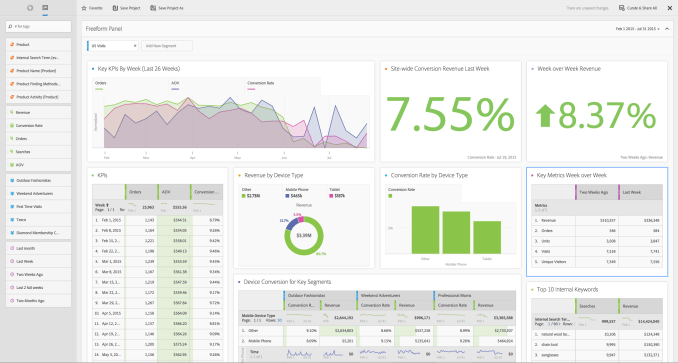
The customer journey involves a lot of different systems, from a company data lake to CRM to point of sale. This tool pulls all of that data together from across multiple systems and various channels and brings it into the data analysis workspace, announced in July.
Nate Smith, group manager for product marketing for Adobe Analytics, says the idea is to give access to this data in a standard way across the organization, whether it’s a data scientist, an analyst with SQL skills or a marketing pro simply looking for insight.
“When you think about organizations that are trying to do omni-channel analysis or trying to get that next channel of data in, they now have the platform to do that, where the data can come in and we standardize it on an academic model,” he said. They then layer this ability to continuously query the data in a visual way to get additional insight they might not have seen.
Screenshot: Adobe
Adobe is trying to be as flexible as possible in every step of the process, and openness was a guiding principle here, Smith said. That means that data can come from any source, and users can visualize it using Adobe tools or an external tool like Tableau or Looker. What’s more, they can get data in or out as needed, or even use your their own models, Smith said.
“We recognize that as much as we’d love to have everyone go all in on the Adobe stack, we understand that there is existing significant investment in other tech and that integration and interoperability really needs to happen, as well,” he said.
Ultimately this is about giving marketers access to a full picture of the customer data to deliver the best experience possible based on what you know about them. “Being able to have insight and engagement points to help with the moments that matter and provide great experience is really what we’re aiming to do with this,” he said.
This product will be generally available next month.
Powered by WPeMatico
More than 50% of the Fortune 500 companies are now using the open-source Cloud Foundry Platform-as-a-Service project — either directly or through vendors like Pivotal — to build, test and deploy their applications. Like so many other projects, including the likes of OpenStack, Cloud Foundry went through a bit of a transition in recent years as more and more developers started looking to containers — and especially the Kubernetes project — as a platform on which to develop. Now, however, the project is ready to focus on what always differentiated it from its closed- and open-source competitors: the developer experience.
Long before Docker popularized containers for application deployment, though, Cloud Foundry had already bet on containers and written its own orchestration service, for example. With all of the momentum behind Kubernetes, though, it’s no surprise that many in the Cloud Foundry started to look at this new project to replace the existing container technology.
Powered by WPeMatico
French startup Spendesk has raised another $38.4 million in a Series B round, with existing investor Index Ventures leading the round. The company has raised $49.4 million (€45 million) over the years.
Spendesk is an all-in-one corporate expense and spend management service. It lets you track expenses across your company, empower your employees with a clear approval process and simplify your bookkeeping.
The service essentially works like Revolut or N26, but for corporate needs. After you sign up, you get your own Spendesk account with an IBAN. You can top up that account and define different sets of policies.
For instance, you can set payment limits depending on everyone’s job and define who’s in charge of approving expensive payments. After that, everyone can generate virtual cards for online payments and get a physical card for business travel.
When you’re on the road, you can pay directly using Spendesk just like any corporate card. If you have to pay in cash or with another card, you can take a photo of the receipt from the Spendesk mobile app and get your money back.
Many Spendesk users also leverage the service for other use cases. For instance, you can define a marketing budget and let the marketing team spend it on Facebook or Google ads using a virtual card.
You also can track all your online subscriptions from the Spendesk interface to make sure that you don’t pay for similar tools. If you hire freelancers, you can upload all your invoices to the platform, export an XML with your outstanding invoices and import it to your banking portal.
Spendesk tries to be smarter than legacy expense solutions. For instance, the company tries to leverage optical character recognition (OCR) to match receipts with payments, autofill the VAT rate, etc.
With today’s funding round, the company plans to open offices in Berlin and London, add more currencies and develop new features. Over the past year, the company went from 20 employees to 120 employees. There are now 1,500 companies using Spendesk in Europe.
Powered by WPeMatico
While the software revolution started out slowly, over the past few years it’s exploded and the fastest-growing segment to-date has been the shift towards software as a service or SaaS.
SaaS has dramatically lowered the intrinsic total cost of ownership for adopting software, solved scaling challenges and taken away the burden of issues with local hardware. In short, it has allowed a business to focus primarily on just that — its business — while simultaneously reducing the burden of IT operations.
Today, SaaS adoption is increasingly ubiquitous. According to IDG’s 2018 Cloud Computing Survey, 73% of organizations have at least one application or a portion of their computing infrastructure already in the cloud. While this software explosion has created a whole range of downstream impacts, it has also caused software developers to become more and more valuable.
The increasing value of developers has meant that, like traditional SaaS buyers before them, they also better intuit the value of their time and increasingly prefer businesses that can help alleviate the hassles of procurement, integration, management, and operations. Developer needs to address those hassles are specialized.
They are looking to deeply integrate products into their own applications and to do so, they need access to an Application Programming Interface, or API. Best practices for API onboarding include technical documentation, examples, and sandbox environments to test.
APIs tend to also offer metered billing upfront. For these and other reasons, APIs are a distinct subset of SaaS.
For fast-moving developers building on a global-scale, APIs are no longer a stop-gap to the future—they’re a critical part of their strategy. Why would you dedicate precious resources to recreating something in-house that’s done better elsewhere when you can instead focus your efforts on creating a differentiated product?
Thanks to this mindset shift, APIs are on track to create another SaaS-sized impact across all industries and at a much faster pace. By exposing often complex services as simplified code, API-first products are far more extensible, easier for customers to integrate into, and have the ability to foster a greater community around potential use cases.
Graphics courtesy of Accel
Whether you realize it or not, chances are that your favorite consumer and enterprise apps—Uber, Airbnb, PayPal, and countless more—have a number of third-party APIs and developer services running in the background. Just like most modern enterprises have invested in SaaS technologies for all the above reasons, many of today’s multi-billion dollar companies have built their businesses on the backs of these scalable developer services that let them abstract everything from SMS and email to payments, location-based data, search and more.
Simultaneously, the entrepreneurs behind these API-first companies like Twilio, Segment, Scale and many others are building sustainable, independent—and big—businesses.
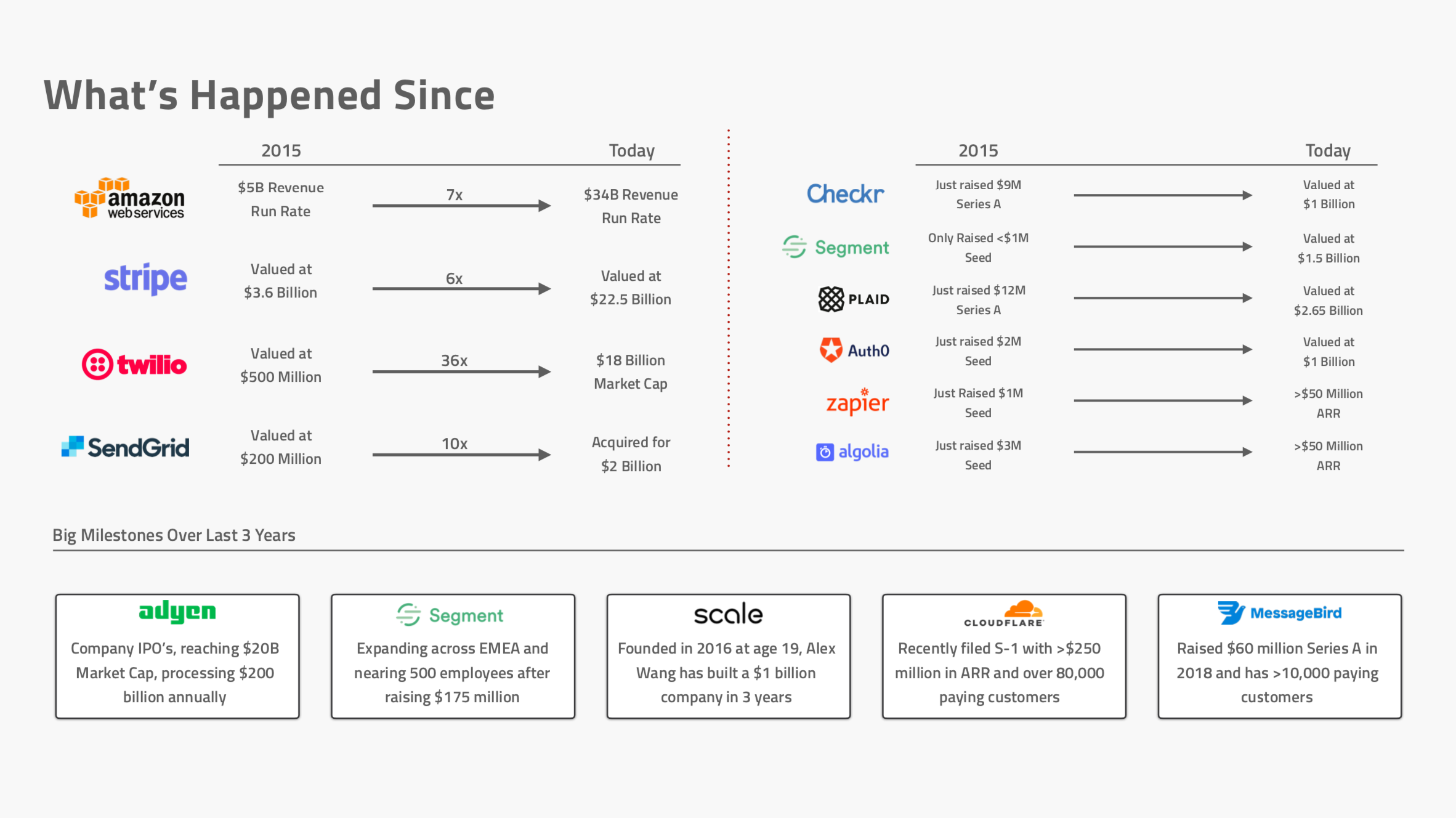
Valued today at over $22 billion, Stripe is the biggest independent API-first company. Stripe took off because of its initial laser-focus on the developer experience setting up and taking payments. It was even initially known as /dev/payments!
Stripe spent extra time building the right, idiomatic SDKs for each language platform and beautiful documentation. But it wasn’t just those things, they rebuilt an entire business process around being API-first.
Companies using Stripe didn’t need to fill out a PDF and set up a separate merchant account before getting started. Once sign-up was complete, users could immediately test the API with a sandbox and integrate it directly into their application. Even pricing was different.
Stripe chose to simplify pricing dramatically by starting with a single, simple price for all cards and not breaking out cards by type even though the costs for AmEx cards versus Visa can differ. Stripe also did away with a monthly minimum fee that competitors had.
Many competitors used the monthly minimum to offset the high cost of support for new customers who weren’t necessarily processing payments yet. Stripe flipped that on its head. Developers integrate Stripe earlier than they integrated payments before, and while it costs Stripe a lot in setup and support costs, it pays off in brand and loyalty.
Checkr is another excellent example of an API-first company vastly simplifying a massive yet slow-moving industry. Very little had changed over the last few decades in how businesses ran background checks on their employees and contractors, involving manual paperwork and the help of 3rd party services that spent days verifying an individual.
Checkr’s API gives companies immediate access to a variety of disparate verification sources and allows these companies to plug Checkr into their existing on-boarding and HR workflows. It’s used today by more than 10,000 businesses including Uber, Instacart, Zenefits and more.
Like Checkr and Stripe, Plaid provides a similar value prop to applications in need of banking data and connections, abstracting away banking relationships and complexities brought upon by a lack of tech in a category dominated by hundred-year-old banks. Plaid has shown an incredible ramp these past three years, from closing a $12 million Series A in 2015 to reaching a valuation over $2.5 billion this year.
Today the company is fueling an entire generation of financial applications, all on the back of their well-built API.
Graphics courtesy of Accel
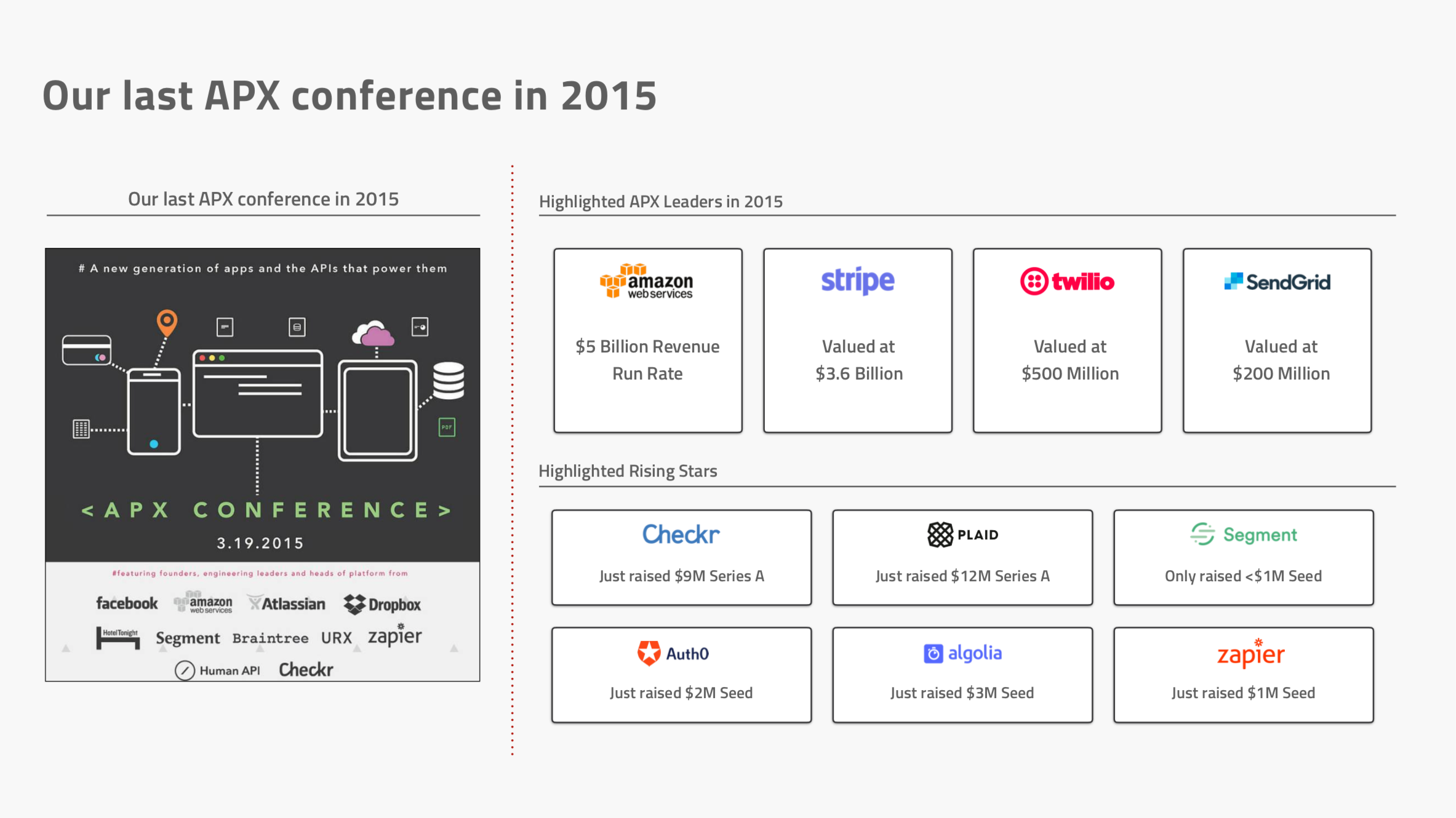
Accel’s first API investment was in Braintree, a mobile and web payment systems for e-commerce companies, in 2011. Braintree eventually sold to, and became an integral part of, PayPal as it spun out from eBay and grew to be worth more than $100 billion. Unsurprisingly, it was shortly thereafter that our team decided to it was time to go big on the category. By the end of 2014 we had led the Series As in Segment and Checkr and followed those investments with our first APX conference in 2015.
Plaid, Segment, Auth0, and Checkr had only raised Seed or Series A financings! And we are even more excited and bullish on the space. To convey just how much API-first businesses have grown in such a short period of time, we thought it would be useful perspective to share some metrics over the past five years, which we’ve broken out in the two visuals included above in this article.
While SaaS may have pioneered the idea that the best way to do business isn’t to actually build everything in-house, today we’re seeing APIs amplify this theme. At Accel, we firmly believe that APIs are the next big SaaS wave — having as much if not more impact as its predecessor thanks to developers at today’s fastest-growing startups and their preference for API-first products. We’ve actively continued to invest in the space (in companies like, Scale, mentioned above).
And much like how a robust ecosystem developed around SaaS, we believe that one will continue to develop around APIs. Given the amount of progress that has happened in just a few short years, Accel is hosting our second APX conference to once again bring together this remarkable community and continue to facilitate discussion and innovation.
Graphics courtesy of Accel
Powered by WPeMatico
Yesterday at TechCrunch’s Enterprise event in San Francisco, we sat down with three venture capitalists who spend a lot of their time thinking about enterprise startups. We wanted to ask what trends they are seeing, what concerns they might have about the state of the market and, of course, how startups might persuade them to write out a check.
We covered a lot of ground with the investors — Jason Green of Emergence Capital, Rebecca Lynn of Canvas Ventures and Maha Ibrahim of Canaan Partners — who told us, among other things, that startups shouldn’t expect a big M&A event right now, that there’s no first-mover advantage in the enterprise realm and why grit may be the quality that ends up keeping a startup afloat.
Jason Green: When we started Emergence 15 years ago, we saw maybe a few hundred startups a year, and we funded about five or six. Today, we see over 1,000 a year; we probably do deep diligence on 25.
Powered by WPeMatico
Superside, a startup aiming to create a premium alternative to the existing crowdsourced design platforms, is announcing that it has raised $3.5 million in new funding.
It’s also adding new features like the ability to work on user interfaces, interaction design and motion graphics. Co-founder and CEO Fredrik Thomassen said this allows the company to offer “a full-service design solution.”
You may have heard about Superside under its old name Konsus . In a blog post, Thomassen explained the recent change in name and branding, writing, “We changed our name and look to align with what we had become: The world’s top team of international designers and creatives.”
He told me Superside was created to address his own frustrations after trying to use marketplaces like 99designs and Fiverr. He argued that there’s a problem with “adverse selection on those platforms.” In other words, “The best people … don’t remain, because they don’t have a career path — they’re fighting with other freelancers to get the jobs.”
Superside, on the other hand, is picky about the designers it works with — it claims to select 100 designers from the more than 50,000 applications it receives each year. But if they are accepted, they’re guaranteed full-time work.
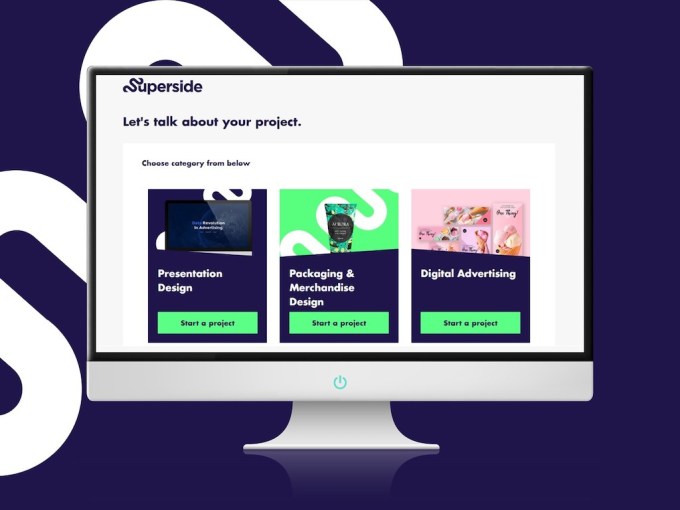
Thomassen said the platform is built for large enterprises that have their own design and marketing teams but still need additional support. Customers include Uber, LinkedIn, L’Oreal, Cisco, Santander, Amazon, Walmart Tiffany & Co. Hewlett Packard and Airbus
In addition to choosing good designers, Superside also built a broader project management platform.
“We’re basically automating everything: Finding people, screening people, on-boarding, on-the-job learning, invoicing of customers, project management, all of the nitty gritty,” Thomassen said. “The only thing not automated is design — that’s where the human element and the creativity come in.”
Plus, Thomassen said Superside can turn around a standard piece of artwork in 12 hours: “Nobody else can do what we’re doing in terms of speed.”
The new funding comes from Freestyle Capital, with participation from High Alpha Ventures, Y Combinator and Alliance Ventures.
“We’re very much a mission-driven company,” Thomassen added. “For me, the reason to go to work in the morning is to help build an online labor market and create equal economic opportunity for everyone in the world.”
Powered by WPeMatico
Last year at this time, Forethought won the TechCrunch Disrupt Battlefield competition. A $9 million Series A investment followed last December. Today at TechCrunch Sessions: Enterprise in San Francisco, the company introduced the latest addition to its platform, called Agatha Predictions.
Forethought CEO and co-founder Deon Nicholas said that after launching its original product, Agatha Answers (to provide suggested answers to customer queries), customers were asking for help with the routing part of the process, as well. “We learned that there’s a whole front end of that problem before the ticket even gets to the agent,” he said. Forethought developed Agatha Predictions to help sort the tickets and get them to the most qualified agent to solve the problem.
“It’s effectively an entire tool that helps triage and route tickets. So when a ticket is coming in, it can predict whether it’s a high-priority or low-priority ticket and which agent is best qualified to handle this question. And this all happens before the agent even touches the ticket. This really helps drive efficiencies across the organization by helping to reduce triage time,” Nicholas explained.
The original product (Agatha Answers) is designed to help agents get answers more quickly and reduce the amount of time it takes to resolve an issue. “It’s a tool that integrates into your Help Desk software, indexes your past support tickets, knowledge base articles and other [related content]. Then we give agents suggested answers to help them close questions with reduced handle time,” Nicholas said.
He says that Agatha Predictions is based on the same underlying AI engine as Agatha Answers. Both use Natural Language Understanding (NLU) developed by the company. “We’ve been building out our product, and the Natural Language Understanding engine, the engine behind the system, works in a very similar manner [across our products]. So as a ticket comes in the AI reads it, understands what the customer is asking about, and understands the semantics, the words being used,” he explained. This enables them to automate the routing and supply a likely answer for the issue involved.
Nicholas maintains that winning Battlefield gave his company a jump start and a certain legitimacy it lacked as an early-stage startup. Lots of customers came knocking after the event, as did investors. The company has grown from five employees when it launched last year at TechCrunch Disrupt to 20 today.
Powered by WPeMatico

Front, the company that lets you manage your inboxes as a team, is adding one more channel: WhatsApp. Starting today, you can read and reply to people contacting you through WhatsApp.
This feature is specifically targeted at users of WhatsApp Business. You can get a business phone number through Twilio and then hand out that number to your customers.
After that, you can see the messages coming in Front and treat them like any Front message. In particular, you can assign conversations to specific team members so that your customers get a relevant answer as quickly as possible. If you need more information, Front integrates with popular CRMs, such as Salesforce, Pipedrive and HubSpot.
You also can discuss with other teammates before sending a reply to your customer. It works like any chat interface — you can at-mention your co-workers and start an in-line chat in the middle of a WhatsApp thread. When you’re ready to answer, you can hit reply and send a WhatsApp message.
Front started with generic email addresses, such as sales@yourcompany or jobs@yourcompany. But the company has added more channels over time, such as Facebook, Twitter, website chat and text messages.
If you’ve already been using Front with text messages, you can now easily add WhatsApp and use the same service for that new channel.

Powered by WPeMatico
At our TC Sessions: Enterprise event, Atlassian co-CEO Scott Farquhar today announced a number of updates to how the company will sell its cloud-based services. These include the launch of new premium plans for more of its products, as well as the addition of a free tier for all of the company’s services that didn’t already offer one. Atlassian now also offers discounted cloud pricing for academic institutions and nonprofit organizations.
The company previously announced its premium plans for Jira Software Cloud and Confluence Cloud. Now, it is adding Jira Service Desk to this lineup, and chances are it’ll add more of its services over time. The premium plan adds a 99.9% update SLA, unlimited storage and additional support. Until now, Atlassian sold these products solely based on the number of users, but didn’t offer a specific enterprise plan.
As Harsh Jawharkar, the head of go-to-market for Cloud Platform at Atlassian, told me, many of its larger customers, who often ran the company’s products on their own servers before, are now looking to move to the cloud and hand over to Atlassian the day-to-day operations of these services. That’s in part because they are more comfortable with the idea of moving to the cloud at this point — and because Atlassian probably knows how to run its own services better than anybody else.
For these companies, Atlassian is also introducing a number of new features today. Those include soon-to-launch data residency controls for companies that need to ensure that their data stays in a certain geographic region, as well as the ability to run Jira and Confluence Cloud behind customized URLs that align with a company’s brand, which will launch in early access in 2020. Maybe more important, though, are features to Atlassian Access, the company’s command center that helps enterprises manage its cloud products. Access now supports single sign-on with Google Cloud Identity and Microsoft Active Directory Federation Services, for example. The company is also partnering with McAfee and Bitglass to offer additional advanced security features and launch a cross-product audit log. Enterprise admins will also soon get access to a new dashboard that will help them understand how Atlassian’s tools are being used across the organization.
But that’s not all. The company is also launching new tools to make customer migration to its cloud products easier, with initial support for Confluence and Jira support coming later this year. There’s also new extended cloud trial licenses, which a lot of customers have asked for, Jawharkar told me, because the relatively short trial periods the company previously offered weren’t quite long enough for companies to fully understand their needs.
This is a big slew of updates for Atlassian — maybe its biggest enterprise-centric release since the company’s launch. It has clearly reached a point where it had to start offering these enterprise features if it wanted to grow its market and bring more of these large companies on board. In its early days, Atlassian mostly grew by selling directly to teams within a company. These days, it has to focus a bit more on selling to executives as it tries to bring more enterprises on board — and those companies have very specific needs that the company didn’t have to address before. Today’s launches clearly show that it is now doing so — at least for its cloud-based products.
The company isn’t forgetting about other users either, though. It’ll still offer entry-level plans for smaller teams and it’s now adding free tiers to products like Jira Software, Confluence, Jira Service Desk and Jira Core. They’ll join Trello, Bitbucket and Opsgenie, which already feature free versions. Going forward, academic institutions will receive 50% off their cloud subscriptions and nonprofits will receive 75% off.
It’s obvious that Atlassian is putting a lot of emphasis on its cloud services. It’s not doing away with its self-hosted products anytime, but its focus is clearly elsewhere. The company itself started this process a few years ago and a lot of this work is now coming to fruition. As Anu Bharadwaj, the head of Cloud Platform at Atlassian, told me, this move to a fully cloud-native stack enabled many of today’s announcements, and she expects that it’ll bring a lot of new customers to its cloud-based services.
Powered by WPeMatico