Enterprise
Auto Added by WPeMatico
Auto Added by WPeMatico
Cloudian, a company that enables businesses to store and manage massive amounts of data, announced today the launch of Edgematrix, a new unit focused on edge analytics for large data sets. Edgematrix, a majority-owned subsidiary of Cloudian, will first be available in Japan, where both companies are based. It has raised a $9 million Series A from strategic investors NTT Docomo, Shimizu Corporation and Japan Post Capital, as well as Cloudian co-founder and CEO Michael Tso and board director Jonathan Epstein. The funding will be used on product development, deployment and sales and marketing.
Cloudian itself has raised a total of $174 million, including a $94 million Series E round announced last year. Its products include the Hyperstore platform, which allows businesses to store hundreds of petrabytes of data on premise, and software for data analytics and machine learning. Edgematrix uses Hyperstore for storing large-scale data sets and its own AI software and hardware for data processing at the “edge” of networks, closer to where data is collected from IoT devices like sensors.
The company’s solutions were created for situations where real-time analytics is necessary. For example, it can be used to detect the make, model and year of cars on highways so targeted billboard ads can be displayed to their drivers.
Tso told TechCrunch in an email that Edgematrix was launched after Cloudian co-founder and president Hiroshi Ohta and a team spent two years working on technology to help Cloudian customers process and analyze their data more efficiently.
“With more and more data being created at the edge, including IoT data, there’s a growing need for being able to apply real-time data analysis and decision-making at or near the edge, minimizing the transmission costs and latencies involved in moving the data elsewhere,” said Tso. “Based on the initial success of a small Cloudian team developing AI software solutions and attracting a number of top-tier customers, we decided that the best way to build on this success was establishing a subsidiary with strategic investors.”
Edgematrix is launching in Japan first because spending on AI systems there is expected to grow faster than in any other market, at a compound annual growth rate of 45.3% from 2018 to 2023, according to IDC.
“Japan has been ahead of the curve as an early adopter of AI technology, with both the governmetn and private sector viewing it as essential to boosting productivity,” said Tso. “Edgematrix will focus on the Japanese market for at least the next year, and assuming that all goes well, it would then expand to North America and Europe.”
Powered by WPeMatico
The Daily Crunch is TechCrunch’s roundup of our biggest and most important stories. If you’d like to get this delivered to your inbox every day at around 9am Pacific, you can subscribe here.
1. Salesforce doubles down on verticals, launches Manufacturing and Consumer Goods Clouds
Salesforce unveiled two new business units today as part of its strategy to build specialized solutions for specific industries.
For example, with its Manufacturing Cloud, Salesforce says it has built a way for sales agreements to link up with a company’s ERP and forecasting software, allowing for improved demand prediction.
2. Samsung’s Galaxy Tab S6 combines creative flexibility with great design
Darrell Etherington says the new Galaxy Tab S6 (with pricing starting at $649.99) expands the definition of what a tablet can be.
3. Facebook rolls out new video tools, plus Instagram and IGTV scheduling feature
The highlights include better ways to prep for and simulcast live broadcasts, ways to take better advantage of Watch Party events, new metrics to track video performance and a much-anticipated option to schedule Instagram/IGTV content for up to six months in advance.
4. Hear how to build a billion-dollar SaaS company at TechCrunch Disrupt
This year we’ll welcome three people to the Extra Crunch stage who know first-hand what it takes to join the billion-dollar club: Battery Ventures partner Neeraj Agrawal, HelloSign COO Whitney Bouck and Harness CEO Jyoti Bansal.
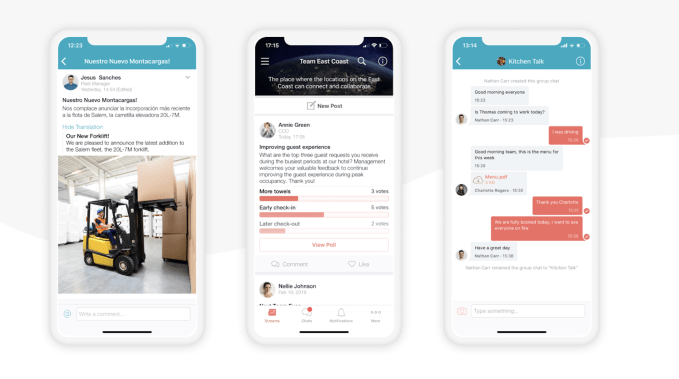
5. Beekeeper raises $45M Series B to become the ‘Slack for non-desk employees’
Beekeeper has built a mobile-first communications platform for employers who need to communicate with blue-collar and service-oriented workers.
6. How to get people to open your emails
We tackle the obvious stuff that can help with low open rates, as well as bigger challenges: Let’s say 60% of your audience opens your email — how can you get the remaining 40% to open and read it too? (Extra Crunch membership required.)
7. This week’s TechCrunch podcasts
The Equity team has some thoughts on the latest WeWork drama, and how it shows that valuations are essentially meaningless. And on Original Content, we review the Netflix documentary series “The Family.”

Powered by WPeMatico
Ten years ago this week, Adobe acquired Omniture for $1.8 billion. At the time, Adobe was a software company selling boxed software like Dreamweaver, Flash and Photoshop to creatives. Many people were baffled by the move, not realizing that purchasing a web analytics company was really the first volley in a full company transformation to the cloud and a shift in focus from consumer to enterprise.
It would take many years for the full vision to unfold, so you can forgive people for not recognizing the implications of the acquisition at the time, but CEO Shantanu Narayen seemed to give an inkling of what he had in mind. “This is a game-changer for both Adobe and our customers. We will enable advertisers, media companies and e-tailers to realize the full value of their digital assets,” he said in a statement after the acquisition became public.
While most people thought that perhaps this move involved some sort of link between design and data, it would turn out to be more complex than that. Tony Byrne, founder and principal analyst at Real Story Group, tried to figure out the thinking behind the deal in an EContent column published a couple of months after it was announced.
“Going forward, I think the real action will continue to revolve around integrating management and metrics, less so than integrating design and metrics. And that’s why I also think that Adobe isn’t done acquiring yet,” It was pure speculation on Byrne’s part, but it proved prescient.
Powered by WPeMatico
Seems like everything is going to the cloud these days, so why should movie making be left out? Today, Walt Disney Studios announced a five-year partnership with Microsoft around an innovation lab to find ways to shift content production to the Azure cloud.
The project involves the Walt Disney StudioLAB, an innovation work space where Disney personnel can experiment with moving different workflows to the cloud. The movie production software company, Avid is also involved.
The hope is that by working together, the three parties can come up with creative, cloud-based workflows that can accelerate the innovation cycle at the prestigious movie maker. Every big company is looking for ways to innovate, regardless of their core business, and Disney is no different.
As movie making involves ever greater amounts of computing resources, the cloud is a perfect model for it, allowing them to scale up and down resources as needed, whether rendering scenes or adding special effects. As Disney’s CTO Jamie Voris sees it, this could make these processes more efficient, which could help lower cost and time to production.
“Through this innovation partnership with Microsoft, we’re able to streamline many of our processes so our talented filmmakers can focus on what they do best,” Voris said in a statement. It’s the same kind of cloud value proposition that many large organizations are seeking. They want to speed time to market, while letting technology handle some of the more mundane tasks.
The partnership builds on an existing one that Microsoft already had with Avid, where the two companies have been working together to build cloud-based workflows for the film industry using Avid software solutions on Azure. Disney will add its unique requirements to the mix, and over the five years of the partnership, hopes to streamline some of its workflows in a more modern cloud context.
Powered by WPeMatico
As more enterprise developers make use of open source, it becomes increasingly important for companies to make sure that they are complying with licensing requirements. They also need to ensure the open-source bits are being updated over time for security purposes. That’s where FOSSA comes in, and today the company announced an $8.5 million Series A.
The round was led by Bain Capital Ventures, with help from Costanoa Ventures and Norwest Venture Partners. Today’s round brings the total raised to $11 million, according to the company.
Company founder and CEO Kevin Wang says that over the last 18 months, the startup has concentrated on building tools to help enterprises comply with their growing use of open source in a safe and legal way. He says that overall this increasing use of open source is great news for developers, and for these bigger companies in general. While it enables them to take advantage of all the innovation going on in the open-source community, they need to make sure they are in compliance.
“The enterprise is really early on this journey, and that’s where we come in. We provide a platform to help the enterprise manage open-source usage at scale,” Wang explained. That involves three main pieces. First it tracks all of the open-source and third-party code being used inside a company. Next, it enforces licensing and security policy, and, finally, it has a reporting component. “We automate the mass reporting and compliance for all of the housekeeping that comes from using open source at scale,” he said.
The enterprise focus is relatively new for the company. It originally launched in 2017 as a tool for developers to track individual use of open source inside their programs. Wang saw a huge opportunity inside the enterprise to apply this same kind of capability inside larger organizations, which were hungry for tools to help them comply with the myriad open-source licenses out there.
“We found that there was no tooling out there that can manage the scale and breadth across all the different enterprise use cases and all the really complex mission-critical code bases,” he said. What’s more, he found that where there were existing tools, they were vastly underutilized or didn’t provide broad enough coverage.
The company announced a $2.2 million seed round in 2017, and since then has grown from 10 to 40 employees. With today’s funding, that should increase as the company is expanding quickly. Wang reports that the startup has been tripling its revenue numbers and customer accounts year over year. The new money should help accelerate that growth and expand the product and markets it can sell into.
Powered by WPeMatico
As legacy industries make the migration to cloud-based digital solutions to run and grow their businesses, Salesforce is hoping that it will get a cut of the action when it comes to their IT investments. The CRM giant has been doubling down on building specialised solutions for individual industry verticals, and today, it is unveiling new business units dedicated to not one but two of them: manufacturing and consumer goods.
The Manufacturing Cloud and Consumer Goods Cloud, as the two new products are called, are the latest in a list of other vertical-specific products the company has created. Other verticals targeted to date include finance, healthcare, media, nonprofits and retail.
The idea behind Salesforce’s strategy to build industry-specific solutions is that while the CRM and sales processes that go into manufacturing and consumer goods do have some aspects in common with other industries, both also have relatively specific requirements, too, around how sales are agreed and clients are managed.
In the case of manufacturing and consumer goods, both are capital-intensive businesses where those working on the physical products might be very removed from those working on sales (not just in terms of job functions, but in terms of the software that’s used to manage each operation), or those who are in the field who are helping to distribute those goods to the people ultimately selling them.
“In the manufacturing industry, changing customer and market demands can have a devastating effect on the bottom line, so being able to understand what is happening on the ground is imperative for success,” said Cindy Bolt, SVP and GM, Salesforce Manufacturing, in a statement. “Manufacturing Cloud bridges the gap between sales and operations teams while ensuring more predictive and transparent business, so they can build deeper and more trusted relationships with their customers.”
In both the cases of manufacturing and consumer goods, Salesforce is not creating these services out of thin air: the company had already been touting solutions for both sectors as part of its bigger push into specific industries. Past acquisitions of companies like Steelbrick — a specialist in quote-to-cash solutions, a cornerstone of how manufacturing sales are made — are likely to have played a contributing role in how the new clouds were built.
With the Manufacturing Cloud, Salesforce says that it has included a feature for sales agreements that link up with a company’s ERP and forecasting software to be able to better predict demand from individual customers as well as the wider market. The services are also coming with more analytical insights by way of Einstein Analytics, and more functionality to work with channel partners. Third parties working with Salesforce on joint solutions using Marketing Cloud include Acumen Solutions, Deloitte and Rootstock.
The Consumer Goods Cloud has some parallel with the Manufacturing Cloud, in that both are targeting businesses that are by their nature and by legacy very rooted in physical goods and are therefore not easily “disrupted” by digital innovation. Indeed, despite all that we hear about the might of Amazon and e-commerce, a full 95% of products are still sold in physical stores. That system has a lot of drawbacks, not least of them being challenges with consumer goods brands having accurate control over how products are distributed and ultimately sold.
“Retail execution remains one of the most important pieces of a consumer goods brands strategy, but so much opportunity is wasted if the field rep doesn’t have the data and technology needed to make smart decisions,” said John Strain, GM and SVP, Retail and Consumer Goods at Salesforce, in a statement. “Consumer Goods Cloud provides these field reps with the tools they need to be successful on the ground while helping build both business opportunities and stronger relationships with their retail partners.”
The company, citing research from PwC, claims that of the $200 billion that’s spent in the U.S. by consumer goods companies each year on merchandising, marketing and sales efforts for in-store sales, some $100 billion of that spend is never used in the way it was originally intended. (That’s one reason so many consumer goods companies have jumped into social media: it’s a way of connecting better and more directly, at least with the customers.)
That represents a huge area to tackle for a company likes Salesforce, and the Consumer Goods Cloud is the start of that effort. The product covers software that addresses areas optimising visits to stores, improving relationships with retailers, using Einstein insights for analytics and ordering software. Partners in the effort include Accenture and PwC.
Another important thing to note here is that Salesforce’s move into the area comes as a competitive strike: Not only are there companies out there that have built products specifically for these markets — Sysco for consumer goods, and Atlatl Software for manufacturing, for example — but Salesforce has to contend with general rivals such as Microsoft and SAP also targeting the same potential customers.
As of last quarter, Sales Cloud now accounts for more than one-quarter of Salesforce’s revenues, but today’s news underscores how “sales” is becoming a more complex and nuanced topic for the company as its business continues to grow, and as cloud-based digital processes become ever more ubiquitous across all sectors beyond simply knowledge workers. As Salesforce builds out more solutions to meet every kind of enterprise’s needs, it’s likely there will be more vertical-specific tools making their way to the platform.
Powered by WPeMatico
There was a time when brick-and-mortar mom and pops framed their first $1 on the wall, but in the SaaS startup the equivalent milestone is $1 billion revenue run-rate.
Salesforce is the SaaS revenue king reporting $4 billion in revenue for its most recent quarterly report, and there are many other relatively new SaaS companies, such as WorkDay, ServiceNow and Atlassian, that have broken the $1 billion barrier.
This year at TechCrunch Disrupt (tickets here!), we welcome three people to the Extra Crunch stage who know first hand what it takes to join the billion dollar club.
Neeraj Agrawal, a partner at Battery Ventures and seasoned enterprise investor, presented his growth thesis in a widely read article for TechCrunch where he outlined the key milestones for a SaaS company to reach a billion dollars.
Whitney Bouck is COO at HelloSign, a startup that was sold to Dropbox in 2018 for $230 million. Bouck was also an executive at Box, guiding their enterprise business from 2011-2015. Prior to that she was at Documentum, which exited in 2003 to EMC for $1.7 billion.
Jyoti Bansal is currently co-founder & CEO of Harness. Previously, he was founder & CEO of AppDynamics, which Cisco acquired in 2017 for $3.7 billion. Bansal is also an investor as co-founder of venture capital firm Unusual Ventures.
The goal of this panel is to help you understand the tools and strategies that go into ramping to a billion in revenue and beyond. It requires a rare combination of good idea, product-market fit, culture and commitment. It also requires figuring out how to evolve the core idea and recover from inevitable mistakes — all while selling investors on your vision.
We’re amped for this conversation, and we can’t wait to see you there! Buy tickets to Disrupt SF here at an early-bird rate!
Did you know Extra Crunch annual members get 20% off all TechCrunch event tickets? Head over here to get your annual pass, and then email extracrunch@techcrunch.com to get your 20% discount. Please note that it can take up to 24 hours to issue the discount code.
Powered by WPeMatico

In November 2020, America will go to the polls to vote in perhaps the most consequential election in a generation. The winner will lead the country amid great social, economic and ecological unrest. The 2020 election will be a referendum on both the current White House and the direction of the country at large.
Nearly 20 years into the young century, technology has become a pervasive element in all of our lives, and will continue to only grow more important. Whoever takes the oath of office in January 2021 will have to answer some difficult questions, raging from an impending climate disaster to concerns about job loss at the hands of robotics and automation.
Many of these questions are overlooked in day to day coverage of candidates and during debates. In order to better address the issues, TechCrunch staff has compiled a 10-part questionnaire across a wide range of tech-centric topics. The questions have been sent to national candidates, regardless of party. We will be publishing the answers as we receive them. Candidates are not required to answer all 10 in order for us to publish, but we will be noting which answers have been left blank.
First up is former Congressman John Delaney. Prior to being elected to Maryland’s 6th Congressional District, Delaney co-founded and led healthcare loan service Health Care Financial Partners (HCFP) and commercial lender CapitalSource. He was elected to Congress in 2013, beating out a 10-term Republican incumbent. Rumored to be running against Maryland governor Larry Hogan for a 2018 bid, Delaney instead announced plans to run for president in 2020.
1. Which initiatives will you prioritize to limit humankind’s impact on climate and avoid potential climate catastrophe?
My $4 trillion Climate Plan will enable us to reach the goal of net zero emissions by 2050, which the IPCC says is the necessary target to avoid the worst effects of climate change. The centerpiece of my plan is a carbon-fee-and-dividend that will put a price on carbon emissions and return the money to the American people through a dividend. My plan also includes increased federal funding for renewable energy research, advanced nuclear technologies, direct air capture, a new Climate Corps program, and the construction of the Carbon Throughway, which would transport captured carbon from all over the country to the Permian Basin for reuse and permanent sequestration.
2. What is your plan to increase black and Latinx startup founders’ access to funding?
As a former entrepreneur who started two companies that went on to be publicly traded, I am a firm believer in the importance of entrepreneurship. To ensure people from all backgrounds have the support they need to start a new business, I will create nonprofit banks to serve economically distressed communities, launch a new SBIC program to help provide access to capital to minority entrepreneurs, and create a grant program to fund business incubators and accelerators at HBCUs. Additionally, I pledge to appoint an Entrepreneurship Czar who will be responsible for promoting entrepreneurship-friendly policies at all levels of government and encouraging entrepreneurship in rural and urban communities that have been left behind by venture capital investment.
3. Why do you think low-income students are underrepresented in STEM fields and how do you think the government can help fix that problem?
I think a major part of the problem is that schools serving low-income communities don’t have the resources they need to provide a quality STEM education to every student. To fix that, I have an education plan that will increase investment in STEM education and use Title I funding to eliminate the $23 billion annual funding gap between predominantly white and predominantly black school districts. To encourage students to continue their education after they graduate from high school and ensure every student learns the skills they need, my plan also provides two years of free in-state tuition and fees at a public university, community college, or technical school to everyone who completes one year of my mandatory national service program.
4. Do you plan on backing and rolling out paper-only ballots or paper-verified election machines? With many stakeholders in the private sector and the government, how do you aim to coordinate and achieve that?
Making sure that our elections are secure is vital, and I think using voting machines that create a voter-verified paper record could improve security and increase voters’ confidence in the integrity of our elections. To address other facets of the election security issue, I have proposed creating a Department of Cybersecurity to help protect our election systems, and while in Congress I introduced election security legislation to ensure that election vendors are solely owned and controlled by American citizens.
5. What, if any, federal regulation should be enacted for autonomous vehicles?
I was proud to be the founder of the Congressional Artificial Intelligence Caucus, a bipartisan group of lawmakers dedicated to understanding the impacts of advances in AI technology and educating other legislators so they have the knowledge they need to enact policies that ensure these innovations benefit Americans. We need to use the legislative process to have a real conversation involving experts and other stakeholders in order to develop a comprehensive set of regulations regarding autonomous vehicles, which should include standards that address data collection practices and other privacy issues as well as more fundamental questions about public safety.
6. How do you plan to achieve and maintain U.S. superiority in space, both in government programs and private industry?
Space exploration is tremendously important to me as a former Congressman from Maryland, the home of NASA’s Goddard Space Flight Center, major space research centers at the University of Maryland, and many companies that develop crucial aerospace technologies. As president, I will support the NASA budget and will continue to encourage innovation in the private sector.
7. Increased capital in startups founded by American entrepreneurs is a net positive, but should the U.S. allow its businesses to be part-owned by foreign governments, particularly the government of Saudi Arabia?
I am concerned that joint ventures between U.S. businesses and foreign governments, including state-owned enterprises, could facilitate the theft of intellectual property, potentially allowing foreign governments to benefit from taxpayer-funded research. We need to put in place greater protections that defend American innovation from theft.
8. Will U.S.-China technology decoupling harm or benefit U.S. innovation and why?
In general, I am in favor of international technology cooperation but in the case of China, it engages in predatory economic behavior and disregards international rules. Intellectual property theft has become a big problem for American businesses as China allows its companies to steal IP through joint ventures. In theory, U.S.-China collaboration could advance technology and innovation but without proper IP and economic protections, U.S.-China joint ventures and partnerships can be detrimental to the U.S.
9. How large a threat does automation represent to American jobs? Do you have a plan to help train low-skilled workers and otherwise offset job loss?
Automation could lead to the disruption of up to 54 million American jobs if we aren’t prepared and we don’t have the right policies. To help American workers transition to the high-tech, high-skill future economy, I am calling for a national AI strategy that will support public/private AI partnerships, develop a social contract with the communities that are negatively impacted by technology and globalization, and create updated education and job training programs that will help students and those currently in the workforce learn the skills they need.
To help provide jobs to displaced workers and drive economic growth in communities that suffer negative effects from automation, I have proposed a $2 trillion infrastructure plan that would create an infrastructure bank to facilitate state and local government investment, increase the Highway Trust Fund, create a Climate Infrastructure Fund, and create five new matching funds to support water infrastructure, school infrastructure, deferred maintenance projects, rural broadband, and infrastructure projects in disadvantaged communities in urban and rural areas. In addition, my proposed national service program will create new opportunities that allow young adults to learn new skills and gain valuable work experience. For example, my proposal includes a new national infrastructure apprenticeship program that will award a professional certificate proving mastery of particular skill sets for those who complete the program.
10. What steps will you take to restore net neutrality and assure internet users that their traffic and data are safe from manipulation by broadband providers?
I support the Save Net Neutrality Act to restore net neutrality, and I will appoint FCC commissioners who are committed to maintaining a fair and open internet. Additionally, I would work with Congress to update our digital privacy laws and regulations to protect consumers, especially children, from their data being collected without consent.

Powered by WPeMatico
It’s easy to think about mainframes as some technology dinosaur, but the fact is these machines remain a key component of many large organizations’ computing strategies. Today, IBM announced the latest in their line of mainframe computers, the z15.
For starters, as you would probably expect, these are big and powerful machines capable of handling enormous workloads. For example, this baby can process up to 1 trillion web transactions a day and handle 2.4 million Docker containers, while offering unparalleled security to go with that performance. This includes the ability to encrypt data once, and it stays encrypted, even when it leaves the system, a huge advantage for companies with a hybrid strategy.
Speaking of which, you may recall that IBM bought Red Hat last year for $34 billion. That deal closed in July and the companies have been working to incorporate Red Hat technology across the IBM business including the z line of mainframes.
IBM announced last month that it was making OpenShift, Red Hat’s Kubernetes-based cloud-native tools, available on the mainframe running Linux. This should enable developers, who have been working on OpenShift on other systems, to move seamlessly to the mainframe without special training.
IBM sees the mainframe as a bridge for hybrid computing environments, offering a highly secure place for data that when combined with Red Hat’s tools, can enable companies to have a single control plane for applications and data wherever it lives.
While it could be tough to justify the cost of these machines in the age of cloud computing, Ray Wang, founder and principal analyst at Constellation Research, says it could be more cost-effective than the cloud for certain customers. “If you are a new customer, and currently in the cloud and develop on Linux, then in the long run the economics are there to be cheaper than public cloud if you have a lot of IO, and need to get to a high degree of encryption and security,” he said.
He added, “The main point is that if you are worried about being held hostage by public cloud vendors on pricing, in the long run the z is a cost-effective and secure option for owning compute power and working in a multi-cloud, hybrid cloud world.”
Companies like airlines and financial services companies continue to use mainframes, and while they need the power these massive machines provide, they need to do so in a more modern context. The z15 is designed to provide that link to the future, while giving these companies the power they need.
Powered by WPeMatico
Trucks and other large commercial vehicles are the biggest whales on the road today — are they also, by virtue of that size, some of the most dangerous and inefficient if they are driven badly. Today, a startup that has built a platform aimed at improving both of those areas has raised a large round of funding to continue fuelling (so to speak) its own growth: SmartDrive, a San Diego-based provider of video-based telematics and transportation insights, has snapped up a round of $90 million.
The company is not disclosing its valuation but according to PitchBook, it was last valued (in 2017) at $290 million, which would put the valuation now around $380 million. But given that the company has been growing well — it says that in the first half of this year, its contracted units were up 48%, while sales were up by 44% — that figure may well be higher. (We are asking.)
The funding comes at an interesting time for fleet management and the trucking industry. A lot of the big stories about automotive technology at the moment seem to be focused on autonomous vehicles for private usage, but that leaves a large — and largely legacy — market in the form of fleet management and commercial vehicles.
That’s not to say it’s been completely ignored, however. Bigger companies like Uber, Telsa and Volvo, and startups like Nikola and more are all building smarter trucks, and just yesterday Samsara, which makes an industrial IoT platform that works, in part, to provide fleet management to the trucking industry, raised $300 million on a $6.3 billion valuation.
The telematics market was estimated to be worth $25.5 billion in 2018 and is forecast to grow to some $98 billion by 2026.
The round was led by TPG Sixth Street Partners, a division of investment giant TPG (which backs the likes of Spotify and many others), which earlier this year was raising a $2 billion fund for growth-stage investments. Unnamed existing investors also participated. The company prior to this had raised $230 million, with other backers including Founders Fund, NewView Capital, Oak Investment Partners, Michelin and more. (NEA had also been an investor but has more recently sold its stake.)
SmartDrive has been around since 2005 and focuses on a couple of key areas. Tapping data from the many sensors that you have today in commercial vehicles, it builds up a picture of how specific truckers are handling their vehicles, from their control on tricky roads to what gears and speed they are using as they go up inclines, and how long they idle their engines. The resulting data is used both to provide a better picture to fleet managers of that performance, and to highlight specific areas where the trucker can improve his or her performance, and how.
Analytics and data provided to customers include multi-camera 360-degree views, extended recording and U-turn triggering, along with diagnostics on specific driver performance. The company claims that the information has led to more satisfaction among drivers and customers, with driver retention rates of 70% or higher and improvements to 9 miles per gallon (mpg) on trips, versus industry averages of 20% driver retention and 6 mpg.
“This is an exciting time at SmartDrive and in the transportation sector overall as adoption of video-based telematics continues to accelerate,” stated Steve Mitgang, SmartDrive CEO, in a statement. “Building on our pioneering video-based safety program, our vision of an open platform powering best-of-breed video, compliance and telematics applications is garnering significant traction across a diverse range of fleets given the benefits of choice, flexibility and a lower total cost of ownership. The investment from TPG Sixth Street Partners and our existing investors will fuel continued innovation in areas such as computer vision and AI, while also enhancing sales and marketing initiatives and further international expansion.”
The focus for SmartDrive seems to be on how drivers are doing in specific circumstances: it doesn’t seem to suggest whether there could have been better routes, or if better fleet management could have resulted in improved performance. (That could be one area where it grows, or fits into a bigger platform, however.)
“SmartDrive is a market leader in the large and expanding transportation safety and intelligence sector and we are pleased to be investing in a growing company led by such a talented team,” noted Bo Stanley, partner and co-head of the Capital Solutions business at TPG Sixth Street Partners, in a statement. “SmartDrive’s proprietary data analytics platform and strong subscriber base put it in a great position to continue to capitalize on its track record of innovation and the broader secular trend of higher demand for safer and smarter transportation.”
Powered by WPeMatico