Enterprise
Auto Added by WPeMatico
Auto Added by WPeMatico
It wasn’t so long ago that sales meant just showing up with a deck and a smile. These days, it seems that sales leaders almost need a PhD in statistics just to get through the typical day managing a sales funnel. From SQLs and MQLs to NDRR and managing overall retention, the roles of VP of Sales and Chief Revenue Officers (CROs) are evolving rapidly in tandem with the best practices of SaaS startups.
Few people know this world better than David Ives, who is a partner at True Search, one of the top executive recruiting firms in the country where he co-leads the go-to-market practice. David has led countless CRO and VP of Sales searches, and in the process, has learned not just what CEOs and boards are looking for, but also the kinds of skills that candidates need to shine in these important career inflection points.
In our conversation, we talk about the evolving nature of the sales org, how leaders can best position themselves for future advancement, what companies are looking for today in new executive sales hires, and compensation changes in the industry.
This interview has been extensively edited and condensed for clarity
Danny: Why don’t we start with your background — how did you get into recruiting?
David: So my background was definitely unique. I started as an enterprise sales rep of the truest form selling subscription-based data analytics and systems into capital markets, so into investment banks, trading desks, hedge funds, asset managers, portfolio managers — you name it. Then I drifted purposely, intentionally away from capital markets and did about four different growth technology companies. I landed at NewsCred, and it was a neat time — it was really the birth of the startup landscape with the whole Flatiron district in New York.
Later, I was looking for my next CRO opportunity and was networking with some of the investor folks that I knew. I had a friend of mine who was a talent partner at a private equity firm who said to me, “I’ve always thought that you’d be really good at this and we’re starting to push for our search firms to have operators.” I went and met with Brad and Joe [founders of True], and three weeks later I was in the seat.
Danny: That’s great. And what do you do at True?
David: Well, we moved to a specialization model right when I got here. I don’t know if I was the test case or not, but I didn’t know search, so my skillset was that I knew the role. I run our go-to-market practice with another partner, and we have probably 40, 45 people in that group. We focus exclusively on sales, marketing, customer success, we’ll do biz dev. I probably skew more to CRO than anything else, but I do CMO and VP of marketing as well, and then I do a handful of business development, chief client officers, and VPs of customer success a year. That’s my mix basically.
Danny: You’ve been in the sales leadership space for a long time, and you’ve been in the recruiting space for a couple of years. What are some of the changes that you’re seeing today in terms of candidates, skills, and experiences?
David: I think a big change has been from what I call a backend pipeline manager to what I would call a full funnel manager.
Powered by WPeMatico
You can’t talk enterprise software without talking SAP, one of the giants in a $500 billion industry. And not only will SAP’s CEO Bill McDermott share insights at TC Sessions: Enterprise 2019 on September 5, but the company will also sponsor two breakout sessions.
The editors will sit down with McDermott and talk about SAP’s quick growth due, in part, to several $1 billion-plus acquisitions. We’re also curious to hear about his approach to acquisitions and his strategy for growing the company in a quickly changing market. No doubt he’ll weigh in on the state of enterprise software in general, too.
Now about those breakout sessions. They run in parallel to our Main Stage set and we have a total of two do-not-miss presentations for you to enjoy. On September 5, you’ll enjoy three breakout sessions –two from SAP and one from Pricefx. You can check out the agenda for TC Sessions: Enterprise, but we want to shine the light on the sponsored sessions to give you a sense of the quality content you can expect:
TC Sessions: Enterprise 2019 takes place in San Francisco on September 5. It’s a jam-packed day (agenda here) filled with interviews, panel discussions and breakouts — from some of the top minds in enterprise software. Buy your ticket today and remember: You receive a free Expo-only pass to TechCrunch Disrupt SF 2019 for every ticket you buy.
Powered by WPeMatico
The hype around blockchain seems to have cooled a bit, but companies like Kadena have been working on enterprise-grade solutions for some time, and continue to push the technology forward. Today, the startup announced that Kadena Scalable Permissioned Blockchain on Azure is available for free in the Azure Marketplace.
Kadena co-founder and CEO Will Martino says today’s announcement builds on the success of last year’s similar endeavor involving AWS. “Our private chain is designed for enterprise use. It’s designed for being high-performance and for integrating with traditional back ends. And by bringing that chain to AWS marketplace, and now to Microsoft Azure, we are servicing almost all of the enterprise blockchain market that takes place in the cloud,” Martino told TechCrunch.
The free product enables companies to get comfortable with the technology and build a Proof of Concept (PoC) without making a significant investment in the tooling. The free tool provides 2,000 transactions a second across four nodes. Once companies figure this out and want to scale, that’s when the company begins making money, but Martino recognizes that the technology is still immature and companies need to get comfortable with it, and that’s what the free versions on the cloud platforms like Azure are encouraging.
Martino says Kadena favors a hybrid approach to enterprise blockchain that combines public and private chains, and in his view, gives customers the best of both worlds. “You can run a smart contract on our public Chainweb protocol that will be launching on October 30th, and that smart contract can be linked to a cluster of private permission chain nodes that are running the other half of the application. This allows you to have all of the market access and openness and transparency and ownerlessness of a public network, while also having the control and the security that you find in a private network,” he said.
Martino and co-founder Stuart Popejoy both worked on early blockchain projects at JPMorgan, but left to start Kadena in 2016. The company has raised $14.9 million to date.
Powered by WPeMatico
Cybersecurity asset management startup Axonius has raised $20 million in its second round of funding this year.
Venture capital firm OpenView led the Series B, joining existing investors in bringing $37 million to date following the startup’s $13 million Series A in February.
The security startup, founded in 2017, helps companies keep track of their enterprise assets, such as how many clouds, computers and devices are on their network. The logic goes that if you know what you have — including devices plugged into your network by employees or guests — you can keep track and discover holes in your enterprise security. That insight allows enterprises to enforce security policies to keep the rest of the network safe — like installing endpoint security software, or blocking devices from connecting to the network altogether.
Axonius’ co-founder and chief executive Dean Sysman said the company takes a different approach to asset management.
“You can’t secure what you don’t know about,” he told TechCrunch. “Almost everything you’re doing in security relies on a foundation of knowing your assets and how they stack up against your security policies. Once you get that foundation taken care of, everything else you do will benefit,” he said.
Instead, Axonius integrates with more than a hundred existing security and management solutions to build up a detailed picture of an entire organization.
Clearly it’s a strategy that’s paying off.
The company already has big-name clients like The New York Times and Schneider Electric, as well as a handful of customers in the Fortune 500.
Sysman said the bulk of the funding will go toward the expansion of its sales and marketing teams, but also the continued improvement and development of its product. “We’re hitting the gas and continuing to bring our solution to as many organizations in the market as we can,” he said.
Axonius said OpenView partner Mackey Craven, who focuses on cloud computing and enterprise infrastructure companies, will join the board of directors following the fundraise.
Powered by WPeMatico
Hedvig, a Swedish startup, is following in the footsteps of Lemonade, building a new generation of insurance platforms that use AI to help evaluate customers and operate on a policy of using surplus for social good. Today the company announced the next stage of its growth. The startup has closed a SEK100 million ($10.4 million) round of funding to expand from its current offering of property insurance into a wider range of categories, and begin the costly process of expanding its business into more countries beyond its home market.
The funding values the company at SEK342 million ($35.5 million) — a modest figure considering Lemonade’s recent $300 million round, reportedly (per PitchBook) at a $2.1 billion post-money valuation — but helps position the company to set its sights on being a strong regional player (if not an acquisition target for Lemonade if it wants to quickly add new regions: the latter kicked off its first services in Europe earlier this year, so its global aspirations are clear).
It currently has 15,000 customers in its home market of Sweden, who use it for property insurance on rented or owned apartments, and Lucas Carlsen, the co-founder and CEO, said in an emailed interview with TechCrunch that it “definitely” plans to expand that to houses as well as other categories. Home insurance also covers contents, such as gadgets, and travel, and Carlsen said that the former (gadgets) accounts for the majority of claims at the moment.
The round was led by Obvious Ventures, the venture fund co-founded by Twitter/Medium/Blogger co-founder Ev Williams, with D-Ax, the early-stage investment arm of Swedish retail giant Axel Johnson Group, also participating, along with past investor Cherry Ventures.
“We are building a global company. We just started in Sweden since we happened to live here, and it serves as a good test market as we have some of the worlds’ most progressive and demanding consumers. Today, we do not have any news to share about future markets, but stay tuned!,” said Carlsen.
“The new funding will mainly be used to fuel growth in Sweden, but we’ll also be looking at extending into new markets and insurance categories. Insurance is capital intensive and our new partners are committed to supporting our long-term vision,” he continued.
Indeed, getting an investor like Obvious (which published its own short announcement about the investment) involved could open the door to introductions with a number of other investors down the road.
“Hedvig is harnessing its purpose, the power of AI, and its human-centered product to create a modern, full-stack insurance company. Their incredible team is delivering against the mission – to give people the world’s most incredible insurance experience – and we at Obvious are honored to help scale it further,” said Vishal Vasishth, one of Obvious Ventures’ other co-founders, in a statement.
Hedvig — named, Carlsen said, after a legend of “someone who stood up for others and fought for their causes: that’s what we do,” — will sound familiar to you if you know Lemonade.
It follows in a wave of more socially forward businesses that are being created, which are using technology to help disrupt the status quo but also to bridge the gap between building services that consumers need and the principles they would like to adhere to more if possible. (Other examples include the likes of Beyond Meat, which is also backed by Obvious; as well as the plethora of electric and hybrid vehicle makers; and more.)
In the case of Hedvig and the challenge of insurance, the proposition goes like this:
Hedvig uses technology and innovative algorithms to help assess a potential customer, who is then provided with lowest-cost, and often competitively priced, premiums. Then, as a “full-stack” digital company, it also uses its algorithms to help process claims. After Hedvig uses its bigger pot of money to pay out claims, the annual surplus is donated to charities selected by its customers.
“By not pocketing this money ourselves we can focus on providing the best service possible to you and not on making more money from denying claims,” Carlsen said.
Hedvig itself makes money by taking a cut off users’ monthly premiums (it doesn’t specify how much). To date, Hedvig has not disclosed how much it has been able to “give back” according to its business model. But the philosophy is that by digitising some of the more mundane processes that are relegated to human adjustors and customer agents at traditional agencies — and by not being inherently greedy — the startup is able to provide a more pleasant, more efficient and more conscionable service.
Powered by WPeMatico
You really have to give Oracle a lot of points for persistence, especially where the $10 billion JEDI cloud contract procurement process is concerned. For more than a year, the company has been complaining across every legal and government channel it can think of. In spite of every attempt to find some issue with the process, it has failed every time. That did not stop it today from filing a fresh appeal of last month’s federal court decision that found against the company.
Oracle refuses to go quietly into that good night, not when there are $10 billion federal dollars on the line, and today the company announced it was appealing Federal Claims Court Senior Judge Eric Bruggink’s decision. This time they are going back to that old chestnut that the single-award nature of the JEDI procurement process is illegal:
“The Court of Federal Claims opinion in the JEDI bid protest describes the JEDI procurement as unlawful, notwithstanding dismissal of the protest solely on the legal technicality of Oracle’s purported lack of standing. Federal procurement laws specifically bar single award procurements such as JEDI absent satisfying specific, mandatory requirements, and the Court in its opinion clearly found DoD did not satisfy these requirements. The opinion also acknowledges that the procurement suffers from many significant conflicts of interest. These conflicts violate the law and undermine the public trust. As a threshold matter, we believe that the determination of no standing is wrong as a matter of law, and the very analysis in the opinion compels a determination that the procurement was unlawful on several grounds,” Oracle’s General Counsel Dorian Daley said in a statement.
In December, Oracle sued the government for $10 billion, at the time focusing mostly on a perceived conflict of interest involving a former Amazon employee named Deap Ubhi. He worked for Amazon prior to joining the DOD, where he worked on a committee of people writing the RFP requirements, and then returned to Amazon later. The DOD investigated this issue twice, and found no evidence he violated federal conflict of interest of laws.
The court ultimately agreed with the DOD’s finding last month, ruling that Oracle had failed to provide evidence of a conflict, or that it had impact on the procurement process. Judge Bruggink wrote at the time:
We conclude as well that the contracting officer’s findings that an organizational conflict of interest does not exist and that individual conflicts of interest did not impact the procurement, were not arbitrary, capricious, an abuse of discretion, or otherwise not in accordance with law. Plaintiff’s motion for judgment on the administrative record is therefore denied.
The company started complaining and cajoling even before the JEDI RFP process started. The Washington Post reported that Oracle’s Safra Catz met with the president in April, 2018 to complain that the process was unfairly stacked in favor of Amazon, which happens to be the cloud market share leader by a significant margin, with more than double that of its next closest rival, Microsoft.
Later, the company filed an appeal with the Government Accountability Office, which found no issue with the RFP process. The DOD, which has insisted all along there was no conflict in the process, also did in an internal investigation and found no wrong-doing.
The president got involved last month when he ordered Defense Secretary Mark T. Esper to look into the idea that, once again, the process has favored Amazon. That investigation is ongoing. The DOD did name two finalists, Amazon and Microsoft, in April, but has yet to name the winner as the protests, court cases and investigations continue.
The controversy in part involves the nature of the contract itself. It is potentially a decade-long undertaking to build the cloud infrastructure for the DOD, involves the award of a single vendor (although there are several opt-out clauses throughout the term of the contract) and involves $10 billion and the potential for much more government work. That every tech company is salivating for that contract is hardly surprising, but Oracle alone continues to protest at every turn.
The winner was supposed to be announced this month, but with the Pentagon investigation in progress, and another court case underway, it could be some time before we hear who the winner is.
Powered by WPeMatico
Usually when someone in tech says the word “quantum,” I put my hands on my ears and sing until they go away. But while IBM’s “quantum computing safe tape drive” nearly drove me to song, when I thought about it, it actually made a lot of sense.
First of all, it’s a bit of a misleading lede. The tape is not resistant to quantum computing at all. The problem isn’t that qubits are going to escape their cryogenic prisons and go interfere with tape drives in the basement of some data center or HQ. The problem is what these quantum computers may be able to accomplish when they’re finally put to use.
Without going too deep down the quantum rabbit hole, it’s generally acknowledged that quantum computers and classical computers (like the one you’re using) are good at different things — to the point where in some cases, a problem that might take incalculable time on a traditional supercomputer could be done in a flash on quantum. Don’t ask me how — I said we’re not going down the hole!
One of the things quantum is potentially very good at is certain types of cryptography: It’s theorized that quantum computers could absolutely smash through many currently used encryption techniques. In the worst-case scenario, that means that if someone got hold of a large cache of encrypted data that today would be useless without the key, a future adversary may be able to force the lock. Considering how many breaches there have been where the only reason your entire life wasn’t stolen was because it was encrypted, this is a serious threat.
IBM and others are thinking ahead. Quantum computing isn’t a threat right now, right?  It isn’t being seriously used by anyone, let alone hackers. But what if you buy a tape drive for long-term data storage today, and then a decade from now a hack hits and everything is exposed because it was using “industry standard” encryption?
To prevent that from happening, IBM is migrating its tape storage over to encryption algorithms that are resistant to state of the art quantum decryption techniques — specifically lattice cryptography (another rabbit hole — go ahead). Because these devices are meant to be used for decades if possible, during which time the entire computing landscape can change. It will be hard to predict exactly what quantum methods will emerge in the future, but at the very least you can try not to be among the low-hanging fruit favored by hackers.
The tape itself is just regular tape. In fact, the whole system is pretty much the same as you’d have bought a week ago. All the changes are in the firmware, meaning earlier drives can be retrofitted with this quantum-resistant tech.
Quantum computing may not be relevant to many applications today, but next year who knows? And in 10 years, it might be commonplace. So it behooves companies like IBM that plan to be part of the enterprise world for decades to come to plan for it today.
Powered by WPeMatico
For the longest time, even while scientists were working to make it a reality, quantum computing seemed like science fiction. It’s hard enough to make any sense out of quantum physics to begin with, let alone the practical applications of this less than intuitive theory. But we’ve now arrived at a point where companies like D-Wave, Rigetti, IBM and others actually produce real quantum computers.
They are still in their infancy and nowhere near as powerful as necessary to compute anything but very basic programs, simply because they can’t run long enough before the quantum states decohere, but virtually all experts say that these are solvable problems and that now is the time to prepare for the advent of quantum computing. Indeed, Gartner just launched a Quantum Volume metric, based on IBM’s research, that looks to help CIOs prepare for the impact of quantum computing.
To discuss the state of the industry and why now is the time to get ready, I sat down with IBM’s Jay Gambetta, who will also join us for a panel on Quantum Computing at our TC Sessions: Enterprise event in San Francisco on September 5, together with Microsoft’s Krysta Svore and Intel’s Jim Clark.
Powered by WPeMatico
At VMworld today in San Francisco, VMware introduced a new set of services for managing virtual machines and containers in a single view. Called Tanzu, the product takes advantage of the knowledge the company gained when it acquired Heptio last year.
As companies face an increasingly fragmented landscape of maintaining traditional virtual machines, alongside a more modern containerized Kubernetes environment, managing the two together has created its own set of management challenges for IT. This is further complicated by trying to manage resources across multiple clouds, as well as the in-house data centers. Finally, companies need to manage legacy applications, while looking to build newer containerized applications.
VMware’s Craig McLuckie and fellow Heptio co-founder Joe Beda were part of the original Kubernetes development team. They came to VMware via last year’s acquisition. McLuckie believes that Tanzu can help with all of this by applying the power of Kubernetes across this complex management landscape.
“The intent is to construct a portfolio that has a set of assets that cover every one of these areas, a robust set of capabilities that bring the Kubernetes substrate everywhere — a control plane that enables organizations to start to think about [and view] these highly fragmented deployments with Kubernetes [as the] common lens, and then the technologies you need to be able to bring existing applications forward and to build new application and to support third-party vendors bringing their applications into [this],” McLuckie explained.
It’s an ambitious vision that involves bringing together not only VMware’s traditional VM management tooling and Kubernetes, but also open-source pieces and other recent acquisitions, including Bitnami and Cloud Health along with Wavefront, which it acquired in 2017. Although the vision was defined long before the acquisition of Pivotal last week, it will also play a role in this. Originally that was as a partner, but now it will be as part of VMware.
The idea is to eventually cover the entire gamut of building, running and managing applications in the enterprise. Among the key pieces introduced today as technology previews are the Tanzu Mission Control, a tool for managing Kubernetes clusters wherever they live, and Project Pacific, which embeds Kubernetes natively into vSphere, the company’s virtualization platform, bringing together virtual machines and containers.
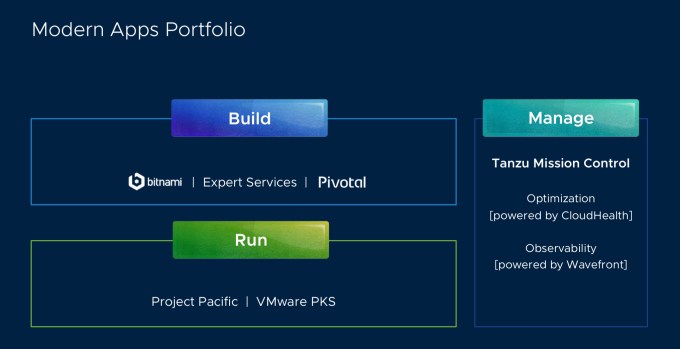
VMware Tanzu (Slide: VMware)
McLuckie sees bringing virtual machine and Kubernetes together in this fashion provides a couple of key advantages. “One is being able to bring a robust, modern API-driven way of thinking about accessing resources. And it turns out that there is this really good technology for that. It’s called Kubernetes. So being able to bring a Kubernetes control plane to vSphere is creating a new set of experiences for traditional VMware customers that is moving much closer to a kind of cloud-like agile infrastructure type of experience. At the same time, vSphere is bringing a whole bunch of capabilities to Kubernetes that’s creating more efficient isolation capabilities,” he said.
When you think about the cloud-native vision, it has always been about enabling companies to manage resources wherever they live through a single lens, and this is what this set of capabilities that VMware has brought together under Tanzu is intended to do. “Kubernetes is a way of bringing a control metaphor to modern IT processes. You provide an expression of what you want to have happen, and then Kubernetes takes that and interprets it and drives the world into that desired state,” McLuckie explained.
If VMware can take all of the pieces in the Tanzu vision and make this happen, it will be as powerful as McLuckie believes it to be. It’s certainly an interesting attempt to bring all of a company’s application and infrastructure creation and management under one roof using Kubernetes as the glue — and with Heptio co-founders McLuckie and Beda involved, it certainly has the expertise in place to drive the vision.
Powered by WPeMatico
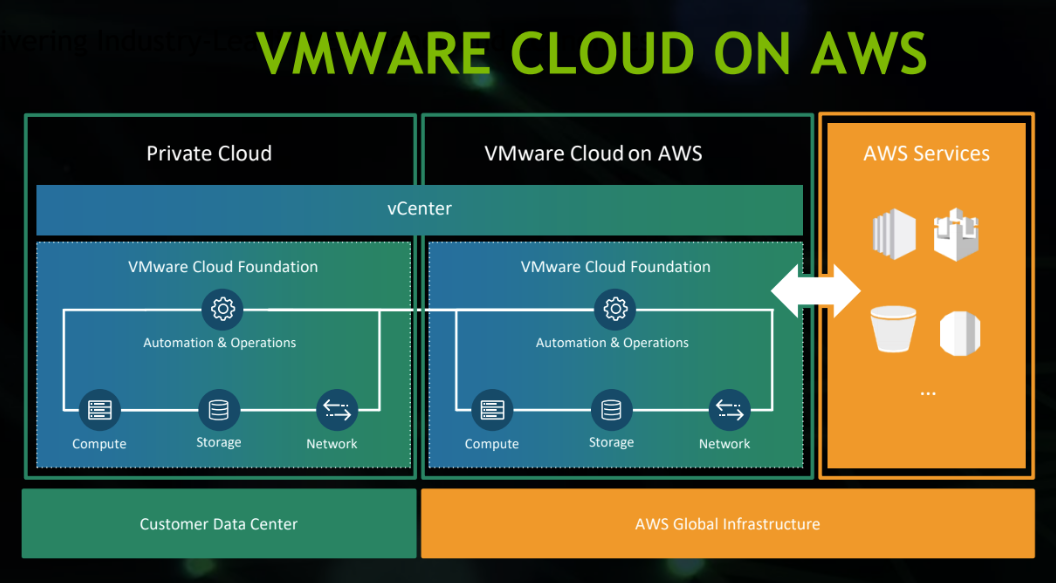
Nvidia today announced that it has been working with VMware to bring its virtual GPU technology (vGPU) to VMware’s vSphere and VMware Cloud on AWS. The company’s core vGPU technology isn’t new, but it now supports server virtualization to enable enterprises to run their hardware-accelerated AI and data science workloads in environments like VMware’s vSphere, using its new vComputeServer technology.
Traditionally (as far as that’s a thing in AI training), GPU-accelerated workloads tend to run on bare metal servers, which were typically managed separately from the rest of a company’s servers.
“With vComputeServer, IT admins can better streamline management of GPU accelerated virtualized servers while retaining existing workflows and lowering overall operational costs,” Nvidia explains in today’s announcement. This also means that businesses will reap the cost benefits of GPU sharing and aggregation, thanks to the improved utilization this technology promises.
Note that vComputeServer works with VMware Sphere, vCenter and vMotion, as well as VMware Cloud. Indeed, the two companies are using the same vComputeServer technology to also bring accelerated GPU services to VMware Cloud on AWS. This allows enterprises to take their containerized applications and from their own data center to the cloud as needed — and then hook into AWS’s other cloud-based technologies.
“From operational intelligence to artificial intelligence, businesses rely on GPU-accelerated computing to make fast, accurate predictions that directly impact their bottom line,” said Nvidia founder and CEO Jensen Huang . “Together with VMware, we’re designing the most advanced and highest performing GPU- accelerated hybrid cloud infrastructure to foster innovation across the enterprise.”
Powered by WPeMatico