Enterprise
Auto Added by WPeMatico
Auto Added by WPeMatico
TechCrunch is live from San Francisco’s YBCA’s Blue Shield of California Theater, where we’re hosting our first event dedicated to the enterprise. Throughout the day, attendees and viewers can expect to hear from industry experts and partake in discussions about the potential of new technologies like quantum computing and AI, how to deal with the onslaught of security threats, investing in early-stage startups and plenty more.
We’ll be joined by some of the biggest names and the smartest and most prescient people in the industry, including Bill McDermott at SAP, Scott Farquhar at Atlassian, Julie Larson-Green at Qualtrics, Wendy Nather at Duo Security, Aaron Levie at Box and Andrew Ng at Landing AI.
Our agenda showcases some of the powerhouses in the space, but also plenty of smaller teams that are building and debunking fundamental technologies in the industry.
Investing with an Eye to the Future
Jason Green (Emergence Capital), Maha Ibrahim (Canaan Partners) and Rebecca Lynn (Canvas Ventures)
9:35 AM – 10:00 AM
In an ever-changing technological landscape, it’s not easy for VCs to know what’s coming next and how to place their bets. Yet, it’s the job of investors to peer around the corner and find the next big thing, whether that’s in AI, serverless, blockchain, edge computing or other emerging technologies. Our panel will look at the challenges of enterprise investing, what they look for in enterprise startups and how they decide where to put their money.
Talking Shop
Scott Farquhar (Atlassian)
10:00 AM – 10:20 AM
With tools like Jira, Bitbucket and Confluence, few companies influence how developers work as much as Atlassian. The company’s co-founder and co-CEO Scott Farquhar will join us to talk about growing his company, how it is bringing its tools to enterprises and what the future of software development in and for the enterprise will look like.
Q&A with Investors
10:10 AM – 10:40 AM
Your chance to ask questions of some of the greatest investors in enterprise.
Innovation Break: Deliver Innovation to the Enterprise
Monty Gray (Okta), DJ Paoni (SAP), Sanjay Poonen (VMware) and Shruti Tournatory (Sapphire Ventures)
10:20 AM – 10:40 AM
For startups, the appeal of enterprise clients is not surprising — signing even one or two customers can make an entire business, and it can take just a few hundred to build a $1 billion unicorn company. But while corporate counterparts increasingly look to the startup community for partnership opportunities, making the jump to enterprise sales is far more complicated than scaling up the strategy startups already use to sell to SMBs or consumers. Hear from leaders who have experienced successes and pitfalls through the process as they address how startups can adapt their strategy with the needs of the enterprise in mind. Sponsored by SAP.
Apple in the Enterprise
10:40 AM – 11:00 AM
Apple’s Susan Prescott has been at the company since the early days of the iPhone, and she has seen the company make a strong push into the enterprise, whether through tooling or via strategic partnerships with companies like IBM, SAP and Cisco.
Box’s Enterprise Journey
Aaron Levie (Box)
11:15 AM – 11:35 AM
Box started life as a consumer file-storage company and transformed early on into a successful enterprise SaaS company, focused on content management in the cloud. Levie will talk about what it’s like to travel the entire startup journey — and what the future holds for data platforms.
Bringing the Cloud to the Enterprise
Mark Russinovich (Microsoft)
11:35 AM – 12:00 PM
Cloud computing may now seem like the default, but that’s far from true for most enterprises, which often still have tons of legacy software that runs in their own data centers. What does it mean to be all-in on the cloud, which is what Capital One recently accomplished. We’ll talk about how companies can make the move to the cloud easier, what not to do and how to develop a cloud strategy with an eye to the future.
Keeping the Enterprise Secure
Martin Casado (Andreessen Horowitz), Emily Heath (United Airlines) and Wendy Nather (Duo Security)
1:00 PM – 1:25 PM
Enterprises face a litany of threats from both inside and outside the firewall. Now more than ever, companies — especially startups — have to put security first. From preventing data from leaking to keeping bad actors out of your network, enterprises have it tough. How can you secure the enterprise without slowing growth? We’ll discuss the role of a modern CSO and how to move fast… without breaking things.
Keeping an Enterprise Behemoth on Course
Bill McDermott (SAP)
1:25 PM – 1:45 PM
With over $166 billion is market cap, Germany-based SAP is one of the most valuable tech companies in the world today. Bill McDermott took the leadership in 2014, becoming the first American to hold this position. Since then, he has quickly grown the company, in part thanks to a number of $1 billion-plus acquisitions. We’ll talk to him about his approach to these acquisitions, his strategy for growing the company in a quickly changing market and the state of enterprise software in general.
How Kubernetes Changed Everything
Brendan Burns (Microsoft), Tim Hockin (Google Cloud), Craig McLuckie (VMware) and Aparna Sinha (Google)
1:45 PM – 2:15 PM
You can’t go to an enterprise conference and not talk about Kubernetes, the incredibly popular open-source container orchestration project that was incubated at Google. For this panel, we brought together three of the founding members of the Kubernetes team and the current director of product management for the project at Google to talk about the past, present and future of the project and how it has changed how enterprises think about moving to the cloud and developing software.
Innovation Break: The Future of Data in an Evolving Landscape
Alisa Bergman (Adobe Systems), Jai Das (Sapphire Ventures) and Sanjay Kumar (Geospatial Media) moderated by: Nikki Helmer (SAP)
2:15 PM – 2:35 PM
Companies have historically competed by having data in their toolbox, and gleaning insights to make key business decisions. However, increased regulatory and societal scrutiny is requiring companies to rethink this approach. In this session, we explore the challenges and opportunities that businesses will experience as these conversations evolve. Sponsored by SAP.
AI Stakes its Place in the Enterprise
Marco Casalaina (Salesforce), Jocelyn Goldfein (Zetta Venture Partners) and Bindu Reddy (Reality Engines)
2:35 PM – 3:00 PM
AI is becoming table stakes for enterprise software as companies increasingly build AI into their tools to help process data faster or make more efficient use of resources. Our panel will talk about the growing role of AI in enterprise for companies big and small.
Q&A with Founders
3:00 PM – 3:30 PM
Your chance to ask questions of some of the greatest startup minds in enterprise technology.
The Trials and Tribulations of Experience Management
Amit Ahuja (Adobe), Julie Larson-Green (Qualtrics) and Peter Reinhardt (Segment)
3:15 PM – 3:40 PM
As companies gather more data about their customers, it should theoretically improve the customer experience, buy myriad challenges face companies as they try to pull together information from a variety of vendors across disparate systems, both in the cloud and on prem. How do you pull together a coherent picture of your customers, while respecting their privacy and overcoming the technical challenges? We’ll ask a team of experts to find out.
Innovation Break: Identifying Overhyped Technology Trends
James Allworth (Cloudflare), George Mathew (Kespry) and Max Wessel (SAP)
3:40 PM – 4:00 PM
For innovation-focused businesses, deciding which technology trends are worth immediate investment, which trends are worth keeping on the radar and which are simply buzzworthy can be a challenging gray area to navigate and may ultimately make or break the future of a business. Hear from these innovation juggernauts as they provide their divergent perspectives on today’s hottest trends, including Blockchain, 5G, AI, VR and more. Sponsored by SAP.
Fireside Chat
Andrew Ng (Landing AI)
4:00 PM – 4:20 PM
Few technologists have been more central to the development of AI in the enterprise than Andrew Ng. With Landing AI and the backing of many top venture firms, Ng has the foundation to develop and launch the AI companies he thinks will be winners. We will talk about where Ng expects to see AI’s biggest impacts across the enterprise.
The Quantum Enterprise
Jim Clarke (Intel), Jay Gambetta (IBM) and Krysta Svore (Microsoft)
4:20 PM – 4:45 PM
While we’re still a few years away from having quantum computers that will fulfill the full promise of this technology, many companies are already starting to experiment with what’s available today. We’ll talk about what startups and enterprises should know about quantum computing today to prepare for tomorrow.
Overcoming the Data Glut
Benoit Dageville (Snowflake), Ali Ghodsi (Databricks) and Murli Thirumale (Portworx)
4:45 PM – 5:10 PM
There is certainly no shortage of data in the enterprise these days. The question is how do you process it and put it in shape to understand it and make better decisions? Our panel will discuss the challenges of data management and visualization in a shifting technological landscape where the term “big data” doesn’t begin to do the growing volume justice.
Powered by WPeMatico
It turns out GDPR was just the tip of the privacy iceberg. With California’s privacy law coming on line January 1st and dozens more in various stages of development, it’s clear that governments are taking privacy seriously, which means companies have to as well. New York startup BigID, which has been developing a privacy platform for the last several years, finds itself in a good position to help. Today, the company announced a $50 million Series C.
The round was led by Bessemer Venture Partners with help from SAP.io Fund, Comcast Ventures, Boldstart Ventures, Scale Venture Partners and ClearSky. New investor Salesforce Ventures also participated. Today’s investment brings the total raised to more than $96 million, according to Crunchbase.
In addition to the funding, the company is also announcing the formation of a platform of sorts, which will offer a set of privacy services for customers. It includes data discovery, classification and correlation. “We’ve separated the product into some constituent parts. While it’s still sold as a broad-based solution, it’s much more of a platform now in the sense that there’s a core set of capabilities that we heard over and over that customers want,” CEO and co-founder Dimitri Sirota told TechCrunch.
He says that these capabilities really enable customers to see connections in the data across a set of disparate data sources. “There are a lot of products that do the request part, but there’s nobody that’s able to look across your entire data landscape, the hundreds of petabytes, and pick out the data in Salesforce, Workday, AWS, mainframe, and all these places you could have data on [an individual], and show how it’s all tied together,” Sirota explained.
It’s interesting to see the mix of strategic investors and traditional venture capitalists that are investing in the company. The strategics in particular see the privacy landscape as well as anyone, and Sirota says it’s a case of privacy mattering more than ever and his company providing the means to navigate the changing landscape. “Consumers care about privacy, which means legislators care about it, which ultimately means companies have to care about it,” he said. He added, “Strategics, whether they are companies that collect personal data or those that sell to those companies, therefore have an interest in BigID .”
The company has been growing fast and raising money quickly to help it scale to meet demand. Starting in January 2018, it raised $14 million. Just six months later, it raised another $30 million and you can tack on today’s $50 million. Sirota says having money in the bank and seeing these investments helps give enterprise customers confidence that the company is in this for the long haul.
Sirota wouldn’t give an exact valuation, only saying that while the company is not a unicorn, the valuation was a “robust number.” He says the plan now it to keep expanding the platform, and there will be announcements coming soon around partnerships, customers and new capabilities.
Sirota will be appearing at TechCrunch Sessions: Enterprise on September 5th at 11 am on the panel “Cracking the Code: From Startup to Scaleup in Enterprise Software.”
Powered by WPeMatico
Palo Alto Networks surely loves to buy security startups. Today it added to its growing collection when it announced its intent to acquire IoT security startup Zingbox for $75 million.
The company had raised $23.5 million, according to Crunchbase data. The three co-founders, Xu Zou, May Wang and Jianlin Zeng, will be joining Palo Alto after the sale is official.
With Zingbox, the company gets IoT security chops, something that is increasingly important as companies deploy internet-connected smart devices and sensors. While these tools can greatly benefit customers, they also often carry a huge security risk.
Zingbox, which was founded in 2014, gives Palo Alto a modern cloud-based solution built on a subscription model along with engineering talent to help build out the solution further. Nikesh Arora, chairman and CEO of Palo Alto Networks, certainly sees this.
“The proliferation of IoT devices in enterprises has left customers facing an enormous gap in protection against cybersecurity attacks. With the proposed acquisition of Zingbox, we will provide a first-of-its-kind subscription for our Next-Generation Firewall and Cortex platforms that gives customers the ability to gain control, visibility and security of their connected devices at scale,” Arora said in a statement.
This is the fourth security startup the company has purchased this year. It acquired two companies, nabbing PureSec and Twistlock, on the same day last Spring. Earlier this year, it bought Demisto for $560 million. All of these acquisitions are meant to build up the company’s portfolio of modern security offerings without having to build these kinds of tools in-house from scratch.
Powered by WPeMatico
Starboard Value, LP revealed in an SEC Form 13D filing last week that it owns a 7.5% stake in Box, the cloud content management company.
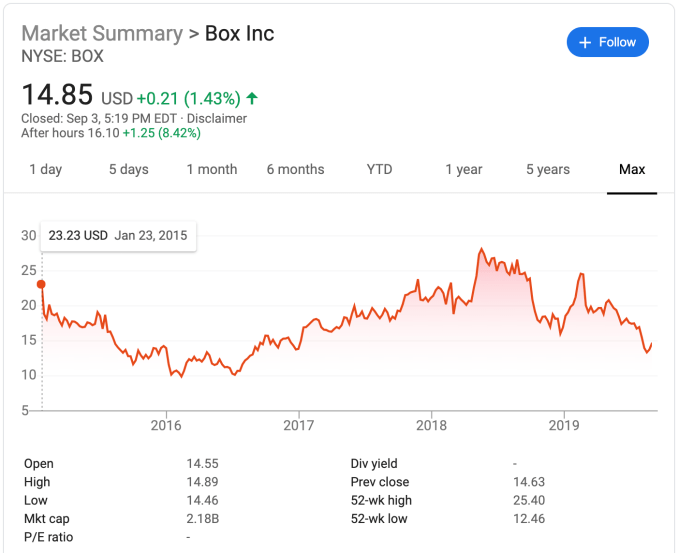
It is probably not a coincidence that Starboard Value looks for undervalued stocks. Box stock has been on a price roller coaster ride, since it went public in 2015 at a price of $14.00 per share before surging to $23.23 per share. It had high share price of $28.12 in May 2018, but the price dipped into the teens in March and was at $14.85 as we went to press. It has a 52-week low price of $12.46 per share.
As for Box, it wasn’t saying much. “While we do not comment on interactions with our investors, Box is committed to maintaining an active and engaged dialogue with stockholders. The Board of Directors and management team are focused on delivering growth and profitability to drive long-term stockholder value as we continue to pioneer the Cloud Content Management market,” a Box spokesperson told TechCrunch.
The company, which began life as a consumer storage company, made the transition to enterprise software several years after it launched in 2005. It raised more than $500 million along the way, and was a Silicon Valley SaaS darling until it filed its S-1 in 2014.
The S-1 revealed massive sales and marketing spending, and critics came down hard on the company. That led to one of the longest IPO delays in memory, taking 9 month from the time the company filed until it finally had its IPO in January 2015.
In its most recent earnings report last week, Box announced $172.5M in revenue for for the quarter, putting it on a run rate close to $700M.
Levie will be appearing at TechCrunch Sessions: Enterprise on Thursday.
We emailed Starboard Value for comment on this article. Should it respond, we will update the article.
Powered by WPeMatico
Data is the new oil, as the saying goes, and today Kabbage — a fintech startup backed by SoftBank that has built a business around lending up to $250,000 to small and medium enterprises, using AI-based algorithms to help determine the terms of the loan — is picking up an asset to expand its own data trove as it looks to expand into further SMB financial services. The company has acquired Radius Intelligence, the marketing technology firm that has built a database of information on some 20 million small and medium businesses in the U.S.
Terms of the deal are not being disclosed, but notably, it comes on the heels of a sightly tumultuous period for Radius . Last year, the company announced a merger with its big competitor Leadspace, only to quietly cancel the deal three months later. Then two months after that, it replaced its longtime CEO.
Radius — which is backed by some $120 million from investors that include Founders Fund, David Sacks, Salesforce Ventures, AME Cloud Ventures and the actor Jared Leto, among others — last had a valuation of around $200 million, according to PitchBook, but that was prior to these events. Kabbage, meanwhile, has raised hundreds of millions in equity and debt and is valued at more than $1 billion. The deal will be financed off Kabbage’s own balance sheet and will not require the company to raise more funds, I understand.
Rob Frohwein, Kabbage’s co-founder and CEO, said in an interview that the plan is to integrate Radius’ tech and IP into the Kabbage platform — the task will be overseen by Radius’ current CEO, Joel Carusone — as well as Radius’ tech team of 20 engineers, who will work for the Atlanta-based startup out of its office in San Francisco.
He also added that Radius’ current products — which include market intelligence and contact information for employees at SMBs in the U.S., along with a host of related solutions, which up to now had been gathered both via public sources and the businesses updating the information themselves; as well as the technology for merging disparate sources of data and ferreting out the “valid” pieces that are worth retaining and throwing out what is out of date — will not be sold any longer via Radius. From now on, there will be only one customer for all that data: Kabbage itself (the company had already been a user of Radius’ data to help its own marketing team connect with new and and existing customers).
“We have known the company for a long time,” said Frohwein. Other customers that Radius lists on its site include Square, American Express, LendingTree, FirstData, MetLife, Sam’s Club, Yahoo and more.
This doesn’t mean that Kabbage might not offer the SMB intelligence in a format to businesses directly via its own platform at some point, but it also means that as Kabbage expands into services that might compete with some of Radius’ now-former customers — payments and merchant acquirer services, as well as tools to help SMBs grow their own customer funnels are some that are on the cards for the coming months — it will have an edge on them because of the data on users that it will now own.
The deal underscores two bigger trends among startups that focus on enterprise customers. First, it points to ongoing consolidation in the world of marketing tech, in part as businesses look for ways to better compete against the likes of Microsoft and Salesforce, which are also continually building out their stacks of services. And we likely will see more activity from stronger fintech companies keen to expand their platforms to provide more touchpoints and revenue streams from existing customers, as well as more services to expand the customer base overall.
“We’re thrilled to join the Kabbage team. As a company dedicated to small business analytics and data management, we’ve always had a deep respect for Kabbage’s data-driven technology and focus,” Radius CEO Carusone said in a statement. “Our companies have complementary technical architectures and domain experience for decision making. With Kabbage, we can build a more sophisticated analytics solution to identify, reach and serve small businesses.”
Kabbage itself is not looking for new funding at the moment, Frohwein said, but he added also that it is on a fast trajectory at the moment but still a ways away from an IPO, so I wouldn’t discount more raises in the future. The company is currently on track to see revenues up 40% versus last year, with customers up 60%.
“We’re always looking to grow,” he said.
Powered by WPeMatico
OpenGov, the firm co-founded by Palantir’s Joe Lonsdale that helps government and other civic organizations organise, analyse and present financial and other data using cloud-based architecture, has raised another big round of funding to continue expanding its business. The startup has picked up an additional $51 million in a Series D round led by Weatherford Capital and 8VC (Lonsdale’s investment firm), with participation from existing investor Andreessen Horowitz.
The funding brings the total raised by the company to $140 million, with previous investors in the firm including JC2 Ventures, Emerson Collective, Founders Fund and a number of others. The company is not disclosing its valuation — although we are asking — but for some context, PitchBook noted it was around $190 million in its last disclosed round — although that was in 2017 and has likely increased in the interim, not least because of the startup’s links in high places, and its growth.
On the first of these, the company says that its board of directors includes, in addition to Lonsdale (who is now the chairman of the company); Katherine August-deWilde, Co-Founder and Vice-Chair of First Republic Bank; John Chambers, Founder and CEO of JC2 Ventures and Former Chairman and CEO of Cisco Systems; Marc Andreessen, Co-Founder and General Partner of Andreessen Horowitz; and Zac Bookman, Co-Founder and CEO of OpenGov .
And in terms of its growth, OpenGov says today it counts more than 2,000 governments as customers, with recent additions to the list including the State of West Virginia, the State of Oklahoma, the Idaho State Controller’s Office, the City of Minneapolis MN, and Suffolk County NY. For comparison, when we wrote in 2017 about the boost the company had seen since Trump’s election (which has apparently seen a push for more transparency and security of data), the company noted 1,400 government customers.
Government data is generally associated with legacy systems and cripplingly slow bureaucratic processes, and that has spelled opportunity to some startups, who are leveraging the growth of cloud services to present solutions tailored to the needs of civic organizations and the people who work in them, from city planners to finance specialists. In the case of OpenGov, it packages its services in a platform it calls the OpenGov Cloud.
“OpenGov’s mission to power more effective and accountable government is driving innovation and transformation for the public sector at high speed,” said OpenGov CEO Zac Bookman in a statement. “This new investment validates OpenGov’s position as the leader in enterprise cloud solutions for government, and it fuels our ability to build, sell, and deploy new mission-critical technology that is the safe and trusted choice for government executives.”
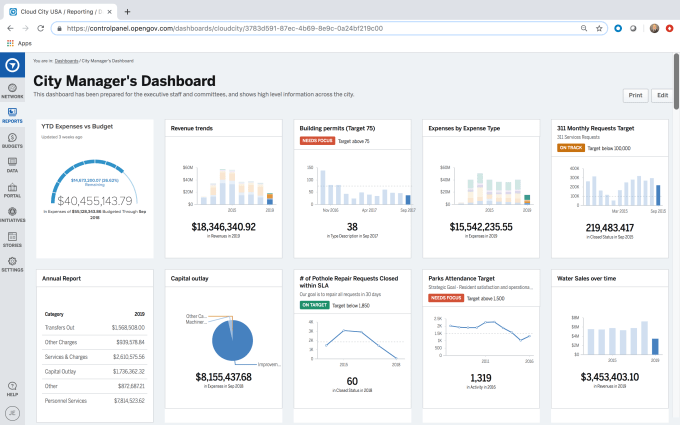
It’s also, it seems, a trusted choice for government executives who have left public service and moved into investing, leveraging some of the links they still have into those who manage procurement for public services. Weatherford Capital, one of the lead investors, is led in part by managing partner Will Weatherford, who is the former Speaker of the House for the State of Florida.
“OpenGov’s innovative technology, accomplished personnel, market leadership, and mission-first approach precisely address the growing challenges inherent in public administration,” he said in a statement. “We are thrilled at the opportunity to partner with OpenGov to accelerate its growth and continue modernizing how this important sector operates.”
It will be interesting to see how and if the company uses the funding to consolidate in its particular area of enterprise technology. There are other firms like LiveStories that have also been building services to help better present civic data to the public that you could see as complementary to what OpenGov is doing. OpenGov has made acquisitions in the past, such as Ontodia to bring more open-source data and technology into its platform.
Powered by WPeMatico
Salesforce chairman, co-founder and CEO Marc Benioff took a lot of big chances when he launched the company 20 years ago. For starters, his was one of the earliest enterprise SaaS companies, but he wasn’t just developing a company on top of a new platform, he was building one from scratch with social responsibility built-in.
Fast-forward 20 years and that company is wildly successful. In its most recent earnings report, it announced a $4 billion quarter, putting it on a $16 billion run rate, and making it by far the most successful SaaS company ever.
But at the heart of the company’s DNA is a charitable streak, and it’s not something they bolted on after getting successful. Even before the company had a working product, in the earliest planning documents, Salesforce wanted to be a different kind of company. Early on, it designed the 1-1-1 philanthropic model that set aside 1% of Salesforce’s equity, and 1% of its product and 1% of its employees’ time to the community. As the company has grown, that model has serious financial teeth now, and other startups over the years have also adopted the same approach using Salesforce as a model.
In our coverage of Dreamforce, the company’s enormous annual customer conference, in 2016, Benioff outlined his personal philosophy around giving back:
You are at work, and you have great leadership skills. You can isolate yourselves and say I’m going to put those skills to use in a box at work, or you can say I’m going to have an integrated life. The way I look at the world, I’m going to put those skills to work to make the world a better place.
This year Benioff is coming to TechCrunch Disrupt in San Francisco to discuss with TechCrunch editors how to build a highly successful business, while giving back to the community and the society your business is part of. In fact, he has a book coming out in mid-October called Trailblazer: The Power of Business as the Greatest Platform for Change, in which he writes about how businesses can be a positive social force.
Benioff has received numerous awards over the years for his entrepreneurial and charitable spirit, including Innovator of the Decade from Forbes, one of the World’s 25 Greatest Leaders from Fortune, one of the 10 Best-Performing CEOs from Harvard Business Review, GLAAD, the Billie Jean King Leadership Initiative for his work on equality and the Variety Magazine EmPOWerment Award.
It’s worth noting that in 2018, a group of 618 Salesforce employees presented Benioff with a petition protesting the company’s contract with the Customs and Border Patrol (CBP). Benioff in public comments stated that the tools were being used in recruitment and management, and not helping to separate families at the border. While Salesforce did not cancel the contract, at the time, co-CEO Keith Block stated that the company would donate $1 million to organizations helping separated families, as well as match any internal employee contributions through its charitable arm, Salesforce.org.
Disrupt SF runs October 2 to October 4 at the Moscone Center in the heart of San Francisco. Tickets are available here.
Did you know Extra Crunch annual members get 20% off all TechCrunch event tickets? Head over here to get your annual pass, and then email extracrunch@techcrunch.com to get your 20% discount. Please note that it can take up to 24 hours to issue the discount code.
Powered by WPeMatico
If you think about the traditional hotel business, there hasn’t been a ton of innovation. You mostly still stand in a line to check in, and sometimes even to check out. You let the staff know about your desire for privacy with a sign on the door. Mews believes it’s time to rethink how hotels work in a more modern digital context, especially on the administrative side, and today it announced a $33 million Series B led by Battery Ventures.
When Mews founder Richard Valtr started his own hotel in Prague in 2012, he wanted to change how hotels have operated traditionally. “I really wanted to change the way that hotel systems are built to make sure that it’s more about the experience that the guest is actually having, rather than facilitating the kind of processes that hotels have built over the last hundred years,” Valtr told TechCrunch.
He said most of the innovation in this space has been in the B2C area, using Airbnb as a prime example. He wants to bring that kind of change to the way hotels operate. “That’s essentially what Mews is trying to do. [We want to shift the focus to] the fundamental things about why we love to travel and why people actually love to stay in hotels, experience hotels, and be cared for by professional staff. We are trying to do that in a way that that actually delivers a really meaningful experience and personalized experience to that one particular customer,” he explained.
For starters, Mews is a cloud-based system that automates a lot of the manual tasks, like room assignments that hotel staff at many hotels often still have to handle as part of their jobs. Valtr believes by freeing the staff from these kinds of tedious activities, it enables them to concentrate more on the guests.
It also offers ways for guests and hotels to customize their stays to get the best experience possible. Valtr says this approach brings a new level of flexibility that allows hotels to create new revenue opportunities, while letting guests choose the kind of stay they want.
From a guest perspective, they could by-pass the check-in process altogether, sharing all of their registration details ahead of time and getting a pass code sent to their phone to get into the room. The system integrates with third-party hotel booking sites like Booking.com and Expedia, as well as other services, through its open hospitality API, which offers lots of opportunities for properties to partner with local businesses.
The company is currently operating at 1,000 properties across 47 countries, but it lacks a presence in the U.S. and wants to use this round to open an office in NYC and expand into this market. “We really want to attack the U.S. market because that’s essentially where most of the decision makers for all of the major chains are. And we’re not going to change the industry if we don’t actually change the thinking of the biggest brands,” Valtr said.
Today, the company has 270 employees spread across 10 offices around the world. Headquarters are in Prague and London, but the company is in the process of opening that NYC office, and the number of employees will expand when that happens.
Powered by WPeMatico
Software APIs help different tools communicate with one another, let developers access essential services without having to code it themselves and are critical components for driving a platform-driven strategy. Yet they require solid documentation to help make the best use of them. ReadMe, a startup that helps companies customize their API documentation, announced a $9 million Series A today led by Accel with help from Y Combinator. The company was part of the Y Combinator Winter 2015 cohort.
Prior to today’s funding announcement, the company had taken just a $1.2 million seed round in 2014. Today, it reports 3,000 paying customers and that it has been profitable for the last several years, an unusual position for a startup. In spite of this success, co-founder and CEO Gregory Koberger said as the company has taken on larger customers, they have more sophisticated requirements, and that prompted them to take this round of funding.
In addition, it has expanded the platform to use a company’s API logs to help create more dynamic documentation and improve customer support kinds of scenarios. But by taking on data from other companies, it needs to make sure the data is secure, and today’s funding will help in that regard.
“We’re going to still build the company traditionally by hiring more engineers, more support people, more designers, the obvious stuff, but the main impetus for doing this was that we started working with bigger companies with more secure data. So a lot of the money is going to help make sure that we handle that right,” Koberger explained.
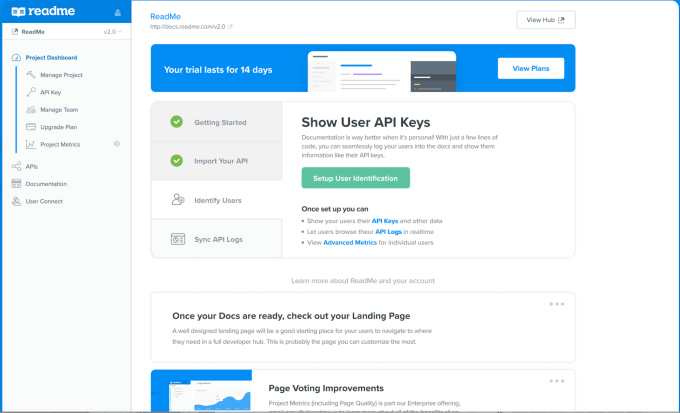
Image: ReadMe
He says this ability to make use of the API logs has opened up all kinds of possibilities for the company, as the data provides a valuable window into how people use the APIs. “It’s amazing how much you get by just actually seeing what the server sees. When people are having problems with an API, they can debug it themselves because they can actually see the problems, the support team can see it as well,” Koberger said.
Accel’s Dan Levine, whose firm is leading the investment, believes that having good documentation is the difference between making and breaking an API. “APIs don’t just create technical integration, they create ecosystems around core services and underpin corporate partnerships that generate billions of dollars. ReadMe is as much a strategy as it is a service for businesses. Providing clean, interactive, data-driven API documentation to make developers love working with you can be the difference between 100 partnerships or 1,000 partnerships,” Levine said.
ReadMe was founded in 2014. It has 22 employees in their San Francisco office, a number that should increase with today’s funding.
Powered by WPeMatico
ThoughtSpot was started by a bunch of ex-Googlers looking to bring the power of search to data. Seven years later the company is growing fast, sporting a fat valuation of almost $2 billion and looking ahead to a possible IPO. Today it announced a hefty $248 million Series E round as it continues on its journey.
Investors include Silver Lake Waterman, Silver Lake’s late-stage growth capital fund, along with existing investors Lightspeed Venture Partners, Sapphire Ventures and Geodesic Capital. Today’s funding brings the total raised to $554 million, according to the company.
The company wants to help customers bring speed to data analysis by answering natural language questions about the data without having to understand how to formulate a SQL query. As a person enters questions, ThoughtSpot translates that question into SQL, then displays a chart with data related to the question, all almost instantly (at least in the demo).
It doesn’t stop there though. It also uses artificial intelligence to understand intent to help come up the exact correct answer. ThoughtSpot CEO Sudheesh Nair says that this artificial intelligence underpinning is key to the product. As he explained, if you are looking for the answer to a specific question, like “What is the profit margin of red shoes in Portland?,” there won’t be multiple answers. There is only one answer, and that’s where artificial intelligence really comes into play.
“The bar on delivering that kind of answer is very high and because of that, understanding intent is critical. We use AI for that. You could ask, ‘How did we do with red shoes in Portland?’ I could ask, ‘What is the profit margin of red shoes in Portland?’ The system needs to know that we both are asking the same question. So there’s a lot of AI that goes behind it to understand the intent,” Nair explained.
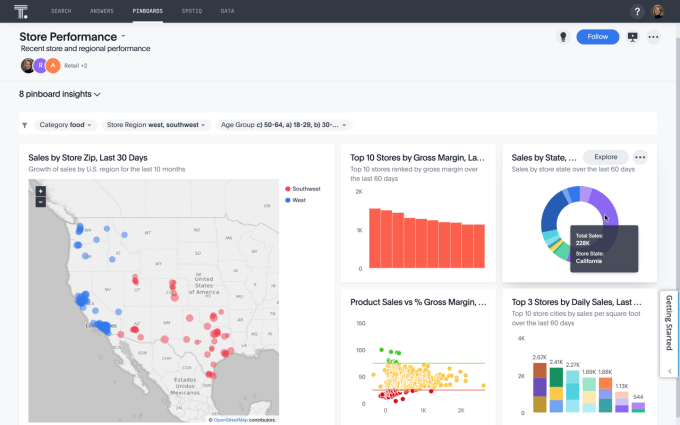
Image: ThoughtSpot
ThoughtSpot gets answers to queries by connecting to a variety of internal systems, like HR, CRM and ERP, and uses all of this data to answer the question, as best it can. So far, it appears to be working. The company has almost 250 large-company customers, and is on a run rate of close to $100 million.
Nair said the company didn’t necessarily need the money, with $100 million still in the bank, but he saw an opportunity, and he seized it. He says the money gives him a great deal of flexibility moving forward, including the possibility of acquiring companies to fill in missing pieces or to expand the platform’s capabilities. It also will allow him to accelerate growth. Plus, he sees the capital markets possibly tightening next year and he wanted to strike while the opportunity was in front of him.
Nair definitely sees the company going public at some point. “With these kind of resources behind us, it actually opens up an opportunity for us to do any sort of IPO that we want. I do think that a company like this will benefit from going public because Global 2000 kind of customers, where we have our most of our business, appreciate the transparency and the stability represented by public companies,” he said.
He added, “And with $350 million in the bank, it’s totally [possible to] IPO, which means that a year and a half from now if we are ready to take the company public, we can actually have all options open, including a direct listing, potentially. I’m not saying we will do that, but I’m saying that with this kind of funding behind us, we have all those options open.”
Powered by WPeMatico