Enterprise
Auto Added by WPeMatico
Auto Added by WPeMatico
HPE announced today that it has acquired Scytale, a cloud native security startup that is built on the open-source Secure Production Identity Framework for Everyone (SPIFFE) protocol. The companies did not share the acquisition price.
Specifically, Scytale looks at application-to-application identity and access management, something that is increasingly important as more transactions take place between applications without any human intervention. It’s imperative that the application knows it’s OK to share information with the other application.
This is an area that HPE wants to expand into, Dave Husak, HPE fellow and GM of cloudless initiative wrote in a blog post announcing the acquisition. “As HPE progresses into this next chapter, delivering on our differentiated, edge to cloud platform as-a-service strategy, security will continue to play a fundamental role. We recognize that every organization that operates in a hybrid, multi-cloud environment requires 100% secure, zero trust systems, that can dynamically identify and authenticate data and applications in real-time,” Husak wrote.
He also was careful to stress that HPE would continue to be good stewards of the SPIFFE and SPIRE (the SPIFFE Runtime Environment) projects, both of which are under the auspices of the Cloud Native Computing Foundation.
Scytale co-founder Sunil James, writing in a blog post about the deal, indicated that this was important to the founders that HPE respect the startup’s open-source roots. “Scytale’s DNA is security, distributed systems, and open-source. Under HPE, Scytale will continue to help steward SPIFFE. Our ever-growing and vocal community will lead us. We’ll toil to maintain this transparent and vendor-neutral project, which will be fundamental in HPE’s plans to deliver a dynamic, open, and secure edge-to-cloud platform,” he wrote.
Scytale was founded in 2017 and had raised $8 million, according to PitchBook data. The bulk of that was in a $5 million Series A last March led by Bessemer. The deal closed today.
Powered by WPeMatico
Microsoft Teams, the collaboration platform that competes with Slack, has been down since about 8:30 am ET. Microsoft reports the outage was due to an expired certificate.
Microsoft first posted on its Office 365 Status Twitter feed about 9:00 am ET that an outage was in progress, stating the company was looking into the problem.
We’re investigating an issue where users may be unable to access Microsoft Teams. We’re reviewing systems data to determine the cause of the issue. More information can be found in the Admin center under TM202916
— Microsoft 365 Status (@MSFT365Status) February 3, 2020
At approximately 10:00 am ET, the company posted the reason for the problem, an expired certificate, which frankly, has to be pretty embarrassing for the group responsible for keeping the Teams service running.
We’ve determined that an authentication certificate has expired causing, users to have issues using the service. We’re developing a fix to apply a new certificate to the service which will remediate impact. Further updates can be found under TM202916 in the admin center.
— Microsoft 365 Status (@MSFT365Status) February 3, 2020
About an hour ago, the company updated the status again, indicating it had begun deploying the updated certificate.
We’ve initiated the deployment of the updated certificate and are monitoring service health as the fix progresses. Additional information can be found under TM202916 in the admin center.
— Microsoft 365 Status (@MSFT365Status) February 3, 2020
Some customers have begun reporting on Twitter that service has been restored.
Microsoft has kept the status updates pretty business like, but has not apologized to its 20 million users as of publication. The company is in the midst of a battle with Slack for hearts and minds in the enterprise collaboration space, and a preventable outage has to be awkward for them.
The company will no doubt do a post-mortem to figure out how this mistake happened and how to prevent this kind of issue from taking down the site again. While every service is going to experience an outage from time to time, it’s up to the organization to understand why it happened and put systems in place to keep a preventable incident like this one from happening again in the future.
Powered by WPeMatico
When Ginni Rometty steps down as CEO at IBM in April and her replacement Arvind Krishna takes the helm, more than eight years will have passed since she took the reins at Big Blue. The executive helped lead a massive transformation, but IBM has had a bumpy financial ride throughout her tenure — at one time recording an astonishing 22 straight quarters of declining revenue.
To be fair, Rometty took over at a tumultuous time when technology was shifting from on-prem software stacks to the cloud. She saw what was coming and used the company’s considerable cash position to buy what she needed to make that switch while taking advantage of IBM’s extensive R&D to build other pieces in-house. But the transition took time, which resulted in some financial missteps.
She deserves credit for trying to move the battleship in a new direction — culminating with the $34 billion purchase of Red Hat — even if the results were ultimately mixed.
Rometty was the first woman to lead IBM in an industry where female CEOs are scarce. When she came on board in 2012, there were just 21 women running Fortune 500 companies; last year, that number had risen to 33, still a paltry 6.6%. Along with Safra Catz at Oracle and Lisa Su of Advanced Micro Devices, Rometty has been part of a small group of female CEOs at large technology companies.
Powered by WPeMatico
Back in 2016, Nutanix decided to take the big step of going public. Part of that process was creating a pitch deck and presenting it during its roadshow, a coming-out party when a company goes on tour prior to its IPO and pitches itself to investors of all stripes.
It’s a huge moment in the life of any company, and after talking to CEO Dheeraj Pandey and CFO Duston Williams, one we better understood. They spoke about how every detail helped define their company and demonstrate its long-term investment value to investors who might not have been entirely familiar with the startup or its technology.
Pandey and Williams reported going through more than 100 versions of the deck before they finished the one they took on the road. Pandey said they had a data room checking every fact, every number — which they then checked yet again.
In a separate Extra Crunch post, we looked at the process of building that deck. Today, we’re looking more closely at the content of the deck itself, especially the numbers Nutanix presented to the world. We want to see what investors did more than three years ago and what’s happened since — did the company live up to its promises?
Powered by WPeMatico
The Daily Crunch is TechCrunch’s roundup of our biggest and most important stories. If you’d like to get this delivered to your inbox every day at around 9am Pacific, you can subscribe here.
1. Arvind Krishna will replace Ginni Rometty as IBM CEO in April
Krishna, IBM’s senior vice president for cloud and cognitive software, will take over on April 6 after a couple months of transition. Rometty will remain with the company as chairman of the board.
Krishna reportedly drove the massive $34 billion acquisition of Red Hat at the end of 2018, and there was some speculation at the time that Red Hat CEO Jim Whitehurst was the heir apparent. Instead, the board went with a more seasoned IBM insider for the job, while naming Whitehurst as president.
2. Apple’s redesigned Maps app is available across the US, adds real-time transit for Miami
The redesigned app will include more accurate information overall as well as comprehensive views of roads, buildings, parks, airports, malls and other public places. It will also bring Look Around to more cities and real-time transit to Miami.
3. Social media boosting service exposed thousands of Instagram passwords
The company, Social Captain, says it helps thousands of users to grow their Instagram follower counts by connecting their accounts to its platform. But TechCrunch learned this week Social Captain was storing the passwords of linked Instagram accounts in unencrypted plaintext.
4. Elon Musk just dropped an EDM track on SoundCloud
That is a real headline and I probably don’t need to say much else. Listen to the track, or don’t.
5. Being a child actress prepared me for a career in venture capital
Crystal McKellar played Becky Slater on “The Wonder Years,” and she writes about how that experience prepared her to be a managing partner at Anathem Ventures. (Extra Crunch membership required.)
6. Moda Operandi, an online marketplace for high-end fashion, raises $100M led by NEA and Apax
High-end fashion might not be the first thing that comes to mind when you think about online shopping, but it has actually been a ripe market for the e-commerce industry.
7. Why Sony’s PlayStation Vue failed
Vue launched in March 2015, offering live and on-demand content from more than 85 channels, including many local broadcast stations. But it failed to catch on with a broader audience, despite — or perhaps, because of — its integration with Sony’s PS3 and PS4 devices, and it shut down this week. (Extra Crunch membership required.)

Powered by WPeMatico
When analyzing the cloud market, there are many ways to look at the numbers; revenue, year-over-year or quarter-over-quarter growth — or lack of it — or market share. Each of these numbers tells a story, but in the cloud market, where aggregate growth remains high and Azure’s healthy expansions continues, it’s still struggling to gain meaningful ground on AWS’s lead.
This has to be frustrating to Microsoft CEO Satya Nadella, who has managed to take his company from cloud wannabe to a strong second place in the IaaS/PaaS market, yet still finds his company miles behind the cloud leader. He’s done everything right to get his company to this point, but sometimes the math just isn’t in your favor.
John Dinsdale, chief analyst at Synergy Research, says Microsoft’s growth rate is higher overall than Amazon’s, but AWS still has a big lead in market share. “In absolute dollar terms, it usually has larger increments in revenue numbers and that makes Amazon hard to catch,” he says, adding “what I can say is that this is a very tough gap to close and mathematically it could not happen any time soon, whatever the quarterly performance of Microsoft and AWS.”
The thing to remember with the cloud market is that it’s not even close to being a fixed pie. In fact, it’s growing rapidly and there’s still plenty of market share left to win. As of today, before Amazon has reported, it has a substantial lead, no matter how you choose to measure it.
Powered by WPeMatico
IBM announced today that the board of directors has elected IBM senior vice president for Cloud and Cognitive Software Arvind Krishna to replace current CEO Ginni Rometty. He will take over on April 6th after a couple of months of transition. Rometty will remain with the company as chairman of the board.
Krishna reportedly drove the massive $34 billion acquisition of Red Hat at the end of 2018, and there was some speculation at the time that Red Hat CEO Jim Whitehurst was the heir apparent, but the board went with a more seasoned IBM insider for the job, while naming Whitehurst as president.
In a statement Rometty called Krishna the right man for the job, as she steps back after more than eight years on the job. “Through his multiple experiences running businesses in IBM, Arvind has built an outstanding track record of bold transformations and proven business results, and is an authentic, values-driven leader. He is well-positioned to lead IBM and its clients into the cloud and cognitive era,” she said in a statement.
She added that in choosing Krishna and Whitehurst, the board chose a technically and business savvy team to lead the company moving forward. It’s clear that the board went with two men who have a deep understanding of cloud and cognitive computing technologies, two areas that are obviously going to be front and center of technology for the foreseeable future, and areas where IBM needs to thrive.
Ray Wang, founder and principal analyst at Constellation Research, sees the CEO-president model as a sound approach. “It’s and inside-outside model. To truly understand IBM, you have to come from the inside [like Krishna], but to truly innovate you need someone on the outside [like Whitehurst] and that CEO-president model is helping,” he said.
Patrick Moorhead, founder and principal analyst at Moor Insights & Strategies, says that he was surprised by the timing of the announcement, which seemed to come out of nowhere. “I am a bit surprised at the speed of this announcement as I don’t believe there was a formal succession plan with a named successor. IBM has always had these and it was always apparent who the next CEO would be,” he said. That was not the case this time.
But like Wang, Moorhead likes the approach of having an “outsider” and long-time IBMer working in tandem. “Krishna spearheaded many of the next-generation IBM initiatives like the Red Hat acquisition, blockchain and quantum. I am also very pleased to see Whitehurst appointed president as now there’s an outsider and a long-time IBMer running the company in the number one and two spots,” he said.
Wang believes the new leaders have to honestly assess the company’s strengths and weaknesses and find ways to compete with today’s cloud companies for the hearts and minds of the enterprise customers.
“Today IBM is in an interesting position where the world has changed, and people go to Amazon or Salesforce or they go to Google or Workday or Microsoft. Companies still have a lot of IBM, they still trust IBM, but the new leadership team needs to figure out where the technology gaps are, which ones they need to build, which ones they need to partner, and in some cases say, this is not our market,” he said.
Powered by WPeMatico
The open-source Hyperledger Foundation announced the release of Hyperledger Fabric 2.0 today, the first such project to reach a 2.0 release.
It’s a notable milestone. The blockchain as a business tool has certainly had a rocky road over the last few years, but there is still plenty to like about smart contracts that have automated compliance checks built-in. Hyperledger Fabric 2.0 has lots of new features with that in mind.
The biggest updates involve forcing agreement among the parties before any new data can be added to the ledger, known as decentralized governance of the smart contracts. In practice, it means that the system will prevent any entity from writing to the ledger until there is consensus among the parties involved in the transaction, a basic blockchain tenet.
This is a requirement because the beauty and the curse of the distributed ledger is that it is an immutable record. Once you have written something in the ledger, it becomes very difficult to change it without the agreement of all those involved in the contract. You want to make sure you get it right before you commit something to the ledger.
Along those same lines, developers can build in automated checks along the way. As they say, this ensures the parties can “validate additional information before endorsing a transaction proposal.”
Brian Behlendorf, executive director at Hyperledger and a big advocate of open-source distributed ledger technology, says this is a big milestone for the project and the organization as it looks to help organizations adopt distributed ledger technology.
“Fabric 2.0 is a new generation framework developed by and for the enterprises that are building distributed ledger capabilities into the core of their businesses. This new release reflects both the development and deployment experience of the Fabric community and confirms the arrival of the production era for enterprise blockchain,” Behlendorf said in a statement.
That remains to be seen. The rise of blockchain in business has moved at a slow pace, but this release shows that the open-source community is still committed to building enterprise-grade distributed ledger technology. Today’s announcement is another step in that direction.
Powered by WPeMatico

OpsRamp, a service that helps IT teams discover, monitor, manage and — maybe most importantly — automate their hybrid environments, today announced that it has closed a $37.5 million funding round led by Morgan Stanley Expansion Capital, with participation from existing investor Sapphire Ventures and new investor Hewlett Packard Enterprise.
OpsRamp last raised funding in 2017, when Sapphire led its $20 million Series A round.
At the core of OpsRamp’s services is its AIOps platform. Using machine learning and other techniques, this service aims to help IT teams manage increasingly complex infrastructure deployments, provide intelligent alerting and eventually automate more of their tasks. The company’s overall product portfolio also includes tools for cloud monitoring and incident management.
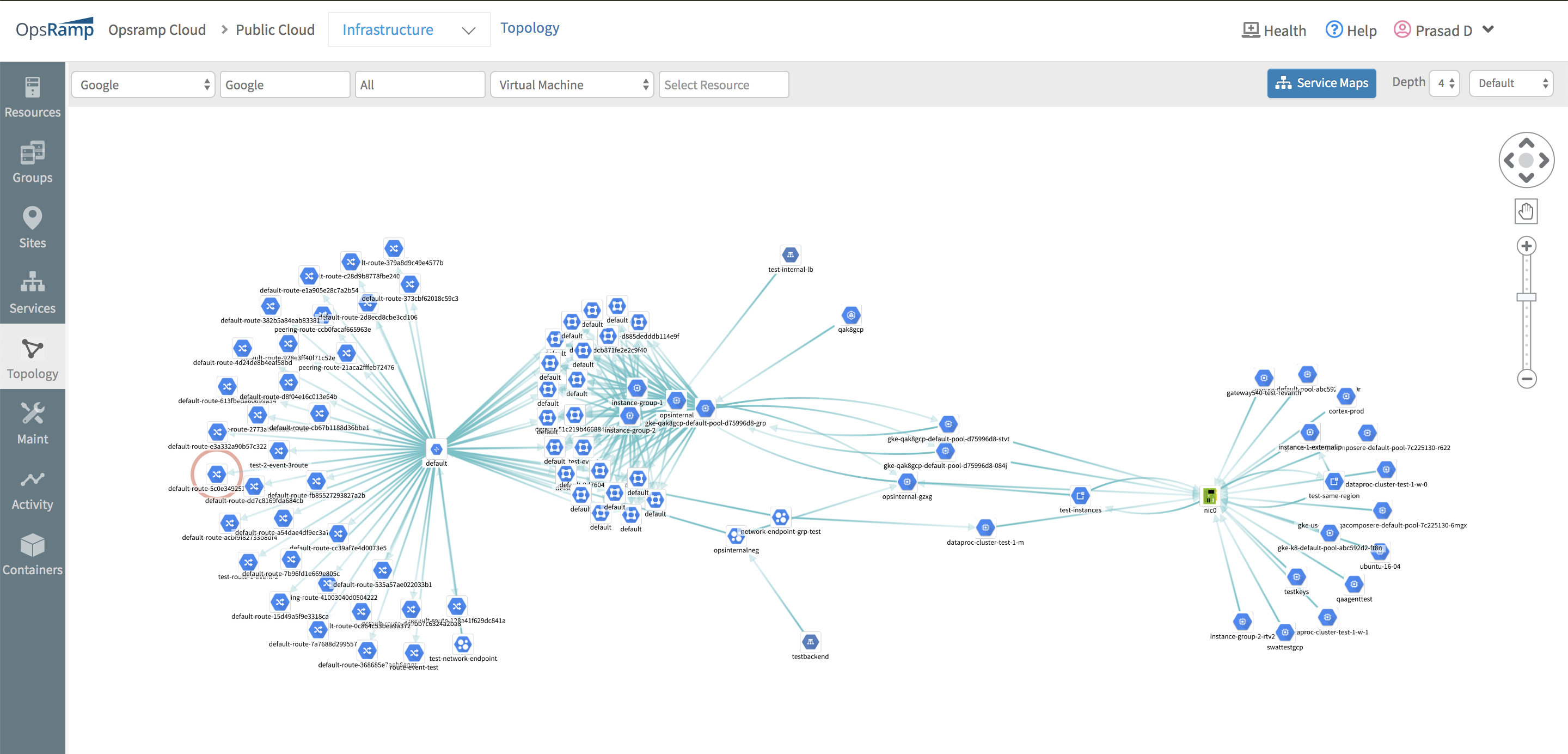 The company says its annual recurrent revenue increased by 300% in 2019 (though we obviously don’t know what number it started 2019 with). In total, OpsRamp says it now has 1,400 customers on its platform and alliances with AWS, ServiceNow, Google Cloud Platform and Microsoft Azure.

OpsRamp co-founder and CEO Varma Kunaparaju
According to OpsRamp co-founder and CEO Varma Kunaparaju, most of the company’s customers are mid to large enterprises. “These IT teams have large, complex, hybrid IT environments and need help to simplify and consolidate an incredibly fragmented, distributed and overwhelming technology and infrastructure stack,” he said. “The company is also seeing success in the ability of our partners to help us reach global enterprises and Fortune 5000 customers.”
Kunaparaju told me that the company plans to use the new funding to expand its go-to-market efforts and product offerings. “The company will be using the money in a few different areas, including expanding our go-to-market motion and new pursuits in EMEA and APAC, in addition to expanding our North American presence,” he said. “We’ll also be doubling-down on product development on a variety of fronts.”
Given that hybrid clouds only increase the workload for IT organizations and introduce additional tools, it’s maybe no surprise that investors are now interested in companies that offer services that rein in this complexity. If anything, we’ll likely see more deals like this one in the coming months.
“As more of our customers transition to hybrid infrastructure, we find the OpsRamp platform to be a differentiated IT operations management offering that aligns well with the core strategies of HPE,” said Paul Glaser, vice president and head of Hewlett Packard Pathfinder. “With OpsRamp’s product vision and customer traction, we felt it was the right time to invest in the growth and scale of their business.”
Powered by WPeMatico
Early Stage SF is around the corner, on April 28 in San Francisco, and we are more than excited for this brand new event. The intimate gathering of founders, VCs, operators and tech industry experts is all about giving founders the tools they need to find success, no matter the challenge ahead of them.
Struggling to understand the legal aspects of running a company, like negotiating cap tables or hiring international talent? We’ve got breakout sessions for that. Wondering how to go about fundraising, from getting your first yes to identifying the right investors to planning the timeline for your fundraise sprint? We’ve got breakout sessions for that. Growth marketing? PR/Media? Building a tech stack? Recruiting?
We. Got. You.
Today, we’re very proud to announce one of our few Main Stage sessions that will be open to all attendees. Reid Hoffman and Sarah Guo will join us for a conversation around “How To Raise Your Series A.”
Reid Hoffman is a legendary entrepreneur and investor in Silicon Valley. He was an Executive VP and founding board member at PayPal before going on to co-found LinkedIn in 2003. He led the company to profitability as CEO before joining Greylock in 2009. He serves on the boards of Airbnb, Apollo Fusion, Aurora, Coda, Convoy, Entrepreneur First, Microsoft, Nauto and Xapo, among others. He’s also an accomplished author, with books like “Blitzscaling,” “The Startup of You” and “The Alliance.”
Sarah Guo has a wealth of experience in the tech world. She started her career in high school at a tech firm founded by her parents, called Casa Systems. She then joined Goldman Sachs, where she invested in growth-stage tech startups such as Zynga and Dropbox, and advised both pre-IPO companies (Workday) and publicly traded firms (Zynga, Netflix and Nvidia). She joined Greylock Partners in 2013 and led the firm’s investment in Cleo, Demisto, Sqreen and Utmost. She has a particular focus on B2B applications, as well as infrastructure, cybersecurity, collaboration tools, AI and healthcare.
The format for Hoffman and Guo’s Main Stage chat will be familiar to folks who have followed the investors. It will be an updated, in-person combination of Hoffman’s famously annotated LinkedIn Series B pitch deck that led to Greylock’s investment, and Sarah Guo’s in-depth breakdown of what she looks for in a pitch.
They’ll lay out a number of universally applicable lessons that folks seeking Series A funding can learn from, tackling each from their own unique perspectives. Hoffman has years of experience in consumer-focused companies, with a special expertise in network effects. Guo is one of the top minds when it comes to investment in enterprise software.
We’re absolutely thrilled about this conversation, and to be honest, the entire Early Stage agenda.
Here’s how it all works:
There will be about 50+ breakout sessions at the event, and attendees will have an opportunity to attend at least seven. The sessions will cover all the core topics confronting early-stage founders — up through Series A — as they build a company, from raising capital to building a team to growth. Each breakout session will be led by notables in the startup world.
Don’t worry about missing a breakout session, because transcripts from each will be available to show attendees. And most of the folks leading the breakout sessions have agreed to hang at the show for at least half the day and participate in CrunchMatch, TechCrunch’s app to connect founders and investors based on shared interests.
Here’s the fine print. Each of the 50+ breakout sessions is limited to around 100 attendees. We expect a lot more attendees, of course, so signups for each session are on a first-come, first-serve basis. Buy your ticket today and you can sign up for the breakouts that we’ve announced. Pass holders will also receive 24-hour advance notice before we announce the next batch. (And yes, you can “drop” a breakout session in favor of a new one, in the event there is a schedule conflict.)
Grab yourself a ticket and start registering for sessions right here. Interested sponsors can hit up the team here.
Powered by WPeMatico