Enterprise
Auto Added by WPeMatico
Auto Added by WPeMatico
The COVID-19 crisis is touching all aspects of society, including how we work. In response, many companies are considering asking some percentage of their workforce to work remotely until the crisis abates.
If your organization doesn’t have a great deal of experience with remote work, there are a number of key things to think about as you set up a program. You are going to be under time constraints when it comes to enacting an action plan, so think about ways to leverage the tools, procedures and technologies you already have in place. You won’t have the luxury of conducting a six-month study.
We spoke to a few people who have been looking at the remote working space for more than a decade and asked about the issues companies should bear in mind when a large number of employees suddenly need to work from home.
Alan Lepofsky, currently VP of Salesforce Quip, has studied the remote work market for more than a decade. He says there are three main pieces to building a remote working strategy. First, managers need to evaluate which tools they’ll be using to allow employees to continue collaborating when they aren’t together.
Powered by WPeMatico
Oribi, an Israeli startup promising to democratize web analytics, is now launching in the United States.
While we’ve written about a wide range of new or new-ish analytics companies, founder and CEO Iris Shoor said that most of them aren’t built for Oribi’s customers.
“A lot of companies are more focused on the high end,” Shoor told me. “Usually these solutions are very much based on a lot of technical resources and integrations — these are the Mixpanels and Heap Analytics and Adobe Marketing Clouds.”
She said that Oribi, on the other hand, is designed for small and medium businesses that don’t have large technical teams: “They have digital marketing strategies that are worth a few hundred thousand dollars a month, they have very large activity, but they don’t have a team for it. And I would say that all of them are using Google Analytics.”
Shoor described Oribi as designed specifically “to compete with Google Analytics” by allowing everyone on the team to get the data they need without requiring developers to write new code for every event they want to track.
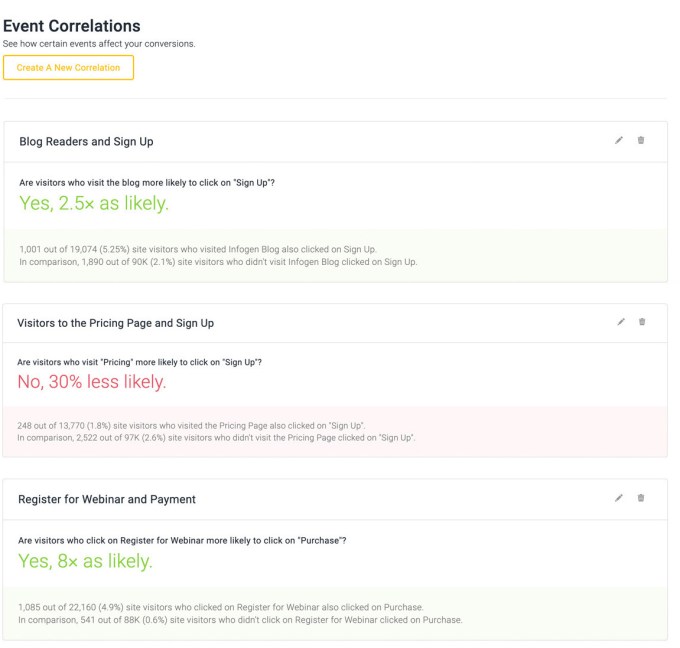
In fact, if you use Oribi’s plugins for platforms like WordPress and Shopify, there’s no coding at all involved in the process. Apparently, that’s because Oribi is already tracking every major event in the customer journey. It also allows the team to define the conversion goals that they want to focus on — again, with no coding required.
Shoor contrasted Oribi with analytics platforms that simply provide “more and more data” but don’t help customers understand what to do with that data.
“We’ve created something that is much more clean,” she said. “We give them insights of what’s working; in the background, we create all these different queries and correlations about which part of the funnels are broken and where they can optimize.”
There are big businesses using Oribi already — including Audi, Sony and Crowne Plaza — but the company is now turning its attention to U.S. customers. Shoor said Oribi isn’t opening an office in the United States right away, but there are plans to do so in the next year.
Powered by WPeMatico

SaaStr, the venture firm that puts on the largest conference for SaaS companies, postponed its SaaStr Annual 2020 conference today amid concerns from local and national officials around large gatherings in light of the COVID-19 virus. The event was scheduled to take place next week.
On March 5th, Santa Clara County issued updated guidelines that included, “[Minimizing] the number of employees working within arm’s length of one another, including minimizing or canceling large in-person meetings and conferences.”
Company founder Jason Lemkin said his team was prepared to go forward and had put stringent safeguards in place. “We put in place health and safety measures no one else in the industry equaled, but once the County made its statement, we needed to reschedule,” he told TechCrunch.
They outlined the health guidelines for the event in an article on the company website earlier this week, including not allowing anyone from a hot zone to attend, passport checks to enforce that, temperature checks and more. As Lemkin tweeted:
A reminder: we’ve designed SaaStr Annual to have the more stringent health & safety events of any event:
– no handshakes
– wash before every session
– thermal scanning
– lower density, & comfortable spaces for calm discussions— Jason
SaaStrAnnual.com
(@jasonlk) March 2, 2020
The event will now be folded into the company’s fall conference, which they say will be even bigger now, while replacing the company’s annual Scale conference. “Following that [guidance from Santa Clara County] and guidance from the CDC, and the growing escalation of the Covid-19 outbreak around the world and in the United States, SaaStr Annual must now be rescheduled and merged with our existing fall event into a new, less formal ‘SaaStr Bi-Annual’ to take place in September 2020,” the company wrote in a statement.
Lemkin expressed frustration with authorities today on Twitter about the lack of leadership on this:
Where was leadership from cities & convention centers?
Why did everyone ignore us weeks back and mock us when we asked for help?
There is a lot of noise today and I think it is very possible to put on an event far safer than Disneyland or the airport
But not without leadership
— Jason
The event included some of the biggest names in SaaS, from Jennifer Tejada of PagerDuty and Aaron Levie of Box and many more. It’s an event that’s designed to help SaaS companies of all sizes discuss the issues facing them, in one place, with panels, interviews and sessions. Many other tech conferences are being cancelled as well, including SXSW.
Powered by WPeMatico
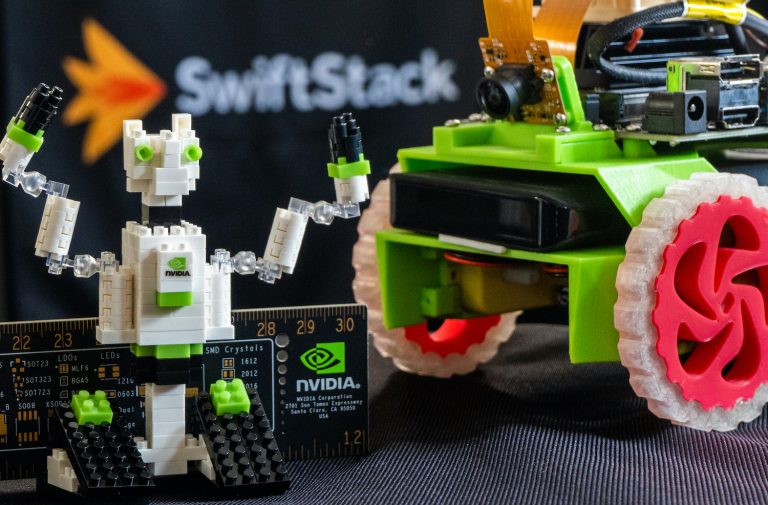
Nvidia today announced that it has acquired SwiftStack, a software-centric data storage and management platform that supports public cloud, on-premises and edge deployments.
The company’s recent launches focused on improving its support for AI, high-performance computing and accelerated computing workloads, which is surely what Nvidia is most interested in here.
“Building AI supercomputers is exciting to the entire SwiftStack team,” says the company’s co-founder and CPO Joe Arnold in today’s announcement. “We couldn’t be more thrilled to work with the talented folks at NVIDIA and look forward to contributing to its world-leading accelerated computing solutions.”
The two companies did not disclose the price of the acquisition, but SwiftStack had previously raised about $23.6 million in Series A and B rounds led by Mayfield Fund and OpenView Venture Partners. Other investors include Storm Ventures and UMC Capital.
SwiftStack, which was founded in 2011, placed an early bet on OpenStack, the massive open-source project that aimed to give enterprises an AWS-like management experience in their own data centers. The company was one of the largest contributors to OpenStack’s Swift object storage platform and offered a number of services around this, though it seems like in recent years it has downplayed the OpenStack relationship as that platform’s popularity has fizzled in many verticals.
SwiftStack lists the likes of PayPal, Rogers, data center provider DC Blox, Snapfish and Verizon (TechCrunch’s parent company) on its customer page. Nvidia, too, is a customer.
SwiftStack notes that it team will continue to maintain an existing set of open source tools like Swift, ProxyFS, 1space and Controller.
“SwiftStack’s technology is already a key part of NVIDIA’s GPU-powered AI infrastructure, and this acquisition will strengthen what we do for you,” says Arnold.
Powered by WPeMatico
Founded in 2005, Etsy was born before cloud infrastructure was even a thing.
As the company expanded, it managed all of its operations in the same way startups did in those days — using private data centers. But a couple of years ago, the online marketplace for crafts and vintage items decided to modernize and began its journey to the cloud.
That decision coincided with the arrival of CTO Mike Fisher in July 2017. He was originally brought in as a consultant to look at the impact of running data centers on Etsy’s ability to innovate. As you might expect, he concluded that it was having an adverse impact and began a process that would lead to him being hired to lead a long-term migration to the cloud.
That process concluded last month. This is the story of how a company born in data centers made the switch to the cloud, and the lessons it offers.
When Fisher walked through the door, Etsy operated out of private data centers. It was not even taking advantage of a virtualization layer to maximize the capacity of each machine. The approach meant IT spent an inordinate amount of time on resource planning.
Powered by WPeMatico
One of the more interesting and useful applications of artificial intelligence technology has been in the world of biotechnology and medicine, where now more than 220 startups (not to mention universities and bigger pharma companies) are using AI to accelerate drug discovery by using it to play out the many permutations resulting from drug and chemical combinations, DNA and other factors.
Now, a startup called Turing — which is part of the current cohort at Y Combinator due to present in the next Demo Day on March 22 — is taking a similar principle but applying it to the world of building (and “discovering”) new consumer packaged goods products.
Using machine learning to simulate different combinations of ingredients plus desired outcomes to figure out optimal formulations for different goods (hence the “Turing” name, a reference to Alan Turing’s mathematical model, referred to as the Turing machine), Turing is initially addressing the creation of products in home care (e.g. detergents), beauty and food and beverage.
Turing’s founders claim that it is able to save companies millions of dollars by reducing the average time it takes to formulate and test new products, from an average of 12 to 24 months down to a matter of weeks.
Specifically, the aim is to reduce all the time it takes to test combinations, giving R&D teams more time to be creative.
“Right now, they are spending more time managing experiments than they are innovating,” Manmit Shrimali, Turing’s co-founder and CEO, said.
Turing is in theory coming out of stealth today, but in fact it has already amassed an impressive customer list. It is already generating revenues by working with eight brands owned by one of the world’s biggest CPG companies, and it is also being trialed by another major CPG behemoth (Turing is not disclosing their names publicly, but suffice it to say, they and their brands are household names).
Turing is co-founded by Shrimali and Ajith Govind, two specialists in data science that worked together on a previous startup called Dextro Analytics. Dextro had set out to help businesses use AI and other kinds of business analytics to help with identifying trends and decision making around marketing, business strategy and other operational areas.
While there, they identified a very specific use case for the same principles that was perhaps even more acute: the research and development divisions of CPG companies, which have (ironically, given their focus on the future) often been behind the curve when it comes to the “digital transformation” that has swept up a lot of other corporate departments.
“We were consulting for product companies and realised that they were struggling,” Shrimali said. Add to that the fact that CPG is precisely the kind of legacy industry that is not natively a tech company but can most definitely benefit from implementing better technology, and that spells out an interesting opportunity for how (and where) to introduce artificial intelligence into the mix.
R&D labs play a specific and critical role in the world of CPG.
Before eventually being shipped into production, this is where products are discovered; tested; tweaked in response to input from customers, marketing, budgetary and manufacturing departments and others; then tested again; then tweaked again; and so on. One of the big clients that Turing works with spends close to $400 million in testing alone.
But R&D is under a lot of pressure these days. While these departments are seeing their budgets getting cut, they continue to have a lot of demands. They are still expected to meet timelines in producing new products (or often more likely, extensions of products) to keep consumers interested. There are a new host of environmental and health concerns around goods with huge lists of unintelligible ingredients, meaning they have to figure out how to simplify and improve the composition of mass-market products. And smaller direct-to-consumer brands are undercutting their larger competitors by getting to market faster with competitive offerings that have met new consumer tastes and preferences.
“In the CPG world, everyone was focused on marketing, and R&D was a blind spot,” Shrimali said, referring to the extensive investments that CPG companies have made into figuring out how to use digital to track and connect with users, and also how better to distribute their products. “To address how to use technology better in R&D, people need strong domain knowledge, and we are the first in the market to do that.”
Turing’s focus is to speed up the formulation and testing aspects that go into product creation to cut down on some of the extensive overhead that goes into putting new products into the market.
Part of the reason why it can take upwards of years to create a new product is because of all the permutations that go into building something and making sure it works as consistently as a consumer would expect it to (which still being consistent in production and coming in within budget).
“If just one ingredient is changed in a formulation, it can change everything,” Shrimali noted. And so in the case of something like a laundry detergent, this means running hundreds of tests on hundreds of loads of laundry to make sure that it works as it should.
The Turing platform brings in historical data from across a number of past permutations and tests to essentially virtualise all of this: It suggests optimal mixes and outcomes from them without the need to run the costly physical tests, and in turn this teaches the Turing platform to address future tests and formulations. Shrimali said that the Turing platform has already saved one of the brands some $7 million in testing costs.
Turing’s place in working with R&D gives the company some interesting insights into some of the shifts that the wider industry is undergoing. Currently, Shrimali said one of the biggest priorities for CPG giants include addressing the demand for more traceable, natural and organic formulations.
While no single DTC brand will ever fully eat into the market share of any CPG brand, collectively their presence and resonance with consumers is clearly causing a shift. Sometimes that will lead to acquisitions of the smaller brands, but more generally it reflects a change in consumer demands that the CPG companies are trying to meet.
Longer term, the plan is for Turing to apply its platform to other aspects that are touched by R&D beyond the formulations of products. The thinking is that changing consumer preferences will also lead to a demand for better “formulations” for the wider product, including more sustainable production and packaging. And that, in turn, represents two areas into which Turing can expand, introducing potentially other kinds of AI technology (such as computer vision) into the mix to help optimise how companies build their next generation of consumer goods.
Powered by WPeMatico
Google Cloud today announced a new solution for its telecom customers: Anthos for Telecom. You can think of this as a specialized edition of Google’s container-based Anthos multi-cloud platform for both modernizing existing applications and building new ones on top of Kubernetes. The announcement, which was originally slated for MWC, doesn’t come as a major surprise, given Google Cloud’s focus on offering very targeted services to its enterprise customers in a number of different verticals.
Given the rise of edge computing and, in the telco business, 5G, Anthos for Telecom makes for an interesting play in what could potentially be a very lucrative market for Google. This is also the market where the open-source OpenStack project has remained the strongest.
What’s maybe even more important here is that Google is also launching a new service called the Global Mobile Edge Cloud (GMEC). With this, telco companies will be able to run their applications not just in Google’s 20+ data center regions, but also in Google’s more than 130 edge locations around the world.
“We’re basically giving you compute power on our edge, where previously it was only for Google use, through the Anthos platform,” explained Eyal Manor, the VP of Engineering for Anthos. “The edge is very powerful and I think we will now see substantially more innovation happening for applications that are latency-sensitive. We’ve been investing in edge compute and edge networking for a long time in Google over the years for the internal services. And we think it’s a fairly unique capability now to open it up for third-party customers.”
For now, Google is only making this available to its teleco partners, with AT&T being the launch customers, but over time, Manor said, it’ll likely open its edge cloud to other verticals, as well. Google also expects to be able to announce other partners in the near future.
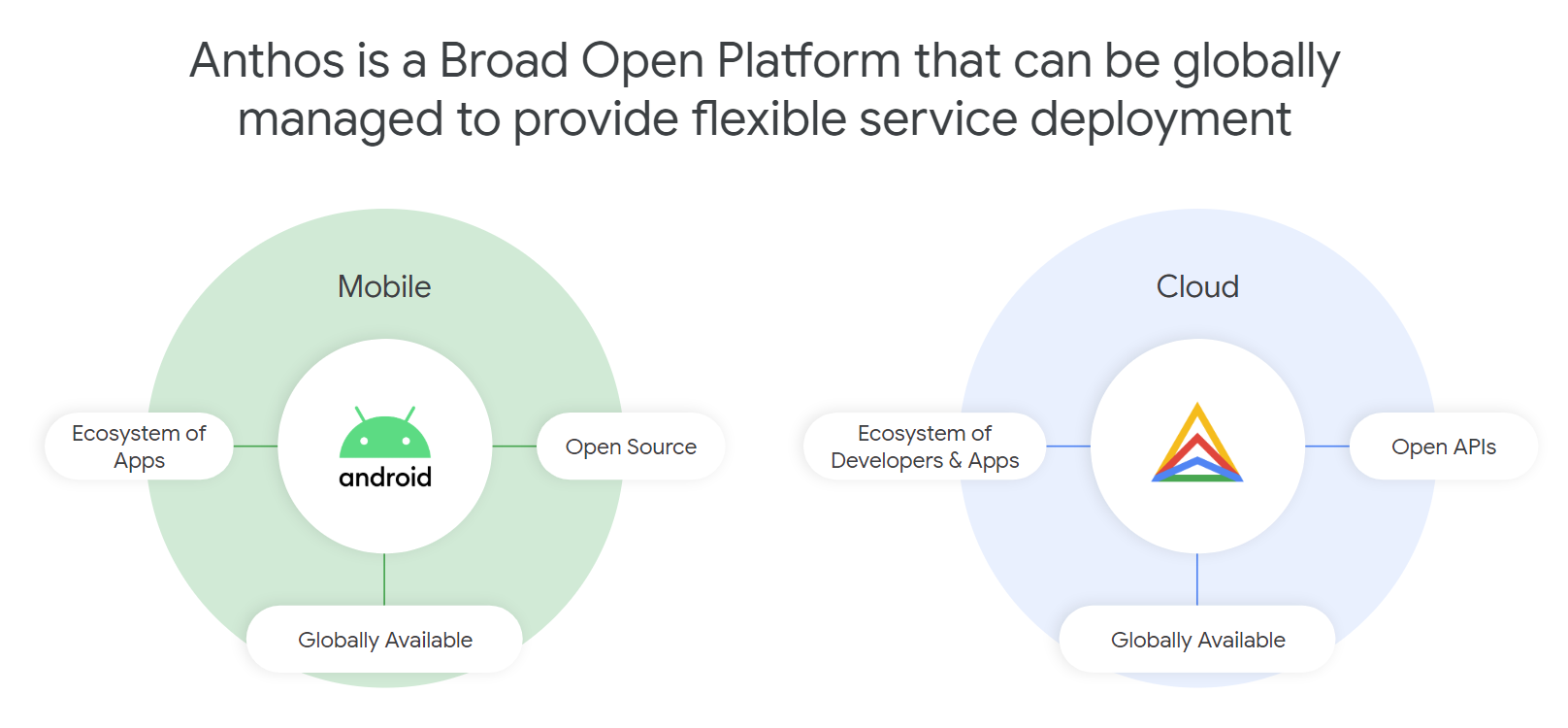
As for Anthos for Telecom, Manor notes that this is very much what its customers are asking for, especially now that so many of their new applications are containerized.
“[Anthos] brings the best of cloud-as-a-service to our customers, wherever they are, in multiple environments and provide the lock-in free environment with the latest cloud tools,” explained Manor. “The goal is really to empower developers and operators to move faster in a consistent way, so regardless of where you are, you don’t have to train your technical staff. It works on-premise, it works on GCP and on other clouds. And that’s what we hear from customers — customers really like choice.”
In the telecom industry, those customers also want to get higher up the stack and get consistency between their data centers and the edge — and all of that, of course, is meant to bring down the cost of running these networks and services.
“We don’t want to manage the [technology] we previously invested in for many years because the upgrades were terribly expensive and slow for that. I hear that consistently. And please Google, make this seem like a service in the cloud for us,” Manor said.
For developers, Anthos also promises to provide the same development experience, no matter where the application is deployed — and Google now has an established network of partners that provides both solutions to developers as well as operators around Anthos. To this effect, Google is also launching new partnerships with the Amdocs customer experience platform and Netcracker today.
“We’re excited to unveil a new strategy today to help telecommunications companies innovate and accelerate their digital transformation through Google Cloud,” said Thomas Kurian, CEO of Google Cloud, in today’s announcement. “By collaborating closely with leading telecoms, partners and customers, we can transform the industry together and create better overall experiences for our users globally.”
Powered by WPeMatico

Google Cloud today announced its plans to open four new data center regions. These regions will be in Delhi (India), Doha (Qatar), Melbourne (Australia) and Toronto (Canada) and bring Google Cloud’s total footprint to 26 regions. The company previously announced that it would open regions in Jakarta, Las Vegas, Salt Lake City, Seoul and Warsaw over the course of the next year. The announcement also comes only a few days after Google opened its Salt Lake City data center.
GCP already had a data center presence in India, Australia and Canada before this announcement, but with these newly announced regions, it now offers two geographically separate regions for in-country disaster recovery, for example.

Google notes that the region in Doha marks the company’s first strategic collaboration agreement to launch a region in the Middle East with the Qatar Free Zones Authority. One of the launch customers there is Bespin Global, a major managed services provider in Asia.
“We work with some of the largest Korean enterprises, helping to drive their digital transformation initiatives. One of the key requirements that we have is that we need to deliver the same quality of service to all of our customers around the globe,” said John Lee, CEO, Bespin Global. “Google Cloud’s continuous investments in expanding their own infrastructure to areas like the Middle East make it possible for us to meet our customers where they are.”
Powered by WPeMatico
Like many technology companies, Zendesk made the tough decision to cancel its Zendesk Relate customer conference this week in Miami amid COVID-19 health concerns. That doesn’t mean the announcements didn’t happen though, even if the conference didn’t, and today the company announced a major update to its Sunshine development platform.
You may recall that the company, which is widely known for its help desk software, made the move to CRM when it acquired Base in September 2018. A little later that year, it announced the Sunshine platform, which customers could use to build applications on top of the Zendesk platform.
It has been working to integrate the CRM tool more broadly into the platform, and today’s announcement is about giving Zendesk users a broader view of its customers. Zendesk has a great amount of data at its disposal about the customer’s likes and dislikes based on interactions with the help desk side of the house, and Zendesk CEO Mikkel Svane sees the two sides being interconnected. At the same time, he’s embracing the idea of this all taking place in the public cloud on AWS.
“Our vision is really to have all the components, all the infrastructure, all the business logic that you need to build a customer experience, and customer relationship management applications, all on the Sunshine platform, all living natively on AWS,” Svane told TechCrunch.
All of this is in service of giving customers a better experience based on what you know about them. He said that the goal today is to retain and satisfy the customer, and the platform is designed to give them the data they need to help do that.
“In the old days, you went out and you bought a product, and that was kind of the end of the transaction. Today, through the convenience economy, through the subscription economy, it’s more about your long-term engagement with a vendor,” he explained.
He sees the platform helping pull all of this data together, while recognizing and acknowledging the challenges involved here. In fact, he is reluctant to call it a complete picture, calling that a false narrative other vendors are putting out.
“We do want to help our customers extract all the relevant information and to try and create a picture that is helpful across all these different channels, but we also know that the reality of it is that you have so many disparate systems right now,” he said.
He sees his platform with the engagement data on one side and the customer record on the other as a good starting point for this. “I think there’s a lot you can do to collect a lot of information and have an abstraction layer, and that’s what we try to do with Sunshine. We want to have an abstraction layer where you start working and seeing all of this data to get insights into your customer. And I think that’s much better start.”
Powered by WPeMatico
Netlify, the startup that wants to kill the web server and change the way developers build websites, announced a $53 million Series C today.
EQT Ventures Fund led the round with contributions from existing investors Andreessen Horowitz and Kleiner Perkins and newcomer Preston-Werner Ventures. Under the terms of the deal Laura Yao, deal partner and investment advisor at EQT Ventures will be joining the Netlify board. The startup has now raised $97 million, according to the company.
Like many startups recently, Netlify’s co-founder Chris Bach says they weren’t looking for new funding, but felt with the company growing rapidly, it would be prudent to take the money to help continue that growth.
While Bach and CEO Matt Biilmann didn’t want to discuss valuation, they said it was “very generous” and in line with how they see their business. Neither did they want to disclose specific revenue figures, but did say that the company has tripled revenue three years running.
One thing fueling that growth is the sheer number of developers joining the platform. When we spoke to the company for its Series B in 2018, it had 300,000 sign-ups. Today that number has ballooned to 800,000.
As we wrote about the company in a 2018 article, it wants to change the way people develop web sites:
“Netlify has abstracted away the concept of a web server, which it says is slow to deploy and hard to secure and scale. By shifting from a monolithic website to a static front end with back-end microservices, it believes it can solve security and scaling issues and deliver the site much faster.”
While developer popularity is a good starting point, getting larger customers on board is the ultimate goal that will drive more revenue, and the company wants to use its new injection of capital to build the enterprise side of the business. Current enterprise customers include Google, Facebook, Citrix and Unilever.
Netlify has grown from 38 to 97 employees since the beginning of last year and hopes to reach 180 by year’s end.
Powered by WPeMatico