Enterprise
Auto Added by WPeMatico
Auto Added by WPeMatico
Justin Kan’s hybrid legal software and law firm startup Atrium is shutting down today after failing to figure out how to deliver better efficiency than a traditional law firm, the CEO tells TechCrunch exclusively. The startup has now laid off all its employees, which totaled just over 100. It will return some of its $75.5 million in funding to investors, including Series B lead Andreessen Horowitz. The separate Atrium law firm will continue to operate.
“I’m really grateful to the customers and the team members who came along with me and our investors. It’s unfortunate that this wasn’t the outcome that we wanted but we’re thankful to everyone that came with us on the journey” said Kan. He’d previously founded Justin.tv which pivoted to become Twitch and later sold to Amazon for $970 million. “We decided to call it and wind down the startup operations. There will be some capital returned to investors post wind-down” Kan told me.

Atrium had attempted a pivot back in January, laying off its in-house lawyers to become a more pure software startup with better margins. Some of its lawyers formed a separate standalone legal firm and took on former Atrium clients. But Kan tells me that it was tough to regain momentum coming out of that change, which some Atrium customers tell me felt chaotic and left them unsure of their legal representation.
More layoffs quietly ensued as divisions connected to those lawyers were eliminated. But trying to build software for third-party lawyers, many of which have entrenched processes and older leadership, proved difficult. The streamlined workflows may not have seemed worth the thrash of adopting new technology.
“If you look at our original business model with the veritcalized law firm, a lot of these companies that have this kind of full stack model are not going to survive” Kan explained. “A lot of these companies, Atrium included, did not figure out how to make a dent in operational efficiency.”
Founded in 2017, Atrium built software for startups to navigate fundraising, hiring, acquisition deals, and collaboration with their legal team. Atrium also offered in-house lawyers that could provide counsel and best practices in these matters. The idea was that the collaboration software would make its lawyers more efficient than a traditional law firm so they could get work done faster, translating to savings for clients and Atrium.
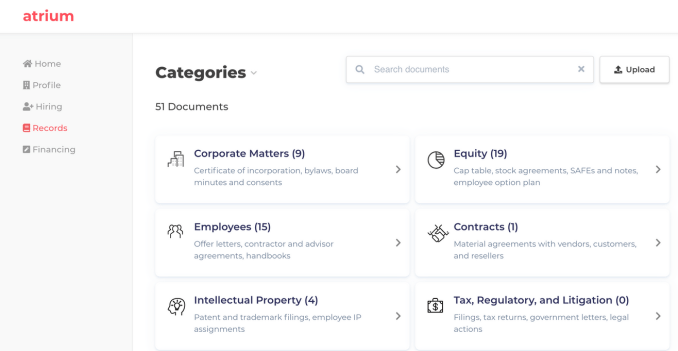
Atrium’s software included Records, a Dropbox-esque system for keeping track of legal documents, and Hiring, which instantly generated employment offer letters based on details punched into a form while keeping track of signatures. The startup hoped it could prevent clients and lawyers from wasting time digging through email chains or missing a sign-off that could put them in legal jeopardy.
The company tried to generate client leads by hosting fundraising workshops for startups, starring Kan and his stories from growing Twitch. A charismatic leader with a near-billion dollar exit under his belt, investors and founders alike were quick to buy into Kan’s vision and advice. Startups saw Atrium as an ally with industry expertise that could help them avoid dirty term sheets or botched hires.

But keeping a large squad of lawyers on staff proved costly. Atrium priced packages of its software and legal assistance under subscriptions, with momentous deals like acquisitions incurring add-on fees. The model relied less on milking clients with steep hourly rates measured down to six-minute increments like most law firms.
Yet eliminating the busy work for lawyers through its software didn’t materialize into bountiful profits. The pivot saught to create a professional services network where Atrium could route clients to attorneys. The layoffs had shaken faith in the startup as clients demanded stability lest they be caught without counsel at a tough time
Rather than trudge on, Kan decided to fold the company. The standalone Atrium law firm will continue to operate under partners Michel Narganes and Matthew Melville, but the startup developing legal software is done.
Atrium’s implosion could send ripples through the legaltech scene, and push other entrepreneurs to start with a more focused software-only approach.
Powered by WPeMatico
Most developers think of Stack Overflow as a question and answer site for their programming questions. But over the last few years, the company has also built a successful business in its Stack Overflow for Teams product, which essentially offers companies a private version of its Q&A product. Indeed, the Teams product now brings in a significant amount of revenue for the company and the new executive team at Stack Overflow is betting that it can help the company grow rapidly in the years to come.
To make Teams even more attractive to businesses, the company today launched a number of new integrations with Jira (Enterprise and Business), GitHub (Enterprise and Business) and Microsoft Teams (Enterprise). These join existing integrations with Slack, Okta and the Business tier of Microsoft Teams.
“I think the integrations that we have been building are reflective of that developer workflow and all of the number of tools that someone who is building and leveraging technology has to interact with,” Stack Overflow Chief Product Officer Teresa Dietrich told me. “When we think about integrations, we think about the vertical right, and I think that ‘developer workflow’ is one of those industry verticals that we’re thinking about. ChatOps is obviously another one, as you can see from our Slack and Teams integration. And the JIRA and GitHub [integrations] that we’re building are really at the core of a developer workflow.”
Current Stack Overflow for Teams customers include the likes of Microsoft, Expensify and Wix. As the company noted, 65 percent of its existing Teams customers use GitHub, so it’s no surprise that it is building out this integration.
Powered by WPeMatico
Ampere, the chip startup run by former Intel President Renee James, announced a new chip today that she says is designed specifically to optimize for cloud workloads.
Ampere VP of product Jeff Wittich says the new chip is called the Ampere Altra, and it’s been designed with some features that should make it attractive to cloud providers. This involves three main focuses including high performance, scalability and power efficiency — all elements that would be important to cloud vendors operating at scale.
The Altra is an ARM chip with some big features.”It’s 64-bit ARM cores or 160 cores in a two-socket platforms –we support both one socket and two socket [configurations]. We are running at 3 GHz turbo, and that’s 3 GHz across all of the cores because of the way that cloud delivers compute, you’re utilizing all the cores as much of the time as possible. So our turbo performance was optimized for all of the cores being able to sustain it all the time,” Wittich explained.
The company sees this chip as a kind of workhorse for the cloud. “We’ve really looked at this as we’re designing a general purpose CPU that is built for the cloud environment, so you can utilize that compute the way the cloud utilizes that type of compute. So it supports the vast array of all of the workloads that run in the cloud,” he said.
Founder and CEO James says the company has been working with their cloud customers to give them the kind of information they need to optimize the chip for their individual workloads at a granular configuration level, something the hyper scalers in particular really require.
“Let’s go do what we can to build the platform that delivers the raw power and performance, the kind of environment that you’re looking for, and then have a design approach that enables them to work with us on what’s important and the kind of control, that kind of feature set that’s unique because each one of them have their own software environment,” James explained.
Among the companies working with Ampere early on have been Oracle (an investor, according to Crunchbase) and Microsoft, among others.
James says one of the unforeseen challenges of delivering this chip is possible disruptions in the supply chain due to the Corona-19 virus and its impact in Asia where many of the parts come from, and the chips are assembled.
She says the company has taken that into consideration and has been able to build up a worldwide supply chain she hopes will help with hiccups that might occur because of supply chain slow downs.
Powered by WPeMatico
Data management company Datastax, one of the largest contributors to the Apache Cassandra project, today announced that it has acquired The Last Pickle (and no, I don’t know what’s up with that name either), a New Zealand-based Cassandra consulting and services firm that’s behind a number of popular open-source tools for the distributed NoSQL database.
As Datastax Chief Strategy Officer Sam Ramji, who you may remember from his recent tenure at Apigee, the Cloud Foundry Foundation, Google and Autodesk, told me, The Last Pickle is one of the premier Apache Cassandra consulting and services companies. The team there has been building Cassandra-based open source solutions for the likes of Spotify, T Mobile and AT&T since it was founded back in 2012. And while The Last Pickle is based in New Zealand, the company has engineers all over the world that do the heavy lifting and help these companies successfully implement the Cassandra database technology.
It’s worth mentioning that Last Pickle CEO Aaron Morton first discovered Cassandra when he worked for WETA Digital on the special effects for Avatar, where the team used Cassandra to allow the VFX artists to store their data.
“There’s two parts to what they do,” Ramji explained. “One is the very visible consulting, which has led them to become world experts in the operation of Cassandra. So as we automate Cassandra and as we improve the operability of the project with enterprises, their embodied wisdom about how to operate and scale Apache Cassandra is as good as it gets — the best in the world.” And The Last Pickle’s experience in building systems with tens of thousands of nodes — and the challenges that its customers face — is something Datastax can then offer to its customers as well.
And Datastax, of course, also plans to productize The Last Pickle’s open-source tools like the automated repair tool Reaper and the Medusa backup and restore system.
As both Ramji and Datastax VP of Engineering Josh McKenzie stressed, Cassandra has seen a lot of commercial development in recent years, with the likes of AWS now offering a managed Cassandra service, for example, but there wasn’t all that much hype around the project anymore. But they argue that’s a good thing. Now that it is over ten years old, Cassandra has been battle-hardened. For the last ten years, Ramji argues, the industry tried to figure out what the de factor standard for scale-out computing should be. By 2019, it became clear that Kubernetes was the answer to that.
“This next decade is about what is the de facto standard for scale-out data? We think that’s got certain affordances, certain structural needs and we think that the decades that Cassandra has spent getting harden puts it in a position to be data for that wave.”
McKenzie also noted that Cassandra provides users with a number of built-in features like support for mutiple data centers and geo-replication, rolling updates and live scaling, as well as wide support across programming languages, give it a number of advantages over competing databases.
“It’s easy to forget how much Cassandra gives you for free just based on its architecture,” he said. “Losing the power in an entire datacenter, upgrading the version of the database, hardware failing every day? No problem. The cluster is 100 percent always still up and available. The tooling and expertise of The Last Pickle really help bring all this distributed and resilient power into the hands of the masses.”
The two companies did not disclose the price of the acquisition.
Powered by WPeMatico

“The best-kept secret in quantum computing.” That’s what Cambridge Quantum Computing (CQC) CEO Ilyas Khan called Honeywell‘s efforts in building the world’s most powerful quantum computer. In a race where most of the major players are vying for attention, Honeywell has quietly worked on its efforts for the last few years (and under strict NDA’s, it seems). But today, the company announced a major breakthrough that it claims will allow it to launch the world’s most powerful quantum computer within the next three months.
In addition, Honeywell also today announced that it has made strategic investments in CQC and Zapata Computing, both of which focus on the software side of quantum computing. The company has also partnered with JPMorgan Chase to develop quantum algorithms using Honeywell’s quantum computer. The company also recently announced a partnership with Microsoft.

Honeywell has long built the kind of complex control systems that power many of the world’s largest industrial sites. It’s that kind of experience that has now allowed it to build an advanced ion trap that is at the core of its efforts.
This ion trap, the company claims in a paper that accompanies today’s announcement, has allowed the team to achieve decoherence times that are significantly longer than those of its competitors.
“It starts really with the heritage that Honeywell had to work from,” Tony Uttley, the president of Honeywell Quantum Solutions, told me. “And we, because of our businesses within aerospace and defense and our business in oil and gas — with solutions that have to do with the integration of complex control systems because of our chemicals and materials businesses — we had all of the underlying pieces for quantum computing, which are just fabulously different from classical computing. You need to have ultra-high vacuum system capabilities. You need to have cryogenic capabilities. You need to have precision control. You need to have lasers and photonic capabilities. You have to have magnetic and vibrational stability capabilities. And for us, we had our own foundry and so we are able to literally design our architecture from the trap up.”

The result of this is a quantum computer that promises to achieve a quantum Volume of 64. Quantum Volume (QV), it’s worth mentioning, is a metric that takes into account both the number of qubits in a system as well as decoherence times. IBM and others have championed this metric as a way to, at least for now, compare the power of various quantum computers.
So far, IBM’s own machines have achieved QV 32, which would make Honeywell’s machine significantly more powerful.
Khan, whose company provides software tools for quantum computing and was one of the first to work with Honeywell on this project, also noted that the focus on the ion trap is giving Honeywell a bit of an advantage. “I think that the choice of the ion trap approach by Honeywell is a reflection of a very deliberate focus on the quality of qubit rather than the number of qubits, which I think is fairly sophisticated,” he said. “Until recently, the headline was always growth, the number of qubits running.”
The Honeywell team noted that many of its current customers are also likely users of its quantum solutions. These customers, after all, are working on exactly the kind of problems in chemistry or material science that quantum computing, at least in its earliest forms, is uniquely suited for.
Currently, Honeywell has about 100 scientists, engineers and developers dedicated to its quantum project.

Powered by WPeMatico
Google today announced that it is canceling the physical part of Cloud Next, its cloud-focused event and its largest annual conference by far with around 30,000 attendees, over concerns around the current spread of COVID-19.
Given all of the recent conference cancellations, this announcement doesn’t come as a huge surprise, especially after Facebook canceled its F8 developer conference only a few days ago.
Cloud Next was scheduled to run from April 6 to 8. Instead of the physical event, Google will now host an online event under the “Google Cloud Next ’20: Digital Connect” moniker. So there will still be keynotes and breakout sessions, as well as the ability to connect with experts.
“Innovation is in Google’s DNA and we are leveraging this strength to bring you an immersive and inspiring event this year without the risk of travel,” the company notes in today’s announcement.
The virtual event will be free and in an email to attendees, Google says that it will automatically refund all tickets to this year’s conference. It will also automatically cancel all hotel reservations made through its conference reservation system.
It now remains to be seen what happens to Google’s other major conference, I/O, which is slated to run from May 12 to 14 in Mountain View. The same holds true for Microsoft’s rival Build conference in Seattle, which is scheduled to start on May 19. These are the two premier annual news events for both companies, but given the current situation, nobody would be surprised if they get canceled, too.
Powered by WPeMatico
Thoma Bravo announced today that it has closed its hefty $3.9 billion acquisition of security firm Sophos, marking yet another private equity deal in the books.
The deal was originally announced in October. Stockholders voted to approve the deal in December.
They were paid $7.40 USD per share for their trouble, according to the company, and it indicated that as part of the closing, the stock had ceased trading on the London Stock Exchange. It also pointed out that investors who got in at the IPO price in June 2015 made a 168% premium on that investment.
Sophos hopes its new owner can help the company continue to modernize the platform. “With Thoma Bravo as a partner, we believe we can accelerate our progress and get to the future even faster, with dramatic benefits for our customers, our partners and our company as a whole,” Sophos CEO Kris Hagerman said in a statement. Whether it will enjoy those benefits or not, time will tell.
As for the buyer, it sees a company with a strong set of channel partners that it can access to generate more revenue moving forward under the Thoma Bravo umbrella. Sophos currently partners with 53,000 resellers and managed service providers, and counts more than 420,000 companies as customers. The platform currently helps protect 100 million users, according to the company. The buyer believes it can help build on these numbers.
The company was founded way back in 1985, and raised over $500 million before going public in 2015, according to PitchBook data. Products include Managed Threat Response, XG Firewall and Intercept X Endpoint.
Powered by WPeMatico
The world of consumer banking has seen a massive shift in the last ten years. Gone are the days where you could open an account, take out a loan, or discuss changing the terms of your banking only by visiting a physical branch. Now, you can do all this and more with a few quick taps on your phone screen — a shift that has accelerated with customers expecting and demanding even faster and more responsive banking services.
As one mark of that switch, today a startup called Thought Machine, which has built cloud-based technology that powers this new generation of services on behalf of both old and new banks, is announcing some significant funding — $83 million — a Series B that the company plans to use to continue investing in its platform and growing its customer base.
To date, Thought Machine’s customers are primarily in Europe and Asia — they include large, legacy outfits like Standard Chartered, Lloyds Banking Group, and Sweden’s SEB through to “challenger” (AKA neo-) banks like Atom Bank. Some of this financing will go towards boosting the startup’s activities in the US, including opening an office in the country later this year and moving ahead with commercial deals.
The funding is being led by Draper Esprit, with participation also from existing investors Lloyds Banking Group, IQ Capital, Backed and Playfair.
Thought Machine, which started in 2014 and now employs 300, is not disclosing its valuation but Paul Taylor, the CEO and founder, noted that the market cap is currently “increasing healthily.” In its last round, according to PitchBook estimates, the company was valued at around $143 million, which, at this stage of funding, puts this latest round potentially in the range of between $220 million and $320 million.
Thought Machine is not yet profitable, mainly because it is in growth mode, said Taylor. Of note, the startup has been through one major bankruptcy restructuring, although it appears that this was mainly for organisational purposes: all assets, employees and customers from one business controlled by Taylor were acquired by another.
Thought Machine’s primary product and technology is called Vault, a platform that contains a range of banking services: checking accounts, savings accounts, loans, credit cards and mortgages. Thought Machine does not sell directly to consumers, but sells by way of a B2B2C model.
The services are provisioned by way of smart contracts, which allows Thought Machine and its banking customers to personalise, vary and segment the terms for each bank — and potentially for each customer of the bank.
It’s a little odd to think that there is an active market for banking services that are not built and owned by the banks themselves. After all, aren’t these the core of what banks are supposed to do?
But one way to think about it is in the context of eating out. Restaurants’ kitchens will often make in-house what they sell and serve. But in some cases, when it makes sense, even the best places will buy in (and subsequently sell) food that was crafted elsewhere. For example, a restaurant will re-sell cheese or charcuterie, and the wine is likely to come from somewhere else, too.
The same is the case for banks, whose “Crown Jewels” are in fact not the mechanics of their banking services, but their customer service, their customer lists, and their deposits. Better banking services (which may not have been built “in-house”) are key to growing these other three.
“There are all sorts of banks, and they are all trying to find niches,” said Taylor. Indeed, the startup is not the only one chasing that business. Others include Mambu, Temenos and Italy’s Edera.
In the case of the legacy banks that work with the startup, the idea is that these behemoths can migrate into the next generation of consumer banking services and banking infrastructure by cherry-picking services from the VaultOS platform.
“Banks have not kept up and are marooned on their own tech, and as each year goes by, it comes more problematic,” noted Taylor.
In the case of neobanks, Thought Machine’s pitch is that it has already built the rails to run a banking service, so a startup — “new challengers like Monzo and Revolut that are creating quite a lot of disruption in the market” (and are growing very quickly as a result) — can integrate into these to get off the ground more quickly and handle scaling with less complexity (and lower costs).
Taylor was new to fintech when he founded Thought Machine, but he has a notable track record in the world of tech that you could argue played a big role in his subsequent foray into banking.
Formerly an academic specialising in linguistics and engineering, his first startup, Rhetorical Systems, commercialised some of his early speech-to-text research and was later sold to Nuance in 2004.
His second entrepreneurial effort, Phonetic Arts, was another speech startup, aimed at tech that could be used in gaming interactions. In 2010, Google approached the startup to see if it wanted to work on a new speech-to-text service it was building. It ended up acquiring Phonetic Arts, and Taylor took on the role of building and launching Google Now, with that voice tech eventually making its way to Google Maps, accessibility services, the Google Assistant and other places where you speech-based interaction makes an appearance in Google products.
While he was working for years in the field, the step changes that really accelerated voice recognition and speech technology, Taylor said, were the rapid increases in computing power and data networks that “took us over the edge” in terms of what a machine could do, specifically in the cloud.
And those are the same forces, in fact, that led to consumers being able to run our banking services from smartphone apps, and for us to want and expect more personalised services overall. Taylor’s move into building and offering a platform-based service to address the need for multiple third-party banking services follows from that, and also is the natural heir to the platform model you could argue Google and other tech companies have perfected over the years.
Draper Esprit has to date built up a strong portfolio of fintech startups that includes Revolut, N26, TransferWise and Freetrade. Thought Machine’s platform approach is an obvious complement to that list. (Taylor did not disclose if any of those companies are already customers of Thought Machine’s, but if they are not, this investment could be a good way of building inroads.)
“We are delighted to be partnering with Thought Machine in this phase of their growth,” said Vinoth Jayakumar, Investment Director, Draper Esprit, in a statement. “Our investments in Revolut and N26 demonstrate how banking is undergoing a once in a generation transformation in the technology it uses and the benefit it confers to the customers of the bank. We continue to invest in our thesis of the technology layer that forms the backbone of banking. Thought Machine stands out by way of the strength of its engineering capability, and is unique in being the only company in the banking technology space that has developed a platform capable of hosting and migrating international Tier 1 banks. This allows innovative banks to expand beyond digital retail propositions to being able to run every function and type of financial transaction in the cloud.”
“We first backed Thought Machine at seed stage in 2016 and have seen it grow from a startup to a 300-person strong global scale-up with a global customer base and potential to become one of the most valuable European fintech companies,” said Max Bautin, Founding Partner of IQ Capital, in a statement. “I am delighted to continue to support Paul and the team on this journey, with an additional £15 million investment from our £100 million Growth Fund, aimed at our venture portfolio outperformers.”
Powered by WPeMatico
A new startup called Notivize aims to give product teams direct access to one of their most important tools for increasing user engagement — notifications.
The company has been testing the product with select customers since last year and says it has already sent hundreds of thousands of notifications. And this week, it announced that it has raised $500,000 in seed funding led by Heroic Ventures .
Notivize co-founder Matt Bornski has worked at a number of startups, including AppLovin and Wink, and he said he has “so many stories I can tell you about the time it takes to change a notification that’s deeply embedded in your stack.”
To be clear, Bornski isn’t talking about a simple marketing message that’s part of a scheduled campaign. Instead, he said that the “most valuable” notifications (e.g. the ones that users actually respond to) are usually driven by activity in an app.
For example, it might sound obvious to send an SMS message to a customer once the product they’ve purchased has shipped, but Bornski said that actually creating a notification like that would normally require an engineer to write new code.
“There’s the traditional way that these things are built: The product team specs out that we need to send this email when this happens, or send this SMS or notification when this happens, then the engineering team will go in and find the part of the code where they detect that such a thing has happened,” he said. “What we really want to do is give [the product team] the toolkit, and I think we have.”

So with Notivize, non-coding members of the product and marketing team can write “if-then” rules that will trigger a notification. And this, Bornski said, also makes it easier to “A/B test and optimize your copy and your send times and your channels” to ensure that your notifications are as effective as possible.
He added that companies usually don’t build this for themselves, because when they’re first building an app, it’s “not a rational thing to invest your time and effort in when you’re just testing the market or you’re struggling for product market fit.” Later on, however, it can be challenging to “go in and rip out all the old stuff” — so instead, you can just take advantage of what Notivize has already built.
Bornski also emphasized that the company isn’t trying to replace services that provide the “plumbing” for notifications. Indeed, Notivize actually integrates with SendGrid and Twilio to send the notifications.
“The actual sending is not the core value [of what we do],” he said. “We’re improving the quality of what you’re paying for, of what you send.”
Notivize allows customers to send up to 100 messages per month for free. After that, pricing starts at $14.99 per month.
“The steady march of low-code and no-code solutions into the product management and marketing stack continues to unlock market velocity and product innovation,” said Heroic Ventures founder Michael Fertik in a statement. “Having been an early investor in several developer platforms, it is clear that Notivize has cracked the code on how to empower non-technical teams to manage critical yet complex product workflows.”
Powered by WPeMatico
The “Sent via Superhuman iOS” email signature has become one of the strangest flexes in the tech industry, but its influence is enduring, as the $30 per month invite-only email app continues to shape how a wave of personal productivity startups are building their business and product strategies.
I had a chance to chat with Superhuman CEO and founder Rahul Vohra earlier this month during an oddly busy time for him. He had just announced a dedicated $7 million angel fund with his friend Todd Goldberg (which I wrote up here) and we also noted that LinkedIn is killing off Sales Navigator, a feature driven by Rapportive, which Vohra founded and later sold in 2012. All the while, his buzzy email company is plugging along, amassing more interested users. Vohra tells me there are now more than 275,000 people on the waitlist for Superhuman.
Below is a chunk of my conversation with Vohra, which has been edited for length and clarity.
TechCrunch: When you go out to raise funding and a chunk of your theoretical user base is sitting on a waitlist, is it a little tougher to determine the total market for your product?
Rahul Vohra: That’s a good question. When we were doing our Series B, it was very easily answered because we’re one of a cohort of companies, that includes Notion and Airtable and Figma, where the addressable market — assuming you can build a product that’s good enough — is utterly enormous.
With my last company, Rapportive, there was a lot of conversation around, “oh, what’s the business model? What’s the market? How many people need this?” This almost never came up in any fundraising conversation. People were more like, “well, if this thing works, obviously the market is basically all of prosumer productivity and that is, no matter how you define it, absolutely huge.”
Powered by WPeMatico