Enterprise
Auto Added by WPeMatico
Auto Added by WPeMatico
Hitachi Vantara, the wholly owned subsidiary of Hitachi that focuses on building hardware and software to help companies manage their data, today announced that it has acquired the assets of Containership, one of the earlier players in the container ecosystem, which shut down its operations last October.
Containership, which launched as part of our 2015 Disrupt New York Startup Battlefield, started as a service that helped businesses move their containerized workloads between clouds, but as so many similar startups, it then moved on to focus solely on Kubernetes and helping enterprises manage their Kubernetes infrastructure. Before it called it quits, the company’s specialty was managing multi-cloud Kubernetes deployments. The company wasn’t able to monetize its Kubernetes efforts quickly enough, though, the company said at the time in a blog post that it has now removed from its website.
“Containership enables customers to easily deploy and manage Kubernetes clusters and containerized applications in public cloud, private cloud, and on-premise environments,” writes Bobby Soni, the COO for digital infrastructure at Hitachi Vantara. “The software addresses critical cloud native application issues facing customers working with Kubernetes such as persistent storage support, centralized authentication, access control, audit logging, continuous deployment, workload portability, cost analysis, autoscaling, upgrades, and more.”
Hitachi Vantara tells me that it is not acquiring any of Containership’s customer contracts or employees and has no plans to keep the Containership brand. “Our primary focus is to develop new offerings based on the Containership IP. We do hope to engage with prior customers once our new offerings become commercially available,” a company spokesperson said.
The companies did not disclose the price of the acquisition. Pittsburgh-based Containership only raised about $2.6 million since it was founded in 2014, though, and things had become pretty quiet around the company in the last year or two before its early demise. Chances are then that the price wasn’t all that high. Investors include Birchmere Ventures, Draper Triangle and Innovation Works.
Hitachi Vantara says it will continue to work with the Kubernetes community. Containership was a member of the Cloud Native Computing Foundation. Hitachi never was, but after this acquisition, that may change.
Powered by WPeMatico
Dell’s 2015 decision to buy EMC for $67 billion remains the largest pure tech deal in history, but a transaction of such magnitude created a mountain of debt for the Texas-based company and its primary backer, Silver Lake.
Dell would eventually take on close to $50 billion in debt. Years later, where are they in terms of paying that back, and has the deal paid for itself?
When EMC put itself up for sale, it was under pressure from activist investors Elliott Management to break up the company. In particular, Elliott reportedly wanted the company to sell one of its most valuable parts, VMware, which it believed would help boost EMC’s share price. (Elliott is currently turning the screws on Twitter and SoftBank.)
Whatever the reason, once the company went up for sale, Dell and private equity firm Silver Lake came ‘a callin with an offer EMC CEO Joe Tucci couldn’t refuse. The arrangement represented great returns for his shareholders, and Tucci got to exit on his terms, telling Elliott to take a hike (even if it was Elliott that got the ball rolling in the first place).
Dell eventually took itself public again in late 2018, probably to help raise some of the money it needed to pay off its debts. We are more than three years past the point where the Dell-EMC deal closed, so we decided to take a look back and see if Dell was wise to take on such debt or not.
Powered by WPeMatico
No-code tools are on the rise, and a YC-backed company called Snapboard is looking to join the fight.
Snapboard, led by solo founder Calum Moore, started when Moore decided to build one product a week for a year as a personal challenge. In the second week, he realized just how many apps and services it took not only to build the product, but to post about it on social media.
He wanted a way to manage all those apps and tools from one dashboard. So he built Snapboard.
Snapboard allows users to link and manage a wide variety of apps and platforms in a single, customizable dashboard. Users can create boards that act as internal tools without getting the product or engineering team involved for an internal project. Moore describes it as “Airtable, but with all of your data already in there.”
More than 50 apps are available on the Snapboard platform, including Shopify, Dropbox, Google Analytics, MailChimp, MongoDB, MySQL, Trello, Zendesk and many more. Moore isn’t concerned with onboarding new integrated apps for Snapboard, as most of the popular tools used by startups and tech firms are API supported.
The use cases are innumerable, which is just as challenging as it is beneficial. Moore detailed a few examples, including building boards for each individual customer, combining Stripe data with emails sent through Mail Chimp to try to target behavior.
However, the flexibility of the platform means that it can do almost anything, but only if you know what you want to do with it. It can be difficult to evangelize for something that is so nebulous, and can be used so many ways.
Moore says the key is to sprint on building out the template library for Snapboard, offering new users a multitude of options as inspiration.
Snapboard offers a free tier, and then charges $10/month/seat for more advanced features. Thus far, the company has 3,000 registered users and around 230 WAUs.
The company is targeting tech companies but sees the potential for other industries to tap into Snapboard’s internal tool-making platform.
Beyond the difficulty of messaging a platform that can be used in countless ways, Moore identifies UX design as one of the company’s greatest challenges.
“We’re taking something only developers used to be able to do and making it available for everyone else,” said Moore. “If you give a developer a platform, they’ll work their way through it. They’ll find some way to make it work. Whereas, with less technical people, they want products to be very obvious and easy to use. So, for us, it’s about delivering that kind of technical experience in a really non-technical way.”
Snapboard has raised a total of $150K from Y Combinator and will present in the upcoming demo day.
Powered by WPeMatico
Electric, the platform that delivers IT services to small and medium businesses, has today announced that it has raised an additional $14.5 million on its Series B from 01 Advisors, the fund led by Twitter alums Dick Costolo and Adam Bain.
Though the funding is a part of the company’s Series B financing, founder Ryan Denehy explained that the deal was signed on an uptick in valuation, though wouldn’t elaborate further.
Electric raised a $25 million Series B led by GGV in January of 2019.
The company allows businesses with small IT teams, or no IT team, to get on the platform and either automate or manage with one click the various administrative facets of that role. Most IT tasks are focused on administration, distribution and maintenance of software programs.
Electric customers ensure that the software is installed on every corporate machine, effectively giving the top IT employee or decision-maker an easy way to grant and revoke permissions, assign roles and make sure software is up to date on various machines.
The hope is that this allows IT specialists to focus on the jobs that are best suited to their skills, such as troubleshooting, hardware installation and other more difficult tasks.
Denehy said this new fundraise was all about bringing strategic operators under the tent, not cash. He explained that at the close of last year, VCs started reaching out to get in on the company’s Series C. The team sat down for a board meeting where they weighed their options, one of which being a $40 million Series C.
“We have no immediate use for most of that money,” said Denehy. “Is it going to make our customers happy or is it going to make us a better-run company? It’s kind of a philosophical question. A lot of founders sort of equate success to the fact that they raised two rounds within six months of each other, and I just took the contrarian view. I wondered what we could actually do to make our company run better and the conclusion was to get the best business leaders and operators in tech to get around the table at our company.”
This brings Electric’s total funding to just over $50 million. Denehy says part of the reluctance around fundraising stemmed from the fact that Electric had tripled top-line growth over the past two years. But that doesn’t mean he had all the answers when it comes to hyper growth and scaling the business.
Costolo recalled when Bain first met Ryan Denehy, and came back excited about his willingness to learn.
“Ryan is a really enthusiastic founder/CEO,” said Costolo. “Some founders know they don’t have the answers to everything and that there’s still a lot to learn, and they want to learn. And Ryan is right down the middle for that.”
Costolo also explained that he’s excited about how well Electric fits in to the dogma of “software is eating the world,” automating these low-level tasks to free up resources and energy for higher-order tasks.
Costolo and Bain operate slightly unusually for a growth-stage fund (01 Advisors writes checks for later A rounds and B rounds). The duo don’t want to take board seats, as they’d rather be “sitting next to the founder instead of across the table from the founder.”
This results in a hands-on approach based on their experience as operators. Remember, Costolo grew Twitter to a market cap of $23.4 billion before stepping down, and Bain spent six years at Twitter as president of Global Revenue and Partnerships before stepping into the COO role.
Costolo and Bain have already brought their hands-on approach to Electric, having conversations with the head of HR around how to introduce HR business partners to different departments and how to scale and set goals for the enterprise sales team.
Powered by WPeMatico
BackboneAI, an early-stage startup that wants to help companies dealing with lots of data, particularly coming from a variety of external sources, announced a $4.7 million seed investment today.
The round was led by Fika Ventures with participation from Boldstart Ventures, Dynamo Ventures, GGV Capital, MetaProp, Spider VC and several other unnamed investors.
Company founder Rob Bailey says he has spent a lot of time in his career watching how data flows in organizations. There are still a myriad of challenges related to moving data between organizations, and that’s what his company is trying to solve. “BackboneAI is an AI platform specifically built for automating data flows within and between companies,” he said.
This could involve any number of scenarios from keeping large, complex data catalogues up-to-date to coordinating the intricate flow of construction materials between companies or content rights management across an entertainment industry.
Bailey says that he spent 18 months talking to companies before he built the product. “What we found is that every company we talked to was, in some way or another, concerned about an absolute flood of data from all these different applications and from all the companies that they’re working with externally,” he explained.
The BackboneAI platform aims to solve a number of problems related to this. For starters, it automates the acquisition of this data, usually from third parties like suppliers, customers, regulatory agencies and so forth. Then it handles ingestion of the data, and finally it takes care of a lot of actual processing from external sources, while mapping it to internal systems like the company ERP system.
As an example, he uses an industrial supply company that may deal with a million SKUs across a couple of dozen divisions. Trying to track that with manual or even legacy systems is difficult. “They take all this product data in [from external suppliers], and then process the information in their own [internal] product catalog, and then finally present that data about those products to hundreds of thousands of customers. It’s an incredibly large and challenging data problem as you’re processing millions and millions of SKUs and orders, and you have to keep that data current on a regular basis,” he explained.
The company is just getting started. It spent 2019 incubating inside of Boldstart Ventures . Today the company has close to 20 employees in New York City, and it has signed its first Fortune 500 customer. Bailey says they have 15 additional Fortune 500 companies in the pipeline. With the seed money, he hopes to build on this initial success.
Powered by WPeMatico
TFLiving, looking to bring amenities to residential and commercial spaces, has today announced the close of a $4.8 million seed financing led by Camber Creek. Courtside Ventures, and other strategic investors, also participated in the round.
TFLiving uses technology to connect service providers, like massage therapists, yoga instructors and dog walkers, with property managers and their residents. The service allows residents to sign up for classes or services, as well as request other community events or services, directly from an app.
The most popular use case of the service is fitness, both classes and individual trainings, but TFLiving offers a relatively broad variety of services and experiences to residents at its 300 partnered properties.
Here’s how it works.
TFLiving signs partnerships with property managers of buildings that don’t currently offer amenities, or want to complement existing amenity offerings. After checking out the building, TFLiving determines if there is any under-utliized space in the building, such as a rooftop or a vacant unit, that could be repurposed for community classes.
After evaluating the space, TFLiving surveys residents and determines what they’re interested in via the app, which then serves up options from actual service providers on the service within the guidelines of the property manager’s financial guidelines.
One of the strengths of the business, according to founder and CEO Devin Wirt, is that the cost structure of the platform is highly customizable. Who pays is a question that can be answered by the property manager. If the building has a huge budget for community engagement and the property manager sees value in offering five classes/month and unlimited on-demand massage, they can choose to do so. The property manager can also grant TFLiving access to the building without paying a dime, passing on the full cost of the service to residents.
In most cases, property managers will foot the bill for community events, while residents pay for their own individual services like massage and dog walking.
Because TFLiving’s pricing is based on service and not calculated by number of units, the product can be priced at an affordable cost within the budget of the property and based on demand from the residents.
TFLiving also allows property managers to mark up the class or service and keep a cut of the profit. For example, if a property manager doesn’t have the budget for community classes or services, but doesn’t mind letting residents book individual personal training in the on-site gym, that property manager can mark up the cost of fitness classes by 20% and generate some revenue that could eventually go toward community events.
“One of the things that we stay pretty stringent on is just how far they’re able to market the prices,” said Wirt. “As a core mission of staying affordable to all asset classes, we understand that because we’re not paying a lease, we’re able to charge below market pricing. We still want to stay true to our core mission that we want to provide affordable services.”
Unlike ClassPass, which also connects service providers to users in the fitness space, TFLiving does not dynamically price its various classes and services based on popularity or quality. Fitness classes, for example, are always between $50 and $80, with geography being the main determining factor on specific price.
The company declined to share the revenue breakdown between the company and service providers, but noted that it varies by vertical and that service providers receive a majority of the revenue.
TFLiving currently has agreements with properties across 29 states, with contracts at more than 800 properties, soon covering more than 200,000 units.
Wirt says that he sees the potential to implement TFLiving in commercial spaces as well, such as offices.
Moreover, TFLiving has worked on the tech side to be as useful, not necessarily as prominent, as possible. TFLiving integrates with a variety of property management platforms, from mobile doorman apps to platforms for paying rent to maintenance requests. Residents using those apps can request and book TFLiving amenities straight from those platforms.
Powered by WPeMatico
Box has joined a number of tech companies supporting employees to work remotely from home in response the outbreak of the novel coronavirus.
It’s applying the policy to all staff, regardless of location.
Late yesterday Box co-founder Aaron Levie tweeted a statement detailing the cloud computing company’s response to COVID-19, the name of the disease caused by the coronavirus — to, as he put it, “ensure the availability of our service and safety of our employees”.
We know how important secure collaboration and remote work is becoming for our customers right now. Here are a few of the measures we’re taking to ensure the availability of our service and safety of our employees: https://t.co/i65ONkIgNp
— Aaron Levie (@levie) March 8, 2020
In recent days Twitter has similarly encouraged all staff members to work from home. While companies including Amazon, Google, LinkedIn and Microsoft have also advised some staff to work remotely to reduce the risk of exposure to the virus.
In its response statement Box writes that it’s enacted its business continuity plans “to ensure core business functions and technology are operational in the event of any potential disruption”.
“We have long recognized the potential risks associated with service interruptions due to adverse events, such as an earthquake, power outage or a public health crisis like COVID-19, affecting our strategic, operational, stakeholder and customer obligations. This is why we have had a Business Continuity program in place to provide the policies and plans necessary for protecting Box’s operations and critical business functions,” the company writes.
In a section on “workforce resilience and business continuity” it notes that work from home practices are a normal part of its business operations but says it’s now extending the option to all its staff, regardless of the office or location they normally work out of — saying it’s doing so “out of an abundance of caution during COVID-19”.
Other measures the company says it’s taken to further reduce risk include suspending all international travel and limiting non-essential domestic travel; reducing large customer events and gatherings; and emphasizing health and hygiene across all office locations — “by maintaining sanitation supplies and encouraging an ‘if you are sick, stay home’ mindset”.
It also says it’s conducting all new hire orientation and candidate interviews virtually.
Box names a number of tools it says it routinely uses to support mobility and remote working, including its own service for secure content collaboration; Zoom’s video communication tool; the Slack messaging app; Okta for secure ID; plus additional unnamed “critical cloud tools” for ensuring “uninterrupted remote work for all employees”.
Clearly spying the opportunity to onboard new users, as more companies switch on remote working as a result of COVID-19 concerns, Box’s post also links to free training resources for its own cloud computing tools.
This report was updated with a correction to clarify that COVID-19 is the disease caused by the novel coronavirus; rather than another name for the virus
Powered by WPeMatico
Hello and welcome back to TechCrunch’s China Roundup, a digest of recent events shaping the Chinese tech landscape and what they mean to people in the rest of the world. This week, a post from Sequoia Capital sounding the alarm of the coronavirus’s impact on businesses is reaching far corners of tech communities around the world, including China.
Many echo Sequoia’s observation that the companies that are the “most adaptable” are the likeliest to survive. Others cling to the hope of “[turning] a challenging situation into an opportunity to set yourself up for enduring success.”
Two weeks ago I wrote about how the private sector and the government in China are working together to contain the epidemic, bringing a temporary boost to the technology industry. This week I asked a number of investors and founders which of these changes will stand to last, and why.
The business-to-business (B2B) space was rarely a hot topic in China until online consumer businesses became relatively saturated in recent times. And now, the COVID-19 epidemic has unexpectedly breathed life into the once-boring field, which stretches from virtual meetings, online education, digital healthcare, cybersecurity, telecommunications, logistics to smart cities, analysis from investment firm Yunqi Partners shows.
For one, there is an obvious opportunity for remote collaboration tools as people work from home. Downloads of indigenous work apps like Dingtalk, WeChat Work, TikTok’s sister Lark as well as America’s Zoom jumped exponentially amid the health crisis. While some argue that the boom is overblown and will dissipate as soon as businesses are back to normal, others suggest that the shift in behavior will endure.
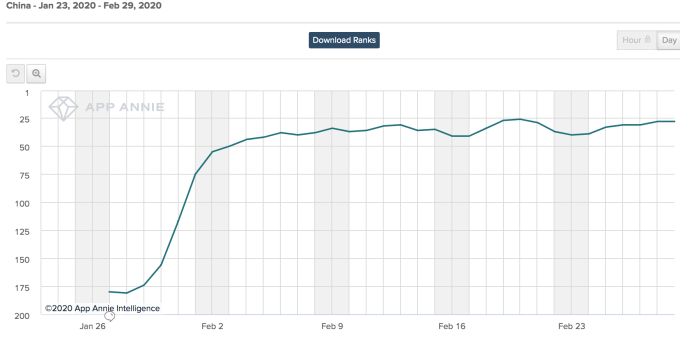
Like other work collaboration services, Zoom soared in China amid the coronavirus outbreak, jumping from No. 180 in late January to No. 28 as of late February in overall app installs. Data: App Annie
“People are reluctant to change once they form a new habit,” suggests Joe Chan, partner at Hong Kong-based Mindworks Ventures. The virus outbreak, he believes, has educated the Chinese masses to work remotely.
“Meeting in person and through Zoom both have their own merits, depending on the social norm. Some people are used to thinking that relationships need to be established through face-to-face encounters, but those who don’t hold that view will have fewer meetings. [The epidemic] presents a chance for a paradigm shift.”
Growth in enterprise businesses might be less visible than what China witnessed over the SARS epidemic that fueled internet consumer verticals such as ecommerce. That’s because software-as-a-services (SaaS), cloud computing, health tech, logistics and other enterprise-facing services are intangible for most consumers.
“Compared to changes in consumer behavior, the adoption of new technologies by enterprises happen at a slower pace, so the impact of coronavirus on new-generation innovations [B2B] won’t come as rapidly and thoroughly as what happened during SARS,” contended Jake Xie, vice president of investment at China Growth Capital.
Xie further suggested that the opportunities presented by the outbreak are reserved for companies that have been steadily investing in the field, in part because enterprise services have a longer life cycle and require more capital-intensive infrastructure. “Opportunists don’t stand a chance,” he concluded.
As for changing consumer behavior, such as the uptick in grocery delivery usage by seniors trapped indoors, the impact might be short-lived. “The only benefit that the epidemic brings to these apps is getting more people to try their services. But how many of them will stay? The argument that people will keep using these apps over concerns of getting sick in offline markets is unsubstantiated. The strength of a business lies in its ability to solve user problems in the long term, for example, providing affordability and convenience,” suggested Derek Shen, chairman of Danke Apartment, the Chinese co-living startup slated to list on NYSE.
The adjacent sector of enterprise services — at-scale technologies tailored to energizing government functions — has also seen traction over the course of the epidemic. Private firms in China have teamed up with regional authorities to better track people’s movements, ramp up facial recognition capacities aimed at a mask-wearing public, develop contact-free consumer experience, among other measures.
Tech firms touting services to the government are no stranger to criticisms concerning the lack of transparency in how user data is used. But the appeal to private firms is huge, not only because state contracts tend to provide a steady stream of long-term revenue, but also that certain public-facing projects can be billed as a fulfillment of corporate social responsibilities. Following the virus outbreak, Chinese tech companies of all sizes hastened to offer contributions, with efforts ranging from making monetary donations to building tools that keep the public informed.
On the flip side, the government also needs private help in emergency management. As prominent Chinese historian Luo Xin poignantly pointed out in podcast SurplusValue’s recent episode [1:00:00], some of the most efficient and effective responses to the public health crisis came not from the government but the private sector, whether it is online retailer JD.com or logistics firm SF Express delivering relief supplies to the epicenter of the outbreak.
That said, Luo argued there are signs that some local authorities’ tendency to centralize control is getting in the way of private efforts. For example, some government offices have stumbled in their attempts to develop crisis management systems from scratch, overlooking a pool of readily available and proven infrastructure powered by the country’s tech giants.
Powered by WPeMatico
If you were a software company employee or venture capitalist in Silicon Valley before 1993, chances are you were talking about “Information Systems Software” and not “Enterprise Software.” How and why did the industry change its name?
The obvious, but perplexing answer is simple — “Star Trek: The Next Generation.”
As befuddling and mind-numbingly satisfying as it is to your local office Trekkie, the industry rebranded itself thanks to a marketing campaign from the original venture-backed system software company, Boole & Babbage (now BMC software).
While the term “Enterprise” was used to describe complex systems for years before 1993, everything changed when Boole & Babbage signed a two-year licensing agreement with the then-highest-rated show in syndication history to produce an infomercial.
Star Trek fans have been talking about this crazy marketing agreement for years, and you can read the full details about how it was executed in TrekCore. But even Trekkies don’t appreciate its long-term impacts on our industry. In this license agreement with Paramount, Boole & Babbage had unlimited rights to create and distribute as much Star Trek content as they could. They physically mailed VHS cassettes to customers, ran magazine ads and even dressed their employees as members of Starfleet at trade shows. Boole & Babbage used this push to market itself as the “Enterprise Automation Company.”
Commander Riker says in the infomercial, “just as the bridge centralizes the functions necessary to control the USS Enterprise, Boole’s products centralize data processing information to allow centralized control of today’s complex information systems.” This seemed to scratch an itch that other systems companies didn’t realize needed scratching.
Not to be outdone, IBM in 1994 rebranded their OS/2 operating system “OS/2 Warp,” referring to Star Trek’s “warp drive.” They also tried to replicate Babbage’s licensing agreement with Paramount by hiring the Enterprise’s Captain Picard (played by actor Patrick Stewart) to emcee the product launch. Unfortunately, Paramount wouldn’t play ball, and IBM hired Captain Janeway (played by actress Kate Mulgrew) from Star Trek: Voyager instead. The licensing issues didn’t stop IBM from also hiring Star Trek’s Mr. Spock (played by actor Leonard Nimoy) to tape a five-minute intro to the event:
Outside of OS/2, IBM’s 1994 announcement list included 13 other “enterprise” initiatives. Soon, leading software companies began to rebrand themselves and release products using the term “enterprise software” as a valuable identifier. MRP software makers like SAP and Baan began embracing the new “Enterprise” moniker after 1993 and in 1995, Lotus rebranded itself as an “Enterprise Software Company.”
“Enterprise” was officially the coolest new vernacular and after industry behemoth IBM bought Lotus in 1996, they incorporated “Enterprise” across all of their products. And while Gartner’s 1990 paper “ERP: A Vision of the Next-Generation MRP II” by Wylie is the technical birth of ERP software, no one cared until Commander Riker told Harold to “monitor your entire Enterprise from a single point of control.” The ngram numbers don’t lie:
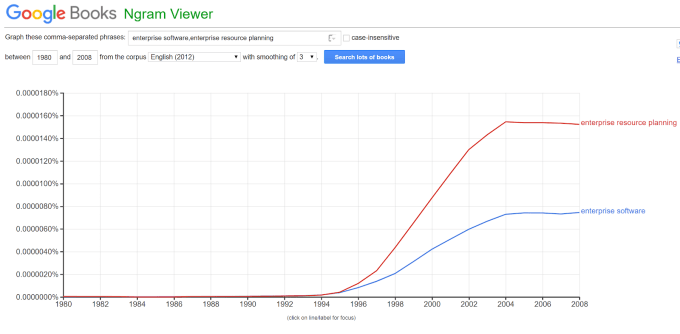
Almost 30 years later, we live in a world in which business is run on enterprise software and the use of the term is ubiquitous. Whenever I see a software business plan come across my desk or read an article on enterprise software, I can’t help but give Commander Riker a little due credit.
Powered by WPeMatico