Enterprise
Auto Added by WPeMatico
Auto Added by WPeMatico
By now we know that Kubernetes is a wildly popular container management platform, but if you want to use it, you pretty much have to choose between having someone manage it for you or building it yourself. Spectro Cloud emerged from stealth today with a $7.5 million investment to give you a third choice that falls somewhere in the middle.
The funding was led by Sierra Ventures with participation from Boldstart Ventures.
Ed Sim, founder at Boldstart, says he liked the team and the tech. “Spectro Cloud is solving a massive pain that every large enterprise is struggling with: how to roll your own Kubernetes service on a managed platform without being beholden to any large vendor,” Sim told TechCrunch.
Spectro co-founder and CEO Tenry Fu says an enterprise should not have to compromise between control and ease of use. “We want to be the first company that brings an easy-to-use managed Kubernetes experience to the enterprise, but also gives them the flexibility to define their own Kubernetes infrastructure stacks at scale,” Fu explained.
Fu says that the stack, in this instance, consists of the base operating system to the Kubernetes version to the storage, networking and other layers like security, logging, monitoring, load balancing or anything that’s infrastructure related around Kubernetes.
“Within an organization in the enterprise you can serve the needs of your various groups, down to pretty granular level with respect to what’s in your infrastructure stack, and then you don’t have to worry about lifecycle management,” he explained. That’s because Spectro Cloud handles that for you, while still giving you that control.
That gives enterprise developers greater deployment flexibility and the ability to move between cloud infrastructure providers more easily, something that is top of mind today as companies don’t want to be locked into a single vendor.
“There’s an infrastructure control continuum that forces enterprises into trade-offs against these needs. At one extreme, the managed offerings offer a kind of nirvana around ease of use, but it’s at the expense of control over things like the cloud that you’re on or when you adopt new ecosystem options like updated versions of Kubernetes.”
Fu and his co-founders have a deep background in this, having previously been part of CliQr, a company that helped customers manage applications across hybrid cloud environments. They sold that company to Cisco in 2016 and began developing Spectro Cloud last spring.
It’s early days, but the company has been working with 16 beta customers.
Powered by WPeMatico

Addapptation, a startup that wants to build a practical design layer on top of Salesforce and other enterprise tools, announced a $1.3 million seed investment today.
2048 Ventures led the round with participation from East Coast Angels, The Millworks II Fund and additional angel investors from New Hampshire, where the firm is located
Co-founder Sumner Vanderhoof says the startup’s goal is to build a user experience platform for enterprise tools like Salesforce . “Our goal is to help make simple, easy to use Salesforce.com solutions built on the addapptation UX platform.
“At the end of the day, we’re really helping transform the way companies work, making their employees more efficient, making the job they do easier and more consistent, so they have a bigger impact on the companies that they work for,” Vanderhoof told TechCrunch.
He says they do this by looking at the company workflow and what issue the customer is trying to solve — such as a problem converting deals through the sales cycle. They will then help build tools and an interface to make it easier to pinpoint this information with the goal of being able to reuse whatever solutions they create for other customers.
He says the platform is template-driven and designed to quickly go from idea to solution. A typical solution takes no longer than two weeks to build and implement. Once a customer is using addapptation, employees can log into the addapptation platform or it can be a layer built into Salesforce providing a more guided experience.
The company has built around 40 plug-ins for the platform, including a heat map that identifies where sales is likely to find the best opportunities to close a deal. The solutions they build are designed to work online or on mobile devices as needed.
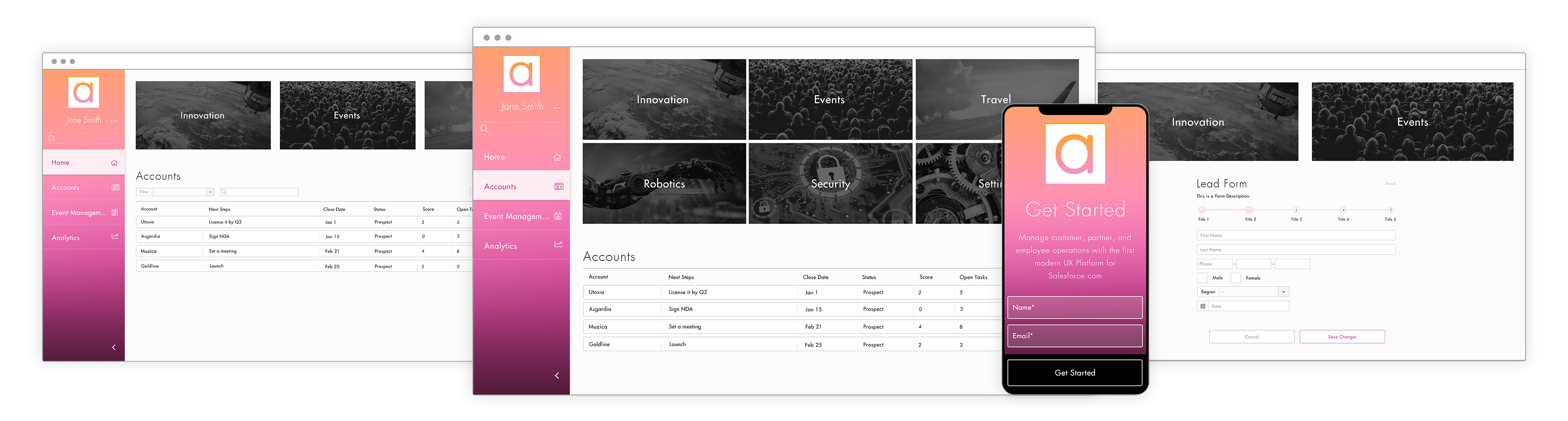
Photo: addapptation
Vanderhoof says that the company has a good relationship with Salesforce, and it doesn’t compete directly with the company. “Their main focus is providing tools for a wide audience. Ours is extending the platform beyond what it can do,” he said.
The two founders, Vanderhoof and his wife Carla, took three years building the platform, essentially bootstrapping before taking today’s funding. The company has 15 employees in its Exeter, NH, headquarters and has 20 customers including Comcast and Ingram Micro.
Powered by WPeMatico
While companies might pay for a CEO coach, lower level employees often get stuck with lame skill-building worksheets or no mentorship at all. Not only does that limit their potential productivity, but it also makes them feel stagnated and undervalued, leading them to jump ship.
Therapy… err… executive coaching is finally becoming destigmatized as entrepreneurs and their teams realize that everyone can’t be crushing it all the time. Building a business is hard. It’s okay to cry sometimes. But the best thing you can do is be vulnerable and seek help.
Torch emerged from stealth last year with $18 million in funding to teach empathy to founders and C-suite execs. Since 2013, Everwise has raised $26 million from Sequoia and others for its peer-to-peer mentorship marketplace that makes workplace guidance accessible to rank-and-file staffers. Tomorrow they’ll official announce their merger under the Torch name to become a full-stack career coach for every level of employee.
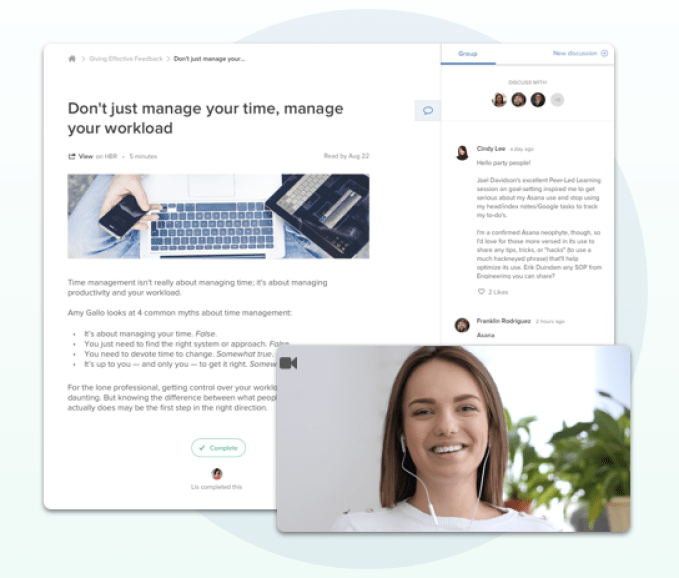
“As human beings, we face huge existential challenges in the form of pandemics, climate change, the threats coming down the pipe from automation and AI” says Torch co-founder and CEO Cameron Yarbrough. “We need to create leaders at every single level of an organization and ignite these people with tools and human support in order to level up in the world.”
Startup acquisitions and mergers can often be train wrecks because companies with different values but overlapping products are jammed together. But apparently it’s gone quite smoothly since the products are so complementary, with all 70 employees across the two companies keeping their jobs. “Everwise is much more bottom up whereas Torch is about the upper levels, and it just sort of made sense” says Garry Tan, partner and co-founder of Initialized Capital that funded Torch’s Series A and is also a client of its coaching.
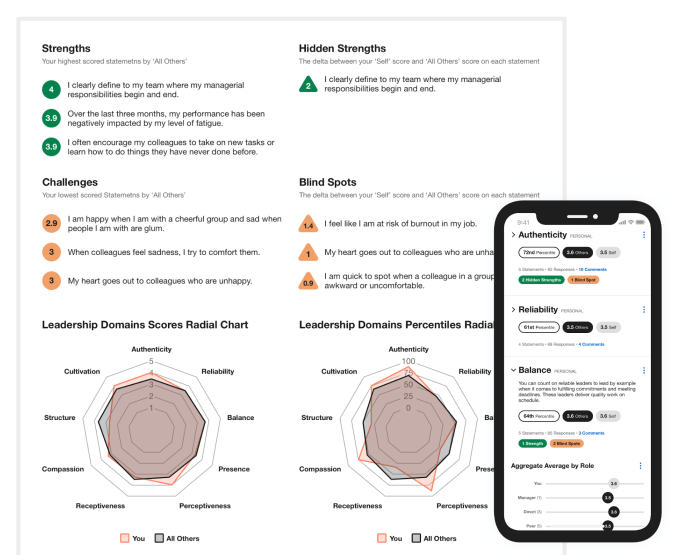
How does each work? Torch goes deep, conducting extensive 360-interviews with an executive as well as their reports, employees, and peers to assess their empathy, communication, vision, conflict resolution, and collaboration. Clients’ executives do extensive 360-interviews. It establishes quantifiable goals that executives work towards through video call sessions with Torch’s coaches. They learn about setting healthy workplace boundaries, staying calm amidst arguments, motivating staff without seeming preachy, and managing their own ego.
This coaching can be exceedingly valuable for the leaders setting a company’s strategy and tone. But the one-on-one sessions are typically too expensive to buy for all levels of employees. That’s where Everwise comes in.
Everwise goes wide, offering a marketplace with 6,000 mentors across different job levels and roles that can provide more affordable personal guidance or group sessions with 10 employees all learning from each other. It also provides a mentorship platform where bigger companies can let their more senior staffers teach junior employees exactly what it takes to succeed. That’s all stitched together with a curated and personalized curriculum of online learning materials. Meanwhile, a company’s HR team can track everyone’s progress and performance through its Academy Builder dashboard.
“We know Gen Z has grown up with mentors by their side from SAT prep” says Torch CMO Cari Jacobs. Everwise lets them stay mentored, even at early stages of their professional life. “As they advance through their career, they might notch up to more executive private coaching.” Post-merger, Torch can keep them sane and ambitious throughout the journey.
“It really allows us to move up market without sacrificing all the traction we’ve built working with startups and mid-market companies,” Yarbrough tells me. Clients have included Reddit and ZenDesk, but also giants like Best Buy, Genentech, and T-Mobile.

The question is whether Everwise’s materials are engaging enough to not become just another employee handbook buried on an HR site that no one ever reads. Otherwise, it could just feel like bloat tacked onto Torch. Meanwhile, scaling up to bigger clients pits Torch against long-standing pillars of the executive coaching industry like Aon and Korn Ferry that have been around for decades and have billions in revenue. Meanwhile, new mental health and coaching platforms are emerging like BetterUp and Sounding Board.
But the market is massive since so few people get great coaching right now. “No one goes to work and is like, ‘Man, I wish my boss was less mindful,’” Tan jokes. When Yarbrough was his coach, the Torch CEO taught the investor that while many startup employees might think they thrive on flexibility, “people really want high love and high structure.” In essence, that’s what Torch is trying to deliver — a sense of emotional camaraderie mixed with a prod in the direction of fulfilling their destiny.
Powered by WPeMatico
The rise of the cloud over the past decade has forced software developers and DevOps engineers to completely rearchitect the modern web application, ensuring scalability, performance, and security. That’s a really painful proposition when done manually, which is where Hashicorp comes in to play. The company’s suite of products helps everyone in the tech workforce from IT admins to software developers operate in the cloud (mostly) effortlessly and natively.
The company’s products have long garnered rave reviews from technical staffs, and now the company is looking at a brand new massive valuation.
The SF-based startup announced today that it has raised $175 million in Series E financing from Franklin Templeton Investments at a scorching $5.1 billion valuation. For context, when we last covered the company back in late 2018, its valuation was only a “paltry” $1.9 billion following a $100 million round led by growth investor IVP.
The company in its release today touted its success in doubling revenues and customers every year for four straight years as the key reason behind the flush valuation. The company is making a (not so) subtle point that David McJannet, who joined the company as CEO in mid-2016 following a stint as an EIR at Greylock, has seen some success in his new role.

Hashicorp CEO David McJannet. Photo via Hashicorp
The company, founded by Mitchell Hashimoto and Armon Dadgar in 2012, is one of the major pioneers in helping companies build high-quality infrastructure that’s a mix of multi-cloud providers, private cloud, and even legacy systems.
It’s most well-known product is Terraform, which allows developers to write repeatable rules around enterprise infrastructure rather than a patchwork of different scripts that might not work as its writers intended. The idea is that with a consistent framework, Hashicorp’s product can help companies reduce costs (by protecting against, say, over-provisioning of resources) while also helping to balance scale and performance. The company’s other products include Consul around network automation, Vault for security, and Nomad for application deployment.
Hashicorp touches on a bunch of competitive products, but its cohesive set of tools and strong outreach to the developer community has set itself apart from the competition in recent years.
Franklin Templeton is a fairly late stage investor that has funded such enterprise companies as Cloudflare, which went public last year, logs management platform SumoLogic, and cybersecurity business Tanium, all according to Crunchbase.
With a hefty $5.1 billion valuation, the company narrowly missed the catastrophic decline of SaaS stocks over the past few weeks, which have been buffeted by the rapidly spreading global pandemic. But with a new war chest and a focus on a popular and growing enterprise market, the company seems poised to continue its growth.
Powered by WPeMatico
We need to go hands-off in the age of coronavirus. That means touching fewer doors, elevators, and sign-in iPads. But once a building is using phone-based identity for security, there’s opportunities to speed up access to WIFI networks and printers, or personalize conference rooms and video call set-ups. Keyless office entry startup Proxy wants to deliver all of this while keeping your phone in your pocket.
“The door is just a starting point” Proxy co-founder and CEO Denis Mars tells me. “We’re . . . empowering a movement to take back control of our privacy, our sense of self, our humanity, our individuality.”

With the contagion concerns and security risks of people rubbing dirty, cloneable, stealable key cards against their office doors, investors see big potential in Proxy. Today it’s announcing here a $42 million Series B led by Scale Venture Partners with participation from former funders Kleiner Perkins and Y Combinator plus new additions Silicon Valley Bank and West Ventures.
The raise brings Proxy to $58.8 million in funding so it can staff up at offices across the world and speed up deployments of its door sensor hardware and access control software. “We’re spread thin” says Mars. “Part of this funding is to try to grow up as quickly as possible and not grow for growth sake. We’re making sure we’re secure, meeting all the privacy requirements.”
How does Proxy work? Employers get their staff to install an app that knows their identity within the company, including when and where they’re allowed entry. Buildings install Proxy’s signal readers, which can either integrate with existing access control software or the startup’s own management dashboard.
Employees can then open doors, elevators, turnstiles, and garages with a Bluetooth low-energy signal without having to even take their phone out. Bosses can also opt to require a facial scan or fingerprint or a wave of the phone near the sensor. Existing keycards and fobs still work with Proxy’s Pro readers. Proxy costs about $300 to $350 per reader, plus installation and a $30 per month per reader subscription to its management software.
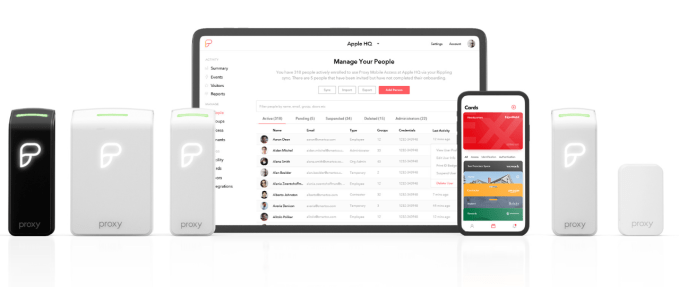
Now the company is expanding access to devices once you’re already in the building thanks to its SDK and APIs. Wifi router-makers are starting to pre-provision their hardware to automatically connect the phones of employees or temporarily allow registered guests with Proxy installed — no need for passwords written on whiteboards. Its new Nano sensors can also be hooked up to printers and vending machines to verify access or charge expense accounts. And food delivery companies can add the Proxy SDK so couriers can be granted the momentary ability to open doors when they arrive with lunch.
Rather than just indiscriminately beaming your identity out into the world, Proxy uses tokenized credentials so only its sensors know who you are. Users have to approve of new networks’ ability to read their tokens, Proxy has SOC-2 security audit certification, and complies with GDPR. “We feel very strongly about where the biometrics are stored . . . they should stay on your phone” says Mars.
Yet despite integrating with the technology for two-factor entry unlocks, Mars says “We’re not big fans of facial recognition. You don’t want every random company having your face in their database. The face becomes the password you were supposed to change every 30 days.”

Keeping your data and identity safe as we see an explosion of Internet Of Things devices was actually the impetus for starting Proxy. Mars had sold his teleconferencing startup Bitplay to Jive Software where he met his eventually co-founder Simon Ratner, who’d joined after his video annotation startup Omnisio was acquired by YouTube. Mars was frustrated about every IoT lightbulb and appliance wanting him to download an app, set up a profile, and give it his data.
The duo founded Proxy in 2016 as a universal identity signal. Today it has over 60 customers. While other apps want you to constantly open them, Proxy’s purpose is to work silently in the background and make people more productive. “We believe the most important technologies in the world don’t seek your attention. They work for you, they empower you, and they get out of the way so you can focus your attention on what matters most — living your life.”
Now Proxy could actually help save lives. “The nature of our product is contactless interactions in commercial buildings and workplaces so there’s a bit of an unintended benefit that helps prevent the spread of the virus” Mars explains. “We have seen an uptick in customers starting to set doors and other experiences in longer-range hands-free mode so that users can walk up to an automated door and not have to touch the handles or badge/reader every time.”

The big challenge facing Proxy is maintaining security and dependability since it’s a mission-critical business. A bug or outage could potentially lock employees out of their workplace (when they eventually return from quarantine). It will have to keep hackers out of employee files. Proxy needs to stay ahead of access control incumbents like ADT and HID as well as smaller direct competitors like $10 million-funded Nexkey and $28 million-funded Openpath.
Luckily, Proxy has found a powerful growth flywheel. First an office in a big building gets set up, then they convince the real estate manager to equip the lobby’s turnstiles and elevators with Proxy. Other tenants in the building start to use it, so they buy Proxy for their office. Then they get their offices in other cities on board…starting the flywheel again. That’s why Proxy is doubling down on sales to commercial real estate owners.
The question is when Proxy will start knocking on consumers’ doors. While leveling up into the enterprise access control software business might be tough for home smartlock companies like August, Proxy could go down market if it built more physical lock hardware. Perhaps we’ll start to get smart homes that know who’s home, and stop having to carry pointy metal sticks in our pockets.
Powered by WPeMatico

Startups have done some wild things to get the attention of VCs. In fact, Instacart founder Apoorva Mehta sent YC partner (at the time) Garry Tan a six-pack of beer through the service after missing the deadline for Y Combinator by two months.
Yesterday, the ingenuity of startups struck again.
Tadabase.io, an enterprise startup that offers no-code tools to help businesses automate their processes, has had an ad running that was… well, hyper targeted.
ProductHunt founder and WeekendFund investor Ryan Hoover discovered the ad and shared it on Twitter.
I google’d @msuster’s LinkedIn and this is what I found
pic.twitter.com/ANMZ2dg6AD
— Ryan Hoover (@rrhoover) March 13, 2020
Hoover told TechCrunch he was Googling Mark Suster to facilitate an introduction between Suster and one of Hoover’s portfolio companies. Instead, he found a Google ad directed squarely at Suster from Tadabase.io.
“Mark Suster, you haven’t invested in nocode” read the paid listing. “Therefore, we put this ad here to get your attention. If you’re not Mark, please don’t click here and save us some money.”
I reached out to Suster, managing partner at UpFront Ventures, to see what he thought of the ad. He told me he “loved it” and has already contacted the CEO to set up a call for next week.
Whether this clever Google ad will result in an actual investment is yet to be determined. Also unclear: will Ryan Hoover get in on the deal?
I reached out to Tadabase founder and CEO Moe Levine via email to ask about the ad, how they went about targeting, and how he feels about his upcoming phone call next week. He hasn’t responded yet. I’ll update if/when he does.
Powered by WPeMatico
The JEDI contract award process might never be done. Following legal challenges from Amazon after the Pentagon’s massive, $10 billion cloud contract was awarded to Microsoft in October, the Pentagon indicated in court documents last night that it wishes to reconsider the award.
It’s just the latest plot twist in an epic government procurement saga.
Here’s what we know. The Pentagon filing is based on Amazon’s complaints about the technical part of the deal only. Amazon has said that it believes political interference influenced the awarding of the contract. However, the cloud computing giant also believes it beat Microsoft on the technical merits in a majority of instances required in the request for proposals issued by the Pentagon.
In fact, sources told TechCrunch, “AWS’s protest identified evaluation errors, clear deficiencies and unmistakable bias in six of the eight evaluation factors.”
Obviously Amazon was happy to hear this news. “We are pleased that the DoD has acknowledged ‘substantial and legitimate’ issues that affected the JEDI award decision, and that corrective action is necessary,” a spokesperson stated.
“We look forward to complete, fair, and effective corrective action that fully insulates the re-evaluation from political influence and corrects the many issues affecting the initial flawed award.”
As would expect, Microsoft thinks that the DoD made the correct choice, and believes the review will bear that out. “Over two years, the DoD reviewed dozens of factors and sub factors and found Microsoft equal or superior to AWS on every factor. We remain confident that Microsoft’s proposal was technologically superior, continues to offer the best value, and is the right choice for the DoD,” Microsoft VP of communications Frank Shaw said.
The court granted the Pentagon 120 days to review the results again, but indicated it could take longer. In the meantime, the project is at a standstill.
On Friday, the court issued a ruling that Amazon was likely to succeed on its complaint on merit, and that could have been the impetus of this latest action by the Pentagon.
While the political influence piece might not be overtly part of this filing, it does lurk in the background. The president has made it clear that he doesn’t like Amazon founder and CEO Jeff Bezos, who also owns The Washington Post. As we wrote last year:
Amazon, for instance, could point to Jim Mattis’ book where he wrote that the president told the then Defense Secretary to “screw Bezos out of that $10 billion contract.” Mattis says he refused, saying he would go by the book, but it certainly leaves the door open to a conflict question.
As we previously reported, AWS CEO Andy Jassy stated at a press event at AWS re:Invent in December that the company believed there was political bias at play in the decision-making process.
“What I would say is that it’s fairly obvious that we feel pretty strongly that it was not adjudicated fairly,” he said. He added, “I think that we ended up with a situation where there was political interference. When you have a sitting president, who has shared openly his disdain for a company, and the leader of that company, it makes it really difficult for government agencies, including the DoD, to make objective decisions without fear of reprisal.”
The story has been updated with a comment from Microsoft. We have requested comment from DoD and will update the story should they respond.
Powered by WPeMatico
Yext says that in response to the COVID-19 pandemic, it’s making its Yext Answers site search product free for 90 days.
You might not see an obvious connection between site search and a worldwide pandemic. You might even think this sounds like a marketing gimmick. But Yext CEO Howard Lerman said that for the past 10 days, the company has seen a spike in coronavirus-related searches across sites that use Yext Answers.
After all, Lerman said Yext has a lot of customers in the healthcare industry, such as the IHA medical group. But even beyond that, companies are getting related questions, whether it’s a hotel getting asked about their cleaning procedures, or an airline being asked whether it’s safe to fly or a vodka company getting asked about whether vodka can be used as hand sanitizer.
Businesses could try to answer those questions on a single web page or blog post, but that’s probably not going to be comprehensive. Yext Answers offers a way to present and save this information in a much more structured way, so that a visitor can jump to the exact answer that interests them. In addition, it provides data on what visitors are searching for, so companies can answer the questions that people are actually asking.
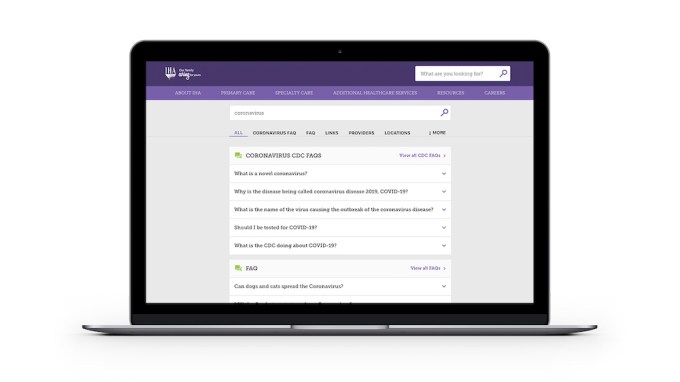
Yext is also offering a free plugin that includes frequently asked questions about the coronavirus, with answers sourced directly form the U.S. Centers for Disease Control and Prevention.
“We have a product that could be pretty useful right now,” Lerman said. “We don’t want people to be getting wrong answers in the time of a global pandemic.”
He added that the company would normally charge around $100,000 for three months of Yext Answers. However, the free offering will be limited to 1,000 entities (which can be FAQs, locations or anything else), and Lerman said most paying customers are already using more than that.
While the product is free, the company will still schedule an initial setup call with a Yext administrator and provide ongoing email support. You can read more on Yext’s new website.
Powered by WPeMatico
CRM software accounts for one-quarter of all enterprise IT spend. But ironically, while a lot of money is spent on platforms like Salesforce or SAP to manage incoming calls and outgoing marketing and sales activity, not a lot of attention is given to the issue of how to help the teams using all that software work better.
What are the peak times for calls? What are the most common questions? Which staff are best skilled at what kinds of questions? And who is actually working at any given time? These are just some of the issues, but in many cases, there isn’t much in the way of tools used to help with these at all — organisations often just hack a spreadsheet platform like Google Sheets or a calendar app to get by, or do nothing at all.
Today, a startup called Assembled is coming out of stealth mode to address that gap in the market, with a platform that’s built specifically to address the kinds of questions and issues that customer support teams encounter and — answered well — can help them work much better.
Out of the gate, Assembled is announcing $3.1 million in seed funding led by Stripe — where the founding team previously worked — with participation also from Basis Set Ventures, Signalfire and several angel investors (who are also mostly former Stripe employees).
Assembled’s longer-term ambition is to build tools for what co-founder Ryan Wang describes as “the logistics of customer support.”
“We want to become the operating system for support teams,” he said. Most immediately, the company’s focus will be on agent performance. “Teams want to learn about their top performers and how they spend their time, and offer data to empower their decision-making.”
Stripe — the payments and related services provider that is now valued at $35 billion — has developed a sizable operation funding startups adjacent to its own interests in cultivating relationships with startups and other smaller businesses. You could consider it a strategic investor in Assembled: alongside Grammarly, Gofundme, Hopper and Harry’s, Stripe is one of Assembled’s marquee customers.
Wang, an ex-Stripe engineer who co-founded Assembled with his brother John and Assembled’s CEO Brian Sze (both also ex-Stripe), said in an interview that the idea for the startup came directly out of the pair’s experiences as early employees at Stripe.
The approach at the startup in its early days was very grass-roots: employees would get together outside the office to go through support tickets as a way of identifying trends and to talk through them to figure out what might need fixing, how to handle issues in the future and so on.
It was probably a great way for the team to really stay in touch with what customers needed and wanted. But eventually this approach presented a problem: How do you scale this kind of process? To a tech person, the solution would be obvious: build a platform that can help you do this.
“Within the landscape of CRM, we could see that tech hadn’t really been applied to the business of supporting customer support,” Wang said. “That is why we left. We’d understood that it was a broad problem.”
A tool to help improve workforce management for customer support teams is a no-brainer for a company already trying to address these issues through its own home-baked solutions. Wang noted that one of its current customers had built out such an extensive map of data on Google Sheets trying to address customer support workforce management that “they broke Google Sheets. It was just too big.”
Indeed, Bob van Winden, Stripe’s head of operations, noted: “Millions of businesses rely on Stripe every day. To support them, we obsess over every detail of delivering fast, reliable customer service, including free 24×7 phone and chat support. This led us to Assembled, which our global support teams are using to stay coordinated and focused on helping Stripe’s users thrive.”
Less obvious is the use case when a company has never identified these issues, or sees them but haven’t made efforts to try to solve them because it seems too difficult. (The classic issues here are that Assembled is “too clever by half,” or “too ahead of its time.”) That presents both an open market for Assembled, but also a greenfield challenge.
One route to customers has been to integrate with more established CRM packages. Currently Assembled integrates with Salesforce, Kustomer and Zendesk, so that it can source data from these to provide more insights to users.
Another is to provide a set of tools that speak to the wider trend for analytics and data-based insights that can be used to improve how a company works. Indeed, just as Kustomer has disrupted the idea of a CRM being focused on a narrow funnel of inbound requests, Assembled also is rethinking how to parse data to figure out what a customer support person should be doing and when.
The startup provides a way to forecast inbound support query volumes, and to map that into staffing plans that cover multiple channels like chat, email, phone and social media. The staffing plan, in turn, also acts as a scheduling tool to set up group and single calendars for individuals.
A team’s activity, meanwhile, is tracked through a set of metrics the whole team can see and use to calibrate their work better.
Going forward, you can imagine Assembled expanding in a couple of different directions. One might be to offer workforce management to more teams beyond customer support, but that also have to work out how to manage inbound requests and turn them into more efficient work plans. Another might be to continue expanding the kinds of tools it might provide to customer support teams to continue complementing basic CRMs, in particular as customer support comes to mean different things, depending on who the “customer” actually is.
“We see the term ‘customer support’ evolving,” Wang said. “The big struggle is what the encompassing term should be instead. Generally, our view is that we want to transform and elevate what customer support means. It’s not just about call centers, but any drivers of customer experience related to your products.”
Powered by WPeMatico
AWS has launched its own open-source operating system for running containers on both virtual machines and bare metal hosts. Bottlerocket, as the new OS is called, is basically a stripped-down Linux distribution that’s akin to projects like CoreOS’s now-defunct Container Linux and Google’s container-optimized OS. The OS is currently in its developer preview phase, but you can test it as an Amazon Machine Image for EC2 (and by extension, under Amazon EKS, too).
As AWS chief evangelist Jeff Barr notes in his announcement, Bottlerocket supports Docker images and images that conform to the Open Container Initiative image format, which means it’ll basically run all Linux-based containers you can throw at it.
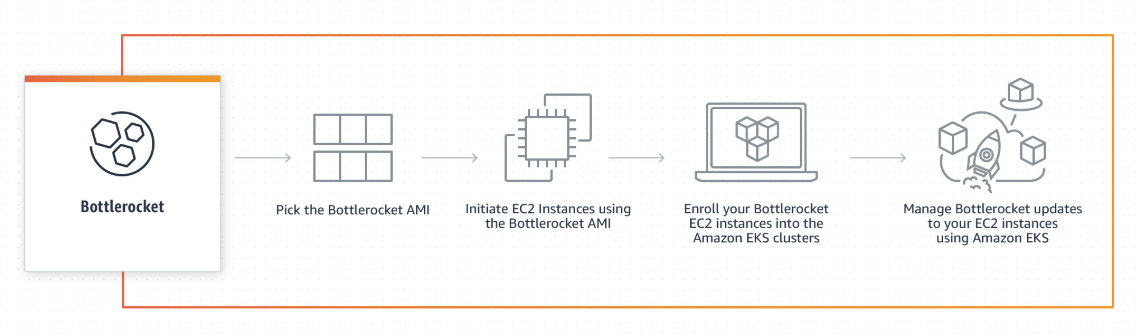
One feature that makes Bottlerocket stand out is that it does away with a package-based update system. Instead, it uses an image-based model that, as Barr notes, “allows for a rapid & complete rollback if necessary.” The idea here is that this makes updates easier. At the core of this update process is “The Update Framework,” an open-source project hosted by the Cloud Native Computing Foundation.
AWS says it will provide three years of support (after General Availability) for its own builds of Bottlerocket. As of now, the project is very much focused on AWS, of course, but the code is available on GitHub and chances are we will see others expand on AWS’ work.
 The company is launching the project in cooperation with a number of partners, including Alcide, Armory, CrowdStrike, Datadog, New Relic, Sysdig, Tigera, Trend Micro and Waveworks.
“Container-optimized operating systems will give dev teams the additional speed and efficiency to run higher throughput workloads with better security and uptime,” said Michael Gerstenhaber, director of Product Management at Datadog.” We are excited to work with AWS on Bottlerocket, so that as customers take advantage of the increased scale they can continue to monitor these ephemeral environments with confidence.”
Powered by WPeMatico