Enterprise
Auto Added by WPeMatico
Auto Added by WPeMatico
CRM has for years been primarily a story of software to manage customer contacts, data to help agents do their jobs, and tools to manage incoming requests and outreach strategies. Now to add to that we’re starting to see a new theme: apps to help agents track how they work and to work better.
Today comes the latest startup in that category, a Dutch company called Kaizo, which uses AI and gamification to provide feedback on agents’ work, tips on what to do differently, and tools to set and work to goals — all of which can be used remotely, in the cloud. Today, it is announcing $3 million in a seed round of funding co-led by Gradient — Google’s AI venture fund — and French VC Partech.
And along with the seed round, Kaizo (which rebranded last week from its former name, Ticketless) is announcing that Christoph Auer-Welsbach, a former partner at IBM Ventures, is joining the company as a co-founder, alongside founder Dominik Blattner.
Although this is just a seed round, it’s coming after a period of strong growth for the company. Kaizo has already 500 companies including Truecaller, SimpleSurance, Miro, CreditRepairCloud, Justpark, Festicket and Nmbrs are using its software, covering “thousands” of customer support agents, which use a mixture of free and paid tools that integrate with established CRM software from the likes of Salesforce, Zendesk and more.
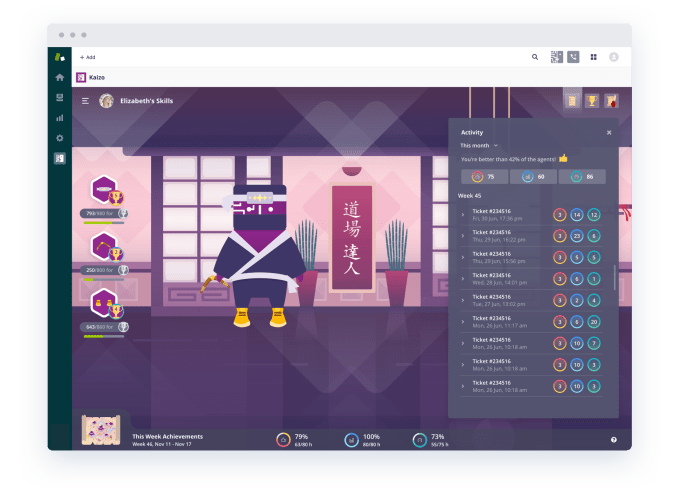
Customer service, and the idea of gamifying it to motivate employees, might feel like the last thing on people’s minds at the moment, but it is actually timely and relevant to our current state in responding to and living with the coronavirus.
People are spending much more time at home, and are turning to the internet and remote services to get what they need, and in many cases are finding that their best-laid plans are now in freefall. Both of these are driving a lot of traffic to sites and primarily customer support centers, which are getting overwhelmed with people reaching out for help.
And that’s before you consider how customer support teams might be impacted by coronavirus and the many mandates we’ve had to stay away from work, and the stresses they may be under.
“In our current social climate, customer support is an integral part of a company’s stability and growth that has embraced remote work to meet the demands of a globalized customer-base,” said Dominik Blattner, founder of Kaizo, in a statement. “With the rise of support teams utilizing a digital workplace, providing standards to measure an agent’s performance has never been more important. KPIs provide these standards, quantifying the success, achievement and contribution of each team member.”
On a more general level, Kaizo is also changing the conversation around how to improve one’s productivity. There has been a larger push for “quantified self” platforms, which has very much played out both in workplaces and in our personal lives, but a lot of services to track performance have focused on both managers and employees leaning in with a lot of input. That means if they don’t set aside the time to do that, the platforms never quite work the way they should.
This is where the AI element of Kaizo plays a key role, by taking on the need to proactively report into a system.
“This is how we’re distinct,” Auer-Welsbach said in an interview. “Normally KPIs are top-down. They are about people setting goals and then reporting they’ve done something. This is a bottom-up approach. We’re not trying to change employees’ behaviour. We plug into whatever environment they are using, and then our tool monitors. The employee doesn’t have to report or measure anything. We track clicks on the CRM, ticketing, and more, and we analyse all that.” He notes that Kaizo is looking at up to 50 datapoints in its analysis.
“We’re excited about Kaizo’s novel approach to applying AI to existing ticket data from platforms like Zendesk and Salesforce to optimize the customer support workflow,” said Darian Shirazi, General Partner at Gradient Ventures, in a statement. “Using machine learning, Kaizo understands which behaviors in customer service tickets lead to better outcomes for customers and then guides agents to replicate that using ongoing game mechanics. Customer support and service platforms today are failing to leverage data in the right way to make the life of agents easier and more effective. The demand Kaizo has seen since they launched on the Zendesk Marketplace shows agents have been waiting for such a solution for some time.”
Kaizo is not the only startup to have identified the area of building new services to improve the performance of customer support teams. Assembled earlier this month also raised $3.1 million led by Stripe for what it describes as the “operating system” for customer support.
Powered by WPeMatico
Yaguara, a Denver-based startup that wants to help e-commerce companies understand their customers better to deliver more meaningful experiences, announced a $7.2 million seed investment today.
The round was led by Foundation Capital with participation from Gradient Ventures, Rainfall Ventures and Zelkova. It also had help from some e-commerce heavy hitters including Warby Parker, Harry’s and Allbirds.
Yaguara CEO Jonathan Smalley was working at an agency building specialized cloud tools for online businesses when he recognized there was a need to pull data together into a single place and help companies understand their customer’s behavior better.
“Yaguara is based on integrating data and having all their data in the right place. For us, it started with several dozen tools from performance marketing to your actual e-commerce data to your fulfillment and unit economic data — bringing that all into one place letting them see their data in real time.”
“Then our platform serves predictive and prescriptive insights and recommendations to individual users across your teams, so they can drive specific outcomes across the organization based on that unified data set,” Smalley explained.
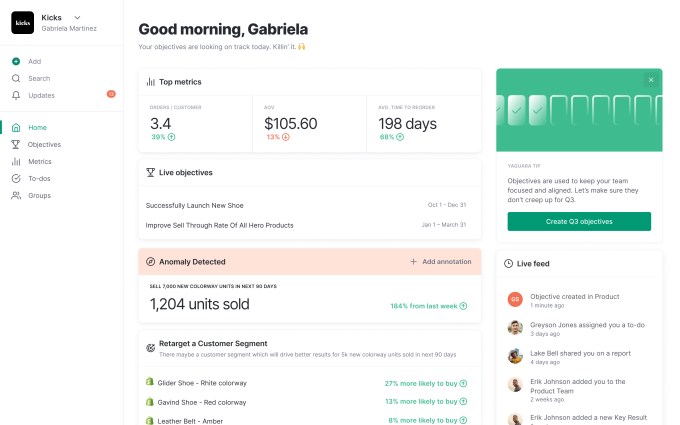
Screenshot: Yaguara
They build that data set by connecting to a variety of popular tools to help understand what’s happening across the customer lifecycle, whether that’s customer acquisition through Facebook or Google ads or understanding shopping cart abandonment data or how often the customer has returned to buy again, all of which help build a better picture of the customer.
While this may sound like a customer data platform (CDP), Smalley says it’s actually more than that. While the CDP provides the pipeline to your data sources like Yaguara, it doesn’t stop there. He says it reduces the complexity of helping front-line marketing personnel access and query that data without having to know SQL or R or have a technical intermediary to understand the data.
While the company is young it already has 250 e-commerce customers using the platform. With the new infusion of cash, it should be able to bring in more employees, build more data connectors and continue working to build out the platform.
Powered by WPeMatico
Spotinst, the startup that helps companies find lower-cost spot instances in the cloud, announced today that it was rebranding as Spot. It also announced a brand new cloud usage dashboard to help companies get a detailed view of their cloud spend.
Amiram Shachar, co-founder and CEO at Spot, says the new product is designed to give customers much greater insight and visibility into cloud usage and spending.
“With this new product we’re providing a more holistic platform that lets customers see all of their cloud spending in one place — all of their usage, all of their costs, what they are spending and doing across multiple clouds — and then what they can actually do [to deploy resources more efficiently],” Shachar told TechCrunch.
The visibility means that customers can see across cloud vendors and get a big picture view of how they are deploying cloud resources to optimize their usage, which could be useful for the financial side of the house and IT.
“We’re basically bifurcating all of our customers’ cloud infrastructure and telling them this is what you should run on spot instances, this is what you should run on reserved instances and this is why you should keep on-demand instances,” he said.
The new product builds on the company’s core competency: helping customers deploy cheaper spot and reserved instances from cloud infrastructure vendors in an automated fashion.
Spot instances are a product where cloud vendors deploy their unused resources for much lower cost, while reserved instances provide a discounted rate for buying resources in advance for a set price. However, spot instances have a big catch: when the cloud vendor needs those resources, you get kicked off. Spot helps in this regard by safely moving the workload to another available spot instance automatically.
Spot was founded in 2015 and has raised more than $52 million, according to Crunchbase. Shachar says the company is in the $30 million revenue range and this new product should help drive that higher.
Powered by WPeMatico
Humio, a startup that has built a modern unlimited logging solution, announced a $20 million Series B investment today.
Dell Technologies Capital led the round with participation from previous investor Accel. Today’s investment brings the total raised to $32 million, according to the company.
Humio co-founder and CEO Geeta Schmidt says the startup wanted to build a solution that would allow companies to log everything, while reducing the overall cost associated with doing that, a tough problem due to the resource and data volume involved. The company deals with customers who are processing multiple terabytes of data per day.
“We really wanted to build an infrastructure where it’s easy to log everything and answer anything in real time. So we built an index-free logging solution which allows you to ask […] ad hoc questions over large volumes of data,” Schmidt told TechCrunch.
They are able to ingest so much data by using streaming technology, says company EVP of sales Morten Gram. “We have this real time streaming engine that makes it possible for customers to monitor whatever they know they want to be looking at. So they can build dashboards and alerts for these [metrics] that will be running in real time,” Gram explained.
What’s more, because the solution enables companies to log everything, rather than pick and choose what to log, they can ask questions about things they might not know, such as an on-going security incident or a major outage, and trace the answer from the data in the logs as the incident is happening.
Perhaps more importantly, the company has come up with technology to reduce the cost associated with processing and storing such high volumes of data. “We have thought a lot about trying to do a lot more with a lot less resources. And so, for example, one of our customers, who moved from a competitor, has gone from 80 servers to 14 doing the same volumes of data,” she said.
Deepak Jeevankumar, managing director and lead investor at Dell Technologies Capital, says that his firm recognized that Humio was solving these issues in a creative and modern way.
“Humio’s team has created a new log analysis architecture for the microservices age. This can support real-time analysis at full-speed ingest, while decreasing cost of storage and analysis by at least an order of magnitude,” he explained. “In a short-period of time, Humio has won the confidence of many Fortune 500 customers who have shifted their log platforms to Humio from legacy, decade-old architectures that do not scale for the cloud world.”
The company’s customers include Netlify, Bloomberg, HP Aruba and Michigan State University. It offers on-prem, cloud and hosted SaaS products. Today, the company also announced it was introducing an unlimited ingest plan for hosted SaaS customers.
Powered by WPeMatico
Espressive, a four-year-old startup from former ServiceNow employees, is working to build a better chatbot to reduce calls to company help desks. Today, the company announced a $30 million Series B investment.
Insight Partners led the round with help from Series A lead investor General Catalyst along with Wing Venture Capital. Under the terms of today’s agreement, Insight founder and managing director Jeff Horing will be joining the Espressive Board. Today’s investment brings the total raised to $53 million, according to the company.
Company founder and CEO Pat Calhoun says that when he was at ServiceNow he observed that, in many companies, employees often got frustrated looking for answers to basic questions. That resulted in a call to a Help Desk requiring human intervention to answer the question.
He believed that there was a way to automate this with AI-driven chatbots, and he founded Espressive to develop a solution. “Our job is to help employees get immediate answers to their questions or solutions or resolutions to their issues, so that they can get back to work,” he said.
They do that by providing a very narrowly focused natural language processing (NLP) engine to understand the question and find answers quickly, while using machine learning to improve on those answers over time.
“We’re not trying to solve every problem that NLP can address. We’re going after a very specific set of use cases which is really around employee language, and as a result, we’ve really tuned our engine to have the highest accuracy possible in the industry,” Calhoun told TechCrunch.
He says what they’ve done to increase accuracy is combine the NLP with image recognition technology. “What we’ve done is we’ve built our NLP engine on top of some image recognition architecture that’s really designed for a high degree of accuracy and essentially breaks down the phrase to understand the true meaning behind the phrase,” he said.
The solution is designed to provide a single immediate answer. If, for some reason, it can’t understand a request, it will open a help ticket automatically and route it to a human to resolve, but they try to keep that to a minimum. He says that when they deploy their solution, they tune it to the individual customers’ buzzwords and terminology.
So far they have been able to reduce help desk calls by 40% to 60% across customers with around 85% employee participation, which shows that they are using the tool and it’s providing the answers they need. In fact, the product understands 750 million employee phrases out of the box.
The company was founded in 2016. It currently has 65 employees and 35 customers, but with the new funding, both of those numbers should increase.
Powered by WPeMatico

The coronavirus demand crunch has taken another bite: Palo Alto-based corporate travel-focused unicorn TripActions has confirmed laying off hundreds of staff.
Per this post on Blind — written by someone with a verified TripActions email address — the company laid off 350 people. Business Insider reported the same figure yesterday, and the Wall Street Journal said the layoffs amount to between one-quarter to one-fifth of the startup’s total staff, citing a person familiar with the situation.
Update: A spokesman for TripActions told us the number of impacted employees impacted is “less than 300” — although he qualified the remark by saying the figure includes 25 people who were offered other roles within the company.
In an earlier email to Crunchbase News TripActions confirmed axing jobs in response to the COVID-19 global health crisis — saying it had “cut back on all non-essential spend.” It did not confirm exactly how many employees it had fired at that point.
“[We] made the very difficult decision to reduce our global workforce in line with the current climate,” TripActions wrote in the statement. “We look forward to when the strength of the global economy and business travel inevitably return and we can hire back our colleagues to rejoin us in our mission to make business travel effortless for our customers and users.”
“This global health crisis is unlike anything we’ve ever seen in our lifetimes, and our hearts go out to everyone impacted around the world, including our own customers, partners, suppliers and employees,” it added. “The coronavirus has had [a] wide-reaching effect on the global economy. Every business has been impacted including TripActions. While we were fortunate to have recently raised funding and secured debt financing, we are taking appropriate steps in our business to ensure we are here for our customers and their travelers long into the future.”
Per the post on Blind, TripActions is providing one week of severance to sacked staff and medical cover until end of month. “With [the coronavirus pandemic] going on you think they would do better,” the OP wrote. The layoffs were made by Zoom call, they also said.
However TripActions’ spokesman disputed the details about severance and medical cover, saying it is offering severance packages for U.S. employees that include two months of company-paid COBRA health insurance coverage, extending health benefits through the end of June, along with a minimum of 3 weeks salary.
He added that U.S. employees who were given notice yesterday were told their last day would be April 1, 2020 — meaning their health benefits continue through the end of April.
Travel startups are facing an unprecedented nuclear winter as demand has fallen off a cliff globally — with little prospect of a substantial change to the freeze on most business travel in the coming months as rates of COVID-19 infections continue to grow exponentially outside China.
However, TripActions is one of the highest valued and best financed of such startups, securing a $500 million credit facility for a new corporate product only last month. At the time, Crunchbase recorded $480 million in tracked equity funding for the company, including a $250M Series D TripActions raised in June from investors including a16z, Group 11, Lightspeed and Zeev Ventures.
Before the layoffs, the company had already paused all hiring, per one former technical sourcer for the company writing on LinkedIn.
This post was updated with additional comment from TripActions

Powered by WPeMatico

It’s like Google Docs for everything. Screen is a free interactive multiplayer screensharing app that gives everyone a cursor so they can navigate, draw on and even code within the apps of their co-workers while voice or video chatting. Screen makes it easy and fun to co-design content, pair program, code review or debug together, or get feedback from a teacher.
Jahanzeb Sherwani sold his last screensharing tool Screenhero to Slack, but it never performed as well crammed inside the messaging app. Five years later, he’s accelerated the launch of Screen to today and made it free to help all the teams stuck working from home amidst coronavirus shelter-in-place orders.

Sherwani claims that Screen is “2x-5x faster than other screen sharing tools, and has between 30ms-50ms end-to-end latency. Most other screen sharing tools have between 100ms-150ms.” For being built by just a two-person team, Screen has a remarkable breadth of features that are all responsive and intuitive. Sherwani says the startup is making due with “no funding, 100% bootstrapped, and I’d like to keep it that way” so he can control his destiny rather than being prodded for an exit by investors.
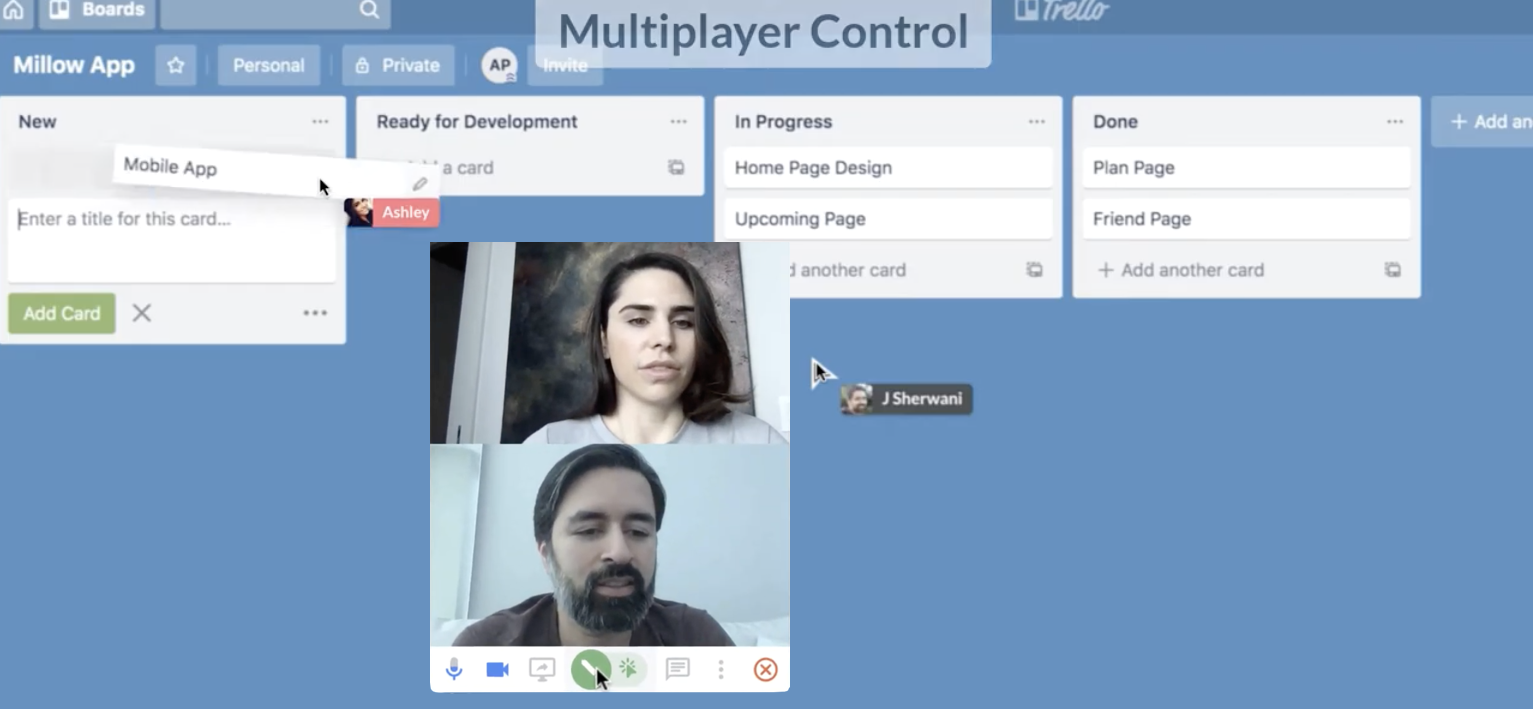
A few things you can do with Screen:
Normally Screen is free for joining meetings, $10 per month to host them and $20 per person per month for enterprise teams. But Sherwani writes that for now it’s free to host too “so you can stay healthy & productive during the coronavirus outbreak.” If you can afford to pay, you should, though, as “We’re trying this as an experiment in the hope that the number of paid users is sufficient to pay for our running costs to help us stay break-even.”
Sherwani’s new creation could become an acquisition target for video call giants like Zoom, but he might not be so willing to sell this time around. Founded in 2013, Screenhero was incredibly powerful for its time, offering some of the collaboration tools now in Screen. But after it was acquired by Slack after raising just $1.8 million, Screenhero never got the integration it deserved.
“We finally shipped interactive screen sharing almost three years later, but it wasn’t as performant as Screenhero, and was eventually removed in 2019,” Sherwani writes. “Given that it was used by a tiny fraction of Slack’s user-base, and had a high maintenance cost, this was the correct decision for Slack .” Still, he explains why a company like Screen is better off independent. “Embedding one complex piece of software in another imposes a lot more constraints, which makes it more expensive to build. It’s far easier to have a standalone app that just does one thing well.”
Screen actually does a lot of things well. I tried it with my wife, and the low latency and extensive flexibility made it downright delightful to try co-writing this article. It’s easy to imagine all sorts of social use cases springing up if teens get hold of Screen. The whole concept of screensharing is getting popularized by apps like Squad and Instagram’s new Co-Watching feature that launched today.

The new Co-Watching feature is like screensharing just for Instagram
Eventually, Screen wants to launch a virtual office feature so you can just instantly pull co-workers into meetings. That could make it feel a lot more like collaborating in the same room with someone, where you can start a conversation at any time. Screen could also democratize the remote work landscape by shifting meetings from top-down broadcasts by managers to jam sessions where everyone has a say.
Sherwani concludes, “When working together, everyone needs to have a seat at the table.”
Powered by WPeMatico
For much of the history of enterprise technology, companies tended to buy from a single vendor because it made managing the entire affair much easier while giving them a “single throat to choke” when something went wrong. On the flip side, it also put customers at the mercy of said vendor — and it wasn’t always pretty.
As we move deeper into the cloud model, many IT pros are looking for more flexibility than they had in the past, avoiding the vendor lock-in from the previous generation of enterprise tech, and what being beholden to a single vendor could mean for the bottom line and their own flexibility.
This is something that comes up frequently in discussions about moving workloads from one cloud to another, and is sometimes referred to as a multi-cloud approach. Customers are loath to leave their workloads in the hands of one vendor again and repeat the mistakes of the past. They are looking to have the same flexibility on the infrastructure side that they are getting in the SaaS world, where companies tend to purchase best-of-breed from multiple vendors.
That means, they want the freedom to move workloads between clouds, but that’s not always as easy a prospect as it might seem, and it’s an area where startups could help lead the way.
What’s stopping customers from just moving data and applications between clouds? It turns out that there is a complex interlinking of public cloud APIs that help the applications and data work in tandem. If you want to pull out of one public cloud, it’s not a simple matter of just migrating to the next one.
Powered by WPeMatico
When designers need to collaborate with other teams, they can currently turn to products like InVision and Zeplin. But Ceros creative director Jack Dixon said there’s a “pretty interesting gap in the market” — once you move beyond prototypes and start working with websites that are either live or in staging, the process starts to become fragmented, relying on screenshots and email/phone/Google Docs.
That’s why the company (which focuses on powering interactive content “experiences”) is launching a new product called MarkUp. The product was created by a team led by Greg DiNardo and Alex Bullington, who joined Ceros last August through the acquisition of their polling and market research startup Arbit.
Dixon, DiNardo and Bullington gave me a quick demo, showing off how users can mark areas of interest on a website, leave comments and tasks, then mark revisions as completed.
It all looked pretty simple and straightforward, but DiNardo suggested that it’s a real technical challenge — even more than he and Bullington had expected — to provide those kinds of features on top of a live site.
He added that the product’s simplicity was very much by design: “I don’t think we’re going to add a million features … The goal is honestly simplicity, something that graphic designers can kind of live in.”
Eventually, MarkUp could be used not just to solicit design feedback across teams, but also from the public at-large.
Ceros says MarkUp is free to everyone and will function separately from the core Ceros Studio platform. In fact, it’s already being used by designers at the Huffington Post, Cushman & Wakefield and Informa.
“As of today we want to remove any friction or barrier to entry, so it’s 100 percent free to [everyone],” Dixon said. “Getting the involvement of the broadest community and user base is going to be critical for this. What we’re learning is that some of the enterprise clients might pay for bigger, more grown-up features [like white labeling]. We can figure out how to monetize later.”
Update: An earlier version of this post incorrectly stated that MarkUp would only be free to Ceros customers.
Powered by WPeMatico
When activist investors Starboard Value took a 7.5% stake in Box last September, there was reasonable speculation that it would begin to try and push an agenda, as activist investors tend to do. While the firm has been quiet to this point, today Box announced that Starboard was adding three members to the 9 member Box board.
At the same time, two long-time Box investors and allies, Rory O’Driscoll from Scale Venture Partners and Josh Stein from Threshold Ventures (formerly from DFJ), will be retiring from the board and not seeking re-election at the annual stockholder’s meeting in June.
O’Driscoll involvement with the company dates back a decade, and Stein has been with the company for 14 years and has been a big supporter from almost the beginning of the company.
For starters, Jack Lazar, whose credentials including being chief financial officer at GoPro and Atheros Communications, is joining the board immediately. A second new board member from a list to be agreed upon by Box and Starboard will also be joining immediately.
Finally, a third member will be selected by the newly constituted board in June, giving Starboard three friendly votes and the ability to push the Box agenda in a significant way.
While this was obviously influenced by Starboard’s activist approach, a person close to the situation stressed that it was a highly collaborative effort between the two organizations, and also indicated that there was general agreement that it was time to bring in new perspectives to the board. The end goal for all concerned is to raise the stock value, and do this against the current bleak economic backdrop.
At the time it announced it was taking a stake in Box, Starboard telegraphed that it could be doing something like this. Here’s what it had to say in its filing at the time:
“Depending on various factors including, without limitation, the Issuer’s financial position and investment strategy, the price levels of the Shares, conditions in the securities markets and general economic and industry conditions, the Reporting Persons may in the future take such actions with respect to their investment in the Issuer as they deem appropriate including, without limitation, engaging in communications with management and the Board of Directors of the Issuer, engaging in discussions with stockholders of the Issuer or other third parties about the Issuer and the [Starboard’s] investment, including potential business combinations or dispositions involving the Issuer or certain of its businesses, making recommendations or proposals to the Issuer concerning changes to the capitalization, ownership structure, board structure (including board composition), potential business combinations or dispositions involving the Issuer or certain of its businesses, or suggestions for improving the Issuer’s financial and/or operational performance, purchasing additional Shares, selling some or all of their Shares, engaging in short selling of or any hedging or similar transaction with respect to the Shares…”
Box CEO Aaron Levie appeared at TechCrunch Sessions: Enterprise, the week this news about Starboard broke, and he was careful in how he discussed a possible relationship with the firm. “Well, I think in their statement actually they really just identified that they think there’s upside in the stock. It’s still very early in the conversations and process, but again we’re super collaborative in these types of situations. We want to work with all of our investors, and I think that’ll be the same here,” Levie told us at the time.
Now the company has no choice but to work more collaboratively with Starboard as it takes a much more meaningful role on the company board. What impact this will have in the long run is hard to say, but surely significant changes are likely on the way.
Powered by WPeMatico